
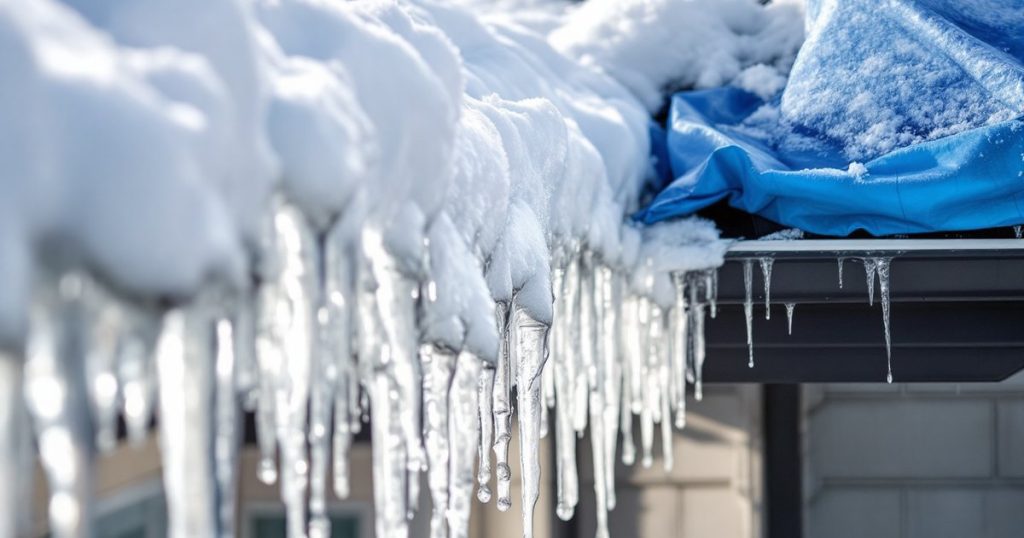
Roof repair in winter is possible, and a leak should not wait for spring, but every repair in the cold is limited by what the materials allow. Asphalt shingle sealant strips need sun and warmth to bond, so cold-weather shingle repairs are hand-sealed with roof cement. Patching products and membrane adhesives each carry a minimum application temperature on the label, commonly between 20°F and 50°F depending on the product.
This page covers repairs: what a roofer can fix in the cold, what temperature each material needs, and what can safely wait. If you are weighing a full replacement and its timing, our roofing seasonality index covers off-season pricing, and our cold-climate flat roof guide covers winter membrane installation.
By The Roofing Brief Team. Last reviewed: October 2026.
Key numbers at a glance
These six figures set the rules for most winter roof repairs. Each comes from a manufacturer document or a federal regulation, and product limits can change between label or bulletin revisions, so the current document for the exact product on your roof governs.
| Figure | What it means | Source |
|---|---|---|
| 40°F (4°C) | Owens Corning applies its cold-weather shingle procedures when air and surface temperatures are at or below this point | Owens Corning Technical Bulletin TB-10022497-A (April 2026) |
| 4 dabs, 1 inch each | Hand-seal per laminate shingle along the entire roof perimeter in cold weather, using ASTM D4586 asphalt roof cement | Owens Corning TB-10022497-A |
| Above 70°F for at least 24 hours | GAF’s suggested storage for shingles before a cold-weather install, “if possible,” to make them more pliable | GAF Technical Bulletin R-133 |
| 20°F to 120°F | Labeled application range for Henry 208 Wet Patch roof cement | Henry product page |
| 50°F surface minimum | Labeled application floor for Gardner Wet-R-Dri All-Season Roof Patch, despite the “all-season” name | Gardner-Gibson product label |
| 6 feet | Height above a lower level at which OSHA requires fall protection for workers in residential construction | 29 CFR 1926.501(b)(13) |
Can roof repairs be done in the winter?
Yes. Roof repairs can be done in winter on dry, frost-free days, and leaks, missing shingles and failed flashing generally should not wait for spring. The work is slower and more conditional: shingles must be hand-sealed because their factory sealant may not activate, patching products must be applied above their labeled minimum temperature, and ice and snow make access more dangerous.
Owens Corning’s April 2026 cold-weather bulletin explains the core problem. Its shingles carry “a factory-applied strip of thermally activated sealant,” and “direct exposure to the sun’s energy activates the sealant.” The bulletin adds that “shingles installed in cold weather may not immediately seal until warmer temperatures are present for the sealant to activate.” GAF’s professional field guide puts it more bluntly: shingles installed in cold weather “may not seal until the following spring.”
Three other cold-weather effects shape a winter repair:
- Brittle shingles. IKO’s Bulletin R-52 states asphalt shingles “can become more brittle in cold weather,” citing 50°F (10°C) and below, and warns never to bend, drop or throw bundles.
- Stiff sealants. GAF’s data sheet for MATRIX 203 Plastic Roof Cement warns that “cold weather will cause product to stiffen, making application difficult.”
- Broken seals from foot traffic. The Asphalt Roofing Manufacturers Association (ARMA) cautions that roof traffic in cold weather can break the sealant bond between courses, and that those shingles may then need hand-sealing.
What temperature is too cold to repair or replace a roof?
No major shingle manufacturer we reviewed sets a single temperature below which roofing is banned. Instead, 40°F is the common trigger for cold-weather procedures: Owens Corning applies its cold-weather rules at or below 40°F, and GAF’s Bulletin R-133 says that in cold weather, “for easiest handling, temperatures should be above 40° F.” Below that, the work is still allowed but must follow the manufacturer’s extra steps.
The table compares the exact language in each manufacturer’s cold-weather document. The wording matters because warranty coverage can depend on following it.
| Manufacturer | Document | Temperature language | What it calls for |
|---|---|---|---|
| Owens Corning | TB-10022497-A, Cold Weather Shingle Installation (April 2026) | Procedures apply “when the air and surface temperatures are at or below 40°F (4°C)” | Hand-seal all perimeter shingles (four 1-inch dabs on laminates, two per tab on three-tab strips); leave up to a 1/16-inch gap at end joints |
| GAF | Technical Bulletin R-133, Temperature Extremes and Fiberglass Asphalt Shingles | “For easiest handling, temperatures should be above 40° F”; during very cold weather shingles may “become brittle and possibly crack, break or delaminate when bending” | Store shingles in a heated area above 70°F for at least 24 hours if possible; hand-seal |
| GAF | Technical Bulletin R-114, Hand-Sealing Shingles | Hand-seal “in cold weather, fall or winter” | Also lists hand-sealing “while performing repairs,” in any season |
| Malarkey | Technical Bulletin, Asphalt Shingles in Cold Weather (<40°F), October 2024 | “It is difficult to say a specific ambient temperature”; the shingle’s radiant temperature activates the seal | Four quarter-size dabs of ASTM D4586 cement per laminate; wind warranties apply only when shingles are sealed |
| IKO | Information Bulletin R-52 (August 2012) | Shingles grow more brittle at 50°F (10°C) and below; sealing “might take up to several weeks” | Manual sealing with asphalt plastic cement if shingles may not seal before winter |
| ARMA (industry association) | Recommendations for Installation of Asphalt Roofing Shingles in Cold Weather | Refers installers to “manufacturer instructions for specific directions related to cold weather installation temperature” | Store shingles indoors; consider open metal valleys; hand-seal with approved cement |
Malarkey’s bulletin lists the factors that decide whether a strip seals: roof slope, shingle color (darker seals faster), sun or shade, wind, and roof orientation, with south and west faces typically sealing faster than north and east. That is why a south-facing repair on a sunny 35°F day may seal sooner than a shaded north slope at 45°F.
How do roofers hand-seal shingles in cold weather?
Hand-sealing means bonding each repaired shingle to the course below with dabs of asphalt roof cement instead of waiting for the factory strip to activate. Owens Corning specifies four 1-inch dabs of ASTM D4586 cement per laminate shingle, placed about 1 inch from the leading edge. GAF’s R-114 lists repairs as a hand-sealing case in any season, so a replaced shingle should be sealed even in mild weather.
A cold-weather shingle repair done to manufacturer instructions typically follows this sequence:
- Warm the materials. Keep replacement shingles and cement in a heated space beforehand; GAF suggests above 70°F for at least 24 hours if possible, and Malarkey suggests letting shingles warm in the sun.
- Clear and dry the area. Malarkey’s bulletin says to make sure ice or frost is not present on the walking surface, and adhesives need a dry, frost-free substrate.
- Break the old seal gently. Cold shingles crack easily, so the course above is lifted with a flat bar only as far as needed to reach the nails.
- Fasten flat. IKO warns that a nail may break through a cold shingle that is not lying flat, and Malarkey suggests hand-nailing to avoid overdriven fasteners when compressor pressure drifts in the cold.
- Apply the cement dabs. Four 1-inch dabs for a laminate (Owens Corning) or a quarter-size dab under each tab of a three-tab shingle (IKO), using cement meeting ASTM D4586.
- Press, do not flood. Owens Corning, IKO and Malarkey all warn that excess cement can make shingles blister, and Owens Corning says not to let it squeeze out past the leading edge.
- Re-seal disturbed neighbors. Per ARMA, shingles whose bond was broken by foot traffic in the cold may need hand-sealing too.
Which sealants and membranes work in cold weather?
Most asphalt roof cements, primers and bucket adhesives want 40°F to 50°F and rising, while a few products are labeled lower: Henry 208 Wet Patch lists 20°F, Elevate’s self-adhered EPDM and TPO 20°F, and induction welding 0°F. Products sold as “all-season” are not necessarily cold-rated, so read the label’s application temperature, not the product name.
| Product | Used for | Labeled application temperature | Source |
|---|---|---|---|
| Henry 208 Wet Patch | Asphalt roof cement, wet or dry leaks; meets ASTM D4586 | 20°F to 120°F | Henry product page |
| Henry 887 Tropi-Cool silicone | Silicone coating and wet patch | 35°F to 120°F | Henry product page |
| GAF MATRIX 203 Plastic Roof Cement | General-purpose cold-applied repair cement | 45°F and rising | GAF data sheet |
| Gardner Wet-R-Dri All-Season Roof Patch | Asphalt patching compound | Surface 50°F to 120°F; at 50°F and below, store at 70°F to 80°F for 24 hours first | Gardner-Gibson product label |
| Grace Ice & Water Shield HT | Self-adhered underlayment at eaves, valleys, repairs | Air, deck and membrane at 40°F or higher | GCP Applied Technologies data sheet |
| Elevate EPDM SA and TPO SA | Self-adhered single-ply membrane | Ambient and substrate above 20°F | Elevate Cold Weather Application Guidelines (Rev. Feb 2025) |
| Elevate EPDM Solvent-Free Bonding Adhesive | EPDM bonding | Above 40°F; not if freezing is expected within 12 hours | Elevate Cold Weather Application Guidelines |
| Elevate Multi-Purpose MB Flashing Cement | Modified bitumen flashing repairs | Above 40°F and rising | Elevate Cold Weather Application Guidelines |
| SBS and APP modified bitumen rolls | Mod-bit patches and plies | 40°F and rising; use within 4 hours of leaving heated storage | Elevate Cold Weather Application Guidelines |
| Elevate PVC water-based bonding adhesive | PVC membrane bonding | 50°F and rising, held for 48 hours after | Elevate Cold Weather Application Guidelines |
| Elevate AC Fast FR PMMA | Liquid flashing at penetrations | 35°F and rising | Elevate Cold Weather Application Guidelines |
| InvisiWeld induction welding (TPO, PVC) | Mechanically attached thermoplastic membranes | 0°F minimum; no moisture or condensation on plates or membrane | Elevate Cold Weather Application Guidelines |
Elevate’s bulletin adds a rule that applies to almost any cold repair: store adhesives, sealants and primers between 60°F and 80°F and bring them to the roof only 1 to 4 hours before use. It also flags “blushing,” where evaporating solvent chills the adhesive film to the dew point and condensation ruins the bond, and recommends midday application in sunlight. For membrane-specific steps, see our guide to TPO roof repair.
Emergency fixes vs permanent repairs in winter
A winter emergency fix stops water today; a permanent repair restores the roof to manufacturer specification once conditions allow. Tarps and cold-rated wet-patch cement are emergency tools. Replacing shingles with hand-sealing, rebuilding flashing, or re-bonding a membrane seam are permanent repairs that need a dry, frost-free day at or above the product’s labeled temperature.
| Problem | Emergency step now | Permanent repair | When the permanent fix can happen |
|---|---|---|---|
| Active leak from missing or torn shingles | Tarp over the ridge, or a cold-rated wet-patch cement over the opening | Replace shingles and hand-seal per the manufacturer | First dry, frost-free day; easiest above 40°F per GAF R-133 |
| Leak behind an ice dam | Professional steam removal; catch water inside | Air-seal and insulate the attic; self-adhered ice barrier at the eaves at next reroof | Attic work any time; underlayment at 40°F or higher (Grace data sheet) |
| Failed chimney or wall flashing | Roof cement over the gap at its labeled temperature | New step and counter flashing | Dry day within cement and sealant limits |
| Split EPDM or TPO seam | Self-adhered patch rated for the temperature | Clean, prime and re-bond per the membrane maker | When ambient and substrate meet the adhesive’s limit (often 40°F and rising) |
| Shingles from a fall install that have not sealed | None if no damage is visible | Hand-seal if lifting or wind exposure appears | Mild, sunny day; many will self-seal as weather warms |
For tarp sizing, fastening and how long a tarp lasts, see our temporary roof repair guide; for what emergency tarping service costs, see our roof tarping cost breakdown.
Ice dams: steam them, do not chip them
An ice dam that is pushing water into the house is the most common winter roof emergency, and the safe removal method is low-pressure steam from a professional crew. Clean Energy Resource Teams, a Minnesota energy partnership, advises hiring “a professional ice dam removal service that uses steamers” and warns: “Do not remove ice with chippers, chemicals or heat.”
Removing the ice treats the symptom. University of Minnesota Extension explains that ice dams form when upper roof areas sit above 32°F while the eaves stay below freezing, and the heat “primarily comes from the house.” Extension advises not to repair interior damage until ceilings and walls are dry, and to combine that repair with correcting the heat loss. Our ice dam removal guide compares steam, calcium chloride and roof rakes.
What roof repairs can wait until spring?
Anything that lets water in, or that leaves shingles loose enough to blow off, should be handled in winter, at least temporarily. Cosmetic issues, slow wear and planned upgrades can usually wait for warmer, drier weather, when sealants and shingles perform as designed. Use the decision table below as a starting point, and have a roofer confirm on site.
| Situation | Recommendation | Why |
|---|---|---|
| Water dripping into living space | Repair now (temporary fix the same day) | Wet insulation and drywall can grow mold; UMN Extension advises drying wet areas immediately |
| Leak traced to an ice dam | Repair now: steam removal, then fix attic heat loss | Water keeps backing up as long as the dam and heat loss persist |
| Missing or creased shingles after wind, no leak yet | Repair now on a mild day, hand-sealed; tarp if conditions are too cold | Exposed underlayment is not designed to be a long-term roof surface |
| Sagging deck, cracking sounds or doors sticking under heavy snow | Leave the area and call a professional now | Possible overload; see our snow-load and roof collapse report |
| Lifted flat roof seam, no interior water | Temporary fix now, permanent re-bond above the adhesive’s limit | Many membrane adhesives need 40°F and rising |
| Fall-installed shingles not yet sealed | Wait and monitor; hand-seal if they lift | Manufacturers expect delayed sealing; Malarkey says flattening “may take a couple weeks to several months” |
| Granule loss, moss, minor curling, faded shingles | Wait until spring | Cosmetic or slow-wear issues; cold traffic risks cracking shingles |
| Attic insulation and ventilation upgrades | Can be done now | Owens Corning notes interior attic work is “relatively easy, winter or summer” |
| Full roof replacement | Wait for a forecast window or spring unless the roof is failing | Cold-weather procedures add steps; see our seasonality index |
Is it safe to work on a roof in winter?
Winter roof work carries more fall risk than any other season, and most homeowners should stay off a snowy or frosty roof. OSHA’s hazard alert on rooftop snow removal (OSHA 3513) reports that falls cause the most worker fatalities and injuries during that work, including falls off edges, through snow-covered skylights, and from ladders and aerial lifts.
For professional crews, OSHA’s rule at 29 CFR 1926.501(b)(13) requires guardrails, safety nets or personal fall arrest for workers in residential construction 6 feet or more above a lower level, unless the employer documents that those systems are infeasible and follows a written fall protection plan. OSHA 3513 also urges methods that keep workers off the roof where possible, such as roof rakes used from the ground and marking hazards like skylights and drains before snow hides them.
University of Minnesota Extension’s guidance is direct: “Anyone on the roof during the winter or performing work on the roof from below risks injury and may cause damage to the roof and house.” Cold shingles add a second risk, since Malarkey warns that cold, hardened shingles “can crack or have their sealant bonds broken very easily” underfoot.
Does winter change the cost or wait for a roof repair?
Winter is the slow season for roofing contractors, which can shorten waits for non-emergency repairs. On The Roofing Brief’s Seasonality Index, built from U.S. Bureau of Labor Statistics employment data for roofing contractors (NAICS 238160, 2022 to 2025), January reads 89.5 and February 90.5 against a July peak of 100.
Two factors can push a winter repair bill the other way. Cold-weather procedures add labor: hand-sealing every perimeter shingle, warming materials and working only during the warm part of the day. Emergency calls after a storm or ice event can also carry after-hours pricing, as our tarping cost guide explains. No public dataset we found isolates a winter repair premium or discount, so treat any quote as local and compare at least two. For typical repair price ranges by damage type, see how much it costs to repair a roof.
Warranty terms are the other cost to watch. GAF’s limited warranty states that “hand-sealing of shingles may be required if the temperature is too cold to activate the adhesive relatively promptly.” Malarkey states its wind warranties apply only when shingles are sealed, and that failure to seal under adverse conditions “is not a manufacturing defect.” Ask your roofer to note hand-sealing on the invoice for any winter shingle repair.
Frequently asked questions
Can roof repairs be done in the winter?
Yes. Roofers repair leaks, replace shingles and fix flashing in winter on dry, frost-free days. Shingles are hand-sealed with ASTM D4586 roof cement because factory sealant strips need sun and warmth to activate; Owens Corning applies its cold-weather procedures at or below 40°F. Patching products must be used within their labeled temperature range, and snow or ice on the roof can delay access.
What temperature is too cold to replace a roof?
Manufacturers do not publish a single cutoff. Owens Corning triggers cold-weather procedures at or below 40°F, and GAF says shingles handle most easily above 40°F. Below that, roofing can continue with extra steps: warmed materials, careful handling to avoid cracking, and hand-sealing. Malarkey notes that sun, slope, color and wind matter as much as air temperature in whether shingles seal.
How can I get my roof repaired if I have no money?
Start with the USDA Section 504 Home Repair program if you live in an eligible rural area and have very low income. USDA Rural Development lists a maximum loan of $40,000 and a maximum grant of $10,000, with grants limited to homeowners age 62 or older. Weatherization programs, local housing agencies and nonprofits may also help. See our roof repair assistance programs guide.
How much does it cost to replace a roof on a 4,000 square foot house?
It depends on roof area, not living area. Fixr puts roof replacement at $3.75 to $11 per square foot of roof. A single-story 4,000 square foot home with a 6/12 pitch has roughly 4,470 square feet of roof before overhangs, or about $16,800 to $49,200. A two-story home with a 2,000 square foot footprint has about half that roof area. See our roof replacement cost guide.
Will shingles installed in winter ever seal?
In most cases, yes, once the roof gets enough sun and warmth. GAF’s field guide says cold-weather shingles may not seal until the following spring, and IKO says sealing can take up to several weeks. Until then, hand-sealing holds the shingles against wind. If shingles lift or flap before warm weather arrives, a roofer can hand-seal them on a mild day. For other causes of lifting or wavy shingles on a new roof, see our guide to new roof shingles not laying flat.
Is it safe to remove snow from my roof myself?
Working on a snowy roof is risky, and OSHA reports that falls cause most deaths and serious injuries during rooftop snow removal. A roof rake used from the ground avoids climbing, though University of Minnesota Extension warns rakes may damage roofing materials. For heavy loads, ice dams or any sagging, hire a professional crew that uses fall protection.
Sources
- Owens Corning, Technical Bulletin TB-10022497-A, Cold Weather Shingle Installation, April 2026.
- GAF, Technical Bulletins R-114 (Hand-Sealing Shingles) and R-133 (Temperature Extremes and Fiberglass Asphalt Shingles); Pro Field Guide for Steep-Slope Roofs; Shingle and Accessory Limited Warranty; MATRIX 203 Plastic Roof Cement data sheet.
- Malarkey Roofing Products, Technical Bulletin, Installation Guidelines for Application of Asphalt Shingles in Cold Weather, October 2024.
- IKO, Residential Information Bulletin R-52, Installing Shingles in Cold Weather, August 2012.
- Asphalt Roofing Manufacturers Association, Recommendations for Installation of Asphalt Roofing Shingles in Cold Weather.
- Holcim Elevate, Cold Weather Application Guidelines 2024 to 2025 (Rev. February 2025).
- Henry Company, 208 Wet Patch and 887 Tropi-Cool product pages; Gardner-Gibson, Wet-R-Dri All-Season Roof Patch label; GCP Applied Technologies, Grace Ice & Water Shield HT data sheet.
- OSHA, 29 CFR 1926.501(b)(13), and Hazard Alert OSHA 3513, Falls and Other Hazards to Workers Removing Snow from Rooftops.
- University of Minnesota Extension, Dealing with and preventing ice dams (reviewed 2022); Clean Energy Resource Teams, Got ice dams? (March 2019).
- USDA Rural Development, Single Family Housing Repair Loans and Grants; Fixr, Roof Replacement Cost.