
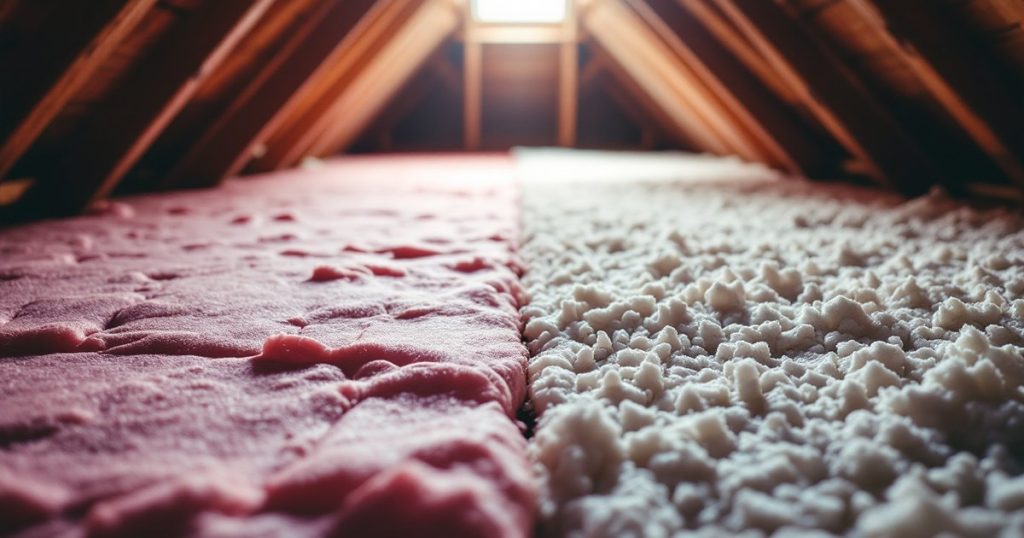
Blown-in insulation vs batts comes down to coverage more than material. On an existing attic floor crowded with wiring, junction boxes, bridging and uneven joists, blown-in loose fill usually gets closer to its labeled R-value because it flows around obstructions, and in October 2026 retail listings its material cost per square foot was roughly half that of batts, or less, at the same R-value. Batts win in open framing you can see and fit by hand: stud walls, cathedral rafter bays, knee walls and clean new joists. Air sealing comes first with either one.
This page is the head-to-head comparison. Bag counts, blower setup and depth by material are covered in our blown-in insulation guide. Batt thickness by framing cavity is in our batt insulation R-value chart.
By The Roofing Brief Team. Last reviewed: October 2026.
Key numbers at a glance
These figures come from current manufacturer data sheets, federal rules and retailer listings checked in early October 2026. Values differ by brand and product, so the label on the bag or batt you actually buy is the number that counts.
| Figure | Blown-in (loose fill) | Batts | Source |
|---|---|---|---|
| R-value per inch | About R-2.8 to R-2.9 (loose-fill fiberglass); R-3.7 (cellulose, settled) | About R-3.2 to R-3.7 (attic fiberglass batts); R-4.0 to R-4.3 (stone wool) | Owens Corning AttiCat, Greenfiber SANCTUARY, Owens Corning PINK Next Gen and ROCKWOOL Comfortbatt data sheets |
| Thickness for R-49 | 17 in (fiberglass); 14.3 in installed, 13.3 in settled (cellulose) | 14 in (fiberglass batt) | Same data sheets |
| Material cost at R-49 | About $1.01 to $1.13 per sq ft | About $2.27 per sq ft | Home Depot, Lowe’s and HEP Sales listings, October 2026; Roofing Brief arithmetic |
| Pro installed cost at R-49 | $1,100 to $1,900 per 1,000 sq ft | $0.80 to $2.60 per sq ft (attic batts, all R-values) | HomeGuide cost guides, November 2025 and January 2026 |
| Grade I install limit | No more than 2% of the area with gaps, voids or compression | Same rule | ANSI/RESNET/ICC 301-2022, Appendix A |
| Federal 25C credit for 2026 work | None | None | Public Law 119-21; IRS |
Blown-in vs batt insulation: side-by-side comparison
Blown-in loose fill and batts are often made from the same glass or stone fiber, so the real differences are form, R-value per inch, how forgiving each is to install, weight and cost. The table compares them on the factors that decide an attic job, using manufacturer figures wherever a number exists.
| Factor | Blown-in (loose fill) | Batts | Basis |
|---|---|---|---|
| Materials | Fiberglass, cellulose or stone wool, blown by machine | Fiberglass or stone wool blankets cut to fit 16 in or 24 in framing | Manufacturer literature |
| R-value per inch | R-2.8 to R-2.9 fiberglass; R-3.7 cellulose | R-3.2 to R-3.7 attic fiberglass; R-4.0 to R-4.3 stone wool | Data sheets (table below) |
| Wires, ducts, bridging | Flows around them | Must be cut and fitted at each one | RESNET grading counts every gap |
| Depth control | Needs depth markers; cellulose settles to 90% of installed depth | Fixed factory thickness | Greenfiber chart; 2021 IECC R303.1.1.1 |
| Weight at R-49, per 1,000 sq ft | 688 lb fiberglass; 1,770 lb cellulose | Not stated on batt labels | AttiCat and SANCTUARY coverage charts |
| DIY tools | Rented blower, two people | Utility knife, straightedge | Home Depot rental terms |
| Moving it later | Shifts when walked on or covered | Can be lifted and relaid | Product form |
| Best fit | Existing attic floors; closed walls (dense-pack) | Open walls, cathedral bays, knee walls, clean joists | See placement table below |
What R-value per inch does each type deliver?
Per inch, batts and cellulose beat loose-fill fiberglass, but that is the wrong number to shop on for an open attic floor. Current data sheets put Owens Corning AttiCat loose-fill fiberglass at about R-2.8 to R-2.9 per inch, Greenfiber SANCTUARY cellulose at R-3.7, Owens Corning PINK Next Gen batts at R-3.2 to R-3.7 and ROCKWOOL Comfortbatt stone wool at R-4.0 to R-4.3. An open attic has room for depth, so R-value per dollar matters more.
| Product (type) | Labeled R-value at thickness | R per inch | Source |
|---|---|---|---|
| Owens Corning AttiCat (loose-fill fiberglass) | R-38 at 13.5 in; R-49 at 17 in; R-60 at 20.5 in | 2.81 to 2.93 | AttiCat product data sheet, May 2026 |
| Greenfiber SANCTUARY (loose-fill cellulose) | R-38 at 10.4 in; R-49 at 13.3 in; R-60 at 16.1 in (settled) | 3.65 to 3.73 (Greenfiber lists 3.7) | Greenfiber DIY instructions DM-6.3-38 Rev F (05-26); product page |
| Owens Corning PINK Next Gen (fiberglass batt) | R-30 at 9.5 in; R-38 at 12 in; R-49 at 14 in | 3.16 to 3.50 | Owens Corning submittal sheet, September 2025 |
| Owens Corning high-density “C” batts | R-30C at 8.25 in; R-38C at 10.25 in | 3.64 to 3.71 | Same submittal sheet |
| ROCKWOOL Comfortbatt (stone wool batt) | R-15 at 3.5 in; R-23 at 5.5 in; R-30 at 7.25 in; R-38 at 9.5 in | 4.00 to 4.29 | ROCKWOOL technical data sheet, issued July 2026 |
R per inch is Roofing Brief arithmetic: labeled R-value divided by labeled thickness. Do not run that math in reverse on a job site. The federal rule below bars installers from figuring a receipt R-value by multiplying a per-inch figure by the inches installed.
What the FTC R-value Rule requires on the label
Every R-value on an insulation bag, fact sheet or ad must come from tests run under the FTC R-value Rule, 16 CFR Part 460, at a 75°F mean temperature with a 50°F temperature difference, plus or minus 10°F (section 460.5). No individual specimen may test more than 10% below the labeled R-value (section 460.8). Loose-fill cellulose must be tested at its settled density.
The rule also fixes what each package must show (section 460.12). A batt package lists R-value, length, width, thickness and square feet. A loose-fill bag carries a chart with minimum settled thickness, initial installed thickness, maximum net coverage, bags per 1,000 sq ft and minimum weight per sq ft at R-13, R-19, R-22, R-30, R-38 and R-49, plus the blowing machine settings used. Under section 460.17, an installer’s receipt for loose fill must show coverage area, initial installed thickness, minimum settled thickness, R-value and the number of bags used.
The practical point for blown-in: count bags, not only inches. Owens Corning’s AttiCat data sheet states that the labeled R-value requires both the minimum bag count per 1,000 sq ft and the minimum thickness, and that missing either one lowers the R-value.
How thick and heavy are R-38, R-49 and R-60 in each type?
Reaching R-49 takes about 17 inches of AttiCat loose-fill fiberglass, 14.3 inches of freshly blown SANCTUARY cellulose that settles to 13.3 inches, or one 14-inch fiberglass batt. Cellulose is thinner for the same R-value but about 2.6 times heavier: roughly 1,770 pounds per 1,000 sq ft at R-49, against 688 pounds for the loose-fill fiberglass.
| Target | Loose-fill fiberglass (AttiCat): thickness, lb per sq ft, bags per 1,000 sq ft | Cellulose (SANCTUARY): installed and settled thickness, lb per sq ft, bags per 1,000 sq ft | Fiberglass batt (Owens Corning) | Stone wool batt (ROCKWOOL) |
|---|---|---|---|---|
| R-38 | 13.5 in; 0.523; 19 | 11.2 in to 10.4 in; 1.32; 52.6 | 12 in, or R-38C at 10.25 in | 9.5 in |
| R-49 | 17 in; 0.688; 25 | 14.3 in to 13.3 in; 1.77; 70.8 | 14 in | Layered: R-38 plus R-15 gives R-53 at 13 in |
| R-60 | 20.5 in; 0.866; 31.5 | 17.3 in to 16.1 in; 2.16; 86.0 | Layered: two R-30 batts give R-60 at 19 in | Layered: two R-30 batts give R-60 at 14.5 in |
Source: AttiCat product data sheet (May 2026), Greenfiber SANCTUARY attic chart (DM-6.3-38 Rev F), Owens Corning and ROCKWOOL data sheets. Owens Corning lists the same figure for minimum and settled thickness. Greenfiber states settled thickness is 90% of installed thickness. Layered batt values are Roofing Brief arithmetic, since R-values of uncompressed layers add. Settled density works out to about 0.46 to 0.51 lb per cubic foot for the AttiCat fiberglass and about 1.5 to 1.6 for the cellulose; Greenfiber lists 1.5 pcf.
Why installation quality decides the real R-value
A labeled R-value assumes a near-perfect install. ANSI/RESNET/ICC 301-2022, the standard HERS raters use, grades batts and loose fill by the same rule: Grade I allows no more than 2% of the insulated area with gaps, voids or compression (and no compression deeper than 3/4 inch), Grade II allows up to 15%, and anything worse is Grade III. Energy models then treat Grade II as 2% uninsulated and Grade III as 5% uninsulated.
Small holes cost far more than their share of the area, because heat takes the easiest path. The table applies the RESNET modeling convention to a flat attic ceiling using parallel-path arithmetic, with R-1.7 for the drywall and air films alone (typical ASHRAE handbook values) and framing ignored.
| Labeled attic R-value | Grade I (as labeled) | Grade II model (2% bare) | Grade III model (5% bare) |
|---|---|---|---|
| R-38 | R-39.7 | R-27.3 | R-18.6 |
| R-49 | R-50.7 | R-31.9 | R-20.5 |
| R-60 | R-61.7 | R-35.9 | R-22.1 |
Source: Roofing Brief estimate from the ANSI/RESNET/ICC 301-2022 Section 4.2.2.3.2 modeling rule. Whole-ceiling values include the R-1.7 of drywall and air films.
This is where the blown-in vs batts question is really settled. Batts reach Grade I when every bay is clean and each cut is tight. In a retrofit attic, every cable, junction box, cross brace and duct boot is a cut, and each cut is a chance for a gap or a crushed edge. Loose fill flows around those obstructions, but it misses Grade I too when depth is uneven, which is why the 2021 IECC (Section R303.1.1.1) requires depth markers for blown-in attic insulation, at least one per 300 sq ft, facing the attic access.
Does blown-in fiberglass lose R-value in extreme cold?
One loose-fill fiberglass product did in laboratory tests. In 1992, Oak Ridge National Laboratory researchers Kenneth Wilkes and Phillip Childs found its R-value was about 35 to 50% lower at temperature differences of 70 to 76°F than at small differences, which they attributed to natural convection inside the airy layer. Fiberglass batts and one loose-fill cellulose showed no significant convection in the same tests.
Convection began once the temperature difference between the bottom of the drywall and the top of the insulation passed about 32°F, with the climate chamber run as low as minus 18°F. Covering the loose fill with R-19 batts stopped it. For Bismarck, North Dakota, the researchers estimated the convection penalty at $0.025 to $0.028 per sq ft per year at R-19 and about $0.014 at R-38, in 1992 dollars, smaller than the $0.046 to $0.070 saved by going from R-19 to R-38.
Products have changed since that test. Owens Corning’s May 2026 AttiCat data sheet says the product is designed to anticipate convection and its labeled R-value reflects average performance over the winter heating season. For Minnesota, which requires the stated R-value at winter design temperatures, the same sheet lists 2 extra inches and 3.7 extra bags per 1,000 sq ft at R-49. In very cold climates, the options are to blow fiberglass deeper, choose cellulose, or cap loose fill with a batt layer.
Air seal first, whichever one you choose
Neither blown-in insulation nor batts stops air. Both are air-permeable fiber, so warm air leaking through top plates, wiring holes, plumbing chases and recessed lights carries heat straight through them. ENERGY STAR advises contractors to seal attic floor leaks before adding insulation and estimates that sealing and insulating can save up to 10% on annual energy bills.
- Check for hazards. Stop if you find vermiculite (the EPA advises treating it as possibly asbestos-containing and leaving it undisturbed), knob-and-tube wiring, wet sheathing or an active roof leak. Those need a test or a pro before any insulation goes in.
- Seal the attic floor. Caulk or foam top plates, wire and pipe holes, and chase openings. Gaps at metal flues and chimneys need sheet metal and fire-rated sealant, not ordinary foam. Our attic air sealing guide covers each bypass.
- Install baffles at every vented eave. Greenfiber’s installation instructions call for baffles or vent chutes and say insulation should not cover soffit vents.
- Dam heat sources. Owens Corning says not to insulate on top of or within 3 inches of recessed lights unless they are IC-rated, and to keep insulation out of the air space around metal flues and chimneys.
- Set depth markers or check batt fit. For blown-in, staple a marker at least every 300 sq ft. For batts, confirm each one fills its bay full width and full height without compression.
- Install to the label. Blow the full bag count to the chart depth, or lay batts tight to framing with no faced layer on top of existing insulation.
- Keep the receipt. The FTC rule requires installers to give one showing coverage area, thickness, R-value and, for loose fill, bags used.
Blown-in vs batts cost per square foot by R-value
In October 2026 retail listings, blown-in material cost about $0.77 to $0.84 per sq ft at R-38 and $1.01 to $1.13 at R-49, versus about $2.09 and $2.27 per sq ft for R-38 and R-49 fiberglass batts. That makes batt material roughly twice the cost of loose fill for an attic floor at the same R-value. A blower rental is often free, so the material gap carries through to most DIY budgets.
| R-value | Blown fiberglass material (AttiCat, $40.34 per bag, Home Depot) | Cellulose material (SANCTUARY, $15.97 per bag, Lowe’s) | Fiberglass batt material (listing) | Pro installed, blown-in (HomeGuide) |
|---|---|---|---|---|
| R-38 | $0.77 per sq ft | $0.84 per sq ft | $2.09 per sq ft (Owens Corning R-38 unfaced W65A, Home Depot) | $0.84 to $1.50 per sq ft |
| R-49 | $1.01 per sq ft | $1.13 per sq ft | $2.27 per sq ft (Owens Corning R-49 kraft-faced BF93, HEP Sales, $108.98 per 48 sq ft bag) | $1.10 to $1.90 per sq ft |
| R-60 | $1.27 per sq ft | $1.37 per sq ft | Two layers; not priced | $1.40 to $2.40 per sq ft |
Loose-fill cost per sq ft is Roofing Brief arithmetic: bag price times bags per 1,000 sq ft from the manufacturer chart, divided by 1,000. Prices vary by store, region and week, and tax is excluded. HomeGuide’s blown-in figures are its per-1,000-sq-ft ranges by R-value. Its separate range for installed attic batts, $0.80 to $2.60 per sq ft, spans all R-values, so the low end reflects thin batts rather than R-49.
Worked example: cost by attic size at R-49
For a 1,200 sq ft attic floor taken to R-49, DIY material comes to about $1,210 for blown fiberglass (30 AttiCat bags), $1,357 for cellulose (85 SANCTUARY bags) and $2,725 for R-49 batts (25 bags), against $1,320 to $2,280 for a pro blown-in job at HomeGuide’s R-49 rates. Air sealing, baffles and removal of old insulation are extra.
| Attic floor | Blown fiberglass, DIY | Cellulose, DIY | R-49 batts, DIY (48 sq ft bags) | Pro blown-in at R-49 | Added weight, fiberglass vs cellulose |
|---|---|---|---|---|---|
| 800 sq ft | 20 bags, $807 | 57 bags, $910 | 17 bags, $1,853 | $880 to $1,520 | 550 lb vs 1,416 lb |
| 1,200 sq ft | 30 bags, $1,210 | 85 bags, $1,357 | 25 bags, $2,725 | $1,320 to $2,280 | 826 lb vs 2,124 lb |
| 2,000 sq ft | 50 bags, $2,017 | 142 bags, $2,268 | 42 bags, $4,577 | $2,200 to $3,800 | 1,376 lb vs 3,540 lb |
Source: Roofing Brief arithmetic from the AttiCat and SANCTUARY R-49 charts (25 and 70.8 bags per 1,000 sq ft), the listing prices above and HomeGuide’s R-49 range of $1,100 to $1,900 per 1,000 sq ft. Bag counts are rounded up. The batt line uses the kraft-faced BF93 listing as a price proxy; a top-up over existing insulation calls for unfaced batts. In climate zones 4 through 8, ENERGY STAR’s target for an attic that already has 3 to 4 inches is to add R-49, so this example matches a common northern top-up.
DIY vs pro: which is easier to install yourself?
Batts are the easier DIY product to start, since they need only a knife, a straightedge and protective gear, but they are the harder product to install at Grade I in a cluttered attic. Blown-in needs a rented blower and two people, one feeding the hopper and one running the hose. Home Depot waives the first day’s blower rental with the purchase of 10 or more bags of loose fill.
- DIY blown-in fits a walkable attic with at least a few feet of headroom at the center, a clear path for 100 feet of hose, and a helper. Greenfiber’s product guide calls for safety eyewear and an N95 mask.
- DIY batts fit a small attic with clean, evenly spaced joists, or open walls and knee walls where every bay is visible.
- Hire a pro for dense-pack wall retrofits, cathedral ceilings, low-slope attics with tight eaves, flue and chimney sealing, or any hazard from step 1 above.
Fire, moisture and pests: how they compare
Glass and stone wool test as noncombustible under ASTM E136. Cellulose is paper fiber treated with fire retardants and must meet the federal CPSC cellulose standard. Glass and stone fiber data sheets report mold resistance under ASTM C1338, and none of these products is sold as a rodent barrier.
| Concern | Loose-fill fiberglass (AttiCat) | Cellulose (SANCTUARY) | Fiberglass batts (PINK Next Gen) | Stone wool batts (Comfortbatt) |
|---|---|---|---|---|
| Combustibility | Noncombustible (ASTM E136); flame spread 0, smoke developed 5 | Fire retardant treated; critical radiant flux of at least 0.12 W/cm² and smoldering limits under CPSC 16 CFR Part 1209; flame spread 5, smoke developed 5 | Unfaced: noncombustible (ASTM E136). Kraft facing: not rated for flame | Noncombustible (ASTM E136); flame spread 0, smoke developed 0 |
| Moisture | Does not absorb moisture (ASTM C1104) | Moisture absorption rated “acceptable” | Not stated on submittal | Water vapor sorption 0.05% by volume (ASTM C1104) |
| Mold (ASTM C1338) | Does not support mold growth | Fungi resistance “acceptable” | Mold and mildew resistant | Passed fungi resistance |
| Pests | No pest claim | No pest claim; the separate SANCTUARY DEFENSE product adds an EPA-registered insecticide | No pest claim | No pest claim |
Source: manufacturer data sheets named above; Greenfiber SANCTUARY technical data; 16 CFR Part 1209.
Kraft-faced batts carry one code limit. The 2021 IRC (Section R302.10.1) allows a facing that is not flame-rated only where it sits in substantial contact with the unexposed side of the ceiling, floor or wall finish. In an attic that means facing down against the drywall, never exposed. Any wet insulation loses R-value, so fix a roof leak before insulating over it. For the limits that come with very deep insulation, such as ceiling weight and blocked soffit vents, see our answer to can you over insulate a house.
Where each one fits: attic floors, walls, cathedral ceilings and knee walls
Blown-in owns the open attic floor and closed existing walls. Batts own open framing you can see into: new or gutted stud walls, cathedral rafter bays and attic knee walls. The table maps each location to the better fit and the detail that most often goes wrong.
| Location | Better fit | Why | Watch for |
|---|---|---|---|
| Existing attic floor | Blown-in | Fills around wiring and bridging; tops up old insulation | Depth markers; eave baffles |
| Clean new attic joists | Either | Batts can reach Grade I when bays are clear | Batts above joist height need a second layer across the joists |
| Closed exterior walls | Blown-in, dense-packed | ENERGY STAR advises drilling and blowing empty wall cavities when siding is off | The Cellulose Insulation Manufacturers Association notes some makers call for at least 3.5 lb per cubic foot in sidewalls |
| Open stud walls | Batts | Sized to 2×4 and 2×6 cavities | No compression or gaps at boxes |
| Cathedral ceiling | High-density batts, dense-pack or foam | Owens Corning R-30C (8.25 in) and R-38C (10.25 in) fit deep rafters | Vented assemblies keep at least a 1 in air space under the sheathing (2021 IRC R806.3) |
| Attic knee walls | Batts | Framing is open and vertical | DOE’s Building America Solution Center calls for a continuous rigid air barrier on the attic side |
Loose-fill coverage charts are written for open, near-level attic floors, so a closed rafter bay calls for batts, dense-pack or foam. Where a roofline cannot be vented, compare foam options in our spray foam vs blown-in insulation guide. Garage ceilings bring their own fire separation and venting rules; see our guide to insulating a garage attic.
How much R-value does ENERGY STAR recommend by climate zone?
ENERGY STAR recommends R-30 to R-60 for attics depending on climate zone, based on the 2021 IECC. An uninsulated attic in zones 4A and 4B through 8 should reach R-60, and an attic that already has 3 to 4 inches should add R-49 in those zones. Either product type can hit these numbers; batts usually need two layers above R-49.
| Climate zone | Uninsulated attic | Attic with 3 to 4 in existing (add) | Floor over unconditioned space |
|---|---|---|---|
| 1 | R-30 | R-25 | R-13 |
| 2 | R-49 | R-38 | R-13 |
| 3 | R-49 | R-38 | R-19 |
| 4A and 4B | R-60 | R-49 | R-19 |
| 4C, 5 and 6 | R-60 | R-49 | R-30 |
| 7 and 8 | R-60 | R-49 | R-38 |
Source: ENERGY STAR, Recommended Home Insulation R-Values, based on 2021 IECC Table R402.1.3.
Can you still get a tax credit for insulation in 2026?
Not a federal one. The Section 25C Energy Efficient Home Improvement Credit, which covered insulation and air sealing materials, ended for property placed in service after December 31, 2025 under Public Law 119-21 (section 70505). The IRS states the credit applied to improvements made through December 31, 2025. State and utility rebates may still exist; check with your utility and a tax professional. Our attic insulation tax credit page covers 2025 claims and replacement programs.
Which should you pick?
Pick by location and attic condition first, then by climate and budget. For most existing attic floors that answer is blown-in loose fill; for open framing you can see into, it is batts. The table maps common situations to a recommendation drawn from the manufacturer data, RESNET grading and cost figures above. If batts win for your attic, start with our attic insulation rolls buyer guide.
| Your situation | Pick | Reason |
|---|---|---|
| Existing attic floor with wiring, ducts or bridging | Blown-in | Fills around obstructions; roughly half the material cost per sq ft, or less |
| Topping up dry old batts or loose fill | Blown-in | Levels gaps and low spots; adds no second facing |
| Zones 7 and 8, open attic | Cellulose, or fiberglass blown deeper or capped with batts | ORNL convection findings; Owens Corning’s Minnesota depth column |
| Ceiling where added weight is a concern | Loose-fill fiberglass or batts | About 0.69 lb per sq ft at R-49 vs 1.77 for cellulose |
| Small, clean attic and no blower | Batts | No machine; fits even bays |
| Open stud walls or knee walls | Batts | Visible bays; add a rigid air barrier on knee walls |
| Cathedral ceiling | High-density batts, dense-pack or foam | Loose fill is charted for open attic floors |
| Closed walls in an older house | Dense-pack blown-in, by a pro | Fills cavities through small holes |
Frequently asked questions
Is blown-in insulation as good as batt insulation?
Yes, and on an existing attic floor it is often better. Labeled R-values for both are tested the same way under the FTC R-value Rule, so R-49 of loose fill and R-49 of batts match on paper. In practice blown-in flows around wires and framing that batts must be cut to fit, which makes a Grade I install easier to reach. Batts can match it in clean, open bays.
What are the downsides of blown-in insulation?
Blown-in needs a blower and two people, it is dusty, and it can end up short or uneven without depth markers. Cellulose settles, with Greenfiber rating settled depth at 90% of installed, and weighs about 1.77 lb per sq ft at R-49. ORNL tests in 1992 found one loose-fill fiberglass lost 35 to 50% of its R-value under extreme cold. It also shifts when walked on.
Should I use blown-in or batt insulation in my attic?
Use blown-in for most existing attic floors, especially ones with wiring, ductwork or uneven joists, and for topping up old insulation. Use batts where the framing is open and clean, such as new joists, stud walls, cathedral rafter bays and knee walls. Either way, air seal the attic floor and install eave baffles first, because neither product stops air leaks.
How much blown-in insulation do I need for a 1,000 sq ft attic?
At R-49, the Owens Corning AttiCat chart calls for 25 bags per 1,000 sq ft at 17 inches, and the Greenfiber SANCTUARY chart calls for 70.8 bags at 14.3 inches installed. At R-38 the counts drop to 19 and 52.6 bags. Measure the net attic floor area, round up, and follow the chart on the bag you buy, since products differ.
Is blown-in insulation cheaper than batts?
In material, yes. October 2026 listings worked out to about $1.01 to $1.13 per sq ft for blown fiberglass or cellulose at R-49, against about $2.27 per sq ft for an R-49 fiberglass batt. Installed, HomeGuide puts blown-in attic insulation at $1,100 to $1,900 per 1,000 sq ft at R-49. A DIY batt job saves the blower, not the material premium.
Can you put blown-in insulation over batts?
Yes, as long as the existing batts are dry, free of mold and not hiding a roof leak. Loose fill spreads over and between old batts, which evens out gaps and low spots. Air seal first where you can reach the top plates. If the old batts are kraft-faced, add only unfaced or loose-fill insulation on top, and keep the eave baffles clear.
What is the best type of insulation for an attic?
For most vented attic floors, blown-in loose fill, either cellulose or fiberglass, gives the most installed R-value per dollar and fills around obstructions. Batts suit clean, open framing. Spray foam belongs at the roofline when you want an unvented, conditioned attic, which is a different design. ENERGY STAR recommends R-49 to R-60 for uninsulated attics in climate zones 2 through 8.
Sources
- Owens Corning, AttiCat PINK Blown-In Fiberglas Insulation product data sheet, May 2026.
- Owens Corning, PINK Next Gen Fiberglas Insulation submittal sheet, September 2025.
- Greenfiber, SANCTUARY do-it-yourself attic installation instructions, DM-6.3-38 Rev F (05-26), and SANCTUARY product page.
- ROCKWOOL, Comfortbatt technical data sheet, issued July 2026.
- Federal Trade Commission, Labeling and Advertising of Home Insulation, 16 CFR Part 460 (eCFR).
- Consumer Product Safety Commission, Interim Safety Standard for Cellulose Insulation, 16 CFR Part 1209.
- RESNET and ICC, ANSI/RESNET/ICC 301-2022, Section 4.2.2.3 and Normative Appendix A.
- K. E. Wilkes and P. W. Childs, Thermal Performance of Fiberglass and Cellulose Attic Insulations, Oak Ridge National Laboratory, 1992 (OSTI 10177817).
- ENERGY STAR, Recommended Home Insulation R-Values; Seal and Insulate with ENERGY STAR; Well-Insulated and Sealed Attic.
- U.S. Department of Energy, Building America Solution Center, Attic Knee Walls.
- International Code Council, 2021 IECC Sections R303.1.1.1 and R402.1.3; 2021 IRC Sections R302.10.1 and R806.3.
- Internal Revenue Service, Energy Efficient Home Improvement Credit; Public Law 119-21, section 70505.
- HomeGuide, Blown-in Insulation Cost (November 2025) and Attic Insulation Cost (January 2026).
- Retail listings checked October 2026: Home Depot (AttiCat, Owens Corning R-38 W65A, blower rental terms), Lowe’s (Greenfiber SANCTUARY), HEP Sales (Owens Corning BF93).