
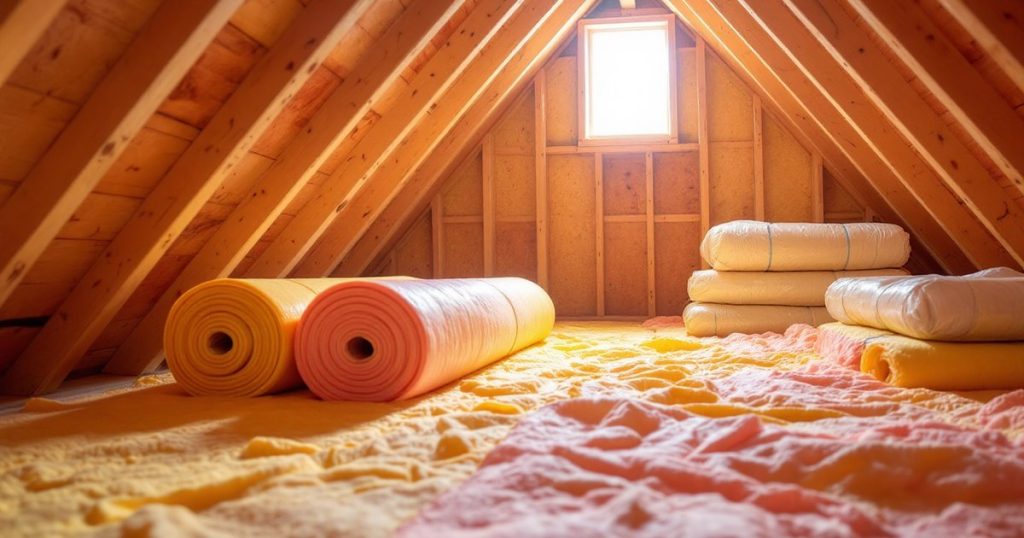
Attic insulation rolls are continuous fiberglass blankets, 15 or 23 inches wide and roughly 22 to 39 feet long, sold at R-11 through R-30 by Owens Corning, Johns Manville, Knauf and CertainTeed. For most attic floors the buy is unfaced R-19 or R-30 rolls laid between the joists, then a second unfaced layer run across the joists to reach R-49 or R-60. Retail rolls stop at R-30. R-38 and thicker come as 4-foot batts.
This page is the product buyer guide for rolls: which sizes exist, how many to buy, what they cost per square foot and how to lay them. For the batts-versus-loose-fill decision, see our blown-in vs batt insulation comparison.
By The Roofing Brief Team. Last reviewed: October 2026.
Key numbers at a glance
These are the figures most roll buyers came for, taken from manufacturer data sheets, ENERGY STAR, the International Residential Code and retailer listings checked on October 12, 2026. Prices change by store and week, so treat them as a dated snapshot.
| Figure | Value | Source |
|---|---|---|
| Most common attic roll | R-30 unfaced, 15 in x 25 ft, 31.25 sq ft per roll | Owens Corning RU70 listing, Home Depot |
| Thickest R-value sold as a roll | R-30 (about 9.5 to 10 in thick) | Owens Corning EcoTouch submittal sheet; Knauf EcoRoll data sheet |
| R-30 roll price | $40.00 to $55.87 per 15 in x 25 ft roll, or $1.28 to $1.79 per sq ft | Lowe’s and Home Depot listings, October 12, 2026 |
| Recommended attic level, uninsulated attic | R-30 (zone 1), R-49 (zones 2 and 3), R-60 (zones 4 to 8) | ENERGY STAR recommended home insulation R-values |
| Rolls for a 1,000 sq ft attic at R-30 | 32 rolls of 15 in x 25 ft | Roofing Brief arithmetic: 1,000 / 31.25 |
| Air space at vented eaves | At least 1 in between insulation and roof sheathing | 2021 IRC Section R806.3 |
Which attic insulation rolls are sold in 2026?
Four brands sell fiberglass insulation rolls through home centers: Owens Corning (EcoTouch, now marketed as PINK Next Gen), Johns Manville, Knauf (EcoRoll, sold at some stores as Performance+) and CertainTeed (InsulPure). ROCKWOOL, the main stone wool brand, sells Comfortbatt only as 47-inch batts, not rolls. Widths of 15 and 23 inches fit joists at 16 and 24 inches on center.
The table lists the attic-relevant sizes we could confirm on a manufacturer data sheet or a named retailer listing. Square footage is the roll’s own area (width x length). Availability differs by region, and Knauf’s data sheet says so directly.
| Brand and line | R-value and facing | Width x length | Sq ft per roll | Thickness | Source |
|---|---|---|---|---|---|
| Owens Corning EcoTouch / PINK Next Gen | R-30 unfaced | 15 in x 25 ft (RU70); 23 in x 25 ft (RU71) | 31.25; 47.92 | 9.5 in | Owens Corning submittal sheet; Home Depot listings |
| Owens Corning EcoTouch / PINK Next Gen | R-19 unfaced | 15 in x 39.2 ft; 23 in x 39.2 ft | 48.96; 75.07 | 6.25 in | HEP Sales (RU40) and Ace Hardware listings |
| Owens Corning EcoTouch / PINK Next Gen | R-19 kraft-faced | 15 in x 39.2 ft (RF40); 23 in x 39.2 ft | 48.96; 75.07 | 6.25 in | Home Depot and Ace Hardware listings |
| Owens Corning EcoTouch / PINK Next Gen | R-13 kraft-faced | 15 in x 32 ft | 40 | 3.5 in | Lowe’s listing; Owens Corning submittal sheet |
| Johns Manville | R-30 unfaced | 15 in x 25 ft; 23 in x 25 ft | 31.25; 47.92 | Per bag label | Home Depot and Lowe’s listings; JM rolls run up to 39 ft 2 in per the JM product selector guide |
| Johns Manville | R-13 kraft-faced | 15 in x 32 ft | 40 | Per bag label | Fleet Farm listing |
| Knauf EcoRoll | R-30 unfaced (23 in width only) | 23 in x 22 ft | 42.17 | 10 in | Knauf EcoRoll data sheet; Home Depot listing |
| Knauf EcoRoll / Performance+ | R-19 unfaced or kraft | 15 in or 23 in x 39 ft 2 in (unfaced also 12 and 24 in) | 48.96 (15 in) | 6.25 in | Knauf EcoRoll data sheet; Menards and Home Depot listings |
| Knauf EcoRoll | R-25 unfaced or kraft | 15 or 23 in unfaced; 16 or 23 in kraft | Varies | 8.5 in | Knauf EcoRoll data sheet |
| CertainTeed InsulPure | R-19 kraft-faced | 15 in x 39 ft 2 in | 48.96 | 6.25 in | Lowe’s and Home Depot listings |
| CertainTeed InsulPure | R-13 kraft-faced | 15 in x 32 ft | 40 | 3.5 in | Lowe’s listing |
| ROCKWOOL Comfortbatt (batt, no roll) | R-30 and R-38 unfaced stone wool | 15.25 or 23 in x 47 in | 29.9 to 30.0 (R-30 pack); 19.9 to 22.5 (R-38 pack) | 7.25 in; 9.5 in | ROCKWOOL Comfortbatt R-value range fact sheet |
In the retail listings we checked, CertainTeed’s attic R-30 and R-38 products were batts (for example R-30 unfaced at 16 x 48 in, 58.67 sq ft per bag at Home Depot), and every Owens Corning R-38 listing we checked was a 48-inch batt, including one lumberyard page that calls it a roll. If a listing calls an R-38 product a roll, check the dimensions before you order.
What is the best roll insulation for an attic?
For an attic floor, the best roll is unfaced fiberglass at the R-value that fills your joist depth: R-19 (6.25 in) for 2×6 joists and R-30 (9.5 to 10 in) for 2×10 joists. Unfaced rolls can go over existing insulation, which faced rolls should not. Knauf’s 23-inch R-30 roll had the lowest cost per square foot of the R-30 rolls we priced.
Brand matters less than fit. The Owens Corning and Knauf data sheets list compliance with ASTM C665, and the FTC R-value Rule requires every brand to label R-value from standard tests. Picking the right width and thickness for the framing decides how close you get to that label, because a roll that is compressed or gapped loses R-value. Our batt insulation R-value chart covers the compression penalty.
| Joist size (actual depth) | Roll that fills the bay | Width at 16 in / 24 in on center | Source |
|---|---|---|---|
| 2×6 (5.5 in) | R-19 (6.25 in), sits about 0.75 in proud | 15 in / 23 in | Owens Corning and Knauf data sheets |
| 2×8 (7.25 in) | R-25 (8 to 8.5 in) or R-19 plus a cross layer | 15 or 16 in / 23 in | Knauf EcoRoll data sheet |
| 2×10 (9.25 in) | R-30 (9.5 to 10 in) | 15 in / 23 in | Owens Corning submittal; Knauf data sheet |
| 2×12 (11.25 in) | R-30 roll plus a cross layer, or R-38 batts (12 in) | 15 or 16 in / 23 or 24 in | Owens Corning submittal sheet |
Faced or unfaced rolls in an attic?
Use unfaced rolls for nearly every attic floor job, and always when adding a layer over existing insulation. Kraft-faced rolls belong only in a first layer against the drywall, paper side down toward the heated room, where a vapor retarder is wanted. Kraft paper is combustible and must not be left exposed.
The code language is narrower than most retail pages suggest. The 2021 IRC Section R702.7 calls for a Class I or II vapor retarder on the interior side of frame walls in climate zones 5, 6, 7, 8 and Marine 4. It is written for walls, so for an attic floor follow the insulation maker’s instructions and your local code official. Knauf rates its kraft facing at 1.0 perm or less, which puts it in the Class II range.
Fire rules are firmer. Under 2021 IRC Section R302.10.1, insulation facings in attics must meet a flame spread index of 25 or less unless the facing is installed in substantial contact with the unexposed surface of the ceiling, floor or wall finish. Knauf’s data sheet states that kraft facing “will burn and should not be left exposed.” Our faced or unfaced attic insulation guide covers facing direction in detail.
| Situation | Use | Why | Source |
|---|---|---|---|
| Adding a layer over existing insulation | Unfaced only | A second facing can trap moisture between layers | Owens Corning “Adding Insulation to an Attic” instructions (unfaced, no vapor retarder products) |
| Second layer laid across the joists | Unfaced only | Same moisture risk; top layer runs perpendicular | NAIMA batt installation critical details |
| Bare joists over new drywall, cold climate | Kraft-faced first layer, paper down, or unfaced plus local practice | Facing in contact with the ceiling finish meets R302.10.1 | 2021 IRC R302.10.1; manufacturer instructions |
| Facing would face up into the attic or stay visible | Unfaced | Exposed kraft is combustible | Knauf EcoRoll data sheet; 2021 IRC R302.10.1 |
How many rolls of insulation do I need for an attic?
Divide the attic floor area in square feet by the square feet printed on one roll, then round up. A 1,000 sq ft attic needs 32 rolls of 15 in x 25 ft R-30 (31.25 sq ft each) or 21 rolls of 15 in x 39.2 ft R-19 (48.96 sq ft each). Every additional layer needs its own count.
The printed coverage is the roll’s own width times its length, not the ceiling it covers. On joists 16 inches on center, a 15-inch roll covers a 16-inch strip of ceiling once the joist is counted, so area divided by the label already carries about 6.7% slack (16 / 15). That slack usually covers end cuts. Add about 5% more only for attics broken up by many short bays, chimneys or hatches, which is a Roofing Brief estimate rather than a manufacturer rule.
| Attic floor area | R-30, 15 in x 25 ft (31.25 sq ft) | R-30, 23 in x 25 ft (47.92 sq ft) | R-19, 15 in x 39.2 ft (48.96 sq ft) | R-19, 23 in x 39.2 ft (75.07 sq ft) |
|---|---|---|---|---|
| 500 sq ft | 16 rolls | 11 rolls | 11 rolls | 7 rolls |
| 1,000 sq ft | 32 rolls | 21 rolls | 21 rolls | 14 rolls |
| 1,500 sq ft | 48 rolls | 32 rolls | 31 rolls | 20 rolls |
| 2,000 sq ft | 64 rolls | 42 rolls | 41 rolls | 27 rolls |
Source: Roofing Brief arithmetic, floor area divided by the square feet per roll from the Owens Corning listings above, rounded up. One layer only.
Cross-check by counting joist bays
Counting bays gives a second, more literal number. Take a 40 ft x 25 ft attic (1,000 sq ft) with joists 16 inches on center spanning the 25 ft direction. The 40 ft wall holds 40 x 12 / 16 = 30 bays, each about 25 ft long, so one 25 ft R-30 roll fills one bay and the job takes 30 rolls.
That is two rolls fewer than the area method’s 32, which is the slack described above. Buy to the area count when bays are interrupted by bracing or hatches, and to the bay count when the framing is clean and the bay length matches the roll length. A 39.2 ft roll in 25 ft bays leaves a 14.2 ft remnant per roll, so plan cuts so remnants fill short bays near hips and hatches.
How much do attic insulation rolls cost per square foot?
On October 12, 2026, R-30 attic rolls listed at about $1.08 to $1.79 per square foot and R-19 rolls at about $0.76 to $1.33 per square foot at Home Depot, Lowe’s, Menards and Ace Hardware. Per R-10 of insulation, Knauf’s 23-inch R-30 roll was the cheapest at about $0.36 to $0.39 per square foot.
The cost-per-R-10 column is Roofing Brief arithmetic: price per square foot divided by the R-value, times 10. It lets you compare a thin roll against a thick one on equal terms. Prices below are single-roll listings as they appeared in retailer product feeds that day, before tax; contractor-pack and sale pricing will differ.
| Product | Size (sq ft) | Listed price per roll | Price per sq ft | Per sq ft per R-10 | Retailer, date |
|---|---|---|---|---|---|
| Knauf EcoRoll R-30 unfaced | 23 in x 22 ft (42.17) | $45.75 to $49.00 | $1.08 to $1.16 | $0.36 to $0.39 | Home Depot, Oct 12, 2026 |
| Owens Corning R-30 unfaced | 15 in x 25 ft (31.25) | $40.00 to $55.87 | $1.28 to $1.79 | $0.43 to $0.60 | Lowe’s ($40.00, $47.97) and Home Depot ($55.87), Oct 12, 2026 |
| Knauf Performance+ R-19 unfaced | 15 in x 39 ft 2 in (48.96) | $36.97 | $0.76 | $0.40 | Menards, Oct 12, 2026 |
| Owens Corning R-19 unfaced | 23 in x 39.2 ft (75.07) | $99.99 | $1.33 | $0.70 | Ace Hardware, Oct 12, 2026 |
| Owens Corning R-19 kraft-faced | 15 in x 39.2 ft (48.96) | $50.57 to $57.81 | $1.03 to $1.18 | $0.54 to $0.62 | Home Depot, Oct 12, 2026 |
| R-13 kraft-faced (Owens Corning, Johns Manville) | 15 in x 32 ft (40) | $26.99 to $28.97 | $0.67 to $0.72 | $0.52 to $0.56 | Fleet Farm (JM) and Home Depot (Owens Corning), Oct 12, 2026 |
| ROCKWOOL Comfortbatt R-30 (batt, for comparison) | 23 in x 47 in pack (30.0) | $76.65 | $2.56 | $0.85 | Kamco Supply, Oct 12, 2026 |
For a hired job, our attic insulation cost guide puts installed fiberglass batts and rolls at $0.80 to $2.60 per square foot across R-values. The federal 25C credit that once covered insulation materials ended for property placed in service after December 31, 2025 under Public Law 119-21, so budget a 2026 job at full price and check state or utility programs.
How do you reach R-49 or R-60 with rolls?
Stack two unfaced layers: rolls between the joists, then a second layer laid at right angles across the joists. R-19 plus R-30 gives R-49, which ENERGY STAR recommends for uninsulated attics in zones 2 and 3. R-30 plus R-30 gives R-60, the ENERGY STAR level for zones 4 to 8. The cross layer also covers the joist tops, which are thermal bridges.
The NAIMA installation details call for the first layer parallel to the framing and flush with the top of the joists, and the second layer perpendicular, with both layers together meeting the required R-value. The second layer does not have to match joist spacing, so 23-inch rolls mean fewer seams. Our R-60 insulation thickness guide shows the depth this takes.
| Target | Layer 1 (between joists, 16 in o.c.) | Layer 2 (across joists) | Rolls for 1,000 sq ft | Material cost, 1,000 sq ft | Material cost, 1,500 sq ft |
|---|---|---|---|---|---|
| R-49 (ENERGY STAR zones 2 and 3) | R-19 unfaced, 15 in x 39 ft 2 in | R-30 unfaced, 23 in x 22 ft | 21 + 24 = 45 | $1,874 (about $1.87 per sq ft) | $2,793 (31 + 36 rolls) |
| R-60 (ENERGY STAR zones 4 to 8) | R-30 unfaced, 15 in x 25 ft | R-30 unfaced, 23 in x 22 ft | 32 + 24 = 56 | $2,378 (about $2.38 per sq ft) | $3,567 (48 + 36 rolls) |
Source: Roofing Brief arithmetic using the lowest October 12, 2026 listings above (Knauf R-19 at $36.97, Menards; Owens Corning R-30 15 in at $40.00, Lowe’s; Knauf R-30 23 in at $45.75, Home Depot). Rolls rounded up per layer; tax, baffles and air sealing excluded.
The 2021 IECC Section R402.2.1 lets R-38 satisfy an R-49 requirement, and R-49 satisfy R-60, where the full uncompressed height extends over the wall top plates at the eaves. Rolls struggle to reach full height at a low-slope eave, which is one reason the eave baffle detail matters.
Rolls vs batts vs blown-in: which fits your attic?
Rolls are the cheapest fiberglass blanket per square foot and leave fewer end seams in long, clean joist bays. Batts come in R-38 and R-49 thicknesses that rolls do not. Blown-in loose fill costs less per square foot at R-49 and flows around wiring and bracing, which is why it usually wins on a cluttered existing attic floor.
| Format | Typical pieces | R-values at retail | Best fit | Material cost, October 2026 | Source |
|---|---|---|---|---|---|
| Rolls | 22 to 39 ft long | R-11 to R-30 | Long, open, evenly spaced joist bays; first layer and cross layer | About $1.08 to $1.79 per sq ft at R-30; about $1.87 per sq ft at R-49 (two layers) | Retailer listings above; Roofing Brief arithmetic |
| Batts | 47 to 105 in long | R-11 to R-49 (14 in) | Short bays, R-38 or R-49 in one layer, hatches and cut-up framing | About $2.09 per sq ft at R-38; $2.27 at R-49 | Owens Corning submittal sheet; fiberglass attic insulation guide |
| Blown-in fiberglass | Bags, machine-blown | Any, by depth (about 17 in at R-49) | Existing floors with wiring, bracing, irregular joists | About $1.01 per sq ft at R-49 | Owens Corning AttiCat chart; Home Depot listing via our blown-in vs batt comparison |
Which roll should you pick?
Match the roll to the job: unfaced R-30 for open 2×10 bays, unfaced R-19 for 2×6 bays, a perpendicular unfaced layer for R-49 or R-60, and kraft-faced only against new drywall. Where the attic floor is crowded or low-pitched at the eaves, blown-in loose fill is often the better tool than any roll.
| Your situation | Pick |
|---|---|
| Bare 2×6 joists, zone 4 to 8 | R-19 unfaced in the bays and R-30 unfaced across (R-49), then R-11 more or loose fill to reach R-60 |
| Bare 2×10 joists, zone 2 or 3 | R-30 unfaced in the bays, R-19 unfaced across (R-49) |
| 3 to 4 in of old insulation already down | Unfaced R-30 or R-38 across the joists (ENERGY STAR suggests adding R-38 in zones 2 and 3, R-49 in zones 4 to 8) |
| Joists 24 in on center | 23 in wide rolls (Knauf R-30 comes only in 23 in) |
| Floor crowded with wiring, bracing or ducts | Blown-in loose fill; see our blown-in vs batt comparison |
| Attic used for storage with plywood decking | A roll no thicker than the joist depth, or raise the deck; compressed fiberglass loses R-value |
| Non-combustible or sound-control priority | ROCKWOOL Comfortbatt batts (flame spread 0, smoke developed 0 per ROCKWOOL data sheet) |
How to install attic insulation rolls with baffles
Air seal the attic floor, fit baffles at every vented eave, then unroll the first layer between the joists from the eaves inward and lay any second layer across the joists. Keep at least 1 inch of air space under the roof sheathing at the vents (2021 IRC R806.3) and never compress the roll to make it fit.
- Check the attic first. Look for roof leaks, damp or stained sheathing, and old vermiculite fill, which should be tested before it is disturbed. Our vermiculite attic insulation guide covers what to do if you find it.
- Measure joist depth, spacing and the floor area. Pick 15-inch rolls for 16 inches on center and 23-inch rolls for 24 inches on center, and count rolls with the area method above.
- Air seal before insulating. Seal top plates, wiring and plumbing holes and duct chases with caulk or foam; fiberglass slows heat flow but does not stop air.
- Install baffles at each vented eave bay. Fasten the baffle so it keeps at least 1 inch of air space between insulation and sheathing (IRC R806.3) and extends over the top of the insulation, as 2021 IECC Section R402.2.3 requires for air-permeable insulation in vented attics.
- Keep required clearances. Hold insulation at least 3 inches from recessed lights that are not IC-rated (NEC 410.116(B)), and at least 3 inches from metal chimneys, gas water heater flues and other heat-producing devices, as Owens Corning’s attic instructions state. Follow the flue maker’s listing where it asks for more.
- Unroll the first layer. Work from the outer edges toward the center, where headroom is best for cutting, and toward the hatch so you do not insulate yourself into a corner. At each eave, push the roll gently against the baffle so it covers the wall top plate. Cut on a board with a straightedge and butt the ends tight, as the NAIMA details show.
- Split, do not stuff, around wiring. Peel the roll into two halves so one passes under the cable and one over it, which keeps full thickness.
- Lay the second layer across the joists. Use unfaced rolls only, run perpendicular to the first layer, and butt the edges together without gaps.
- Insulate and weatherstrip the hatch. Attach insulation to the access door to match the surrounding level and add a dam so loose material stays off the opening.
- Post an insulation card. NAIMA recommends a card in the attic listing the installed R-value, which helps the next inspector or buyer.
Work only from the joists or a temporary plank, since drywall will not carry your weight, and wear gloves, long sleeves, eye protection and a disposable dust mask when handling fiberglass.
Frequently asked questions
What is the best roll insulation for an attic?
Unfaced fiberglass at the R-value that fills your joists: R-19 for 2×6 joists, R-30 for 2×10 joists, then an unfaced layer across the joists to reach R-49 or R-60. Owens Corning, Johns Manville, Knauf and CertainTeed all test to ASTM C665. On October 12, 2026 listings, Knauf’s 23-inch R-30 roll had the lowest price per square foot of the R-30 rolls checked.
Is roll insulation good for an attic?
Yes, in open attics with evenly spaced joists and long, clean bays, where a 25 to 39 ft roll fills a bay with no end seams. Rolls are a poor fit on floors crowded with wiring, bracing and ducts, where loose fill flows around obstacles. In either case, air seal the attic floor and install eave baffles first, because fiberglass does not stop air leaks.
Is R19 or R30 better in the attic?
R-30 resists more heat flow, but neither alone meets the ENERGY STAR level for an uninsulated attic in zones 2 to 8, which is R-49 or R-60. R-19 is the right first layer for 2×6 joists because its 6.25 in thickness roughly fills the 5.5 in bay. R-30 at 9.5 to 10 in suits 2×10 joists. Most attics need both, stacked.
How many rolls of insulation do I need for an attic?
Divide the attic floor area by the square feet on the roll label and round up. A 1,000 sq ft attic takes 32 rolls of 15 in x 25 ft R-30 (31.25 sq ft each) or 21 rolls of 15 in x 39.2 ft R-19 (48.96 sq ft each) per layer. On 16 in joist spacing this already includes about 6.7% slack for cuts.
How much does it cost to insulate a 1500 sq ft attic?
With rolls, one R-30 layer cost about $1,647 to $2,682 in material on October 12, 2026 listings, and a two-layer R-49 build about $2,793 using the lowest listed rolls. A hired job runs about $1,200 to $3,900 at the $0.80 to $2.60 per sq ft installed range for fiberglass batts and rolls, with higher R-values at the top end.
What is the 7 and 7 rule for attics?
It is a rule of thumb for converting an attic to living space, drawn from the IRC: a habitable room needs at least 70 sq ft (R304.1), no horizontal dimension under 7 ft (R304.2), and a 7 ft ceiling over at least half the required floor area (R305.1). It has nothing to do with insulation level, but a conversion moves insulation to the rafters, where kraft facing must be covered.
Can you put faced insulation rolls over existing insulation?
No. Add only unfaced rolls or loose fill over existing insulation. A second facing can hold moisture between the two layers, and kraft facing laid face-up in an attic is exposed combustible paper, which the 2021 IRC Section R302.10.1 allows only when the facing is in substantial contact with the ceiling finish. Owens Corning’s attic instructions specify unfaced, no-vapor-retarder products for added layers.