
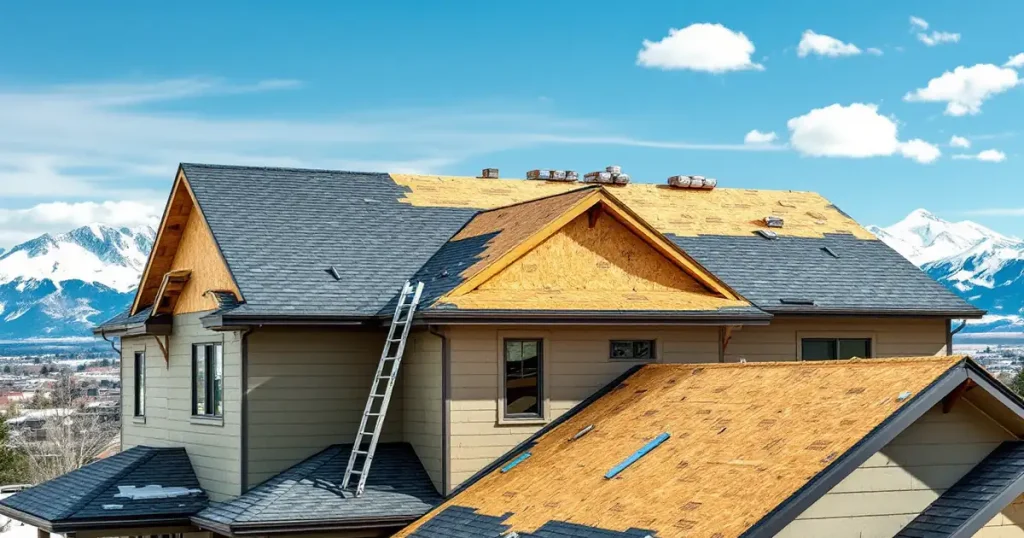
Roof replacement cost in Colorado averages about $9,500 statewide and about $11,700 in Denver for a basic asphalt job, according to This Old House (2026) and Angi (2026), with most jobs between roughly $7,300 and $23,900. Hail is what makes Colorado different: Class 4 impact-resistant shingles add about $95 to $100 per square on published Colorado price lists, and the Colorado Division of Insurance found hail drives 26 to 54 percent of homeowner premiums.
By The Roofing Brief Team. Last reviewed: October 2026. Wage figures are BLS Occupational Employment and Wage Statistics (OEWS) May 2025 estimates; hail counts are our tally of NOAA Storm Events files for 2016 to 2025; statutes are quoted from the Colorado Revised Statutes and the 2025 Colorado Wildfire Resiliency Code.
Colorado roof replacement cost: key numbers at a glance
These are the figures most Colorado homeowners need before the first estimate. Each comes from a named source, and each cost is a range that moves with roof size, pitch, material, impact rating and city. Use them to check whether a quote sits in a normal band, not as a price any contractor owes you.
| Figure | Colorado value | Source |
|---|---|---|
| Average Colorado roof replacement | $9,534 (typical range $7,332 to $23,862) | This Old House, Colorado roof replacement cost (updated June 12, 2026), built on RSMeans data |
| Average Denver roof replacement | $11,712 (normal range $7,419 to $16,461) | Angi, Denver roof replacement cost (updated Aug. 4, 2026) |
| Class 4 premium over a comparable standard shingle | About $95 to $100 per square ($1 per sq ft) | Excel Roofing Colorado price list (Aug. 24, 2026): Owens Corning Duration vs Duration FLEX |
| Hail share of homeowner premium | 26 to 54 percent by county; Denver $1,547 of a $3,040 average premium | Colorado Division of Insurance hail data (February 2026) |
| Colorado roofer mean hourly wage vs U.S. | $27.01 vs $27.95 (97 percent of the U.S. mean) | BLS OEWS, May 2025, SOC 47-2181 |
| NOAA hail reports, Colorado, 2016 to 2025 | 4,491 (3,832 at 1 inch or larger) | NOAA Storm Events Database, Roofing Brief tally |
How much does a roof replacement cost in Colorado in 2026?
A roof replacement in Colorado costs about $4.68 to $11 per square foot installed for asphalt, depending on the source and the shingle’s impact rating. This Old House puts the statewide asphalt rate at $4.68. RoofingCalc’s Colorado guide quotes $6 to $9 for architectural shingles and up to $11 in Denver and Boulder. A Class 4 shingle from a Denver-area contractor’s price list runs $7.50 to $8.25.
Those numbers describe different jobs. This Old House models a basic roof from RSMeans cost data, so it reads like a floor. Contractor price lists in hail country quote impact-rated shingles, synthetic underlayment and full tear-off, so they land higher. The 2025 Cost vs. Value Report’s fully specified 30-square tear-off sits near the top for its Mountain region.
| Source | What it measures | Colorado figure |
|---|---|---|
| This Old House (2026) | Statewide average replacement; asphalt per sq ft | $9,534; $4.68 per sq ft |
| This Old House (2026) | Median Colorado home (2,464 sq ft) | $10,177 |
| Angi (2026) | Denver average; all materials per sq ft | $11,712; $4 to $11 per sq ft |
| RoofingCalc (2025) | Architectural asphalt, installed | $6 to $9 per sq ft; up to $11 in Denver and Boulder |
| Excel Roofing price list (Aug. 2026) | Owens Corning Duration FLEX (Class 4), per square | $750 to $825 |
| Cost vs. Value 2025, Mountain region | 30-square asphalt tear-off, full spec | $28,475 (about $949 per square) |
| The Roofing Brief 2026 roofing cost report | U.S. architectural asphalt baseline | $5 to $8 per sq ft installed |
For how Colorado compares with the rest of the country, see our national roof replacement cost guide and the roof replacement cost by metro ranking.
Colorado roof cost by roof size
Roof size sets the base of every Colorado estimate, and it is measured in roof area, not floor area. A 2,000 sq ft roof is 20 squares. The table applies four published rates to common roof sizes, so you can see the spread between a basic asphalt job, a typical architectural job, a Class 4 job and a top-of-market Denver or Boulder price.
| Roof area | Squares | At $4.68/sq ft (This Old House CO asphalt) | At $5 to $8/sq ft (Roofing Brief baseline) | At $7.50 to $8.25/sq ft (Class 4, Excel list) | At $11/sq ft (RoofingCalc Denver/Boulder top) |
|---|---|---|---|---|---|
| 1,500 sq ft | 15 | $7,020 | $7,500 to $12,000 | $11,250 to $12,375 | $16,500 |
| 2,000 sq ft | 20 | $9,360 | $10,000 to $16,000 | $15,000 to $16,500 | $22,000 |
| 2,500 sq ft | 25 | $11,700 | $12,500 to $20,000 | $18,750 to $20,625 | $27,500 |
| 3,000 sq ft | 30 | $14,040 | $15,000 to $24,000 | $22,500 to $24,750 | $33,000 |
Source note: Roofing Brief calculation from This Old House (2026), our 2026 cost report, Excel Roofing’s published Colorado price list (Aug. 24, 2026) and RoofingCalc (2025). A one-story 2,200 sq ft house with a 6/12 pitch has about 2,460 sq ft of roof (the 6/12 slope factor is 1.118) before overhangs. Our guides to calculating roof square footage, the 2,000 sq ft roof cost and the 30-square roof cost walk through the math.
Colorado roof cost by material
Material changes a Colorado roof price more than any other choice, and in hail country the impact rating matters as much as the material. The ranges below are installed prices from named Colorado sources. The per-square column comes from one Denver-area contractor’s published list, so treat it as one market data point, not a statewide average.
| Material | Statewide per sq ft (This Old House 2026) | Colorado range per sq ft (RoofingCalc 2025) | Denver-area list price per square (Excel Roofing, Aug. 2026) | Colorado note |
|---|---|---|---|---|
| Asphalt, standard architectural | $4.68 | $6 to $9 (up to $11 Denver, Boulder) | $585 to $600 (OC Oakridge); $650 to $730 (OC Duration) | Ask whether the bid is impact rated |
| Asphalt, Class 4 impact resistant | Not split out | Not split out | $700 to $800 (Duration STORM); $750 to $825 (Duration FLEX) | May qualify for a carrier’s hail discount |
| Metal (standing seam, stone-coated steel) | $9.43 | $9 to $17 | $1,350 standing seam; $1,300 to $1,490 stone-coated steel | Sheds snow; check denting terms in the warranty |
| Concrete or clay tile | $15.16 (clay) | $12 to $21 | $1,275 concrete tile | Weight and snow load call for a framing check |
| Wood shakes and shingles | $11.19 | $11 to $20 | $2,200 cedar shake | Must be a Class A assembly in wildfire-code areas |
| Natural slate | $15.24 | $15 to $30 | $2,300 | Heaviest option |
| Synthetic slate or shake | Not listed | Not listed | $2,000 to $2,300 | Check the product’s impact and fire ratings |
| Low-slope (EPDM, PVC, modified bitumen) | Not listed | $7 to $15 | $1,350 EPDM; $1,400 PVC; $750 modified bitumen | Used on flat and low-slope sections |
For metal pricing detail, see our metal roof cost guide, and for how impact ratings differ, our comparison of impact-resistant vs standard shingles.
Hail sets the Colorado roof budget
Hail is the main reason Colorado roofs are replaced, priced and insured differently. NOAA’s Storm Events files list 4,491 hail reports in Colorado from 2016 to 2025, fifth among states behind Texas, Kansas, Oklahoma and Nebraska, and 583 of those stones measured 2 inches or more. About 94 percent fell from May through August, with June the peak month.
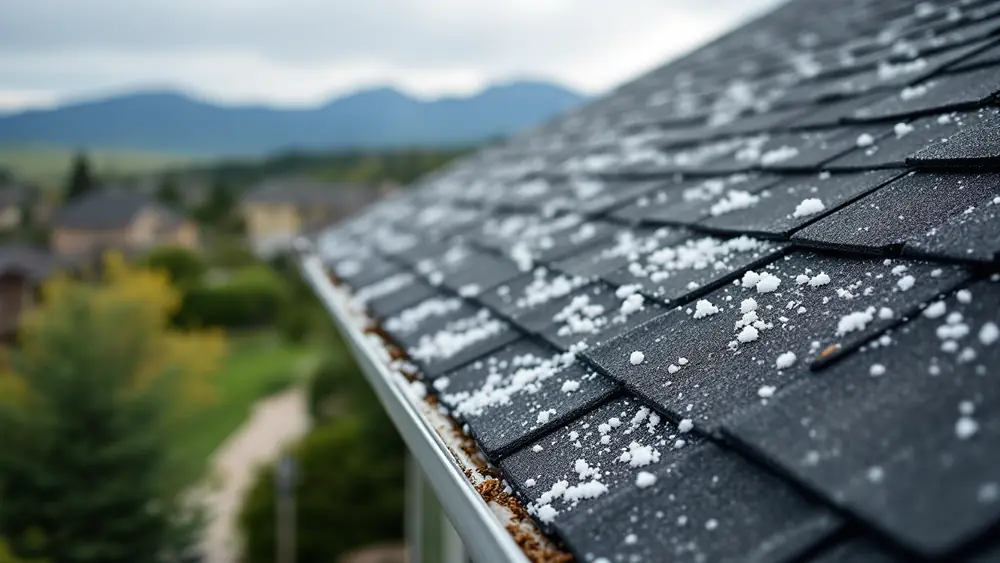
The exposure is lopsided inside the state. The Denver metro counties logged 920 reports and the Colorado Springs counties 781, while Mesa County (Grand Junction) logged 14. That gap is why two Colorado homeowners with the same roof can face very different replacement cycles and premiums.
| Metro (NOAA counties) | Hail reports 2016 to 2025 | 1 inch or larger | 2 inches or larger | Largest reported | Contractor shortlist |
|---|---|---|---|---|---|
| Denver-Aurora (10 counties) | 920 | 767 | 76 | 3.5 in | Best roofers in Denver |
| Colorado Springs (El Paso, Teller) | 781 | 720 | 69 | 4.0 in | Best roofers in Colorado Springs |
| Greeley (Weld) | 431 | 374 | 54 | 4.25 in | Best roofers in Greeley |
| Fort Collins (Larimer) | 143 | 115 | 6 | 2.5 in | Best roofers in Fort Collins |
| Pueblo (Pueblo) | 139 | 125 | 10 | 3.0 in | Best roofers in Pueblo |
| Boulder (Boulder) | 131 | 97 | 8 | 3.0 in | Best roofers in Boulder |
| Grand Junction (Mesa) | 14 | 11 | 0 | 1.75 in | Best roofers in Grand Junction |
Source: The Roofing Brief tally of NOAA National Centers for Environmental Information Storm Events detail files, 2016 to 2025, county-level hail reports deduplicated by event ID. Denver-Aurora counties are Adams, Arapahoe, Broomfield, Clear Creek, Denver, Douglas, Elbert, Gilpin, Jefferson and Park. Report counts depend partly on population, since more people means more spotters.
The costliest single storm in the files hit on May 8, 2017. NOAA’s episode narrative cites the Rocky Mountain Insurance Information Association estimate of about $2.3 billion, Colorado’s most expensive insured catastrophe, with about 50,000 homeowner claims expected. On June 19, 2018, a storm across the northern metro caused an RMIIA-estimated $276.4 million, and on Aug. 6, 2018, hail up to 4 inches hit Colorado Springs, with media-reported damage of $172 million. For how hail damage looks on shingles, see our guide to what hail damage looks like on a roof.
What hail costs Colorado homeowners in premiums
Hail is the largest single piece of many Colorado home insurance bills. In February 2026 the Colorado Division of Insurance published data from 20 carriers writing 80 percent of the market: hail accounted for 26 to 54 percent of the average premium across 11 counties, while wildfire accounted for 0.9 to 24.6 percent. Even mountain counties with little hail pay a large hail share.
| County (DOI sample) | Average annual premium | Hail portion | Hail share | Wildfire portion | Source |
|---|---|---|---|---|---|
| Denver | $3,040 | $1,547 | 50.9 percent | $30 | Colorado DOI hail one-pager (2026) |
| Summit | $3,463 | $1,233 | 35.6 percent | $274 | Colorado DOI hail one-pager (2026) |
| La Plata | $2,170 | $562 | 25.9 percent | $533 | Colorado DOI hail one-pager (2026) |
| Alamosa | $1,590 | $639 | 40.2 percent | $78 | Colorado DOI hail one-pager (2026) |
| Mesa | $1,369 | $353 | 25.8 percent | $138 | Colorado DOI hail one-pager (2026) |
Hail share is The Roofing Brief’s division of the DOI dollar figures. At Denver’s average, the hail portion adds up to about $15,470 over ten years, more than the This Old House statewide roof average. The DOI estimated that hail mitigation such as a fortified roof could save $82 to $387 a year across the 11 counties, against $3 to $25 for wildfire mitigation. See our hail damage insurance claims by state report for national context.
Class 4 shingles in Colorado: what the upgrade costs and what it may save
A Class 4 shingle (the top impact rating under UL 2218) costs about $1 more per sq ft than a comparable standard shingle on one Denver-area contractor’s published list. Whether it pays back depends on your carrier’s discount, which varies by company. The worked example uses the DOI’s hail-mitigation savings range as a stand-in for that discount.
| Line | Low case | High case | Source or method |
|---|---|---|---|
| Standard shingle, per square | $650 (Duration, low) | $730 (Duration, high) | Excel Roofing price list, Aug. 24, 2026 |
| Class 4 shingle, per square | $750 (Duration FLEX, low) | $825 (Duration FLEX, high) | Excel Roofing price list, Aug. 24, 2026 |
| Premium per square | $100 | $95 | Difference of the two rows |
| Premium on a 25-square roof | $2,500 | $2,375 | 25 x premium per square |
| Annual premium saving assumed | $82 | $387 | Colorado DOI hail mitigation estimate (2026) |
| Simple payback | About 30 years | About 6 years | Upgrade cost divided by annual saving |
Source note: Roofing Brief calculation. The DOI range describes hail mitigation broadly, including fortified roofs, not one shingle, and your carrier may offer more, less or nothing. Payback ignores the avoided cost of a hail claim and the deductible, which often decide the case on the Front Range. Ask your insurer for the written discount before you sign, and read our metal roof hail damage guide if you are weighing metal instead.
Roofer wages in Colorado: labor is not the discount here
Colorado roofing labor costs close to the national average, unlike most of its neighbors. Colorado roofers earned a mean $27.01 an hour in May 2025, 97 percent of the $27.95 U.S. mean, per BLS. That is about 9 percent above Utah ($24.80) and 11 percent above Arizona ($24.33), so the labor line on a Colorado bid rarely pulls the total far below national prices.
The median is $24.88 against $26.65 nationally, or 93 percent. The bottom of the scale sits higher than the country: the Colorado 10th-percentile wage is $22.03 an hour against $18.01 nationally, about 22 percent more. BLS counted about 3,340 roofer jobs in Colorado, roughly 1,900 of them in the Denver metro. Our roofer salary by state report ranks every state on the same data.
| Area (BLS) | Roofer jobs | Mean hourly wage | Median hourly wage | Mean vs U.S. | Source |
|---|---|---|---|---|---|
| Denver-Aurora-Centennial | 1,900 | $27.84 | $26.84 | 100 percent | BLS OEWS May 2025 |
| Boulder | 140 | $27.33 | $26.99 | 98 percent | BLS OEWS May 2025 |
| Greeley | 250 | $26.41 | $24.01 | 94 percent | BLS OEWS May 2025 |
| Fort Collins-Loveland | 150 | $25.97 | $23.37 | 93 percent | BLS OEWS May 2025 |
| Colorado Springs | 310 | $25.89 | $23.96 | 93 percent | BLS OEWS May 2025 |
| Grand Junction | 60 | $24.51 | $24.10 | 88 percent | BLS OEWS May 2025 |
| Pueblo | 50 | $24.31 | $22.35 | 87 percent | BLS OEWS May 2025 |
| Colorado statewide | 3,340 | $27.01 | $24.88 | 97 percent | U.S. mean $27.95, median $26.65 |
Source: BLS Occupational Employment and Wage Statistics, May 2025, roofers (SOC 47-2181), state and metropolitan area estimates. Wage is one input to a bid; overhead, insurance, equipment and margin sit on top, so a 3 percent wage gap does not translate into a 3 percent price gap.
What changes the price of a roof replacement in Colorado
Most of the spread between two Colorado quotes for the same house comes from a short list of local factors: the shingle’s impact rating, how many old layers come off, wildfire-code items in mapped areas, elevation-driven ice barrier and snow load, the permit and use-tax line, and decking found after tear-off. The table maps each driver to its effect and its source.
| Driver | Effect on the quote | Source |
|---|---|---|
| Class 4 vs standard shingle | About $95 to $100 more per square on one Denver-area list | Excel Roofing, Aug. 2026 |
| Labor rates | Close to national (97 percent of the U.S. mean), so little labor discount | BLS OEWS, May 2025 |
| All layers off in the Pikes Peak region | New asphalt may not go over any existing layer, so a full tear-off is priced every time | PPRBD Reroofing Guidelines (rev. March 5, 2024) |
| Wildfire-code area | Class A covering, noncombustible gutters and downspouts, metal valleys over cap sheet | 2025 Colorado Wildfire Resiliency Code, 403.2 to 403.3 |
| Elevation at or above 7,000 ft (Pikes Peak region) | Ice barrier required from the eave to 24 inches inside the wall line | PPRBD Reroofing Guidelines; 2023 PPRBC |
| Plank decking with gaps over 1/4 inch | Re-deck with 7/16 inch OSB or overlay with 3/8 inch sheathing | PPRBD Reroofing Guidelines |
| Use tax on materials | El Paso County collects 1.23 percent on 40 percent of valuation at permit; about $74 to $111 on a $15,000 to $22,500 job | El Paso County Use Tax Information |
| Starting before the permit | Stocking materials early in the Pikes Peak region brings a triple permit fee and a stop-work order | PPRBD Reroofing Guidelines |
| Old roof removal | About $1,000 if not included in the Denver bid | Angi, Denver (2026) |
| More than two existing layers | $1 to $2 per sq ft extra tear-off | RoofingCalc, Colorado (2025) |
The use-tax line is a Colorado quirk: home-rule cities set their own sales and use taxes on construction materials. Colorado Springs lists a combined 8.20 percent rate, of which only El Paso County’s 1.23 percent is prepaid at the Pikes Peak Regional Building Department permit. In Denver, a stand-alone roofing trade permit is not subject to the construction and demolition recycling deposit that took effect Sept. 1, 2026, per the city’s Universal Recycling and Composting Ordinance FAQ. Our roof permit cost by metro table compares base permit fees.
The 25 percent wildfire roof rule in Colorado
Colorado now has a statewide minimum wildfire code that reaches existing roofs, which local governments with code authority in the wildland-urban interface must adopt or exceed. The Wildfire Resiliency Code Board, created by SB 23-166, adopted the 2025 Colorado Wildfire Resiliency Code on July 1, 2025 (8 CCR 1507-39). Under Section 101.6, replacing 25 percent or more of a roof’s surface in a mapped area requires the whole covering to meet new-construction rules.
Those rules are in Section 403. The roof must be a Class A covering or assembly tested to ASTM E108 or UL 790 (403.2). Profiles that leave a gap over the deck, such as tile, need firestopping, an ASTM D3909 cap sheet or a listed Class A assembly (403.2.1). Valley flashing must be at least 0.019 inch (No. 26 gauge) metal over a 36-inch cap sheet (403.2.2), and gutters and downspouts must be noncombustible (403.3).
- Who it covers. Parcels in low, moderate or high fire-intensity areas on the state map, in jurisdictions that adopt and enforce the code. Low areas get Class 1 hardening; moderate and high areas get Class 2, which adds eave, exterior wall and other rules (Sections 303.3 and 404.1).
- What a reroof triggers. Centennial, for one, says a roof replacement permit requires only the roofing items, including Class A materials and noncombustible gutters and downspouts; other parts of the property are not inspected. Centennial’s version took effect June 30, 2026.
- What it exempts. Roof work affecting less than 25 percent of the roof covering (Section 102.10, item 4), and existing coverings that already comply with 403.2.
Colorado Springs already sets a citywide floor: the Pikes Peak Regional Building Department requires a minimum Class A roof covering on all one- and two-family dwellings in the city, excluding solid wood roofing products. Check the state map and your building department before pricing wood shakes anywhere near the foothills. Our wildfire roof risk report compares Class A rules across states.
Snow load, ice barrier and altitude
Colorado has no single statewide residential code, so snow loads and ice-barrier rules come from each city or county’s adopted code and amendments. Along the Front Range those loads are moderate; in the mountains they climb steeply with elevation. Higher loads matter on a reroof when you switch to a heavier material, add a layer or find sagging framing.
| Jurisdiction | Code basis | Snow design value | Ice barrier rule | Source |
|---|---|---|---|---|
| Pikes Peak region (Colorado Springs, El Paso County), below 7,000 ft | 2021 IRC with 2023 PPRBC amendments | Ground 43 psf; flat roof 30 psf | Not required below 7,000 ft | 2023 PPRBC RBC303.4.2, Table R301.2 |
| Pikes Peak region, at or above 7,000 ft | 2021 IRC with 2023 PPRBC amendments | Ground 57 psf; flat roof 40 psf | Required: eave to 24 inches inside the wall line | 2023 PPRBC; PPRBD Reroofing Guidelines |
| Broomfield | 2024 I-codes, effective April 15, 2026 | Residential roof 42 psf or ASCE 7-22, whichever is higher | Per adopted IRC | City and County of Broomfield building code information |
| Denver | 2025 Denver Building and Fire Codes (2024 I-codes), effective Dec. 31, 2025 | Per Denver amendments | Per Denver amendments | Denver Community Planning and Development |
The Pikes Peak code also sets a 130 mph ultimate design wind speed, a reminder that Front Range downslope winds load roofs too. NOAA’s files list 1,956 high wind, 1,285 winter storm and 1,101 heavy snow events in Colorado from 2016 to 2025. Our guide to ice dam prevention covers the eave details that keep meltwater out on cold, high-elevation roofs.
Roofer licensing in Colorado: check the city, not the state
Colorado has no statewide roofing contractor license, so a roofer’s credentials depend on where the house sits. Larger jurisdictions run their own programs with different tests and fees. Before you sign, confirm the bidder holds the license that the house’s city or county requires, and that the license is current.
| Jurisdiction | What a residential roofer needs | Test or proof | Source |
|---|---|---|---|
| Denver | Contractor license plus a Class D supervisor certificate: Roofing-Shingles (Residential Only), Roof Covering/Waterproofing, or Metal Roof Installer | Shingles certificate: 2 years of field experience documented by 24 projects from 24 different months; no test | Denver CPD, Specialty Class D Certificates |
| Aurora | Roofing contractor license and supervisor license | ICC Roofing Contractor/Subcontractor certification; $150 license fee, $120 supervisor license fee | City of Aurora Form A105 (rev. January 2024) |
| Colorado Springs and El Paso County | PPRBD license for reroofs over 100 sq ft, unless the owner lives in the house and does the work | Building Department examination and proof of insurance (RBC201.6.1, Table RBC201.7) | PPRBD Reroofing Guidelines; 2023 PPRBC |
| Other cities and counties | Varies; some register contractors, some license roofing | Ask the building department | Colorado Roofing Association guidance |
Colorado roofing contract law: what C.R.S. 6-22 requires
Colorado regulates residential roofing contracts rather than roofers. Article 22 of Title 6 (C.R.S. 6-22-101 to 6-22-105) covers roofing work on detached one- and two-family homes and on multiple single-family dwellings no more than three stories above grade, for contracts over $1,000 (C.R.S. 6-22-102). Before any work starts, the contractor must give you a written contract signed by both sides.
- Required terms. Scope and materials, approximate dates, approximate cost based on damage known at signing, full contact details, and the contractor’s surety and liability insurer if any (C.R.S. 6-22-103(1)).
- 72-hour cancellation. The contract must let you rescind and get a full deposit refund within 72 hours after signing (6-22-103(1)(f)(I)).
- Insurance denial rescission. On insurance-paid jobs you may rescind within 72 hours after written notice that the claim was denied in whole or in part; the contractor returns payments within 10 days, less the value of actual work performed (6-22-104).
- Payments held in trust. In bold on the face of the contract, the contractor must state it will hold your payments in trust until it delivers materials to the site or performs a majority of the work (6-22-103(2)).
- No deductible games. A contractor may not advertise or promise to pay, waive or rebate any part of your deductible, and may not act as a public adjuster (6-22-105).
Grants under the new Strengthen Colorado Homes program carry the same idea: a contractor paid from a grant may not waive homeowner insurance deductibles (SB 26-155). For how door-knocking crews work after storms, see our storm chaser contractors by state report. Our guide to roof replacement cost in Oklahoma covers that state’s FORTIFIED grants.
Worked example: pricing a 25-square Front Range reroof
A 25-square (2,500 sq ft of roof) asphalt reroof in the Colorado Springs area shows how the Colorado-specific lines stack. The base uses our national baseline, then adds the Class 4 upgrade and El Paso County’s prepaid use tax. Every figure is a published rate applied by The Roofing Brief, not a quote.
| Line | Low | High | Source or method |
|---|---|---|---|
| Architectural asphalt, 25 squares at $5 to $8 per sq ft | $12,500 | $20,000 | Roofing Brief 2026 cost report baseline |
| Class 4 upgrade at $95 to $100 per square | $2,375 | $2,500 | Excel Roofing price list difference |
| Subtotal (permitted valuation) | $14,875 | $22,500 | Sum |
| El Paso County use tax: 1.23 percent of 40 percent of valuation | $73 | $111 | El Paso County Material Valuation Method |
| Estimated total before decking repairs and permit fee | $14,948 | $22,611 | Sum |
| If more than two old layers: extra tear-off at $1 to $2 per sq ft | +$2,500 | +$5,000 | RoofingCalc, Colorado (2025) |
Source note: Roofing Brief calculation. The PPRBD base permit fee, any decking replacement found after tear-off and wildfire-code items in mapped areas come on top and vary by house. Our guide to the cost to replace a roof on a 1,500 square foot house runs the same math for a smaller home.
Which roof should you pick in Colorado?
The right Colorado roof depends on your hail exposure, your elevation and snow load, whether you sit in a mapped wildfire area, and how long you will stay. This decision aid maps common Colorado situations to a starting recommendation; confirm each with a licensed local contractor, your insurer and your building department.
| Your situation | Starting recommendation | Why (source) |
|---|---|---|
| Front Range or Eastern Plains, staying 5 years or more | Class 4 asphalt; get the insurer’s discount in writing first | 920 Denver-metro and 781 Colorado Springs hail reports, 2016 to 2025 (NOAA); hail is 26 to 54 percent of premium (DOI) |
| Selling within a couple of years | Standard architectural asphalt, priced against a Class 4 bid | Mountain-region asphalt replacement recoups 71.7 percent vs 54.3 percent for metal (Cost vs. Value 2025) |
| Western Slope, low hail exposure (Grand Junction) | Standard architectural asphalt is often enough | 14 hail reports in Mesa County, 2016 to 2025 (NOAA) |
| Mapped wildfire area or foothills | Class A assembly, noncombustible gutters, metal valleys; avoid wood shakes | 2025 Colorado Wildfire Resiliency Code 101.6 and 403 |
| Mountain home at high elevation | Standing seam metal with snow retention over doors and walkways, after a framing check | Ground snow load of 57 psf at or above 7,000 ft in the Pikes Peak region (2023 PPRBC) |
| Open hail claim | Sign only a C.R.S. 6-22 compliant contract; keep the 72-hour rescission rights | C.R.S. 6-22-103 and 6-22-104 |
How to check a Colorado roof replacement quote
A fair Colorado quote is itemized, matches the roof’s measured squares, names the impact and fire rating of the system, and carries the contract terms state law requires. Use these steps to compare two or three bids line by line instead of on the total alone, and to keep the protections C.R.S. 6-22 gives a homeowner.
- Measure the roof in squares. Ask each bidder for the roof area they priced. A 10 percent gap in measured area explains much of a price gap.
- Verify the local license. Confirm the license your city or county requires, such as a Denver Class D roofing certificate, an Aurora roofing license or a PPRBD license.
- Name the impact rating. Ask whether the shingle is UL 2218 Class 4 and get the line price for both a standard and a Class 4 option.
- Call your insurer. Ask for the written discount for a Class 4 or fortified roof and any proof it needs, such as the product certificate.
- Check the wildfire map. If the parcel is on the state wildfire map in an adopting jurisdiction, make sure the bid includes the Class A assembly, valley flashing and noncombustible gutters.
- Confirm tear-off and decking terms. Get the number of layers removed and a per-sheet decking price in writing.
- Read the contract for the 6-22 terms. Look for the 72-hour rescission clause, the insurance-denial rescission notice, the bold trust statement and the deductible notice.
- Wait for the permit. Do not let materials arrive before the permit is issued; in the Pikes Peak region that brings a triple permit fee.
Programs, tax credits and resale value in 2026
No federal tax credit pays toward an ordinary Colorado roof replacement in 2026. Asphalt and metal roofs stopped qualifying for the Section 25C credit after 2022, 25C itself does not apply to property placed in service after Dec. 31, 2025, and the 25D clean energy credit ended for expenditures after that date (Public Law 119-21, secs. 70505 and 70506). Check current IRS guidance and a tax professional.
The state program to watch is the Strengthen Colorado Homes Enterprise, created by SB 26-155 (signed in June 2026) inside the Division of Insurance. Starting in 2027 it charges insurers a fee of 0.5 percent of homeowner premiums, capped so revenue does not exceed $100 million in its first five years, and at least 85 percent goes to grants for resilient roof systems that cut hail and wind losses. Priority goes to primary residences, considering income, roof age and hail exposure. Check the DOI for when applications open.
On wildfire, HB 25-1182 requires insurers that use wildfire risk models to give annual notice of the score and available mitigation discounts, and to offer discounts for property-level mitigation when their models do not account for it.
| Project (Cost vs. Value 2025) | Mountain region job cost | Mountain resale value | Mountain recouped | U.S. job cost | U.S. recouped |
|---|---|---|---|---|---|
| Roofing replacement, asphalt shingles (30 squares) | $28,475 | $20,427 | 71.7 percent | $31,871 | 67.5 percent |
| Roofing replacement, metal (30 squares) | $46,579 | $25,296 | 54.3 percent | $51,865 | 50.1 percent |
Source: Cost vs. Value Report 2025 (Zonda / JLC), Mountain region and national data. Resale value is an estimate by real estate professionals, not a sale price. Our roof replacement ROI report covers the method, and the Utah and Arizona guides show how the same project prices next door.
Verified roofers in Colorado metros
Pricing a roof is half the job; the other half is choosing who installs it. The Roofing Brief ranks manufacturer-certified roofers in 7 Colorado metros, scoring each on a published formula and checking the leaders against state licence and BBB records.
- Best roofers in Denver, CO: five certified contractors ranked and checked against licence and BBB records, led by Lifetime Roof & Solar (TRB Score 97.7).
- Best roofers in Colorado Springs, CO: five certified contractors ranked and checked against licence and BBB records, led by Native Roofing and Solar (TRB Score 99.6).
- Best roofers in Fort Collins, CO: five certified contractors ranked and checked against licence and BBB records, led by NOCO Roofing (TRB Score 89.5).
- Best roofers in Greeley, CO: five certified contractors ranked and checked against licence and BBB records, led by T Bare Roofing (TRB Score 84.8).
- Best roofers in Boulder, CO: five certified contractors ranked and checked against licence and BBB records, led by WestPro Home Exteriors (TRB Score 96.1).
- Best roofers in Pueblo, CO: one certified contractor ranked and checked against licence and BBB records, led by Drury Brothers Roofing (TRB Score 57.0).
- Best roofers in Grand Junction, CO: two certified contractors ranked and checked against licence and BBB records, led by PRQ Exteriors (TRB Score 81.9).
Frequently asked questions
These answers cover the questions Colorado homeowners ask most about roof replacement cost, from the price of a 2,200 square foot house to what the state’s 25 percent wildfire rule means. Each answer stands alone and uses the same named sources as the tables above.
How much does it cost to replace a roof on a 2,200 square foot house in Colorado?
Start from roof area, not floor area. A one-story 2,200 sq ft house with a 6/12 pitch has about 2,460 sq ft of roof (about 25 squares) before overhangs. At This Old House’s $4.68 per sq ft Colorado asphalt rate that is about $11,500; at our $5 to $8 baseline it is $12,300 to $19,700. A two-story house of the same size has roughly half the roof.
What is the 25% rule for roofing in Colorado?
In Colorado it is a wildfire rule. Section 101.6 of the 2025 Colorado Wildfire Resiliency Code says that where 25 percent or more of an existing roof’s surface is replaced, the entire roof covering must be replaced with a Class A covering that meets new-construction rules. It applies only in mapped wildland-urban interface areas of jurisdictions that enforce the code.
Should a 20 year old roof be replaced?
Not automatically, but a 20-year-old asphalt roof in Colorado is inside the 15 to 30 year range This Old House gives for the state. Replace it if you see widespread granule loss, cracked or bruised shingles, leaks or soft decking. On the Front Range, also check for unreported hail bruising, since Colorado logged 4,491 NOAA hail reports from 2016 to 2025.
What is the average lifespan of a roof in Colorado?
This Old House puts typical asphalt shingle life in Colorado at 15 to 30 years. Where a roof lands in that range depends heavily on hail exposure: NOAA counted 920 hail reports in the Denver metro counties and 14 in Mesa County (Grand Junction) from 2016 to 2025. Sun exposure at altitude, freeze-thaw cycles and attic ventilation also affect service life.
Is $30,000 too much for a roof in Colorado?
It depends on size and spec. The 2025 Cost vs. Value Report priced a fully specified 30-square asphalt tear-off at $28,475 in its Mountain region, about $949 per square, so $30,000 can be normal for a large Class 4 roof. On a 20-square roof, $30,000 is $1,500 per square, well above published Colorado asphalt prices. Ask every bidder for measured squares.
Do roofers need a license in Colorado?
There is no statewide roofing license in Colorado; licensing is local. Denver requires a Class D supervisor certificate such as Roofing-Shingles (Residential Only), Aurora requires an ICC Roofing Contractor certification for its roofing contractor license, and the Pikes Peak Regional Building Department requires a license for most reroofs over 100 sq ft in the Colorado Springs area. Check the city or county where the house sits.
Can a Colorado roofer pay or waive my insurance deductible?
No. C.R.S. 6-22-105 bars a roofing contractor working on an insurance-paid residential roof from advertising or promising to pay, waive or rebate any part of the deductible. If a contractor does, the insurer need not consider that contractor’s estimate, and the homeowner or insurer may sue for damages. The contract itself must state this rule under C.R.S. 6-22-103(1)(g).
Sources
- This Old House, How Much Does a Roof Replacement Cost in Colorado? (updated June 12, 2026; RSMeans data from Gordian).
- Angi, How Much Does Roof Replacement Cost in Denver, CO? (updated Aug. 4, 2026).
- RoofingCalc, Average Cost to Tear Off and Replace a Roof in Colorado (March 29, 2025).
- Excel Roofing, Colorado Roofing Cost Guide (pricing as of Aug. 24, 2026).
- Zonda / JLC, Cost vs. Value Report 2025: Mountain region and national data.
- U.S. Bureau of Labor Statistics, Occupational Employment and Wage Statistics, May 2025, roofers (SOC 47-2181), national, state and metropolitan estimates.
- NOAA National Centers for Environmental Information, Storm Events Database detail files, 2016 to 2025.
- Colorado Division of Insurance, Hail is the Number One Cost Driver of Insurance in Colorado (February 2026), and the Governor’s Office release on the same data.
- Colorado Revised Statutes 6-22-101 to 6-22-105 (2024 official edition).
- Colorado Roofing Association, Do Contractors Need a Colorado Roofing License to Operate in the State? (Dec. 18, 2023).
- SB 23-166; SB 26-155 (signed act, June 2026); HB 25-1182; Colorado General Assembly bill summaries.
- Colorado Division of Fire Prevention and Control, 2025 Colorado Wildfire Resiliency Code (8 CCR 1507-39), Sections 101.6, 102.10, 303.3, 403 and 404.1; City of Centennial CWRC guidance.
- Pikes Peak Regional Building Department, Reroofing Guidelines (rev. March 5, 2024) and 2023 Pikes Peak Regional Building Code.
- City and County of Denver, Community Planning and Development: Building and Fire Codes; Specialty Class D Certificates; C&D Universal Recycling and Composting Ordinance FAQ.
- City of Aurora, Contractor License Fees and Requirements, Form A105 (rev. January 2024).
- City and County of Broomfield, Building Code Information (2024 code update).
- El Paso County, Use Tax Information; City of Colorado Springs, Prepaid Building Permits guidance.
- Public Law 119-21, secs. 70505 and 70506.