
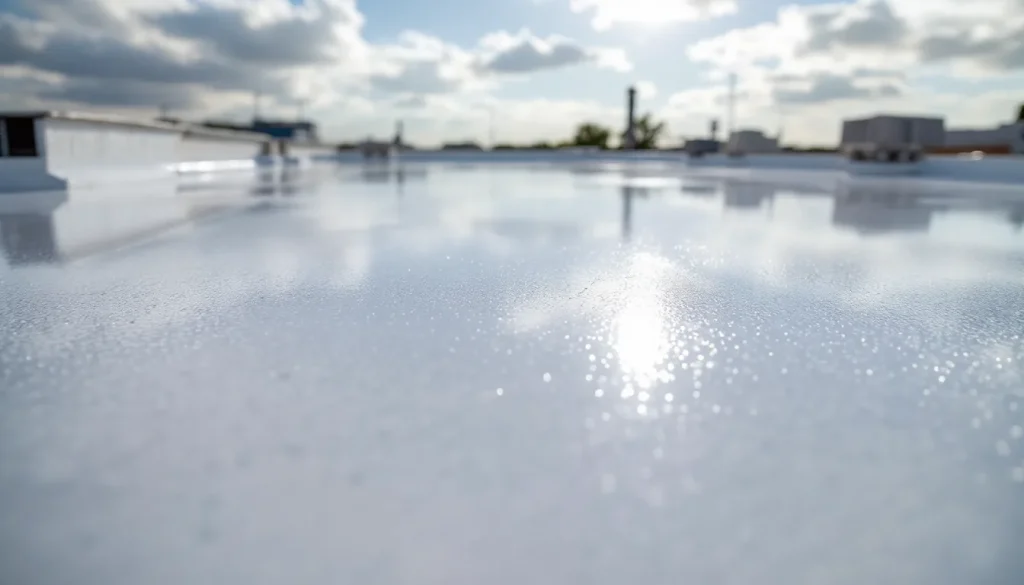
Silicone roof coating outperforms acrylic and polyurethane on ponding water resistance and UV durability, making it the go-to choice for commercial flat roofs that experience water pooling. The 2026 installed cost ranges from $2.50 to $4.00 per square foot, with a 15 to 25 year lifespan and the unusual advantage of being recoatable without full removal. The tradeoff is dirt pickup that reduces reflectivity over time, incompatibility with most other coatings (anything applied over silicone delaminates), and a higher upfront cost than acrylic alternatives. The right use case is restoring a sound commercial flat roof on EPDM, TPO, modified bitumen, BUR, or metal substrate where ponding water is present or expected.
The short version
- Silicone roof coating is the gold standard for ponding water resistance on commercial flat roofs.
- Installed cost: $2.50 to $4.00 per square foot. Lifespan: 15 to 25 years.
- Only coating chemistry that is indefinitely recoatable; subsequent recoats extend life 10 to 15 years each.
- Dirt pickup is the main weakness; reflectance drops from 88 percent to 60 percent within 3 to 5 years.
- Substrate compatibility: EPDM, TPO, modified bitumen, BUR, metal, SPF (with appropriate primer).
- Cool Roof Rating Council and Energy Star listings available on multiple silicone products.
The Short Answer: Silicone Strengths Plus When to Choose
Silicone roof coating is a 100 percent silicone elastomer that cures into a flexible, UV-stable, water-resistant membrane. Compared to acrylic and polyurethane, silicone has three defining strengths: it does not re-emulsify in standing water (the failure mode for acrylic), it carries the longest UV stability of any liquid-applied coating, and it can be recoated indefinitely without removing previous coating layers. These properties make silicone the dominant restoration chemistry on commercial flat roofs across the southern US and the entire commercial market for buildings with ponding water issues.
The reasons to choose silicone over alternatives: ponding water is present on the existing roof (see our commercial roof restoration) (acrylic will fail), the building owner plans long-term ownership (15+ years justifies the cost premium), or the existing substrate is already silicone (only silicone bonds to itself reliably). The reasons to choose against silicone: the budget cannot support the premium cost, the substrate may need replacement within 5 years, or the project requires a coating applied over the silicone in the future (most coatings fail to bond to silicone).
Silicone Chemistry: Single-Component vs Two-Component
Silicone roof coatings come in single-component (1K) and two-component (2K) formulations. Single-component is the dominant residential and most commercial product; two-component is used for higher-performance applications and faster cure times.
Single-component silicone (Gaco S20, GE Silicones SCM Series, Mule Hide 100 percent Silicone, APOC Solar Magic) cures by moisture in the air. It is supplied ready-to-use, has a working pot life of weeks once opened, and cures to a tack-free state in 4 to 8 hours under typical conditions. The cure depends on ambient humidity (50 percent or higher works best) and temperature (50 F minimum).
Two-component silicone uses a base and a catalyst that must be mixed immediately before application. Cure time is faster (1 to 3 hours tack-free), the cure does not depend on humidity, and the cured film has slightly higher tensile strength. Two-component is used on time-pressured commercial projects and on substrates where humidity-cure conditions are not reliable. Pot life after mixing is typically 30 to 90 minutes.
Cost: Installation Plus Materials
| Cost Element | Range (per sq ft) | Notes |
|---|---|---|
| Material only (single-component silicone) | $0.80 to $1.50 | For typical 25-30 mil DFT 2-coat system |
| Material only (two-component silicone) | $1.20 to $2.00 | Higher raw cost for catalyst system |
| Substrate preparation (clean, repair, prime) | $0.50 to $1.00 | Varies by substrate condition |
| Labor (2-coat application) | $0.80 to $1.50 | Sprayed; lower cost than rolled or brushed |
| Total installed (typical commercial) | $2.50 to $4.00 | Includes prep, primer, 2 coats, reinforcement |
| Total installed (premium NDL warranty system) | $3.50 to $5.50 | Higher DFT, manufacturer-trained applicator |
The cost difference between budget and premium silicone installs comes from dry film thickness (DFT), warranty coverage level, and applicator training requirements. A 20-mil DFT acrylic-grade silicone installation will cost $2.50 per square foot but underperform compared to a 30-mil DFT premium silicone at $3.50 per square foot. For commercial roof restoration where the alternative is $10 to $14 per square foot for full TPO replacement, the silicone premium pays for itself.
Lifespan: 15 to 25 Years Typical
Silicone roof coating delivers the longest field-verified lifespan of any liquid-applied roofing chemistry. Industry data, NRCA case studies, and manufacturer field reports consistently document 15 to 25 year service life on properly applied installations, with some premium systems carrying 30+ year manufacturer warranties tied to specified application protocols.
The variables affecting lifespan: dry film thickness (each additional 5 mils of DFT adds approximately 3 to 5 years of service life), substrate stability (a sound substrate that does not move or settle preserves coating integrity), application quality (manufacturer-specified primer and 2-coat application, including reinforcement at seams), climate (UV exposure, freeze-thaw cycles), and maintenance (annual inspection and spot repair extends life materially).
The single most common cause of premature silicone coating failure is undocumented thin spots in the application. Spray-applied coating delivers variable thickness across a roof; without core sample verification, the homeowner or building owner has no proof the manufacturer-specified DFT was actually achieved. Premium installs core sample the coating at multiple points and provide documented DFT measurements before invoicing.
Why Silicone Wins on Ponding Water
Acrylic elastomeric coatings re-emulsify when water sits on them for more than 48 to 72 hours. The acrylic resin softens and eventually breaks down, leading to coating failure in low spots that hold water after rain. Polyurethane coatings tolerate ponding water better than acrylic but can blister under prolonged submersion if not perfectly applied.
Silicone is chemically hydrophobic and inert. Water sits on silicone indefinitely without affecting the coating film. The silicone industry has documented 5+ year service in continuously ponded areas without measurable degradation. This single property is the reason silicone dominates commercial flat roof restoration: every commercial flat roof develops some ponding water over time, and silicone is the only chemistry that does not require that water to drain off promptly.
The ASTM standard for ponding water resistance is ASTM D6694 (Standard Specification for Liquid-Applied Silicone Coating Used in Spray Polyurethane Foam Roofing Systems). The standard specifies maximum water absorption of 2 percent by weight after 7-day water immersion; quality silicone products test at 0.5 to 1.5 percent under this protocol.
The Dirt Pickup Tradeoff
Silicone has one significant weakness: surface dirt pickup. The same molecular structure that makes silicone hydrophobic and UV-stable also makes the surface attract airborne dust, biological growth, and particulate from rain runoff. A new silicone coating with 88 percent solar reflectance can drop to 60 to 65 percent reflectance within 3 to 5 years from accumulated dirt.
This is not a structural failure; the coating still performs waterproofing and chemical protection. But the cool-roof energy savings degrade faster than the waterproofing performance. For projects where energy savings are a major part of the economic justification, this matters. For projects justified on waterproofing extension alone, it matters less.
Pressure washing every 2 to 3 years restores most of the lost reflectance and is an inexpensive maintenance item ($0.05 to $0.10 per square foot). Some manufacturers offer “high-solids” or “anti-dirt-pickup” silicone formulations that mitigate the issue, including Gaco F1700 series and APOC HD silicone, at a 10 to 20 percent cost premium.
UV Stability: Silicone vs Acrylic vs Polyurethane
| Chemistry | UV Stability | Recoat Compatibility | Color Retention |
|---|---|---|---|
| Acrylic | Moderate (10 to 12 years) | Self-compatible only | Yellows in UV |
| Silicone | Excellent (20+ years) | Recoatable indefinitely with silicone | Stays white, dirt pickup obscures |
| Polyurethane (aliphatic) | Good (15+ years) | Self-compatible only | Excellent color retention |
| Polyurethane (aromatic) | Poor (5 to 7 years exposed) | Requires aliphatic topcoat | Yellows badly without topcoat |
Silicone UV stability is the property that drives the long service life. The Si-O bond in silicone is one of the strongest molecular bonds in commercial polymer chemistry, materially stronger than the C-C bonds in acrylic and polyurethane. UV exposure simply does not break down silicone the way it breaks down hydrocarbon-based polymers.
Recoating Without Removal: The Silicone Advantage
The economic killer feature of silicone is the recoat lifecycle. Acrylic and polyurethane coatings, after 10 to 15 years of service, require substrate-down removal before a new coating can be applied. The buildup of cured coating gets too thick, the bond between layers degrades, and the only path forward is removal plus new application at full cost.
Silicone bonds to itself. After 15 to 20 years of service life, a new silicone coat applied over the cleaned existing silicone delivers another 10 to 15 years of life at roughly 60 percent of the original install cost (lower because no substrate preparation, no primer). The recoat cost is typically $1.50 to $2.50 per square foot installed vs $2.50 to $4.00 for the original install.
Over a 50-year building ownership horizon, this is the difference between three coating cycles at $3 per square foot each ($9 per square foot total) and one coating plus two recoats at progressively lower cost ($3 + $1.80 + $1.80 = $6.60 per square foot total). The silicone lifecycle math beats every alternative chemistry for long-term commercial ownership.
Installation: Single-Coat vs Two-Coat Systems
Most commercial silicone installations are 2-coat systems. Single-coat applications exist but are limited to specific products marketed as high-solids one-coat (Gaco UltraGuard, APOC One-Coat). The 2-coat system delivers more reliable DFT achievement, better seam reinforcement coverage, and longer warranty terms.
The 2-coat application process: substrate cleaning (power wash, biological growth treatment), repair and reinforcement (polyester fabric embedded in coating at seams and penetrations), primer if required (silicone on metal typically requires primer; silicone on EPDM may or may not), first coat applied at half the total target DFT (typically 12 to 15 mils wet), cure time per manufacturer (typically 12 to 24 hours), second coat applied perpendicular to first at the remaining DFT (typically 12 to 15 mils wet), and core sample verification at multiple points to confirm final DFT.
Single-coat applications skip the perpendicular cross-coating that ensures film uniformity. They work for budget-driven re-coat scenarios on substrates with existing silicone, but they are not the standard for new applications.
Substrate Compatibility: TPO, EPDM, Modified Bitumen, BUR, Metal
| Substrate | Silicone Compatibility | Primer Required | Notes |
|---|---|---|---|
| EPDM (rubber) | Compatible | Yes (compatible primer required) | Most common silicone substrate |
| TPO (thermoplastic) | Compatible | Yes | Surface oxidation key for adhesion |
| Modified bitumen (APP, SBS) | Compatible | Sometimes | See modified bitumen roof for substrate details |
| Built-up roof (BUR) | Compatible | Yes (aluminum primer typical) | Traditional silicone substrate |
| Metal (Galvalume, painted) | Compatible | Yes (rust primer) | Surface prep critical |
| Spray polyurethane foam (SPF) | Compatible | No (silicone is standard SPF topcoat) | SPF + silicone is a complete system |
| Concrete | Compatible | Yes (concrete primer) | Specialty application |
| Asphalt shingle | NOT compatible | N/A | Voids manufacturer warranty |
| Wood shake | NOT recommended | N/A | Traps moisture |
The substrate dictates the primer and application method. Silicone over metal requires careful rust treatment and metal primer. Silicone over EPDM requires surface degreasing to remove the EPDM oils that interfere with adhesion. Silicone over TPO requires either surface oxidation (the TPO surface chemistry changes with age in ways that improve adhesion) or specific primers.
Cool Roof Rating Council Listings
The Cool Roof Rating Council (CRRC) maintains a publicly searchable database of rated roofing products with measured solar reflectance and thermal emittance values. Energy Star labels low-slope roof products requiring 65 percent initial solar reflectance and 50 percent three-year aged reflectance.
Major silicone products with CRRC listings include Gaco S20 (initial 88 percent, aged 67 percent), APOC Solar Magic (initial 87 percent, aged 64 percent), Mule Hide 100 percent Silicone (initial 87 percent, aged 65 percent), and GE Silicones SCM2200 (initial 89 percent, aged 70 percent). The aged values vary by climate zone and specific application; the CRRC listings provide standardized comparison.
For commercial buildings claiming federal tax credits (Inflation Reduction Act Section 179D), the CRRC and Energy Star certifications are required documentation. The deduction can be up to $5.00 per square foot for qualifying commercial energy efficiency improvements including cool roof coatings.
Brand Comparison: GE Silicones, Gaco, APOC, Henry, Mule Hide
| Brand | Flagship Product | Warranty Range | Market Position |
|---|---|---|---|
| Gaco (Firestone Building Products) | Gaco S20 | 20 to 50 years | Premium tier, largest commercial share |
| GE Silicones | SCM2200, SCM3500 | 15 to 30 years | Industrial chemistry leader |
| APOC | Solar Magic, A-280 | 10 to 20 years | Strong residential and commercial |
| Henry (Carlisle) | Henry 587 HS Silicone | 10 to 20 years | Wide distribution |
| Mule Hide | 100 percent Silicone | 10 to 20 years | Commercial contractor channel |
| Tropical Roofing Products | Silicone-X | 10 to 20 years | Florida-focused commercial |
| Carlisle SynTec | Carlisle Silicone | 10 to 20 years | Tied to Carlisle roof systems |
| Garland | SP-3000 | 10 to 20 years | Government and institutional |
Brand selection should follow the project warranty requirements and the regional contractor base. Gaco S20 carries the longest available silicone warranty (50-year NDL on premium installation) and is the dominant brand on large commercial roof restoration projects. The other brands compete on price, regional distribution, and contractor channel relationships. For a ranked shortlist of specific products with current pricing and warranty terms, see our best silicone roof coating picks.
Manufacturer Warranty (10 to 20 Years Typical)
Silicone manufacturer warranties span 10 to 50 years depending on product line and installation specification. The marketed warranty length and the practical achievable warranty are usually different because the longest warranties require specific protocols.
To qualify for a 20+ year silicone warranty, typical requirements: manufacturer-trained and certified applicator, pre-job substrate inspection by manufacturer technical rep, manufacturer-approved primer (where applicable), specified dry film thickness (typically 30+ mils total system DFT), core sample documentation at completion, and annual inspection during warranty term. For 30+ year and 50-year NDL warranties, add: manufacturer-supplied materials only, manufacturer pre-approved repair procedures for warranty events, and on-site manufacturer rep visits during application.
The trade-off: stricter warranty requirements mean higher install cost (manufacturer rep time, core sampling, documentation) but longer warranty coverage. For commercial buildings with long-term ownership horizons, the trade-off generally favors the stricter warranty. For shorter ownership horizons or budget-driven applications, the shorter warranty at lower install cost may be the better fit.
When Silicone Is NOT the Right Choice
Silicone is the right answer for many commercial flat roof restoration scenarios, but not all. The cases where silicone is the wrong answer:
- Asphalt shingle residential roof (silicone is not approved for shingle substrates; traps moisture)
- Project requires future overcoating with non-silicone (most coatings will not bond to silicone)
- Substrate has widespread structural failure (coating cannot save a failed substrate)
- Budget cannot support silicone premium and acrylic is acceptable for the climate
- Surface dirt pickup is a major project concern (parking deck, light-color requirement)
- Substrate is incompatible (cedar shake, clay tile, certain coatings)
For asphalt shingles specifically: silicone (like any coating) on shingles is part of the “roof restoration” scam pattern targeting homeowners. See roofing scams for the full pattern. The legitimate silicone market is commercial flat roof restoration and specialty residential metal roof applications.
Silicone vs Elastomeric Acrylic vs Polyurethane
| Property | Silicone | Acrylic | Polyurethane |
|---|---|---|---|
| Cost installed (per sq ft) | $2.50 to $4.00 | $1.50 to $2.50 | $3.00 to $5.00 |
| Lifespan | 15 to 25 years | 7 to 12 years | 15 to 20 years |
| Ponding water resistance | Excellent | Poor | Good |
| UV stability | Excellent | Moderate | Good (aliphatic) |
| Recoatable | Indefinitely with silicone | Yes with acrylic, finite cycles | Yes with polyurethane, finite cycles |
| Initial solar reflectance | 85 to 90 percent | 80 to 88 percent | 80 to 88 percent |
| Dirt pickup | High | Moderate | Low |
| Foot traffic tolerance | Moderate | Low | High |
| Chemical resistance | Good | Poor | Excellent |
| VOC content | Low | Very low | Variable |
The clean answer: silicone wins on ponding water, UV durability, and lifecycle cost. Acrylic wins on upfront cost and ease of application. Polyurethane wins on chemical resistance and foot traffic. The application requirements dictate the chemistry; budget-driven substitution rarely delivers the expected economics. For the full side-by-side of every coating chemistry across cost, lifespan, and use case, see our roof coating types compared hub.
The PE-Backed Commercial Coating Market
The commercial coating market has seen significant consolidation in the 2021 to 2026 window. Private equity backed roofing platforms including Tecta America (RedBird Capital), CentiMark (employee-owned), Tremco WTI (RPM International), KPost (Audax Group), and Baker Roofing (Saw Mill Capital) all maintain coating restoration as core service lines.
What separates serious commercial coating installers from residential storm-chasers: specified ASTM D6694 product on the proposal, manufacturer-specified DFT with core sample verification, written maintenance program included with install warranty, licensed and insured crews with documented coating training (NRCA Coating Specialist, manufacturer-specific certifications), and 5+ year warranty backed by manufacturer co-signing.
Frequently Asked Questions
How long does silicone roof coating last?
15 to 25 years for typical commercial flat roof restoration. Premium NDL warranty systems carry 30 to 50 year warranties tied to specified application protocols. Lifespan depends on DFT, substrate, climate, and maintenance.
Is silicone better than acrylic roof coating?
Silicone is materially better for ponding water resistance and UV durability. Acrylic is materially cheaper and easier to apply. Ponding water exposure is the dividing line: with ponding water, silicone. Without ponding water and budget-constrained, acrylic.
Can silicone roof coating be applied over asphalt shingles?
No. Silicone on asphalt shingles traps moisture, accelerates granule loss, and voids the shingle manufacturer warranty. The “roof restoration” pitch for shingles is one of the most common roofing scams.
How much does silicone roof coating cost per square foot?
$2.50 to $4.00 per square foot installed in 2026. Material only: $0.80 to $2.00 per square foot. Premium NDL warranty systems run $3.50 to $5.50 per square foot installed.
Does silicone roof coating need a primer?
Yes for most substrates. EPDM, TPO, metal, BUR, and concrete typically require manufacturer-specified primer. SPF is the exception; silicone is the standard SPF topcoat without separate primer.
Can silicone be recoated when it gets old?
Yes, indefinitely. Silicone is the only coating chemistry that bonds reliably to itself after years of service. Recoat cost is typically 50 to 70 percent of original installation cost.
What is the difference between single-coat and two-coat silicone?
Two-coat applications deliver more reliable DFT, better seam coverage, and longer warranties. Single-coat applications are limited to high-solids products marketed for recoat scenarios. Two-coat is the commercial standard for new applications.
Will silicone coating stop active roof leaks?
No. Silicone is restoration coating, not leak repair. Active leaks must be repaired before coating. Coating over an active leak source will fail at that point within months.
How does silicone compare to other roof coating types?
Silicone leads on ponding water and UV durability but costs more than acrylic ($2.50 to $4.00 vs $1.50 to $2.50 per square foot) and attracts dirt faster. Acrylic wins on price, polyurethane on foot traffic and chemical resistance. Our roof coating types compared hub runs the full side-by-side.
Which silicone roof coating brand is best?
It depends on warranty needs and regional contractor access. Gaco S20 carries the longest silicone warranty (up to 50-year NDL); GE Silicones, APOC, Henry, and Mule Hide compete on price and distribution. See our ranked best silicone roof coating picks for specific products and pricing.
Reviewed by The Roofing Brief Team. Last reviewed August 2026.