
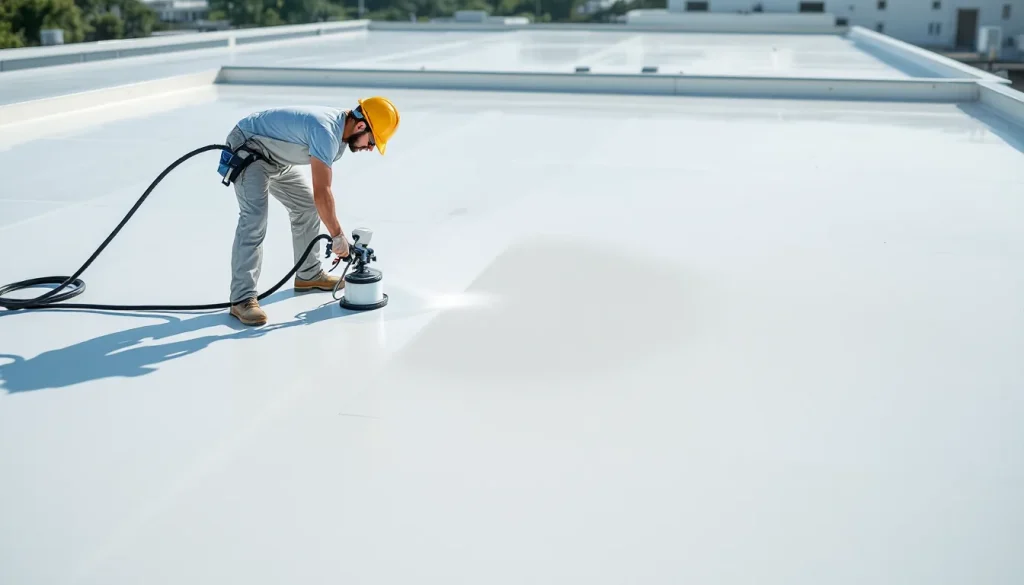
Pricing a commercial roof restoration in 2026 comes down to a single decision the building owner has to get right: does the existing roof system still have enough structural integrity to justify spending $2.50 to $6.00 per square foot on a coating system that buys 10 to 15 years of additional service life, or has it crossed the line into territory where any restoration dollar is wasted because the decking or insulation underneath is already compromised? This guide breaks down 2026 restoration coating costs across the four main chemistry families (silicone (see our roof coating types and cost), acrylic, polyurethane, asphalt emulsion), walks through the inspection and prep work that determines whether restoration actually works, and gives building owners the math for when restoration beats full replacement and when it does not.
What restoration actually is (and is not)
A commercial roof restoration is a fluid-applied coating system, typically sprayed or rolled over an existing single-ply membrane, modified bitumen, BUR, or metal roof, that creates a new monolithic weather barrier on top of the existing roof. Done correctly on the right substrate, restoration extends roof life 10 to 15 years, qualifies the building owner for a new manufacturer warranty (typically 10, 15, or 20 years from coating manufacturers like GACO, Henry, Conklin, or APOC), and avoids the tear-off cost, landfill disposal, and tenant disruption of full replacement.
What restoration is not: a fix for a roof with wet insulation, structural deck damage, widespread membrane failure, or extensive ponding water. Coating over a wet or failing substrate traps moisture, accelerates decking corrosion, and creates a worse problem than the leak the owner was trying to solve. Every honest restoration quote starts with a moisture survey (infrared scan or capacitance meter) and a deck condition assessment. Skip those, and the coating is going on top of a problem it cannot solve. The full pre-coating assessment workflow is covered in our commercial roof restoration overview.
Silicone coating: $2.50-5.00 per sq ft installed
Silicone is the dominant restoration chemistry in 2026, holding roughly 55% of the commercial restoration market. Silicone coatings cure into a flexible, UV-stable, ponding-water-resistant membrane that performs well across temperature extremes and in environments where standing water on the roof is unavoidable. The 2026 pricing range is $2.50 to $5.00 per square foot installed, with most building owners landing at $3.25 to $4.25 per square foot on a 50,000 to 200,000 sq ft project.
The primary silicone products on the market are GACO GacoFlex S2000, Henry 887 Tropi-Cool, Conklin Rapid Roof III, and APOC Tropi-Cool 247. All four carry 10 to 20-year manufacturer warranties when installed by a certified contractor at the manufacturer-specified dry mil thickness (typically 22 to 30 dry mils, applied in one or two coats at 1.5 to 2.5 gallons per 100 sq ft).
Why silicone is priced higher than acrylic. Silicone resin is more expensive than acrylic resin at the raw material level, and silicone requires careful surface prep (clean, dry, primed if specified). Silicone also has a longer cure time and a narrower temperature application window, which can drive labor cost up on weather-constrained projects. The trade-off: silicone outperforms acrylic in ponding water and in long-term UV exposure, which is why it dominates the warranty-backed restoration market.
Silicone restoration drawback. Once a silicone coating is on a roof, the next restoration cycle has to be silicone over silicone, or a full tear-off back to the original membrane before applying a different chemistry. Silicone does not accept overcoating with acrylic or polyurethane. Building owners need to budget for this lock-in.
Acrylic coating: $1.50-3.00 per sq ft installed
Acrylic coatings are the budget option in commercial restoration, priced at $1.50 to $3.00 per square foot installed, with most projects landing at $2.00 to $2.50 per square foot. Acrylic performs well on metal roofs and on single-ply membrane in dry climates with minimal ponding water. The chemistry is water-based, which makes it easier to apply, easier to clean up, and cheaper to ship and store.
Where acrylic does not work: any roof with regular standing water. Acrylic re-emulsifies in prolonged water contact, which means a ponded area will see coating breakdown inside 3-5 years even when the rest of the roof is performing fine. For roofs with drainage issues, silicone or polyurethane is the correct choice. The drainage assessment that determines this is covered in our flat roof drainage design guide.
Acrylic warranty terms are typically 5 to 10 years from the manufacturer, shorter than silicone or polyurethane. The building owner should weigh the lower install cost against the shorter warranty term and shorter expected service life before signing the work order.
Polyurethane coating: $3.00-6.00 per sq ft installed
Polyurethane coatings (often spec’d as a two-coat system with a polyurethane base coat and a silicone or acrylic top coat) are the high-performance option, priced at $3.00 to $6.00 per square foot installed. The chemistry is harder than silicone or acrylic, more resistant to foot traffic and physical damage, and ideal for roofs with heavy HVAC service traffic or rooftop equipment loads.
Two-coat aromatic polyurethane base with aliphatic top is the spec for high-traffic commercial roofs (restaurants, schools, retail with regular HVAC service, anywhere maintenance crews are on the roof more than a few times a year). The aromatic base coat cures fast and provides the structural performance. The aliphatic top coat provides UV stability and color retention.
Polyurethane warranty terms run 10 to 20 years from manufacturer, similar to silicone. The cost premium over silicone (typically $0.75 to $1.50 per square foot) buys foot-traffic resistance and a harder, more durable surface.
Asphalt emulsion and elastomeric coatings: $1.25-2.50 per sq ft
The fourth chemistry family is asphalt emulsion and asphaltic elastomeric coatings, used primarily for restoring older BUR (built-up roofing) and modified bitumen roofs where the goal is to extend service life by 5 to 8 years rather than 10 to 15. These coatings run $1.25 to $2.50 per square foot installed, and the warranty terms are shorter (typically 3 to 7 years).
This is the right chemistry for a 20-year-old BUR or mod-bit roof that is otherwise sound but is showing surface degradation, granule loss, and minor cracking. It is not the right chemistry for single-ply membrane restoration, where silicone, acrylic, or polyurethane should be specified instead.
The substrate prep cost most quotes hide
Coating material and labor is half the restoration cost. The other half is substrate prep, and this is where a lot of contractors lowball the quote and change-order on the back end.
Power wash. $0.15 to $0.35 per square foot. Mandatory on every restoration project. Coating will not bond to a dirty roof.
Primer. $0.20 to $0.55 per square foot. Required on most TPO and PVC substrates, on metal roofs, and on aged BUR. The primer line item is the single most commonly omitted item on lowball quotes.
Seam reinforcement (mesh embedment). $0.75 to $2.00 per linear foot of seam. Most restoration systems require fiberglass or polyester reinforcing mesh embedded in coating at every membrane seam, every penetration, and every transition. A 100,000 sq ft single-ply roof might have 5,000 to 12,000 linear feet of seam needing reinforcement.
Penetration detail work. $35 to $125 per penetration. Every HVAC unit, pipe, vent, and equipment mount needs detailed flashing in coating with reinforcing mesh. A 100,000 sq ft warehouse might have 50 to 120 penetrations.
Wet insulation cut-out and patch. $4 to $9 per square foot of cut-out area. Any wet insulation discovered in the moisture survey has to be cut out, replaced, and the membrane patched before coating. This is the line item that turns a $250,000 restoration into a $310,000 restoration once the infrared scan results come in.
When restoration beats replacement: the math
Restoration beats replacement when three conditions are all true: (1) the existing roof has at least 70% structural integrity (membrane is intact, decking is sound, less than 10-15% wet insulation), (2) the building owner is willing to commit to a 10-15 year extended service horizon rather than starting a new 20-30 year warranty clock, and (3) the cost-per-year over the restoration service life is meaningfully lower than the cost-per-year over a full replacement service life.
The math at typical 2026 pricing: a 100,000 sq ft restoration at $4.00/sq ft = $400,000 spread over 12 years of expected service = $33,333/year. A 100,000 sq ft TPO replacement at $9.00/sq ft = $900,000 spread over 22 years of expected service = $40,909/year. Restoration wins on annualized cost. But the math reverses fast if the substrate inspection shows widespread wet insulation, decking corrosion, or structural failure: the substrate repair line items can drive restoration cost to $6.00 to $8.00/sq ft, which kills the per-year economics. The full replacement cost analysis is in our commercial roof replacement cost guide.
For roofs with severe structural problems or extensive wet insulation, replacement is the financially correct decision. Coating over a failing substrate creates a more expensive teardown 5 years later. The flat roof coating restoration deep-dive covers the failure modes that disqualify a roof from restoration entirely.
When restoration is the wrong call
Restoration is the wrong call when: (1) more than 15-20% of the roof shows wet insulation in the moisture survey, (2) the deck is showing corrosion or rot that would require structural repair before coating, (3) the membrane has membrane shrinkage greater than 2-3% that has lifted detail flashing across the roof, (4) ponding water exceeds 48-72 hours after rainfall across more than 10% of the roof area (drainage redesign is needed, not coating), or (5) the roof has been previously restored with a different chemistry that does not accept overcoating.
Some restoration contractors will coat over any of these conditions to win the job. The result is a roof that fails inside 4-6 years and requires full tear-off and replacement at higher cost than if the building owner had replaced when they should have. A second opinion from a manufacturer-certified consultant (not the contractor bidding the work) is worth the $1,500 to $3,500 inspection fee on any restoration project over $200,000.
Warranty terms by manufacturer in 2026
Coating manufacturer warranties in 2026 typically come in three tiers: labor-only (covering coating defects), material-only (covering coating material replacement), and NDL (no dollar limit, covering both labor and material to repair coating failure).
GACO GacoFlex S2000 silicone offers 10, 15, and 20-year warranty options based on dry mil thickness applied. Henry 887 Tropi-Cool silicone offers 10, 15, and 20-year options with similar thickness gating. Conklin Rapid Roof III silicone offers 10, 15, and 18-year options. APOC Tropi-Cool 247 silicone offers 10 and 15-year options. All four manufacturers gate the warranty term on certified contractor status, manufacturer-specified primer, dry mil thickness verification (often by independent third-party mil thickness audit), and annual inspection by the certified contractor for the warranty term.
Building owners should confirm in writing before signing the work order: which warranty tier they are buying, what dry mil thickness triggers that tier, who performs the mil thickness audit, and what the annual inspection obligation costs. Our commercial roof warranty guide covers the warranty preservation requirements across manufacturers.
Project size and labor market impact on per-sq-ft cost
Restoration pricing scales with project size in a predictable way. Smaller projects (under 25,000 sq ft) carry mobilization overhead that pushes per-sq-ft cost 25-40% higher than the published ranges. Larger projects (over 200,000 sq ft) typically land at the low end of the range or slightly below, because mobilization is amortized over more square footage and the contractor can run multiple crews in parallel.
Labor market also drives meaningful spread. West Coast and Northeast urban markets run 20-35% higher than national averages for restoration labor, while Southeast and Mountain West markets often run 10-20% below. Building owners with multiple facilities across regions should not assume a single per-sq-ft price applies across the portfolio.
Inspection cadence during the warranty term
Every restoration warranty in 2026 requires annual or semi-annual inspection by the certified contractor for the warranty term. The inspection cost runs $400 to $1,500 per visit depending on roof size and complexity, with most warranties requiring 10 to 20 inspections across the warranty life. Building owners should budget this into the total cost of ownership: a $400,000 restoration with a 15-year warranty might carry $12,000 to $25,000 in cumulative inspection cost over the warranty term, which is a meaningful chunk of the per-year economics.
Skipping the required inspections voids the warranty in almost every case. Some contractors bundle the inspection cost into the initial restoration price as a multi-year service agreement, which is the cleanest way to handle it. Owners should confirm in writing whether inspections are included or billed separately, what the per-inspection cost is, and what happens if an inspection identifies needed maintenance.
The restoration ROI calculation building owners should run
A defensible restoration ROI calculation needs four inputs: (1) the all-in cost of restoration including substrate prep and any wet insulation repair, (2) the all-in cost of replacement including tear-off and landfill disposal, (3) the expected service life of each option (12-15 years for restoration, 20-30 years for replacement depending on system), and (4) the building owner’s expected hold period (do they own the building for 5 more years or 25?).
If the hold period is shorter than the expected service life of restoration, restoration is almost always the right call. If the hold period exceeds the replacement service life, replacement is usually correct. The middle case (hold period of 10-18 years) is where the detailed annualized cost math matters most, and where the substrate condition assessment becomes the deciding factor. A restoration done right at the right point in roof life is one of the highest-ROI capital decisions a commercial building owner can make. A restoration done wrong on a failing substrate is one of the most expensive mistakes.