
By The Roofing Brief Team | Last reviewed: November 2026
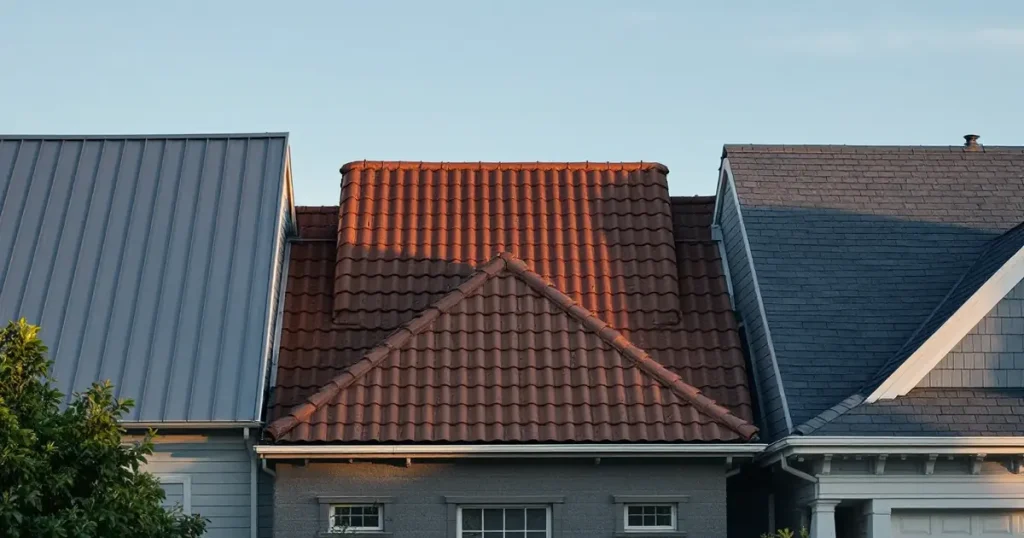
The strongest alternatives to asphalt shingles are standing seam metal, stone-coated steel, synthetic slate or shake, concrete or clay tile, natural slate and cedar, and the right one is set by the problem you are leaving asphalt to fix: hail calls for a UL 2218 Class 4 product, wildfire for an ASTM E108 Class A rating, and a roof flatter than 2:12 for standing seam metal, which the IRC allows down to 1/4:12. Against the 2026 baseline of $5 to $8 per sq ft installed for architectural asphalt in our 2026 Roofing Cost Report, the alternatives run from $6 to $10 per sq ft for exposed-fastener metal up to $15 to $30 for natural slate.
Every rating, weight and price below is compiled from maker data sheets, the 2021 International Residential Code, state insurance regulators and dated cost guides; nothing here comes from hands-on testing. Prices are national ranges, so a local bid that lands outside them deserves a line-item question.
Asphalt shingle alternatives at a glance: price premium, weight and slope
The premium column compares each alternative’s midpoint price with the $6.50 per sq ft midpoint for architectural asphalt, multiplied out for a 2,000 sq ft (20-square) roof, which costs about $13,000 in asphalt at that midpoint. Weight decides whether the framing needs a check; slope decides whether the material is even legal on your roof.
| Alternative | Installed $/sq ft | Premium over asphalt, 20 squares (midpoint) | Weight, lb per square | IRC minimum slope | Source |
|---|---|---|---|---|---|
| Class 4 impact-resistant asphalt (stay with asphalt) | $8 to $13 | +$8,000 | 240 to 340 (asphalt range) | 2:12 (R905.2.2) | TRB 2026 cost report |
| Exposed-fastener metal (R-panel, corrugated) | $6 to $10 | +$3,000 | 50 to 150 | 3:12 without lap sealant, 1/2:12 with (R905.10.2) | TRB 2026 cost report |
| Stone-coated steel (DECRA and similar) | $7 to $13 | +$7,000 | 130 (ICC-ES ESR-1754) to 160 (DECRA 2023 sheet) | 3:12 for metal shingles (R905.4.2); 4:12 for DECRA Shingle XD | HomeGuide, accessed November 2026; DECRA 2023 spec sheet |
| Standing seam metal | $10 to $18 | +$15,000 | 50 to 150 | 1/4:12 (R905.10.2) | TRB 2026 cost report |
| Synthetic slate or shake (DaVinci, Brava, Enviroshake, CeDUR) | $12 to $20 | +$19,000 | 100 to 300 | Per the maker’s evaluation report | TRB 2026 cost report |
| Cedar shake | $10 to $18 | +$15,000 | 200 to 350 | 3:12 (R905.7.2, R905.8.2) | TRB 2026 cost report |
| Concrete tile | $7 to $19 | +$13,000 | 600 to 1,100 | 2-1/2:12 (R905.3.2) | TRB 2026 cost report |
| Clay tile | $11 to $25 | +$23,000 | 600 to 1,200 | 2-1/2:12 (R905.3.2) | TRB 2026 cost report |
| Natural slate | $15 to $30 | +$32,000 | about 935 for 1/4 in slate | 4:12 (R905.6.2) | TRB 2026 cost report; National Slate Association |
Weights other than stone-coated steel and slate are the ranges in our roofing materials comparison, which also carries the cost-per-year table for every material. The slope sections are from the 2021 IRC Chapter 9; your jurisdiction may adopt the 2024 edition or local amendments.
Ranked by the reason you want to leave asphalt
Most lists of shingle alternatives rank materials by price or looks. The better question is which failure of asphalt you are paying to escape, because a material that solves hail (Class 4 steel) can be the wrong answer for a 1:12 porch roof, and the best wildfire answer (tile) can overload rafters sized for 3 psf of shingles.
1. Hail: pick a UL 2218 Class 4 product
UL 2218 drops steel balls from 1-1/4 in up to 2 in diameter on the roof covering, and Class 4 means the sample survived the 2 in ball without cracking through. Non-asphalt products that carry that rating on the maker’s own literature include DECRA stone-coated steel (“Hail: UL 2218 (Class 4)” on the 2023 DECRA spec sheet, which also lists a Hail Stone Penetration Warranty), Enviroshake composite shake (“Level 4 impact resistance (UL 2218)” in the 2024 Enviroshake brochure) and DaVinci Single-Width Slate, listed as Class 4 Impact on the Westlake Royal DaVinci product page.
Class 4 is a cracking test, not a dent test. A stone-coated or standing seam steel roof can pass Class 4 and still show cosmetic dents after a 2 in hailstorm, and some insurers attach cosmetic-damage exclusions to metal roofs, so ask your carrier for the exact endorsement wording before you pay a premium for steel to stop hail claims.
Insurance credits are where hail-resistant roofs pay back, and three states show three different legal models:
- Texas: insurers have been required to offer premium discounts for UL 2218 impact-resistant roofs since 1998, and the Texas Department of Insurance’s roofing discounts page says the amount for each class is set company by company, with Class 4 earning the highest credit.
- Oklahoma: the Oklahoma Insurance Department’s FORTIFIED discount sheet lists filed credits from 3% (QBE Insurance) to 42% (National Security Fire and Casualty), including 30% at State Farm, for homes with a FORTIFIED Home High Wind and Hail roof designation, based on 2018 filings and applied to wind and hail premiums.
- Alabama: Code of Alabama Sections 27-31D-1 and 27-31D-2 provide for insurance premium discounts on homes built or retrofitted to the FORTIFIED standard, and Section 27-31D-2.1 (Act 2019-240) requires insurers to offer an endorsement that pays to upgrade a covered roof replacement to FORTIFIED Roof, per the IBHS summary of the law.
In Oklahoma and Alabama the credit attaches to the FORTIFIED designation, which IBHS issues for the whole roof system (sealed roof deck, ring-shank deck nails and a certified evaluator’s inspection), not to the shingle brand. A Class 4 asphalt shingle installed to FORTIFIED Roof qualifies the same way a metal roof does.
If you stay with asphalt, check what the warranty tier actually pays; our page on 30 year shingles works the proration math.
2. Wind: look for the test class, not the warranty speed
Asphalt shingles are wind-classed under ASTM D3161 (Class F, 110 mph test fan speed) and ASTM D7158 (Class H, 150 mph design wind). The alternatives publish their own numbers: DECRA carries a 120 mph wind speed warranty and UL 580 / UL 1897 Class 90 uplift listings on its 2023 spec sheet, and Enviroshake lists ASTM D3161 and Miami-Dade testing at 180 mph plus approval for High Velocity Hurricane Zones under TAS 125 (Florida approval FL 16037). Standing seam panels are rated by UL 580 and ASTM E1592 uplift pressure in psf, which our roof wind uplift rating guide converts into wind speeds.
Warranty speed is a contract term, not a test class. Owens Corning Duration carries a 130 mph limited wind warranty and GAF Timberline HDZ 130 mph when GAF starter strip is used at eaves and rakes, so a well-installed architectural asphalt roof already matches DECRA’s 120 mph warranty on paper. Leaving asphalt for wind alone makes sense mainly where a FORTIFIED or HVHZ requirement applies.
3. Wildfire: Class A by itself, or Class A only as an assembly
ASTM E108 (UL 790) ranks roof coverings Class A, B or C by flame spread and burning-brand tests. Clay tile, concrete tile, natural slate and metal reach Class A, and DECRA lists UL 790 (ASTM E108 A, B and C) on its spec sheet, with the class set by the listed underlayment or barrier board under ICC-ES ESR-1754. Enviroshake states an unconditional Class A rating under ASTM E108 and CAN/ULC S107 in its 2024 brochure, meaning no special underlayment is needed to reach it.
Cedar is the weak option here: untreated cedar shakes test Class C at best, fire-retardant Certi-Guard red-label shakes reach Class B, and Class A comes only as a tested assembly with a specified underlayment, per the Cedar Shake and Shingle Bureau ratings summarized on our cedar shake roofing page. Many synthetic slate and shake lines reach Class A only over a listed underlayment, so ask for the exact assembly on the UL or Intertek listing. In California, the 2025 California Wildland-Urban Interface Code (Title 24 Part 7) took over the wildfire roofing rules on January 1, 2026, and Very High Fire Hazard Severity Zones require Class A roof assemblies.
4. Lifespan: the break-even math against re-roofing in asphalt
An alternative pays back only if it outlives the asphalt roofs you would otherwise buy. The table counts how many architectural asphalt roofs (midpoint $13,000 for 20 squares, midpoint life 27.5 years) fit inside each alternative’s midpoint life, using today’s prices with no inflation, tear-off or financing. Lifespans are the midpoints of the ranges in the materials comparison linked above.
| Alternative | Midpoint cost, 20 squares | Midpoint life (years) | Asphalt roofs needed over that life | Asphalt cost over that life | Alternative minus asphalt |
|---|---|---|---|---|---|
| Standing seam metal | $28,000 | 55 | 2 | $26,000 | +$2,000 |
| Synthetic slate or shake | $32,000 | 40 | 2 | $26,000 | +$6,000 |
| Concrete tile | $26,000 | 50 | 2 | $26,000 | $0 |
| Clay tile | $36,000 | 75 | 3 | $39,000 | minus $3,000 |
| Natural slate | $45,000 | 112.5 | 5 | $65,000 | minus $20,000 |
| Cedar shake | $28,000 | 30 | 2 | $26,000 | +$2,000 |
Roofing Brief estimate, inputs shown. Two readings follow from it. Over a single 55-year span, standing seam lands within $2,000 of buying asphalt twice, so it wins only if you value skipping the second tear-off. Slate and clay are the only alternatives that beat asphalt on lifetime dollars, and only for an owner who holds the house past the first asphalt replacement at about year 27.
Tile gets its own 50-year cost run, including a lift-and-relay because Polyglass warrants its tile underlayments for up to 30 years, in our tile vs shingle roof comparison.
5. Weight: when to check the rafters first
The IRC rafter span tables R802.4.1(1) through R802.4.1(8) give spans for a 10 psf or a 20 psf dead load. Architectural asphalt at 240 to 340 lb per square adds 2.4 to 3.4 psf, which fits easily inside 10 psf with sheathing and underlayment. Natural slate at about 935 lb per square (9.35 psf for 1/4 in slate at a 3 in headlap, per the National Slate Association) and clay or concrete tile at 600 to 1,200 lb per square push the covering alone to 6 to 12 psf, past the 10 psf column, so an engineer or the building department should confirm the rafters before you switch.
The light alternatives avoid that check: DECRA stone-coated steel at 1.3 psf (about 130 lb per square) under ICC-ES ESR-1754, or 150 to 160 lb per square on its 2023 spec sheet, and metal panels at 50 to 150 lb per square both weigh less than the asphalt they replace. DaVinci Single-Width Slate sits between them at 275 to 367 lb per square depending on exposure, per the DaVinci technical sheet cited in our DaVinci Roofscapes review. Our slate vs asphalt shingles comparison works the load numbers for a full slate conversion.
6. Looks: slate or shake without the weight or the fire class
For a slate or cedar look on standard framing, the 2026 Roofing Cost Report prices synthetic slate and shake at $12 to $20 per sq ft and names DaVinci, Brava, Inspire, CeDUR and EcoStar as the main lines. DaVinci is a Westlake Royal brand, and its Single-Width Slate page lists a Lifetime Limited Material Warranty, Class A fire and Class 4 impact. Enviroshake offers a 50-year Gold warranty or a 25-year Standard warranty per its brochure. Stone-coated steel is the other route: DECRA, an IKO Metals brand, sells shake, shingle and tile profiles with a 120 mph wind warranty and a lifetime limited warranty on single-family homes in the U.S. and Canada. Our stone coated steel roofing guide compares DECRA with Unified Steel and Tilcor.
7. Low slope: what you can legally use under 4:12
Asphalt shingles are allowed down to 2:12, but IRC R905.2.2 requires double underlayment from 2:12 up to 4:12, and below 2:12 shingles are not permitted at all. The 2021 IRC minimums for the alternatives are:
- Standing seam metal panels: 1/4:12 (R905.10.2), the only material on this list that works on a nearly flat porch or addition roof.
- Lapped exposed-fastener panels: 3:12 without lap sealant, 1/2:12 with applied lap sealant (R905.10.2).
- Clay and concrete tile: 2-1/2:12 (R905.3.2), with double underlayment up to 4:12.
- Metal roof shingles: 3:12 (R905.4.2).
- Wood shingles and shakes: 3:12 (R905.7.2, R905.8.2).
- Natural slate: 4:12 (R905.6.2).
Below 1/4:12 none of these apply, and the roof needs a membrane such as EPDM or TPO; our rubber roofing material guide covers that range.
8. Cost: the cheapest non-asphalt roof
Exposed-fastener metal at $6 to $10 per sq ft is the only alternative whose range overlaps architectural asphalt’s $5 to $8, which puts its premium at about $3,000 on a 20-square roof at the midpoints. The catch is slope and fasteners: lapped panels need 3:12 without lap sealant, and every screw penetrates the panel through a sealing washer, so the maker’s screw pattern and spacing govern the warranty. Standing seam hides its fasteners under clips at the seams, which is most of what its $10 to $18 price buys.
Solar shingles and other newer roofing options
Solar shingles are the newest mainstream alternative, and their hail rating changed between generations. GAF Energy’s first-generation Timberline Solar TLS-1 data sheet (June 2023) lists a 46 W energy shingle, about 1.46 kW per square, UL 790 Class A fire, ASTM D3161 Class F wind, a 2:12 minimum pitch and UL 2218 Class 1 impact, the lowest class. The current Timberline Solar ES 2 sheet (SM512, 2026) lists about 1.7 kW per square, 3.36 lb per sq ft installed and UL 2218 Class 4, but only for packages bearing the Intertek-ETL Class 4 listing statement, as our GAF Timberline Solar review details.
The federal 25D Residential Clean Energy Credit ended for systems installed after December 31, 2025 under Public Law 119-21, so a 2026 homeowner-owned solar roof is priced without the former 30% federal credit. Check state and utility programs, and a tax professional, before comparing a solar roof bid with a Class 4 shingle bid.
Staying with asphalt: the Class 4 shingle option
For a hail-only problem, the cheapest fix is often a better asphalt shingle. Class 4 impact-resistant asphalt costs $8 to $13 per sq ft in the 2026 cost report, a premium of about $8,000 over architectural asphalt on 20 squares at the midpoints, and it keeps the 2:12 slope rule, the light weight and the existing crew. Lines with UL 2218 Class 4 listings include GAF Timberline AS II, Owens Corning Duration FLEX, CertainTeed Landmark ClimateFlex and TAMKO StormFighter FLEX; our best asphalt shingles comparison covers their warranties.
| Input | Value | Basis |
|---|---|---|
| Class 4 premium over architectural asphalt, 20 squares | $8,000 | $10.50 vs $6.50 per sq ft midpoints, TRB 2026 cost report |
| Annual wind and hail premium (example) | $2,000 | Hypothetical input; use your own declarations page |
| Credit rate (example) | 20% | Hypothetical; insurers set Class 4 credits company by company (TDI) |
| Annual saving | $400 | $2,000 x 20% |
| Simple payback | 20 years | $8,000 / $400 |
Roofing Brief estimate with stated inputs. At a 20% credit the premium takes about as long to recover as the roof lasts, so the case for Class 4 asphalt rests on avoided hail claims and deductibles as much as on the discount. At the 30% FORTIFIED credit State Farm filed in Oklahoma, the same $8,000 recovers in about 13 years.
Which alternative to asphalt shingles should you pick?
| If your main problem is | Then pick | Proof to ask for |
|---|---|---|
| Hail, roof is 2:12 or steeper, budget under +$10,000 | Class 4 asphalt shingle | UL 2218 Class 4 listing for the exact shingle |
| Hail, and you want 50+ years | Stone-coated steel or Class 4 synthetic | UL 2218 Class 4 plus the insurer’s cosmetic-damage endorsement wording |
| Wildfire zone | Tile, slate, metal or an unconditional Class A composite | ASTM E108 / UL 790 Class A for the full assembly |
| Hurricane or FORTIFIED discount | Any covering installed to FORTIFIED Roof | IBHS FORTIFIED designation certificate |
| Slope between 1/4:12 and 2:12 | Standing seam metal | Maker’s minimum slope for that panel profile |
| Slope under 1/4:12 | Membrane (EPDM, TPO) | Not a shingle alternative; see membrane specs |
| Slate look on rafters sized for shingles | Synthetic slate or stone-coated steel | Weight per square from the maker’s tech sheet |
| Holding the house 50+ years, framing can carry 10+ psf | Natural slate or clay tile | Engineer’s rafter check against the 20 psf dead-load span table |
| Lowest cost that is not asphalt | Exposed-fastener metal at 3:12 or steeper | Screw spec and spacing from the panel maker |
How to switch from asphalt to another roofing material
- Measure the pitch in inches of rise per 12 in of run and match it to the IRC minimum for the material: 4:12 for slate, 3:12 for metal shingles and wood, 2-1/2:12 for tile, 1/4:12 for standing seam.
- Find the rafter size, spacing and span in the attic and compare them with IRC Table R802.4.1 at 10 psf and 20 psf dead load if the new covering weighs over 600 lb per square.
- Pull the product’s rating proof: the UL 2218 class, the ASTM E108 class and the exact assembly, and the wind test class or approval number (Florida approvals and Miami-Dade NOAs are searchable online).
- Call your insurer before signing and ask which rating, form or certificate earns a credit; in Oklahoma and Alabama ask about the FORTIFIED Roof designation, which needs an IBHS-certified evaluator during installation.
- Check HOA covenants and any historic-district rules for material and color limits before ordering.
- Plan a full tear-off: IRC R908.3.1.1 bans a new layer over two existing layers, and tile, slate and standing seam makers generally require a bare, inspected deck.
- Get the installer’s maker certification in writing where the warranty depends on it, and register the warranty the day the job is signed off.
Frequently asked questions
What will replace asphalt shingles?
No single material is replacing asphalt; asphalt still covers about 4 in 5 U.S. homes per the Asphalt Roofing Manufacturers Association. The most common substitutes priced in our 2026 cost report are standing seam and stone-coated steel at $7 to $18 per sq ft, and synthetic slate or shake at $12 to $20, against $5 to $8 for architectural asphalt in the 2026 cost report.
What is the newest type of roofing?
Solar shingles are the newest mainstream type. GAF Energy’s current Timberline Solar ES 2 nails on like a shingle, produces about 1.7 kW per roofing square, and lists UL 2218 Class 4 impact only for packages bearing the Intertek-ETL Class 4 statement; the first-generation TLS-1 was rated Class 1.
What can I use instead of shingles on the roof?
On a roof 4:12 or steeper, you can use metal panels, stone-coated steel, synthetic slate or shake, clay or concrete tile, natural slate or cedar. Between 1/4:12 and 2:12 only standing seam metal fits among those, per IRC R905.10.2, and below 1/4:12 you need a membrane such as EPDM or TPO.
Are there non-asphalt shingles?
Yes. Non-asphalt shingles include stone-coated steel shingles such as DECRA profiles at 150 to 160 lb per square, composite polymer shingles such as DaVinci slate and Enviroshake, cedar shingles and shakes, and natural slate. Each has its own IRC minimum slope, from 3:12 for metal and wood shingles to 4:12 for slate.