
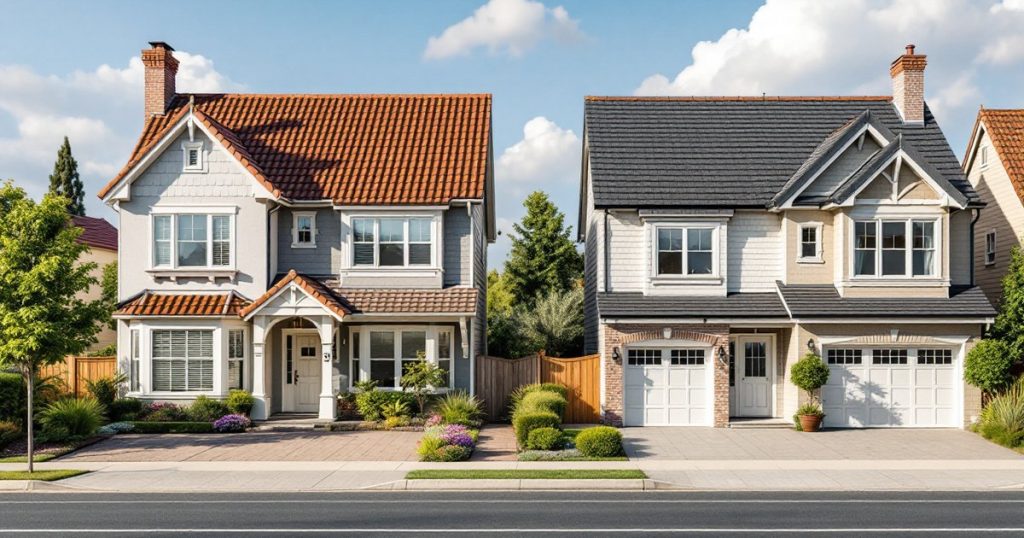
In the tile vs shingle roof decision, asphalt shingles cost about half as much to install and weigh roughly one fifth as much, while clay and concrete tile can outlast several shingle roofs if the framing can carry them. Architectural shingles run $5 to $8 per square foot installed and concrete tile $7 to $19, per The Roofing Brief’s 2026 roofing cost report. Which one is cheaper over 50 years depends mostly on how long shingles last in your climate and what the tile underlayment costs to replace.
By The Roofing Brief Team. Last reviewed: October 2026.
Tile vs shingle roof: key numbers at a glance
These are the figures most people searching tile vs shingle want first. Each row comes from a named source, and each varies by product, region and roof shape, so treat the ranges as planning numbers rather than quotes.
| Figure | Asphalt shingle (architectural) | Concrete tile | Clay tile | Source |
|---|---|---|---|---|
| Installed cost per sq ft | $5 to $8 | $7 to $19 | $11 to $25 | Roofing Brief 2026 Roofing Cost Report |
| 2,000 sq ft of roof, installed | $10,000 to $16,000 | $14,000 to $38,000 | $22,000 to $50,000 | Roofing Brief 2026 Roofing Cost Report |
| Weight per square (100 sq ft) | About 184 to 300 lb | About 900 to 970 lb standard; 550 to 720 lb lightweight | About 800 to 1,575 lb by profile | GAF, Owens Corning and CertainTeed data sheets and EPDs; Eagle Roofing technical specifications; Ludowici product specifications |
| Estimated life | 30 years (20 for 3-tab) | 100+ years for the tile | 100+ years for the tile | InterNACHI Standard Estimated Life Expectancy Chart for Homes |
| Minimum roof slope | 2:12 (double underlayment below 4:12) | 2.5:12 (double underlayment below 4:12) | 2.5:12 (double underlayment below 4:12) | 2021 IRC R905.2.2 and R905.3.2 |
What is the difference between a tile roof and a shingle roof?
A shingle roof uses thin, flexible asphalt shingles nailed to a solid deck, and the shingles themselves are the main water barrier. A tile roof uses rigid, heavy clay or concrete pieces that shed most of the water, while the underlayment beneath them does the final waterproofing. That split explains most of the differences in cost, weight and lifespan.
Asphalt shingles must comply with ASTM D3462 under 2021 IRC Section R905.2.4. Clay roof tile must comply with ASTM C1167 and concrete roof tile with ASTM C1492, under R905.3.4 and R905.3.5. Concrete tile is molded from sand, cement and pigment and is the lower-priced tile; the 2026 cost report lists Florida, Arizona and Southern California as its main markets. Clay tile is fired earthenware, priced higher and colored through the body of the tile. For the full split between the two tiles, see our clay vs concrete roof tile comparison.
Tile vs shingle roof comparison table
The table below puts the two roof types side by side on every factor that usually decides a reroof. Each row names its source. Ratings and weights belong to specific products, so confirm the figures for the exact shingle line or tile profile on your quote.
| Factor | Asphalt shingle | Tile (concrete and clay) | Source |
|---|---|---|---|
| Installed cost | $4 to $6 per sq ft (3-tab); $5 to $8 (architectural); $8 to $13 (Class 4 impact) | $7 to $19 (concrete); $11 to $25 (clay) | Roofing Brief 2026 Roofing Cost Report |
| Covering weight | About 1.8 to 3.0 lb per sq ft | About 5.5 to 9.7 lb per sq ft (concrete); 8 to 15.75 lb (clay) | Manufacturer data sheets and EPDs; Eagle; Ludowici |
| Deck | Solid sheathing | Solid sheathing (spaced lumber allowed in Seismic Design Categories A to C) | 2021 IRC R905.2.1, R905.3.1 |
| Life of the covering | 20 years (3-tab), 30 (architectural); 10 to 12 and 15 to 20 in Florida | 100+ years; 80+ in Florida | InterNACHI national and Florida life expectancy charts |
| Underlayment life | Replaced with each reroof | Shorter than the tile; leading self-adhered tile underlayments carry warranties of up to 30 years | Polyglass Polystick warranty documents |
| Wind standard | ASTM D7158 Class H or ASTM D3161 Class F for the highest IRC wind zones | Florida: FRSA/TRI Florida High Wind Concrete and Clay Roof Tile Installation Manual; Miami-Dade NOA in the HVHZ | 2021 IRC Table R905.2.4.1; Florida Residential Code R905.3.7 |
| Hail test | UL 2218 (steel balls), Class 4 top rating | FM 4473 (ice balls, rigid roofing), Class 4 top rating | UL 2218; ANSI FM 4473 |
| Fire | Class A available (ASTM E108 / UL 790) | Class A assemblies (ASTM E108 / UL 790) | Manufacturer listings |
| Walkability | Walkable with normal care | Step only on the headlap (lower 3 to 4 inches) of each tile | TRI Installation Manual |
| Recover allowed? | One recover may be allowed under R908.3.1 | No recover over existing tile (R908.3.1.1) | 2021 IRC R908 |
How much more expensive is a tile roof than shingles?
A tile roof costs about two to three times as much as an architectural shingle roof to install. At the midpoints of The Roofing Brief’s 2026 ranges, concrete tile ($13 per square foot) runs about 2.0 times architectural asphalt ($6.50), and clay tile ($18) about 2.8 times. On 2,000 square feet of roof, the midpoint gap is about $13,000 for concrete and $23,000 for clay.
| Material | Per sq ft installed | 2,000 sq ft of roof | Midpoint | Midpoint vs architectural |
|---|---|---|---|---|
| 3-tab asphalt | $4 to $6 | $8,000 to $12,000 | $10,000 | 0.8x |
| Architectural asphalt | $5 to $8 | $10,000 to $16,000 | $13,000 | 1.0x |
| Class 4 impact shingle | $8 to $13 | $16,000 to $26,000 | $21,000 | 1.6x |
| Concrete tile | $7 to $19 | $14,000 to $38,000 | $26,000 | 2.0x |
| Clay tile | $11 to $25 | $22,000 to $50,000 | $36,000 | 2.8x |
Source: per-square-foot ranges from the Roofing Brief 2026 Roofing Cost Report, which assumes a simple gable or hip roof with single-layer tear-off. The midpoint and ratio columns are Roofing Brief arithmetic. Spanish, mission and barrel clay profiles, the classic terracotta look, sit in the middle of the clay range, per the same report.
The 2,000 square foot figure is roof surface, not floor area. Steep pitch, multi-layer tear-off and deck replacement add $1 to $4 per square foot in most markets, per the same report. A shingle-to-tile conversion can also add engineering and framing work, which none of these ranges include.
How much does tile weigh compared with shingles, and can your roof carry it?
Standard concrete tile weighs about four to five times as much as architectural shingles. Eagle Roofing lists its flat concrete profiles at about 970 pounds per square installed, while GAF declares Timberline HDZ at about 184 pounds per square and Owens Corning Duration at about 207. On a 20-square roof, switching from HDZ to standard flat Eagle tile adds about 15,700 pounds, close to 8 tons.
| Product | Weight per square (100 sq ft) | Per sq ft | 20 squares (2,000 sq ft) | Source |
|---|---|---|---|---|
| GAF Timberline HDZ | About 184 lb | 1.84 lb | About 3,680 lb | GAF 2025 EPD, via our shingle weight by brand table |
| Owens Corning Duration | About 207 lb | 2.07 lb | About 4,140 lb | Owens Corning published data |
| CertainTeed Landmark Premium | 300 lb | 3.00 lb | 6,000 lb | CertainTeed technical data sheet |
| Eagle Malibu, Eaglelite | 550 lb | 5.50 lb | 11,000 lb | Eagle Roofing technical specifications |
| Eagle Capistrano, standard | 900 lb | 9.00 lb | 18,000 lb | Eagle Roofing technical specifications |
| Eagle Bel Air, standard | 970 lb | 9.70 lb | 19,400 lb | Eagle Roofing technical specifications |
| Ludowici Classic 14″ interlocking clay | 800 lb | 8.00 lb | 16,000 lb | Ludowici specification sheet |
| Ludowici French clay | 1,025 lb | 10.25 lb | 20,500 lb | Ludowici specification sheet |
| Ludowici Provincial clay shingle tile | 1,575 lb | 15.75 lb | 31,500 lb | Ludowici specification sheet |
The 20-square column is Roofing Brief arithmetic (weight per square x 20) and excludes ridge, hip and trim pieces. Eagle notes that standard and lightweight tile availability varies by region.
What the code says about tile weight
The IRC treats tile weight as a design question, not a roofing detail. Section R301.4 of the 2021 IRC says “the actual weights of materials and construction shall be used for determining dead load,” and R908.2 says “the structural roof components shall be capable of supporting the roof covering system and the material and equipment loads that will be encountered during installation.”
Rafter span tables show why the weight matters. In 2021 IRC Table R802.4.1(1), a 2×8 Douglas fir-larch No. 2 rafter at 16 inches on center (20 psf live load, ceiling not attached) spans 18 feet 5 inches at a 10 psf dead load, but only 16 feet 0 inches at 20 psf. Shingles at about 2 psf fit comfortably inside a 10 psf design. Standard concrete tile at 9 to 10 psf, before sheathing and framing are counted, usually does not.
How to check whether a shingle roof can take tile
- Find the original design load. Truss drawings or the original permit set often state the top-chord dead load. If no paperwork exists, the framing has to be measured.
- Price the exact tile profile. Ask for the installed weight per square of the tile on your quote, since a lightweight profile can weigh roughly half of a standard flat tile.
- Hire a licensed engineer. An engineer compares rafter or truss size, species, grade, spacing and span against the new dead load, and many building departments ask for a sealed letter before permitting a shingle-to-tile conversion.
- Price any reinforcement separately. Sistering rafters, adding purlins or replacing trusses is carpentry, not roofing, and should be its own line item.
- Confirm deck and slope rules. Tile needs solid sheathing under 2021 IRC R905.3.1 (spaced lumber is allowed only in Seismic Design Categories A to C) and a slope of at least 2.5:12.
Do tile roofs last 50 years? Lifespan of tile vs shingles
Yes, the tile itself commonly lasts well past 50 years. InterNACHI’s Standard Estimated Life Expectancy Chart for Homes lists clay and concrete roofing at 100+ years, architectural asphalt at 30 and 3-tab at 20. Its Florida chart lists clay and concrete at 80+, architectural asphalt at 15 to 20 and 3-tab at 10 to 12. The underlayment under the tile is the shorter clock.
| Roof covering | InterNACHI national chart | InterNACHI Florida chart |
|---|---|---|
| Asphalt shingles, 3-tab | 20 years | 10 to 12 years |
| Asphalt shingles, architectural | 30 years | 15 to 20 years |
| Clay or concrete tile | 100+ years | 80+ years |
Source: InterNACHI Standard Estimated Life Expectancy Chart for Homes and InterNACHI Estimated Life Expectancy Chart for Florida Homes.
The underlayment caveat
A tile roof leaks when its underlayment fails, not usually when the tile does. Tile makers warrant the tile, not the membrane beneath it: Eagle Roofing’s lifetime limited warranty covers the structural integrity and specific manufacturing defects of the individual tiles. Polyglass offers warranties of up to 30 years on its Polystick self-adhered tile underlayments, such as TU Max and TU Plus, which is a fraction of the tile’s listed life.
When the underlayment wears out, roofers usually perform a lift-and-relay: they remove and stack the tile, install new underlayment and flashing, and reset the same tile. Our tile roof replacement and lift-and-relay guide covers when a relay is enough and when the tile has to go.
Tile vs shingle for wind, hail and fire
Both roof types can reach top-tier ratings, but they are tested under different standards. Shingles are rated for wind under ASTM D7158 or D3161 and for hail under UL 2218. Tile is installed to high-wind manuals and tested for hail under FM 4473, a standard written for rigid roofing. Both can carry Class A fire ratings.
Wind
For shingles, 2021 IRC Table R905.2.4.1 requires ASTM D7158 Class H (or D3161 Class F) where the ultimate design wind speed reaches 168 mph or more. Manufacturer wind warranties are a separate matter: GAF lists Timberline HDZ at 110 mph standard and 130 mph with its starter strips, for example. For tile in Florida, the current Florida Residential Code (R905.3.7) references the FRSA/TRI Florida High Wind Concrete and Clay Roof Tile Installation Manual, Seventh Edition. In the High-Velocity Hurricane Zone (Miami-Dade and Broward), roofing products need a Miami-Dade Notice of Acceptance. Eagle’s own comparison page says its concrete tile withstands sustained winds up to 180 mph, a manufacturer claim that depends on the installed system.
Hail
UL 2218 drops steel balls on flexible products such as shingles, and Class 4 (a 2-inch ball) is the top class. FM 4473 fires ice balls at rigid roofing such as tile, again with Class 4 at the top. Ratings are plant and product specific: Eagle’s Capistrano, Bel Air and Malibu tile from its Sumterville, Florida plant hold FM 4473 Class 4 certificates, while listings for its Phoenix and Stockton plants show Class 3, as detailed in our Eagle roofing tile review. A tile that cracks in a storm can still sit over intact underlayment, but cracked pieces need replacing before the membrane is exposed.
Fire
Clay and concrete tile are noncombustible, and manufacturers list their tile roofs as Class A assemblies under ASTM E108 and UL 790. Many fiberglass-mat asphalt shingles also reach Class A under the same test. Fire class describes the tested assembly, including the underlayment, so check that your installer follows the listed assembly.
Insurance: how roof type and roof age affect coverage
Roof age often matters to an insurer as much as roof material, and long-lived tile can help on that front. In Florida, Statute 627.7011(5) bars an insurer from refusing to issue or renew a homeowner’s policy “solely because of the age of the roof” when the roof is less than 15 years old. For roofs 15 years or older, the insurer must allow an inspection at the homeowner’s expense.
If that inspection by an authorized inspector shows “5 years or more of useful life remaining,” the insurer may not refuse to issue or renew solely because of roof age, under the same subsection. The statute calculates roof age from “the last date on which 100 percent of the roof’s surface area was built or replaced.” In practice, a 20-year-old tile roof may pass that inspection more easily than a 20-year-old shingle roof, but the outcome depends on the inspector, the insurer and the roof’s condition. Ask your insurer in writing whether a permitted lift-and-relay changes the roof age in its file.
Outside Florida, premium credits for impact-rated roofs vary by state and carrier filing. Our impact-resistant roof insurance discounts by state tracks where those credits exist. Confirm any discount, and the documentation it needs, with your own carrier before choosing a roof for it.
What are the downsides of a tile roof?
The main downsides of a tile roof are its upfront cost, its weight, its fragility underfoot and the underlayment that wears out long before the tile. Tile can also crack in hail, needs a specialist crew for repairs, and requires at least a 2.5:12 slope. Shingles avoid most of those issues but need replacing more often.
- Upfront cost. About 2.0 times architectural shingles for concrete and 2.8 times for clay, at the midpoints of the 2026 ranges.
- Weight. Roughly 5.5 to 15.75 pounds per square foot of covering, which can trigger an engineering review on a home framed for shingles.
- Walking. The Tile Roofing Institute installation manual says pressure should be applied only on the headlap of the tile (the lower 3 to 4 inches). Satellite, solar and HVAC technicians can break tile if they ignore that.
- Underlayment. A lift-and-relay is a planned mid-life cost that shingle roofs do not carry, because shingle underlayment is replaced with every reroof.
- Repairs and color match. Broken tiles need matching replacements. Keep spare tiles from the original order, since concrete tile color can weather and discontinued profiles are hard to find.
Shingle roofs have their own maintenance list: lifted or missing tabs after wind, granule loss, and algae streaking in humid climates. Those repairs are usually cheaper and any roofer can do them, which is part of why the cost report treats architectural asphalt as the baseline U.S. residential roof.
Which climates suit tile, and which suit shingles?
Tile fits hot, sunny and fire-prone regions, and The Roofing Brief’s 2026 cost report lists Florida, Arizona and Southern California as concrete tile’s main markets. Shingles fit almost every climate and every roof framed for them. In freeze-thaw country, tile can work, but only tile rated for severe weathering, and the extra snow load stacks on top of the tile’s dead load.
For clay tile in freeze-thaw zones, specify ASTM C1167 Grade 1, the grade for severe weathering. Ludowici, for example, states that all products from its New Lexington, Ohio plant meet C1167 Grade 1. For concrete tile, Eagle lists its tile as freeze-thaw rated, excluding slurry and color-bonded tiles. In the Sun Belt, heat is the issue for shingles: InterNACHI’s Florida chart cuts architectural asphalt to 15 to 20 years, compared with 30 on its national chart.
Does a tile roof add resale value?
There is no national resale benchmark for tile. The 2025 Cost vs Value Report from JLC (Zonda) includes an asphalt shingle roofing replacement, which recouped about 68 percent of its $31,871 job cost ($21,501 resale value), and a metal roofing replacement, but no tile project. Any claim that tile returns a specific percentage at resale is not backed by that report.
In practice, buyers in tile neighborhoods may expect tile, and a newer roof of either type removes a common inspection objection. Our roof replacement ROI and resale value report breaks down the Cost vs Value figures by region.
50-year lifecycle cost: tile vs shingle on a 2,000 sq ft roof
Over 50 years, architectural shingles stay cheaper at national midpoints, while concrete tile pulls ahead where shingles wear out in 15 to 20 years, as InterNACHI lists for Florida. The swing factor is the number of shingle reroofs, not the tile price. This is a Roofing Brief calculation from the cost report and InterNACHI lifespans, shown in full below.
Assumptions: 2,000 square feet of roof surface (20 squares), installed ranges from the 2026 cost report, today’s dollars with no inflation or discounting, and no structural work. Each tile roof includes one lift-and-relay inside 50 years, priced at Fixr’s $3 to $5 per square foot to lift the tile, install new underlayment and relay it ($6,000 to $10,000 on 2,000 square feet, assuming about 10 percent tile breakage). Arizona and Florida bids can run higher once flashing, deck repair and permits are added, as our tile roof underlayment replacement cost guide shows.
| Scenario (50 years) | Roofs bought | Total outlay | Midpoint |
|---|---|---|---|
| Architectural shingle, 30-year life (InterNACHI national) | 2 (years 0 and 30) | $20,000 to $32,000 | $26,000 |
| Architectural shingle, 20-year life (Florida chart, high end) | 3 (years 0, 20, 40) | $30,000 to $48,000 | $39,000 |
| Architectural shingle, 15-year life (Florida chart, low end) | 4 (years 0, 15, 30, 45) | $40,000 to $64,000 | $52,000 |
| Concrete tile plus one relay | 1 tile roof + 1 relay | $20,000 to $48,000 | $34,000 |
| Clay tile plus one relay | 1 tile roof + 1 relay | $28,000 to $60,000 | $44,000 |
Source: Roofing Brief calculation. Installed ranges from the 2026 Roofing Cost Report; lifespans from InterNACHI; relay cost from Fixr. Midpoints average the low and high totals.
Three findings fall out of the arithmetic:
- On the national 30-year shingle life, shingles win by about the cost of the relay. At midpoints, two shingle roofs ($26,000) cost the same as one concrete tile roof before its relay ($26,000), so the $6,000 to $10,000 relay is the margin. At the low ends the two tie at $20,000.
- On Florida lifespans, concrete tile wins. Three shingle roofs at the midpoint ($39,000) cost $5,000 more than concrete tile with one relay ($34,000). At a 15-year shingle life, four shingle roofs ($52,000) cost more than concrete tile even with two relays ($42,000).
- Clay tile rarely wins on cost alone within 50 years. Its midpoint ($44,000) loses to two national shingle roofs and to three Florida ones, and beats only the four-roof case ($52,000). Clay is usually chosen for appearance and a horizon well past 50 years.
The table also understates tile at year 50. The last shingle roof in the national case is 20 years into a 30-year life, while the tile is at half or less of its listed life. It overstates tile wherever framing work is needed for a conversion, because that cost is excluded above.
Are tile roofs better than shingles? Which one should you pick?
Tile is better than shingles when the framing already carries it, the climate shortens shingle life, and you plan to own the house for decades. Shingles are better when the frame was built for them, the budget is fixed, or you expect to sell within 15 to 20 years. Use the table below to map your situation to a choice.
| Your situation | Likely better pick | Why |
|---|---|---|
| House framed for shingles, no engineer’s letter | Asphalt shingle | Standard concrete tile adds about 7 to 8 psf of dead load that the IRC requires the structure to carry (R301.4, R908.2) |
| Existing tile roof with sound tile, leaking underlayment | Tile (lift-and-relay) | Framing is already sized for tile and the tile can be reset |
| Florida or desert Southwest, owning 20+ more years | Concrete tile | InterNACHI’s Florida chart gives architectural shingles 15 to 20 years, so several reroofs fit in 50 |
| Selling within 15 years | Asphalt shingle | Lower upfront cost, and Cost vs Value has no tile benchmark to price a premium |
| Frequent large hail | Class 4 shingle or FM 4473 Class 4 tile | Check the exact product rating; Class 4 shingles cost $8 to $13 per sq ft per the cost report |
| Cold climate with freeze-thaw | Shingle, or Grade 1 clay tile with an engineer’s review | ASTM C1167 Grade 1 is the severe weathering grade; snow load adds to tile weight |
| Spanish, Mediterranean or mission-style house | Tile (clay or concrete) | Appearance and neighborhood expectations usually decide these homes |
| Roof slope between 2:12 and 2.5:12 | Asphalt shingle | Tile requires at least 2.5:12 under 2021 IRC R905.3.2 |
If shingles win, our ranking of the best asphalt shingles for 2026 compares the major lines, and our rundown of asphalt shingles advantages and disadvantages covers the shingle side on its own. If tile wins and metal is also on the list, see our metal roof vs tile roof comparison.
Frequently asked questions
Are tile roofs better than shingles?
Tile roofs last longer and resist fire and heat well, but they are not better for every house. InterNACHI lists clay and concrete tile at 100+ years against 30 for architectural shingles, yet tile costs about two to three times as much and weighs four to five times more. Tile suits homes framed for it in hot climates; shingles suit most other roofs.
What are the downsides of having a tile roof?
The main downsides are cost, weight and the underlayment. Concrete tile runs $7 to $19 per square foot installed against $5 to $8 for architectural shingles, weighs about 5.5 to 9.7 pounds per square foot, and breaks if walked on carelessly. Its underlayment wears out long before the tile, so most tile roofs need a lift-and-relay during their life.
Do tile roofs last 50 years?
The tile usually does. InterNACHI’s life expectancy chart lists clay and concrete roofing at 100+ years nationally and 80+ years in Florida. The underlayment beneath the tile is shorter-lived: Polyglass warrants its Polystick tile underlayments for up to 30 years, so plan for at least one lift-and-relay within 50 years even when the tile itself stays sound.
How much more expensive is a tile roof than shingles?
About two to three times as much upfront. At the midpoints of The Roofing Brief’s 2026 ranges, concrete tile costs about 2.0 times architectural shingles and clay about 2.8 times. On 2,000 square feet of roof, that is roughly $26,000 for concrete and $36,000 for clay against $13,000 for architectural shingles, before any structural work a conversion may need.
Can you put tile on a roof built for shingles?
Sometimes, but only after a structural check. The 2021 IRC requires actual material weights in dead-load design (R301.4) and a structure that can carry the new covering (R908.2). Standard concrete tile adds about 7 to 8 pounds per square foot over shingles, so many building departments ask for a licensed engineer’s letter and any needed reinforcement before permitting the change.
Is tile or shingle cheaper over 50 years?
It depends on how long shingles last where you live. In a Roofing Brief calculation for a 2,000 square foot roof, two architectural shingle roofs at a 30-year life average $26,000 against about $34,000 for concrete tile with one underlayment relay. Where shingles last 15 to 20 years, as InterNACHI lists for Florida, three or four shingle roofs cost more than the tile.