
By The Roofing Brief Team | Last reviewed: November 2026
Used metal roofing is worth buying only when the price per usable sheet lands well below new: on November 20, 2026, Cox Hardware in Houston listed a new 12 ft, 29 gauge galvanized corrugated sheet at $34.99, while the same weight of steel was worth about $2.43 at the 2025 scrap average. Anything between those two numbers is negotiable, and after cutting off damaged ends, a used 12 ft sheet usually needs to sell for under about $28 to beat new.
For the next stock length up, see the 14 ft metal roofing price comparison.
Salvaged tin fits sheds, hay barns, fences, wainscot and garden projects. It is a poor fit for a permitted house roof, because IRC R904.4 expects roof coverings delivered in packages bearing the manufacturer’s identifying marks, and no used sheet has a paint or substrate warranty left that transfers to you.
What used metal roofing is worth: the new price and the scrap floor
Two published numbers bracket any used sheet. The ceiling is a new sheet of the same length and profile from a lumberyard; the floor is what the steel brings as scrap. The USGS Mineral Commodity Summaries 2026 puts the 2025 delivered composite price of No. 1 heavy melting steel scrap at an estimated $319 per metric ton, about $0.145 per pound, and a scrap yard pays a seller less than that mill-delivered price.
| Reference point | Price | Per sq ft or per lb | Source |
|---|---|---|---|
| New 12 ft corrugated, 29 ga galvanized, 26 in wide | $34.99 each ($33.24 at 50+) | $1.35 per gross sq ft (26 sq ft sheet) | Cox Hardware SKU 72822, as listed November 20, 2026 |
| New 8, 10 and 16 ft lengths, same panel | $22.99, $28.79, $45.99 | $1.33 per gross sq ft each | Cox Hardware SKUs 72820, 72821, 72824, as listed November 2026 |
| New 12 ft corrugated, 29 ga Galvalume | $39.97 | 16.8 lb per sheet (listed weight) | Stine Home SKU GL12CR, as listed November 2026 |
| Scrap value of one 16.8 lb sheet | About $2.43 | $0.145 per lb, mill-delivered | Roofing Brief arithmetic from USGS 2025 average ($319 / 2,204.6 lb) |
| Reclaimed corrugated sold as a decor product | $1.75 to $4.00 per sq ft plus freight | Above new 29 ga | Western States Metal Roofing buyer’s guide |
The last row explains why reclaimed tin can cost more than new. Rusty, weathered sheets sold for interior walls and restaurant fit-outs are priced as a finish, and Western States says freight from remote salvage yards can exceed the price of the metal. Farm-sale and Marketplace sheets sold as plain roofing sit near the bottom of the bracket instead. For new-panel pricing by length, see the 12 ft metal roofing price breakdown and the 20 ft metal roofing price list.
Break-even math: the most you should pay per used sheet
A used sheet is only cheaper if its price per usable square foot is lower than new. The formula is simple: maximum price = new price x (1 minus the share of the sheet you will cut off or throw away) minus your hauling cost per sheet. Rotted eave ends, kinked corners and mismatched lengths are the usual waste, and Western States notes that salvage cannot be ordered to custom lengths.
| Waste you cut off (input) | Max price vs $34.99 new galvanized | Max price vs $39.97 new Galvalume | Max price vs $34.99 if the used sheet will last half as long |
|---|---|---|---|
| 10% (one damaged end, about 14 in) | $31.49 | $35.97 | $15.75 |
| 20% (both ends, about 29 in) | $27.99 | $31.98 | $14.00 |
| 30% (ends plus a rusted lap strip) | $24.49 | $27.98 | $12.25 |
The table is Roofing Brief arithmetic on the November 2026 Cox Hardware and Stine Home prices, with hauling set to $0; subtract your own trailer or fuel cost per sheet. The right-hand column applies when a sheet has lost most of its zinc and you expect roughly half the service life of a new G90 sheet. At $15 a sheet with 20% waste, a used 12 ft panel costs $0.72 per usable sq ft ($15 / 20.8 sq ft), about 46% under new.
Where to find used metal roofing
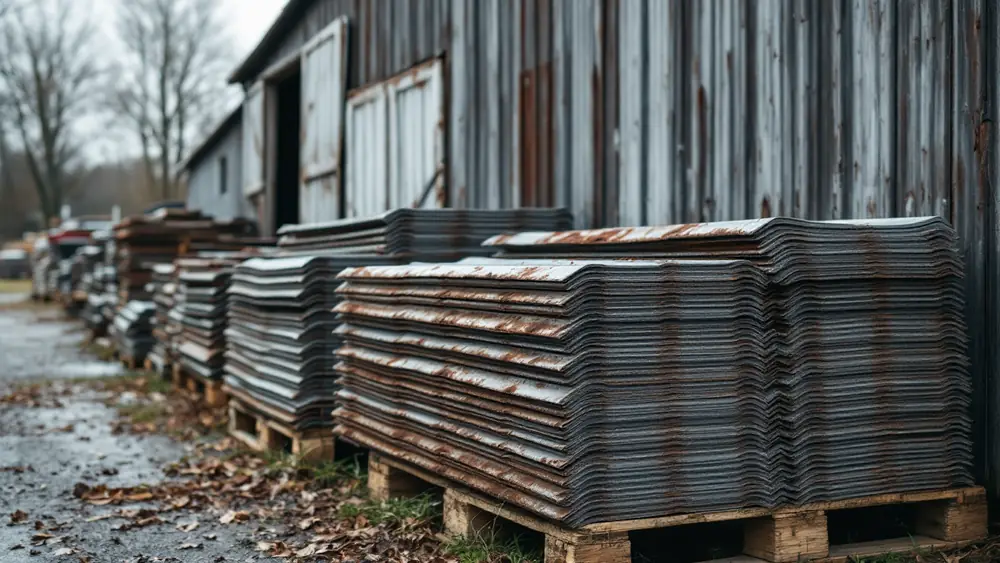
Listings cluster in five places, and each has a different catch. Search with the profile name (“corrugated”, “R panel”, “5V”) and a length, since sellers rarely use the phrase “used metal roofing”.
| Source | What is usually there | The catch | Named example |
|---|---|---|---|
| Facebook Marketplace and Craigslist | Barn and poultry-house teardowns, leftover new sheets from finished jobs | Mixed lengths and profiles in one stack; cash and self-haul | Marketplace “corrugated sheets” category |
| eBay | Small lots of old galvanized tin, often for decor | Freight on 8 to 12 ft sheets can exceed the item price | eBay “tin roofing” category |
| Reclaimed material dealers | Sorted, weathered galvanized for walls and ceilings | Priced as a finish, $1.75 to $4.00 per sq ft per Western States | Reclaimed Lumber Products (Nampa, ID); Timeless Lumber Company (Byron, MI); Elmwood Reclaimed Timber (Peculiar, MO), as listed by Western States |
| Habitat for Humanity ReStores | Donated roofing tin and leftover panels | Stock is local and irregular | Austin Habitat ReStore lists “Roofing tin” among accepted building materials |
| Supplier clearance (new, not used) | Overstock painted and Galvalume coil for roll formers | As-is, final sale, no warranty claims | Sheffield Metals clearance coil, advertised at up to 40% off |
Clearance coil only helps buyers who own or hire a portable roll former. For panel buyers, the closest thing to “seconds” is a local yard’s cut-to-length leftovers, so ask the counter at a farm-supply metal yard whether it sells short-run or wrong-color panels before you drive to a teardown.
How to inspect used metal roofing before you load it
- Magnet test. Hold a magnet to the sheet. Galvanized and Galvalume steel attract it; aluminum does not.
- Measure thickness. Use a 0 to 1 in micrometer on a clean cut edge. Manufacturers’ Standard Gauge bare-steel thickness is 0.0135 in for 29 gauge and 0.0179 in for 26 gauge; on the galvanized gauge chart the figures are 0.0172 and 0.0217 in. A reading under about 0.016 in on a painted sheet means 29 gauge or lighter. Our 26 vs 29 gauge thickness comparison lists the sources.
- Identify the coating. If a backside print names “AZ50”, “AZ55” or “G90”, record it. If nothing is printed, treat the coating as unknown. The coating split is explained in galvanized vs Galvalume roofing.
- Grade the corrosion. Light white or gray deposits are zinc corrosion. The American Galvanizers Association says light wet storage stain “does not necessarily imply any likely reduction in the expected life,” while medium and heavy build-up can badly damage the coating. Red rust means the zinc is gone at that spot and the base steel is corroding.
- Check the bottom 12 in and every lap. Eave ends and the side laps hold water longest, so rust-through shows up there first. Pinholes visible against the sky disqualify that section.
- Rub the paint. Wipe a dark cloth across a painted sheet. Heavy powder on the cloth is chalking, which paint warranties measure by ASTM D4214; McElroy’s Fluropon Kynar 500 warranty limits chalk to a No. 8 rating and fade to 5.0 Hunter delta-E units under ASTM D2244, counted “from the date of shipment”.
- Map the holes. Measure the spacing between rows of old screw holes. If it matches your purlin spacing (24 in on center is common on sheds), you can reuse those rows.
- Match the profile. Measure crest to crest across 5 corrugations and divide by 5. Cox Hardware’s new galvanized sheet uses 2-1/2 in corrugations, while 7/8 in corrugated from PAC-CLAD and Metal Sales runs on a 2.67 in pitch, so the two will not nest at a side lap. Profile dimensions are compared in our guide to corrugated metal panels.
What to do about old screw holes
Old holes are the main leak risk on used metal roofing, and there are only three sound options. The first is reusing the original rows over purlins at the same spacing with a larger screw. Fastener maker SFS says a replacement screw should be “one size wider than what was previously used,” giving a #14 Type A to #17 Type AB swap as its example.
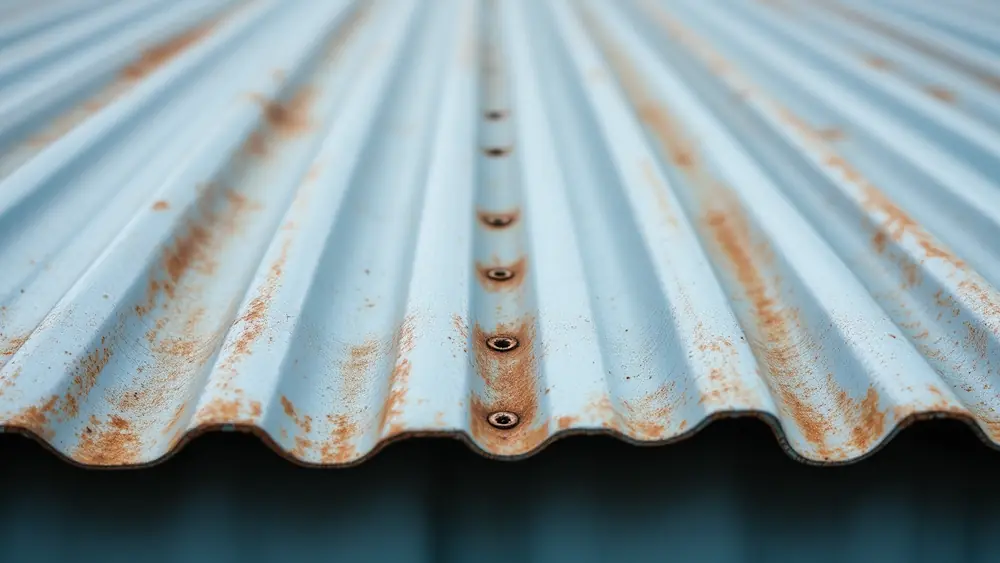
The second option is placing stray holes where they do not matter: on a wall, at the high end of a lap where the next sheet covers them, or in the part of the sheet you trim off. The third, for a hole that cannot be moved, is the repair Hansen Pole Buildings describes as a manufacturer’s only approved fix for a missed screw: hold a wood block under the hole and drive a screw through it, and “Do NOT” rely on caulking alone. Screw counts and placement for new rows are in our metal roofing screw pattern guide.
Condition grades and what each one is fit for
| What you see | What it means | Fit for | Basis |
|---|---|---|---|
| Dull gray, light white powder, no red rust | Zinc patina; coating still working | Shed or barn roof, walls | AGA wet storage stain guidance |
| Red rust spots under 1 in across, not through | Zinc lost locally; steel corroding at those spots | Walls, wainscot, fencing; roof only with cut-outs | AGA: red rust = base steel exposed |
| Rust-through or pinholes at laps or ends | Section is perforated | Cut out the bad section or scrap the sheet | Light-test for holes against the sky |
| Painted, heavy chalk on a cloth, faded | Paint past a No. 8 chalk rating; no warranty | Fine for outbuildings; repaint or accept the look | McElroy warranty limits, ASTM D4214 |
| Kinks, creased ribs, bent corners | Laps will not seat and may leak | Cut down for fence panels or garden bed sides | Profile must nest at side laps |
Decision table: should you use used metal roofing on this project?
| If your project is | Then | Why |
|---|---|---|
| A shed or hay barn at 3:12 or steeper | Used sheets are a fit if the price clears the break-even table | IRC R905.10.2 sets 3:12 as the minimum slope for lapped, nonsoldered-seam metal roofs without applied lap sealant |
| A roof flatter than 3:12 | Buy new, or plan sealant in every lap | Below 3:12 the same section requires applied lap sealant |
| Wainscot, accent walls, fences, privacy screens | Used is ideal, including rusted sheets | No drainage or uplift demand; old holes can face out or be trimmed |
| A hog barn or a building near curing concrete | Avoid used Galvalume; check the coating print first | Cleveland-Cliffs advises against Galvalume in pig barns, as noted in our galvanized vs Galvalume page |
| A permitted house roof or an insured outbuilding with a wind rating | Buy new panels with a published fastener schedule | IRC R904.4 product identification, R905.10.3 coating minimums, and no transferable warranty |
| Painted sheets of unknown age going near children or a pre-1978 home | Test the paint for lead before cutting or sanding | See the lead section below |
Can used metal roofing go on a house? What the code says
The International Residential Code does not ban used material, but it makes salvage hard to document. IRC R904.4, as adopted in Ohio Admin. Code 4101:8-9-01, says “Roof covering materials shall be delivered in packages bearing the manufacturer’s identifying marks.” Table R905.10.3(2) sets minimum corrosion resistance at ASTM A653 G-90 for galvanized steel and ASTM A792 AZ 50 for 55% aluminum-zinc coated steel, and an unmarked used sheet cannot show either.
The administrative rule on reuse points the same way. The 2021 International Building Code Section 104.9.1, reproduced by the Florida Building Commission, states: “Materials that are reused shall comply with the requirements of this code for new materials.” The 2024 IRC renamed its parallel section R104.9.1 “Materials and equipment reuse” per the ICC 2024 significant changes course. Ask your building department, before buying, whether it will accept unlabeled panels and what documentation it wants.
Lead paint on old painted barn tin
The federal government banned the sale of lead-based paint for use in homes in 1978, per the EPA Renovation, Repair and Painting program, so painted farm tin older than that can carry lead. The RRP Rule covers paid work on pre-1978 homes, childcare facilities and preschools, and “does not apply to homeowners doing RRP projects in their own pre-1978 homes”; a barn is not target housing. The hazard comes from dust and chips when you cut, grind or wire-brush the paint.
EPA recognizes three lead test kits for RRP work: LeadCheck, D-Lead and the State of Massachusetts kit, recognized against a regulated level of 1.0 mg/cm2 or 0.5% lead by weight. A positive result on sheets meant for garden beds, a chicken coop or an indoor wall is a reason to pass. Cutting methods that throw less dust are covered in how to cut corrugated metal roofing.
Selling used metal roofing instead of scrapping it
Thirty 12 ft sheets at Stine’s listed 16.8 lb each weigh 504 lb, or 0.229 metric tons. At the USGS 2025 average of $319 per metric ton, that steel is worth about $73 delivered to a mill, and a local yard pays less. Listed at even $8 a sheet, the same 30 sheets bring $240. Measure gauge and length, photograph the worst end of the worst sheet, and state the profile and rib pitch so buyers can check the nest. Barn-specific panel choices are covered in our barn roofing guide.
Frequently asked questions
Is used metal roofing cheaper than new?
Only below the break-even price. With new 12 ft, 29 gauge galvanized at $34.99 (Cox Hardware, November 2026) and 20% of each used sheet cut off, a used sheet must cost under about $28 to save money, or about $14 if it will last half as long as new.
Where is the cheapest place to get metal roofing?
For new panels, farm-supply metal yards and regional lumberyards often undercut big-box stores: Cox Hardware listed 29 gauge galvanized corrugated at $1.33 to $1.35 per gross sq ft in November 2026. For used sheets, Facebook Marketplace and Craigslist teardown listings are cheapest when you can self-haul.
How much is a 20 ft sheet of metal roofing?
About $57 to $64 for unpainted steel. Cox Hardware’s 16 ft price works out to $2.87 per linear foot, or about $57.49 for 20 ft (Roofing Brief estimate), and our 20 ft metal roofing price page lists a 29 gauge Galvalume corrugated sheet at $62.40 and 26 gauge R-panel at $64.00.
What does a 3 ft by 10 ft metal roof cost?
About $58 in new material. Two 10 ft, 26 in wide Cox Hardware sheets at $28.79 each cover 36 in with a one-corrugation side lap, for $57.58 before screws and closures. Two used sheets would need to cost under about $46 combined at 20% waste to beat that.