
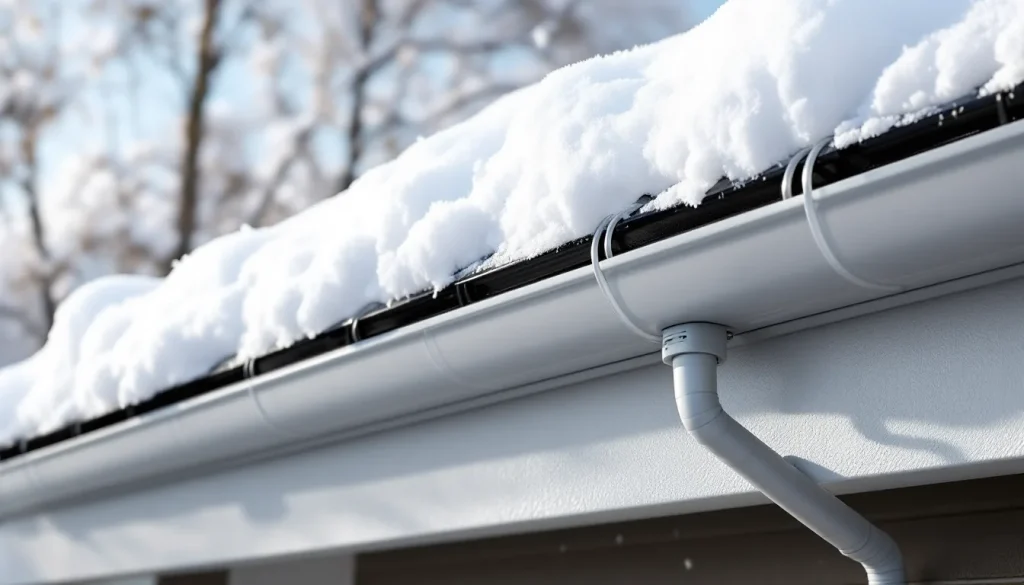
Heated gutter cable is a self-regulating or constant-wattage electric heating element installed inside the gutter and looped down the downspout to keep ice from forming a dam that blocks meltwater drainage. The three brands homeowners actually buy in 2026 are Easy Heat ADKS-1000, Frost King RC60, and Wrap-On Pipe Heat Cable, with HeatTape Pro as the heavy-duty commercial-grade option. Cable draws 5 to 6 watts per linear foot, requires a dedicated GFCI 15-amp circuit, and costs $1 to $3 per linear foot per winter season in electricity depending on climate and run-time. This guide covers brand picks, the zigzag install pattern that matters more than the cable itself, GFCI wiring, and the realistic energy cost.
The short version
- Brand picks: Easy Heat ADKS-1000 (roof and gutter de-icing cable, the residential default), Frost King RC60 (60 ft kit, cheap and widely available), Wrap-On Pipe Heat Cable (long-cord versions), HeatTape Pro (commercial-grade self-regulating).
- Power: 5 to 6 watts per linear foot constant-wattage, 3 to 12 watts per linear foot self-regulating. Always GFCI-protected on a 15-amp dedicated circuit.
- Install pattern: zigzag pattern across the roof eave (triangles roughly 18 to 24 inches tall) plus straight run down each downspout to the ground.
- Total cable length for a typical home eave is roughly 3 times the linear foot of gutter (zigzag math). 100 ft of gutter takes about 300 ft of cable.
- Energy cost: $1 to $3 per linear foot of gutter per winter. A 200 ft home runs $200 to $600 per winter in cold climates.
- Heated cable is a tactical fix for ice dams, not a substitute for proper attic insulation and ventilation. Use it on chronic problem eaves.
What the cable actually does
Heated gutter cable works by maintaining a melt channel through the ice that would otherwise form in the gutter and along the lower roof edge during a thaw-freeze cycle. It does not melt the snow on the roof. It does not prevent ice from forming entirely. What it does is keep one narrow path open so meltwater can run from wherever it starts (upper roof, ridge, valley) through the gutter, into the downspout, and out to grade without being trapped behind an ice dam.
Two cable types are used in residential gutter de-icing:
- Constant-wattage cable. The traditional design. Cable produces a fixed 5 to 6 watts per linear foot whenever it is energized. Cheaper per foot and simpler. Easy Heat ADKS, Frost King RC, and Wrap-On Pipe Heat all use this approach.
- Self-regulating cable. The cable conductor changes resistance based on surrounding temperature. When the gutter is at 40 degrees the cable draws 3 watts per foot. At 10 degrees it draws 12 watts per foot. More expensive per foot but lower seasonal energy use because the cable does not run full power during marginal-cold conditions. HeatTape Pro and most commercial systems use this design.
For most single-family homes the constant-wattage option is fine when paired with a smart controller (a temperature-and-moisture sensor that only energizes the cable when both freezing and wet, available for $50 to $120). The control logic does most of the energy-saving work that self-regulating cable would do on its own.
The four cables worth buying in 2026
| Brand and model | Type | Watts per ft | Available lengths | Price (kit) | Best for |
|---|---|---|---|---|---|
| Easy Heat ADKS-1000 (Roof and Gutter) | Constant-wattage, 240V | 5 | 30 to 200 ft | $45 to $260 | Most homes; widely available; pre-terminated plug |
| Frost King RC60 | Constant-wattage, 120V | 6 | 30, 60, 80, 100 ft | $45 to $110 | Budget pick; one-season DIY; home center stock |
| Wrap-On Pipe Heat Cable | Constant-wattage, 120V | 6 | 30, 60, 100 ft | $50 to $130 | Mid-range; long cord; good for gutter + downspout pair |
| HeatTape Pro (Radiant Solutions) | Self-regulating, 120V | 3 to 12 | Cut to length | $5 to $9 per ft | Heavy snow zones, commercial buildings, hard-wired install |
Two notes that affect the buying decision. First, Easy Heat ADKS-1000 is a 240-volt cable and needs a 240-volt outlet. If your eave only has a standard 120-volt outdoor outlet, you want the Frost King RC60 or Wrap-On instead, both of which run on 120V. Second, none of the plug-in residential kits include the temperature-and-moisture controller. The cables run constantly while plugged in. Budget another $50 to $120 for a Smart-Heat Controller, EasyHeat Snow-Switch, or equivalent thermostat-plus-sensor unit, or you will burn through energy any time the outdoor outlet is energized.
The zigzag pattern: more important than the cable choice
The number one mistake homeowners make with heated cable is running it as a single straight line down the inside of the gutter. That keeps the gutter melted, sure. It does nothing about the ice dam forming on the roof shingle 6 inches above the gutter, which is where the actual dam blocks meltwater from reaching the gutter in the first place.
The correct pattern is a zigzag (also called a serpentine) across the roof eave just above the gutter. The cable goes up the roof 18 to 24 inches, comes back down to the gutter line, goes up again, comes back down, and so on along the full length of the eave. The triangles you create melt channels through the snow at the eave, which lets meltwater reach the gutter regardless of what is happening on the rest of the roof.
Geometry: if your zigzag triangles are 18 inches tall and 18 inches wide at the base, every linear foot of gutter eats about 3 linear feet of cable (the up leg, the down leg, and the base along the gutter). Adjust the math:
| Gutter length | Zigzag triangle height | Cable needed (eave only) | Plus downspout drop | Total cable |
|---|---|---|---|---|
| 40 ft | 18 in | 120 ft | ~20 ft | 140 ft |
| 60 ft | 18 in | 180 ft | ~25 ft | 205 ft |
| 80 ft | 24 in | 280 ft | ~30 ft | 310 ft |
| 100 ft | 24 in | 340 ft | ~40 ft | 380 ft |
The downspout addition is critical. A frozen downspout is the most common cause of mid-winter gutter overflow because meltwater hits the gutter, runs to the outlet, and freezes in the downspout, plugging the system. Run the cable down the inside of each downspout to the ground (or at least to below the frost line if you have buried discharge per /downspout-placement-and-sizing/). On a typical 8 foot one-story downspout you spend about 20 to 30 feet of cable per downspout because of the bends at the elbows.
Step-by-step install for plug-in cable
Cable install takes one person a half day on a one-story home. Two-story houses need a second person or a stable extension ladder with stabilizer bars. The process:
- Lay out the zigzag pattern on the ground below the eave with chalk lines on the lawn to confirm cable length. Add 10 percent slack for fasteners.
- Install clips along the roof eave at the apex of each triangle and along the gutter line. Use the roof-and-gutter clips that come with the kit (or buy a separate clip pack). Clips slide under the first row of shingles or hook over the gutter edge. Do not nail or screw into the roof.
- Run the cable through the clips starting at the outlet end of the gutter farthest from the power outlet. Keep the cable from crossing itself (overlap causes overheating).
- Drop the cable down each downspout from the top. Use a fish tape to feed it down, or feed it before you reattach the top elbow.
- Run the cold lead (the unheated cord) back to a 120V or 240V GFCI outdoor outlet. The kit will have a manufacturer-specified termination point that should not be cut.
- Install a thermostat-and-moisture controller at the outlet. Mount the temperature probe in shade on the north side of the house and the moisture sensor in the gutter where snow falls onto it. Plug the cable into the controller output.
- Test before the first hard freeze by plugging in directly (bypassing the thermostat) and verifying the cable warms within 5 minutes. The cable should feel just warm to the touch (105 to 115 degrees F), not hot. Anything hot enough to discolor shingles is a defective cable.
One install caution: never install heated cable on a roof with curled, brittle, or end-of-life shingles. The clips and the cable weight can break shingles that are already past their service life. If your roof is more than 18 years old, get the roof condition checked first per /30-point-roof-inspection-checklist/ before adding cable.
GFCI and electrical requirements
Heated gutter cable is required by NEC Article 426 to be GFCI-protected. The kit cord plugs into either a GFCI-protected outdoor outlet or a GFCI breaker on the dedicated circuit. Three real-world wiring scenarios:
- Existing GFCI outdoor outlet on a 20-amp circuit. Cable up to 200 linear feet (about 1,200 watts at 6 watts per foot) plugs in directly. Most one-story homes with a back porch outlet are this scenario. Just verify the outlet is on a GFCI breaker and not on a 15-amp circuit shared with the back porch lights.
- No nearby outlet. An electrician runs a new dedicated 15-amp or 20-amp circuit from the main panel to a new GFCI outdoor outlet near the cable termination. Cost: $250 to $600 depending on length of run and whether walls are open.
- Long cable runs over 200 ft. Split into two zones, each on its own circuit. A 200 ft home with 600 ft of cable becomes two 300 ft zones on two separate GFCI circuits. Avoid extension cords; they nuisance-trip GFCI breakers in the cold and they melt at the plug.
Do not run heated cable on a circuit that also powers other outdoor loads (porch lights, security cameras, holiday lights). The combined load trips breakers and the GFCI nuisance trips are nearly impossible to diagnose because they happen most often at 3 AM during a thaw event.
The energy cost most homeowners do not calculate first
Heated cable is significantly more expensive to operate than most homeowners expect. The math:
| Climate zone | Run hours per winter | Watts per ft of gutter (incl downspouts) | kWh per ft of gutter per winter | Cost per ft at $0.15/kWh |
|---|---|---|---|---|
| Boston, NYC, Chicago | ~600 hours | 18 W/ft | 10.8 | $1.62 |
| Minneapolis, Buffalo, Burlington | ~900 hours | 18 W/ft | 16.2 | $2.43 |
| Denver, Salt Lake City | ~400 hours | 18 W/ft | 7.2 | $1.08 |
| Seattle, Portland | ~200 hours | 18 W/ft | 3.6 | $0.54 |
The watts-per-foot-of-gutter number bakes in the zigzag factor (3x cable per foot of gutter) and 6 watts per foot of cable. A 200 ft gutter system in Minneapolis runs about $486 per winter in electricity. The same system in Boston is about $324. The cable hardware is roughly $1,200 to $2,000 for the kit at install. Total 10-year cost of ownership: $5,000 to $7,000 for a typical cold-climate home, mostly in electricity.
This is why heated cable should be treated as a tactical fix for problem eaves, not a whole-house default. If you can solve the underlying problem with $1,500 of attic insulation and soffit ventilation (see /soffit-vents/ and /ice-dam-prevention/), do that first. Use heated cable on the one or two eaves where insulation cannot reach (cathedral ceilings, dormers, low-slope additions) or where you have already insulated and the ice dam still forms because of roof geometry.
When heated cable is the right tool
Three situations where cable is genuinely the best answer:
- Cathedral or vaulted ceiling areas. No attic means no place to add insulation or ventilation. The roof deck stays warm enough to melt snow, and cable is the only way to keep the meltwater channel open.
- North-facing eaves on a complex roof. If the rest of the roof is well-insulated but one north-facing eave consistently forms an ice dam because of shading or roof valley geometry, run cable on that one eave only.
- Buildings where structural ice loading risk exceeds the operating cost. Commercial buildings, condo association common areas, and any roof where an ice dam failure would cause major leak damage. The $500 winter energy bill is cheaper than a $30,000 ceiling and floor restoration.
Where cable is the wrong answer: 1) on a roof where the ice dam is caused by an attic that is not properly insulated or vented (fix the cause, not the symptom); 2) on a low-slope roof where snow accumulates faster than cable can melt a channel; 3) as a substitute for proper gutter sizing per /gutter-sizes-and-capacity/ (a too-small gutter is going to fail in winter no matter how warm you keep the cable).
Self-regulating versus constant-wattage for cold climates
Buyers in Minneapolis, Buffalo, and similar climates often ask whether the upgrade to self-regulating cable pays back. The math:
| System | Cable cost (200 ft eave) | Annual energy | 10-year cost |
|---|---|---|---|
| Constant-wattage with controller | $300 cable + $80 controller | $480 | $5,180 |
| Self-regulating with built-in regulation | $1,800 cable + $120 controller | $280 | $4,720 |
Self-regulating cable saves about $460 over 10 years on a 200 ft home in the coldest zones. It also lasts longer (15 to 25 years vs. 7 to 12 years for constant-wattage). For a heavy-snow climate the upgrade is worth it on the math, particularly if a licensed electrician is hardwiring the install. For a moderate-snow climate or a one-eave tactical install, constant-wattage with a good controller is the better buy. The full ice-dam tactical fix lives at /heat-cable-for-ice-dams/.
Maintenance and replacement cycle
Cable life depends on type and climate. Plan for these replacement intervals:
- Constant-wattage cable: 7 to 12 years. Replace when the cable shows visible jacket cracking or when wattage testing shows a 25 percent drop from new.
- Self-regulating cable: 15 to 25 years. Replace when self-regulation fails (the cable runs at full power even when warm) or when jacket damage is visible.
- Clips and fasteners: Inspect every fall. Replace any cracked or UV-damaged clips. The fasteners usually fail before the cable does.
- Controller and sensors: 5 to 10 years on the controller, 3 to 7 years on the moisture sensor. Replace sensors more often in heavy salt-spray coastal climates.
Annual maintenance is a 30-minute fall inspection: walk the eave, confirm the cable is still in the clips, check for damaged or frayed sections, plug in the controller and verify the cable warms up correctly, and clean any debris off the moisture sensor. Schedule this with your fall gutter cleaning (see /gutter-cleaning-cost-and-schedule/) and the rest of the seasonal roof checklist. For the broader winter readiness checklist see /ice-dam-prevention/ and the active mid-storm response in /ice-dam-removal/.
The verdict
Heated gutter cable is a real, working solution for a narrow set of cold-climate problems. Use Easy Heat ADKS-1000 if you have a 240V outdoor outlet and a standard problem eave; use Frost King RC60 or Wrap-On if you only have 120V available; upgrade to HeatTape Pro self-regulating for hardwired heavy-snow installs. Get the zigzag pattern right, include the downspout drop, wire it through a GFCI on a dedicated circuit, and add a thermostat-and-moisture controller so the cable only runs when needed. Budget $1 to $3 per linear foot of gutter per winter in electricity. And remember: the cable is not a substitute for fixing the underlying attic insulation and ventilation. It is the right answer when the underlying fix is not possible or has already been done and the eave still forms a dam.