
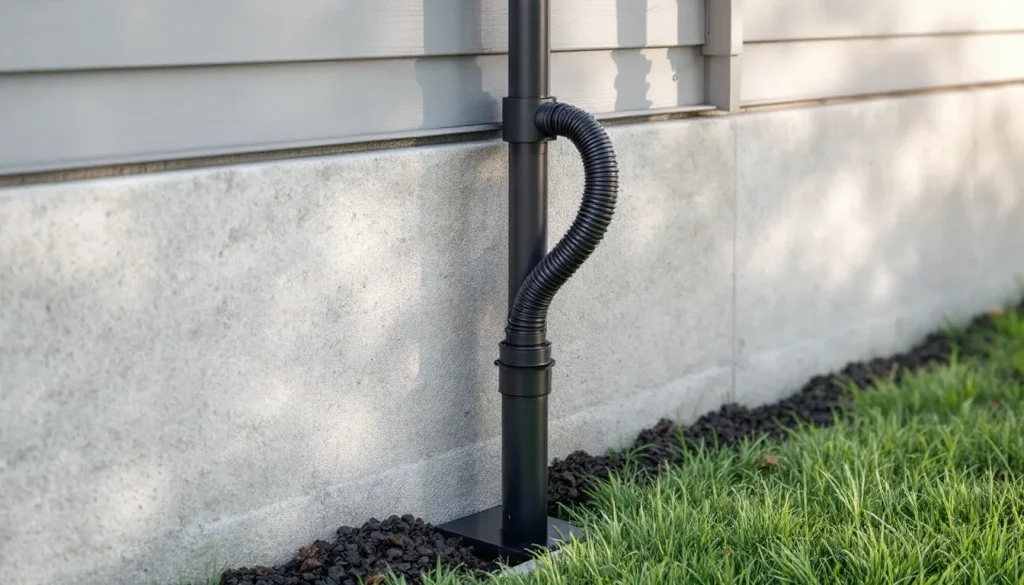
A downspout splash block is the cheapest piece of foundation protection sold at any hardware store, and it’s also the one most homeowners buy wrong, place wrong, or rely on when they should have installed something else. The choice between a splash block and a downspout extension is not aesthetic. It is a runoff-volume calculation, a soil-percolation question, and a grading reality check rolled into one $10 decision.
This guide breaks down the four real options (concrete splash block, polymer or rubber splash block, flexible roll-out extension, and buried PVC to daylight), what each one actually does for foundation protection, and the math that tells you which one is enough for your house.
What Splash Blocks and Extensions Are Trying to Solve
Every downspout dumps a concentrated stream of water at one specific point near the foundation. A 1-inch rainstorm on a typical 2,000 square foot roof produces about 1,250 gallons of runoff. Split across four downspouts, each one is moving 300+ gallons in 30 to 60 minutes. That stream hits the soil at the same spot every storm, every season, every year.
Without anything to disperse or carry that water, three things happen. The soil at the splash point compacts and erodes, creating a low spot that pools and funnels water back toward the foundation. The backfill against the basement wall stays saturated, which raises hydrostatic pressure on the wall and pushes water through any crack or cold joint. And over a 10 to 20 year span, the cyclic wetting and drying of the soil 3 to 6 feet down causes differential settlement that shows up as stair-step cracks in the foundation block or poured wall.
The foundation repair quote for that kind of damage runs $7,000 to $35,000 depending on severity and whether you need pier underpinning. A $10 splash block, sized and placed correctly, is the cheapest insurance policy in the trades. For context on how gutter sizing and installation choices affect that runoff volume in the first place, see our gutter installation guide and gutter installation cost breakdown.
Option 1: Concrete Splash Block ($5 to $12)
The classic. A pre-cast concrete trough about 24 to 36 inches long, 10 to 12 inches wide, with a slight downward slope from the catch end to the discharge end. Quikrete makes them, Oldcastle makes them, every regional concrete yard makes a generic version. They weigh 25 to 40 pounds, which is the point. Wind doesn’t move them, the lawnmower doesn’t kick them out of place, and freeze-thaw doesn’t crack them if the concrete is decent quality.
What they do well: disperse the discharge stream over a 2 to 3 foot run, slow the velocity, and direct water away from the immediate foundation contact zone. What they don’t do: move water any meaningful distance. A 30-inch splash block ends 30 inches from the foundation. In heavy soil or on a flat lot, that is not far enough.
Concrete splash blocks are the right call when grade slopes away from the house at 5% or better (about 6 inches of drop in 10 feet), soil drains reasonably well, and downspout flow is moderate. They are wrong when grade is flat or negative, soil is heavy clay, or runoff volume is high enough to overrun the block in any storm above 1/2 inch per hour.
Placement matters more than brand. The catch end goes directly under the downspout elbow, with no gap. The discharge end aims at the lowest available grade, not at the neighbor’s lot line. Set the block on a bed of pea gravel (not bare dirt) so it doesn’t sink and tilt back toward the foundation over time. A tilted-back splash block is worse than no block at all.
Option 2: Polymer or Recycled Rubber Splash Block ($10 to $25)
Frost King, Amerimax, GreenWorks, and a dozen private-label brands sell molded splash blocks in HDPE or recycled rubber. Shape is similar to concrete, weight is 2 to 8 pounds, and the price is double. The selling point is appearance (matched colors like brown, gray, and black) and longevity (no freeze-thaw cracking, no surface spalling).
The structural performance is comparable to concrete for the dispersion function. The catch is wind and mowing. A 4-pound polymer splash block walks across the lawn every time a leaf blower hits it. Tent stakes or landscape spikes through the front lip solve that, but it’s another step that gets skipped on most installs.
Worth the extra money in two scenarios. First, when the block sits in a high-visibility spot near the front door or a patio and color-matching matters. Second, when freeze-thaw is severe enough to spall concrete blocks in 3 to 5 years (northern New England, upper Midwest, mountain West). Outside those cases, the concrete block does the same job for half the cost.
Option 3: Flexible Roll-Out Extension ($5 to $15)
The Frost King FE49, Flex-A-Spout, and Amerimax Flex-Drain are the same product under different labels. A flat coiled polyethylene tube that snaps over the downspout elbow and unrolls when water pressure pushes through. When the storm ends, the tube collapses flat and rolls back against the house.
They cost $5 to $15. They extend 4 to 9 feet from the downspout, which is meaningfully farther than any splash block. They look ugly on most houses, they trip the lawnmower, and they don’t last more than 2 to 4 seasons before UV degradation cracks the seams. They do, however, get water past the immediate foundation contact zone, which is what matters for short-term protection.
Roll-out extensions are the right call as a stopgap, on rental properties where appearance doesn’t matter, or in extreme cases where you need to extend runoff past a flower bed before installing something permanent. They are not the answer on a forever home.
The variant worth noting: rigid downspout extensions, which are 3 to 6 foot lengths of 2×3 or 3×4 aluminum or vinyl that bolt to the bottom elbow and stay extended permanently. $15 to $40 per piece, hold up to lawnmowers and weather, and look like the rest of the downspout. Use these where you need fixed extension but don’t want to bury pipe.
Option 4: Buried PVC to Daylight ($200 to $600 per Downspout, Installed)
The professional answer for any house where you actually want the problem solved. A 4-inch solid SDR-35 PVC line runs from the downspout into a trench, slopes down at 1% to 2%, and exits at a pop-up emitter, ditch, or daylight point 15 to 30 feet from the foundation.
Materials cost for a typical 20-foot run is $40 to $80 in pipe, fittings, adapter, and pop-up emitter. Trenching and backfill are the labor cost, which is why professional installs run $200 to $600 per downspout depending on access, lawn restoration, and discharge complexity. A four-downspout system runs $800 to $2,400 installed, which is the same price range as one minor foundation crack repair.
This is the only option that genuinely solves the foundation protection problem in heavy clay, flat lots, or high-runoff scenarios. It also removes the splash block from the lawn entirely, which the landscaper will appreciate. If you’re already trenching, consider tying the buried line into a french drain system for full perimeter drainage rather than a single-point discharge.
The detailed install sequence (4-inch corrugated vs. SDR-35 PVC, trench depth, slope, pop-up emitter vs. drywell) lives in our french drain guide. For homes where the underlying drainage is being rebuilt anyway, doing the splash block question and the buried pipe question at the same time is the cheapest sequencing.
The Math That Tells You Which One to Buy
Three inputs, three minutes of estimation, and you know which option is enough for your specific downspout.
Input 1: Contributing roof area per downspout. Divide total roof square footage by number of downspouts. A 2,400 square foot roof with six downspouts is 400 square feet per spout. A 1,600 square foot roof with three downspouts is 533 square feet per spout.
Input 2: Local design rainfall intensity. Look up your county’s 1-hour 10-year rainfall in the NOAA Atlas 14 tables online. East Coast and Gulf Coast cities typically hit 1.5 to 2.5 inches per hour. Mountain West and Pacific Northwest run 0.5 to 1.0 inches per hour. Midwest sits in between.
Input 3: Soil drainage class. Sandy or gravelly soil drains fast. Loam drains moderately. Clay drains poorly to not at all. If you don’t know, dig a 12-inch hole, fill it with water, and time how long it takes to drain. Anything over 4 hours is heavy soil.
The rule of thumb:
Under 300 square feet per downspout, fast-draining soil, positive grade away from the house: concrete or polymer splash block is enough.
300 to 600 square feet per downspout, average soil, moderate grade: splash block plus rigid extension to 4 feet from foundation, or flexible roll-out as a temporary fix.
Over 600 square feet per downspout, heavy soil, flat grade, or any visible foundation water issue already present: buried PVC to daylight or drywell is the only option that solves the problem.
Grading: The Variable Most Homeowners Ignore
The best splash block in the world cannot fix negative grade. If the soil surface within 6 feet of the foundation slopes toward the house instead of away, water flows back to the basement wall no matter where the downspout dumps it. The fix is regrading, which means adding soil to build a positive slope of at least 5% (6 inches of drop in 10 feet) away from the foundation perimeter.
Check grade with a 6-foot level and a tape measure. Set one end of the level against the foundation, raise the far end until the bubble centers, and measure the drop. Less than 6 inches over 10 feet is the danger zone. Negative grade is a regrading project, not a splash block project.
The other variable that ruins splash block performance is mulch and landscaping. A 3-inch deep mulch bed against the foundation can trap water in the bed exactly where you don’t want it. Pull mulch back 12 inches from the foundation wall and slope it away from the house. Same goes for raised beds, decorative rock borders, and any landscape feature that breaks positive grade.
Foundation Damage Math: What You’re Actually Buying
The reason splash block selection matters at all comes down to what improper drainage costs over a 20-year ownership horizon.
Minor foundation crack injection: $400 to $1,200 per crack. Most homes that develop drainage-related cracking get 2 to 4 cracks before remediation.
Basement wall waterproofing (interior drain tile, sump pump, sealing): $4,000 to $12,000 for a full perimeter system.
Exterior excavation and waterproofing: $15,000 to $35,000 for a full-perimeter dig, membrane application, and drain tile installation around the entire foundation.
Pier underpinning for differential settlement: $1,500 to $3,500 per pier, with typical jobs requiring 4 to 12 piers. Total cost: $8,000 to $40,000+.
Against those numbers, the comparison is not concrete splash block versus polymer splash block. The comparison is any drainage protection at all versus the structural repair quote that arrives 15 years later. For homes considering broader exterior protection, our guides on fascia board condition and soffit vent design are part of the same water-management picture.
Installation Mistakes That Cancel Out the Block
The downspout doesn’t reach the block. Standard splash block placement assumes the downspout elbow drops to within 1 inch of the block catch end. If there’s a 6-inch gap, water hits the soil between the elbow and the block, which defeats the entire purpose. Add an extension elbow or a vinyl downspout connector to close the gap.
The block tilts back toward the foundation. Set on bare topsoil, the block sinks over time, especially the catch end where water concentrates. Within 2 years, the slope reverses and water runs back to the wall. Bed the block on 2 inches of pea gravel or crushed stone, level with a torpedo level, and reset annually if the soil is settling.
Mulch buries the block. Landscapers re-mulch every spring, and the block disappears under 3 inches of fresh hardwood. Water then runs over the mulch instead of through the block channel, soaking into the bed at the foundation contact zone. Pull mulch off the block twice a year or mark its perimeter with edging.
The discharge end aims at the neighbor’s lot. Code in most municipalities requires that surface drainage stay on the originating property. A splash block that funnels water onto an adjacent lot is a stop-work order waiting to happen, and a civil dispute if a neighbor’s basement gets wet. Aim discharge into your own yard at all times.
What to Buy
For most homes with positive grade, moderate runoff, and average soil: a 30 to 36 inch concrete splash block at $8 to $12, properly bedded and aimed. Total spend per downspout: $15 with the bedding gravel. Lifespan: 10 to 20 years. Foundation protection: adequate for the conditions described.
For homes with high-volume runoff, heavy soil, or flat grade: buried 4-inch SDR-35 PVC to a pop-up emitter or daylight discharge, 15 to 30 feet from the foundation. Total spend per downspout: $200 to $600 installed. Lifespan: 30+ years. Foundation protection: complete for the conditions described.
For everything in between: a polymer splash block plus a rigid extension to 4 feet from the foundation, anchored and aimed correctly. Or a roll-out extension as a placeholder until you bury pipe next spring.
The splash block decision is small. The damage prevented is not. Buy the right one, set it right, and check it twice a year. The full set of related topics, from gutter sizing through underground drainage, is indexed in our learn library.