
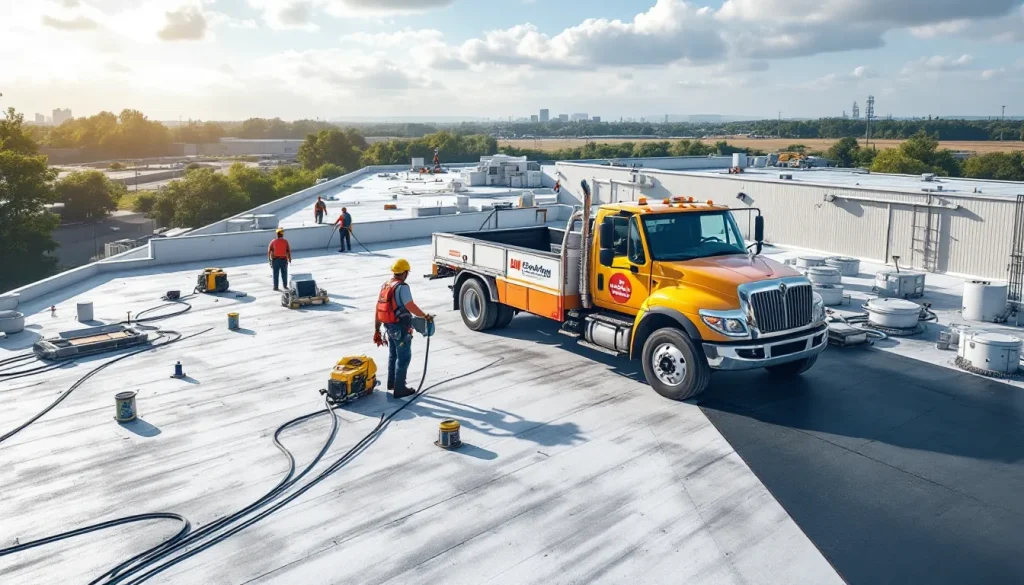
When a facilities director or REIT asset manager needs to replace a 400,000 square foot TPO roof on a distribution center, the shortlist of qualified flat roofing companies shrinks fast. Single-ply membrane work on commercial buildings is a narrow trade, governed by manufacturer certification tiers, state-specific licensing, workers compensation experience modification rates, and the bonding capacity to carry seven-figure projects. This guide profiles the national specialists and regional players who actually win that work in 2026, breaks down the manufacturer authorized applicator programs that gate NDL warranty eligibility, and walks through the six-step vetting framework used by experienced commercial property owners.
Last reviewed: August 2026.
- Tecta America is the largest pure-play commercial roofer at roughly $1.5B in revenue and 80 locations, owned by Altas Partners since 2018.
- Centimark (Pittsburgh, around 70 locations, employee-owned ESOP) and Nations Roof (~30+ locations, Trilantic North America majority) round out the true national footprint.
- Strong regional players like Baker Roofing in NC, Latite Roofing in FL, and A.W. Farrell in NY frequently beat the nationals on responsiveness and price for single-site jobs.
- Carlisle Centurion Award winners and GAF Master Select contractors sit at the top of the manufacturer certification pyramid, with the rest tiered below.
- NDL (No Dollar Limit) manufacturer warranties are only available through top-tier certified applicators.
- State licensing varies widely: Florida requires a state-issued CCC license, California requires a C-39, and hurricane-zone work carries additional bonding requirements.
- Six-step vetting: license verification, manufacturer certification, EMR below 1.0, three reference checks, bonded financials, and SDS plus safety documentation.
The shape of the commercial flat roofing market in 2026
The U.S. commercial roofing market sits at roughly $20B in annual reroof and new-construction spend, with TPO membrane carrying about 60 percent of the low-slope share, EPDM at around 20 percent, PVC at 10 percent, and modified bitumen plus built-up roofing splitting the balance. The buyer side is concentrated: industrial REITs, healthcare systems, school districts, big-box retail chains, and federal facilities account for the bulk of multi-million dollar projects. That concentration drives demand for contractors who can self-perform across multiple states with consistent crews and unified safety programs, which is the structural reason private equity has rolled up the top tier of the market over the past decade.
For a wider view of how the market segments by membrane type, see our commercial flat roof overview, which breaks down TPO, EPDM, PVC, and modified bitumen suitability by climate zone and use case.
National flat roofing companies with multi-state coverage
True national coverage in commercial roofing is rare. Most contractors marketing themselves as national are franchises or loose affiliate networks. The four below operate company-owned branches with shared crews, shared safety programs, and unified bonding.
| Company | Headquarters | Footprint | Ownership |
|---|---|---|---|
| Tecta America | Not stated | ~80 locations across 30 or more states | Altas Partners (PE-backed), majority since 2018 |
| Centimark | Canonsburg, PA | ~70 locations across the U.S. and Canada | Employee-owned (ESOP) |
| Nations Roof | Not stated | 30 or more locations | Trilantic North America, majority since 2021 |
| KPost Company | Dallas, TX | National large-format projects | Not stated |
Tecta America
Tecta America is the largest pure-play commercial roofer in North America at approximately $1.5B in annual revenue across roughly 80 locations in 30+ states. Altas Partners took majority ownership in 2018 and has continued to acquire bolt-on regional roofers under the Tecta umbrella, preserving local brand equity in many markets. Tecta is multi-trade integrated, offering sheet metal, waterproofing, daylighting (skylights), and exterior wall work alongside its core single-ply membrane and built-up roofing services. The company carries top-tier certifications with Carlisle, GAF, Versico, Sika Sarnafil, and Johns Manville. For multi-site portfolios needing a single point of accountability across 10+ states, Tecta is typically the default option on the bid list.
Centimark
Centimark is headquartered in Canonsburg PA (Pittsburgh metro) and operates approximately 70 locations across the U.S. and Canada. The company is employee-owned through an ESOP, which produces a distinctly different culture from PE-backed competitors: longer tenure crews, lower turnover at the foreman level, and a focus on long-term service relationships rather than near-term EBITDA. Centimark self-performs commercial and industrial work almost exclusively (no residential) and operates a national service group that handles repairs and maintenance for chain accounts. Manufacturer certifications include GAF, Carlisle, Firestone (now Holcim Elevate), and Sika Sarnafil at top applicator tiers.
Nations Roof
Nations Roof has grown to 30+ locations across the U.S. with a single-source national accounts model targeting REITs, retail chains, healthcare systems, and federal work. Trilantic North America took majority ownership in 2021 and has funded continued geographic expansion through tuck-in acquisitions. Nations Roof carries Carlisle, GAF, and Firestone top-tier certifications and runs a dedicated national accounts service desk for clients with sites across multiple regions.
KPost Company
KPost is Dallas-headquartered and known for large-format commercial projects, including stadium, airport, and convention center work. The company is a Carlisle Authorized Applicator and a Centurion Award winner, and is recognized for tight execution on ICC International Building Code-compliant assemblies on high-profile projects. While not a true 50-state national, KPost takes on signature jobs nationwide and is frequently on the GC bid list for landmark commercial builds.
Strong regional flat roofing contractors
For single-site projects or local clusters, regional specialists frequently win on responsiveness, pricing, and local relationships. This is why the search for commercial roofing contractors near you often ends with a strong regional firm rather than a national brand, and why buyers lean on guides to finding vetted regional specialists. These are not small operators: each profile below clears $50M in revenue and carries top-tier manufacturer certifications.
Southeast and Mid-Atlantic
- Baker Roofing (Raleigh NC): Approximately $300M in annual revenue across roughly 10 locations in NC, SC, and VA. Family-held since 1915, four-generation ownership. Carries Carlisle Centurion, GAF Master Select, and Sika Sarnafil top certifications. Strong in healthcare and higher education accounts.
- Latite Roofing (Pompano Beach FL): Largest commercial roofer in Florida at $150M+ in annual revenue, hurricane-market specialist with full Florida Building Code high-velocity hurricane zone (HVHZ) expertise. Strong on tile, metal, and single-ply across South Florida commercial and luxury residential.
- Tremco WTI: Service-only regional teams in most Eastern markets, owned by Tremco Roofing parent RPM International. Strong reroofing service contracts on existing Tremco-installed assemblies.
Northeast
- A.W. Farrell & Son (Buffalo NY): Approximately 100 years in business, covers NY, PA, and OH markets. Strong industrial and commercial reputation in the Rust Belt. Carlisle and Firestone top-tier certifications.
- Christian Brothers Roofing (Pittsburgh PA): Commercial and industrial specialist serving Western PA, eastern OH, and WV. Strong relationships with steel mills, distribution centers, and educational accounts.
Midwest
- DC Taylor Co. (Cedar Rapids IA): Iowa-based commercial specialist covering IA, IL, MN, WI, NE, and surrounding markets. Strong on agricultural processing, distribution, and manufacturing accounts.
- Maxwell Roofing (Nashville TN): Commercial focus across TN and contiguous states. Healthcare, education, and industrial work. Carlisle Centurion certified.
West Coast
- Highland Commercial Roofing (Riverside CA): Southern California commercial specialist holding a California C-39 license. Strong on industrial, retail, and education accounts across the Inland Empire and LA basin.
- Best Contracting Services (Gardena CA): Large Southern California commercial contractor with sheet metal and waterproofing divisions in addition to roofing.
For a deeper directory by metro and submarket, our commercial flat roofing contractors guide expands these lists with current contact information and project portfolios.
Manufacturer authorized applicator certifications: the real gatekeeper
Membrane manufacturer warranties are the single most important commercial roofing variable for owners, and warranty eligibility is gated by which contractor tier the installer holds with each manufacturer. The hierarchy below lists the certifications that actually move the needle on bid lists for projects requiring NDL (No Dollar Limit) warranties.
- Carlisle Authorized Applicator + Centurion Award: Carlisle is the largest single-ply membrane manufacturer in North America. Authorized Applicator status is the baseline for installing Carlisle systems; the Centurion Award is reserved for the top contractors by volume and quality, and is typically required for the largest NDL warranty projects.
- GAF Master Select: GAF’s top commercial contractor designation. Master Select status is required for GAF’s strongest warranty options on TPO and EPDM systems, and is awarded only after a multi-year performance review.
- Versico VersiTrac: Versico is Carlisle’s secondary commercial brand. VersiTrac is the equivalent of the Carlisle Authorized Applicator program for that product line.
- Firestone Red Shield (now Holcim Elevate Red Shield): Holcim acquired Firestone Building Products in 2022 and rebranded to Elevate in 2023. The Red Shield contractor designation continues to gate top-tier warranty eligibility on Elevate (formerly Firestone) systems.
- Sika Sarnafil Roofing Standards Bureau (SRSB): Sika Sarnafil PVC membrane is the premium European-engineered single-ply product widely used in healthcare, education, and federal work. SRSB membership is selective and required for the strongest Sarnafil warranties.
- Johns Manville Peak Advantage: JM’s top contractor program, required for the strongest JM single-ply and built-up roof warranties.
- IB Roof Systems Certified Applicator: IB Roof Systems is a PVC specialist. Certified Applicator status is required for the IB warranty.
A contractor without at least one top-tier certification cannot offer a 25-year or 30-year NDL warranty on a new TPO or PVC roof. That is the single biggest filter on bid lists for institutional and REIT owners. Our commercial roof warranty guide walks through warranty types in detail and what NDL actually covers versus material-only warranties.
National account vs regional specialist: the real tradeoffs
The decision between a national contractor and a strong regional specialist usually comes down to portfolio shape and accountability needs. Multi-site owners across five or more states favor a national firm for single-vendor accountability and unified reporting, while single-site owners favor a regional specialist for responsiveness and price. For a broader look at how experienced buyers find and vet commercial roofers, weigh the tradeoffs below against your own portfolio rather than the brand name.
- Multi-site portfolios across 5+ states (REIT, retail chain, hospital system): A national contractor offers single-vendor accountability, consistent crew quality, unified safety reporting, and a single point of contact for warranty service across the portfolio. This is typically worth a 5 to 10 percent price premium for owners who would otherwise be managing 12 separate regional vendors.
- Single-site or local cluster (2-3 buildings in one metro): A regional specialist usually wins on responsiveness (faster service calls, faster mobilization on emergencies), pricing (lower overhead allocation), and local relationships (better inspector relationships, faster permit pulls). The regional contractor often holds the same manufacturer certifications as the national.
- Specialty work (hurricane zones, hospital infection control, cold storage, federal): Often a specialized regional contractor with deep market expertise beats a generalist national. Latite in Florida hurricane work is the standard example; KPost on signature large-format projects is another.
For more on matching contractor scale to project type, see best commercial roofing companies.
Ownership structure matters more than people realize
The ownership profile of a roofing contractor has a measurable effect on service quality, crew tenure, and long-term warranty service. Private equity, employee ownership, and family ownership each shape crew retention and how a firm services a warranty over a 20 to 30 year roof life. Three structures dominate the market, and each carries a distinct set of tradeoffs for owners:
- PE-backed (Tecta America/Altas Partners, Nations Roof/Trilantic, many regional rollups): Strong investment in safety, technology, and geographic expansion. EBITDA discipline can sometimes pressure long-term service continuity, but the largest PE-backed roofers run multi-decade hold horizons that align with commercial roof life cycles.
- ESOP / employee-owned (Centimark, several regional players): Lower foreman turnover, stronger long-term service culture, and a workforce with direct financial stake in repeat business. Centimark is the prominent example at national scale.
- Family-held (Baker Roofing since 1915, A.W. Farrell roughly 100 years): Multi-generational relationships, strong local reputation, and continuity of leadership. Family-held contractors typically have lower crew turnover and stronger institutional knowledge of legacy roof assemblies in their markets.
State licensing and bonding requirements
Commercial roofing licensing varies state by state, and the variance is operationally significant. A contractor licensed in one state cannot automatically work in an adjacent state, and requirements range from a state-issued license in Florida and California to municipal registration in Texas and city-level licensing in New York. Verifying current licensing in every state of operation is the first qualification step before an RFP goes out.
- Florida: Requires a Certified Roofing Contractor (CCC) license issued by the Florida Department of Business and Professional Regulation. Hurricane zones (Miami-Dade, Broward, parts of Palm Beach) require additional HVHZ compliance and product approvals.
- California: Requires a C-39 Roofing Contractor license from the Contractors State License Board, with separate bonding requirements and prevailing wage compliance on public work.
- Texas: No statewide roofing license requirement, but municipal registration is common in major metros. The Roofing Contractors Association of Texas (RCAT) offers a voluntary certification program.
- New York: Licensing is city-level rather than state-level. NYC requires Home Improvement Contractor licensing and local 7000 series safety training documentation for any work over 6 stories.
- Massachusetts: Requires a Construction Supervisor License (CSL) for any work over $1,000 on residential, with separate municipal commercial requirements.
For multi-state portfolio work, verifying licensing in every state of operation is the first step before issuing an RFP. Our how to choose a roofing contractor guide includes a state-by-state licensing reference.
The six-step vetting framework
Experienced commercial property owners use a consistent six-step process to qualify roofing contractors before issuing an RFP: license verification, manufacturer certification, an EMR below 1.0, three reference checks, bonded financials, and safety documentation. Skipping any of these steps is the single most common cause of warranty disputes and project failure, so treat all six as mandatory rather than optional.
- License verification: Pull the current license from the state licensing board for every state the contractor will work in. Confirm the license is active, in good standing, and held by the entity (not a predecessor company).
- Manufacturer certification: Confirm current top-tier certification with the manufacturer specified in the project assembly. A lapsed certification voids NDL warranty eligibility. Carlisle Centurion, GAF Master Select, Holcim Elevate Red Shield, and Sika SRSB are the gating certifications for most commercial work.
- EMR below 1.0: Workers compensation Experience Modification Rate (EMR) below 1.0 indicates a safety record better than the industry average. Above 1.2 is a red flag. Major institutional and REIT owners will not let a contractor onto a site with an EMR above 1.0.
- Three reference checks: Request three references for projects of comparable size and assembly type completed in the last 24 months. Actually call the references, ask about service after substantial completion, and ask whether they would rehire.
- Bonded financials: Request a current bonding letter from the contractor’s surety. Confirm the contractor can carry a bond at least equal to the contract value (single project bond) and that aggregate bonding capacity is at least 5x the proposed contract.
- SDS and safety documentation: Confirm OSHA 30 training for foremen, current Safety Data Sheets for every product on site, a written fall protection plan compliant with OSHA 1926.501, and current hot work permits if torch-down or open-flame work is part of the assembly.
What a tight commercial flat roofing RFP looks like
The cleanest RFPs in commercial roofing specify: membrane type and thickness (e.g., 60-mil TPO mechanically attached), insulation R-value and type, cover board, attachment method, drainage details, warranty term and type (NDL vs material-only), bonding requirements, safety requirements (EMR cap, OSHA documentation), and required manufacturer certifications. Less experienced owners issue vague RFPs and end up comparing apples to oranges on bid day.
For pricing benchmarks before issuing an RFP, our commercial roof replacement cost guide breaks down per-square-foot installed pricing by membrane type, region, and project size, and our TPO roof installation cost guide focuses specifically on the most-installed commercial membrane. For national and regional pricing trends across the year, our 2026 roofing cost report tracks material and installed-cost movement.
Service and maintenance: where the contractor relationship pays off
A commercial flat roof is a 20 to 30 year asset, and most of the financial value of the warranty is realized through routine maintenance and prompt service response. The strongest national and regional contractors all run dedicated service divisions separate from their new-construction crews. Centimark and Tecta America both run national service desks; Baker Roofing, Latite, and most strong regional contractors run their own local service groups. When evaluating contractors, ask specifically about: average response time on service calls, whether the service group is a separate P&L from new construction, and how preventive maintenance contracts are priced (typically $0.05 to $0.15 per square foot per year). Our commercial roof maintenance program guide goes deeper on what to expect from a preventive maintenance agreement.
Bottom line on flat roofing contractor selection
For a multi-site portfolio across 5+ states, a national contractor with company-owned branches (Tecta America, Centimark, or Nations Roof) is the default starting point. For single-site or local cluster work, a strong regional specialist with the same manufacturer certifications typically wins on responsiveness and price. In every case, the six-step vetting framework (license, certification, EMR, references, financials, safety) is the filter that separates qualified bidders from price-only proposals. The manufacturer certification tier determines warranty eligibility, and warranty eligibility is the single largest financial variable on a commercial flat roof project. Get those two right and the rest of the contractor selection process is much simpler.
Flat roofing companies: frequently asked questions
Who is the largest flat roofing company in the United States?
Tecta America is the largest pure-play commercial roofer in North America, at roughly $1.5 billion in annual revenue across about 80 locations in 30 or more states. Altas Partners has held majority ownership since 2018. Tecta is multi-trade integrated, covering sheet metal, waterproofing, daylighting, and wall work alongside single-ply membrane and built-up roofing, and it carries top-tier certifications with Carlisle, GAF, Versico, Sika Sarnafil, and Johns Manville.
What is an NDL warranty and which companies can offer one?
NDL stands for No Dollar Limit, the manufacturer warranty that covers the full cost of covered repairs with no cap. Only top-tier certified applicators can offer one. A contractor without at least one top-tier certification, such as Carlisle Centurion or GAF Master Select, cannot provide a 25-year or 30-year NDL warranty on a new TPO or PVC roof, which is the biggest filter on institutional bid lists.
Should I hire a national or a regional flat roofing company?
It depends on portfolio shape. Multi-site portfolios across five or more states usually favor a national contractor for single-vendor accountability, consistent crews, and unified warranty service, typically worth a 5 to 10 percent premium. Single-site or local-cluster projects usually favor a regional specialist that wins on responsiveness, pricing, and local relationships while often holding the same manufacturer certifications as the national firms.
Which manufacturer certifications should a flat roofing company hold?
The certifications that move the needle on bid lists include Carlisle Authorized Applicator with Centurion Award, GAF Master Select, Versico VersiTrac, Holcim Elevate Red Shield (formerly Firestone), Sika Sarnafil SRSB membership, Johns Manville Peak Advantage, and IB Roof Systems Certified Applicator. Each gates the strongest warranty options for its product line, and a lapsed certification voids NDL warranty eligibility on that manufacturer’s systems.
How do I vet a flat roofing company before issuing an RFP?
Use a six-step framework: verify the state license in every state of work, confirm current top-tier manufacturer certification, require an EMR below 1.0, check three references for comparable recent projects, request a bonding letter confirming adequate capacity, and confirm safety documentation including OSHA 30 training and a written fall protection plan. Skipping any step is the most common cause of warranty disputes.
Do flat roofing companies need a state license?
Licensing varies by state. Florida requires a Certified Roofing Contractor (CCC) license and California requires a C-39 license, each with its own bonding rules. Texas has no statewide roofing license but common municipal registration, while New York licenses at the city level. A contractor licensed in one state cannot automatically work in an adjacent one, so verify licensing wherever the work will happen.