
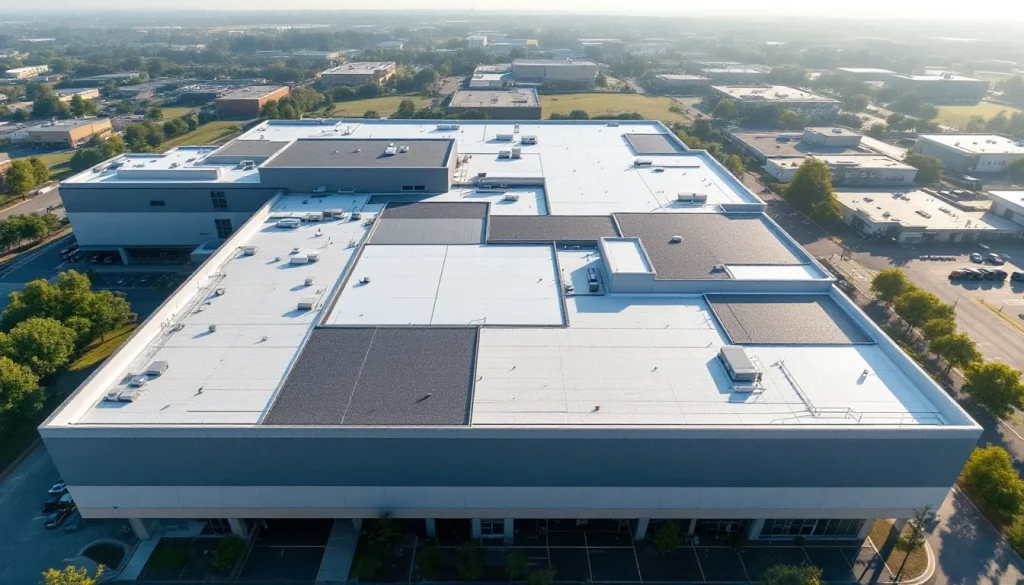
Commercial flat roofing is a decision most building owners make exactly once every 25 to 30 years, which is why so many of them make it badly. The five-system comparison (TPO, EPDM, PVC, modified bitumen, built-up) gets pitched as a price-per-square-foot bake-off, but the actual differences between systems only show up in years 12 through 25, long after the installing contractor has moved on and the original facility manager has retired. This guide is about the 30-year total cost of ownership math, not the install (see our commercial roof installation guide guide) price.
The TCO framing changes the conversation. EPDM at $5 to $9 per square foot installed looks cheaper than PVC at $9 to $15. But once you fold in 30 years of inspection costs, repair budget, energy savings, restoration (see our restoration coating commercial roof) coatings, and eventual replacement, the rank order shifts. Sometimes the most expensive installation is the cheapest over the asset life. Sometimes it isn’t. The point is to do the math, not to default to the lowest bid.
The Five Systems, At a Glance
The commercial (see our commercial roofs overview) flat roof market in 2026 is dominated by five chemistries, each with a distinct cost profile and service life.
TPO (thermoplastic polyolefin) is the white single-ply membrane (see our low-slope roof systems overview) that took over the commercial market starting in the late 1990s. Install cost runs $7 to $12 per square foot for a 60-mil membrane with insulation and cover board. Service life is 20 to 25 years on a properly installed adhered system, 15 to 22 years on a mechanically fastened system. Major manufacturers: Carlisle SynTec Sure-Weld, GAF EverGuard, Johns Manville TPO, Holcim (formerly Firestone) UltraPly.
EPDM (ethylene propylene diene monomer) is the black rubber membrane that’s been on commercial roofs since the 1970s. Install cost runs $5 to $9 per square foot. Service life is 25 to 35 years, longer than any other commercial system. Major manufacturers: Carlisle SynTec Sure-Seal, Holcim RubberGard, Johns Manville EPDM.
PVC (polyvinyl chloride) is the premium single-ply system. Install cost runs $9 to $15 per square foot. Service life is 25 to 30 years. PVC’s edge is chemical resistance (essential on restaurants, food processing, and any building with grease or solvent exposure on the roof) and fire performance. Major manufacturers: Sika Sarnafil, Carlisle Sure-Flex, GAF EverGuard PVC, Johns Manville PVC.
Modified bitumen (mod-bit) is asphalt-based membrane reinforced with polyester or fiberglass, modified with SBS (styrene-butadiene-styrene) or APP (atactic polypropylene) polymers for flexibility and weathering. Install cost runs $6 to $11 per square foot for a two-ply system. Service life is 18 to 25 years. Major manufacturers: Soprema, Siplast, GAF Ruberoid, Johns Manville DynaLastic.
Built-up roofing (BUR) is the traditional tar-and-gravel system, layers of bitumen-saturated felt with stone or mineral surfacing. Install cost runs $5 to $10 per square foot. Service life is 20 to 30 years. BUR is mature technology with declining market share, but still specified on industrial (see our industrial roof repair guide) facilities, government buildings, and any project where the owner wants the redundancy of a multi-ply system.
For the head-to-head comparison between the two single-ply leaders, our TPO vs. EPDM piece breaks down the chemistry, and our modified bitumen roof piece covers the mod-bit lineup.
The 30-Year TCO Math
Total cost of ownership over 30 years includes install cost, annual inspection cost, repair budget, restoration (see our commercial roof restoration cost) coating, and replacement at end of life. Running the math on a 50,000 square foot commercial flat roof:
TPO 60-mil adhered: Install $10/sq ft = $500,000. Twice-yearly inspections at $1,200 each = $72,000 over 30 years. Repair budget at $0.30/sq ft/yr = $450,000. Restoration coating in year 18 at $3/sq ft = $150,000 (extends life to year 28). Partial replacement in year 28 at $8/sq ft for failed sections, roughly 40 percent of roof = $160,000. 30-year TCO: $16 to $21 per square foot ($800,000 to $1.05 million).
EPDM 60-mil fully adhered: Install $7/sq ft = $350,000. Twice-yearly inspections = $72,000. Repair budget at $0.25/sq ft/yr = $375,000. Restoration coating year 22 at $3/sq ft = $150,000. Replacement deferred to year 32, so the 30-year TCO doesn’t include replacement. 30-year TCO: $12.50 to $16.50 per square foot ($625,000 to $825,000).
PVC 60-mil adhered: Install $12/sq ft = $600,000. Twice-yearly inspections = $72,000. Repair budget at $0.30/sq ft/yr = $450,000. Restoration coating year 22 at $3/sq ft = $150,000. Replacement deferred past year 30. 30-year TCO: $18 to $24 per square foot ($900,000 to $1.2 million).
Modified bitumen 2-ply SBS: Install $9/sq ft = $450,000. Twice-yearly inspections = $72,000. Repair budget at $0.40/sq ft/yr = $600,000. Restoration coating year 15 at $3/sq ft = $150,000 (extends life). Partial replacement year 25 = $200,000. 30-year TCO: $19 to $24 per square foot ($950,000 to $1.2 million).
Built-up roofing: Install $7.50/sq ft = $375,000. Inspections = $72,000. Repair budget at $0.45/sq ft/yr (BUR is the most maintenance-heavy) = $675,000. Restoration coating year 18 at $3/sq ft = $150,000. 30-year TCO: $17 to $22 per square foot ($850,000 to $1.1 million).
The headline: EPDM has the lowest 30-year TCO by a meaningful margin, despite being the cheapest install. PVC has the highest absolute cost but the longest service life. TPO is in the middle on cost and life. Mod-bit and BUR are competitive on install but have higher maintenance burdens that erode their cost advantage.
This is national-average math. Local labor markets, regional climate stresses, and the specific building’s use case shift the numbers meaningfully. Restaurant roofs eat PVC’s chemical resistance value. Heavy snow markets reward EPDM’s freeze-thaw performance. Hot dry climates accelerate mod-bit oxidation. The TCO has to be done with the specific building’s parameters, not pulled from a brochure.
Restoration Coatings: The Lever Most Owners Miss
The TCO math above assumes a restoration coating at roughly year 15 to 22 of the membrane’s life. This is the single biggest financial lever in commercial flat roofing and it’s missed on probably 60 percent of eligible buildings.
A restoration coating is a fluid-applied liquid membrane (silicone, acrylic, or polyurethane) applied over an existing single-ply or modified bitumen roof that’s reached mid-life. The coating fills small seam separations, encapsulates surface oxidation, restores reflectivity, and extends service life by 10 to 15 years.
Material cost: $2 to $5 per square foot installed. Service life of the coating itself: 10 to 15 years before recoating is needed. Compared to a full membrane replacement at $8 to $15 per square foot, the coating is a 60 to 80 percent cost savings for half the additional service life.
Major coating manufacturers in 2026: GAF UniSeal silicone, Henry Tropi-Cool acrylic, Karnak silicone, Mule-Hide PVC, GE Silicones SilCoat. Silicone leads the segment because it sheds dirt better than acrylic and tolerates ponding water (acrylic does not).
The catch: the existing roof has to be sound enough to recoat. A mod-bit roof with 50 percent granule loss and lap separations isn’t a recoat candidate, it’s a tear-off. A TPO roof with intact seams and minor chalk surface is an ideal candidate. The pre-recoat inspection determines whether the project is a smart investment or a paint job over a failing roof.
Our elastomeric roof coating piece covers the coating selection and the prep work.
Maintenance: What “Twice-Yearly Inspections” Actually Means
The $1,200 inspection cost in the TCO math assumes a real inspection by a qualified roofing professional, not a facility manager walking the roof with a phone camera. A real commercial roof inspection includes:
Visual inspection of every seam, penetration, drain, and edge condition. Documentation of any membrane bruising, blistering, or surface degradation. Drain function test (water hose test, not just visual). Test cuts at 2 to 4 locations to verify membrane thickness and adhesion. Infrared scan annually to detect wet insulation before it shows up as a leak (some firms include this, some charge separately).
The inspection report goes into the building’s roof file with photos, GPS-tagged drain locations, and a prioritized repair list. The repair list drives the annual maintenance budget.
Buildings on a formal roof maintenance plan (RMP) with a commercial roofing contractor (see our commercial flat roofing contractors) typically see 50 to 70 percent longer service life than buildings on a “react when it leaks” approach. The math is so favorable that most major manufacturer warranties now require documented inspections at specified intervals to maintain warranty validity.
The Warranty Question
Commercial single-ply manufacturers offer NDL (No Dollar Limit) warranties of 20, 25, or 30 years on installed systems (see our the broader commercial roof types overview guide). The warranty covers defects in materials and workmanship and pays for repair or replacement of failed sections.
What the warranty doesn’t cover: damage from third-party trades on the roof (HVAC service contractors are the main culprits), damage from owner failure to perform maintenance, damage from acts of God above specified thresholds, and damage from chemical exposure not anticipated in the warranty terms.
The warranty cost is built into the installed price. A 30-year NDL on a 50,000 square foot TPO system costs the manufacturer maybe $0.30 per square foot in expected claims; they charge the contractor $0.50 to $0.70 per square foot for it, and the contractor passes it through.
The warranty is only as good as the manufacturer behind it. Carlisle, GAF, Holcim (formerly Firestone), Johns Manville, and Sika have decades of NDL claim history and well-functioning warranty departments. Smaller manufacturers offering long-term NDLs are a riskier bet because there’s no track record on how the warranty actually performs.
System Selection by Building Use
The right membrane depends on what’s happening on and below the roof.
Office buildings, schools, government facilities: TPO or EPDM. Low chemical exposure, modest foot traffic, long hold periods. TPO is more common on new construction (see our commercial roof construction (new build) guide) (white reflective surface aids cooling). EPDM is more common on retrofits and in northern climates.
Restaurants, food processing, commercial kitchens: PVC. Grease and animal fats degrade TPO and EPDM. PVC’s chemical resistance is non-negotiable on these buildings.
Warehouses, distribution centers, light industrial (see our industrial roof replacement guide): TPO or modified bitumen. Mod-bit is the right call on buildings with heavy rooftop foot traffic (mechanical service, antenna maintenance) because of its puncture resistance. TPO wins on cooling cost.
Cold storage, refrigerated facilities: Insulated metal panels (IMP) or PVC over high-R insulation. The thermal performance dominates the decision. EPDM is rarely used because the black surface gains heat that fights the refrigeration load.
Hospitals, labs, pharmaceutical manufacturing: PVC. Chemical resistance, fire performance, and the ability to weld field-applied flashings on irregular geometry all favor PVC.
Strip retail, multi-tenant commercial: TPO. Cheapest reliable single-ply for buildings with short hold periods (5 to 12 years for most strip retail before refinancing or sale). The TCO advantage of EPDM only matters if the owner holds the building 30 years.
Government and institutional with long hold periods: EPDM or BUR. Lowest TCO over the 40 to 50-year hold periods typical for public-sector real estate. BUR sees more public-sector use than private-sector use for exactly this reason.
Insulation: The Layer Below the Membrane
A flat roof system is the membrane plus what’s below it. The dominant insulation in 2026 is polyisocyanurate (polyiso), a closed-cell foam with R-values of 5.7 to 6.5 per inch (slightly derated in cold weather). EPS (expanded polystyrene) and XPS (extruded polystyrene) are used in tapered insulation systems where positive slope to drains is engineered into the assembly.
Code-minimum R-value in 2026 ranges from R-25 to R-49 depending on climate zone per IECC. Most new commercial work in cold climates installs R-30 to R-40 of polyiso, often as a base layer of 2.5-inch polyiso plus a 0.5-inch cover board (high-density polyiso, perlite, or gypsum) below the membrane.
The insulation decision drives the membrane warranty: adhered membranes need a smooth, rigid substrate. The cover board provides that. Membranes installed directly over polyiso without a cover board void most NDL warranties because polyiso’s facers degrade in UV and don’t hold adhesion.
Drainage Design
A flat roof isn’t flat. It’s a low-slope roof, typically designed at 1/4 inch per foot of positive slope to internal drains or scuppers. Tapered insulation systems are how that slope is built into the assembly when the structural deck is genuinely flat.
Ponding water is the number-one warranty claim on commercial flat roofs. Standing water that doesn’t drain within 48 hours after rain degrades every membrane chemistry except PVC and silicone-coated systems, voids most NDL warranties, and accelerates biological growth. The fix is engineered drainage, not “the membrane should be waterproof anyway.” It should, but warranties don’t cover what designers should have prevented.
The roof drain count, sizing, and overflow scupper placement are governed by the International Plumbing Code with reference to ASCE 7-22 for rainfall rates. Designed properly, the roof drains within 30 to 60 minutes of a major rainfall. Designed poorly, ponding becomes the dominant failure mode and the membrane choice becomes secondary.
Installation Method: Adhered vs. Mechanically Fastened vs. Ballasted
Three installation methods, each with cost and performance trade-offs.
Fully adhered: membrane bonded to the substrate with solvent-based or water-based adhesive. Cleanest aesthetic, best wind performance (no fasteners to pull through), highest install cost. Standard on PVC and architectural TPO/EPDM.
Mechanically fastened: fasteners and plates through the membrane into the deck at engineered spacing. Faster install, lower cost, but every fastener is a stress point and the membrane balloons between fasteners in wind. Standard on commodity TPO and EPDM on warehouses.
Ballasted: loose-laid membrane held down by stone or concrete pavers. Mostly historic at this point; rarely specified on new construction due to weight loading concerns and wind risk in extreme events.
For new construction on a roof that needs to last 30+ years with minimum lifecycle cost, fully adhered with a 60-mil membrane is the right call regardless of chemistry. The premium over mechanically fastened is $1 to $3 per square foot, and the wind performance and longevity gains exceed that premium.
What This Costs in 2026 (and the Pick)
Quick installed cost summary for a 50,000 square foot commercial flat roof with new insulation:
TPO 60-mil adhered: $400,000 to $600,000 ($8 to $12/sq ft).
EPDM 60-mil adhered: $300,000 to $450,000 ($6 to $9/sq ft).
PVC 60-mil adhered: $500,000 to $750,000 ($10 to $15/sq ft).
Modified bitumen 2-ply SBS torch-applied: $350,000 to $550,000 ($7 to $11/sq ft).
Built-up roofing 4-ply with gravel: $300,000 to $500,000 ($6 to $10/sq ft).
The default pick for most commercial flat roofs in 2026: TPO 60-mil adhered with R-30 polyiso and 0.5-inch high-density cover board. The chemistry’s combination of reflectivity, install cost, and warranty support makes it the right answer for the broad middle of the commercial market. EPDM is the better pick when the hold period is 30+ years and the building doesn’t need a cool roof. PVC is the right pick on restaurants and chemical-exposure buildings. Mod-bit and BUR remain valid on industrial buildings with heavy rooftop traffic.
The wrong pick is whatever the cheapest bidder quoted without doing the TCO math. The right contractor will run the 30-year numbers as part of the proposal. The contractor selection process matters; our contractor selection guide covers the credential checks that filter out the bidders who’ll regret the lowest-cost membrane in year 12.