
By The Roofing Brief Team | Last reviewed: October 2026
Bats in the attic leave through one-way exits, not traps: fit them outside your state’s pup season (April 1 to August 31 by federal default), leave them five nights, seal gaps of 1/4 inch or more, then clean guano wet.
Key takeaways
- Bats can enter through openings as small as 1/4 inch, and the CDC says to caulk any opening larger than a dime (CDC, Bats and Rabies).
- Without a state rule, the US Fish and Wildlife Service guide treats April 1 through August 31 as no-eviction maternity season (WNS Working Group, Acceptable Management Practices, 2015).
- Florida bans any device that blocks bat movement at a roost from April 16 through August 14 under rule 68A-9.010; the NC Wildlife Resources Commission bars agents from evictions May 1 through July 31.
- One-way exits stay up at least five nights, three in a row above 50°F, before holes are sealed (USFWS-published AMP, 2015).
- Bats caused 62 of 89 (70%) US-acquired human rabies cases from 1960 to 2018, and post-exposure shots averaged $3,800 (CDC MMWR Vital Signs, 2019).
- Professional bat removal averages $490, with a normal range of $232 to $754; guano cleanup adds $500 to $8,000 (HomeAdvisor cost guide, updated June 20, 2026).
Bats in the attic: key numbers at a glance
Six figures decide most bat jobs: the entry gap (1/4 inch), the federal default pup season (April 1 to August 31), the minimum device time (five nights above 50°F), the histoplasmosis window (3 to 17 days), the rabies share from bats (70%) and the typical pro price ($232 to $754). Each row cites its document.
| Figure | Value | Source |
|---|---|---|
| Smallest opening bats use | 1/4 inch | CDC, Bats and Rabies (July 1, 2025) |
| Default maternity season (no state rule) | April 1 to August 31 | USFWS-published AMP, 2015 |
| Minimum time for one-way exits | 5 nights, 3 in a row above 50°F, wind under 10 mph | USFWS-published AMP, 2015 |
| Histoplasmosis symptom onset | 3 to 17 days after breathing spores | CDC, About Histoplasmosis |
| US-acquired human rabies cases from bats, 1960 to 2018 | 62 of 89 (70%) | CDC MMWR 68(23), 2019 |
| Professional bat removal, normal range | $232 to $754 (average $490) | HomeAdvisor, updated June 20, 2026 |
How do you know you have bats in the attic?
The surest signs of bats in the attic are piles of droppings under one spot that crumble to powder with shiny insect bits, brown greasy rub marks at a gap, and bats leaving the eaves at dusk. The Internet Center for Wildlife Damage Management bat identification page separates bat droppings from mouse droppings by texture: bat pellets are segmented and friable, rodent pellets are harder and fibrous.
Penn State Extension describes bat droppings as dry, black and “about the size of a grain of rice” on its bat management page. Do not crush them bare-handed to test them.
| Sign | What it looks or sounds like | Bat or rodent? | Source |
|---|---|---|---|
| Droppings | Rice-grain size, segmented, crumble to powder with shiny insect parts, piled under the roost | Bat (mouse and rat pellets taper, stay hard, scatter) | ICWDM; Penn State Extension |
| Rub marks | Smooth, polished, slightly sticky yellow-brown to blackish stain at a gap, may hold bat hairs | Bat | ICWDM |
| Odor | Pungent, musty, acrid smell, often detectable outside with a large or long-term colony | Bat colony | ICWDM |
| Sounds | Squeaks, scratching and crawling, loudest on hot days, before dusk exit and at dawn return | Bat (thumping suggests rats, mice or squirrels) | ICWDM |
| Bats at dusk | Bats dropping from eaves, gable vents or loose shingles in the evening | Bat | CDC; NC Wildlife Resources Commission |
Daytime thumping or gnawing points to a rodent instead; see our guides to squirrels in the attic and roof rats. Bats “do not nest, chew, or claw their way into a structure,” per the 2015 USFWS-published practices guide, so chewed wiring points away from bats.
Are bats in the attic dangerous?
Bats in the attic carry two documented health risks: rabies through a bite or scratch, and histoplasmosis from breathing dust of old droppings. CDC’s 2019 Vital Signs report attributed 62 of 89 (70%) US-acquired human rabies cases from 1960 to 2018 to bats, and CDC histoplasmosis guidance says symptoms appear 3 to 17 days after exposure. Structural damage is minor by comparison.
The bedroom case matters most. The CDC’s Advisory Committee on Immunization Practices lists “a deeply sleeping person awakens to find a bat in the room” and a bat in a room with an unattended child or an intoxicated person as possible exposures (ACIP, MMWR 57(RR-3), 2008). Act the same day in any of these cases:
- Someone was bitten or scratched: wash with soap and water and get medical care (CDC).
- A bat was in the room with a deeply sleeping person, an unattended child, or an intoxicated person (ACIP).
- Bat saliva reached eyes, nose, mouth or an open wound (CDC).
In each case, keep the bat for testing and call the health department; CDC’s 2019 report put average post-exposure shots at $3,800.
NIOSH places Histoplasma mainly in the central and eastern states, around the Ohio and Mississippi River Valleys, in its employer fact sheet (NIOSH Publication 2022-103).
How do you get a single bat out of the house?
To get a single bat out of the house, close interior doors so it stays in one room, open the outside windows and doors, and let it fly out, per the US Fish and Wildlife Service bat removal story. Release bats outdoors only above 50°F with no rain or high wind. If anyone may have been bitten or slept in that room, capture the bat for testing instead.
- Never touch the bat with bare hands; wear thick leather work gloves (USFWS; CDC).
- Wait for it to land, cover it with a sturdy container such as a shoe box, and slide cardboard underneath (USFWS).
- For testing, punch small air holes in the cardboard, tape it shut and call the health department (CDC).
- For release, set it on a window sill or branch at least 4 feet above the ground so it can drop into flight (USFWS-published AMP).
When is it legal to remove bats from an attic?
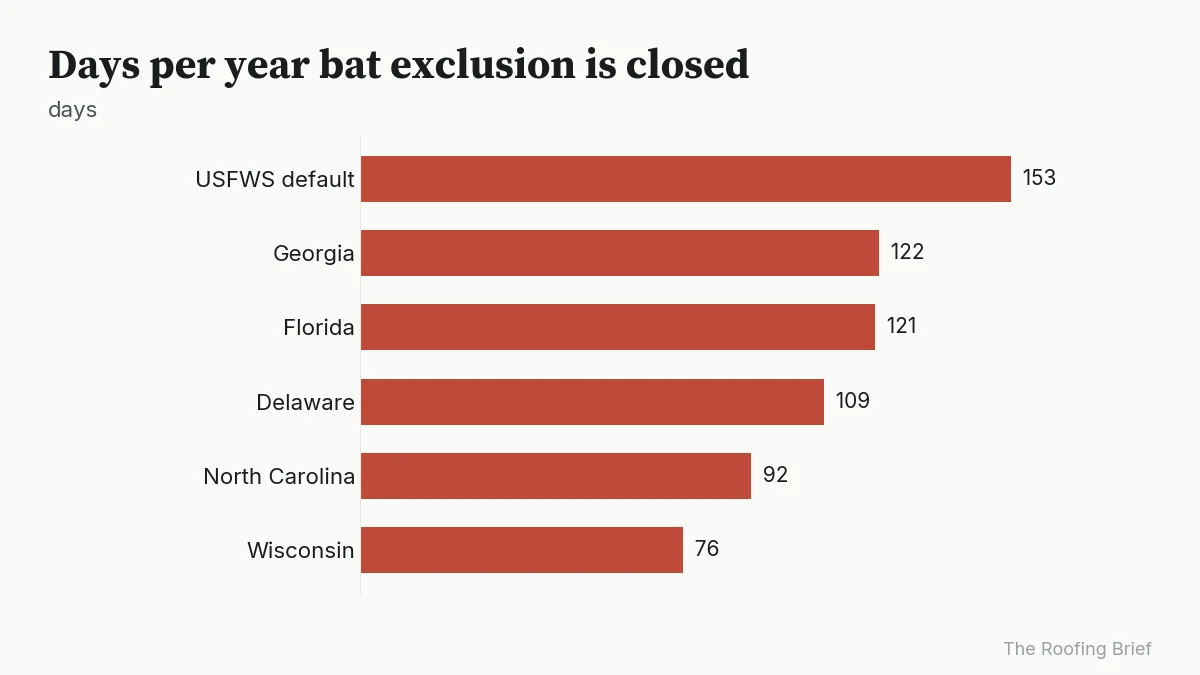
Removing bats from an attic is generally legal only outside the pup season, and the dates are set by each state. The federal default in the USFWS-published practices guide is April 1 to August 31. Florida closes April 16 to August 14 by rule, Georgia April 1 to July 31, North Carolina May 1 to July 31, Delaware May 15 to August 31 and Wisconsin June 1 to August 15.
The reason is biology. Pups are flightless for about four weeks after birth, per the Wisconsin DNR bat exclusion fact sheet, so a June exclusion starves pups and pushes mothers toward the living space.
| Jurisdiction | Closed period | Days closed | Rule type and citation |
|---|---|---|---|
| Federal default (no state rule) | April 1 to August 31 | 153 | Guidance: WNS Working Group AMP, USFWS, 2015 |
| Georgia | April 1 to July 31 | 122 | Guidance; licensed NWCO required inside the window: Georgia DNR |
| Florida | April 16 to August 14 | 121 | Rule: Fla. Admin. Code 68A-9.010(2)(e) |
| Delaware | May 15 to August 31 | 109 | Guidance: DNREC Best Management Practices, 2010 |
| North Carolina | May 1 to July 31 | 92 | Prohibition for Wildlife Control Agents: NC Wildlife Resources Commission |
| Wisconsin | June 1 to August 15 | 76 | Broad Incidental Take Permit non-exclusion period: Wisconsin DNR |
The northern long-eared bat, which sometimes roosts in barns and sheds, became federally endangered under a final rule published in November 2022 (USFWS species page). In Texas, Senate Bill 1285 (2025) would have barred exclusion May 1 to August 31 under Parks and Wildlife Code 63.101, but it stalled after a House committee report on May 25, 2025, per the Texas Legislature bill history.
Bat exclusion by month
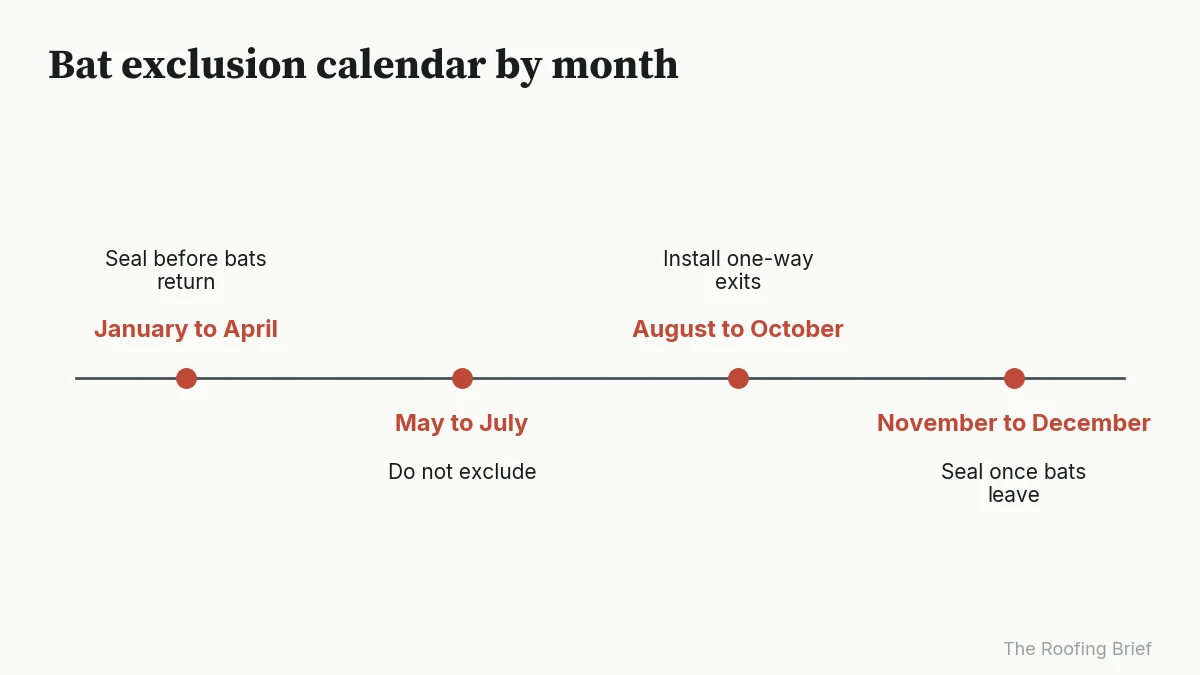
For most of the US, the safe calendar runs like this: seal from January to April before bats return, leave them alone from May to July, fit one-way exits from August to October, and seal from November to December once they leave. That schedule comes from Penn State Extension’s Timing for Excluding Bats (updated October 6, 2025); shift it to match your state’s closed dates.
| Months | What to do | Rule behind it |
|---|---|---|
| January to April | Seal entrances before bats return, unless bats are hibernating inside | Penn State Extension; USFWS AMP bars winter exclusion where bats hibernate |
| May to July | Do not exclude; seal only openings into living space | Pups flightless until about mid-July (Penn State); NC, GA, FL closed |
| August to October | Install one-way exits on nights above 50°F | Penn State; UGA Extension gives mid-August to mid-October |
| November to December | Seal entrances once bats have left | Penn State Extension |
What size gaps do bats use, and what should you seal them with?
Bats use gaps far smaller than most homeowners expect: the CDC gives 1/4 inch, Delaware’s wildlife agency says 1/8 inch is enough to get back in, and Penn State gives a 1/2 by 1-1/4 inch crack. Seal with caulk, steel wool or hardware cloth after the bats are out. Do not use spray foam where bats can touch it, per Delaware DNREC.
| Opening | What the source says | Source |
|---|---|---|
| 1/8 inch | Enough for bats to get back in after exclusion | Delaware DNREC BMP, 2010 |
| 1/4 inch | Smallest opening bats fit; any crevice this wide or wider | CDC; USFWS-published AMP |
| 3/8 inch | Smaller species, about the diameter of a US dime | ICWDM |
| 1/4 x 3/4 inch | Slot opening into living space | USFWS-published AMP |
| 5/8 inch | Round hole into living space | USFWS-published AMP |
| 1/2 x 1-1/4 inch | Crack a bat can crawl through | Penn State Extension |
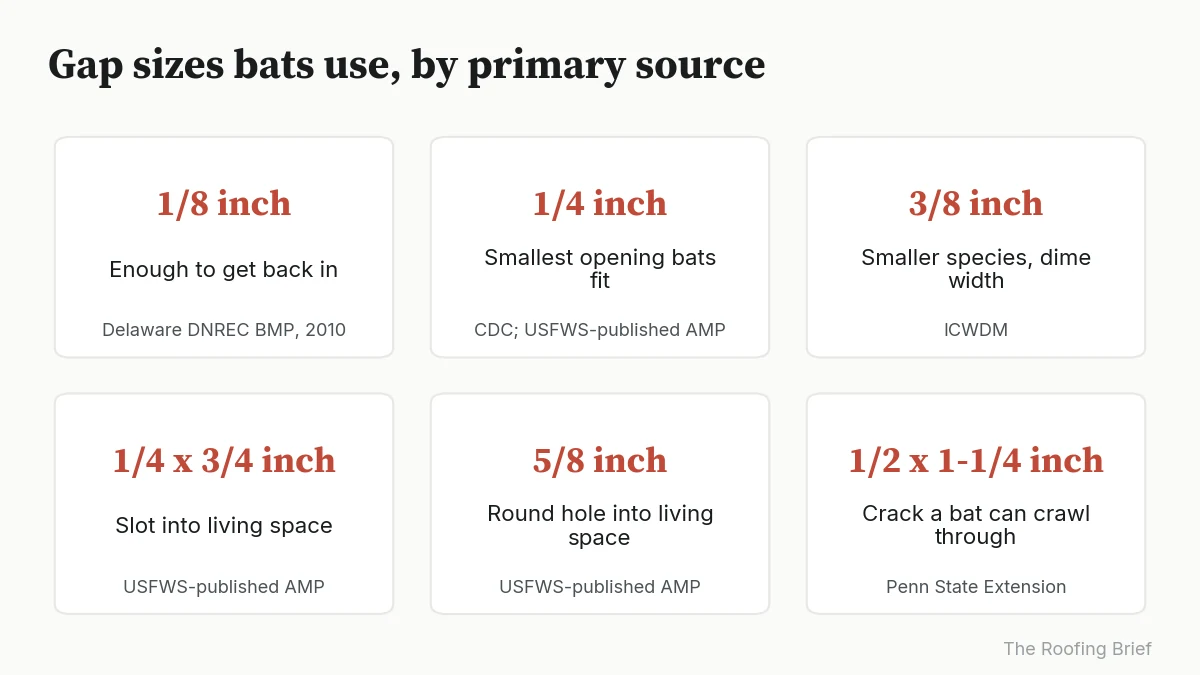
The practical rule from the primary sources: treat any gap of 1/4 inch or more as a bat door, and seal to a 1/8 inch target. Company pages usually quote one number; the agency figures in this table span 1/8 inch to 1/2 x 1-1/4 inch, so build to the smallest.
Use caulk on cracks larger than a dime and steel wool or caulk around pipes and wires (CDC), hardware cloth of 1/4 to 1/2 inch mesh over louvered vents (Virginia DWR), and a cap on the chimney flue (CDC).
The NC Wildlife Resources Commission names loose gable vent screens, gaps under shingles and decking, and broken siding as common entries. See our gable vent guide for screens, our soffit vent guide for eave intakes, and our guide to the chimney cap for an open flue.
How does a one-way bat exclusion device work?
A one-way bat exclusion device is a cone, tube or mesh flap over the main exit that lets bats leave the roost but not re-enter it. The USFWS-published guide requires material with no sharp edges or tangling spaces, and a minimum of five nights in place, including three consecutive nights above 50°F, before the hole is sealed.
| Device or rule | Specification | Source |
|---|---|---|
| Netting or screen flap | 1/4 to 1/2 inch mesh, extends about 3 feet below the hole, stands 3 to 5 inches clear of it | Penn State Extension |
| Polypropylene netting | Mesh under 1/6 inch; leave 5 to 7 days | Delaware DNREC |
| Hardware cloth tunnel | 1/4 to 1/2 inch mesh, runs 18 to 24 inches below the hole, open to the ground | Virginia DWR |
| Bat-Cone 2 Square | Covers a 1-1/4 x 2 inch hole; $14.95 each | Nixalite listing, Oct 2026 |
| Pro-cone Round or Square | Covers up to a 2 inch hole; $14.95 each; vinyl flange to 6 inch square $2.00 | Nixalite listing, Oct 2026 |
| Minimum time, federal guide | 5 nights, 3 consecutive above 50°F, wind under 10 mph, no heavy rain | USFWS-published AMP, 2015 |
| Minimum time, Florida rule | 4 consecutive days and nights with forecast lows above 50°F | Fla. Admin. Code 68A-9.010(1)(b)3.b |
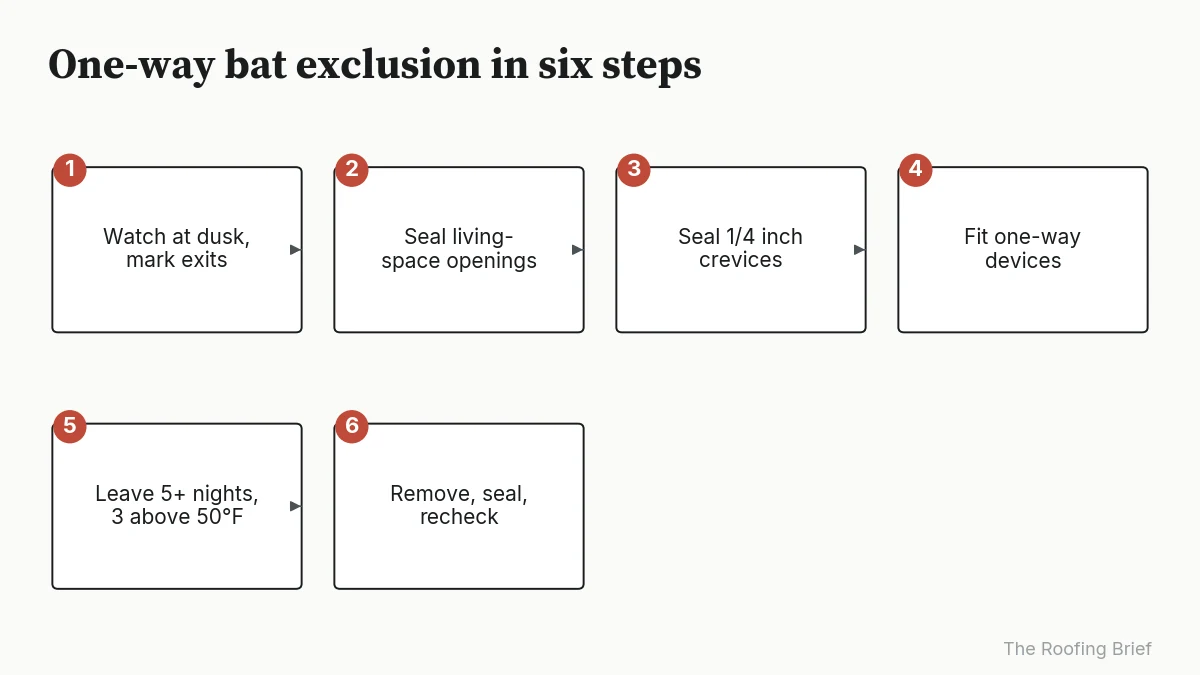
- Watch the house at dusk, mark every hole bats leave from, and count the bats (CDC).
- Seal openings between the attic and the living space first: hatches, plumbing chases, duct boots and fan housings, any opening 5/8 inch round or 1/4 x 3/4 inch (USFWS-published AMP).
- Seal every secondary crevice of 1/4 inch or wider on all four sides of the house, leaving only the main exits open (USFWS-published AMP).
- Fit a one-way device on each main exit: netting hanging about 3 feet below the hole, or a cone sized to the opening, mounted pointing down (Penn State; Nixalite instructions).
- Leave the devices for at least five nights, with three consecutive nights above 50°F and wind under 10 mph; in Florida, four nights with forecast lows above 50°F (USFWS AMP; rule 68A-9.010).
- Watch the exits on the last night, remove the devices, seal the holes to a 1/8 inch target, and recheck at dusk; reinstall for another five nights if any bat re-enters (USFWS AMP; Delaware DNREC).
Never seal holes at night without devices: Delaware DNREC says this “often traps some adult or young bats inside the structure.” Relocation fails too; Wisconsin DNR says most of a colony moved 200 miles would return.
How do you clean bat guano in an attic safely?
Clean bat guano only after the exclusion is finished, keep it wet the whole time, and wear a NIOSH-approved respirator with disposable hooded coveralls and shoe covers. NIOSH Publication 2022-103 tells employers to “spray water or use other dust suppression techniques,” and NIOSH says large accumulations belong with a professional hazardous-waste cleanup firm.
- Confirm the attic is empty of bats: at least five nights after devices went up, and a dusk recheck after sealing (USFWS AMP).
- Put on a NIOSH-approved respirator, eye protection, gloves, disposable hooded coveralls and shoe covers (NIOSH PPE guidance).
- Mist droppings with water and keep them damp while you work, the dust suppression NIOSH calls for (NIOSH 2022-103).
- Bag the damp material and soiled insulation and dispose of it under state and local requirements (NIOSH 2022-103).
- Remove coveralls and shoe covers at the hatch so spores do not ride into the house or car (NIOSH PPE guidance).
| Respirator type | Assigned protection factor | Where it fits (our reading) | Source |
|---|---|---|---|
| Filtering facepiece (N95) | 10 | Brief inspection, small scatter of droppings | NIOSH, Histoplasmosis PPE |
| Full facepiece elastomeric, 100-series filters | 50 | Shoveling or bagging piled guano | NIOSH, Histoplasmosis PPE |
| Powered air-purifying (PAPR) | 25 to 50 | Long sessions in hot attics; professional jobs | NIOSH, Histoplasmosis PPE |
NIOSH notes an N95 gives only 20% of the protection of a PAPR or a full facepiece respirator, and Histoplasma spores measure 1 to 5 µm. For respirator fit and models, our roofing respirator guide covers N95 and P100 options. Guano-soaked insulation is a removal job; see our insulation removal and replacement guide and the rodent-waste steps in our attic cleaning guide.
How much does it cost to get bats out of the attic?
Getting bats out of the attic costs $232 to $754 for a typical professional job, with a $490 average, per HomeAdvisor’s guide updated June 20, 2026. Colony size moves the price most: HomeAdvisor lists $230 to $1,500 for under 50 bats and $5,000 or more above 200. Guano cleanup and attic restoration are separate line items that can exceed the exclusion itself.
| Line item | Low | High | Source |
|---|---|---|---|
| Typical removal job | $232 | $754 | HomeAdvisor, June 20, 2026 |
| Inspection | $75 | $400 | This Old House, June 5, 2026 |
| Sealing entry points | $100 | $1,500 | HomeAdvisor, June 20, 2026 |
| Exclusion, 2 to 50 bats, several entry points | $400 | $1,500 | HomeAdvisor, June 20, 2026 |
| Exclusion, 50 to 200 bats, several entry points | $2,000 | $8,000 | HomeAdvisor, June 20, 2026 |
| Guano cleanup | $500 | $8,000 | HomeAdvisor, June 20, 2026 |
| Repairs or attic restoration | $2,500 | $5,000 | HomeAdvisor, June 20, 2026 |
| Rabies post-exposure shots, per person | $1,200 | $6,500 | CDC MMWR 68(23), 2019 |
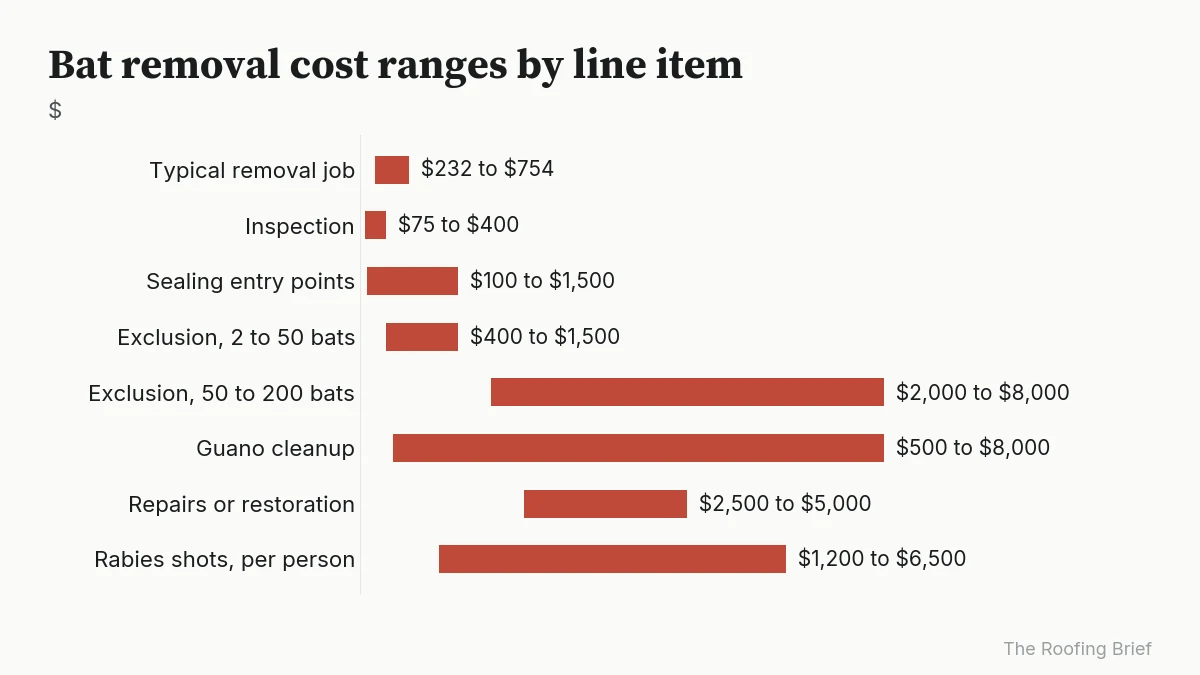
The worked example adds HomeAdvisor’s line items for a colony of 2 to 50 bats with several entry points; local quotes replace these numbers.
| Scenario | Arithmetic (low) | Arithmetic (high) | Total range |
|---|---|---|---|
| A. Exclusion only | $400 | $1,500 | $400 to $1,500 |
| B. Exclusion plus guano cleanup | $400 + $500 = $900 | $1,500 + $8,000 = $9,500 | $900 to $9,500 |
| C. B plus insulation and drywall repair | $900 + $2,500 = $3,400 | $9,500 + $5,000 = $14,500 | $3,400 to $14,500 |
| DIY devices, 3 main exits | 3 x $14.95 = $44.85 | $44.85 + 3 x $2.00 flange = $50.85 | $44.85 to $50.85 before sealant |
The DIY line uses Nixalite’s October 2026 cone prices and excludes sealant, ladders and respirators; HomeAdvisor lists DIY kits at $25 to $150. Whether homeowners insurance pays is doubtful: the standard ISO form HO 00 03 10 00 excludes loss caused by “birds, vermin, rodents, or insects” at Section I, A.2.c.(6)(g), so ask your adjuster in writing whether the carrier treats bats as vermin.
When should you call a pro for bats in the attic, and what should you ask?
Call a licensed wildlife control operator when exits sit above one story, the colony is large or old enough to leave piled guano, or the work must happen inside a closed window. North Carolina requires certified Wildlife Control Agents for any paid eviction (G.S. 113-273(l)), and Georgia DNR says maternity-period work must be done by a licensed Nuisance Wildlife Control Operator.
Ask each company these questions and get the answers in the written quote:
- Are you licensed or permitted by the state wildlife agency for bats, and what is the license number? (NC G.S. 113-273(l); Georgia DNR.)
- Which device will you use on each exit, and how many nights will it stay up at what temperature? (USFWS AMP: five nights, three above 50°F.)
- Will you seal every gap of 1/4 inch on all sides, including the roof edge, or only the exits you saw? (CDC; USFWS-published AMP.)
- Is guano cleanup priced per square foot or per job, and does it include insulation removal and disposal? (HomeAdvisor lists $500 to $8,000.)
- How many years does your re-entry warranty run, and do you return free if bats get back in? (Wisconsin DNR advises a several-year bat-free guarantee.)
Refuse any bid that offers trapping, poison or relocation: the 2015 USFWS-published guide says those methods “are illegal in many states.”
What to do about bats in your attic: decision table
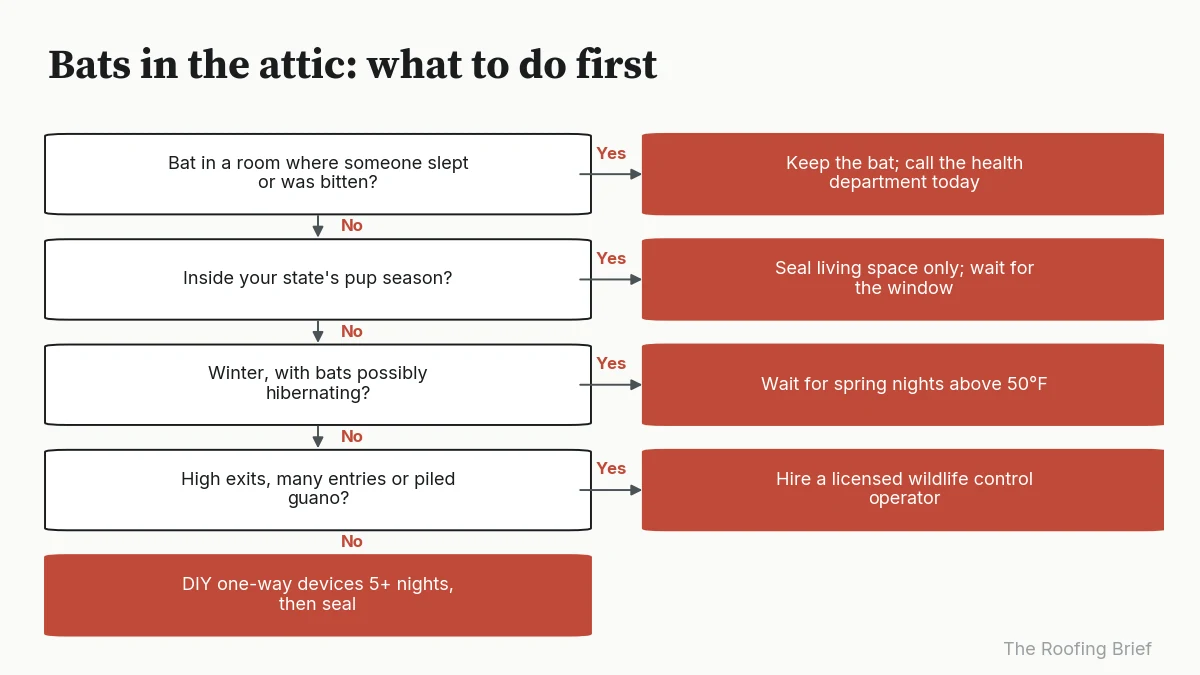
Use the decision table below in order: health first, then the calendar, then the season’s weather, then the access. A bat in a bedroom where someone slept is a health department call the same day, per ACIP. Everything else waits for your state’s open window and nights above 50°F, per the USFWS-published guide and Florida rule 68A-9.010.
| If your situation is | Do this | Rule |
|---|---|---|
| A bat was in a room where someone slept, a child was alone, or someone was bitten | Contain the bat for testing; call the health department today | ACIP 2008; CDC |
| It is inside your state’s pup season | Seal openings into the living space only; wait for the window | State closed-season rules; USFWS AMP default April 1 to August 31 |
| It is winter and bats may be hibernating inside | Wait for spring nights above 50°F before excluding | USFWS AMP |
| Exits are above one story, or there are many entry points or piled guano | Hire a licensed wildlife control operator | NC G.S. 113-273(l); Georgia DNR; NIOSH 2022-103 |
| One or two reachable exits, open window, nights above 50°F | DIY: one-way devices for 5 or more nights, then seal to 1/8 inch | USFWS AMP; Delaware DNREC |
A bat house near the old exit gives the colony somewhere to go. The USFWS-published guide recommends putting one up a few months to a year before a planned exclusion, and Penn State gives the build: crevices 3/4 to 1 inch deep, at least seven hours of sun, and mounted 10 to 15 feet above the ground.
How we compiled this
We compiled this page in October 2026 from 24 documents: CDC and NIOSH guidance, the 2015 USFWS-published practices guide, species page and bat removal story, six state wildlife agencies, two extension services, ICWDM, a Texas bill history, the ISO HO 00 03 form, one maker price list and two dated cost guides. We did not test devices or perform exclusions. FAQ questions follow the Google People Also Ask box pulled on October 20, 2026.
Frequently asked questions
Should I be worried about bats in my attic?
Bats in the attic are worth acting on but are rarely an emergency. CDC’s 2019 Vital Signs report tied 62 of 89 (70%) US-acquired human rabies cases from 1960 to 2018 to bats, and disturbed droppings can spread histoplasmosis. Bats do not nest, chew or claw their way into a structure, per the 2015 USFWS-published guide. Worry most if a bat reaches a room where someone slept.
What can I do if I have bats in my attic?
Seal every opening between the attic and the living space first, then check your state’s pup-season dates, April 1 to August 31 by federal default. Outside that window, fit one-way exits on the main holes for at least five nights, three of them above 50°F, seal gaps of 1/4 inch or more, and clean guano wet, per USFWS, CDC and NIOSH guidance.
How long do bats stay in your attic?
A maternity colony usually stays from spring to late summer. Penn State Extension says bats enter roosts in late April or early May and pups fly by about mid-July, and the USFWS-published guide says colonies disband in late summer. Big brown bats can winter inside buildings, and colonies return to the same roost every year unless it is sealed.
What will make bats leave your attic?
One-way exclusion devices make bats leave: netting, cones or tubes over the main exits let bats out but not back in, and they stay up at least five nights under the USFWS-published guide. Delaware DNREC says ultrasonic devices, chemical repellents and smoke do not work, and Wisconsin DNR says most of a colony moved 200 miles would return.
Is it safe to sleep in a house with bats in the attic?
Sleeping in a house with bats in the attic is low risk while no bat can reach the bedrooms. Seal attic hatches, plumbing chases and duct openings of 5/8 inch or more, per the USFWS-published guide. If a bat is ever found in a room where someone slept, ACIP treats it as a possible rabies exposure: keep the bat and call your health department.
Does homeowners insurance cover bat removal?
Usually not. The standard ISO HO 00 03 10 00 homeowners form excludes loss caused by birds, vermin, rodents, or insects at Section I, A.2.c.(6)(g). Whether bats count as vermin depends on your carrier and policy wording, so ask the adjuster in writing before paying for guano cleanup that can run $500 to $8,000.
Sources
- CDC: Bats and Rabies (page dated July 1, 2025), accessed Oct 2026
- CDC MMWR 68(23): Vital Signs, Trends in Human Rabies Deaths and Exposures, United States, 1938 to 2018 (2019), accessed Oct 2026
- CDC ACIP: Human Rabies Prevention, MMWR 57(RR-3) (2008), accessed Oct 2026
- CDC: About Histoplasmosis, accessed Oct 2026
- NIOSH Publication 2022-103: What Employers Need to Know about Histoplasmosis (December 2021), accessed Oct 2026
- NIOSH: Histoplasmosis, Personal Protective Equipment, accessed Oct 2026
- White-nose Syndrome Conservation and Recovery Working Group: Acceptable Management Practices for Bat Control Activities in Structures, US Fish and Wildlife Service, Hadley, MA (April 1, 2015), accessed Oct 2026
- US Fish and Wildlife Service: Five methods to safely remove a bat from your home, accessed Oct 2026
- US Fish and Wildlife Service: Northern long-eared bat species page, accessed Oct 2026
- Florida Administrative Code 68A-9.010, Taking Nuisance Wildlife (Cornell LII copy), accessed Oct 2026
- Wisconsin DNR Bat Program: I have bats in my attic! What do I do?, accessed Oct 2026
- NC Wildlife Resources Commission: Managing Conflicts with Bats, accessed Oct 2026
- Georgia DNR Wildlife Resources Division: Bats in Your House?, accessed Oct 2026
- Delaware DNREC: Best Management Practices for Bat Exclusions (December 2010), accessed Oct 2026
- Virginia DWR: Nuisance Bats in Homes or Buildings, accessed Oct 2026
- Texas Legislature Online: SB 1285 (89R) bill history, accessed Oct 2026
- Penn State Extension: Timing for Excluding Bats (updated October 6, 2025), accessed Oct 2026
- Penn State Extension: Bats, accessed Oct 2026
- UGA Cooperative Extension, Bartow County: Bats in the Attic (September 14, 2020), accessed Oct 2026
- Internet Center for Wildlife Damage Management: Bat Damage Identification, accessed Oct 2026
- ISO Homeowners 3 Special Form HO 00 03 10 00 (Insurance Information Institute sample), accessed Oct 2026
- Nixalite: Batcone Wildlife Excluders price listing, accessed Oct 2026
- HomeAdvisor: Bat Removal Cost (updated June 20, 2026), accessed Oct 2026
- This Old House: Bat Removal Cost (updated June 5, 2026), accessed Oct 2026