
By The Roofing Brief Team | Last reviewed: October 2026
A chimney liner is the code-required inner flue of a masonry chimney: clay tile, stainless steel, aluminum or cast-in-place. The right one depends on the appliance’s fuel and flue collar size, and a pro reline averages $2,500 (HomeAdvisor, June 2026).
Key takeaways
- Masonry chimneys must be lined to suit the connected appliance’s listing (2021 IRC Section R1003.11).
- DuraVent DuraFlex AL aluminum liners are limited to Category I, draft-hood gas; wood, coal, oil and pellets need stainless, clay or another listed system (DuraVent DuraFlex AL catalog).
- A single draft-hood gas flue may be no larger than 7 times the outlet area, so a water heater left alone in an old furnace flue often needs a liner (IRC G2427.5.4).
- Olympia requires a 1/2 inch blanket on Forever Flex for solid fuel in unlined or cracked-tile chimneys, but lists it uninsulated for oil and gas (Forever Flex manual).
- In October 2026, 6 inch by 25 foot stainless kits listed for $587.00 to $883.99, or $23.48 to $35.36 per foot, before insulation and labor (Fire Pit Surplus, Rockford Chimney Supply).
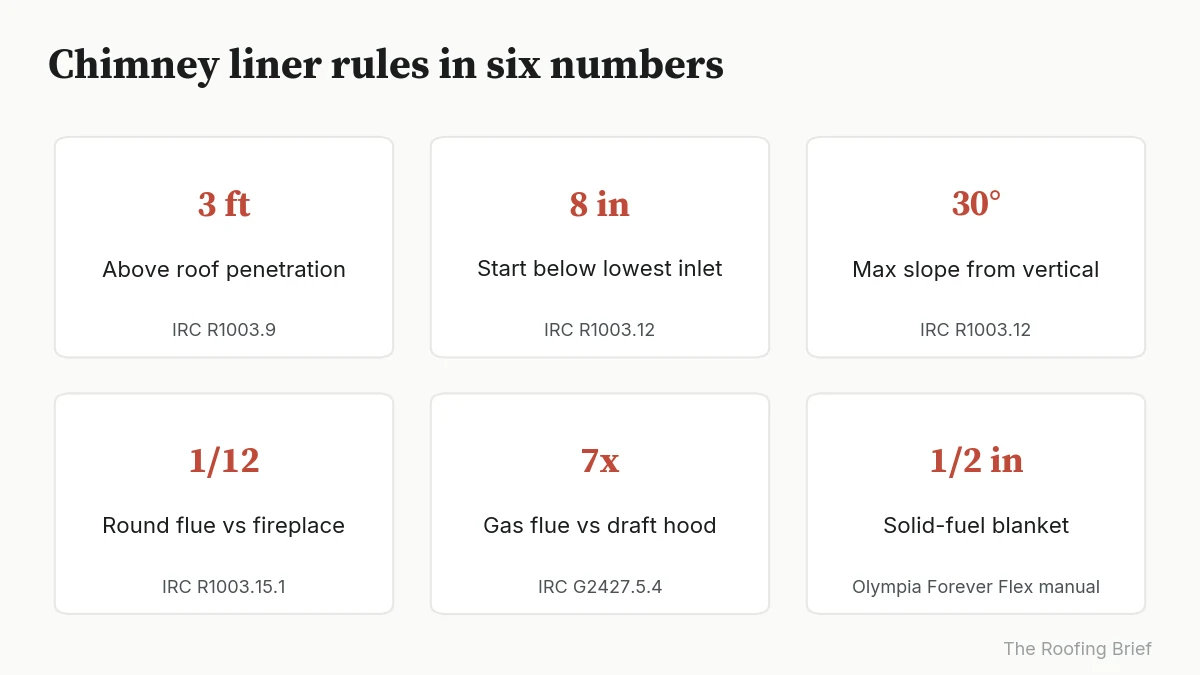
Chimney liner key numbers at a glance
Eight figures decide most chimney liner jobs, from how high the flue must rise to how thick the insulation must be. Each row below comes from the 2021 IRC or from a maker installation manual, so an installer’s quote can be checked against the exact clause it claims to meet.
| Figure | Value | Source |
|---|---|---|
| Chimney height above the roof penetration | 3 ft minimum | IRC R1003.9 |
| Height above any building part within 10 ft | 2 ft minimum | IRC R1003.9 |
| Clay liner start below the lowest inlet | 8 in minimum | IRC R1003.12 |
| Maximum clay liner slope from vertical | 30° | IRC R1003.12 |
| Round fireplace flue area vs fireplace opening | 1/12 minimum | IRC R1003.15.1 |
| Single draft-hood gas flue area vs outlet area | 7x maximum | IRC G2427.5.4 |
| Insulating blanket for solid fuel, Forever Flex | 1/2 in (or two 1/4 in layers) | Olympia Forever Flex manual |
| Chimney height range, Forever Flex system | 8 to 75 ft | Olympia Forever Flex manual |
What does a chimney liner do, and does code require one?
A chimney liner, also called a chimney flue liner, carries smoke and flue gas from the appliance to the top of the chimney and keeps heat, condensate and creosote away from the brick. The 2021 IRC states it plainly in Section R1003.11: “Masonry chimneys shall be lined,” and the lining must be appropriate for the appliance connected, following that appliance’s listing and the manufacturer’s instructions.
IRC R1003.11.1 accepts four routes for residential appliances: clay flue lining to ASTM C315, listed lining systems complying with UL 1777, factory-built chimneys listed for use inside masonry, or other approved materials that resist flue gas and condensate at up to 1,800°F. A UL 1777 system listed for contact with combustibles also waives the 2 inch framing clearance in IRC R1003.18.
Gas appliances add one more rule: IRC G2427.5.5.1 says chimneys “shall be lined in accordance with NFPA 211,” the NFPA 211 Standard for Chimneys, Fireplaces, Vents, and Solid Fuel-Burning Appliances, whose current edition is 2024.
Which chimney liner types exist, and what is each one listed for?
Four chimney liner families cover nearly every relining job: clay tile, stainless steel in 304, 316 or 316Ti alloys, two-ply aluminum for Category I gas, and cast-in-place cementitious linings. The table names documented products with their UL files, so a quote can be checked against the maker’s own fuel list.
| Liner type | Named product | Material | Fuels allowed by maker or code | Listing | Source |
|---|---|---|---|---|---|
| Clay tile | ASTM C315 flue tile | Fired clay in ASTM C199 refractory mortar | Residential-type appliances | ASTM C315, laid per ASTM C1283 | IRC R1003.11.1, R1003.12 |
| Flexible stainless, 304L | Olympia Forever Flex 304L | 304L stainless | Wood pellet stoves, wood stoves, fireplaces | UL 1777, UL file MH26852 | Olympia manual; NYC MEA 31-08-M |
| Flexible stainless, 316Ti | HomeSaver UltraPro | 316Ti stainless, .005 in, roll-lock seam | Wood, pellet, coal, oil, Category I gas | UL 1777, UL file MH13768 | NYC MEA 183-02-M Vol. II |
| Flexible stainless, 304 or 316 | DuraVent DuraFlex 304 and 316 | Single-wall .005 in stainless | Wood, non-condensing gas, oil; 316 recommended for coal | UL 1777, ULC S635 | DuraVent DuraFlex catalog |
| Flexible aluminum | DuraVent DuraFlex AL | .010 in aluminum (2-ply .005 in) | Category I, draft-hood gas only | UL 1777 | DuraVent DuraFlex AL catalog |
| Flexible aluminum | Z-Flex GAK kit | Aluminum, Triple-Lock seam | Natural gas or propane only, chimney up to 65 ft | UL 1777, ULC S635 | Z-Flex installation instructions |
| Cast-in-place | Poured or pumped cementitious lining | Cementitious or refractory mix | Per the system’s listing | UL 1777 listing or approval to 1,800°F | IRC R1003.11.1 |
Alloy matters most with wood and coal. Olympia’s manual assigns 304L Forever Flex to wood pellet stoves, wood stoves and fireplaces, and 316 to wood, coal, oil and gas, while DuraVent recommends 316 “where greater corrosion resistance is desired, such as coal-fired appliances.” Olympia also says AL 29-4C Forever Flex “should not be used with wood burning appliances.”
Factory-built fireplaces follow different rules. DuraVent sells a separate Factory-Built Reline Kit for solid-fuel use and states that relining “is critical for performance and safety when a wood-burning insert is installed into an existing UL-127-listed fireplace.” The metal chase top on those systems is covered in our guide to the chimney chase cover.
Which liner does each appliance need?
The appliance decides the chimney liner, not the chimney. The IRC splits the rules by fuel: Chapter 10 covers solid fuel, pellet and oil appliances, and Chapter 24 covers gas. The table pairs each common appliance with the code section that governs its lining, so a homeowner can ask an installer which clause the proposed liner meets.
| Appliance | Linings the code accepts | Code section |
|---|---|---|
| Open masonry fireplace or wood stove | ASTM C315 clay, UL 1777 system, factory-built chimney listed for masonry, or approved material to 1,800°F | IRC R1003.11.1 |
| Pellet stove | Any R1003.11.1 system, or a pellet vent listed for installation inside masonry chimneys | IRC R1003.11.4 |
| Oil appliance approved for Type L vent | Any R1003.11.1 system, or a listed liner complying with UL 641 | IRC R1003.11.5 |
| Category I gas furnace, boiler or water heater | ASTM C315 clay, UL 1777 system, approved material, or a liner listed for gas only with a permanent label | IRC G2425.12, G2425.13, G2427.5.2 |
| Category II, III or IV gas appliance | The venting the appliance manufacturer’s instructions specify | IRC G2425.14 |
| Any flue relined with a material outside R1003.11.1 | Permanent label naming the only appliance and fuel allowed | IRC R1003.11.6 |
High-efficiency gas appliances are the common trap. The IRC fuel gas chapter sends Category II, III and IV venting to the appliance maker (G2425.14), and Olympia states its Forever Flex system “is not intended for use with high efficiency appliances that require type BH gas venting systems, or that create positive pressures in the chimney.” Its warranty also limits gas use to Category I appliances.
How do you size a chimney liner?
Size a chimney liner from the appliance, then check the flue against two limits: never smaller than the appliance outlet, and never so large that the gas cools and drafts poorly. IRC R1003.14 sets the floor for every appliance, R1003.15.1 sets fireplace ratios, G2427.5.4 caps a single draft-hood gas flue at 7 times the outlet, and stove makers publish their own ceiling.
A round liner’s area is pi times the radius squared, so a 6 inch liner carries 28.27 square inches and an 8 inch liner 50.27. IRC Table R1003.14(1) rounds the same sizes to 28 and 50 square inches, and Table R1003.14(2) lists clay flues from 4.5 by 8.5 inches (23 square inches) to 24 by 24 inches (431). The worked cases below use those table values for clay and the exact arithmetic for round liners.
| Case | Inputs | Rule | Arithmetic | Result |
|---|---|---|---|---|
| Wood stove, 6 in collar, 13 x 13 in clay flue | Collar 28.27 sq in; flue 127 sq in | At least the collar area, no more than 3x (Englander 24 FC manual) | 127 ÷ 28.27 = 4.49x | Too large: reline with a 6 in liner |
| Same stove, 8 x 12 in clay flue | Collar 28.27 sq in; flue 67 sq in | Same | 67 ÷ 28.27 = 2.37x | Within 3x if the tile is sound |
| Open fireplace, 36 x 28 in opening, round flue | Opening 1,008 sq in | Round flue at least 1/12 of opening (IRC R1003.15.1) | 1,008 ÷ 12 = 84 sq in | 10 3/4 in round (90 sq in) passes; 10 in (78 sq in) fails |
| Same fireplace, square flue | Opening 1,008 sq in | Square flue at least 1/10 of opening | 1,008 ÷ 10 = 100.8 sq in | 12 x 12 in (102 sq in) passes |
| Same fireplace, 8.5 x 18 in flue (aspect over 2:1) | Opening 1,008 sq in | Rectangular flue of 2:1 or more at least 1/8 of opening | 1,008 ÷ 8 = 126 sq in | 8.5 x 18 in (101 sq in) fails |
| Gas water heater alone, 3 in draft hood, 8 x 12 in clay flue | Outlet 7.07 sq in; flue 67 sq in | No more than 7x the outlet (IRC G2427.5.4) | 67 ÷ 7.07 = 9.48x | Too large: a 4 in liner (12.57 sq in) is 1.78x |
The gas case is the “orphaned water heater” problem. When a furnace is permanently disconnected from a shared flue, IRC G2425.15.1 requires the chimney to be resized as needed to control condensation and keep the remaining appliance drafting, with Category I resizing done under Section G2426. A liner is the usual way to shrink the flue.
Shaped liners lose area. Olympia warns that ovalizing or squaring a round liner “will alter its cross-sectional area,” and DuraVent’s catalog shows how much: its 6 inch oval (4.2 by 7.2 inches) is listed at 24.60 square inches, about 13% less than the 28.27 square inches of a true 6 inch circle (the same table prints 28.46 for the round). Ask the installer for the shaped area in writing when a round liner will not fit the tile.
Does a stainless steel chimney liner need insulation?
A stainless steel chimney liner on wood, coal or pellets usually needs insulation; one on gas or oil usually does not. The Chimney Safety Institute of America (CSIA) says liners for gas and oil appliances “do not require insulation to meet the manufacturers’ installation and warranty requirements,” while liners serving solid fuel “do need to be insulated.” The maker rules set the exact thresholds.
- DuraVent ProFoil: a 1/2 inch wrap is required unless the chimney has both 1 inch from the liner to the inside of the masonry and 1 inch from the masonry to the house framing (DuraVent DuraFlex catalog).
- Olympia Forever Flex: a single 1/2 inch or two 1/4 inch layers of 8 lb density blanket over the full length in an unlined, partially lined or cracked-tile chimney, which gives a zero-clearance listing to combustibles (Forever Flex manual).
- Insulating mix alternative: a 1 inch layer of EverGuard or TherMix between the liner and 4 inch nominal masonry also gives zero clearance (Forever Flex manual; NYC MEA 31-08-M).
- Oil and gas: Forever Flex is listed without insulation in unlined, damaged-tile or sound-tile chimneys, though Olympia calls one 1/4 inch layer “good practice” to stabilize draft (Forever Flex manual).
How much does a chimney liner cost?
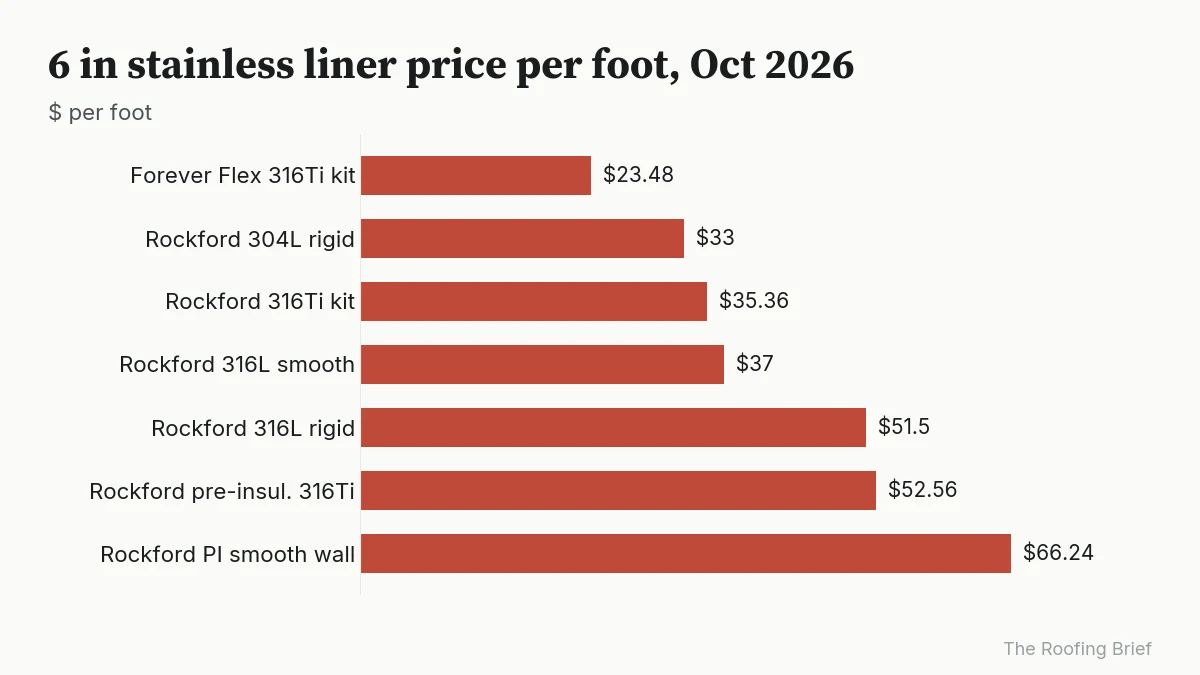
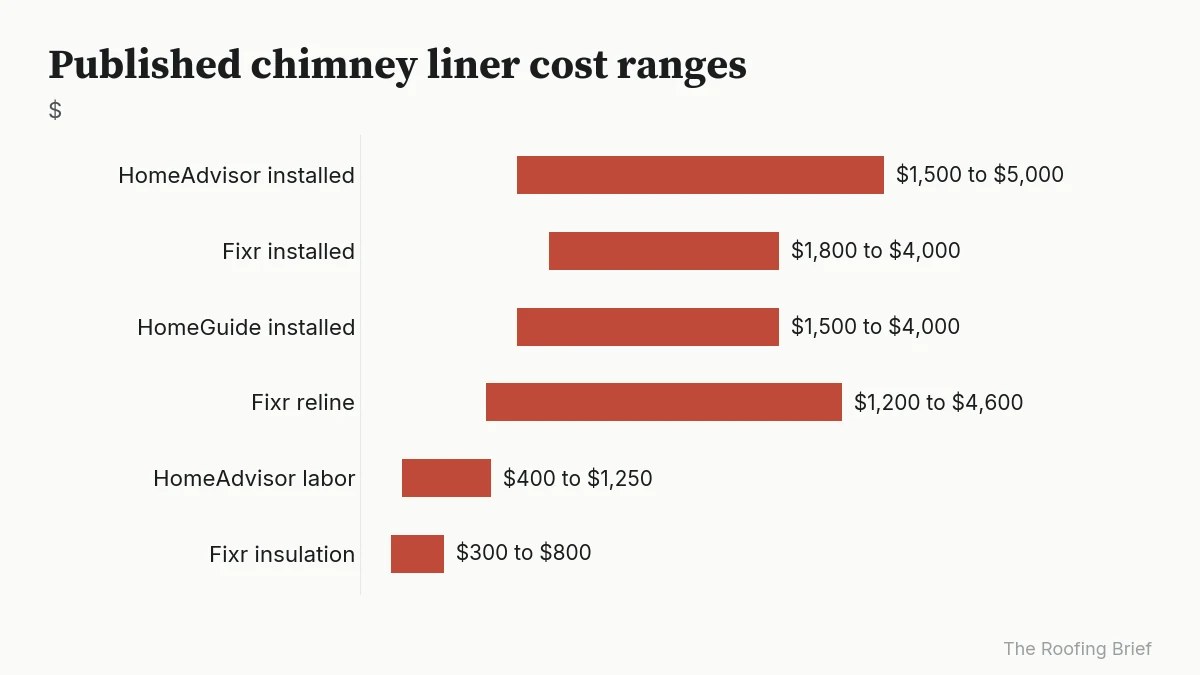
A professionally installed chimney liner costs $1,500 to $5,000, averaging $2,500, according to HomeAdvisor’s guide updated June 20, 2026, while Fixr’s January 2025 guide gives $1,800 to $4,000. Retail stainless kits for a 6 inch by 25 foot flue list at $587.00 to $883.99 in October 2026, so labor, insulation and the pre-relining inspection make up most of a pro quote.
| Product | Alloy or build | Size | Price | Per foot | Retailer, date seen |
|---|---|---|---|---|---|
| Olympia Forever Flex tee kit | 316Ti | 6 in x 25 ft | $587.00 | $23.48 | Fire Pit Surplus, Oct 2026 |
| Rockford kit RFLEX625AC, insert connector | 316Ti | 6 in x 25 ft | $883.99 | $35.36 | Rockford Chimney Supply, Oct 2026 |
| Rockford Premium Smooth Wall, liner only | 316L, .010 in | 6 in x 25 ft | $924.99 | $37.00 | Rockford Chimney Supply, Oct 2026 |
| Rockford Pre-Insulated, liner only | 316Ti, insulated | 6 in x 25 ft | $1,313.99 | $52.56 | Rockford Chimney Supply, Oct 2026 |
| Rockford Pre-Insulated Premium Smooth Wall, liner only | Smooth wall, insulated | 6 in x 25 ft | $1,655.99 | $66.24 | Rockford Chimney Supply, Oct 2026 |
| Rockford rigid section | 304L | 6 in x 48 in | $131.99 | $33.00 | Rockford Chimney Supply, Oct 2026 |
| Rockford rigid section | 316L | 6 in x 48 in | $205.99 | $51.50 | Rockford Chimney Supply, Oct 2026 |
Kit contents decide how much more you buy. A chimney liner kit pairs the flexible liner with the parts that close the top and connect the bottom, and the four documented kits below, from Rockford, Z-Flex and DuraVent, differ in what they include. Check for a top plate, a cap and the right bottom fitting (tee for a stove pipe, straight connector for an insert) before comparing prices.
| Kit | Liner | What the kit includes | Source |
|---|---|---|---|
| Rockford RFLEX625AC | 316Ti, 6 in x 25 ft | No-sag top plate with quick-connect collar, rain cap with screen and wind guard, vertical appliance (insert) connector | Rockford Chimney Supply listing, Oct 2026 |
| Z-Flex 2ZFSFKIT0625X tee kit | 316Ti, 6 in x 25 ft | Rain cap, 13 x 13 in flashing, Z-Lok tee adapter and cleanout cap in 304 stainless, self-tapping screws; listed to UL 1777 and ULC S635 Class 3 | PEX Universe listing, Oct 2026 |
| DuraVent DuraFlex AL kit | Aluminum, 3 to 8 in, 25 or 35 ft | DuraFlex AL length, cap, top plate and mortar sleeve | DuraVent DuraFlex AL catalog |
| Z-Flex GAK aluminum kit | Aluminum gas liner | Gas liner, mortar guard, rain cap, flashing and self-tapping screws | Z-Flex installation instructions |
Insulation is the biggest swing in the materials line. On Rockford’s own October 2026 listings, the 6 inch by 25 foot Premium Smooth Wall liner costs $924.99 bare and $1,655.99 pre-insulated, a $731.00 difference, or $29.24 per foot. Fixr prices insulation for a stainless liner at $300 to $800 installed.
| Item | Range | Average | Source, date |
|---|---|---|---|
| Installed liner, national | $1,500 to $5,000 | $2,500 | HomeAdvisor, Jun 20, 2026 |
| Installed liner, typical | $1,800 to $4,000 | $2,500 | Fixr, Jan 31, 2025 |
| Chimney liner installation | $1,500 to $4,000 | Not stated | HomeGuide, Feb 9, 2026 |
| Remove old liner and reline | $1,200 to $4,600 | Not stated | Fixr, Jan 31, 2025 |
| Labor only | $400 to $1,250 | Not stated | HomeAdvisor, Jun 20, 2026 |
| Insulation for a stainless liner | $300 to $800 | Not stated | Fixr, Jan 31, 2025 |
| High end, cast-in-place | Up to $7,000 | Not stated | Fixr, Jan 31, 2025 |
The worked example prices a 25 foot reline for a wood stove insert with a 6 inch collar, using one dated listing and the published ranges. It adds a Level 2 inspection, which CSIA recommends before lining or relining, at HomeGuide’s February 2026 range of $250 to $600. What that visit includes is broken down in our guide to chimney inspection cost.
| Line | Low case | High case | Source |
|---|---|---|---|
| 316Ti kit, 6 in x 25 ft (Rockford RFLEX625AC) | $883.99 | $883.99 | Rockford Chimney Supply, Oct 2026 |
| Insulation for solid fuel | $300.00 | $800.00 | Fixr, Jan 2025 |
| Installation labor | $400.00 | $1,250.00 | HomeAdvisor, Jun 2026 |
| Level 2 inspection before relining | $250.00 | $600.00 | HomeGuide, Feb 2026 |
| Total | $1,833.99 | $3,533.99 | Sum of the rows |
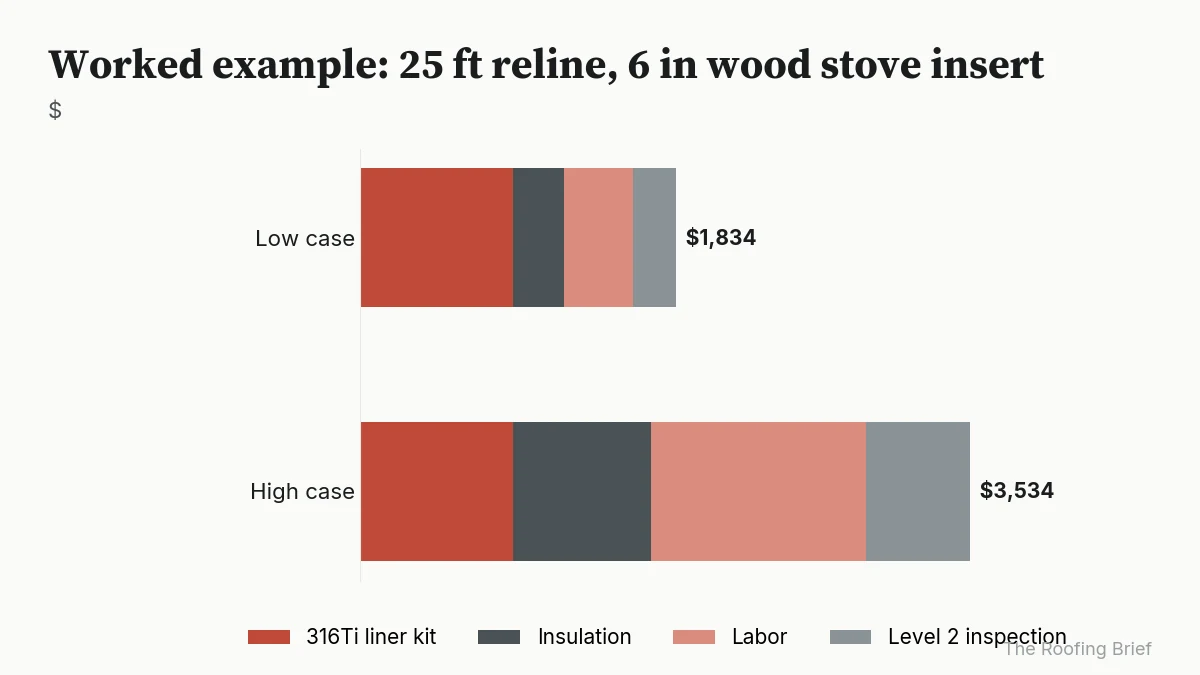
Both totals sit inside HomeAdvisor’s $1,500 to $5,000 band. A taller chimney adds liner at roughly the per-foot rates above, an offset flue or a roof above 8/12 adds labor time, and a cracked crown or loose brick must be fixed first. That repair is covered in our guide to the chimney crown.
How is a chimney liner installed?
A flexible chimney liner goes in from the roof in one continuous run after the flue is cleaned, inspected and measured. The steps below follow the Olympia Forever Flex and Z-Flex installation instructions, the DuraVent catalog and the IRC, with the measurement or rule each step needs. Permit and inspection rules come from the local building department.
- Clean out all creosote, including tar glaze, which Olympia calls “a warranty prerequisite.”
- Repair cracked, loose or missing brick and mortar; Olympia says an unsound chimney “should not be relined.”
- Measure the flue’s inside dimensions and its height from top to bottom (CSIA Level 2 procedure), then size the liner to the appliance outlet.
- Pull a short test piece on a pulling cone through the flue to prove the diameter fits (Olympia).
- For solid fuel, wrap the 1/2 inch blanket from connector to crown, tape the seams and add mesh (Olympia; DuraVent ProFoil).
- Lower the liner and fit the tee or connector; a joining connector may carry no more than 50 feet of liner (Olympia).
- Fix the top plate and a listed cap, ending 3 feet above the roof penetration and 2 feet above anything within 10 feet (IRC R1003.9).
- Post any label the code requires (IRC G2427.5.2 for gas-only liners, R1003.11.6 for other materials) and file the warranty card.
DIY is legal in many places, but the warranty conditions are strict. Olympia’s Forever Warranty requires cleaning and inspection by “an experienced chimney professional” at intervals of no more than 18 months, logged on the warranty card with receipts kept, and a cap on the chimney. Cap choices are compared in our guide to the chimney cap.
What several guides say vs what the primary source says
Five claims about chimney liners recur in cost guides and stove manuals, and each one shifts when checked against the primary document. The table pairs the common wording with the DuraVent, Olympia or Englander document, the IRC section or the plain arithmetic that governs it.
| Common claim | What the primary source says | Source |
|---|---|---|
| Aluminum liners work for gas appliances | DuraFlex AL is limited to Category I, draft-hood gas; Category II to IV follow the appliance maker | DuraVent DuraFlex AL catalog; IRC G2425.14 |
| Every stainless liner must be insulated | Forever Flex is listed without insulation for oil and gas; DuraVent needs no wrap with 1 in plus 1 in clearances | Olympia manual; DuraVent catalog |
| A 6 in stove collar is 28.87 sq in (Englander 24 FC manual) | Pi x 3 squared = 28.27 sq in; the manual’s 84.8 sq in maximum equals 3 x 28.27 | Englander 24 FC manual; IRC Table R1003.14(1) |
| Stainless liners cost “$65 per square foot” (HomeAdvisor summary table) | Liners sell by the linear foot; the same page gives $20 to $40 rigid and $40 to $90 flexible per foot | HomeAdvisor; Rockford listings |
| A lifetime warranty covers the liner for life with no conditions | Olympia 304L Forever Flex pays 100% for 15 years, then 50%; all lines need professional cleaning and inspection at no more than 18 months | Olympia Forever Flex manual |
Which chimney liner should you choose?
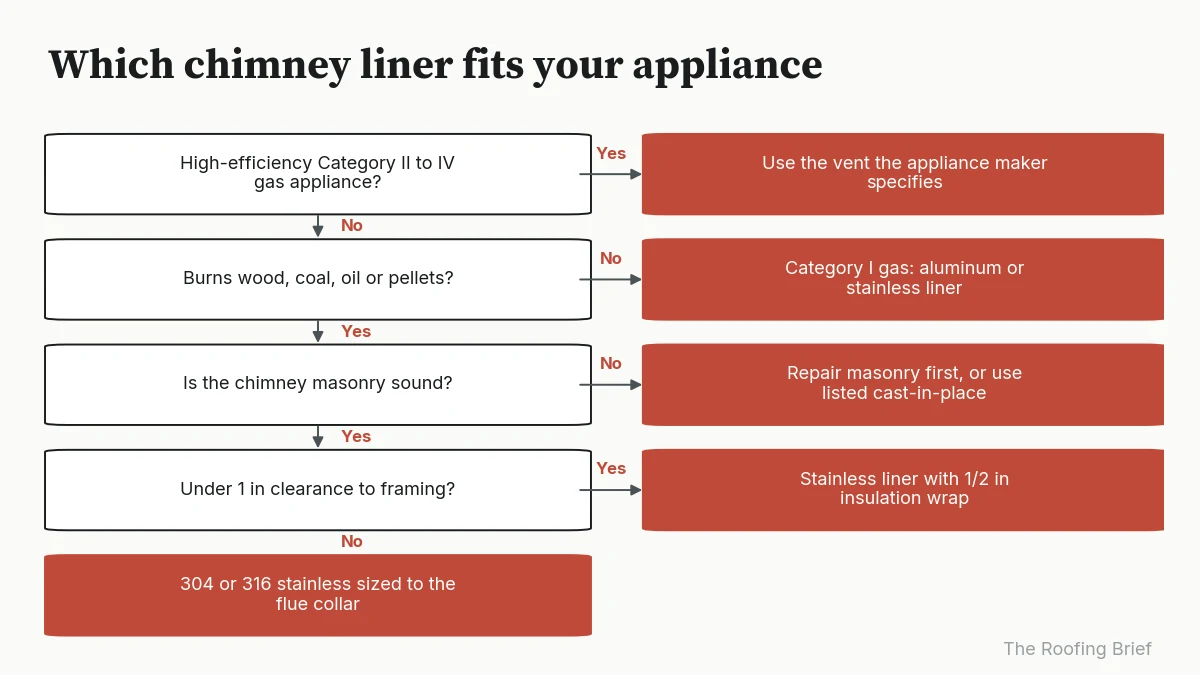
Choose the chimney liner by fuel first, chimney condition second and clearance third. The decision table turns the code sections and maker rules above into actions, and the flowchart walks the same logic in four questions. Where two answers seem to fit, the appliance installation manual governs, because IRC R1003.11 ties the lining to the appliance listing.
| If your situation is | Do this | Rule behind it |
|---|---|---|
| High-efficiency Category II, III or IV gas appliance | Use the vent the appliance maker specifies, not a UL 1777 liner | IRC G2425.14; Forever Flex manual |
| Category I gas water heater left alone after a furnace is removed | Resize the flue with an aluminum or stainless liner | IRC G2425.15.1, G2427.5.4 |
| Cracked, loose or missing masonry | Repair the masonry before relining, or ask for a listed cast-in-place system | Forever Flex manual; IRC R1003.11.1 |
| Wood, coal, oil or pellet appliance with under 1 in clearance to framing | Stainless liner with a 1/2 in insulation wrap or 1 in insulating mix | DuraVent catalog; Forever Flex manual |
| Wood, oil or pellet appliance with full clearances | 304 or 316 stainless liner sized to the flue collar | Forever Flex manual; Englander 24 FC manual |
| Coal stove or boiler | 316 or 316Ti stainless | DuraVent catalog; Forever Flex manual |
| Open fireplace with sound clay tile of the right area | Keep the tile and repair mortar joints | IRC R1003.15.1 |
A leak around the outside of the chimney is a flashing or masonry job, not a liner job, and the first suspect is bad chimney flashing. A chimney wider than 30 inches that does not meet the ridge also needs a cricket under IRC R1003.20, explained in our guide to the chimney cricket. Water soaking through the brick face itself is a sealing job, priced in our guide to chimney waterproofing.
How we compiled this
We compiled this page from 20 primary documents opened in October 2026: IRC Chapters 10 and 24, five maker manuals and catalogs, two NYC Department of Buildings acceptance reports, two CSIA documents, the ASTM C315 and NFPA 211 records and seven dated retailer listings. We did not install or test any liner. Installed costs come from HomeAdvisor, Fixr and HomeGuide, with their dates.
Frequently asked questions
Is a chimney liner really necessary?
Yes, in a masonry chimney. The 2021 IRC Section R1003.11 says “masonry chimneys shall be lined,” using ASTM C315 clay tile, a UL 1777 listed system, a factory-built chimney listed for masonry or another approved material. A cracked or wrongly sized liner usually means relining, which CSIA lists as a Level 2 inspection trigger.
How much should a chimney relining cost?
Fixr’s January 2025 guide prices removing an old liner and relining at $1,200 to $4,600, and HomeAdvisor’s June 2026 guide puts an installed liner at $1,500 to $5,000, averaging $2,500. Our worked example for a 25 foot, 6 inch 316Ti reline, built on an $883.99 Rockford kit plus published insulation, labor and inspection ranges, totals $1,833.99 to $3,533.99.
Can you put a liner in an old chimney?
Yes, if the masonry is sound. Olympia lists Forever Flex for an existing, properly built masonry chimney with a cracked clay tile liner and at least 4 inches of nominal masonry, but says a chimney that is not structurally sound should not be relined. DuraVent says its liners can go inside existing clay tiles, or the tiles can be removed.
Can I install a chimney liner myself?
Retail kits such as the Olympia Forever Flex 316Ti tee kit ($587.00 at Fire Pit Surplus, October 2026) are sold to the public, and DuraVent’s catalog tells installers to contact the local building inspector for permit requirements. Olympia’s warranty still requires an experienced chimney professional to clean and inspect the liner at least every 18 months.
What size chimney liner do I need?
Start at the appliance outlet: IRC R1003.14 says the flue may not be smaller than the connector area. The Englander 24 FC manual caps a wood stove flue at 3 times the collar area, and IRC G2427.5.4 caps a single draft-hood gas flue at 7 times the outlet.
How long does a stainless steel chimney liner last?
Makers state life as warranty terms, not years of service. Olympia’s 304L Forever Flex warranty pays 100% for 15 years and 50% after, and DuraVent states 100% for 15 years and 50% beyond for DuraFlex. Olympia’s coverage also requires professional cleaning and inspection at no more than 18 months.
Does a gas furnace need a chimney liner?
A Category I gas furnace vented into masonry needs a lining that meets IRC G2425.12 or G2425.13: ASTM C315 clay, a UL 1777 system or a liner listed for gas. If the furnace is removed and a water heater is left alone, G2425.15.1 requires the flue to be resized.
Sources
- 2021 International Residential Code, Chapter 10 Chimneys and Fireplaces (New Jersey edition, UpCodes), accessed Oct 2026
- 2021 International Residential Code, Chapter 24 Fuel Gas (New Jersey edition, UpCodes), accessed Oct 2026
- DuraVent, DuraFlex Stainless Steel Flexible Relining catalog DV-DF-CT-001E (04-23), accessed Oct 2026
- DuraVent, DuraFlex AL Aluminum Flexible Relining catalog (04-23), accessed Oct 2026
- Olympia Chimney Supply, Forever Flex and ArmorFlex/Hybrid Liner Installation and Maintenance Instructions with Limited Forever Warranty, accessed Oct 2026
- Z-Flex, Aluminum Chimney Liner Kit Installation Instructions (models GAK, GAFK, GIAK, GIAFK), accessed Oct 2026
- England’s Stove Works, Englander 24 FC Installation and Operation Manual, accessed Oct 2026
- NYC Department of Buildings, MEA 31-08-M (Olympia Chimney Supply liners, UL file MH26852), accessed Oct 2026
- NYC Department of Buildings, MEA 183-02-M Vol. II (HomeSaver UltraPro, UL file MH13768), accessed Oct 2026
- ASTM C315, Standard Specification for Clay Flue Liners and Chimney Pots, accessed Oct 2026
- NFPA 211, Standard for Chimneys, Fireplaces, Vents, and Solid Fuel-Burning Appliances, document page, accessed Oct 2026
- Chimney Safety Institute of America, Homeowner Resources and FAQ, accessed Oct 2026
- CSIA, Standard Operating Procedure: Level 2 Inspection, Masonry Chimney (Rev. 4/5/19), accessed Oct 2026
- Rockford Chimney Supply, 6 in. x 25 ft. 316Ti Chimney Liner Kit RFLEX625AC listing, accessed Oct 2026
- Rockford Chimney Supply, Premium Smooth Wall Chimney Liner Only listing, accessed Oct 2026
- Rockford Chimney Supply, Pre-Insulated Flexible Chimney Liner Only listing, accessed Oct 2026
- Rockford Chimney Supply, 304L Rigid Chimney Liner 48 in. listing, accessed Oct 2026
- Rockford Chimney Supply, 316L Rigid Chimney Liner 48 in. listing, accessed Oct 2026
- PEX Universe, Z-Flex 2ZFSFKIT0625X 6 in. x 25 ft. 316Ti Chimney Liner Tee Kit listing, accessed Oct 2026
- Fire Pit Surplus, Olympia Forever Flex Chimney Liner Kit 6 in. listing, accessed Oct 2026
- HomeAdvisor, How Much Does a Chimney Liner Cost? (updated Jun 20, 2026), accessed Oct 2026
- Fixr, Chimney Liner Installation Cost (updated Jan 31, 2025), accessed Oct 2026
- HomeGuide, Chimney Inspection Cost (Feb 9, 2026), accessed Oct 2026