
By The Roofing Brief Team | Last reviewed: October 2026
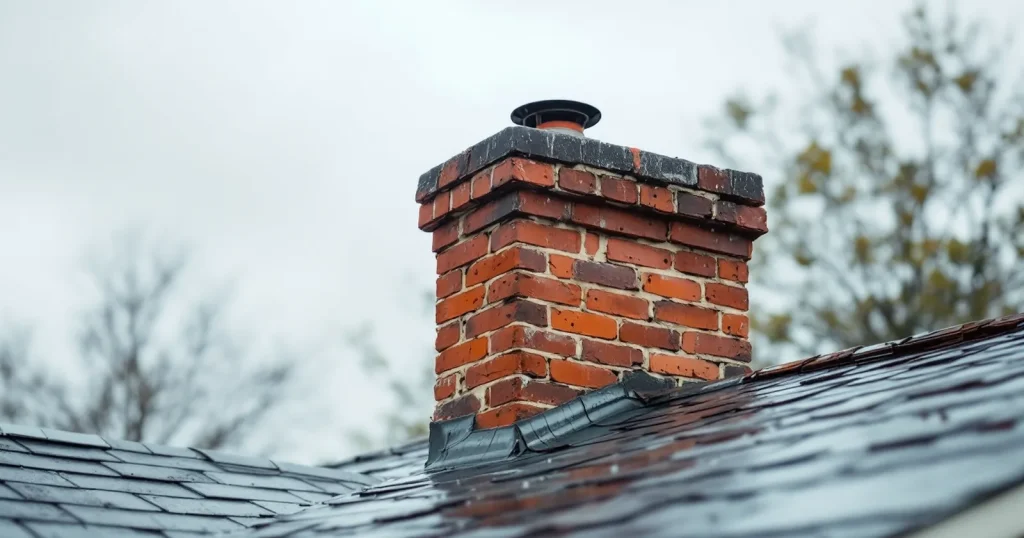
Chimney waterproofing means treating brick with a breathable silane or siloxane water repellent that blocks rain but passes vapor (NPS Preservation Brief 1). It cannot fix flashing, crown cracks or open mortar joints, so repair those first.
Key takeaways
- A water repellent is not a waterproof coating: the National Park Service says repellents are “often referred to incorrectly as ‘sealers'” and let vapor pass, while waterproof coatings seal out liquid and vapor and include “bituminous coatings and some elastomeric paints” (Preservation Brief 1, November 2000).
- Published test data separates products: PROSOCO Siloxane WB Concentrate cuts brick absorption 99.23% (ASTM C67) with water vapor transmission of 1.21 grains per hour per sq ft (ASTM D6490), per its 2025 data sheet.
- Coverage on porous brick runs 100 to 150 sq ft per gallon per coat for ChimneySaver Advanced, and SaverSystems lists a 1 gallon can at $86.65 (October 2026).
- Timing rules from the data sheets: cure new masonry 28 days, wait 72 hours after repointing, apply at 40 F or warmer, and keep rain off for 6 hours (ChimneySaver).
- Repellents will not keep water out of “structural cracks, defects or open joints” (PROSOCO), and PROSOCO says the wall top must be “capped and made watertight” first. A pro waterproofing job costs $150 to $500 (Fixr, January 2025).
What does chimney waterproofing actually do?
Chimney waterproofing, done correctly, is a penetrating water repellent that soaks 1/16 to 1/4 inch into brick and mortar and makes the pores shed liquid water, while still letting water vapor leave, per the ChimneySaver Water-Base data sheet. It is not a film or a paint. The National Park Service draws that line sharply in Preservation Brief 1.
The vapor side matters more on a chimney than on a wall. SaverSystems’ ChimneySaver Advanced data sheet says the product “allows water vapor produced during the combustion process to escape from the chimney.” A film that traps that vapor holds moisture in the brick, where freeze-thaw cycles do their damage.
| Treatment | What it does to water and vapor | Where it belongs | Source |
|---|---|---|---|
| Penetrating water repellent (silane, siloxane) | Repels liquid water, passes water vapor; generally clear | Chimney brick, mortar, stone faces | NPS Preservation Brief 1 |
| Waterproof coating (bituminous, some elastomeric paints) | Seals out liquid water and water vapor; usually opaque | Not the brick face of a working chimney | NPS Preservation Brief 1 |
| Elastomeric crown coating (for example CrownCoat) | Forms a flexible waterproof membrane, 200% elongation | The horizontal crown only | SaverSystems CrownCoat data sheet |
| Elastomeric flashing sealant (for example FlashSeal) | Elastomeric sealant for leaks around the base of chimneys, 200% elongation, 7 year warranty | The roof to chimney joint only | SaverSystems FlashSeal data sheet |
One claim deserves a neutral correction. ChimneySaver data sheets list “100% Vapor Permeable” from the OHD-L-35 test, while Preservation Brief 1 says modern repellents “still reduce the vapor permeability of the masonry.” Both can be true: the maker figure is a pass result on one method, and PROSOCO instead publishes a measured transmission rate (1.21 and 1.33 grains per hour per sq ft under ASTM D6490) that a reader can compare product to product.
Silane vs siloxane: which water repellent should go on a chimney?
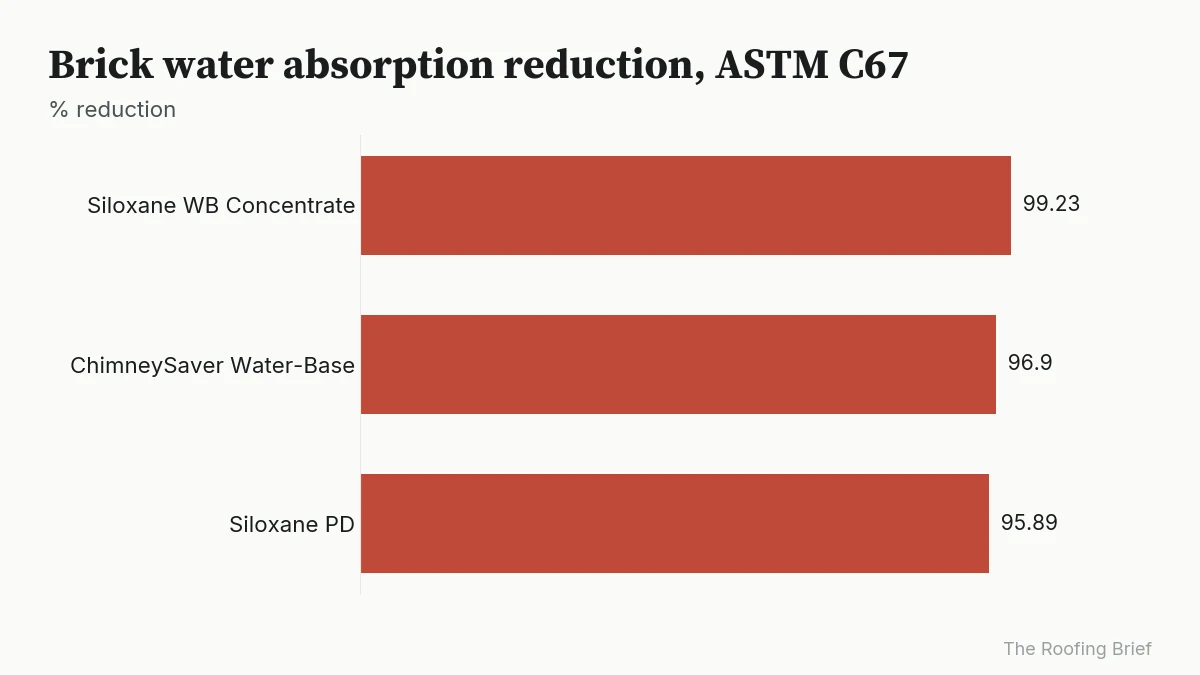
Silane, siloxane and blended silane/siloxane repellents all qualify as breathable penetrants under Preservation Brief 1, so the chemistry label alone does not settle the choice. The published test numbers do: water absorption reduction on brick under ASTM C67, leakage reduction under ASTM E514, and vapor transmission under ASTM D6490. The table lists every figure the three data sheets publish.
| Product | Chemistry | Brick absorption reduction (ASTM C67) | Vapor result | Other test | Source |
|---|---|---|---|---|---|
| PROSOCO Sure Klean Weather Seal Siloxane WB Concentrate | Silanes and oligomeric alkoxysiloxanes, 100% active, diluted on site | 99.23% | 1.21 grains/hr/sq ft (ASTM D6490) | Concrete 94.52% (ASTM D6532); SWR Institute validation 2024 to 2029 | PROSOCO PDS, 2025 |
| PROSOCO Sure Klean Weather Seal Siloxane PD | Water-based silane/siloxane, 7% active, ready to use | 95.89% | 1.33 grains/hr/sq ft (ASTM D6490) | Concrete 88.98% (ASTM D6532); service life “estimated at more than 10 years” | PROSOCO PDS, 2025 |
| ChimneySaver Water-Base Water Repellent | Modified siloxane, water carrier | 96.9% | 100% (OHD-L-35) | 99.9% leakage reduction (ASTM E514); no loss after 3,000 hr (ASTM G53) | SaverSystems data sheet, 2015 |
Concentration changes the job, not just the price. Siloxane WB Concentrate mixes at 1 part to 9 parts water for porous vertical surfaces and up to 1 to 19 for dense ones, and PROSOCO says one gallon of concentrate “treats up to 4,000 square feet.” Siloxane PD ships at 7% active content and is applied “as packaged,” which removes mixing errors on a roof.
Two substrate limits apply to the PROSOCO pair: neither is for “limestone, marble, travertine or other calcareous stones,” and Siloxane PD is not for synthetic resin paints or gypsum. A stone chimney needs a stone test patch first, per both PROSOCO Siloxane PD and Siloxane WB data sheets.
Which chimney water repellents have published spec sheets?
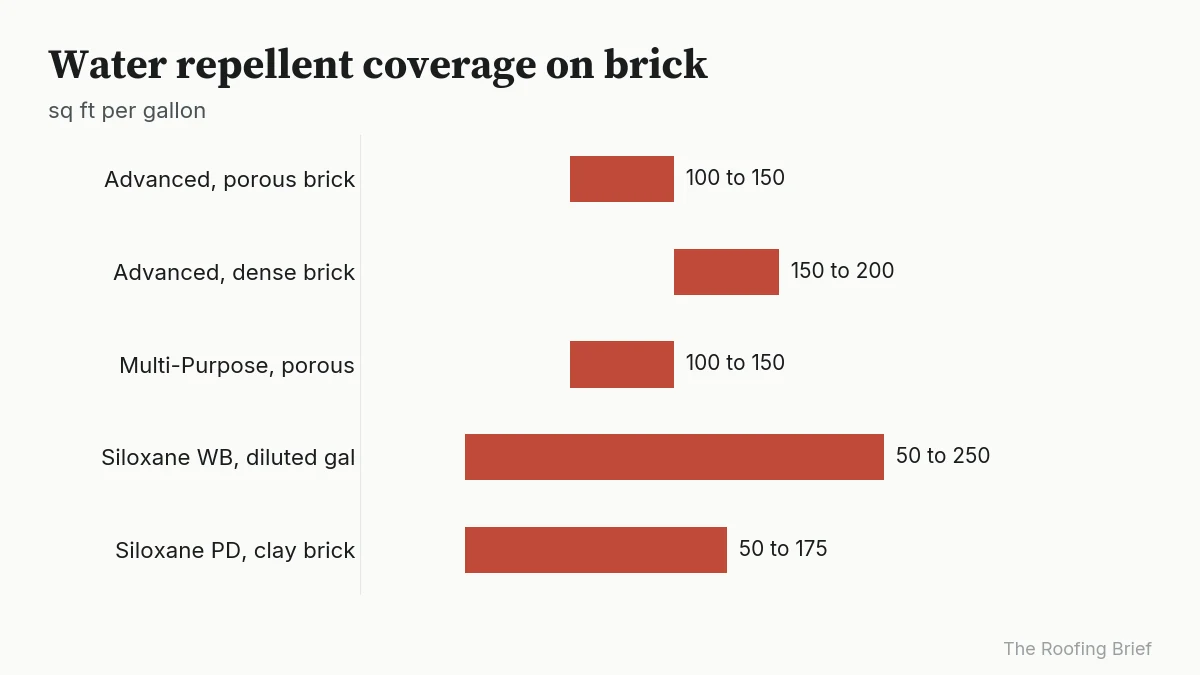
Four chimney-suitable repellents publish full data sheets with coverage, temperature and rain limits: ChimneySaver Advanced, ChimneySaver Multi-Purpose, PROSOCO Siloxane WB Concentrate and PROSOCO Siloxane PD. Coverage on clay brick ranges from 50 to 250 sq ft per gallon depending on product and porosity, and the two ChimneySaver products carry 10 year limited warranties for professional application on vertical surfaces.
| Product | Coverage on brick | Temperature window | Rain-free after | Warranty | Price seen Oct 2026 |
|---|---|---|---|---|---|
| ChimneySaver Advanced (polysiloxane, zero VOC) | 100 to 150 sq ft per coat porous; 150 to 200 dense | 40 to 110 F | 6 hours | 10 years, vertical, professional application | $86.65 per gal; $424.75 per 5 gal (SaverSystems) |
| ChimneySaver Multi-Purpose (silane/siloxane, 6 g/L VOC) | 100 to 150 sq ft per coat porous; 150 to 200 dense | 40 to 110 F | 6 hours | 10 years, vertical, professional application | $447.57 (SaverSystems; 5 gal is the smallest size on the data sheet) |
| PROSOCO Siloxane WB Concentrate | 50 to 250 sq ft per diluted gal on fired clay brick | 40 to 90 F, held 8 hours | 4 hours | Free from defects | Not priced (distributor sale) |
| PROSOCO Siloxane PD | 50 to 175 sq ft per gal on fired clay brick | 40 to 95 F, held 8 hours | Not stated; protect from water 6 hours before glass cleanup | Free from defects | Not priced (distributor sale) |
The 10 year warranty wording sets expectations. SaverSystems warrants that ChimneySaver Advanced “will exhibit a water repellent effect on vertical surfaces for ten years” when “properly applied by a professional contractor,” supplies replacement product only (no labor), and excludes “pre-existent flaking, spalling, abrading, faulty construction.” ChimneySaver Advanced is also the product SaverSystems says can “penetrate through existing penetrating water repellents,” which matters on a chimney treated before.
Two retail products lead Google results for this topic in October 2026 without full data sheets. The DRYLOK chimney sealer page describes Siloxane 7 as a “7% silane/siloxane blend” applied in one coat at 50 F or warmer after at least a two day dry spell, with an estimated service life of more than 10 years. The Amazon listing for ChimneyRx 300119 sells a 1 gallon siloxane-based, non-film-forming repellent but shows no test results, so compare it on the numbers in the tables above.
When should you waterproof a chimney?
Waterproof a chimney when the brick itself is absorbing water and every other entry point has been fixed: the crown capped and sealed, the flashing tight, cracks and open joints repointed. Both makers make repairs a precondition, and Preservation Brief 1 warns that a repellent applied to a damp or salt-laden wall can hold moisture in and drive spalling.
The ChimneySaver data sheets list the repairs to make first: “structural cracks, faulty roofing, copings, flashings, expansion joints, mortar joints and sealants.” PROSOCO adds that “the top of walls need to be capped and made watertight prior to application,” which on a chimney means the crown; how to check and repair it is in our guide to the chimney crown.
Preservation Brief 1 also explains why a treatment is not always the answer. It says water entering masonry “is seldom due to porous masonry, but results from poor or deferred maintenance,” and that salts trapped behind a repellent can crystallize “beneath the surface as subflorescence,” which “eventually may cause the surface of the masonry to spall.” Clean off efflorescence first, as the ChimneySaver preparation steps require, and find the water source that put it there.
- Do not apply to painted or glazed brick or tile (ChimneySaver limitation).
- Do not apply below 40 F or to frozen brick (all four data sheets); ChimneySaver also bars wet or frost-covered surfaces.
- Do not use PROSOCO Siloxane WB or PD on limestone, marble or travertine (PROSOCO limitation).
- Do not use it for interior surfaces or to resist hydrostatic pressure (ChimneySaver limitation).
How do you apply a chimney water repellent?
Apply a chimney water repellent from the bottom up with a low-pressure sprayer at 10 to 25 psi, flooding the brick until it runs 6 to 8 inches below the spray line, then recoat wet-on-wet within 3 to 5 minutes, per the ChimneySaver Advanced data sheet. PROSOCO’s sheets give the same method with a 4 to 8 inch rundown and a 5 to 10 minute wait for Siloxane PD.
- Confirm the forecast: at least 40 F and no rain or sub-40 F temperatures for 6 hours after application (ChimneySaver Advanced).
- Finish repairs and wait: 28 days for new masonry and 72 hours after repairs or tuckpointing (ChimneySaver).
- Clean the brick of dust, efflorescence, oils and coatings, and let it become visibly dry.
- Cover shingles, windows, plants and anything asphalt-based; ChimneySaver says not to use it on asphalt-based material.
- Test a small area to confirm coverage and appearance; dense brick may darken slightly.
- Spray from the bottom up at 10 to 25 psi with a fan nozzle, or roll with at least a 3/8 inch nap, flooding to a 6 to 8 inch rundown.
- Recoat wet-on-wet within 3 to 5 minutes, then remove overspray from roofing and glass with soap and water.
PROSOCO also warns not to atomize the product: its sheets call for “high volume, low-pressure (<50 psi) spray” with fan tips. For Siloxane WB, mix only what you will use, since diluted product “must be applied within 24 hours of dilution.”
How long does chimney waterproofing take to cure?
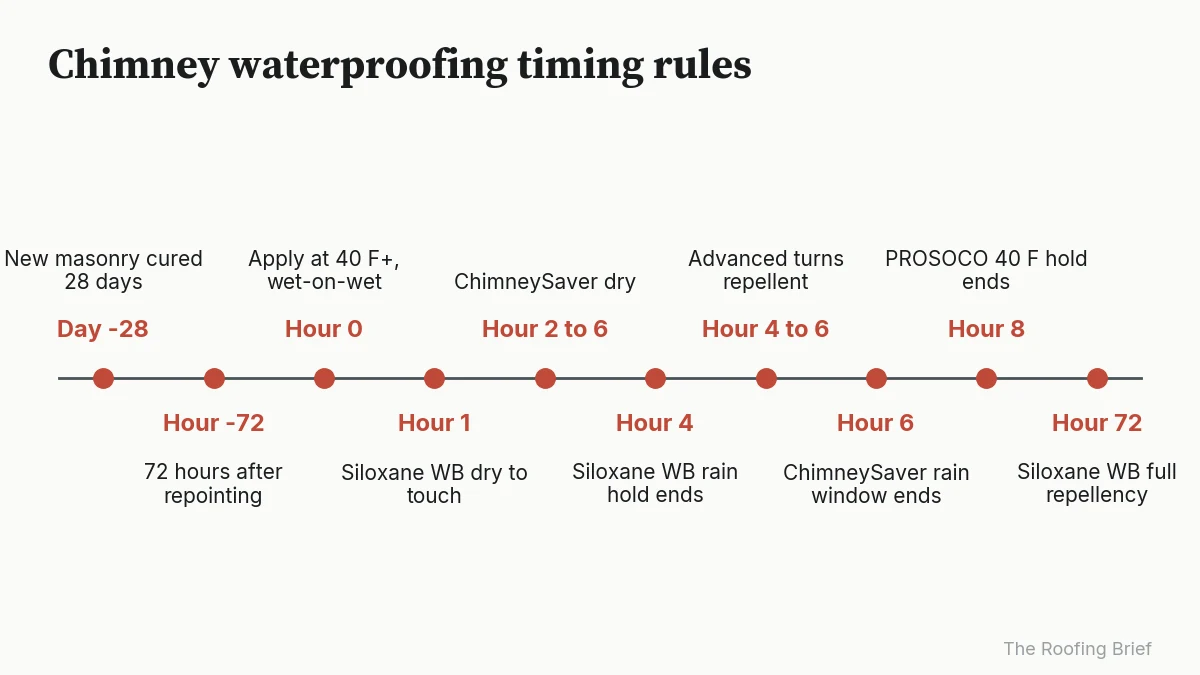
Chimney waterproofing dries in 1 to 6 hours and becomes water repellent within hours, but full repellency can take up to 72 hours, per the data sheets. ChimneySaver Advanced turns water repellent “after 4 to 6 hours of exposure to UV light and atmospheric moisture,” and PROSOCO says Siloxane WB surfaces “may require as many as 72 hours to gain their water repellency properties.”
| When | What happens or is required | Source |
|---|---|---|
| Day -28 | New masonry cured at least 28 days | ChimneySaver Advanced and Water-Base data sheets |
| Hour -72 | At least 72 hours since repairs or tuckpointing | ChimneySaver data sheets |
| Hour 0 | Apply at 40 F or warmer, wet-on-wet | ChimneySaver; PROSOCO |
| Hour 1 | Siloxane WB dry to the touch | PROSOCO Siloxane WB PDS |
| Hour 2 to 6 | ChimneySaver dry, depending on temperature and humidity | ChimneySaver Advanced data sheet |
| Hour 4 | End of Siloxane WB minimum rain protection | PROSOCO Siloxane WB PDS |
| Hour 4 to 6 | ChimneySaver Advanced becomes water repellent under UV | ChimneySaver Advanced data sheet |
| Hour 6 | End of ChimneySaver rain and 40 F window | ChimneySaver Advanced data sheet |
| Hour 8 | End of PROSOCO 40 F minimum hold | PROSOCO Siloxane WB and PD PDS |
| Hour 72 | Siloxane WB may need this long for full repellency | PROSOCO Siloxane WB PDS |
ChimneySaver Advanced “increases in strength for several weeks after treatment,” per its sheet, so a hose test on day one understates the final result. If a hose test still shows water inside after 72 hours, check the crown and flashing next.
What does chimney waterproofing not fix?
Chimney waterproofing does not fix failed flashing, a cracked crown, an open flue joint, mortar joints that need repointing, cracks wider than 0.02 inch, spalled brick or water ponding behind a wide chimney. PROSOCO says its repellents will not keep water out of “cracks, defects or open joints,” and the ChimneySaver warranty excludes pre-existing spalling and faulty construction.
| Problem | Why a repellent does not fix it | What does |
|---|---|---|
| Leak at the roof line, stain on the ceiling beside the chimney | Water enters at the flashing joint, not through the brick face | Flashing repair or replacement |
| Cracked crown or open joint at the flue liner | Horizontal crown and joint need a membrane or sealant; PROSOCO requires the top capped first | Crown coating, bond break sealant or rebuild |
| Cracks wider than 0.02 in, open mortar joints | PROSOCO rates bridging only for shrinkage cracks of 0.02 in or less | Repointing, then wait 72 hours (ChimneySaver) |
| Spalled or flaking brick | Excluded from the ChimneySaver warranty; NPS warns a coating on spalling stone may form a crust | Brick replacement |
| Water ponding behind a chimney wider than 30 in | Ponding stays against the brick and flashing | A cricket (IRC R1003.20); General Shale says one “is usually required” over 30 in |
| Rain and animals entering the flue | The flue opening is not a brick face | A chimney cap |
A roof-line leak needs a hose test that separates flashing from brick, run zone by zone in 5 minute passes in our guide to a chimney flashing leak. The warning signs of failed metal are listed in our page on bad chimney flashing. The reglet-set top piece is explained in our guide to counter flashing.
A chimney wider than 30 inches also needs its cricket checked before treatment, as set out in our page on chimney cricket installation. The flue opening itself is covered in our guide to the chimney cap.
How much does chimney waterproofing cost?
Professional chimney waterproofing costs $150 to $500, per Fixr’s chimney repair guide updated January 31, 2025, which calls sealing “also known as chimney waterproofing.” Materials for the two example chimneys below run $86.65 to $173.30 at SaverSystems’ October 2026 price for ChimneySaver Advanced. The repairs a repellent cannot replace cost more.
| Job | Published range | Source and date |
|---|---|---|
| Chimney sealing (waterproofing), pro | $150 to $500 | Fixr, updated January 31, 2025 |
| Leaking chimney repair | $150 to $500 | HomeAdvisor, updated June 20, 2026 |
| Repointing a chimney | $500 to $2,500 | Fixr, January 31, 2025 |
| Repointing brick, per sq ft | $4 to $25 | HomeAdvisor, June 20, 2026 |
| Spalling repair | $1,000 to $2,500 | Fixr, January 31, 2025 |
| Crown repair | $150 to $350 | HomeAdvisor, June 20, 2026 |
The worked example below sizes material for two chimneys using ChimneySaver Advanced’s lowest porous-brick coverage, 100 sq ft per coat, and assumes two full coats even though the second wet-on-wet coat uses less. It is a Roofing Brief estimate that shows the arithmetic, not a quote.
| Line | Chimney A | Chimney B | How it is calculated |
|---|---|---|---|
| Size above the roof | 2 x 2 ft, 6 ft tall | 2 x 4 ft, 8 ft tall | Input |
| Brick area, four faces | 48 sq ft | 96 sq ft | Perimeter x height (8 x 6; 12 x 8) |
| Gallons, two coats at 100 sq ft per coat | 0.96 gal | 1.92 gal | Area x 2 / 100 |
| Material, ChimneySaver Advanced | $86.65 (1 gal) | $173.30 (2 x 1 gal) | SaverSystems store, Oct 2026 |
| Pro job, Fixr range | $150 to $500 | $150 to $500 | Fixr, January 31, 2025 |
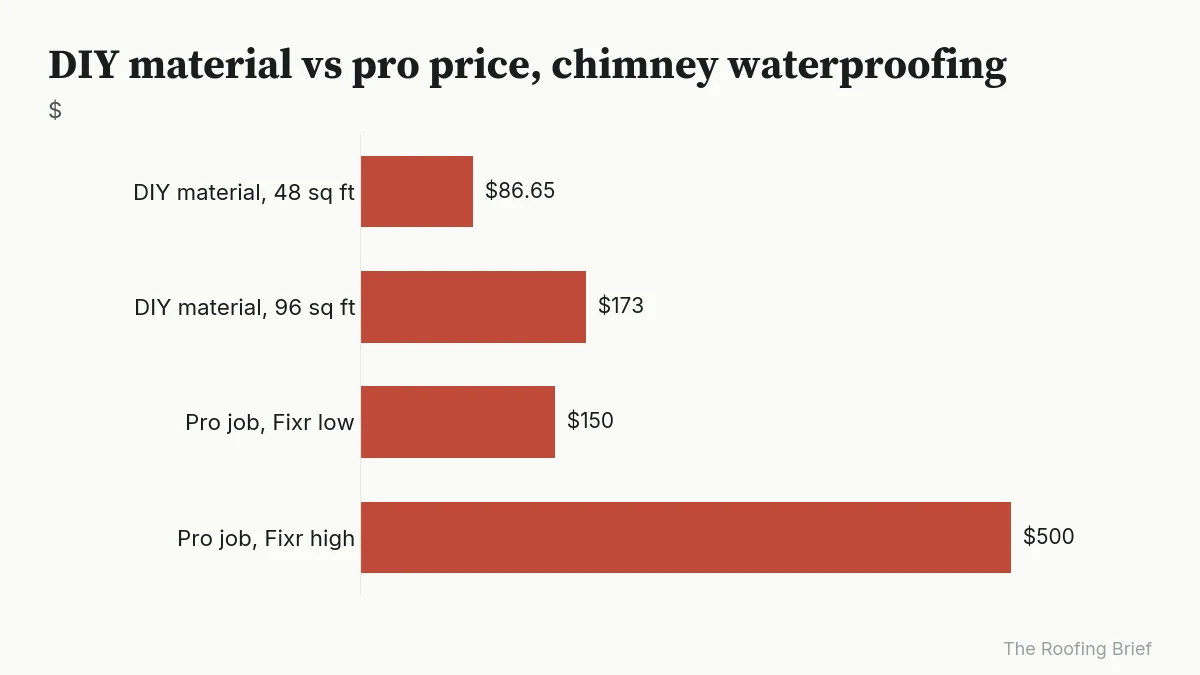
Two 1 gallon cans ($173.30) beat one 5 gallon pail ($424.75) for Chimney B. Access sets the rest of the bill: Fixr prices chimney labor at $50 to $150 per hour and scaffolding at $50 to $200 extra in its chimney repair cost guide.
Chimney waterproofing decision table: if your situation is X, do Y
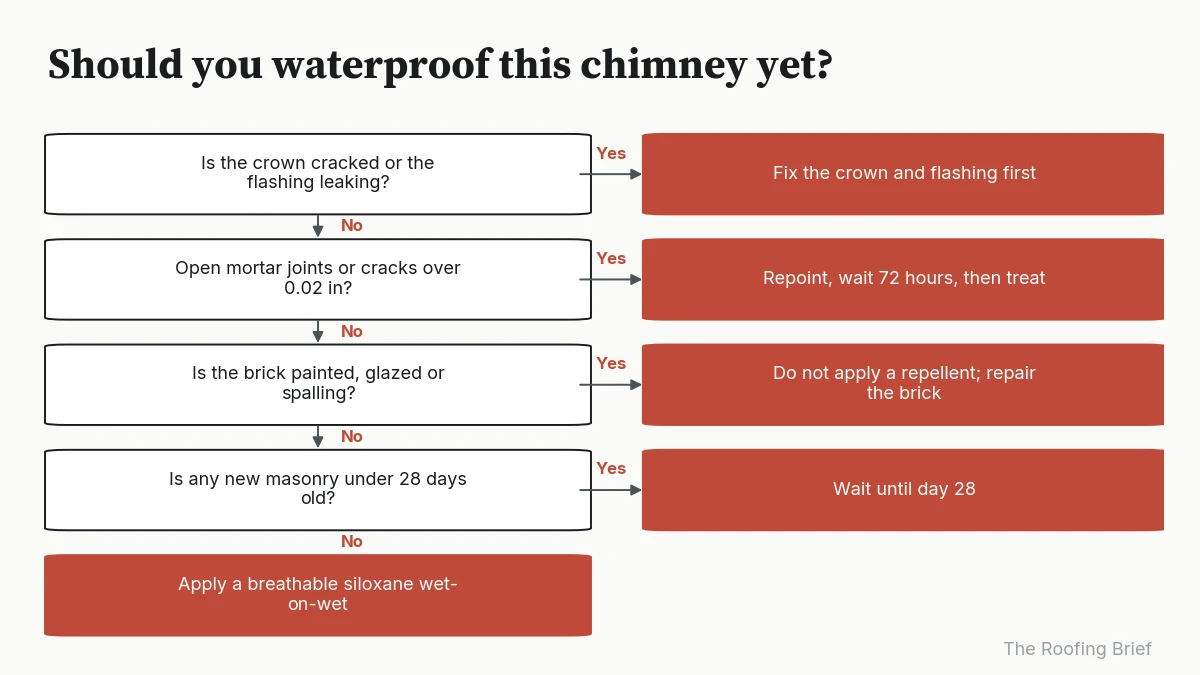
Match the chimney’s condition to the row below. Each row carries a threshold from a maker data sheet, the IRC or Preservation Brief 1 (temperature, crack width, cure days, surface type), so the same chimney lands on the same answer whoever checks it. The flowchart runs the same order of operations in four questions: top and flashing, joints, surface, then cure time.
| If your situation is | Do this | Rule behind it |
|---|---|---|
| Crown cracked or flashing leaking | Fix the crown and flashing first | PROSOCO: top must be “capped and made watertight”; ChimneySaver repair list |
| Open mortar joints or cracks over 0.02 in | Repoint, wait 72 hours, then treat | PROSOCO crack limit; ChimneySaver 72 hour wait |
| Brick painted, glazed or spalling | Do not apply a repellent; repair or replace the brick | ChimneySaver limitations and warranty exclusions |
| New masonry under 28 days old | Wait until day 28 | ChimneySaver data sheets |
| Brick absorbs water, everything else sound | Apply a breathable siloxane wet-on-wet at 100 to 150 sq ft per coat | ChimneySaver Advanced data sheet |
| Chimney treated with a repellent before | Use a product rated to go over prior penetrating repellents | ChimneySaver Advanced data sheet |
| Limestone, marble or travertine chimney | Do not use Siloxane WB or PD; test any product first | PROSOCO limitations |
| Below 40 F expected within 6 hours | Wait | ChimneySaver Advanced data sheet |
If you are buying a house and the seller lists a recent waterproofing, ask for the product name and date, since the 10 year ChimneySaver warranty depends on professional application to label instructions. What an inspection covers and costs is in our page on chimney inspection cost.
How we compiled this
We compiled this page from 15 primary documents accessed in October 2026: NPS Preservation Brief 1, four SaverSystems product data sheets, two PROSOCO product data sheets, a DRYLOK product page, an Amazon product listing, SaverSystems store price listings, two cost guides and a General Shale chimney bulletin. We did not test, apply or measure any product; every performance figure is the maker’s published result.
Frequently asked questions
Is waterproofing a chimney worth it?
It is worth it when the brick itself absorbs water and the crown, flashing and mortar are already sound. NPS Preservation Brief 1 says water entry “is seldom due to porous masonry” and usually traces to deferred maintenance, so fix those first. A pro treatment costs $150 to $500, per Fixr’s January 2025 guide.
How can I waterproof my chimney?
Repair the crown, flashing and open joints first and wait 72 hours after repointing. Then spray a breathable siloxane from the bottom up at 10 to 25 psi until it runs 6 to 8 inches below the spray line, and recoat wet-on-wet within 3 to 5 minutes. Work at 40 F or warmer with no rain for 6 hours, per ChimneySaver Advanced.
How much does it cost to waterproof your chimney?
A professional chimney sealing job costs $150 to $500, per Fixr’s guide updated January 31, 2025. Doing it yourself, a 48 sq ft chimney needs under 1 gallon of ChimneySaver Advanced ($86.65 at SaverSystems, October 2026) for two coats at 100 sq ft per coat, and a 96 sq ft chimney needs about 2 gallons ($173.30).
What is the best product for waterproofing a chimney?
Pick a breathable silane or siloxane repellent that publishes test data, not a film-forming coating. PROSOCO Siloxane WB Concentrate lists 99.23% brick absorption reduction under ASTM C67, ChimneySaver Water-Base 96.9% and PROSOCO Siloxane PD 95.89%. ChimneySaver Advanced is rated to go over earlier penetrating repellents, which suits a chimney treated before.
How long does chimney waterproofing last?
SaverSystems warrants that ChimneySaver Advanced and Multi-Purpose will show a water repellent effect on vertical surfaces for 10 years when a professional contractor applies them to label instructions. PROSOCO estimates Siloxane PD’s service life at more than 10 years. Neither figure covers spalling, faulty construction or labor to reapply.
How soon can it rain after waterproofing a chimney?
ChimneySaver Advanced needs 6 hours with no rain and no drop below 40 F after application. PROSOCO Siloxane WB needs at least 4 hours of rain protection and may take up to 72 hours to reach full water repellency. Cover the chimney with polyethylene if rain arrives early, as the ChimneySaver Water-Base sheet allows.
Should you paint or seal a chimney with a waterproof coating?
Not the brick face of a working chimney. NPS Preservation Brief 1 says waterproof coatings, including bituminous coatings and some elastomeric paints, seal out water vapor as well as liquid. SaverSystems notes that combustion produces water vapor that must escape the chimney, which is why breathable silane and siloxane repellents are used instead.
Does chimney waterproofing stop leaks?
Only leaks through the brick face. ChimneySaver Water-Base lists a 99.9% leakage reduction under ASTM E514, but PROSOCO says repellents will not keep water out of cracks, defects or open joints. Leaks at the roof line usually come from flashing, which HomeAdvisor prices at $150 to $500 for a leaking chimney repair.
Sources
- National Park Service, Preservation Brief 1: Assessing Cleaning and Water-Repellent Treatments for Historic Masonry Buildings (November 2000), accessed Oct 2026
- SaverSystems, ChimneySaver Advanced Water Repellent product data sheet (2026), accessed Oct 2026
- SaverSystems, ChimneySaver Multi-Purpose Water Repellent product data sheet, accessed Oct 2026
- SaverSystems, ChimneySaver Water-Base Water Repellent product data sheet (2015), accessed Oct 2026
- SaverSystems, CrownCoat Brushable Sealant product data sheet, accessed Oct 2026
- SaverSystems, FlashSeal product data sheet, accessed Oct 2026
- PROSOCO, Sure Klean Weather Seal Siloxane WB Concentrate product data sheet (2025), accessed Oct 2026
- PROSOCO, Sure Klean Weather Seal Siloxane PD product data sheet (2025), accessed Oct 2026
- DRYLOK, How to Utilize a Clear Sealer on Chimneys (Siloxane 7), accessed Oct 2026
- Amazon, ChimneyRx 300119 Masonry Chimney Water Repellent listing, accessed Oct 2026
- SaverSystems store, chimney water repellent price listings, accessed Oct 2026
- SaverSystems store, ChimneySaver Advanced: 1 gal $86.65, 5 gal $424.75, accessed Oct 2026
- Fixr, chimney repair cost guide (updated January 31, 2025), accessed Oct 2026
- HomeAdvisor, chimney repair cost guide (updated June 20, 2026), accessed Oct 2026
- General Shale Brick, Tech Bulletin: Chimney Checklist (June 2020), accessed Oct 2026