
By The Roofing Brief Team | Last reviewed: October 2026
A chimney crown is the sloped concrete, stone or metal slab sealing a masonry chimney’s top. IRC R1003.9.1 requires a drip edge and caulked flue bond break; ASTM C1283 sets a 10 degree slope and 2 inch overhang.
Key takeaways
- The model code text reads: “Masonry chimneys shall have a concrete, metal or stone cap, a drip edge and a caulked bond break around any flue liners in accordance with ASTM C1283,” sloped to shed water (IRC R1003.9.1, as printed in the 2025 California Residential Code).
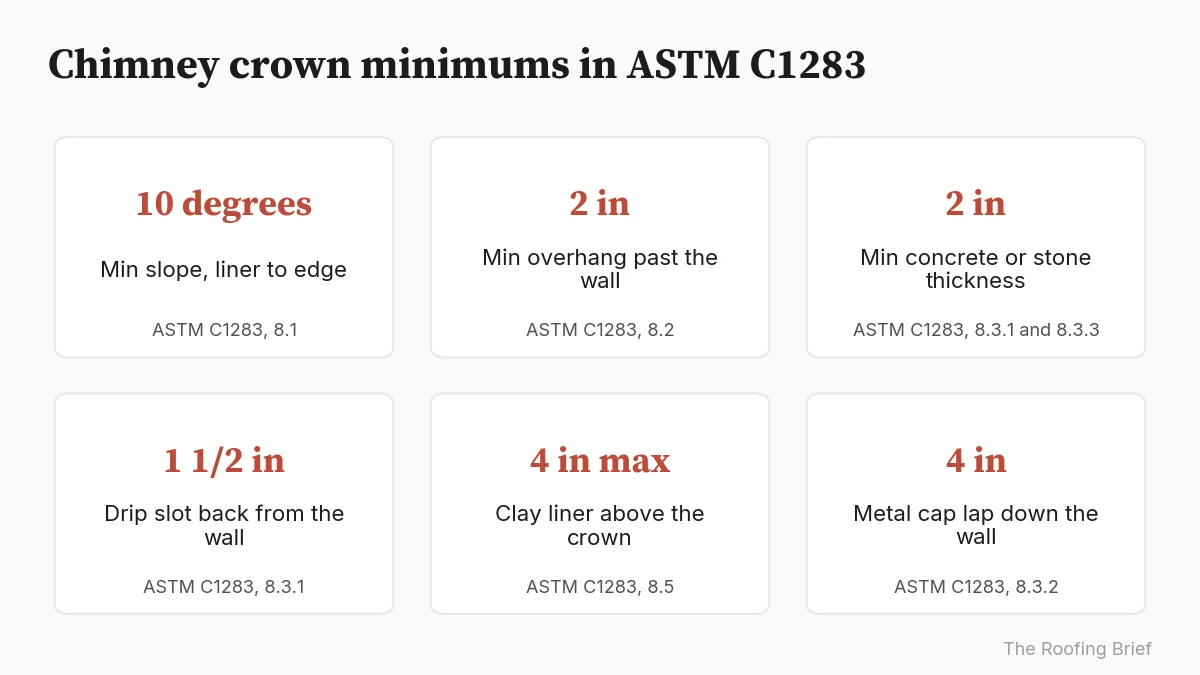
- ASTM C1283 Section 8 supplies the numbers: 10 degree minimum slope, 2 inch minimum overhang, 2 inch minimum thickness for concrete or stone, a drip slot at least 1 1/2 inches from the wall, and a clay liner no more than 4 inches above the crown (Buckley Rumford transcription of ASTM C1283).
- A thin, feathered mortar “wash” is the usual failure: General Shale’s chimney bulletin says these caps “usually crack due to shrinkage of the mortar soon after construction.”
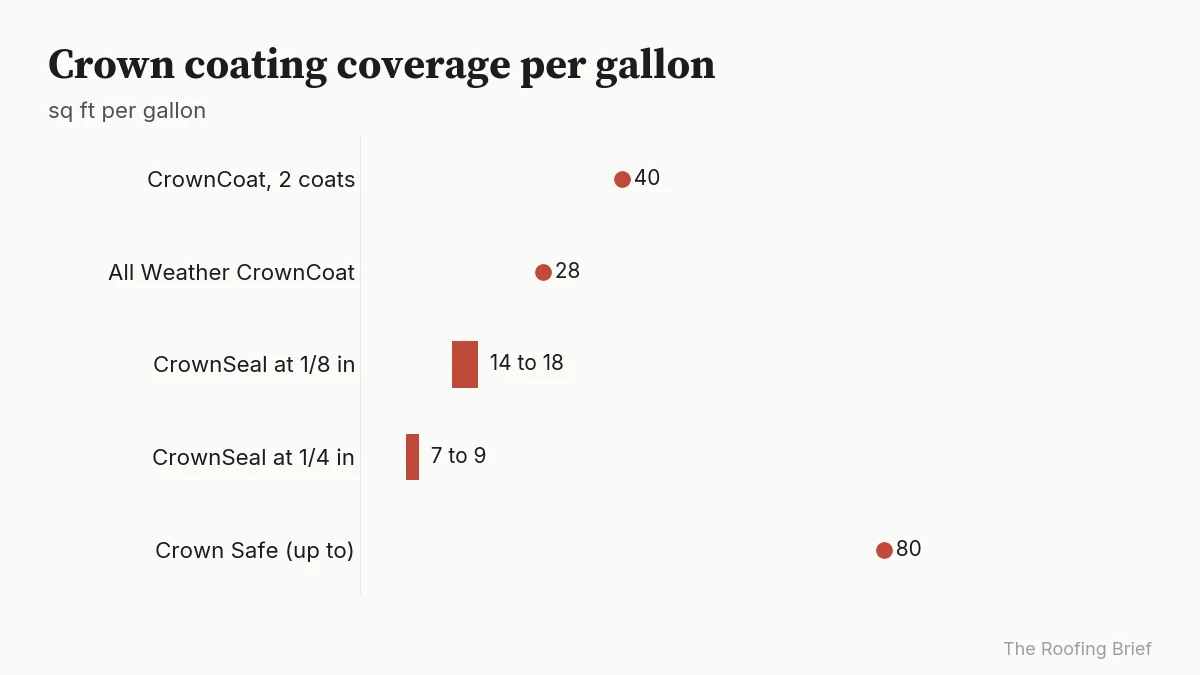
- Elastomeric crown coatings only go on a sound crown: SaverSystems requires a surface that is “structurally sound, not loose” for CrownCoat (40 sq ft per gallon, two coats) and CrownSeal (14 to 18 sq ft per gallon at 1/8 inch).
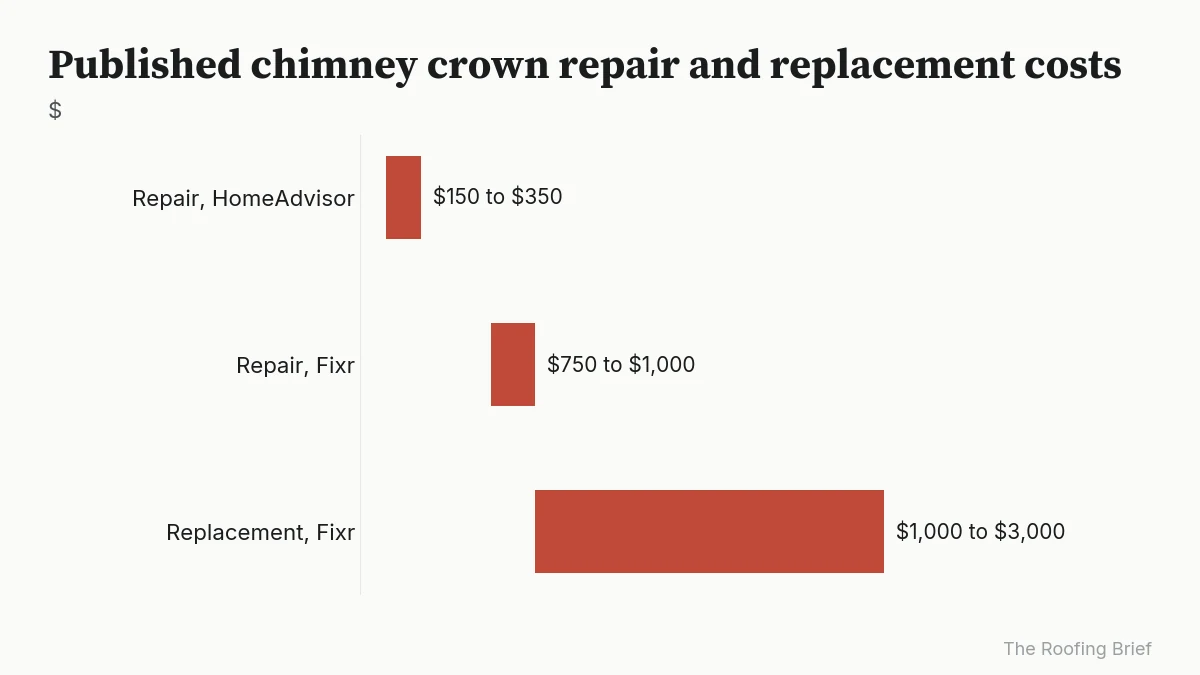
- Published crown repair costs run $150 to $350 (HomeAdvisor, updated June 20, 2026) to $750 to $1,000 (Fixr, January 2025), and crown replacement runs up to $3,000 in both guides.
What is a chimney crown, and what does the code require?
A chimney crown is the top slab of a masonry chimney, the part that keeps rain off the brick core and drains it past the walls. The International Residential Code calls it a “cap” in Section R1003.9.1 and requires three things: a concrete, metal or stone material, a drip edge, and a caulked bond break around each flue liner built to ASTM C1283, all sloped to shed water.
The code hands the dimensions to ASTM C1283, the Standard Practice for Installing Clay Flue Lining, whose Section 8 is transcribed by Jim Buckley of Buckley Rumford Fireplaces on his chimney cap training page. Michigan once wrote the same numbers straight into its amended R1003.9.1, adding that joint sealants meet ASTM C920 Type S or M, Grade NS, Class 25; that rule was rescinded effective August 29, 2025 (Mich. Admin. Code R 408.30547b, Cornell LII).
| Crown requirement | Minimum or limit | Source |
|---|---|---|
| Slope from flue liner to edge | 10 degrees | ASTM C1283, 8.1 |
| Overhang past the chimney wall | 2 in | ASTM C1283, 8.2 |
| Concrete or stone thickness | 2 in | ASTM C1283, 8.3.1 and 8.3.3 |
| Drip slot set back from the wall | 1 1/2 in | ASTM C1283, 8.3.1 |
| Clay liner height above the crown | 4 in max | ASTM C1283, 8.5 |
| Metal cap lap down the wall | 4 in | ASTM C1283, 8.3.2 |
| Concrete reinforcement | 1/2 in mesh galvanized hardware cloth, halfway into the form | ASTM C1283, 8.3.1 |
| Bond break at each flue liner | Sealed with a noncombustible resilient sealant | ASTM C1283, 8.4; IRC R1003.9.1 |
ASTM C1283 calls the bond break “a maintenance joint” that “should be checked and renewed as needed.” In other words, the standard expects the sealant at the liner to need renewal during the crown’s life, so a crown with sound concrete can still leak at that joint.
Chimney crown vs wash vs cap vs chase cover: which one do you have?
Four different parts get called a “chimney top,” and only one of them is a chimney crown: a formed concrete, stone or metal slab with a 2 inch overhang (ASTM C1283). A mortar wash is a thin troweled topping with no overhang, and a chimney cap is a metal hood over the flue opening. A chase cover is the sheet metal top of a framed chase around a factory-built flue.
| Part | What it is | Governing rule |
|---|---|---|
| Chimney crown (code: “cap”) | Cast-in-place or precast concrete, stone or metal slab, sloped, with overhang and drip | IRC R1003.9.1; ASTM C1283 Section 8 |
| Mortar wash | Trowel-applied mortar topping, often feathered to the brick edge; cracks and debonds from the brick below (General Shale) | BIA Technical Note 19B says feathering “should be avoided” |
| Chimney cap (rain cap, spark arrestor) | Metal hood and screen over the flue outlet | IRC R1003.9.2 and R1003.9.3: net free area at least 4 times the flue outlet |
| Chase cover | Sheet metal top on a framed chase around a factory-built chimney | Chimney maker’s listing (IRC R1005) |
The hood over the flue falls under IRC R1003.9.2, which requires a spark arrestor with openings between 3/8 and 1/2 inch on any solid-fuel chimney, per the 2025 CRC text. Sizing and buying one is covered in our guide to the chimney cap.
A framed chimney with a metal top has no crown at all, so crown coatings and concrete do not apply. That metal pan is explained in our page on the chimney chase cover.
How much overhang and slope does a chimney crown need?
A chimney crown needs at least a 2 inch overhang on every side and at least a 10 degree slope from the flue liner to the edge, per ASTM C1283 Sections 8.1 and 8.2. Ten degrees works out to about 2 1/8 inches of fall per foot of run (12 inches x tan 10 degrees = 2.12 inches). Several popular guides quote stricter or different numbers, so the table sets each claim against the primary document.
| Item | What a guide or bulletin says | What the primary standard says | Reading |
|---|---|---|---|
| Slope | “Minimum of 3 inches of fall per foot” (Ask the Builder) | 10 degrees minimum, about 2 1/8 in per ft (ASTM C1283, 8.1) | 3 in per ft is about 14 degrees: stricter than the minimum, still compliant |
| Overhang | At least 2.5 in on all sides (Ask the Builder) | 2 in minimum (ASTM C1283, 8.2) | 2.5 in exceeds the minimum |
| Flue liner above the crown | “At least four (4) inches” (General Shale bulletin); “minimum of 2 in.” (BIA TN 19B) | Clay liner “not more than 4 in.” (ASTM C1283, 8.5) | 4 in satisfies all three documents; 2 to 4 in satisfies BIA and ASTM |
| Bond break width | 3/8 to 1/2 in (General Shale); at least 5/8 in (Buckley Rumford) | Sealed bond break required, no width stated (ASTM C1283, 8.4) | Follow the sealant maker’s joint width |
| Slope (CSIA training) | “Slope 1 inch per foot” (Russ Dimmitt, CSIA, 2020 HPBExpo) | 10 degrees minimum, about 2 1/8 in per ft (ASTM C1283, 8.1) | 1 in per ft is about 5 degrees: below the ASTM minimum, so build to 10 degrees |
| Drip edge position | “Drip edge 1 inch from the chimney” (CSIA session) | Drip slot at least 1 1/2 in from the wall (ASTM C1283, 8.3.1) | Set the slot at 1 1/2 in or more |
| Name | “Crown” in the trade | “Chimney caps” is the IRC R1003.9.1 heading | Same part; ask a mason which one a quote means |
Check the liner height on any quote. ASTM C1283 caps clay liner projection at 4 inches, General Shale’s June 2020 chimney checklist asks for at least 4 inches, and the Brick Industry Association’s Technical Note 19B (reissued April 1998) asks for at least 2 inches. A liner that sits flush with the crown fails all three.
Where a crown cannot overhang, BIA Technical Note 19B says “the last two courses of the chimney brickwork should be corbeled out to form a drip.” Without either, water runs down the brick face, the wetting addressed in our guide to chimney waterproofing.
Why do chimney crowns crack?
Most chimney crowns crack for one of three documented reasons: the crown is a thin mortar wash that shrinks, the crown is bonded tight to the flue liner so liner heat movement splits it, or the concrete has no reinforcement and no flashing beneath it. Each cause is named in a brick maker or trade association document, and each points to a different repair.
- Shrinkage of a thin mortar wash (General Shale; SaverSystems CrownPrep sheet)
- A crown bonded to the flue liner with no sealed joint (General Shale; ASTM C1283, 8.4)
- No reinforcement and no flashing under cast-in-place concrete (BIA TN 19B)
On shrinkage, General Shale’s bulletin says thin, feather-edged parge caps “usually crack due to shrinkage of the mortar soon after construction.” The SaverSystems CrownPrep data sheet adds that crowns “are commonly made with mortar instead of the recommended concrete.”
On liner movement, General Shale says the crown “should not be bonded or mechanically anchored to the flue tile,” because the tile’s thermal expansion will “crack the cap.” Buckley Rumford’s chimney cap page warns that a joint thinner than 5/8 inch “will tear away and fail.”
On reinforcement, BIA Technical Note 19B says shrinkage “is a certainty” in cast-in-place caps and recommends flashing beneath them, which can double as the bond break. ASTM C1283 sets the reinforcement at 1/2 inch mesh galvanized hardware cloth placed halfway into the form.
Which crack repair products work on a chimney crown?
Chimney crown repair products split into brushable elastomeric coatings for hairline cracks, trowel-grade elastomeric coatings for wider cracks and rough surfaces, and cementitious resurfacers. All five maker data sheets below require a clean, dry crown, and the SaverSystems sheets add that it must be “structurally sound, not loose.” Coverage ranges from 7 to 80 square feet per gallon depending on film thickness.
| Product (maker) | Type | Coverage | Application temperature | Cure | Elongation or warranty | Source |
|---|---|---|---|---|---|---|
| CrownCoat Brushable Sealant (SaverSystems) | Brushable elastomeric resin blend | About 40 sq ft per gal, two coats | 45 to 95 F; no drop below 45 F within 4 hours | Touch dry 30 to 60 min; full cure 2 to 4 hours | 200% elongation; 10,000 hr ASTM G53 QUV with no cracking | CrownCoat data sheet |
| All Weather CrownCoat (SaverSystems) | Brushable elastomeric, freeze-cure | About 28 sq ft per gal | Up to 95 F, down to minus 40 F | About 4 hours at 40 F and above; about 24 hours at 32 to 40 F | 200% elongation; 10 year limited warranty, professional application | All Weather CrownCoat data sheet |
| CrownSeal (SaverSystems) | Trowel-grade elastomeric, 1/8 to 1/4 in (1 in max) | 14 to 18 sq ft per gal at 1/8 in; 7 to 9 at 1/4 in | 45 to 95 F; no drop below 45 F within 24 hours | 6 to 8 hours warm; 24 to 72 hours cool | 10 year limited warranty, professional application; 5,000 hr QUV | CrownSeal data sheet |
| CrownSaver Crown Repair System (SaverSystems) | Polymer hydraulic cement with modified polysiloxane, mixed 1:3 with sand | About 30 sq ft at 1/2 in per container | 40 to 95 F | Touch dry 4 to 6 hours; full cure 24 hours | 10 year warranty against shrinkage cracks, professional application | CrownSaver data sheet |
| Crown Safe (U.S. Fireplace Products) | Fibered, brushable elastic sealant, dries clear | Up to 80 sq ft per gal at 1/16 to 1/8 in | Labeled for wet and freezing conditions | Not stated on the sheet | Limited lifetime warranty; 5 years after a home sale | Crown Safe data sheet |
Read the warranty terms before a DIY application. The 10 year CrownSeal and All Weather CrownCoat warranties apply “when properly applied by a professional contractor,” exclude spalling and faulty construction, and supply replacement product only, not labor. Crown Safe excludes labor too, is void if corrosive cleaners are used, and dries clear; the SaverSystems coatings dry light gray with VOC content of 30 to 35 g/L (EPA Method 24).
How do you seal a cracked chimney crown?
Sealing a cracked chimney crown is a six-step job on a dry day between 45 and 95 F: clean, open or reseal the bond break, fill wide cracks, prime soft mortar, coat, and keep rain off until cure. The steps below follow the SaverSystems data sheets and ASTM C1283; any crown that crumbles under a stiff brush in step 1 needs a rebuild instead.
- Check the forecast: CrownCoat needs 45 F or warmer with no rain for 4 hours; CrownSeal needs 45 F or warmer and no rain for 24 hours (SaverSystems data sheets).
- Brush the crown with a stiff poly brush and remove loose material. If pieces come away or the crown rocks, stop and plan a rebuild.
- Cut out old sealant at each flue liner and reseal the bond break with a noncombustible resilient sealant (ASTM C1283, 8.4). CrownSaver’s sheet calls for a 1/2 inch bead of silicone around each tile liner; General Shale warns that acid-cure silicones do not bond to cement products.
- Fill larger cracks and voids with fast-setting patching cement or siliconized acrylic latex caulk; CrownCoat and CrownSeal may go over the caulk before it cures.
- On a sandy mortar crown, brush two wet-on-wet coats of CrownPrep, wait 5 to 10 minutes to tack up, then coat (CrownPrep covers 100 to 150 sq ft per half gallon).
- Coat: mist the crown lightly (skip misting after CrownPrep), then brush two coats of CrownCoat with a 3 or 4 inch synthetic brush, or trowel CrownSeal to at least 1/8 inch, coating the base of each flue tile. Tape the top brick course for a clean edge, then remove the tape.
Cover CrownSeal with plastic if rain arrives before its 6 to 72 hour cure, per its data sheet. If water still shows inside after the coating cures, check the counter flashing set into the brick next, described in our counter flashing guide.
What does chimney crown repair cost?
Chimney crown repair costs $150 to $350 in HomeAdvisor’s guide updated June 20, 2026, and $750 to $1,000 in Fixr’s guide updated January 31, 2025; both put crown replacement at up to $3,000. The two guides do not define the job the same way, so ask each quote to say whether it covers a coating, a patch or a removal.
| Job | Published range | Source and date |
|---|---|---|
| Crown repair (HomeAdvisor) | $150 to $350 | HomeAdvisor chimney repair cost guide, updated June 20, 2026 |
| Crown repair (Fixr) | $750 to $1,000 | Fixr chimney repair cost guide, updated January 31, 2025 |
| Crown replacement (Fixr) | $1,000 to $3,000 | Fixr, January 31, 2025 |
| Crown replacement (HomeAdvisor) | Up to $3,000 | HomeAdvisor, June 20, 2026 |
| Chimney labor rate | $50 to $150 per hour | Fixr, January 31, 2025 |
| Scaffolding add-on | $50 to $200 extra | Fixr, January 31, 2025 |
Access is priced on top of the crown work. Fixr adds $50 to $200 for scaffolding and prices labor at $50 to $150 per hour in its chimney repair cost guide, so every extra hour of setup on a tall or steep roof adds up to $150 before any material.
The worked example below prices materials for a single-flue chimney with a 24 x 24 inch brick top and a 13 x 13 inch clay liner, using SaverSystems store prices and one hardware retailer seen in October 2026. It is a Roofing Brief estimate built to show the arithmetic, not a quote.
| Line | Value | How it is calculated |
|---|---|---|
| Crown footprint with 2 in overhang | 28 x 28 in = 5.44 sq ft | 24 in brick + 2 in each side (ASTM C1283, 8.2) |
| CrownCoat needed, two coats | 0.14 gal | 5.44 sq ft / 40 sq ft per gal |
| CrownSeal needed at 1/4 in | 0.78 gal | 5.44 sq ft / 7 sq ft per gal (low end) |
| Rebuild volume, 2 in at edge rising at 10 degrees | 0.92 cu ft | 3.32 in thick at the liner, 2 in at the edge, liner area excluded |
| Path A: ChimneyRX brushable, 1 gal | $89.99 | Hemlock Hardware listing, Oct 2026 |
| Path B: CrownPrep half gallon + CrownSeal 2 gal | $295.20 | $58.80 + $236.40, SaverSystems store, Oct 2026 |
| Path C: 1Trip! CrownMix rebuild, 3 x 50 lb pails | $223.89 | 0.92 / 0.4 cu ft per pail = 2.3, rounded up; 3 x $74.63 |
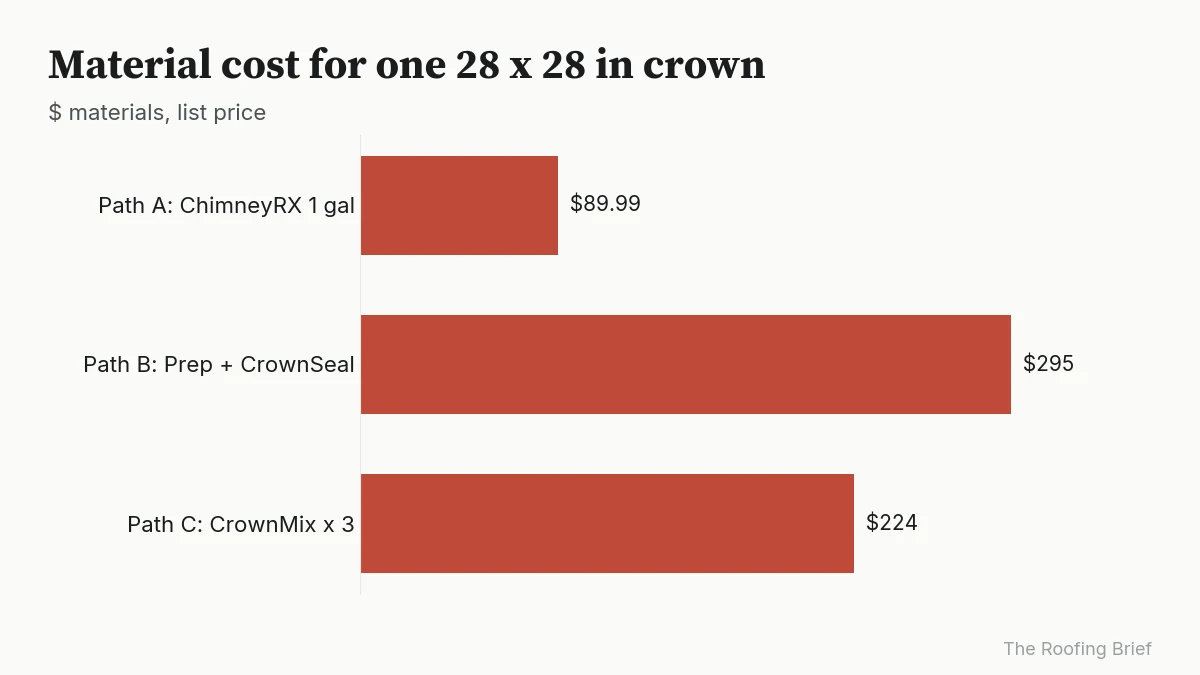
Path C excludes forms, the 1Trip! Form Release ($101.98), demolition of the old crown and bond break sealant, so its real total is higher than Path B. The smallest pail drives Paths A and B: a 5.44 sq ft crown uses about 14% of one gallon of CrownCoat, yet SaverSystems sells CrownCoat from $250.87 for a 2 gallon pail.
Repair or rebuild: where is the chimney crown threshold?
Repair a chimney crown when it is solid concrete or stone, overhangs the brick, and shows only cracks a coating can bridge; rebuild it when it is loose, crumbling, or a feathered mortar wash with no overhang. The repair line comes from the coating data sheets, which require a structurally sound surface, and the rebuild target comes from ASTM C1283 Section 8.
A coating cannot add what the crown lacks. CrownSeal goes on at 1/8 to 1/4 inch with a 1 inch maximum, and CrownCoat is a paint-thin film, so neither creates a 2 inch overhang, a 1 1/2 inch drip slot or a 10 degree slope. A flat, flush mortar wash that is still sound can be coated to stop water entering, but it will keep shedding water down the brick face until it is replaced.
The Chimney Safety Institute of America’s education director, Russ Dimmitt, lists three triggers for total replacement in his 2020 HPBExpo chimney crown session: the crown “is fragmented,” has “large pieces missing,” or the “substrate [is] unable to hold a coating product.” The same session warns that crack repairs made with tar or silicone sealants “will fail.”
A crown rebuild follows the sequence below, built from ASTM C1283, BIA Technical Note 19B, the CSIA session and the This Old House replacement guide; ask the mason to put each step in the written scope.
- Remove the old crown down to sound brick, then wet the brick so it does not pull moisture from the new mix (This Old House).
- Install support and a bond break: BIA Technical Note 19B recommends flashing under cast-in-place caps, which can double as the bond break, and General Shale says concrete caps “should be underlain by flashing.”
- Set forms for at least a 2 inch overhang (ASTM C1283, 8.2; the CSIA session teaches 2 1/2 inches) with a drip slot at least 1 1/2 inches from the wall.
- Place 1/2 inch mesh galvanized hardware cloth halfway into the form (ASTM C1283, 8.3.1).
- Pour concrete at least 2 inches thick at the edge, sloped at least 10 degrees from the liner, keeping a gap at each liner (3/8 inch in the CSIA session) and clay liners 2 to 4 inches above the crown (BIA TN 19B; ASTM C1283, 8.5).
- Strip and cure to the mix maker’s schedule: 1Trip! CrownMix sets in about 1 to 2 hours, forms come off at about 2 hours, and curing continues 5 days in warm weather, with a 50 F application minimum (1Trip! CrownMix product page).
- Seal the liner gap with a noncombustible resilient sealant, the maintenance joint in ASTM C1283, 8.4.
Have the liner checked while the top is open; liner repair is priced in our guide to the chimney liner.
Chimney crown decision table: if your situation is X, do Y
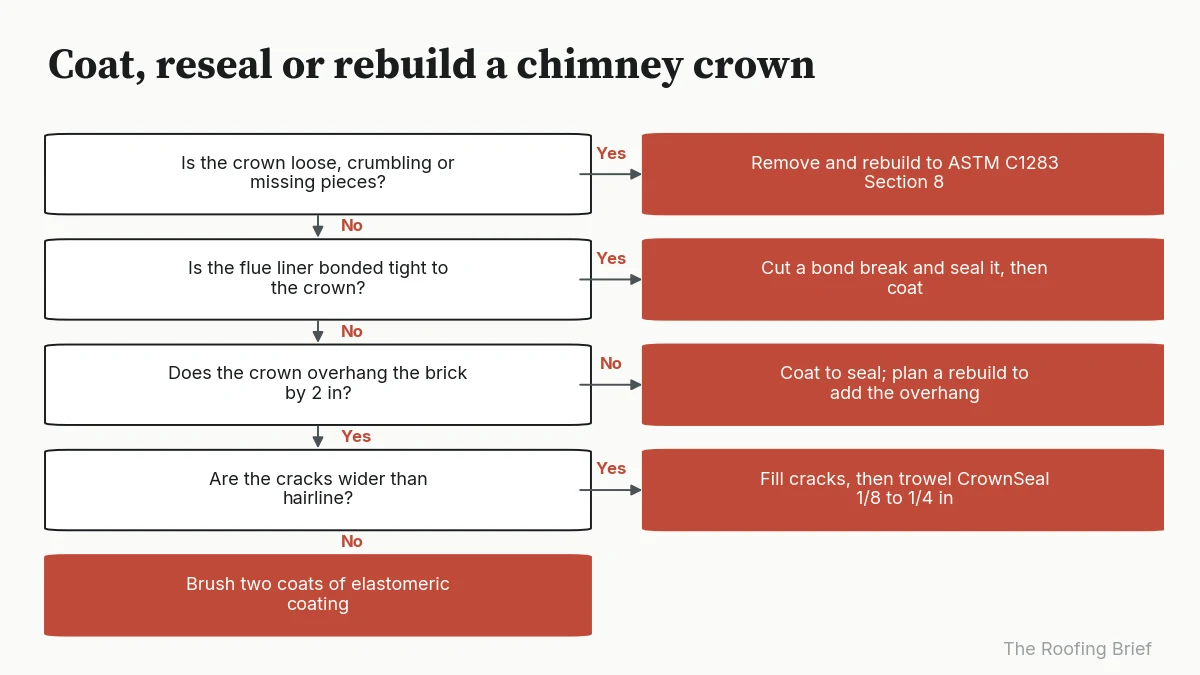
Use the table below to match the crown’s condition to the repair. Each row names a measurable threshold (temperature, overhang, crack size, soundness) taken from a maker data sheet or ASTM C1283, so the same crown should land on the same row whoever inspects it. The flowchart under the table runs the same logic in four questions.
| If your situation is | Do this | Rule behind it |
|---|---|---|
| Crown loose, crumbling or missing pieces | Remove and rebuild to ASTM C1283 Section 8 | Coatings need a surface “structurally sound, not loose” (SaverSystems) |
| Flue liner bonded tight to the crown | Cut a bond break and seal it, then coat | ASTM C1283, 8.4; IRC R1003.9.1 |
| Crown sound but flush, no 2 in overhang | Coat to seal; plan a rebuild to add the overhang and drip | ASTM C1283, 8.2 and 8.3.1 |
| Crown sound, cracks wider than hairline | Fill cracks, then trowel CrownSeal 1/8 to 1/4 in | CrownSeal data sheet |
| Crown sound, hairline cracks only | Brush two coats of an elastomeric coating (about 40 sq ft per gal) | CrownCoat data sheet |
| Work must happen below 45 F | Use All Weather CrownCoat or wait for warmer weather | All Weather CrownCoat cures down to minus 40 F |
| Crown sound and coated, water still entering | Inspect counter flashing and the brick face next | General Shale bulletin: walls and flashing are separate leak paths |
The crown is one stop on a longer leak path. If the crown checks out, the six failure modes at the roof line are covered in our guide to a chimney flashing leak. If you are buying a house, ask that the crown, liner projection and bond break be written into the inspection report; prices by inspection level are in our page on chimney inspection cost.
How we compiled this
We compiled this page from 19 primary documents accessed in October 2026: IRC R1003.9 as printed in the 2025 California Residential Code, a rescinded Michigan amendment, three Buckley Rumford pages on ASTM C1283, BIA Technical Note 19B, a General Shale bulletin, a 2020 CSIA training session, six maker data sheets, two sellers’ price listings and two cost guides. Two secondary guides were checked against them. We did not test, install or inspect any crown or product.
Frequently asked questions
What is the crown on a chimney?
The crown on a chimney is the concrete, stone or metal slab that covers the top of a masonry chimney around the flue liners. IRC R1003.9.1 requires it to be sloped to shed water, with a drip edge and a caulked bond break at each liner, and ASTM C1283 sets a 10 degree minimum slope and a 2 inch overhang.
How much does a chimney crown cost?
Crown repair runs $150 to $350 in HomeAdvisor’s guide updated June 20, 2026, and $750 to $1,000 in Fixr’s January 2025 guide. Full crown replacement runs $1,000 to $3,000 in Fixr’s guide, and HomeAdvisor puts it at up to $3,000. Fixr adds $50 to $200 for scaffolding and prices labor at $50 to $150 per hour.
How long will a chimney crown last?
Neither IRC R1003.9.1 nor ASTM C1283 Section 8 sets a service life for a crown. ASTM C1283 does call the liner bond break a maintenance joint that “should be checked and renewed as needed.” For coated crowns, SaverSystems warrants CrownSeal and All Weather CrownCoat to stay intact for 10 years when a professional contractor applies them.
Can I repair my chimney crown myself?
Yes, if the crown is solid and you can work safely on the roof. SaverSystems’ CrownCoat brushes on in two coats at about 40 sq ft per gallon and cures in 2 to 4 hours above 45 F. A crown that is fragmented or missing large pieces needs a rebuild instead, and the 10 year coating warranties apply only to professional application.
What is the difference between a chimney crown and a chimney cap?
A chimney crown is the concrete, stone or metal slab that covers the whole top of a masonry chimney, sloped at least 10 degrees with a 2 inch overhang under ASTM C1283. A chimney cap is the metal hood and screen over the flue opening. Confusingly, IRC R1003.9.1 uses the heading “Chimney caps” for the crown.
How thick should a chimney crown be?
ASTM C1283 Section 8.3 sets a 2 inch minimum thickness for precast or cast-in-place concrete and stone crowns, and Michigan’s former amendment measured it at the outer edge. Because the crown rises at least 10 degrees toward the flue, a crown with a 7.5 inch run from liner to edge is then about 3.3 inches thick at the liner.
Does a chimney crown need an overhang?
Yes. ASTM C1283 Section 8.2 requires the crown to overhang the chimney wall by at least 2 inches, and CSIA training teaches 2 1/2 inches, with a drip slot underneath at least 1 1/2 inches from the wall. If a crown cannot overhang, BIA Technical Note 19B says to corbel the last two brick courses out to form a drip.
How high should the flue liner stick out above the crown?
For clay liners, ASTM C1283 Section 8.5 sets a maximum of 4 inches above the crown, BIA Technical Note 19B asks for at least 2 inches, and General Shale’s 2020 bulletin asks for at least 4 inches. A liner projecting exactly 4 inches satisfies all three documents.
Sources
- 2025 California Residential Code, Sections R1003.9 to R1003.9.3 (IRC text), accessed Oct 2026
- Buckley Rumford, chimney cap training page quoting ASTM C1283 Section 8, accessed Oct 2026
- Buckley Rumford, ASTM C1283-02 ballot text, Section 8, accessed Oct 2026
- Buckley Rumford, chimney cap detail (5/8 inch bond break), accessed Oct 2026
- Brick Industry Association, Technical Note 19B, Residential Chimneys: Design and Construction (reissued April 1998), accessed Oct 2026
- General Shale Brick, Tech Bulletin: Chimney Checklist (June 2020), accessed Oct 2026
- Mich. Admin. Code R 408.30547b, Chimneys (rescinded effective Aug 29, 2025), Cornell LII, accessed Oct 2026
- SaverSystems, CrownCoat Brushable Sealant product data sheet, accessed Oct 2026
- SaverSystems, All Weather CrownCoat product data sheet, accessed Oct 2026
- SaverSystems, ChimneySaver CrownSeal product data sheet, accessed Oct 2026
- SaverSystems, CrownSaver Crown Repair System product data sheet, accessed Oct 2026
- SaverSystems, ChimneySaver CrownPrep product data sheet, accessed Oct 2026
- U.S. Fireplace Products, Crown Safe product data and installation sheet, accessed Oct 2026
- SaverSystems store, chimney crown repair price listings (CrownCoat, CrownSeal, CrownPrep, 1Trip! CrownMix), accessed Oct 2026
- SaverSystems store, CrownSeal Flexible Coating, 2 gal $236.40 and 5 gal $518.13, accessed Oct 2026
- SaverSystems store, CrownCoat Brushable Sealant, 2 gal $250.87 and 5 gal $503.32, accessed Oct 2026
- Hemlock Hardware, Chimney RX 1 Gal. Brushable Crown Repair listing ($89.99), accessed Oct 2026
- HomeAdvisor, chimney repair cost guide (updated June 20, 2026), accessed Oct 2026
- Fixr, chimney repair cost guide (updated January 31, 2025), accessed Oct 2026
- Russ Dimmitt, CSIA Director of Education, Chimney Crowns (2020 HPBExpo education session, NFI), accessed Oct 2026
- SaverSystems, ChimneySaver 1Trip! CrownMix product page ($74.63, set and cure times), accessed Oct 2026
- This Old House, How To Replace a Chimney Crown (secondary, checked against ASTM C1283), accessed Oct 2026
- Ask the Builder, Chimney Crown Repairs (compared against ASTM C1283), accessed Oct 2026