
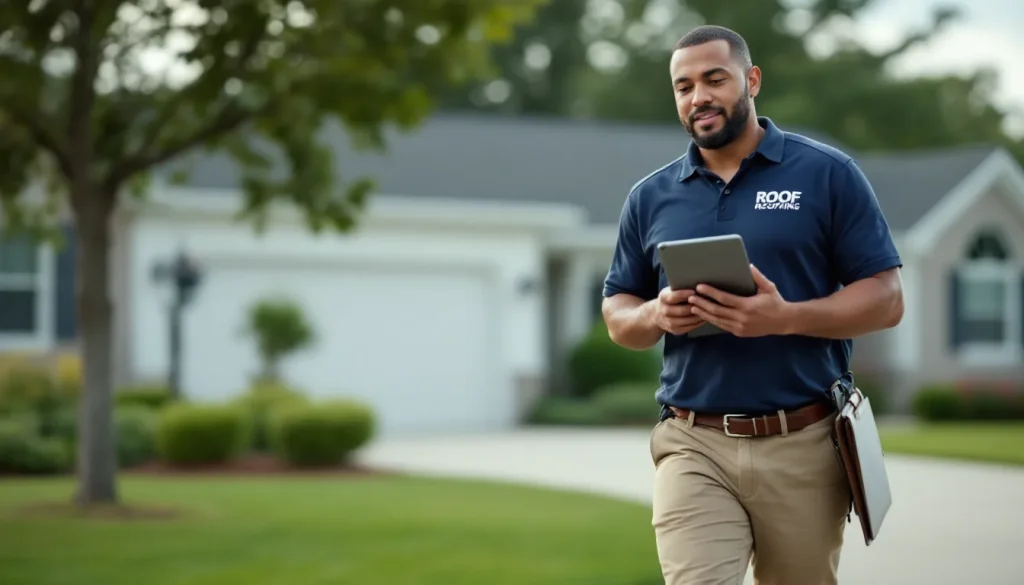
The honest truth about door to door roofing sales in 2026 is that the math still works, but only for teams that respect the new compliance and conversion environment. A trained rep working a storm-affected neighborhood averages 80 to 120 knocks per appointment set, 3 to 4 appointments per signed contract, and an average contract value of $14,000 to $22,000 on residential reroof. That produces $1,500 to $3,500 of commission per sale and $20K to $40K of gross revenue per productive rep-week. The reps and teams that fail are not failing because D2D stopped working. They are failing because they tried to run 2015 plays in a state with a no-knock registry, a license requirement, and a post-storm AOB restriction. This guide covers the conversion math, the state-by-state compliance environment, the four-step sales process that actually closes in 2026, and the team-size transition point where you should be moving budget from D2D to inbound channels.
The short version
- Real D2D conversion math in storm areas: 80 to 120 knocks per appointment, 3 to 4 appointments per close, $14K to $22K average ticket.
- Compliance is the difference between $30K commission months and a personal misdemeanor charge in eight states.
- Florida AOB reform restricts what reps can do at the door; California requires a separate solicitor permit on top of the contractor license.
- Rep ramp time is 30 to 60 days to break even; reps who do not produce by day 75 should be cut.
- Storm-affected D2D math is 3 to 5x better than cold-knock D2D math; treat them as separate channels.
- The team size transition point from D2D-led to inbound-led is roughly $5M to $8M of revenue.
The Short Answer: D2D Math + Why Compliance Is the Difference
Door-to-door roofing sales survives in 2026 because it is the only acquisition channel where unit economics work in the immediate post-storm window. When 5,000 roofs in a single zip code need replacement within 90 days, no amount of paid search or local SEO can compete with a trained rep walking the neighborhood with a tablet and a tape measure. The math at the unit level: a productive rep generates $20K to $40K of signed revenue per week at a 7 to 12 percent commission rate, meaning $1,400 to $4,800 of weekly rep cost on $20K to $40K of revenue. That is sustainable.
What changed is the compliance environment. Eight states now have specific contractor solicitation registration requirements that go beyond the underlying contractor license. Nineteen states have no-knock or Do Not Knock registries that reps are required to check before approaching a home. Multiple states (Florida, North Carolina, South Carolina, Mississippi, Texas) have post-storm contractor registration requirements that activate after a federally declared disaster. And the AOB reform laws in Florida specifically have restricted what reps can promise homeowners at the door about insurance work.
Teams that ignore the compliance environment get fined, lose their licenses in extreme cases, and damage the brand in ways that hurt inbound channels. The teams that thrive in 2026 D2D have built compliance into the daily routine: rep training that covers state-specific rules, daily check-in on no-knock lists, documented opt-in for AOB-restricted states, and disciplined script management.
The Real D2D Conversion Math
The conversion funnel for D2D roofing sales in 2026 has four stages: knocks (households contacted), appointments set (homeowner agrees to inspection), inspections completed (rep gets on the roof), and contracts signed. The conversion rates between stages depend heavily on context. Storm-affected neighborhoods produce dramatically different numbers than cold neighborhoods.
| Context | Knocks per Appointment | Appointments per Inspection | Inspections per Close | Avg Ticket |
|---|---|---|---|---|
| Storm-affected (within 30 days) | 40 to 80 | 1.2 to 1.5 | 2.0 to 3.0 | $18,000 to $28,000 |
| Storm-affected (30 to 90 days) | 80 to 150 | 1.3 to 1.8 | 2.5 to 3.5 | $15,000 to $22,000 |
| Cold (no storm, residential) | 200 to 400 | 1.5 to 2.0 | 3.5 to 5.0 | $12,000 to $18,000 |
| Cold (with referral angle) | 120 to 250 | 1.3 to 1.7 | 3.0 to 4.0 | $13,000 to $19,000 |
| Commercial (cold) | 500 to 1,000 | 2.0 to 3.0 | 5.0 to 8.0 | $45,000 to $150,000 |
The math for a single productive rep in a storm-affected neighborhood at 60 days post-storm: 100 knocks per day, 80 percent of which are contacts (someone answers), 1 appointment set per 100 knocks. That is 5 appointments per week. 3 appointments produce inspections, 1 inspection per 3 produces a signed contract. So 5 weekly appointments produces roughly 1.5 to 2 signed contracts per week at $18K average ticket, or $27K to $36K of weekly revenue per rep. The rep commission at 8 percent is $2,200 to $2,900 per week.
The math at the team level is where managers compound the unit economics. A team of 6 productive reps generates $160K to $215K of weekly revenue, which at 35 to 40 percent gross margin is $56K to $86K of gross profit per week. The sales manager overhead, supplies, tablets, and CRM cost roughly $8K to $15K weekly, leaving $40K to $70K of contribution margin per week from the D2D channel.
State-by-State D2D Compliance
The compliance environment is the single biggest differentiator between teams that scale and teams that get shut down. Here is the framework: every state has a contractor license requirement (covered in the separate licensing guide), some states layer a solicitor or canvasser permit on top of that, some have no-knock registries that must be checked, and some have post-storm specific rules that activate after disaster declarations.
| State | Solicitor Permit Required | No-Knock Registry | Post-Storm Rules | D2D Difficulty |
|---|---|---|---|---|
| Florida | Local (varies by city) | Yes (statewide) | AOB restrictions + 60-day cancellation | High |
| California | Yes (state level) | Yes (local) | Specific wildfire zone rules | Very High |
| Texas | Local (no state) | Some cities | Post-storm registration in declared zones | Moderate |
| Colorado | Yes in Denver, Aurora | Statewide | None specific | Moderate |
| Oklahoma | No statewide | Some cities | Post-storm registration in declared zones | Low to Moderate |
| Tennessee | No statewide | Limited | None specific | Low |
| North Carolina | Local | Limited | Post-storm contractor registration | Moderate |
| South Carolina | Local | Limited | Post-storm contractor registration | Moderate |
| Georgia | Local | Limited | None specific | Low to Moderate |
| Minnesota | Yes (state level) | Yes | Post-storm rules + contract requirements | High |
| Louisiana | Local | Limited | Post-storm contractor registration | Moderate |
| New York | Yes (state + local) | Yes (statewide) | 3-day rescission strict enforcement | Very High |
The solicitor permit requirements vary by city even within states. In Texas, Houston requires no permit but Dallas does. In Colorado, Denver and Aurora require permits but unincorporated Adams County does not. The practical implication: a D2D team operating across a metro area needs to know permit requirements at the city level and have a daily check-in process to confirm reps are working in permitted areas.
The no-knock registry compliance is the single largest source of fines. A homeowner on the registry who is approached by a D2D rep can file a complaint that triggers a state investigation and a fine that ranges from $500 to $10,000 per violation depending on the state. The fix is daily access to the registry (most states make it available to licensed contractors), a tablet-based route planning tool that filters out registry addresses, and rep training that emphasizes the personal liability.
Florida D2D Restrictions
Florida is the most complicated D2D state because of the combination of AOB reform, storm activity, and aggressive consumer protection enforcement. The 2023 AOB reform (covered in detail in the Florida AOB roofing reform guide) restricted what contractors can do with assignment of benefits, which directly affects what D2D reps can promise homeowners about insurance work.
The specific D2D rules in Florida 2026: reps must carry their state contractor license number on physical ID at all times. Reps cannot promise to handle the insurance claim on behalf of the homeowner without specific disclosures and signed paperwork that meet the post-reform requirements. The 60-day cancellation right gives homeowners a window to back out of any contract signed at the door, which means revenue from D2D-signed contracts cannot be fully recognized for 60 days.
The practical implications for Florida D2D teams: scripts have to be carefully written to avoid promises that violate the AOB rules; the close is harder because the rep cannot offer to deal with the insurance carrier as a one-stop shop; and the 60-day cancellation requires cash flow management because some contracts will cancel. Despite these challenges, Florida D2D works because of the volume of storm activity and the size of the residential reroof market.
Florida also has city-by-city peddler and solicitor ordinances that need to be checked. Some Florida cities require a separate solicitor permit on top of the state contractor license. The permits typically cost $50 to $300 and take 7 to 14 days to issue. Plan for this in your route expansion strategy; do not assume a state license covers all Florida D2D activity.
Texas D2D Considerations
Texas is the most active D2D market in the country because of storm frequency, the absence of state-level licensing, and the size of the residential market. Texas D2D teams operate aggressively, which has driven the regulatory response in some metros.
Houston requires no permit for door-to-door contractor solicitation. Dallas requires a solicitor permit for any commercial door-to-door activity. Austin has city-level no-knock list enforcement. San Antonio requires a solicitor permit. The variation across Texas metros means D2D teams need metro-specific compliance protocols, not a Texas-wide approach.
The post-storm rules activate after federal disaster declarations. In federally declared disaster zones, the Texas Department of Licensing and Regulation requires contractor registration that includes proof of insurance and a statement about pricing practices. The registration is fast (typically 48 hours) but is non-negotiable for contractors who want to work declared zones.
The competitive dynamics in Texas D2D are intense because the low barrier to entry attracts many out-of-state storm chasers after major events. The teams that win in Texas are typically locally based, have brand recognition from prior work in the market, and emphasize quality and warranty rather than competing on price. The race-to-the-bottom on pricing destroys margins quickly in Texas hail markets.
California D2D Rules
California is the most restrictive D2D state and the one where teams most often get into legal trouble. The C-39 roofing license is the underlying requirement, but on top of that, California has the Home Solicitation Sales Act (Civil Code Section 1689.5), which gives homeowners a 3-day rescission right on any contract signed in their home or at any location other than the contractor’s place of business.
The 3-day rescission requires specific disclosures in the contract, in 12-point bold font, and signed acknowledgment by the homeowner. Contracts that do not meet these requirements are voidable for the entire contract life, not just 3 days. California has been aggressive in enforcement, with consumer protection actions resulting in seven-figure penalties for non-compliant contractors.
California also has specific rules for wildfire-affected zones. After a declared disaster, contractors working in the affected area must register with the California Contractors State License Board within 7 days of starting work. The state also restricts down payments to $1,000 or 10 percent of contract value, whichever is less, on home improvement contracts (Business and Professions Code Section 7159.5). This restricts the cash flow model many D2D teams use elsewhere.
The 1099 misclassification rules under AB-5 apply directly to D2D reps. California has effectively required W-2 employment for roofing sales reps unless they meet very narrow exceptions. This raises the cost of California D2D meaningfully because workers comp on sales reps adds 3 to 8 percent to total compensation cost. The teams that work California successfully either accept the higher cost structure or focus exclusively on owner-led sales in California.
The 4-Step D2D Sales Process
The actual sales process at the door has four steps that have not fundamentally changed in 20 years, but the execution requirements have. Step one is opening, which is the first 15 seconds at the door. Step two is qualifying, where the rep determines if there is a real opportunity. Step three is presenting, which involves the roof inspection and damage documentation. Step four is closing, which is the contract signing decision.
The opening in 2026 has to be honest and specific because homeowners have heard every aggressive script. The strongest openings are situational: “We just finished a job two blocks over and noticed your shingles have similar storm damage. I have 10 minutes between appointments and can do a free inspection right now.” This works because it is true (the team should actually have a nearby job site) and offers something concrete (10 minutes, free inspection, immediate). Aggressive openings (“We’re the only ones who can help you with your insurance company”) trigger compliance issues and get the door closed.
Qualifying is where new reps lose most opportunities. The goal is to find out three things: does the homeowner own the home (renters cannot sign a roofing contract), is there a likely insurance claim opportunity (recent storm, observable damage), and is there decision-making authority at the door (or does the spouse need to be present). The conversational questions: “How long have you been in the home? Have you noticed any leaks recently? Is there another decision-maker who needs to be part of this?”
The presentation includes the roof inspection itself. A rep documents damage with photos, measures the roof, identifies the carrier name from any visible decals or asks the homeowner, and presents findings in a structured way. CompanyCam photos, EagleView measurements, and a clean tablet-based presentation increase close rates by 20 to 35 percent compared to verbal-only presentations. The companion guide on inspections and how to choose a roofing contractor covers the homeowner perspective on this process.
The close in 2026 is rarely a hard close. The strongest D2D closers walk the homeowner through the next steps and ask for the contract signature in the same calm tone as the rest of the conversation. The high-pressure close (“we have a special price only good today”) is both illegal in some states under the Home Solicitation Sales Act and ineffective in others because savvy homeowners recognize the pressure pattern and disengage.
Storm-Chasing Reputation Problem
The reputation problem facing D2D roofing in 2026 is real and is partly driven by the worst 5 percent of operators. Storm-chasing teams that move into a disaster zone, sign contracts at high pressure, take down payments, and disappear without delivering work have damaged the entire D2D channel. State enforcement actions, news coverage, and homeowner experiences have made the reputation issue a real barrier even for legitimate operators.
The legal lines that legitimate teams do not cross: misrepresenting insurance claim outcomes to the homeowner, taking down payments that exceed state limits, signing contracts without the required disclosures, working without proper registration in declared disaster zones, and using fake or out-of-state license numbers. Each of these is a state-specific offense with fines from $500 to $25,000 per occurrence and potential license revocation.
The ethical lines are looser but matter for long-term business: pressure-closing homeowners who are clearly distressed by storm damage, overstating roof damage to drive insurance claims, charging the homeowner the deductible (which is illegal in most states as insurance fraud), and operating in markets where the team has no intent to return for warranty work. Teams that hold themselves to ethical standards above the legal minimum build brand reputation that helps inbound channels grow over time.
The defensible D2D operator has visible local presence (a real office, local phone number, local employees), strong online reviews and BBB rating, partnerships with respected manufacturers and roofing material distributors, and documented warranty programs. These signals separate the legitimate operators from the storm chasers in the homeowner’s mind and protect the close rate.
Lead Routing After the Knock
What happens after a rep gets an appointment determines whether the appointment converts. The lead routing process needs three components: a CRM that captures lead details in real time (typically through the rep’s tablet), an inspection scheduling system that gets the rep or a specialist back to the property within 24 to 48 hours, and a contract generation tool that produces compliant contracts at the kitchen table.
The CRM options that handle D2D-specific workflow are JobNimbus, Acculynx, and Roofr. The comparison in the Acculynx vs JobNimbus vs Roofr guide covers feature differences. The D2D-specific requirements: territory mapping with no-knock filtering, mobile-first lead entry, real-time photo upload, and integration with measurement tools. All three major CRMs support these in 2026, but the specific implementations differ.
The handoff between the rep who sets the appointment and the inspector who runs the roof inspection is where many teams lose deals. The most productive D2D operations have one of two models: the rep is also the inspector (single rep handles knock through close), or the appointment-setter rep hands off to a senior closer who handles inspection and contract. The two-step model produces higher close rates (the senior closer is more skilled) but lower throughput. The single-rep model produces higher throughput but lower close rates. Choose based on rep experience and team size.
Commission Structure for D2D Reps
The 2026 commission structures for D2D roofing reps range from $1,500 to $3,500 per signed contract, with the variation driven by experience, ticket size, and base salary structure. The three common models: commission-only (highest per-deal commission, no base), low base plus commission (modest base, slightly lower per-deal commission), and high base plus override (significant base, smaller per-deal commission but residual income from team builds).
| Structure | Base Salary | Commission per Sale | Best For | Typical Annual Comp |
|---|---|---|---|---|
| Commission-Only | $0 | $2,500 to $3,500 | Experienced storm-chasers | $80K to $250K |
| Low Base + Commission | $24K to $36K | $1,800 to $2,500 | Mid-career, established markets | $70K to $180K |
| High Base + Commission | $50K to $70K | $1,000 to $1,500 | New reps, complex sales markets | $80K to $150K |
| Salary + Team Override | $60K to $90K | $500 to $800 + 1% team | Sales managers leading teams of 5+ | $120K to $300K |
| Percentage of Job | $0 to $24K | 7 to 12% of gross | High-ticket commercial or specialty | $100K to $400K |
The commission-only model produces the highest individual rep earnings for top performers but has high churn at the bottom of the team. Teams running commission-only typically have rep turnover of 60 to 80 percent within the first 90 days. The low-base-plus-commission model retains more reps through the ramp period and is the more common structure for residential teams in 2026.
The 1099 versus W-2 question is closely related to commission structure. Many D2D teams have historically classified reps as 1099 independent contractors to avoid workers compensation and tax withholding costs. State enforcement (especially California, New York, Massachusetts, New Jersey) has intensified, and the cost of misclassification can be six or seven figures in penalties plus back taxes. The defensible position in 2026 is to treat D2D reps as W-2 employees in nearly all states.
Training Time vs Productivity
The realistic ramp time for a new D2D rep is 30 to 60 days to break even on cost, and 75 to 90 days to determine whether they will be productive long-term. Teams that expect a new rep to produce in week one are setting unrealistic expectations and creating high churn. Teams that carry unproductive reps past day 90 are burning cash on people who will not produce.
Week one and two are training. Rep learns the company, the products, the script, the CRM, the compliance environment, and the territory. Productive activity is limited to ride-alongs and observation. Week three through six is supervised production. The rep works alongside an experienced rep or sales manager, builds confidence at the door, and starts to set their own appointments. By the end of week six, a competent rep should be setting 2 to 3 appointments per week independently.
Week seven through ten is independent production. The rep is on their own and producing at a low-but-positive rate. A reasonable benchmark: 1 signed contract per week by end of week ten, generating $15K to $20K of revenue and $1,500 to $2,500 of commission. By end of week twelve, the rep should be at 2 contracts per week or be on a performance improvement plan.
Day 90 to 100 is the cut decision. Reps producing below 1.5 contracts per week consistently should be cut. Reps producing 2 to 3 contracts per week are keepers. Reps producing 4+ contracts per week are exceptional and should be tracked for sales management roles. The discipline to cut underperformers at day 90 is what separates profitable D2D teams from unprofitable ones.
Tools and Tablets D2D Reps Carry
The modern D2D rep carries a specific tool kit: a tablet (iPad or rugged Samsung), CompanyCam for photo documentation, EagleView or Hover for roof measurement, a CRM mobile app, a tape measure, a flashlight, business cards, paper backup contracts, and proper safety equipment for the roof inspection (harness, hard hat, soft-sole shoes).
The tablet is the productivity hub. A rep without a tablet is operating at 2018 productivity. The tablet stores the inspection app, the photo documentation tool, the CRM, the contract generator, and the route map with no-knock filtering. Most teams provide tablets to reps or require reps to buy and configure their own as a condition of employment. Tablet cost is roughly $400 to $800 plus monthly software costs of $100 to $200 per rep.
EagleView reports remain the standard for roof measurement, costing $20 to $90 per report depending on size and detail level. The reports give the rep accurate square footage, pitch, ridge length, and valley measurements without climbing the roof for measurements. The competitive close rate boost from carrying an EagleView report to the close meeting is meaningful: reps with EagleView data have measurably higher close rates than reps without.
Hover offers 3D modeling that helps in sales presentations because the homeowner can see their actual home modeled in 3D with proposed materials. Hover is particularly effective for retail (non-insurance) sales where the homeowner is comparing aesthetic options. CompanyCam is the photo documentation standard and integrates with the major CRMs.
After-the-Storm vs Cold-Knock Different Math
The single largest distinction in D2D roofing economics is whether the team is working a storm-affected neighborhood (where homeowners are already considering roof work) or cold-knocking (where the rep is creating the need). The math differs by 3x to 5x at the conversion rate level.
Storm-affected math: 80 to 150 knocks per appointment, 60 to 70 percent close rate on inspections, $15K to $22K average ticket, 12-week revenue cycle (the storm cycle). A single productive rep can generate $400K to $700K of annual revenue in storm-affected territories.
Cold-knock math: 200 to 400 knocks per appointment, 20 to 30 percent close rate on inspections, $12K to $18K average ticket, year-round activity. A single productive rep generates $200K to $350K of annual revenue in cold territories. The economics work but require higher base salary support for the rep and more patience from management.
The teams that scale build different playbooks for each channel. Storm-chasing playbook: rapid deployment to declared disaster zones, sub-crew partnerships for capacity, aggressive territorial management. Cold-knock playbook: territory-based reps with longer customer relationships, slower roll-out, higher emphasis on referrals from completed work.
When D2D Stops Working
D2D is the right channel for new and small roofers. It stops being the right primary channel somewhere between $5M and $8M of revenue, when the cost of managing a D2D team starts to exceed the efficiency of investing in inbound channels (paid search, local SEO, referral systems, partnership channels). The transition is gradual rather than abrupt.
The signals that the D2D channel is reaching its limit: rep recruitment becomes harder as the team grows, rep churn accelerates, management ratio (reps per sales manager) becomes hard to maintain at 5:1, and the cost of compliance (training, monitoring, registry checks) grows faster than revenue. The math: at $5M of revenue, a 12-rep D2D team is reasonable. At $10M, a 24-rep team starts to show structural overhead problems.
The transition path is to invest in inbound channels (paid search, SEO, referral programs) while gradually reducing D2D headcount through attrition rather than layoffs. The inbound channels produce lower-cost leads with higher close rates because the homeowner is already in the buying process when they contact the company. The handoff to inside sales reps with closing skills also tends to produce higher average ticket and better customer satisfaction.
Some roofing companies remain D2D-led at scale because their market is storm-driven (Texas, Oklahoma, Florida hail markets), their brand recognition is low, or their leadership is comfortable with the D2D model. There is no single correct answer about when to transition. The trigger is when the D2D channel marginal economics turn negative, which can happen anywhere from $5M to $20M depending on market and team quality.
Common Compliance Failures (And the Fines)
The compliance failures that cost the most money in 2026 D2D roofing: no-knock registry violations ($500 to $10,000 per violation), missing solicitor permits ($250 to $2,500 per rep per municipality), AOB compliance failures in Florida ($1,000 to $5,000 per contract plus contract voidability), 1099 misclassification ($1,000 to $25,000 per rep plus back wages and taxes), and contract disclosure failures under home solicitation acts ($500 to $10,000 per contract plus rescission rights).
The most expensive single failure pattern is California D2D operating without proper home solicitation disclosures. A non-compliant contract is voidable for the contract life, which means a homeowner can rescind the contract after the work is completed and demand a refund. Multiple California operators have faced six-figure judgments from a single non-compliant transaction.
The compliance discipline that protects teams: daily training huddles that emphasize one compliance topic per day, monthly compliance audits where contracts are reviewed for required disclosures, monthly registry checks documented in the CRM, and an annual compliance review by an outside attorney specializing in contractor law. The cost of this compliance infrastructure is $25K to $75K per year, which is trivial compared to the cost of a single major enforcement action.
FAQs
How many doors do I have to knock to get one sale?
In storm-affected neighborhoods, 200 to 400 knocks per sale (which is roughly 100 knocks per appointment, 3 appointments per close). In cold neighborhoods with no storm angle, 600 to 1,200 knocks per sale. The difference is why storm work dominates D2D economics. A productive rep in storm work signs 1.5 to 2 contracts per week; the same rep in cold work might sign 0.5 to 1 contract per week.
Is door-to-door roofing sales legal in my state?
Generally yes, but with state-specific requirements. Every state requires the underlying contractor license. Eight states require additional solicitor permits at state or local level. Nineteen states have no-knock registries that must be checked. Multiple states have specific post-storm contractor registration requirements that activate after federal disaster declarations. Check the state-by-state table in this guide and confirm with a local attorney before launching D2D operations in a new state.
What commission should I pay a D2D rep?
$1,500 to $3,500 per signed contract is the 2026 range, depending on base salary, experience, and ticket size. Commission-only structures pay the top end ($2,500 to $3,500 per contract) but have high rep churn. Low-base-plus-commission ($24K to $36K base plus $1,800 to $2,500 per contract) is more common for residential teams and retains reps through the ramp period. The right structure depends on your market, your team experience profile, and your cash flow position.
How long does it take to train a D2D rep?
30 to 60 days to reach breakeven on cost, 75 to 90 days to determine if the rep will produce long-term. The first two weeks are pure training. Weeks three through six are supervised production. Weeks seven through ten are independent production at low rates. By day 90, a rep should be producing 2+ contracts per week or be cut. Carrying underperformers past day 90 is the most common money-leak in D2D operations.
Should I classify D2D reps as W-2 or 1099?
W-2 in nearly all states in 2026. The 1099 classification has been challenged in multiple states (California, New York, Massachusetts, New Jersey) and the enforcement actions have produced large penalties for misclassified operators. The cost difference (workers comp, payroll taxes, benefits) is roughly 15 to 25 percent of compensation, but the legal risk of 1099 classification is meaningful enough that most defensible operators have moved to W-2. Consult a local employment attorney for state-specific guidance.
What tools should D2D reps carry?
A tablet (iPad or rugged Samsung), CompanyCam app for photo documentation, EagleView account for roof measurement, the company CRM mobile app, a tape measure, a flashlight, business cards, paper backup contracts, and safety equipment for roof inspections (harness, hard hat, soft-sole shoes). The total per-rep tool cost is $400 to $1,200 hardware plus $100 to $200 per month in software subscriptions.
What is the difference between AOB-restricted and non-restricted states?
AOB (Assignment of Benefits) is a contractual arrangement where the homeowner assigns their insurance claim rights to the contractor. Florida heavily restricted AOB in 2023, requiring specific disclosures and limiting contractor authority to negotiate with insurance carriers. Other states (Louisiana, Mississippi, North Carolina) have considered similar restrictions but have not implemented comprehensive AOB reform. D2D scripts and processes need to be state-specific to comply with AOB rules where they exist.
When should I transition from D2D-led to inbound-led marketing?
Typically between $5M and $8M of annual revenue, when the marginal cost of managing additional D2D reps starts to exceed the marginal efficiency of inbound channels. The signals: rep recruitment becomes harder, rep churn accelerates, compliance overhead grows, and the management-to-rep ratio becomes hard to maintain. The transition is gradual, with inbound channels (paid search, SEO, referral programs) growing while D2D headcount stabilizes or shrinks through attrition.