
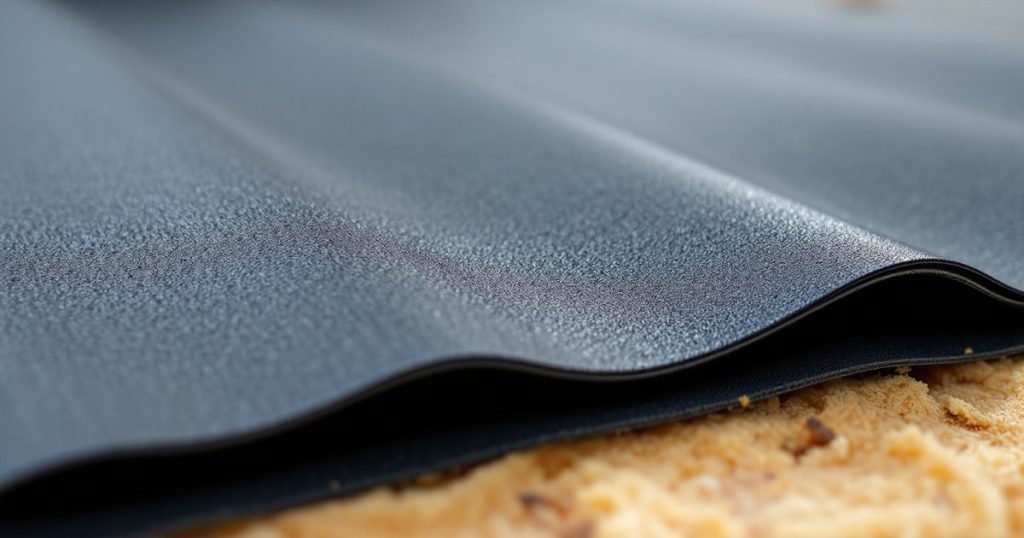
EPDM roofing thickness comes in four standard sheet gauges: 45 mil (0.045 inch), 60 mil (0.060 inch), 75 mil (0.075 inch, reinforced only) and 90 mil (0.090 inch, non-reinforced only). For most residential flat roofs over living space, 60 mil is the common choice. 45 mil suits low-traffic sheds and garages, and 90 mil is the sheet Carlisle, Johns Manville and Elevate (formerly Firestone Building Products) accept for 30-year fully adhered system warranties, with 75-mil reinforced as the alternative at Carlisle and JM.
The number on the roll is a nominal thickness, not a guaranteed minimum. Under the tolerance printed on Carlisle, Johns Manville and Versico data sheets, a 60-mil sheet can measure as thin as 54 mil and still conform to ASTM D4637. That detail, the weight you are loading onto the deck, and the warranty term each thickness qualifies for matter more to the decision than the general “thicker is better” advice.
The Roofing Brief Team (masthead) · Last reviewed: October 2026
EPDM thickness: key numbers at a glance
These are the figures most buyers need before reading a bid. Every value comes from a named manufacturer document or the ASTM standard and can vary by product line and system design.
| Question | Answer | Source |
|---|---|---|
| Standard thicknesses | 45, 60 and 90 mil non-reinforced; 45, 60 and 75 mil reinforced | Carlisle Sure-Seal and Sure-Tough data sheets; JM EPDM guide specification |
| Thickness tolerance | Plus or minus 10% of nominal (Elevate prints +15%, minus 10%) | Carlisle, JM and Versico data sheets; Elevate TIS 104 and TIS 109 |
| Thinnest conforming 60-mil sheet | 0.054 inch (54 mil) | Roofing Brief arithmetic: 60 x 0.90 |
| Weight, non-reinforced | 0.29 / 0.39 / 0.59 lb per sq ft for 45 / 60 / 90 mil | Carlisle Sure-Seal Kleen Non-Reinforced PDS (12.05.24) |
| Longest system warranty | 30 years, generally tied to 90-mil adhered, 75-mil reinforced or 60-mil and up ballasted | Carlisle warranty quick reference (07.31.24); JM RS-1670 (6-25); Elevate warranties page |
| Material price step (retail, black, 10-ft wide) | $1.05 / $1.15 / $1.45 per sq ft for 45 / 60 / 90 mil | Flat Roof Solutions online listing, checked October 12, 2026 |
How thick is EPDM roofing in inches and millimeters?
EPDM roofing is between 0.045 and 0.090 inch thick, or 1.14 to 2.29 mm, for standard roofing sheets. A mil is one thousandth of an inch, so 60 mil equals 0.060 inch (1.52 mm), just under 1/16 inch. For scale, the U.S. Mint lists the one-cent coin at 1.52 mm thick, the same as a 60-mil sheet, and the nickel at 1.95 mm, close to 75 mil.
| Nominal thickness | Inches | Millimeters | Closest everyday comparison | Made as | Source |
|---|---|---|---|---|---|
| 45 mil | 0.045 | 1.14 | Just under 3/64 inch | Non-reinforced and reinforced | Carlisle Sure-Seal and Sure-Tough PDS |
| 60 mil | 0.060 | 1.52 | A U.S. penny (1.52 mm) | Non-reinforced and reinforced | Carlisle PDS; U.S. Mint coin specifications |
| 75 mil | 0.075 | 1.90 | A U.S. nickel (1.95 mm) | Reinforced only | Carlisle Sure-Tough PDS; Elevate RubberGard MAX TIS 104 |
| 90 mil | 0.090 | 2.29 | About 3/32 inch | Non-reinforced only | Carlisle Sure-Seal PDS; Elevate RubberGard Platinum TIS 109 |
| 100 to 145 mil | 0.100 to 0.145 | 2.5 to 3.7 | Fleece-backed sheet; the figure includes the fleece | FleeceBACK (Carlisle) | Carlisle EPDM warranty quick reference |
The fleece-backed numbers are not comparable to bare sheet. A 115-mil FleeceBACK product is EPDM laminated to a polyester fleece, so the rubber layer that keeps water out is thinner than the headline figure. Check the product data sheet for the membrane layer itself before comparing it to a 90-mil bare sheet.
What ASTM D4637 says about EPDM thickness
ASTM D4637 is the product standard for EPDM roofing sheet, and the current edition is D4637/D4637M-15(2021)e1. Its scope reads: “This specification covers flexible sheet made from ethylene-propylene-diene terpolymer (EPDM) intended for use in single-ply roofing membranes exposed to the weather.” It sets material properties for the sheet, including thickness tolerance, and leaves system design to the roof designer.
Section 1.2 of the standard is the part buyers miss: “In-place roof system design criteria, such as fire resistance, field seaming strength, material compatibility, and uplift resistance, among others, are factors that must be considered but are beyond the scope of this specification.” In plain terms, a sheet that meets D4637 has passed lab tests. It says nothing about whether the roof was glued, fastened or detailed correctly.
The standard sorts EPDM sheet into three types by construction:
- Type I: non-reinforced. This is the plain rubber sheet sold in 45, 60 and 90 mil, such as Carlisle Sure-Seal, JM EPDM NR and Elevate RubberGard Platinum.
- Type II: scrim (or fabric) internally reinforced. A polyester scrim sits inside the rubber, as in Carlisle Sure-Tough, JM EPDM R and Elevate RubberGard MAX in 45, 60 and 75 mil.
- Type III: fabric backed, meaning a fabric layer bonded to the underside.
Minimum vs nominal thickness under the tolerance
The thickness printed on an EPDM roll is nominal. Carlisle, Johns Manville and Versico data sheets list the D4637 tolerance on nominal thickness as plus or minus 10%. Elevate’s RubberGard technical sheets print the ASTM value as +15% and minus 10%, for example 0.090 inch +0.0135/minus 0.009 inch for 90 mil. Every source agrees on the floor: 10% under the label.
| Nominal sheet | Lowest conforming reading (minus 10%) | Highest reading at +10% | Highest reading at +15% (Elevate) | Source |
|---|---|---|---|---|
| 45 mil | 40.5 mil (0.0405 in) | 49.5 mil | 51.8 mil | Roofing Brief arithmetic from Carlisle PDS and Elevate TIS 104 tolerances |
| 60 mil | 54 mil (0.054 in) | 66 mil | 69 mil | Same |
| 75 mil | 67.5 mil (0.0675 in) | 82.5 mil | 86.3 mil | Same |
| 90 mil | 81 mil (0.081 in) | 99 mil | 103.5 mil | Same, plus Elevate TIS 109 |
Real sheets land inside that band. Elevate’s RubberGard MAX sheet (TIS 104, September 4, 2025) reports a typical measured thickness of 0.058 inch for its 60-mil product and 0.046 inch for 45 mil. Both are normal and conforming. If a specification says “60 mil minimum,” a nominal 60-mil roll can technically fall short of that wording, so spec writers who want a true floor should say so and name the tolerance.
Reinforced vs non-reinforced EPDM: what changes with thickness
Reinforced EPDM (ASTM D4637 Type II) has a polyester scrim inside the sheet and comes in 45, 60 and 75 mil. Non-reinforced EPDM (Type I) is solid rubber and comes in 45, 60 and 90 mil. The scrim adds tear and breaking strength, which is why mechanically fastened systems use reinforced sheet. Non-reinforced sheet stretches far more and is used mainly in fully adhered and ballasted roofs.
With a scrim, part of the thickness is fabric, so the rubber above it matters. Carlisle’s Sure-Tough data sheet lists the ASTM D4637 annex minimum for thickness over scrim as 0.015 inch, with typical values of 0.016 inch (45 mil), 0.020 inch (60 mil) and 0.032 inch (75 mil). Elevate makes the same point from the other side: its RubberGard Platinum sheet “offers 90 mils of unobstructed waterproofing, unlike membranes that contain a reinforcing fabric.”
Attachment method follows the reinforcement. Carlisle’s warranty quick reference lists only Sure-Tough reinforced sheet (45, 60, 75 mil) and FleeceBACK for mechanically fastened EPDM, and the JM Peak Advantage guarantee pages list only JM EPDM R 60 and 75 mil for mechanically attached systems. Carlisle states its non-reinforced 45, 60 and 90-mil sheets are “utilized primarily in Design A (Fully Adhered roofing systems).”
EPDM weight per square foot by thickness
EPDM weighs about 0.27 to 0.32 pounds per square foot at 45 mil, 0.39 to 0.42 at 60 mil, 0.48 to 0.55 at 75 mil and 0.58 to 0.59 at 90 mil, based on Carlisle and Elevate data sheets. A full 10 by 100 foot roll of 60-mil non-reinforced sheet therefore weighs roughly 390 pounds, and the same roll in 90 mil roughly 590 pounds.
| Thickness | Carlisle non-reinforced (lb/sq ft) | Carlisle Sure-Tough reinforced (lb/sq ft) | Elevate (lb/sq ft) | Weight of a 1,000 sq ft roll (Carlisle non-reinforced) |
|---|---|---|---|---|
| 45 mil | 0.29 | 0.27 | 0.32 (RubberGard MAX, reinforced) | About 290 lb |
| 60 mil | 0.39 | 0.39 | 0.42 (RubberGard MAX, reinforced) | About 390 lb |
| 75 mil | Not made | 0.48 | 0.55 (RubberGard MAX, reinforced) | Not made |
| 90 mil | 0.59 | Not made | 0.58 (RubberGard Platinum, non-reinforced) | About 590 lb |
Sources: Carlisle Sure-Seal Kleen Non-Reinforced PDS (12.05.24); Carlisle Sure-Tough Reinforced PDS (07.24.25); Elevate TIS 104 (September 4, 2025) and TIS 109 (August 20, 2025). Roll weights are Roofing Brief arithmetic (weight per sq ft x 1,000).
Going from 60 to 90 mil adds about 0.2 pounds per square foot, or about 200 pounds across a 1,000 square foot roof. For most decks that matters less for structure than for handling, since a full 90-mil roll weighs about as much as three people and has to be hoisted and unrolled on the roof.
Puncture and tear data from Carlisle, Elevate and Johns Manville
Every conforming EPDM sheet must pass the same ASTM D4637 puncture tests, so a thicker sheet’s advantage shows up in margin and in warranty coverage rather than in a pass/fail line. Non-reinforced sheet is tested for tear with ASTM D624 (pounds per inch) and reinforced sheet with ASTM D751 tongue tear (pounds), so the two columns below cannot be compared number for number.
| Product (thickness) | Type | Tear strength, typical | ASTM minimum | Puncture tests reported | Source |
|---|---|---|---|---|---|
| Carlisle Sure-Seal (45, 60, 90 mil) | I, non-reinforced | 200 lbf/in (D624) | 150 lbf/in | Not listed on PDS | Carlisle PDS, 12.05.24 |
| JM EPDM NR 60 mil | I, non-reinforced | 181 lbf/in (D624) | 150 lbf/in | Dynamic 5 J (D5635) pass; static 44.1 lbf (D5602) pass | JM data sheet RS-3005 |
| JM EPDM NR 90 mil | I, non-reinforced | 171 lbf/in (D624) | 150 lbf/in | Dynamic 5 J pass; static 44.1 lbf pass | JM data sheet RS-3006 (3-23) |
| Elevate RubberGard Platinum 90 mil | I, non-reinforced | 207 lbf/in (D624) | 150 lbf/in | Dynamic 5 J pass; static 20 kg (44.1 lbf) pass | Elevate TIS 109, August 20, 2025 |
| Carlisle Sure-Tough (45, 60, 75 mil) | II, reinforced | 70 lbf (D751 tongue tear); breaking strength 210 lbf | 10 lbf tear; 90 lbf breaking | Carlisle cites 60% greater puncture resistance than non-reinforced (D5635 and Federal Method 2031) | Carlisle PDS, 07.24.25 |
| Elevate RubberGard MAX (45 / 60 / 75 mil) | II, reinforced | 116 / 116 / 112 lbf (D751); breaking strength 218 / 198 / 239 lbf | 10 lbf tear; 90 lbf breaking | Dynamic 10 J (D5635) pass; static 25 kg pass | Elevate TIS 104, September 4, 2025 |
Two practical readings come out of these sheets. First, typical tear values sit well above the ASTM floor at every thickness, so a 45-mil sheet is not weak in the lab; it simply has less rubber to lose to abrasion, dropped tools and UV over decades. Second, the manufacturers put their thickness premium into warranty terms for hail and accidental puncture, covered in the next section, which is the clearest published signal of how much more abuse each gauge is expected to take.
EPDM warranty length by thickness
Manufacturer system warranties scale with thickness. In Carlisle’s EPDM warranty quick reference (July 31, 2024), a fully adhered non-reinforced roof tops out at 15 years in 45 mil, 25 years in 60 mil and 30 years in 90 mil. Johns Manville follows the same pattern, and Elevate’s 30-year Red Shield Platinum warranty for adhered EPDM requires a minimum of 90 mil.
| Manufacturer and system | 45 mil | 60 mil | 75 mil (reinforced) | 90 mil | Source |
|---|---|---|---|---|---|
| Carlisle, fully adhered, non-reinforced Sure-Seal | 15 yr, 90 mph, no hail | 25 yr, 120 mph, 1 in hail | n/a | 30 yr, 120 mph, 2 in hail, 32 hr puncture | Carlisle EPDM warranty quick reference, 07.31.24 |
| Carlisle, fully adhered, Sure-Tough reinforced | 15 yr | 20 yr | 30 yr, 2 in hail | n/a | Same |
| Carlisle, ballasted, non-reinforced | 25 yr, 1 in hail | 30 yr, 2 in hail | n/a | 30 yr, 3 in hail | Same; Carlisle SpecTopics, October 2024 |
| Carlisle, mechanically fastened, Sure-Tough | 15 yr | 20 yr | 30 yr | n/a | Same |
| Johns Manville, adhered | Up to 15 yr | Up to 25 yr | Up to 30 yr | Up to 30 yr | JM Peak Advantage RS-1670 (6-25) |
| Johns Manville, ballasted | Up to 15 yr | Up to 30 yr | Up to 30 yr | Up to 30 yr | Same |
| Johns Manville, mechanically attached (reinforced) | n/a | Up to 25 yr | Up to 30 yr | n/a | Same |
| Elevate, Red Shield Platinum 30 yr | Below the 90-mil minimum | Fully adhered RubberGard, minimum 90 mil | Elevate warranties page | ||
The Carlisle hail and puncture columns assume an approved adhered cover board, such as 1/2-inch DensDeck Prime or Securock, under the membrane. Carlisle also announced in October 2024 a 40-year non-prorated material warranty for its 90-mil Sure-Seal and Sure-White sheet, which covers the membrane only, not labor or the system.
These warranties are generally issued only through manufacturer-licensed contractors on approved assemblies, and the fees are real line items. JM’s 2025 schedule charges $10 per square (100 sq ft) for 20 years and $15 per square for 30 years, with minimums of $1,000 and $1,500. Elevate’s December 2, 2025 pricing guide lists $0.10 per sq ft for 20 years and $0.17 for 30-year Platinum, with minimums of $750 and $1,275. On a small residential roof those minimums can exceed the per-foot math, so ask your contractor which coverage, if any, the bid includes. Warranties also set out the owner’s duties after installation, which our guide to EPDM maintenance and warranty conditions walks through.
Does thickness change how long EPDM lasts?
Field data says thickness is not the only lifespan driver. The EPDM Roofing Association’s 2010 studies tested five membrane samples with 28 to 32 years in service, all 45 mil, that still met new-material standards. In the association’s 2025 survey of nearly 600 roofing professionals (published February 2026), the most common expectation for adhered 90-mil EPDM was 40 years or more (28% of respondents), while 30% expected 25 to 29 years from adhered 60 mil. Drainage, flashing work and traffic often decide the outcome before the gauge does.
How much more does 60 or 90 mil EPDM cost than 45 mil?
The material step between thicknesses is smaller than most buyers expect. At Flat Roof Solutions’ online listing for black 10-foot-wide sheet (checked October 12, 2026), a 10 by 10 foot cut costs $105 in 45 mil, $115 in 60 mil and $145 in 90 mil. That works out to $1.05, $1.15 and $1.45 per square foot, so 60 mil adds about $0.10 per sq ft over 45 mil and 90 mil adds $0.30 over 60 mil.
| Cost item | 45 mil | 60 mil | 90 mil | Source |
|---|---|---|---|---|
| Membrane only, retail, per sq ft | $1.05 | $1.15 | $1.45 | Flat Roof Solutions listing, October 12, 2026 |
| Membrane only, 1,000 sq ft roof | $1,050 | $1,150 | $1,450 | Roofing Brief arithmetic from the listing |
| Installed, per sq ft | $4 to $6 | $5.50 to $8 | $7 to $10 | SquareDash, “Rubber Roof Guide,” April 19, 2026 |
| Installed, commercial system with insulation | $5 to $9 (ballasted) | Between the two | $9 to $14 (fully adhered with polyiso) | The Roofing Brief 2026 Roofing Cost Report |
Installed quotes usually spread wider than the membrane price because the thicker sheet tends to arrive with a different system. A 90-mil bid is often a fully adhered roof with an adhered cover board, upgraded flashing details and a 30-year warranty fee, while a 45-mil bid may be ballasted or carry a 15-year term. Compare bids with the same attachment method and warranty term before reading anything into the thickness line. Our EPDM roofing cost guide breaks the installed price down by roof size and attachment.
Roofing Brief estimate for a 1,000 sq ft residential flat roof: moving from 45 to 60 mil adds about $100 in membrane, and moving from 60 to 90 mil adds about $300, based on the retail listing above. The larger cost jumps come from warranty minimums and cover-board requirements, if the bid includes them.
Which EPDM thickness should you use?
Use 60 mil for most residential flat roofs over living space, 45 mil only for low-traffic outbuildings or ballasted roofs where the warranty term is acceptable, and 90 mil (or 75 mil reinforced) where foot traffic, hail or a 30-year warranty is the priority. Mechanically fastened roofs need reinforced sheet. The table maps common situations to a starting specification.
| Your situation | Starting thickness | Why | Source for the reasoning |
|---|---|---|---|
| Shed, carport or detached garage, little foot traffic | 45 mil non-reinforced | Cheapest sheet; lab tear values well above the ASTM floor; 15-year adhered warranty ceiling at Carlisle and JM is often acceptable here | Carlisle PDS and warranty quick reference; JM RS-1670 |
| Residential flat roof over a living space or addition | 60 mil non-reinforced, fully adhered | Qualifies for 25-year adhered terms at Carlisle and JM; costs about $0.10 per sq ft more than 45 mil in material | Carlisle quick reference; JM RS-1670; Flat Roof Solutions listing |
| Ballasted roof (stone or pavers) | 45 mil for up to 25 years at Carlisle; 60 mil for 30 years | Carlisle extended ballasted terms in October 2024; JM caps 45-mil ballast at 15 years | Carlisle SpecTopics, October 2024; JM RS-1670 |
| Fully adhered roof needing a 30-year warranty | 90 mil non-reinforced or 75 mil reinforced | Carlisle, JM and Elevate tie 30-year adhered terms to these sheets | Carlisle quick reference; JM RS-1670; Elevate warranties page |
| Mechanically fastened commercial roof | 60 or 75 mil reinforced | Carlisle and JM list only reinforced sheet for mechanically fastened EPDM; 75 mil reaches 30 years | Carlisle quick reference; JM RS-1670 |
| Rooftop equipment, frequent foot traffic or hail region | 90 mil adhered over an approved cover board, plus walkway pads | Carlisle’s adhered 90-mil system carries 2-inch hail and 32 hours of accidental-puncture coverage, versus 1-inch hail and none for 60 mil | Carlisle warranty quick reference |
Is 45 mil EPDM good enough for a roof?
Yes, 45 mil EPDM is a full ASTM D4637 roofing sheet and can perform for decades, as the EPDM Roofing Association’s 28 to 32-year samples show. Its limits are commercial rather than chemical: Carlisle and JM cap 45-mil adhered warranties at 15 years, and it has the least rubber to spare against foot traffic and hail. It fits outbuildings and ballasted roofs better than a roof over a bedroom.
What does “playground EPDM” thickness mean?
Searches for EPDM thickness for playgrounds refer to poured-in-place rubber surfacing made with EPDM granules, which is measured in inches of depth for fall protection. It is a different product from EPDM roofing sheet, and the mil figures on this page do not apply to it.
How to measure EPDM roofing thickness
Measure EPDM thickness with a dial or digital thickness gauge that reads to 0.001 inch, take several readings across a clean offcut, and compare the lowest reading with the 90% floor for the nominal size. A 60-mil sheet should read no lower than about 0.054 inch. Reinforced sheet needs one extra check that only a lab can do.
- Get a sample without damaging the roof. Use an offcut from the same roll, the cut end of a field sheet before installation, or a flashing trim piece. Cutting a test hole in a warranted roof can affect coverage, so contact the manufacturer first.
- Read the roll label and paperwork. The roll wrapper, delivery ticket and product name (for example Sure-Seal, RubberGard Platinum or JM EPDM NR 60 mil) state the nominal thickness and whether the sheet is reinforced.
- Zero a flat-anvil thickness gauge. A dial or digital gauge with flat contact faces gives a cleaner reading than calipers, which can squeeze soft rubber. Close the gauge gently without clamping.
- Measure at five or more points. Spread readings across the width of the sample and stay off factory-applied seam tape, primer and adhesive, which add thickness.
- Compare the lowest reading with the floor. Under the minus 10% tolerance in Carlisle, JM and Elevate data, the floors are 40.5 mil for 45, 54 mil for 60, 67.5 mil for 75 and 81 mil for 90.
- Treat reinforced sheet differently. Overall thickness reads the same way, but the rubber over the scrim (minimum 0.015 inch in the ASTM D4637 annex) is measured optically under ASTM D7635. A field gauge cannot check it.
- Do not compare fleece-backed sheet to bare sheet. FleeceBACK ratings of 100 to 145 mil include the fleece, so a gauge reading on those products overstates the rubber layer.
An older roof that measures well under its nominal size may simply have been a thinner sheet from the start, so check the original paperwork before drawing conclusions.
If you are still deciding between membranes rather than gauges, our TPO vs EPDM roofing comparison covers lifespan, energy and installed cost for commercial roofs. For the chemistry behind the name, see what EPDM stands for in roofing. Building owners comparing system types can also read our commercial rubber roofing guide.
Frequently asked questions
What is the best thickness for EPDM roofing?
For most residential flat roofs over living space, 60 mil is the best balance. It costs about $0.10 per square foot more than 45 mil at retail and qualifies for 25-year adhered warranties at Carlisle and Johns Manville. Choose 90 mil, or 75 mil reinforced, when you need a 30-year warranty, expect regular foot traffic, or face hail. Use 45 mil for low-traffic sheds and garages.
Is 45 mil EPDM good for a roof?
Yes. 45 mil EPDM meets ASTM D4637 and has field samples still meeting new-material standards after 28 to 32 years, per EPDM Roofing Association studies. It works well on sheds, garages and ballasted roofs. Its drawbacks are shorter warranties, 15 years maximum on adhered systems at Carlisle and JM, and less rubber to absorb foot traffic, dropped tools and hail.
How thick is an EPDM roof?
A standard EPDM roof membrane is 0.045 to 0.090 inch thick, which is 1.14 to 2.29 mm. The four common sheet sizes are 45, 60, 75 and 90 mil, with 75 mil made only as reinforced sheet and 90 mil only as non-reinforced. Fleece-backed EPDM is sold at 100 to 145 mil, but that figure includes the fleece layer.
How thick is 60 mil EPDM in inches?
60 mil EPDM is 0.060 inch thick, or 1.52 mm, which is just under 1/16 inch and the same thickness as a U.S. penny. Because ASTM D4637 allows a tolerance of minus 10% on nominal thickness, a conforming 60-mil sheet can measure as thin as 0.054 inch. Manufacturer data typically shows readings close to nominal.
Is 60 mil thicker than 45 mil EPDM?
Yes. 60 mil is 0.060 inch and 45 mil is 0.045 inch, so the 60-mil sheet has 33% more rubber. It also weighs more, about 0.39 versus 0.29 pounds per square foot in Carlisle’s non-reinforced line. On a 1,000 square foot roof that is roughly 100 extra pounds of membrane and about $100 more in retail material cost.
What thickness of EPDM should I use on a shed?
45 mil non-reinforced EPDM is the usual choice for a shed or other low-traffic outbuilding. It is the cheapest and lightest standard sheet, about 0.29 pounds per square foot. Step up to 60 mil if the roof sees foot traffic, overhanging branches or frequent hail, since the extra material cost on a small roof is minor.