
By The Roofing Brief Team | Last reviewed: November 2026
Gutter guards for metal roofs work when they fasten to the gutter’s front lip and to the fascia or gutter back, not under or through the metal panels, and when the panel hangs only about 1 to 1-1/4 inches past the eave trim into the gutter. Micro-mesh that is bent and screwed to the fascia, solid steel covers on 8:12 or flatter standing seam, and in-gutter brushes are the three styles whose maker instructions or product pages address metal roofs directly; reverse-curve helmets and slide-under screens are the two that most often fight a metal eave.
Compatibility here is compiled from maker installation sheets, metal panel eave details and dated product listings, not from installs or product testing. Snow is the other half of the answer: on a slick metal roof pitched 2:12 to 12:12, snow retention goes on before any guard, because a sliding sheet of snow loads the gutter line long before leaves do.
Why the usual gutter guard install fails on a metal roof
Most retail gutter guards assume an asphalt shingle roof: the back edge slides under the first shingle course and the front edge screws to the gutter lip. A metal roof removes that shingle course, and three other details change at the eave: a panel overhang of 1 to 4 in depending on the maker, faster runoff, and snow that slides off in sheets.
The eave trim and closures under that overhang are covered piece by piece in our guide to metal roof trim pieces.
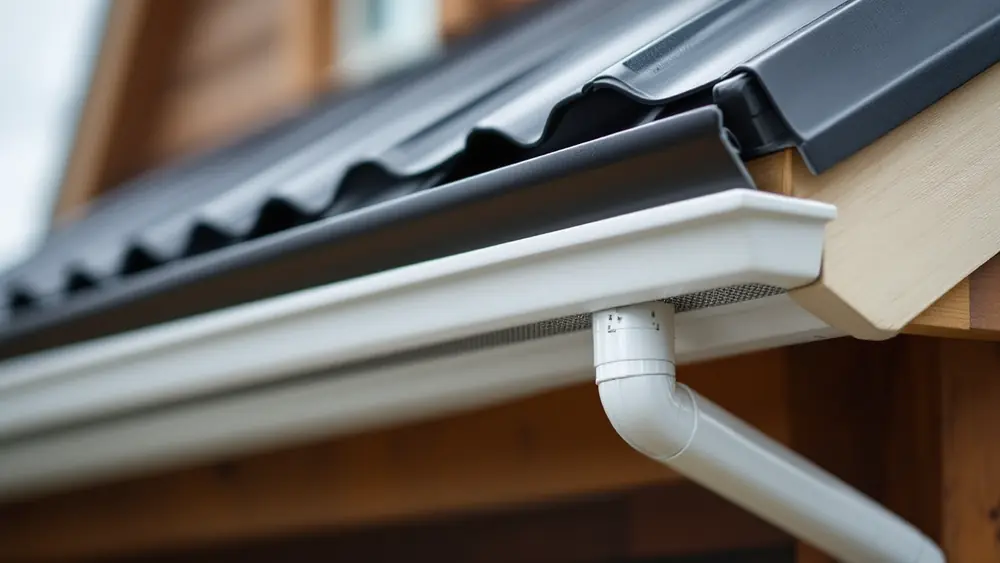
- No course to tuck under. Standing seam pans are clipped and sealed at the eave, and exposed fastener panels are screwed through butyl tape. The Gutterglove DIY instructions list stone coated steel, corrugated steel and standing lock seam among compatible roofs. A second Gutter Guard by Gutterglove sheet tells installers to bend the mesh and screw it to the gutter, drip edge or fascia whenever the roofing is adhered to the underlayment or the guard would make the roof edge ramp up.
- Panel overhang. Panels that hang 2 to 4 inches past the trim cover part of the gutter opening and leave no room for a guard’s back rail. The maker figures are in the table below.
- Water speed. Jim Ealer of Midwest Enterprises, maker of E-Z-Gutter Guards, told Metal Roofing Magazine that a 6-inch gutter is the standard for most metal roofs, versus 5-inch on shingle roofs, and that hangers should sit at 24 inches maximum, 20 inches preferred.
- Snow slides. Snow leaves a metal roof as a frozen sheet in the plane of the roof. Ealer’s advice in the same article is to hang the gutter a little below that plane so the sheet clears the gutter and its cover, and Fabral puts the slide-risk range at 2:12 to 12:12.
What metal panel makers specify at the eave
Panel overhang into the gutter is set by the panel maker’s eave detail, and the published figures cluster at 1 to 1-1/4 inches where a gutter is used. A roof built with 3 or 4 inches of overhang may need the panel ends trimmed back with a nibbler or shear before any guard fits.
| Panel type | Maker eave instruction | What it means for a gutter guard | Source |
|---|---|---|---|
| Snap-lock standing seam (Mueller MSL) | Panel overhangs the eave trim by 1-1/4 in “to accommodate optional gutter” | Leaves most of a 6 in gutter opening clear for a fascia-mount guard | Mueller MSL manual, fixed eave page |
| Residential standing seam (Bryer Company) | Panel ends extend 1 in past the eave over 1/8 x 3/4 in butyl tape set about 2 in up | Panel end is sealed and screwed; nothing can slide under it | Bryer residential standing seam manual, eave detail E-12 |
| Exposed fastener eave (ABC Metal Roofing install video) | Overhang the eave by 1-1/2 to 2 in at most | At 2 in, a 5 in gutter loses roughly 40 percent of its opening | ABC Metal Roofing installation transcript |
| Corrugated panel (Mueller) | Overhang “may be increased to extend up to 4 in past the eave trim”; gutter fastened with #14 x 7/8 in screws at 12 in o.c. | A 4 in overhang leaves no room for a back rail; use an in-gutter brush or trim the panels | Mueller corrugated panel manual, eave trim with gutter |
Measure from the face of the fascia to the panel’s drip edge before buying anything. Subtract that number from the gutter width (5 or 6 in for K-style) to get the open intake left for a guard. A Roofing Brief rule of thumb: under about 3 in of open intake on a 6 in gutter, plan on an in-gutter brush or on trimming the panels. The panel and trim pieces at this edge are covered in our guide to standing seam metal roof details.
Gutter guard compatibility matrix for metal roofs
The matrix below rates each gutter guard style against the three common residential metal roof types, using the attachment method each maker publishes, from Gutter Guard by Gutterglove to the K&M Sheet Metal solid cover. “Works” means the published method needs no fastener through the roof panel; “Conditional” means it works only with the stated limit; “Avoid” means the published method depends on lifting or screwing the roofing.
| Guard style (example) | Standing seam | Exposed fastener (R-panel, corrugated) | Stone-coated steel | Attachment and source |
|---|---|---|---|---|
| Stainless micro-mesh, fascia-mount (Gutter Guard by Gutterglove) | Works | Works | Works | Rear rail bent up or down and screwed to fascia or gutter back; 3 self-tapping screws per 4 ft section into the front lip, per the Gutterglove instruction sheet |
| Micro-mesh, under-roof “Option 1” (Gutterglove, Raptor) | Avoid | Avoid | Conditional | Slides under the first shingle course; Gutterglove says not to use it when roofing is adhered to underlayment, which rules out butyl-sealed metal eaves |
| Snap-in steel screen (Amerimax Metal Lock-In) | Avoid | Avoid | Conditional | Galvanized steel, 6 x 36 in, “slides under the shingles” per the Amerimax Lock-In sheet |
| Solid steel cover (K&M GC-40, 24 ga Galvalume or 0.032 in Kynar aluminum) | Conditional: about 8:12 or flatter | Conditional | Conditional | K&M lists “usually 8” as the maximum pitch for standing seam versus about 12 for shingle and slate, per its GC-40 product page |
| Reverse-curve helmet (Gutter Helmet, LeafGuard) | Conditional | Conditional | Conditional | Surface tension must turn the water around the nose; fast runoff from smooth panels can overshoot it, the failure mode My Gutter Doctor describes under valleys and steep sections |
| In-gutter brush (GutterBrush, LeafBlox) | Works | Works | Works | Sits inside the gutter with no roof contact; GutterBrush sells 6.5 in diameter brushes for 7 in metal building gutters on its metal building page |
| Foam insert | Conditional | Conditional | Conditional | No roof contact, but a full-depth insert cuts the open volume a 6 in metal-roof gutter needs; compared on our plastic gutter guards page |
Raptor’s product page says its stainless V-Bend mesh attaches to “most gutter-to-roof scenarios” with included self-tapping screws and carries a 25 year warranty, but no Raptor sheet found for this review addresses metal panels by name. On a metal roof, treat any under-roof instruction as a fascia-mount install. The five guard families and their mesh sizes are compared in our overview of types of gutter guards.
How to fit a fascia-mount micro-mesh guard under a metal roof edge
The fascia-mount method is the one install that every metal profile accepts, because it puts zero screws into the panels. The steps below follow the Gutterglove DIY instructions, which set a target guard slope of 5 to 25 degrees, dropping to 5 to 10 degrees when the gutter hangs low or the roof is steep.
- Clear and check the gutter. Flush each run until water leaves the downspout freely, and confirm hangers sit at 24 in or closer; the Amerimax metal gutter instructions call for one hanger every 24 in, or every 18 in in heavy ice and snow areas.
- Measure the open intake. Measure from the fascia to the inside of the gutter’s front lip, then from the fascia to the panel drip edge. The difference is the width the mesh must cover without touching the panel: a 6 in gutter under a 1-1/4 in overhang leaves 4-3/4 in.
- Mark and bend the rear rail. Transfer the fascia-to-lip measurement to the guard and bend the back of the mesh up or down along that line; for a gutter hung low, Gutterglove allows either direction, whichever reaches the fascia below the eave trim at 5 to 25 degrees.
- Fasten the rear rail to the fascia or gutter back. Gutter Guard by Gutterglove instructions specify 3 screws per 4 ft section into the fascia, gutter back or drip edge. On metal, keep the screws below the panel and eave trim so none passes through roofing.
- Fasten the front edge to the gutter lip. Use 3 self-tapping screws per 4 ft section, or the 3M VHB tape supplied on each section.
- Check the slope and the drip line. The finished guard should sit 5 to 25 degrees, and the panel’s drip edge should land over the mesh, not beyond the front lip. Water landing past the lip means the gutter needs to move out or the overhang needs trimming.
Gutterglove’s 25 year parts-only warranty drops to 5 years within 5 miles of the coast, a clause that matters on coastal metal roofs. It is printed in the Gutterglove DIY kit warranty, which also excludes hail, windstorm and improper installation.
Snow on metal roofs: put snow guards in before gutter guards
On a metal roof between 2:12 and 12:12, snow retention should be installed before or with any gutter guard, because the gutter line is where a sliding sheet of snow lands. Fabral’s Technical Bulletin 722 says snow guards should be considered for pitches between 2:12 and 12:12, placed above the bearing wall at the eave, in several rows rather than one. Row counts and clamp types by panel are laid out in our guide to snow guards for metal roofs.
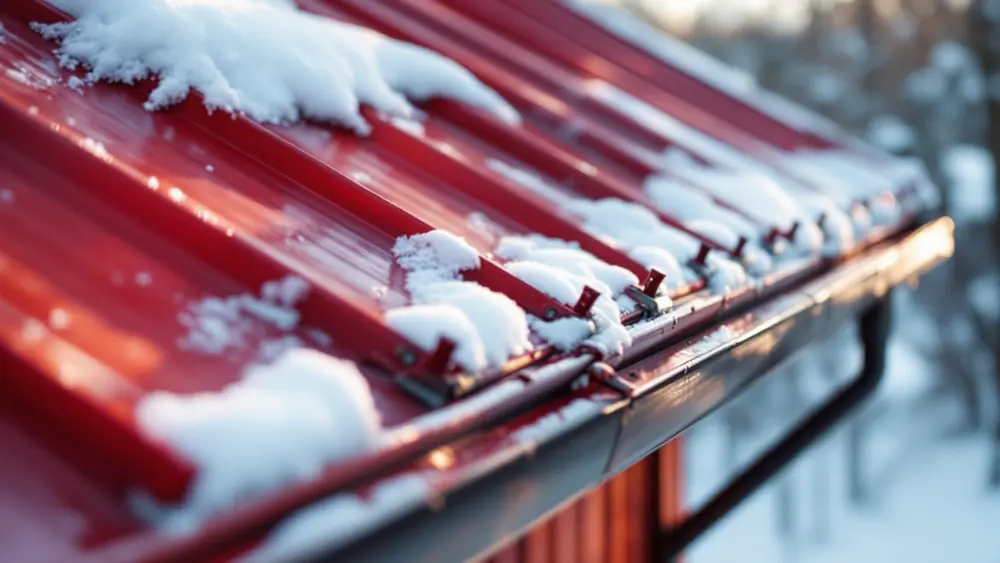
The same bulletin says Fabral does not recommend screwed-on snow guards on standing seam because screws “can restrain the designed thermal movement of the panel system”, and it calls for clamp-on guards instead. Fabral is now owned by McElroy Metal, and the 2009 bulletin is still posted on Fabral’s site. The same logic is why a gutter guard on standing seam should not be screwed through the pans.
How much snow can reach the gutter line
Roof snow load is quoted in pounds per square foot of horizontal projection, so the weight that can slide toward one foot of gutter equals the load times the horizontal run from eave to ridge. The figures below are Roofing Brief arithmetic with stated inputs, not a structural rating, and the impact of a sliding sheet adds to them.
| Horizontal run (eave to ridge) | Settled snow load | Snow above each foot of gutter | Load per hanger at 24 in spacing | Load per hanger at 18 in spacing |
|---|---|---|---|---|
| 12 ft | 20 psf | 240 lb | 480 lb | 360 lb |
| 12 ft | 30 psf | 360 lb | 720 lb | 540 lb |
| 15 ft | 30 psf | 450 lb | 900 lb | 675 lb |
| 15 ft | 40 psf | 600 lb | 1,200 lb | 900 lb |
For scale, Alu-Rex rates its Double-Pro continuous hanger system at 425 lb per linear foot, a maker claim quoted by My Gutter Doctor. A 15 ft run under 30 psf already exceeds that figure, which is why snow guards that hold the sheet on the roof come first. Snow guard types and costs, about $10 to $40 per linear foot installed, are compared in snow guards vs heat cable.
In heavy-snow regions Ealer recommends a solid cover over a screen, because a solid aluminum or steel cover helps snow and ice shed off the gutter, and a screen where heavy rain is the main load, as quoted in Metal Roofing Magazine. The article sums it up in 7 words: covers where it snows, screens where it rains.
Fast runoff: gutter size, hang height and overshoot
A smooth metal panel delivers water to the eave faster than shingles, and a guard can only accept what reaches it. Ealer’s figures are a 6 in gutter as the metal-roof standard, at least 6 or 7 in for tile-profile metal, and hangers at 20 to 24 in. Hanging the gutter slightly below the roof plane lets both water and snow land in or clear the gutter instead of striking the front edge.
Reverse-curve helmets such as Gutter Helmet and LeafGuard are the style most exposed to overshoot on metal, since the water has to cling to a curved nose at speed. Flat micro-mesh has a smaller version of the same problem when the panel’s drip edge lands near the front lip. The surface-tension design and its warranty transfer terms are covered in our Gutter Helmet review. If water clears the gutter during a downpour before any guard is installed, fix the overhang, the hang height or the valley flow first; a guard cannot catch water that misses the gutter.
Profile shape changes the flow as well. Ealer told Metal Roofing Magazine that tile-profile roofs funnel water into the troughs between ridges, “effectively cutting the size of your roof in half or more” at the gutter, which is his reason for 6 or 7 in gutters on metal tile. The outlet end needs a strainer too, covered in our downspout guard guide.
What gutter guards for metal roofs cost in 2026
DIY in-gutter brushes for a 6 in gutter list at about $4.48 to $5.53 per linear foot in November 2026, while professionally installed micro-mesh averages roughly $40 to $62 per linear foot across the four providers This Old House priced. Prices change, so treat the listings below as dated snapshots.
| Product (6 in gutter) | Listing | Per linear foot | Source, as listed November 2026 |
|---|---|---|---|
| GutterBrush 6 in (5.25 in diameter) | 60 ft for $269; 36 ft for $170 | $4.48 to $4.72 | GutterBrush store |
| LeafBlox 6 in (oversized) | 60 ft for $299; 36 ft for $199 | $4.98 to $5.53 | MetalRoofSnowGuards.com LeafBlox listing |
| GutterBrush commercial 7 in (6.5 in diameter) | 108 ft for $645 | $5.97 | GutterBrush store |
| Professionally installed micro-mesh (LeafFilter, LeafGuard, HomeCraft, All American) | Provider averages | $39.59 to $61.61 | This Old House, 2026 |
Worked example: 150 linear feet of 6 in gutter
| Option | Packs or rate | Coverage | Total |
|---|---|---|---|
| GutterBrush 6 in, DIY | 2 x 60 ft ($538) + 1 x 36 ft ($170) | 156 ft | $708 |
| LeafBlox 6 in, DIY | 2 x 60 ft ($598) + 1 x 36 ft ($199) | 156 ft | $797 |
| Installed micro-mesh, low average | 150 ft x $39.59 | 150 ft | $5,939 |
| Installed micro-mesh, high average | 150 ft x $61.61 | 150 ft | $9,242 |
The gap between the DIY brush and an installed system is roughly $5,200 to $8,500 on 150 ft, before snow guards. On a two-story metal roof, ladder work at the eave is the main reason homeowners pay for installation; the removal side of that work is covered in how to remove gutter guards.
Which gutter guard to use on your metal roof
The decision follows two measurements and one climate question: how far the panel overhangs the gutter (1 to 4 in in the maker details above), how steep the roof is (8:12 is the K&M solid cover limit on standing seam), and whether snow slides off it. The table maps each combination to the guard style whose published install method fits.
| If your roof and gutter look like this | Then use | Why |
|---|---|---|
| Standing seam, 1 to 1-1/4 in overhang, little snow | Stainless micro-mesh, fascia-mount | No screws through pans; fine debris and pine needles stay out |
| Standing seam, 8:12 or flatter, heavy snow | Clamp-on snow guards first, then a solid steel cover such as K&M GC-40 | Fabral calls for clamp-on retention; K&M lists about 8:12 as the standing seam limit for its solid cover |
| Exposed fastener or corrugated, overhang 2 in or more | In-gutter brush (GutterBrush, LeafBlox), or trim panels to 1 to 1-1/2 in | Brush needs no rear rail; Mueller allows up to 4 in of overhang, which blocks fascia-mount guards |
| Pole barn or shop with 7 in or larger box gutter | Commercial brush sized to the gutter (6.5 in diameter for 7 in) | Sold specifically for metal building gutters |
| Steep metal roof over 7:12, heavy rain | Micro-mesh bent to a 5 to 10 degree slope, 6 in gutter hung below the roof plane | Gutterglove’s steep-roof slope; Ealer’s hang-height advice |
| Water already overshoots the gutter | Fix overhang, gutter size or valley flow before any guard | A guard cannot catch water that misses the gutter |
Frequently asked questions
Can you use gutter guards on metal roofs?
Yes. Gutter guards work on standing seam, exposed fastener and stone-coated steel roofs when they attach to the gutter lip and the fascia or gutter back instead of sliding under the panels. Gutterglove’s DIY instructions list stone coated steel, corrugated steel and standing lock seam as compatible roofs and describe a bend-and-screw fascia method, 3 screws per 4 ft section, for roofs where the edge cannot be lifted.
What is the best gutter guard for a metal roof?
For most metal roofs, a stainless micro-mesh guard mounted to the fascia is the most flexible choice, because it needs no fasteners through the panels and blocks pine needles. In heavy-snow regions on 8:12 or flatter standing seam, a solid steel cover behind clamp-on snow guards handles sliding snow better, and on panels overhanging 2 in or more an in-gutter brush fits where other guards do not.
What are the best DIY gutter guards for metal roofs?
In-gutter brushes are the simplest DIY option because they sit inside the gutter with no tools or screws; GutterBrush and LeafBlox 6 in brushes list at about $4.48 to $5.53 per linear foot in November 2026. A DIY micro-mesh kit such as Gutter Guard by Gutterglove takes 3 self-tapping screws per 4 ft section and a bent rear rail fastened to the fascia.
What are the downsides of using gutter guards on a metal roof?
The main downsides are overshoot, snow damage and cost. Fast runoff can jump reverse-curve and flat guards in heavy rain, sliding snow can bend guards that only rest on the gutter, and installed micro-mesh averages about $40 to $62 per linear foot per This Old House. Gutterglove’s warranty also excludes hail and windstorm damage and drops to 5 years within 5 miles of the coast.