
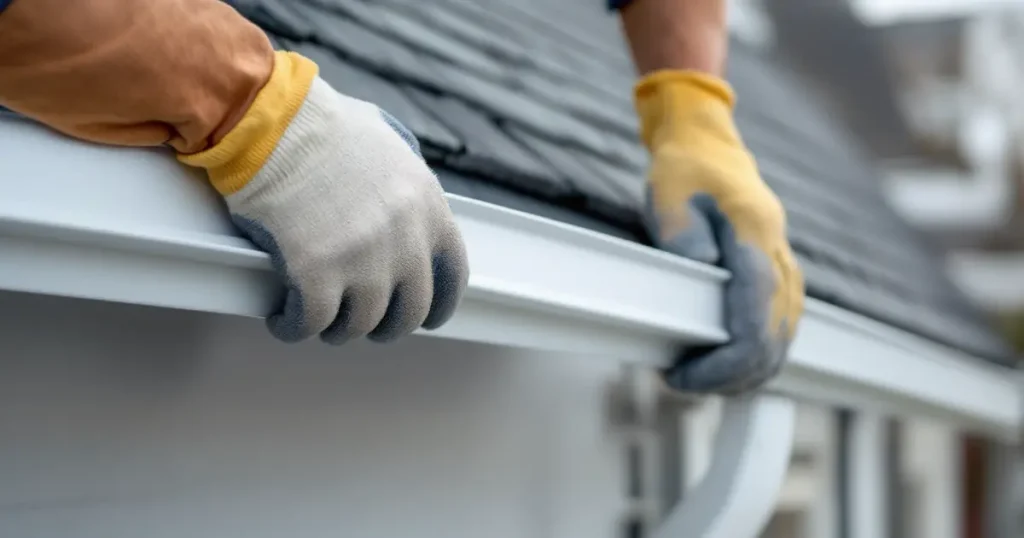
To remove gutters, take the downspouts off first, then back out every hanger fastener (a 1/4 in hex-head screw on most hidden hangers, a 7 in spike on spike-and-ferrule gutters) while a helper supports the trough, and lower each section to the ground. On a one-story house with 10 ft sectional aluminum lengths, that is a ladder-and-drill job; a 40 ft seamless run on a second story needs two or three people, a 28 ft extension ladder and a plan for where the gutter goes once it is loose.
The fastener tells you the method. Amerimax’s “Installing Metal Gutter Systems” sheet specifies one hanger every 24 in, or every 18 in in heavy ice and snow areas, so a 150 ft eave carries roughly 76 to 101 fasteners to find and remove before anything comes down.
Gutter removal: key numbers at a glance
| Figure | Value | Source |
|---|---|---|
| Hanger spacing you will be removing | Every 24 in; every 18 in in heavy ice and snow areas | Amerimax installation sheet; Spectra aluminum gutter instructions (24 in) |
| Hidden hanger screw head | 1/4 in hex (metal systems); 5/16 in hex on Plastmo vinyl hanger screws | Amerimax; Plastmo vinyl rainware manual |
| Downspout bands per 10 ft section | 2 | Amerimax installation sheet |
| Ladder rails above the landing | At least 3 ft | OSHA 29 CFR 1926.1053(b)(1) |
| Ladder base setback | About 1/4 of the working length (the 4:1 rule) | OSHA 1926.1053(b)(5)(i) |
| Pro removal and disposal | $1 to $2 per linear ft, $150 to $300 average | HomeGuide, via our gutter installation cost report |
| Scrap value, clean aluminum gutters | $0.62 to $0.72 per lb (estimate as of Nov 12, 2026) | MetalCharts scrap aluminum table |
Is it easy to remove gutters?
Removing gutters is easy on a one-story house with sectional aluminum hung on hidden hangers: each 10 ft length (the stock length in the Amerimax and Plastmo systems) weighs about 3.7 lb at .027 in thickness and comes off once 5 or 6 screws are out. It gets hard with seamless runs over about 35 ft, second-story eaves, roof-strap hangers under the shingles, or rusted spikes in steel gutters.
Weight is rarely the problem. A 40 ft seamless 5 in K-style run of .027 in aluminum weighs about 15 lb (40 x 0.37 lb per ft, the coil weight in our gutter coil guide), but it flexes and kinks if it is supported only at the ends. A long GarageJournal thread on removing and rehanging seamless gutters converges on three people for a 40 to 50 ft run: one on each end on ladders and one holding a rope tied near the middle.
Tools and ladder setup for gutter removal
Amerimax lists eye protection, a tape measure, level, hacksaw, drill, screwdriver, hammer, pliers, ladder, tin snips and gloves for a gutter job, and removal adds a flat pry bar and a nut driver. Match the extra tools to the fastener you find, not to a generic list, because a spike needs a pry bar or a saw while a hidden hanger needs only a 1/4 in hex bit.
| Fastener you find | Tool that removes it | Backup if it will not come out |
|---|---|---|
| Hidden hanger, 1/4 in hex screw | Drill or impact driver with 1/4 in hex nut driver | Locking pliers on a stripped head |
| Plastmo or similar vinyl hanger, #10 screw | 5/16 in hex nut driver (screws also take #2 Robertson or slot) | Leave hanger on fascia; unsnap gutter only |
| Spike and ferrule (7 in spike) | Flat pry bar or cat’s paw, pried against a wood block | Reciprocating saw with a bi-metal metal-cutting blade between gutter back and fascia |
| Fascia bracket (nailed or screwed) | Pry bar for nails, driver for screws | Lift gutter out of the bracket and remove brackets afterward |
| Roof strap hanger under shingles | Flat bar slid under the first course to pull nails | Tin snips to cut the strap at the roof edge |
| Pop rivets at joints and outlets | Drill bit matching the rivet diameter, drilled through the head | Hacksaw through the joint |
| Sheet metal screws at elbows and end caps | 1/4 in hex driver | Drill out the screw head |
Which ladder size reaches your gutters?
Size the extension ladder from the height of the gutter. The Werner ladder chart reproduced in the Sherwin-Williams ladder buying guide pairs a 20 ft ladder with a gutter 9 to 13 ft up and a 28 ft ladder with 17 to 21 ft. OSHA 1926.1053 requires the rails to extend 3 ft above the landing and the base to sit about 1/4 of the working length out from the wall.
| Height to gutter | Extension ladder size | Base setback at 4:1 (approx.) | Source |
|---|---|---|---|
| Up to 9 ft | 16 ft | 2 ft 3 in | Werner chart via Sherwin-Williams; OSHA 1926.1053(b)(5)(i) |
| 9 to 13 ft (typical one-story) | 20 ft | 2 ft 6 in to 3 ft 3 in | Same |
| 13 to 17 ft | 24 ft | 3 ft 3 in to 4 ft 3 in | Same |
| 17 to 21 ft (typical two-story) | 28 ft | 4 ft 3 in to 5 ft 3 in | Same |
| 21 to 25 ft | 32 ft | 5 ft 3 in to 6 ft 3 in | Same |
Do not lean the ladder on the gutter you are taking down, because the top rails will ride down with it as hangers come loose. A standoff that bears on the wall or roof keeps the ladder off the trough; our ladder stabilizer comparison separates wall standoffs from roof-bearing models. Near a service drop, OSHA 1926.1053(b)(12) calls for nonconductive siderails where the ladder could contact energized equipment, so use fiberglass, not aluminum.
Identify your gutter hangers before you loosen anything
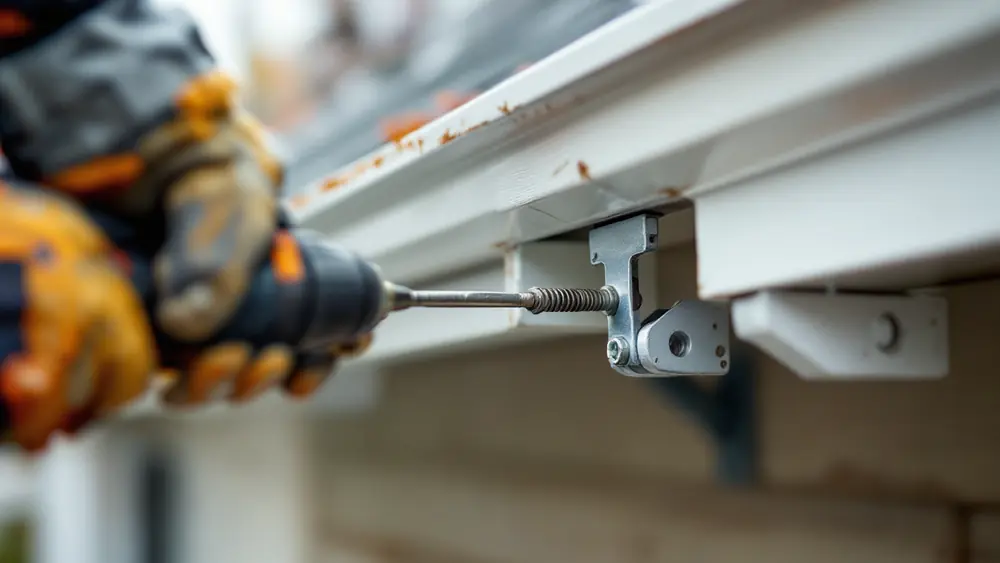
Look along the front face and inside the back of the gutter from the ladder before touching a fastener. Round spike heads on the front face every 24 in mean spike and ferrule; screw heads inside against the back wall mean hidden hangers; straps disappearing under the first shingle course mean roof hangers, which Amerimax says to use only when no fascia board exists.
| Hanger type | What you see | How it comes off | Reuse the gutter? |
|---|---|---|---|
| Hidden hanger with screw | Bracket under the front lip; hex screw head inside, at the back wall | Back out the screw; the hanger stays clipped in the gutter | Usually yes; screw holes are hidden in the back wall |
| Spike and ferrule | Spike head on the front face; ferrule tube inside, front to back | Pry the spike out or cut it at the back of the gutter | Often no; the front-face holes stay visible |
| Screw and ferrule | Screw head on the front face, same layout as a spike | Back out the screw | Yes, with the same visible-hole caveat |
| Fascia bracket (snap-lock or half-round) | Bracket cradling the gutter from below | Release the gutter from the bracket, then unscrew brackets | Yes |
| Roof hanger with strap | Strap running up under the shingles; no fascia fasteners | Pull strap nails under the first course, or cut the strap | Yes, but resetting means lifting shingles again |
| Vinyl snap-in hanger (Plastmo, similar) | Plastic hanger; gutter rear edge hooked in, front snapped over the tip | Pop the front lip off the hanger tip, then unhook the rear edge | Yes if not cracked; cemented corners stay joined |
Hanger layouts and spacing rules for each type are compared in our gutter brackets guide.
How to remove gutters, step by step
These 8 steps fit K-style aluminum (.027 or .032 in), steel and vinyl gutters hung on fascia at 18 to 24 in hanger spacing; stop after step 7 if only one section needs to come down.
- Clear the gutter. Scoop out debris and flush the trough so a 10 ft section is not carrying wet leaves while you hold it overhead.
- Remove the downspouts first. Take out the 2 bands per 10 ft section, then the sheet metal screws joining the upper elbow to the drop outlet (full method in the downspout section).
- Count and mark the hangers. On a 40 ft run at 24 in spacing, expect 21 hangers (40 x 12 / 24, plus 1); at 18 in, expect 28. Mark each with tape so none is missed.
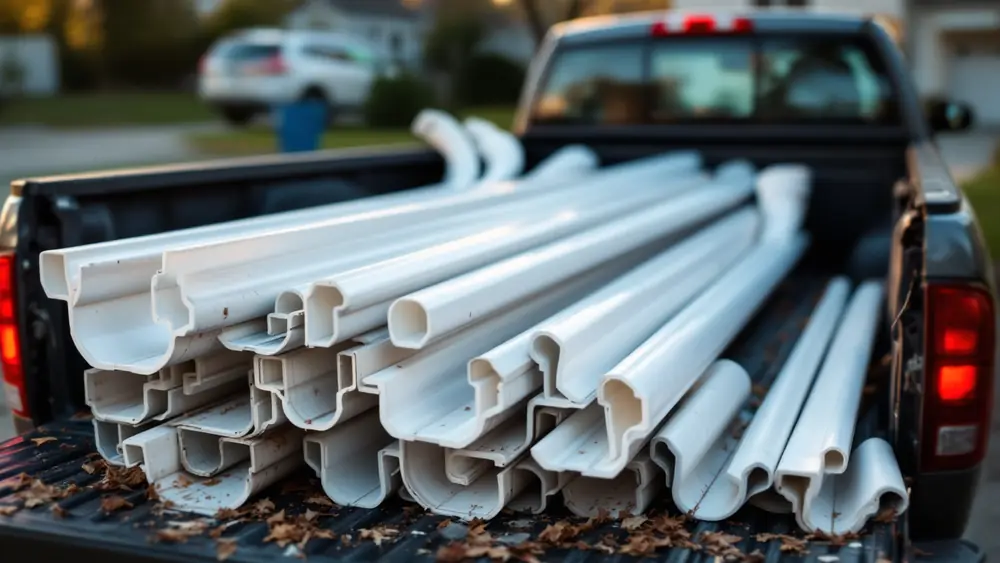
- Cut the run into handling lengths if you are not reusing it. A hacksaw or tin snips cuts .027 in aluminum; 10 ft pieces fit in a pickup bed and through a scrap yard gate.
- Remove fasteners from the ends toward the middle. Leave every third or fourth hanger in (one every 6 to 8 ft at 24 in spacing) until a helper or a rope is supporting the gutter, so the loose run cannot fold.
- Drill out pop rivets at joints, miters and end caps if sections must come apart; drill through the head with a bit that matches the rivet diameter, such as a 1/8 in bit for a 1/8 in rivet.
- Lower each section. Hand each 10 ft length down level, or lower it with ropes from both ends; never drop aluminum onto a hard surface if you want to rehang it.
- Pull leftover nails and hanger screws from the fascia and inspect the board, the rafter tails and the drip edge, which IRC R905.2.8.5 requires to extend at least 1/4 in below the sheathing.
Removing hidden hangers
Hidden hangers are the fastest to remove: put a 1/4 in hex nut driver on a drill, reverse it, and back each screw out of the fascia; the hanger usually stays clipped under the front lip and comes down with the gutter. Amerimax’s sheet tells installers to “power drive” that 1/4 in hex screw, so a screw that spins with no bite means the wood behind it has failed.
Removing spike-and-ferrule gutters
A spike-and-ferrule gutter is held by a long aluminum nail (Amerimax sells a 7 in spike with a 5 in ferrule, per its 20-pack listing at RONA) driven through the front face, the ferrule tube and the fascia. Pry it out with a cat’s paw against a scrap of wood so the bar does not crush the front face, or saw through the spike between the gutter’s back wall and the fascia with a reciprocating saw.
Removing roof strap hangers under shingles
Roof strap hangers are nailed to the deck under the first shingle course, so removal means breaking the sealant strip on that course with a flat bar and pulling the nails. If the roof is due for replacement within a few years, cutting the strap flush at the roof edge with tin snips leaves the nails buried and avoids lifting shingles twice; reseal any lifted tab with ASTM D4586 asphalt roof cement.
Removing vinyl gutters from clips
Vinyl systems like Plastmo hook the rear edge of the gutter into a plastic hanger every 24 in and snap the front lip over the hanger’s tip, per Plastmo’s manual. Reverse that: press the front lip outward off the tip, then lower the rear edge out of the hook. Plastmo cements corners and end caps (with its own cement, at 32 F or warmer), so those joints do not come apart; cut beside them instead.
How to remove a gutter downspout
A gutter downspout comes off in three parts: the bottom elbow or extension, the vertical pipe held by wall bands, and the elbows joining the pipe to the gutter’s drop outlet. Spectra’s instructions join every downspout and elbow with a screw at a crimped joint, large end up, so expect a sheet metal screw at each connection and 2 bands per 10 ft per Amerimax.
- Remove the bottom elbow, extension or splash block, or unhook the pipe from an underground drain adapter.
- Back out the screws joining the upper elbow to the drop outlet under the gutter (Spectra uses two elbows here).
- Have a helper hold the pipe, then remove the wall bands from the top down.
- Lower the pipe and separate elbows by removing their screws or drilling out rivets.
- Fill band screw holes in siding or brick with a sealant made for that surface.
For where the water should go once the downspout is back up, or if you are leaving it off, the 5 ft discharge rule below applies.
How to remove gutters without damaging them
To remove gutters without damaging them for reuse, keep the run supported at no fewer than three points while the hangers come out, keep the hidden hangers clipped in, and set the gutter down on sawhorses rather than the ground. Seamless runs are the risk: a 40 ft trough held only at the ends bends at the middle, and a bent front lip will not take a hidden hanger again.
Two workarounds appear repeatedly in the GarageJournal thread: tie the gutter off to ropes or supports at the 1/3 and 2/3 points (about 13 ft and 27 ft along a 40 ft run) while working outward from the center, or cut the run into numbered pieces and rejoin them with slip-joint connectors. Each added joint is a seam that needs sealant, which is the trade-off of reusing a cut seamless run.
| Condition | Reuse or replace | Why |
|---|---|---|
| Straight trough, sound paint, hidden hangers | Reuse; rehang with new screws in fresh wood | Old screw holes are in the back wall and out of sight |
| Spike holes in the front face | Replace, or seal the holes and accept them | Rehanging on hidden hangers leaves a row of holes at 24 in |
| Kinked or creased front lip | Replace that section | A creased lip will not seat a hidden hanger |
| Rust-through on galvanized steel | Replace and scrap | Patching rust-through is a repair, not a rehang |
| Cracked vinyl or brittle hanger hooks | Replace | The snap fit depends on the plastic flexing |
| New fascia going on and gutters under 10 years old | Reuse | The gutter is not the failed part |
If you rehang, reset slope at 1/4 in per 10 ft toward the outlet (Amerimax and Plastmo) or 1 in per 40 ft (Spectra, the same pitch), and use the spacing counts in our gutter hangers per 10 ft guide.
Removing gutters to replace the fascia board
Removing gutters to replace the fascia board follows the same steps, but the inspection after removal decides the scope. Probe the fascia with an awl at every old hanger hole; check that the drip edge still extends at least 1/4 in below the sheathing and 2 in back onto the deck, as 2021 IRC R905.2.8.5 requires for shingle roofs; and look at the rafter tails behind the board.
Wood fascia replacement runs $4.66 to $7.96 per linear foot installed in Homewyse’s May 2026 estimate, so 150 ft of eave comes to $699 to $1,194 before the gutter goes back up. The full fascia sequence, from pulling the drip edge to rehanging, is in our guide to the fascia board and gutter connection.
Houses built before 1978 add a paint question. Prying hangers off painted fascia disturbs paint, and under 40 CFR 745.83 exterior work only counts as minor repair below 20 sq ft of disturbed paint. A 1×6 fascia (5 1/2 in face) along 150 ft has about 69 sq ft of painted face, so a hired contractor replacing it may need EPA lead-safe certification. The EPA’s do-it-yourselfer page says the RRP rule generally does not apply to homeowners working on their own home, unless it is rented, but recommends lead-safe practices.
What to do with old gutters: scrap value
Old aluminum gutters go to a scrap yard as “siding and gutters” grade, which MetalCharts estimates at $0.62 to $0.72 per lb from the LME price as of November 12, 2026 (its yard-board check is dated September 18, 2026). Strip the steel screws, steel hangers and plastic end caps first: MetalCharts lists dirty aluminum with attachments at $0.04 to $0.19 per lb.
| Gutter (aluminum) | Weight per ft | 150 ft weighs | Clean value at $0.62 to $0.72/lb | Dirty value at $0.04 to $0.19/lb |
|---|---|---|---|---|
| 5 in K-style, .027 in (11 3/4 in coil) | 0.37 lb | 56 lb | $34 to $40 | $2 to $11 |
| 5 in K-style, .032 in | 0.44 lb | 66 lb | $41 to $48 | $3 to $13 |
| 6 in K-style, .027 in (15 in coil) | 0.48 lb | 72 lb | $45 to $52 | $3 to $14 |
| 6 in K-style, .032 in | 0.56 lb | 84 lb | $52 to $60 | $3 to $16 |
Roofing Brief estimate. Weight per foot = coil width x thickness x 12 x 0.098 lb per cubic inch (aluminum), as in our gutter coil guide; prices are MetalCharts’ per-lb estimates for Nov 12, 2026. Downspouts add weight. Yard prices differ by buyer and change with the LME.
At $34 to $60 for a typical house, scrap pays for the trip, not the job. Vinyl gutters have no metal value; check whether your hauler or municipal drop-off accepts PVC. Steel gutters bring a ferrous rate, and copper gutters are priced separately, so call the yard before loading.
What gutter removal costs, DIY vs pro
Gutter removal costs about $1 to $2 per linear foot when a pro does it ($150 to $300 average, per HomeGuide in our cost report), and NerdWallet’s gutter cost guide uses the same $1 to $2 per foot plus $150 to $350 for debris removal. DIY costs the hanger replacements if you rehang, at $1 to $3 each for hidden hangers per Angi’s figures in our brackets guide.
| Line item, 150 ft of eave | Rate | Total | Source |
|---|---|---|---|
| Pro removal and disposal | $1 to $2 per LF | $150 to $300 | HomeGuide via Roofing Brief cost report |
| Debris removal, if billed separately | Flat | $150 to $350 | NerdWallet |
| New hidden hangers to rehang (76 at 24 in) | $1 to $3 each | $76 to $228 | Angi, via our gutter brackets guide |
| Wood fascia, if rot is found | $4.66 to $7.96 per LF | $699 to $1,194 | Homewyse, May 2026 |
| New seamless aluminum gutter instead of rehanging | $6.29 to $10.45 per LF | $944 to $1,568 | Homewyse, May 2026 |
| Scrap credit, 5 in .027 in aluminum | $0.62 to $0.72 per lb | Minus $34 to $40 | MetalCharts, Nov 12, 2026 |
Ask for removal as its own line on any roofing or fascia quote, using the $1 to $2 per LF HomeGuide range as the benchmark, because some contractors bundle it and others do not; the full price build for a new system is in our gutter installation cost breakdown.
Can you remove gutters for good?
You can remove gutters permanently only where the code and the site allow it. 2021 IRC R801.3 requires that, where expansive or collapsible soils are known to exist, dwellings have “a controlled method of water disposal from roofs” discharging not less than 5 ft from foundation walls or to an approved drainage system. On those soils, a house without gutters needs another controlled method.
| If your house has | Removing gutters for good | Rule or reason |
|---|---|---|
| Expansive or collapsible soil | Not without another controlled method that discharges 5 ft out | IRC R801.3 |
| Grade falling less than 6 in in the first 10 ft | Regrade first | IRC R401.3 (6 in fall within 10 ft), 2021 IRC chapter 4 |
| A basement or crawl space below the eave | Keep gutters or add a French drain | Roof water lands at the foundation line |
| Asphalt shingles with no drip edge | Add drip edge before removing | IRC R905.2.8.5 requires drip edge at eaves and rakes |
| Wide overhang, sandy well-drained soil, slab, positive grade | Possible, with a gravel drip path | Confirm local amendments with the building department |
The nine common replacements, from drip paths to rain chains, are costed in our gutter alternatives guide.
Which removal plan fits your job?
Pick the plan from the eave height, the hanger type and whether the gutter goes back up. The thresholds below come from the Werner ladder chart, OSHA 1926.1053, the Amerimax and Plastmo instructions and the EPA RRP rule cited above.
| Your situation | Do this | Threshold or source |
|---|---|---|
| One-story eave, 9 to 13 ft, sectional aluminum on hidden hangers | DIY with a 20 ft ladder, 1/4 in nut driver and one helper | Werner chart; Amerimax 1/4 in hex screw |
| Seamless run over about 35 ft that you plan to reuse | Three people, or support at the 1/3 and 2/3 points | GarageJournal thread advice |
| Two-story eave, 17 to 21 ft | 28 ft ladder with a standoff, or hire it out at $1 to $2 per LF | Werner chart; HomeGuide |
| Service drop or power line within reach of the ladder | Fiberglass ladder only, or hire it out | OSHA 1926.1053(b)(12) |
| Spike-and-ferrule gutter | Remove and plan to replace, not rehang | Front-face holes at 24 in remain |
| Roof replacement within a few years | Let the roofer remove and reset; cut roof straps now | Avoids lifting shingles twice |
| Pre-1978 house, painted fascia, hired contractor | Use an EPA lead-safe certified firm if over 20 sq ft | 40 CFR 745.83 |
| Vinyl gutters with cemented corners | Unsnap straight runs; cut beside cemented joints | Plastmo manual |
If you are taking gutters down to paint them, painting in place is usually enough unless the fascia behind them needs paint too, since hangers every 18 to 24 in screw through the gutter into that board; prep and primer by material are in our guide on whether you can paint gutters. More roof-edge explainers sit in the learn roofing hub.
Frequently asked questions
Is it easy to remove gutters?
Removing gutters is easy on a one-story house with sectional aluminum on hidden hangers: back out one 1/4 in hex screw every 24 in and lower 10 ft lengths that weigh about 3.7 lb each at .027 in. It gets hard with seamless runs over about 35 ft, second-story eaves that need a 28 ft ladder, roof-strap hangers under shingles, or rusted spikes.
How do you remove roof gutters?
Remove roof gutters by taking off the downspouts first, then removing each hanger fastener from the ends toward the middle while a helper or rope supports the run. Hidden hangers need a 1/4 in hex driver, spikes need a pry bar or saw, and roof straps are pulled or cut at the shingle edge. Lower each section level and inspect the fascia.
How do I remove gutters to replace the fascia board?
Disconnect the downspouts, remove every hanger fastener along the section (about 21 on a 40 ft run at 24 in spacing), and lower the gutter with a helper. Then pull the drip edge tab, pry off the fascia and check the rafter tails. Wood fascia runs $4.66 to $7.96 per linear foot installed, per Homewyse in May 2026.
Can gutters be removed and reused?
Yes, gutters can be removed and reused when the trough is straight, the front lip is not creased and the gutter hung on hidden hangers, whose screw holes sit hidden in the back wall. Spike-and-ferrule gutters leave holes in the front face every 24 in, and seamless runs bend if supported only at the ends, so those are often replaced instead.
How do you remove a gutter downspout?
Remove the bottom elbow or extension, back out the sheet metal screws joining the upper elbow to the gutter’s drop outlet, then have a helper hold the pipe while you remove the wall bands from the top down. Amerimax uses 2 bands per 10 ft section. Separate the elbows by removing their screws or drilling out rivets.
How do you remove plastic guttering from clips?
Plastic gutters like Plastmo hook the rear edge into each hanger and snap the front lip over the hanger’s tip, with hangers every 24 in. Press the front lip outward off the tip, then lower the rear edge out of the hook. Cemented corners and end caps do not come apart, so cut beside those joints instead.
Do you need to remove gutters to paint them?
No, gutters can usually be cleaned, primed and painted in place from a ladder. Remove them only if the fascia behind needs paint or repair, because hangers screw through the gutter into the fascia every 18 to 24 in. In a pre-1978 house, a hired painter disturbing over 20 sq ft of exterior paint generally falls under EPA’s RRP rule.