
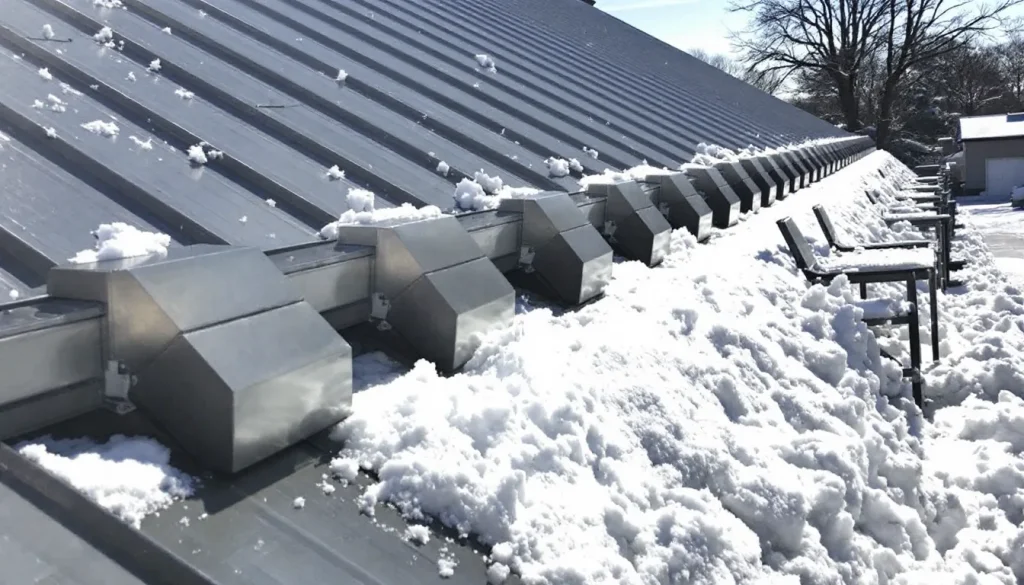
Properly engineered snow guards for metal roofs hold accumulated snow on the roof surface long enough to melt or shed slowly, preventing the avalanche-style slides that damage gutters, snap downspouts, crush landscaping, and seriously injure people standing below. The two main system types are pad-style (individual plastic or aluminum cleats spaced in a grid, $8 to $20 each installed, typical brands SnoBlox/SnoJax, Sno Gem, Alpine SnowGuards) and bar-style (continuous horizontal rails or fences, $25 to $60 per linear foot installed, typical brands S-5! ColorGard, Berger SnoFence, AceClamp). The right product, spacing, and row count is a function of roof slope, panel type, snow load, and the holding force calculation specified by the manufacturer’s engineering tables, not a generic eyeball install.
Last reviewed: September 2026 by The Roofing Brief Team.
The short version
- Pad-style ($8-20 each): individual cleats. Best for low-to-moderate snow loads and standing seam or trapezoidal panels.
- Bar-style ($25-60 per linear foot): continuous fence. Best for high snow loads, steep slopes, and where snow retention must be 100%.
- The holding-force formula: total required hold = friction coefficient times snow weight times roof area divided by guard count, with safety factor 2 to 3.
- Major brands: SnoBlox/SnoJax (pad), Sno Gem (pad), Alpine SnowGuards (pad and bar), S-5! ColorGard (bar), Berger SnoFence (bar), AceClamp (bar).
- Mount type matters: clamp-on (no penetration, only on standing seam) vs adhesive vs through-fastened. Through-fastened voids many panel warranties.
- One row is usually not enough. Most engineered installs need 2 to 4 rows depending on slope length.
Why metal roofs need snow guards in the first place
Metal roof panels are slick by design. The smooth painted Kynar or SMP finish, the continuous standing-seam geometry, and the high coefficient of thermal expansion combine to make snow slide off in large sheets once the sun warms the underside of the panel. The friction coefficient between snow and a clean Kynar finish is roughly 0.10 to 0.15, compared to 0.30 to 0.40 for asphalt shingles. That is why metal roofs avalanche and shingle roofs typically do not.
When 18 inches of accumulated snow on a 24-by-40-foot slope releases at once, the gross weight in motion can exceed 2,500 pounds moving at 5 to 15 miles per hour. That mass hitting a gutter rips it off the fascia. Hitting a downspout snaps it at the elbow. Hitting an HVAC condenser unit at ground level destroys the coil. Hitting a person causes serious injury or death. Snow guards exist to prevent the release.
For homeowners considering metal in snow country, our metal roof installation guide covers the broader install picture; this guide is the snow-guard specifics.
Pad-style snow guards: the dominant residential product
Pad-style guards are individual cleats, typically 3 to 6 inches square, made of polycarbonate plastic, aluminum, or copper, with either a clamp-on or adhesive-mount base. They are installed in a staggered grid pattern across the lower 2 to 4 feet of the roof slope, with the count and spacing engineered to hold the calculated snow load.
SnoBlox / SnoJax (Sno Industries)
The most common pad-style residential product in North America. Made of injection-molded polycarbonate, sold in clear, white, gray, and brown. Adhesive-mount (using VHB tape supplied by manufacturer) or clamp-on for standing seam. Sno Industries’ SnoBlox Original is rated to hold 750 to 1,500 lbs depending on slope, mount, and panel type. Cost $8 to $14 each installed.
The Sno Free is a polycarbonate “fence” variation that fits between two pads, increasing per-foot holding capacity. The SnoBar (also from Sno Industries) is a hybrid bar-and-pad system for steeper slopes.
Sno Gem
Polycarbonate pad-style guard with a wedge profile that channels snow rather than blocking it head-on. Mount options include adhesive, mechanical-clamp (for standing seam), and through-fastened (for exposed-fastener panels). Slightly more expensive than SnoBlox at $12 to $18 each but field-favored for trapezoidal R-panel and PBR panel applications because the wedge geometry fits the panel rib pattern cleanly.
Alpine SnowGuards
Vermont-based manufacturer offering both pad and bar systems. The Alpine pad-style products are typically aluminum or stainless steel rather than polycarbonate, making them better-suited to high snow loads and longer install life. Cost $14 to $22 each. Custom color matching to panel finishes. Often specified on commercial and architectural-spec residential.
S-5! pad-style options
S-5! is best known for clamps and bar systems but also offers the SnoFence pad, designed to fit S-5! clamps. Useful when the rest of the snow-management system is S-5! based and consistency is the priority.
Bar-style snow guards: continuous retention
Bar-style systems use a horizontal rail or fence (often two parallel rails) anchored to the roof at clamp or bracket points. The bars span the entire eave or all needed horizontal sections, presenting a continuous barrier to snow movement. According to the SnoBlox/SnoJax buyer’s guide, individual pad-style and clamp-on guards are generally not recommended once the ground snow load reaches roughly 45 psf, and at or above that level the manufacturer specifies a continuous bar or rail system such as SnoBar or ColorBar, though the exact cutoff can shift with slope length, pitch, and panel type.
S-5! ColorGard
The dominant standing-seam snow-bar system in North America. Anchored with S-5! clamps (non-penetrating, fastener-free on standing seam panels), the ColorGard bar inserts a color-matched strip that visually disappears into the panel finish. Engineered for snow retention with published load tables for every major panel profile and slope. Cost $35 to $50 per linear foot installed.
The non-penetrating mount is the major selling point. Most panel manufacturers preserve their finish and substrate warranty when S-5! ColorGard is used; through-fastened systems typically void the warranty.
Berger SnoFence
Steel pipe-rail snow fence system. More industrial appearance than ColorGard, often specified on commercial roofs and high-snow-load residential. Uses bracket mounts that may be clamp-on (standing seam) or fastener-mount (exposed-fastener panels). Cost $25 to $40 per linear foot. Berger Building Products has been making snow retention systems since the 1840s; the brand is widely respected on engineering-spec jobs.
AceClamp / Universal Clamp brands
AceClamp makes a competing non-penetrating clamp system for standing seam panels, with their own snow bar offering. Often slightly cheaper than S-5! at the clamp level but with smaller engineering documentation library. Used where pricing pressure favors a clamp alternative.
Alpine SnowGuards bar systems
Alpine offers Snow Fence Bar and Snow Net systems for steep slopes and heavy snow loads. Heavy-duty steel bars with snow-net infill prevent even small (see our metal roof on a lean-to addition) snow drift through the bar opening. Cost $40 to $60 per linear foot. Used on ski resort buildings and high-altitude residential.
The holding force calculation
Picking a snow guard product without doing the math is how you end up with snow guards that fail and a sliding avalanche anyway. The engineering formula combines snow weight, friction coefficient, slope, panel area, and the published holding capacity of the chosen guard.
The basic formula in plain English:
Required total holding force equals snow weight per square foot times roof slope area in square feet times sine of slope angle, divided by the friction coefficient, multiplied by a safety factor of 2 to 3.
That number (in pounds) is then divided by the published holding force per individual guard or per foot of bar to determine count or linear footage required. Snow guard manufacturers publish charts that do this math for you given inputs of slope, panel type, snow zone, and product chosen.
Worked example: Vermont colonial
Roof slope is 8/12 (pitch), slope length is 22 feet from eave to ridge, panel run is 36 feet wide. Snow load zone is 60 lbs per square foot ground snow (ASCE 7-22, central Vermont). Roof snow load after conversion factors is 42 lbs per square foot. The step from ground snow load to design roof snow load follows the ASCE 7 exposure, thermal, and slope factors detailed in our roof snow load design and ground-to-roof conversion guide.
Roof slope area is 22 times 36 equals 792 square feet. Snow weight at peak load is 792 times 42 equals 33,264 pounds. Slope angle 8/12 equals about 33.7 degrees, sine equals 0.555. Sliding force equals 33,264 times 0.555 equals 18,461 pounds. Divided by friction coefficient 0.12 for Kynar metal equals 153,841 pounds of theoretical resistance required. With safety factor 2 applied to net resistance, planning target is 36,922 pounds of holding force from snow guards.
That number is intimidating. The published holding force of a single SnoBlox Original on standing seam is roughly 750 pounds at this slope. Even at 3 rows of 30 guards each, total resistance is 67,500 pounds. Adequate margin. But with one row of 30, total is 22,500 pounds. Under-spec, and the snow will release.
Most installers do not run this calc in full. Manufacturer charts simplify it by feeding in slope, snow zone, and panel area, then outputting recommended count and rows. Use the chart, not eyeballing.
Mounting type: where the warranty risk lives
How the guard attaches to the panel determines whether your panel warranty stays intact.
Clamp-on (best on standing seam)
Clamp-on systems (S-5!, AceClamp, Sno Industries SnoClip) grip the standing seam without penetrating the panel. Set screws bear on the seam material, holding the clamp in place by friction. No fasteners through the panel, no penetrations, no compromise of the panel finish or substrate warranty. This is the preferred mount for any standing seam panel with an active manufacturer warranty.
Adhesive-mount (works on most metal panels)
Polycarbonate pad guards with VHB acrylic adhesive tape can be applied to clean, primed panel surfaces. The adhesive bond strength on properly prepped Kynar can exceed 80 psi, holding guards rated to 1,500 pounds. The risk: improper surface prep (cleaning solvent, dust, oxidation) causes failure. Manufacturers spec exactly which cleaner, what dwell time, what temperature range. Skip the spec and the guards peel off the next season.
Through-fastened (avoid on standing seam, OK on R-panel)
Mechanical-fastener mounts drive screws through the panel into substrate. They hold reliably but they puncture the panel weather barrier. On standing seam panels with concealed-fastener finish warranties, through-fastening voids the warranty. On exposed-fastener panels (R-panel, PBR, U-panel) the existing fasteners through the panel already exist, so an additional fastener for a snow guard does not compromise the warranty by itself, though it does add another leak path requiring sealant.
For homeowners installing on standing seam, choose clamp-on or properly-spec’d adhesive. For exposed-fastener panels, through-fastened is acceptable with sealed penetrations.
Pad-style row planning
One row of pad-style guards at the eave alone is rarely enough. The math:
- Up to 12 feet of slope length: one row at eave usually OK in moderate snow zones (under 40 psf design).
- 12 to 24 feet of slope: two rows. First row 2 to 3 feet up from eave, second row at 50% to 60% of slope length.
- 24 to 40 feet of slope: three rows. Eave row, mid row, upper row.
- Over 40 feet of slope: 4 or more rows, plus consider switching to bar-style for guaranteed retention.
Staggering vs aligned
Most manufacturer charts recommend staggered grid (each row offset half-spacing from the row above) over aligned grid. Staggered configuration intercepts more sliding mass per row because there is no straight channel for the snow to slip through.
Eave proximity
The first row should be 18 to 36 inches above the eave edge, not flush with the eave. Mounting at the very edge concentrates holding load at the eave area where the panel has the least structural support, and creates an ice dam risk. For ice dam specifics on metal roofs, see heat cable for ice dams and the general metal roof condensation behavior that interacts with snow accumulation.
Where snow guards are required (and where they save lawsuits)
Snow retention is not federally regulated, but several jurisdictions have local requirements or municipal best-practice standards:
- Some Vermont towns require snow retention on metal roofs over public sidewalks or commercial entries.
- Many ski resort municipal codes (Vail, Aspen, Park City, Mammoth) require engineered snow retention on metal roofs.
- Quebec, New Brunswick, and Ontario building codes recommend snow retention on metal roofs over public access areas.
- The IBC and IRC do not directly require snow guards but reference engineered design for snow loading.
The bigger driver is liability. Snow released from a metal roof onto a public sidewalk, a delivery driver, or a neighbor’s property creates negligence exposure for the homeowner. Snow guards are cheap insurance against a six-figure injury lawsuit.
The dark-color, sunny-day failure mode
Dark-color metal roofs in sun-exposed orientations accumulate heat fast on a sunny winter day. The panel surface temperature can rise 50 to 70 degrees above ambient, melting the snow-panel contact layer into a lubricating water film. The friction coefficient drops toward 0.02. At that point the only thing holding the snow on the roof is the snow guards.
This is the failure mode that catches inadequately-spec’d installs. A roof with one row of SnoBlox at the eave that has held snow for three winters fails catastrophically on the first warm February afternoon. The fix is more rows, or upgrade to bar-style with full retention rating.
Dark color choice contributes to the heat gain. For color-strategy on metal, see best roof color.
Snow guards and ice dams: separate problems
Snow guards do not prevent ice dams. They prevent snow slides. If you are not sure whether your real problem is sliding snow or ice building up at the eave, our breakdown of snow guards versus heat cable covers which fix matches which symptom. The two phenomena have related causes (snow melts at the warm roof surface, refreezes at the cold eave) but different mechanisms. A roof with proper insulation, balanced attic ventilation, and ice-and-water shield at the eave will largely prevent ice dams; snow guards then handle the avalanche question.
Some homeowners install heated snow guards (electrical-resistance heat elements built into the guard) to prevent ice buildup at the guard line itself, where retained snow would otherwise create a dam. Heated systems cost 3 to 4x more than passive guards and only make sense where panel-level ice dam is a documented problem despite proper attic ventilation. See attic ventilation for the prerequisite work.
Cost summary by system type
| System | Cost per guard or linear foot | Typical install for 36 ft eave with 2 rows | Best use case |
|---|---|---|---|
| SnoBlox/SnoJax pad (polycarbonate, adhesive) | $8-14 each, 6″ spacing = 144 guards for 2 rows | $1,150-2,000 | Moderate snow zone, standing seam, residential |
| Sno Gem pad (polycarbonate, clamp or adhesive) | $12-18 each | $1,700-2,600 | R-panel, PBR exposed-fastener panels |
| Alpine pad (aluminum, mechanical) | $14-22 each | $2,000-3,200 | Heavy snow zone, architectural spec, commercial |
| S-5! ColorGard bar (clamp-on) | $35-50 per ft | $2,500-3,600 | Standing seam, premium aesthetic, full retention |
| Berger SnoFence bar (steel) | $25-40 per ft | $1,800-2,900 | Commercial, industrial appearance acceptable |
| Alpine bar/fence | $40-60 per ft | $2,900-4,300 | Extreme snow zones, ski resort, mountain residential |
For multi-row installs the cost scales linearly with row count. Most residential metal roof snow guard projects fall in the $2,000 to $5,000 range across the full structure.
Installation gotchas
- Clean the panel surface with the manufacturer-specified cleaner before adhesive bond. IPA wipes are typically required; Windex and similar consumer cleaners leave residue that defeats the adhesive.
- Install on dry panels at temperatures above 50 degrees F for adhesive cure (or use cold-cure adhesive products rated for lower).
- Allow 24-48 hours cure time before exposure to snow load.
- For clamp-on systems on standing seam, verify the clamp model matches the panel profile exactly. A clamp sized for nominal 1.5-inch seam will slip on a 1.0-inch seam.
- Stagger guards across rows.
- Do not put a snow guard directly over a fastener clip in the underlying structure. Position so the guard load transfers through the panel rib to the structural deck.
FAQ
Will snow guards damage my metal roof?
Properly installed clamp-on or adhesive systems do not damage panels. Through-fastened systems create penetrations that must be sealed; over time these can fail and leak. For standing seam panels with active finish warranty, only use clamp-on or manufacturer-approved adhesive systems.
Can I install snow guards myself?
Pad-style adhesive guards on an accessible single-story roof are within DIY range if you are comfortable on the slope and follow the manufacturer’s adhesive application spec exactly. Bar systems and steep-slope work should be left to a professional. The risk on DIY is not the guard itself but the math: most DIYers install one row at the eave and undercount the rows needed.
Do snow guards work on corrugated metal roofs?
Yes, but the product selection narrows. SnoBlox, Sno Gem, and Alpine pad guards have specific models for corrugated and U-panel profiles. Bar systems are less common on corrugated because the panel rib geometry makes clean bar anchoring harder. For full corrugated-panel context, see corrugated metal roofing.
How long do snow guards last?
Polycarbonate adhesive guards typically last 10 to 20 years before the adhesive bond degrades or UV embrittlement cracks the polycarbonate. Aluminum and steel guards last the life of the roof, 30 to 50 years. Bar systems on clamp mounts last as long as the panels.
If snow guards hold snow, will the extra load damage my roof structure?
Snow guards do not increase the snow load. The snow was already on the roof; the guards just keep it in place instead of letting it slide off. The structure was designed for the design snow load anyway. If snow guards routinely cause your roof to hold visibly more snow than nearby unguarded roofs, you may want a structural review, but for engineered-load roofs this is not normally a concern.
Bottom line
Snow guards on a metal roof are a small investment that prevents large problems: torn gutters, crushed landscaping, injured pedestrians, and lawsuits. Pad-style systems (SnoBlox, Sno Gem, Alpine) work well on moderate-snow residential at $2,000 to $3,000 for typical installs; bar-style systems (S-5! ColorGard, Berger SnoFence) deliver guaranteed retention for high snow zones and premium aesthetics at $2,500 to $5,000. Run the math from the manufacturer’s spacing chart rather than eyeballing it; one row at the eave is rarely enough. On standing seam roofs, choose clamp-on or properly-spec’d adhesive to preserve the panel warranty. For homeowners installing metal in snow country, also see metal roof installation, heat cable for ice dams, and metal roof condensation for the full snow-country picture.