
By The Roofing Brief Team | Last reviewed: October 2026
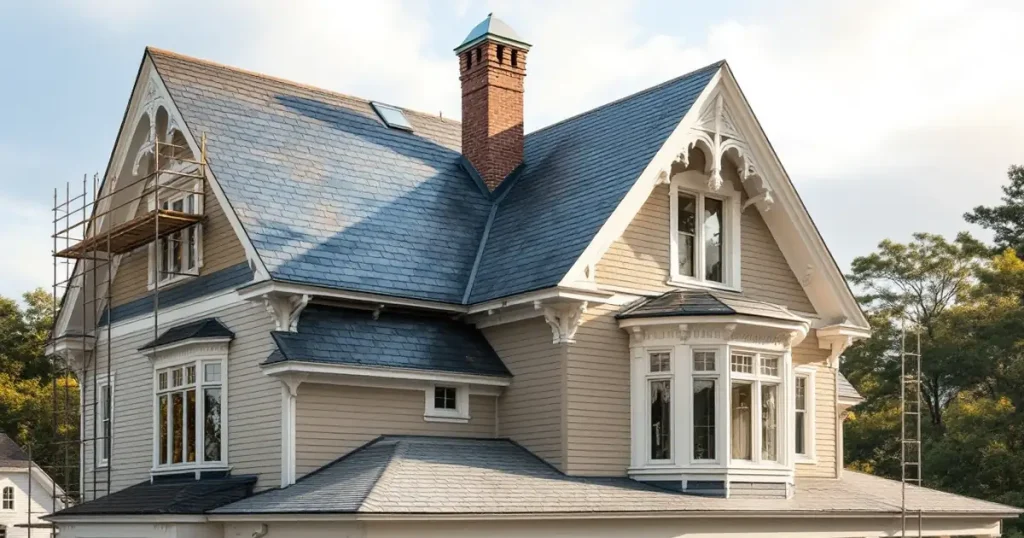
Historic roof replacement is a last resort under federal preservation standards: repair comes first, and when a roof must be replaced, the new one should match the old in design, color, texture and, where possible, material. On a designated house that usually means commission approval before a permit, NPS damage thresholds of about 20 percent for slate and 30 percent for clay tile, and a real price gap: natural slate runs $15 to $30 per square foot installed versus $5 to $8 for architectural asphalt.
The federal 20 percent historic tax credit does not cover a home you live in. It applies only to income-producing certified historic structures under Internal Revenue Code section 47, though some states offer homeowner credits. This guide covers who has a say over the roof, what can substitute for what, the code sections that apply, cost arithmetic, credits and the insurance clause that can leave an owner paying the difference. Upkeep for a single material lives in our slate roof maintenance schedule.
Key numbers at a glance
These are the figures that decide most historic roof projects. They come from National Park Service (NPS) Preservation Briefs, the Internal Revenue Code, federal regulations, a standard homeowners policy form and The Roofing Brief 2026 Roofing Cost Report. Each is a guide, not a ruling, because a local commission, the State Historic Preservation Office (SHPO) and your insurer apply them to one specific building.
| What it is | Figure | Source |
|---|---|---|
| Slate: point where replacement is usually weighed against repair | About 20 percent or more of slates damaged or missing | NPS Preservation Brief 29 |
| Clay tile: point where full replacement may be needed | More than about 30 percent of tiles lost or broken, unless matching tiles can be found | NPS Preservation Brief 30 |
| Realistic life of premium modern wood shingles | 15 to 30 years (historic edge-grain heartwood: over 60) | NPS Preservation Brief 19 |
| Lead time to order new roofing slate | 4 to 12 weeks, up to 1 year for special orders | NPS Preservation Brief 29 |
| Federal historic rehabilitation credit | 20 percent of qualified expenses, claimed ratably over 5 years; income-producing buildings only | 26 U.S.C. 47(a); NPS |
| Federal spending test | Expenses in a 24-month period must exceed the greater of adjusted basis or $5,000 | 26 U.S.C. 47(c)(1)(B) |
| Ordinance or law coverage in a standard HO-3 | Up to 10 percent of the Coverage A limit | NJM New Jersey HO-3 (03/18), ISO-based wording |
| Age benchmark for National Register eligibility | Significance within the past 50 years ordinarily does not qualify | 36 CFR 60.4 |
Repair or replace? How preservation standards decide
A historic roof should be replaced only when repair is no longer practical. Standard 6 of the Secretary of the Interior’s Standards for Rehabilitation, codified at 36 CFR 67.7, says deteriorated historic features “shall be repaired rather than replaced,” and a replacement “shall match the old in design, color, texture, and other visual qualities and, where possible, materials.” The NPS Preservation Briefs translate that into material-specific triggers.
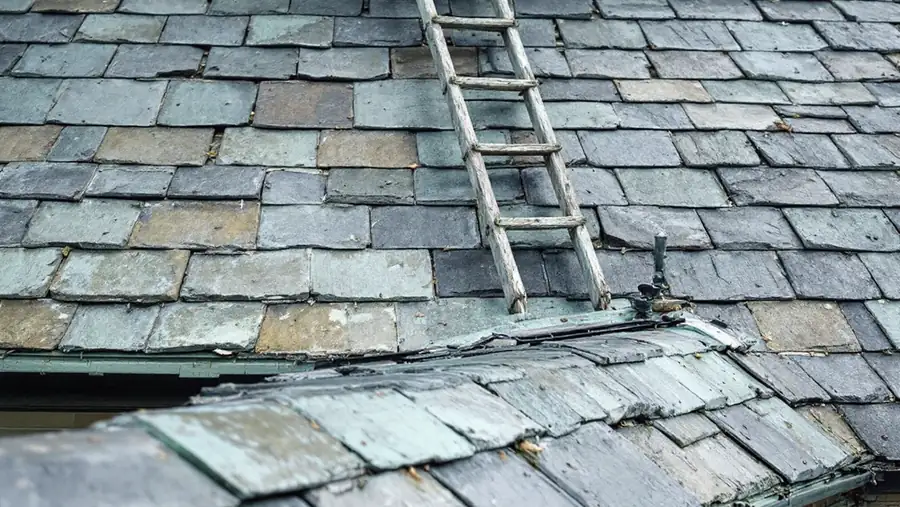
Brief 29 warns that “all too often slate roofs are mistakenly replaced” when the real problem is flashing, gutters or attic condensation. Its repair-or-replace checklist starts with counting damaged slates, checking whether rusting nails rather than failing stone explain slipped slates, and asking whether only one slope is worn, so the cost can be spread over years. Brief 30 notes that clay tiles often outlast their fasteners and can be lifted, the deck repaired, and the same tiles relaid.
| Material | Repair first when | Replacement usually considered when | Service life cited | Source |
|---|---|---|---|---|
| Slate | Damage is scattered; slipped slates are sound but their iron nails rusted (salvage and relay) | About 20 percent or more of slates damaged or missing, or slates flake and thud when tapped | Vermont and New York about 125 years; Buckingham, Virginia 175+; Pennsylvania Soft-Vein 60+ | NPS Preservation Brief 29 |
| Clay tile | The fastening system or deck failed but tiles are sound | More than about 30 percent lost or broken and no matching replacements | Generally about 100 years | NPS Preservation Brief 30 |
| Wood shingles | Only a few shingles are missing or damaged | Shingles are widely eroded, cracked, cupped or split | 15 to 30 years for premium modern shingles | NPS Preservation Brief 19 |
| Sheet metal (tin, terne, copper) | Holes can take a metal patch; surface can be cleaned and recoated | No NPS percentage; judge by pitting, open seams and substrate | Not stated in Brief 4 | NPS Preservation Brief 4 |
For line-item prices on the repair side, see our slate roof repair cost guide. The same logic applies to any material in our guide to roof repair vs replacement.
Is your house historic, and who has a say over the roof?
Who reviews a historic roof replacement depends on the designation, not the age of the house. National Register listing by itself places no federal restrictions on a private owner using private money, according to the NPS National Register FAQ. Local historic districts and landmarks are different: a city commission can require approval for roofing and flashing before a building permit is issued.
Two other reviews can apply by choice. If you seek the federal tax credit, the SHPO and NPS review the whole project. If you seek a state homeowner credit, the state agency must approve the work, usually before it starts. The table sorts out the common cases.
| Designation or program | Who reviews roof work | Effect on a private owner | Source |
|---|---|---|---|
| National Register (individual or contributing), private funds | No federal review | “No federal restrictions or requirements”; local laws still apply | NPS National Register FAQ |
| Local historic district or landmark | Local preservation commission or its staff | Approval needed per local ordinance; Philadelphia lists “roofing and flashing” among work that needs review | Philadelphia Historical Commission |
| Federal 20 percent credit project | SHPO, then NPS (Parts 1, 2 and 3) | Entire project must meet the Standards for Rehabilitation | NPS application process |
| State homeowner credit project | State agency (for example the Maryland Historical Trust) | Work approved before it begins | Maryland Historical Trust |
How historic district approval works for a new roof
In a local historic district, a roof replacement typically needs a commission or staff approval, often called a certificate of appropriateness, before the building permit. Requirements are set city by city. Philadelphia ties the review to the building permit and charges nothing for it, and Detroit’s Historic District Commission asks for cost evidence on repair and replacement before it rules on replacing a historic roofing material.
Detroit’s published checklist is the most specific we found. For a roof replacement involving historic roofing material, it asks for a bulleted scope that includes dormers, gutters, soffit and fascia, plus two estimates to repair the existing roof, two to replace it with the same material and two for asphalt shingle replacement. Detroit also warns that unapproved exterior work is a violation that stays with the property and may complicate a sale.
| Item | Detroit Historic District Commission | Philadelphia Historical Commission | Source |
|---|---|---|---|
| When review happens | Project review online, then building permit if approved | Review is part of getting a building permit | City of Detroit; City of Philadelphia |
| Cost evidence for historic roofing | 2 repair estimates, 2 same-material estimates, 2 asphalt estimates | Not listed | City of Detroit |
| Scope documents | Bulleted scope including dormers, gutters, soffit and fascia | Completed building permit application and supporting materials | City of Detroit; City of Philadelphia |
| Review fee | None; the city warns of phishing emails demanding payment | “No charge for a project review” | City of Detroit; City of Philadelphia |
| Unapproved work | Recorded as a violation that stays with the property | Not stated on the service page | City of Detroit |
Call the commission staff before collecting bids. Staff can tell you whether in-kind replacement is approved administratively, what documentation they want, and whether any substitute material has been accepted on similar houses in your district.
Matching materials: what can replace what
The safest approval path is in-kind replacement: the same material, size, color, exposure and detailing. NPS Preservation Brief 4 says that if a roof “is readily visible, the alternative material should match as closely as possible the scale, texture, and coloration” of the historic roofing. Where a flat roof cannot be seen from any elevation, Brief 4 allows that a modern built-up roof may make better economic and construction sense.
The briefs are firmer about some swaps than others. Brief 29 says slate roofs on historic buildings “cannot be duplicated using substitute materials,” and Brief 30 says concrete, metal or plastic tiles are generally not appropriate substitutes for clay. Brief 19 is more flexible on wood: species and fabrication method can differ if the look matches. Our faux slate guide covers synthetic products a commission may or may not accept.
| Original roofing | In-kind replacement | Substitutes NPS treats as acceptable in some cases | NPS cautions against | Source |
|---|---|---|---|---|
| Slate | New or salvaged slate matched for size, thickness, color and coursing | Case by case only; Brief 29 says slate cannot be duplicated with substitutes | Stripping a significant slate roof for asphalt shingles | NPS Briefs 29 and 4 |
| Clay tile | Matching natural clay tile, salvaged or custom-made, sometimes from original molds | Close but changed modern profiles on a secondary elevation, or when the entire roof is replaced | Concrete, metal or plastic tiles; patching with tar, caulk or non-matching tile | NPS Brief 30 |
| Wood shingles | Matching size, thickness, exposure, butt shape and pattern | Western Red Cedar or Eastern White Pine for an unavailable species; fire-retardant treatment with minimal visual impact | Highly textured rustic shakes, prefabricated hips and ridges, overly wide shingles, unless documented | NPS Brief 19 |
| Tin, terne, zinc or lead | The same metal and seam pattern | Lead-coated copper, terne-coated steel, aluminum/zinc-coated steel | Changing seam spacing on a visible roof | NPS Brief 4 |
| Sheet copper | Sheet copper | Copper-coated steel, which Brief 4 calls less expensive and less durable | Dissimilar metals in contact (galvanic corrosion) | NPS Brief 4 |
| Flat roof hidden from every elevation | Original system if documented | A modern built-up or membrane roof | Not stated | NPS Brief 4 |
Historic metal roofing: tin, terne, copper and standing seam
Historic metal roofing in the United States is mostly tin plate, terne plate, copper and galvanized iron. NPS Preservation Brief 4 notes that once American rolling mills were established, tin plate’s low cost, light weight and low maintenance “made it the most common roofing material,” and Thomas Jefferson put a standing-seam tin roof on Monticello. Tin roofs were kept painted, usually red.
On a visible standing-seam roof, the seam spacing should match the original because it sets the building’s scale, Brief 4 says. Use one metal for flashings, gutters and downspouts to avoid galvanic action, as Brief 29 advises, and never fasten copper with steel nails. Install and gauge details for modern panels are in our standing seam installation guide, and matching rainwater goods are covered in our copper gutters guide.
Building code rules that apply to reroofing a historic house
Reroofing a historic house is still reroofing under the building code, but the existing-building code gives historic structures room to use original materials. The 2021 International Residential Code (IRC) section R908 requires tear-off to the deck for a replacement, forbids recovering over slate or tile, and allows sound slate and tile to be reinstalled. The International Existing Building Code (IEBC) chapter 12 permits repairs and replacement with original materials.
Your jurisdiction may enforce a different edition or local amendments, so confirm with the building department. The table quotes or summarizes the sections most likely to come up.
| Code section | What it says | What it means for a historic roof | Source |
|---|---|---|---|
| 2021 IRC R908.3 | Roof replacement includes removing existing layers of roof coverings down to the roof deck (adhered ice barrier exception) | Replacement means a full tear-off | 2021 IRC, as reproduced in the 2021 Seattle Residential Code |
| 2021 IRC R908.3.1.1 | A roof recover is not permitted where the existing covering is slate, clay, cement or asbestos-cement tile | No layering new roofing over slate or tile | 2021 IRC, same reproduction |
| 2021 IRC R908.5 | “Existing slate, clay or cement tile shall be permitted for reinstallation, except that damaged, cracked or broken slate or tile shall not be reinstalled” | Sound salvaged slate and tile can go back on | 2021 IRC (ICC) |
| 2021 IEBC 1202.1 | Repairs to a historic building are permitted “with original or like materials and original methods of construction” | Like-for-like repair is code-compliant | 2021 IEBC (ICC) |
| 2021 IEBC 1202.2 | “Replacement of existing or missing features using original materials shall be permitted” | In-kind replacement is allowed | 2021 IEBC (ICC) |
| 2024 IEBC 1204.5 | Roof coverings with no less than a Class C rating may be used in lieu of a fire-retardant roof covering | Can matter for wood shingle roofs on altered historic buildings | NPS Preservation Brief 51 (June 2024) |
| 2024 IECC R501.6 | Compliance not required if a historic building report shows it would “threaten, degrade, or destroy” historic form, fabric or function | Energy-code insulation upgrades may be waived with a report | NPS Preservation Brief 51 |
Historic roof replacement cost in 2026
A historic roof replacement usually costs two to five times an asphalt reroof of the same size, mostly because the matching material costs more to buy and install. The Roofing Brief 2026 Roofing Cost Report puts natural slate at $15 to $30 per square foot installed, clay tile at $11 to $25, cedar shake at $10 to $18 and copper standing seam at $20 to $40, against $5 to $8 for architectural asphalt.
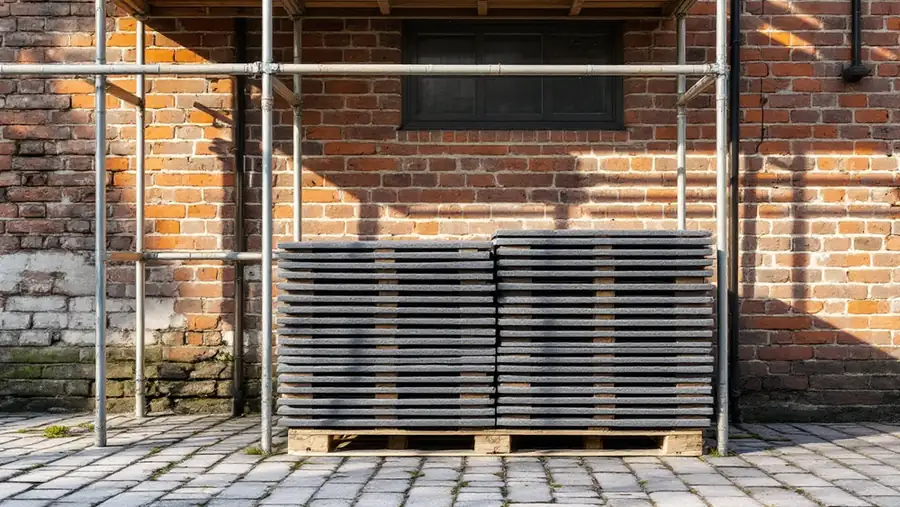
The table applies those 2026 ranges to 2,000 square feet of roof surface (20 squares) and compares each midpoint with the asphalt midpoint. It is Roofing Brief arithmetic, not a quote. The cost report adds that multi-layer tear-off, decking replacement and steep-pitch surcharges add $1 to $4 per square foot in most markets, items an older house may need.
| Material | Installed per sq ft (2026) | 2,000 sq ft of roof | Midpoint | Midpoint vs asphalt ($13,000) | Source |
|---|---|---|---|---|---|
| Architectural asphalt | $5 to $8 | $10,000 to $16,000 | $13,000 | 1.0x | 2026 Roofing Cost Report |
| Cedar shake | $10 to $18 | $20,000 to $36,000 | $28,000 | 2.2x | 2026 Roofing Cost Report |
| Standing seam steel or aluminum | $10 to $18 | $20,000 to $36,000 | $28,000 | 2.2x | 2026 Roofing Cost Report |
| Synthetic slate or shake | $12 to $20 | $24,000 to $40,000 | $32,000 | 2.5x | 2026 Roofing Cost Report |
| Clay tile | $11 to $25 | $22,000 to $50,000 | $36,000 | 2.8x | 2026 Roofing Cost Report |
| Natural slate | $15 to $30 | $30,000 to $60,000 | $45,000 | 3.5x | 2026 Roofing Cost Report |
| Copper standing seam | $20 to $40 | $40,000 to $80,000 | $60,000 | 4.6x | 2026 Roofing Cost Report |
Roof area, not floor area, drives the bill. The next table converts house size to roof area with a pitch multiplier (1.20 for an 8:12 roof, 1.41 for 12:12, ignoring overhangs) and prices it at the same 2026 ranges. A steeper roof raises the bill even at the same per-square-foot rate.
| House | Roof footprint | Roof area (x pitch factor) | Architectural asphalt ($5 to $8) | Natural slate ($15 to $30) | Basis |
|---|---|---|---|---|---|
| 4,000 sq ft, two stories, 8:12 | 2,000 sq ft | 2,400 sq ft | $12,000 to $19,200 | $36,000 to $72,000 | Roofing Brief arithmetic |
| 4,000 sq ft, two stories, 12:12 | 2,000 sq ft | 2,820 sq ft | $14,100 to $22,560 | $42,300 to $84,600 | Roofing Brief arithmetic |
| 4,000 sq ft, one story, 8:12 | 4,000 sq ft | 4,800 sq ft | $24,000 to $38,400 | $72,000 to $144,000 | Roofing Brief arithmetic |
Material detail sits in our sibling guides: clay tile roof cost and lifespan and cedar shake roofing grades and costs.
Does the federal historic tax credit cover a new roof?
The federal historic tax credit can cover a new roof only on an income-producing certified historic structure, and only as part of a substantial rehabilitation. Under 26 U.S.C. 47, the credit is 20 percent of qualified rehabilitation expenses, taken ratably over five years. The NPS states plainly that “owner-occupied residential properties do not qualify.” Public Law 119-21 (July 2025) left section 47 unchanged.
The NPS’s own eligibility example is a roof job: a Victorian rental cottage with a $40,500 adjusted basis gets a new roof, siding repair, wiring and a rebuilt porch for $50,000, which passes the substantial rehabilitation test and yields a $10,000 credit. A roof alone on a building with a higher basis often fails that test, as the arithmetic below shows.
| Requirement | Rule | Source |
|---|---|---|
| Building status | Listed in the National Register, or contributing to a registered historic district and certified by NPS through Part 1 | 26 U.S.C. 47(c)(3); NPS |
| Use | Depreciable, such as business, commercial or rental use, for at least five years after the rehabilitation; a personal residence does not qualify | NPS eligibility requirements |
| Spending test | Qualified expenses in a 24-month period exceed the greater of adjusted basis or $5,000; 60 months for planned phases | 26 U.S.C. 47(c)(1)(B) |
| Work standard | Entire project, not just the roof, must meet the Secretary’s Standards | 36 CFR 67.7; NPS |
| Timing | Apply before work starts; owners who start without NPS approval “do so at their own risk” | NPS application instructions (Rev. 6/2023) |
| Fees | No NPS fee for Part 1; fees for Parts 2 and 3 are based on project cost | NPS |
| Claiming | Form 3468 each year, listing the NPS project number | IRS |
| Scenario | Adjusted basis | Qualified expenses | Passes test? | Credit (20%) | Per year for 5 years | Basis |
|---|---|---|---|---|---|---|
| NPS example: rental cottage, new roof plus siding, wiring, porch | $40,500 | $50,000 | Yes | $10,000 | $2,000 | NPS example; 26 U.S.C. 47(a) |
| Rental, slate roof only | $150,000 | $45,000 | No ($45,000 is below $150,000) | $0 | $0 | Roofing Brief arithmetic |
| Same rental, roof inside a full rehabilitation | $150,000 | $160,000 | Yes | $32,000 | $6,400 | Roofing Brief arithmetic |
| Owner-occupied house, any roof | Any | Any | Not eligible | $0 | $0 | NPS eligibility requirements |
If part of a home is rented or used for business, the NPS says the rehabilitation costs for that portion may be eligible in some instances. Confirm treatment with a tax professional before relying on any credit.
State historic tax credits that can cover a homeowner’s roof
Several states give owner-occupied historic homes the credit the federal program withholds. Maryland, Virginia, North Carolina and Georgia each run a state income tax credit for qualifying rehabilitation of a historic residence, with Maryland listing “roof repair or replacement” as eligible work. All four require the work to meet rehabilitation standards and most want approval before work begins, so apply first.
| State | Homeowner credit | Minimum or threshold | Cap | Process note | Source |
|---|---|---|---|---|---|
| Maryland | 20 percent of eligible rehabilitation expenses | $5,000 in eligible expenses | $50,000 credit in a 24-month period | MHT must approve work before the project begins; single-family, owner-occupied certified historic structure | Maryland Historical Trust |
| Virginia | 25 percent of eligible rehabilitation expenses | Expenses at least 25 percent of the building’s assessed value for the year before work began | Not stated for homeowners on the DHR page | Three-part application; Part 3 needs an independent CPA review of expenses | Virginia DHR |
| North Carolina | 15 percent for owner-occupied residential | More than $10,000 within 24 months | $150,000 in expenses, $22,500 credit | Consult the HPO before starting; two-step application | North Carolina HPO |
| Georgia | 25 percent of qualifying rehabilitation expenses | Must meet the state’s substantial rehabilitation threshold | $100,000 for a principal residence | Homes in local districts became eligible for work starting January 1, 2026 | Georgia DCA |
Here is what a $45,000 slate roof could return in each state, assuming the project is approved and otherwise qualifies. This is Roofing Brief arithmetic from the published rates; actual credits depend on approval, eligible costs and your state tax liability.
| State | Calculation | Possible credit | Condition | Basis |
|---|---|---|---|---|
| Maryland | 20% x $45,000 | $9,000 | Above the $5,000 minimum and under the $50,000 cap | MHT rates |
| Virginia | 25% x $45,000 | $11,250 | Only if the building’s assessed value is $180,000 or less ($45,000 / 0.25) | DHR rates |
| North Carolina | 15% x $45,000 | $6,750 | Above $10,000 and under the $150,000 expense cap | NC HPO rates |
| Georgia | 25% x $45,000 | $11,250 | Only if the project meets the substantial rehabilitation threshold | Georgia DCA rates |
Insurance: replacement cost vs functional replacement cost
Insurance can leave a gap on a historic roof when the policy pays for cheaper materials than the commission requires. A standard HO-3 replacement cost clause pays for repair with “material of like kind and quality.” A functional replacement cost endorsement, ISO form HO 05 30, instead pays for “less costly common construction materials and methods” that are functionally equivalent to “obsolete, antique or custom” materials such as slate.
The HO-3’s ordinance or law additional coverage lets the owner use up to 10 percent of the Coverage A limit for increased costs from enforcing an ordinance or law that regulates repair. Whether a local preservation ordinance triggers it depends on policy wording and the insurer, so ask in writing. The NPS also suggests asking your state insurance regulator about policies for National Register properties.
| Policy feature | What it pays toward a historic roof | Watch for | Source |
|---|---|---|---|
| Replacement cost loss settlement (HO-3) | Repair or replacement “with material of like kind and quality” | Limit of liability and 80 percent insurance-to-value conditions | NJM New Jersey HO-3 (03/18) |
| Functional replacement cost endorsement (HO 05 30) | Less costly common materials functionally equivalent to obsolete, antique or custom ones | Slate or clay tile may be settled at the price of a cheaper covering | ISO HO 05 30 10 00 |
| Ordinance or law additional coverage | Up to 10 percent of Coverage A for increased costs of enforcing an ordinance or law | Whether a historic district rule counts; confirm with the insurer | NJM New Jersey HO-3 (03/18) |
| Example line | Amount | Basis |
|---|---|---|
| Coverage A limit | $500,000 | Assumed for illustration |
| Ordinance or law additional coverage (10%) | Up to $50,000 | HO-3 wording |
| Natural slate, 2,000 sq ft roof, midpoint | $45,000 | 2026 Roofing Cost Report arithmetic |
| Architectural asphalt, same roof, midpoint | $13,000 | 2026 Roofing Cost Report arithmetic |
| Gap if a claim is settled on a functional (cheaper) basis | About $32,000 | Roofing Brief estimate |
For how roof claims work generally, see our guide to whether homeowners insurance covers roof damage.
Which path fits your roof?
The right next step depends on designation, damage pattern, building use and policy wording. The table maps common situations to the response the NPS briefs, the tax rules and local commissions point to, so an owner can brief a contractor, the commission and an insurer before money is spent.
| If | Then | Source |
|---|---|---|
| The house is in a local historic district or is a local landmark | Talk to commission staff before getting bids; expect review of roofing and flashing | City of Philadelphia; City of Detroit |
| The house is National Register listed only, privately funded | No federal review; follow local permit rules | NPS National Register FAQ |
| Slate damage is scattered and under about 20 percent | Repair: replace broken slates, fix flashings, salvage and relay slipped slates | NPS Brief 29 |
| Clay tile loss exceeds about 30 percent with no matching source | Plan full replacement with new matching clay tile | NPS Brief 30 |
| The roof is flat and hidden from every elevation | A modern membrane may be acceptable | NPS Brief 4 |
| The building is a rental or commercial | Test the federal 20 percent credit; file Parts 1 and 2 before work | 26 U.S.C. 47; NPS |
| You live in the house in Maryland, Virginia, North Carolina or Georgia | Apply for the state homeowner credit before work starts | MHT; DHR; NC HPO; Georgia DCA |
| Your policy has a functional replacement cost endorsement | Ask how slate or tile would be settled and price the gap | ISO HO 05 30 |
| The house was built before 1978 and the job disturbs more than 20 square feet of exterior paint | Hire an EPA RRP-certified firm | EPA RRP Rule |
Step-by-step: planning a historic roof replacement
A historic roof replacement runs on a longer clock than an ordinary reroof because approvals and material orders come first. The sequence below combines NPS Preservation Briefs 4 and 29, the NPS tax credit instructions and the Detroit and Philadelphia commission requirements. Budget months, not weeks, when slate or custom tile must be ordered.
- Confirm the designation. Ask the local commission, municipal planning office or SHPO whether the house is individually designated, contributing to a district, or only National Register listed.
- Record the existing roof. Brief 4 calls for photographs and notes on patterns, coursing and details before work begins, and Brief 29 recommends a log book filing all bills and samples.
- Get a condition assessment from a specialist in the material. Apply the 20 percent (slate) and 30 percent (clay tile) tests, and check flashings, gutters and attic ventilation first.
- Meet commission staff, and the SHPO if you want credits. File the state or federal application describing the roof work before signing a contract.
- Collect bids to one written specification: material source, size, exposure, flashing metal and fasteners. In Detroit, gather repair, same-material and asphalt estimates.
- Order material early. Brief 29 says new slate can take 4 to 12 weeks, and up to a year for special orders.
- Pull the building permit after approval, and confirm the crew’s lead-safe certification on a pre-1978 house.
- Strip and reroof in sections, laying felt so the whole roof is never open, as Brief 29 advises. Check sheathing and rafters, and call a structural engineer if you find deflection or cracking.
- Finish chimney repointing and other roof-access work before the new roof goes on, and use one metal for flashings and gutters.
- Photograph the finished work and keep every invoice for the Part 3 or state completion filing.
Frequently asked questions
Does a 20 year old roof need to be replaced?
Not automatically. Age matters only relative to the material. NPS Preservation Brief 19 puts most premium modern wood shingle roofs at 15 to 30 years, while Brief 29 gives Vermont and New York slate about 125 years and Brief 30 gives clay tile about 100. A 20 year old slate or tile roof usually needs flashing or fastener work, not replacement.
How much does it cost to replace a roof on a 4,000 square foot house?
It depends on stories and pitch, because roof area is not floor area. A two story 4,000 square foot house with an 8:12 roof has about 2,400 square feet of roof, roughly $12,000 to $19,200 in architectural asphalt or $36,000 to $72,000 in natural slate at 2026 Roofing Cost Report rates. A one story house of the same size about doubles those figures.
What is the 25% rule in roofing?
It usually refers to Florida, where the building code has limited roof repairs to 25 percent of a roof or roof section in a 12 month period before the whole roof or section must meet current code. Florida Statutes 553.844(5) now says that for roofs built to the 2007 Florida Building Code or later, only the repaired portion must meet current code.
Is $50,000 for a new roof good?
It depends on the material. For architectural asphalt, $50,000 is high: the 2026 Roofing Cost Report range for 2,000 square feet of roof is $10,000 to $16,000. For natural slate the same roof runs $30,000 to $60,000, and copper standing seam $40,000 to $80,000, so $50,000 can be normal for a historic match. Compare itemized bids.
How old is a home to be considered historic?
There is no single age, but 50 years is the usual benchmark. National Register criteria at 36 CFR 60.4 say properties that achieved significance within the past 50 years ordinarily are not eligible. Age alone does not trigger review: a house must be listed, contribute to a district, or be designated under a local ordinance before preservation rules apply to its roof.
Do historic homes qualify for the federal tax credit?
Not if you live in them. The National Park Service states that owner-occupied residential properties do not qualify for the 20 percent federal rehabilitation credit under IRC section 47. The building must be depreciable, such as a rental or commercial property, for at least five years. Maryland, Virginia, North Carolina and Georgia offer state income tax credits to historic homeowners.
Can you put asphalt shingles on a historic house?
Sometimes. National Register listing alone places no federal restriction on a private owner, but a local historic commission may require matching material. NPS Preservation Brief 29 says significant slate roofs should not be stripped and replaced with asphalt shingles, and Detroit asks for repair, same-material and asphalt estimates before deciding. Where asphalt was the original covering, asphalt is the in-kind match.
Sources
Every figure on this page comes from the documents below, read in October 2026. Code sections vary by the edition a jurisdiction adopts, and tax and insurance rules depend on the specific building, policy and filing, so confirm details with the building department, SHPO, a tax professional and your insurer before acting.
- NPS Preservation Brief 4: Roofing for Historic Buildings (Sarah M. Sweetser, 1978)
- NPS Preservation Brief 19: The Repair and Replacement of Historic Wooden Shingle Roofs
- NPS Preservation Brief 29: The Repair, Replacement, and Maintenance of Historic Slate Roofs (Jeffrey S. Levine)
- NPS Preservation Brief 30: The Preservation and Repair of Historic Clay Tile Roofs
- NPS Preservation Brief 51: Building Codes for Historic and Existing Buildings (June 2024)
- 36 CFR 67.7, Standards for Rehabilitation; 36 CFR 60.4, National Register criteria
- 26 U.S.C. 47, Rehabilitation credit; IRS Rehabilitation Credit page (reviewed July 23, 2026)
- NPS Historic Preservation Tax Incentives: Eligibility Requirements; Application Process; NPS Historic Preservation Certification Application Instructions (Rev. 6/2023)
- NPS National Register of Historic Places FAQs
- Maryland Historical Trust, Homeowner Tax Credit; Virginia Department of Historic Resources, Historic Rehabilitation Tax Credits; North Carolina HPO, Non-Income-Producing Credits; Georgia DCA, State Income Tax Credit Program
- City of Detroit, Making Exterior Changes within Local Historic Districts; City of Philadelphia, Get approval for work to a historic property
- 2021 International Residential Code section R908 (ICC; reproduced in the 2021 Seattle Residential Code); 2021 International Existing Building Code chapter 12 (ICC)
- ISO HO 05 30 10 00, Functional Replacement Cost Loss Settlement; NJM New Jersey HO-3 policy (03/18)
- EPA, Lead Renovation, Repair and Painting Program for Contractors; Florida Statutes 553.844
- The Roofing Brief, 2026 Roofing Cost Report