
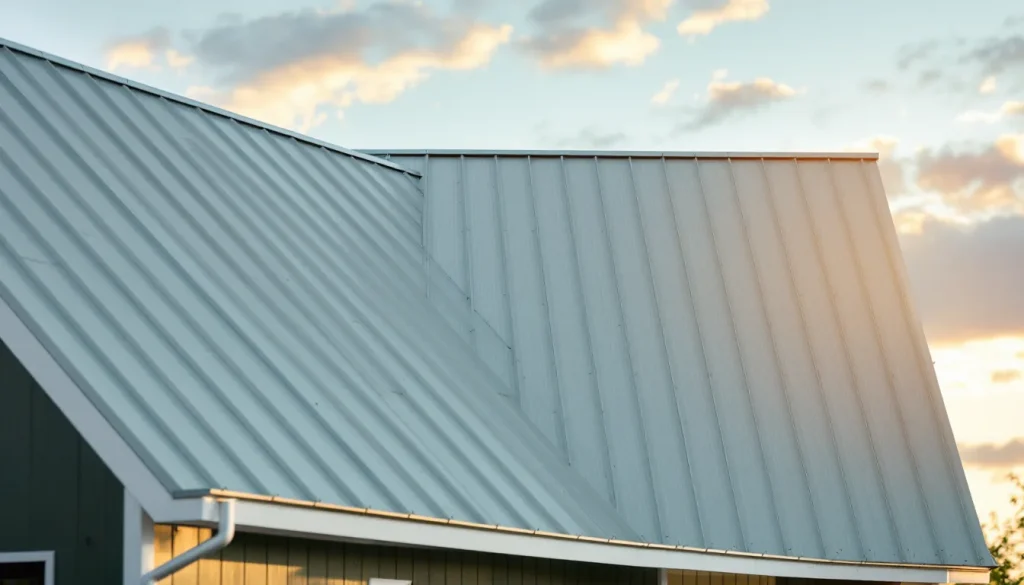
Metal roof colors in 2026 use PVDF (Kynar 500 or Hylar 5000) paint systems that hold their color for 30 to 40 years without significant fading, with manufacturer color palettes ranging from 20 standard options on budget exposed-fastener panels to 60+ on premium standing seam lines from Englert, McElroy, MBCI, and Sheffield Metals. The most popular residential metal roof colors are weathered wood, dark gray, charcoal, and matte black, but cool-roof certified colors (those rated under CRRC with an initial solar reflectance above 0.25 for steep-slope roofs) save 7 to 15 percent on cooling costs in hot climates per LBNL studies. Here is what each paint system actually delivers, how the major manufacturer palettes differ in 2026, and when paying for a custom color is worth the 8 to 14 week lead time.
The short version
- PVDF (Kynar 500 / Hylar 5000) is the premium paint system: 30 to 40 year fade warranty, AAMA 2605 certified, used on standing seam premium lines.
- SMP (silicone-modified polyester) is the value paint system: 25 to 35 year fade warranty, AAMA 2604 certified, used on exposed-fastener corrugated panels.
- Cool roof certified colors carry the CRRC label and save 7 to 15 percent on cooling in southern climates.
- Most popular 2026 metal colors: charcoal, weathered wood (mountain charcoal), matte black, dark bronze, slate gray.
- Custom colors run $0.30 to $1.10 per square foot above standard with 8 to 14 week lead times and 1,500 to 5,000 sq ft minimum orders.
- The single most-asked-for upgrade in 2026: a true matte (low-gloss) finish in dark colors, available across all major brand lines as a no-cost upgrade.
Short answer: paint, palette, and pick
The metal roof color decision has three layers stacked on top of each other:
- Paint system: PVDF for premium 30 to 40 year color hold, SMP for value 25 to 35 year hold. PVDF is what you want on a standing seam roof you expect to own for decades.
- Standard vs cool vs custom: standard colors are catalog-stock and ship in 2 to 4 weeks. Cool roof colors carry CRRC certification and are stock on most premium lines. Custom colors require a minimum production run, 8 to 14 week lead, and a premium of $0.30 to $1.10 per square foot.
- The specific color: within the palette, pick by climate (cool in the South, dark in the North), by architectural style (Mediterranean wants terra cotta, modern farmhouse wants matte black), and by HOA palette.
PVDF (Kynar 500) vs SMP paint systems
The paint coating on a metal roof panel is the layer that determines fade resistance, chalk resistance (the white residue from UV breakdown), and chip resistance. Two coating chemistries dominate residential roofing in 2026:
| Property | PVDF (Kynar 500 / Hylar 5000) | SMP (silicone-modified polyester) |
|---|---|---|
| Standard | AAMA 2605 | AAMA 2604 |
| Color hold (delta E after 10 yr in FL) | 2 to 3 | 3 to 5 |
| Chalk resistance (rating after 10 yr) | 8 to 9 of 10 | 6 to 8 of 10 |
| Typical fade warranty | 30 to 40 years | 25 to 35 years |
| Typical film warranty | 40 years | 25 to 35 years |
| Color palette breadth | 30 to 60+ standards | 20 to 35 standards |
| Cost premium per sq ft | $0.40 to $0.90 | baseline |
| Used on | Standing seam, premium standing seam | Exposed-fastener corrugated, R-panel, AG panel |
Practical takeaways:
- PVDF is the right choice for a standing seam roof you expect to keep 30 to 50 years.
- SMP is acceptable for an exposed-fastener panel on a barn, garage, or budget reroof where the panel itself will likely be replaced before the paint fails meaningfully.
- Avoid polyester-only (no silicone modification) panels in residential. They are common in Eastern European imports and chalk within 5 to 8 years.
Cool roof certification
The Cool Roof Rating Council (CRRC) third-party tests and publishes solar reflectance (SR) and thermal emittance (TE) values for every certified roof product at coolroofs.org. For steep-slope residential metal panels, the cool roof thresholds:
- Initial solar reflectance: 0.25 or higher (Energy Star), 0.20 for Title 24 in California climate zones requiring cool roofs.
- 3-year aged solar reflectance: 0.15 or higher.
- Solar Reflectance Index (SRI): 16 or higher for steep slope (Energy Star).
The pigment science breakthrough that matters here: BASF, Shepherd Color, and Ferro have developed infrared-reflective pigments that allow dark visible colors to reflect 40 to 70 percent of infrared (heat) energy while keeping the visible dark color. That means a “Dark Bronze” or “Matte Black” can be CRRC-certified cool in 2026, where 15 years ago only white and silver met the threshold.
Cool color examples in major brand 2026 palettes:
- Englert ColorClad and Sheffield Metals Cool Roof Colors: Burnished Slate (SR 0.30), Hartford Green (SR 0.27), Patina Green (SR 0.32), Matte Black (SR 0.26).
- McElroy IR Plus: Mansard Brown (SR 0.31), Dark Bronze (SR 0.29), Slate Gray (SR 0.34).
- MBCI Signature 200 cool series: Hartford Green, Slate Gray, Saddle Tan, Burnished Slate, all SR 0.27 to 0.34.
For a 2,000 sq ft attic in Phoenix, LBNL modeling shows annual cooling savings of $180 to $290 from a cool dark-color metal roof vs a non-cool same-color panel. Over a 40-year roof life, $7,000 to $11,500. See standing seam metal roof cost for the broader pricing picture and best roof color for the cross-material color picker.
Most popular metal roof colors by region
| Region | #1 | #2 | #3 | #4 | #5 |
|---|---|---|---|---|---|
| Northeast (NY, NJ, PA, MA) | Charcoal | Matte Black | Dark Bronze | Burnished Slate | Hartford Green |
| Southeast (GA, FL, NC, SC) | Galvalume (silver) | Dark Bronze (cool) | Matte Black (cool) | Burnished Slate (cool) | Slate Gray |
| Midwest (IL, OH, MI) | Charcoal | Matte Black | Burnished Slate | Hartford Green | Mansard Brown |
| South Central (TX, OK, LA) | Galvalume | Matte Black (cool) | Dark Bronze (cool) | Surrey Beige | Burnished Slate (cool) |
| Mountain (CO, UT, NM, AZ) | Dark Bronze (cool) | Mansard Brown (cool) | Charcoal | Galvalume | Slate Gray |
| West Coast (CA, OR, WA) | Galvalume | Matte Black | Dark Bronze | Charcoal | Burnished Slate |
| Plains / Rural (KS, NE, IA, MO) | Galvalume | Burgundy | Hartford Green | Charcoal | Mansard Brown |
| Coastal (FL, NC, SC, TX coast) | Galvalume | Hartford Green | Patina Green | Burnished Slate | Cardinal Red |
Galvalume (the unpainted aluminum-zinc coated steel) is the dominant pick in agricultural and coastal markets because it costs 15 to 25 percent less than painted and develops a uniform light-gray patina over 5 to 10 years. The CRRC rates new Galvalume at SR 0.65, aged Galvalume at SR 0.30.
Manufacturer color palettes
The four largest US standing seam manufacturers each maintain a distinct standard color palette. The overlap is large (everyone offers a “matte black” and a “charcoal”), but the named blends differ.
Englert (Perth Amboy NJ, founded 1944)
Englert ColorClad PVDF standard palette runs about 40 colors. The popular residential picks in 2026:
- Matte Black: deepest matte finish in the lineup. The fastest-growing color in Englert’s 2024-2026 reporting.
- Charcoal Gray: cool neutral with slight blue undertone.
- Burnished Slate: gray-brown blend, CRRC cool certified.
- Dark Bronze: warm brown, popular on craftsman and lodge styles.
- Hartford Green: muted hunter green, popular on rural and historical homes.
- Galvalume Plus: unpainted with acrylic top coat for handling.
McElroy Metal (Bossier City LA, founded 1963)
McElroy Maxima and Medallion lines carry the IR Plus PVDF palette of about 35 standard colors. Popular picks:
- Slate Gray IR Plus: cool certified, SR 0.34.
- Matte Black: standard PVDF in 2026 catalog.
- Dark Bronze: SR 0.29 cool certified.
- Mansard Brown: SR 0.31 cool certified.
- Cardinal Red: bright red for accent and historic work.
MBCI (Metal Building Components Inc, NCI Group, Houston TX)
MBCI Signature 200 and Signature 300 PVDF lines run about 45 standard colors. Popular picks:
- Charcoal Gray: top seller in residential.
- Saddle Tan: warm beige, cool certified.
- Hartford Green: cool certified hunter green.
- Burnished Slate: cool certified gray-brown.
- Patina Green: cool certified weathered-copper green.
Sheffield Metals (Sheffield Village OH, founded 1998)
Sheffield Metals carries one of the broader cool color palettes in 2026 across its standing seam and exposed-fastener lines:
- Cool Galvalume: most popular utility pick.
- Matte Black: cool certified at SR 0.26.
- Hartford Green: cool certified.
- Cool Slate Gray.
- Cool Burnished Slate.
Other notable brands
- Drexel Metals (Carlisle SynTec): 35-color PVDF palette, owned by Carlisle since 2017.
- Petersen Aluminum (PAC-CLAD): historic premium brand, 38-color PVDF palette, strong in Midwest.
- ATAS International: wider specialty palette including matte and metallic finishes for design-led architects.
- AEP Span: Pacific Northwest standout with strong cool roof palette.
Color matching architectural style
Metal panel pairs with style differently than asphalt does. The reflective quality and crisp seam lines push metal toward modern, agricultural, and Mediterranean styles more than toward traditional colonial or Tudor.
| Style | Best metal colors | Panel profile |
|---|---|---|
| Modern Farmhouse | Matte Black, Charcoal, Galvalume | Standing seam, 1.5 to 2 inch tall, snap-lock |
| Mountain / Lodge | Dark Bronze, Hartford Green, Mansard Brown | Standing seam or shake-look |
| Mediterranean / Spanish | Terra Cotta, Mission Tile look, Cardinal Red | Stone-coated steel tile profile |
| Mid-Century Modern | Galvalume, Slate Gray, Patina Green | Standing seam, low-profile snap-lock |
| Contemporary | Matte Black, Dark Bronze, Cool Galvalume | Standing seam, mechanically seamed |
| Coastal | Galvalume Plus, Hartford Green, Patina Green | Marine-grade aluminum standing seam |
| Agricultural / Barn | Galvalume, Burgundy, Hartford Green | Exposed-fastener R-panel or AG panel |
| Craftsman | Dark Bronze, Burnished Slate, Hartford Green | Standing seam or copper accent |
| Traditional Colonial | Charcoal Gray, Matte Black (acceptable but rare) | Standing seam, narrow pan |
Color and lifespan: which pigments fade faster
Not all colors hold equally. Pigment chemistry drives fade rate, and the worst offenders are consistently:
- Bright red and orange (organic pigment formulations): historically the fastest fading. Modern inorganic red oxide pigments (used in Cardinal Red, Brick Red) hold better but still fade roughly 30 to 50 percent faster than neutrals.
- Bright yellow: the rarest fading-prone color in roofing because yellow is rarely specified, but historically problematic.
- Bright blue and purple: faster fading than gray, brown, and green. Avoid for primary roof color.
The most fade-resistant pigment families in 2026:
- Iron oxide blacks and browns: 35 to 40 year hold, almost no measurable fade.
- Inorganic gray and charcoal blends: 30 to 40 year hold.
- Cool roof IR-reflective pigments: 30 to 40 year hold, with the bonus of UV-stable infrared reflectance.
The AAMA 2605 spec requires less than 5 delta-E units of color change after 10 years of South Florida exposure for full PVDF compliance. The AAMA 2604 spec (SMP) allows up to 8 delta-E units in the same period. For comparison, the eye perceives delta-E of 2 as a “barely noticeable” change.
AAMA 2604 vs 2605 paint warranty
The two AAMA performance specifications define what a paint system is required to deliver:
| Test | AAMA 2604 (SMP) | AAMA 2605 (PVDF) |
|---|---|---|
| South Florida exposure required | 5 years | 10 years |
| Color change (delta E max) | 5 | 5 |
| Chalk resistance (rating min) | 8 | 8 |
| Gloss retention (min %) | 30 percent | 50 percent |
| Salt spray resistance (hours) | 3,000 | 3,000 |
| Humidity resistance (hours) | 3,000 | 4,000 |
| Manufacturer fade warranty | 25 to 35 years | 30 to 40 years |
Manufacturers typically warrant PVDF paint with two separate terms: a “film warranty” (no cracking, peeling, blistering) of 35 to 40 years, and a “fade warranty” of 30 to 40 years using the delta-E test. SMP paint warranties are typically 25 to 35 years.
Practical advice: read the warranty exclusions before signing the contract. Common gotchas:
- Coastal exclusion zones (within 1,500 feet of saltwater) cut the warranty period by 5 to 10 years or void it outright. Specialty marine-grade aluminum coatings preserve coverage in coastal use.
- Industrial environment exclusions (heavy SO2, chloride exposure) limit coverage in some manufacturing-adjacent zones.
- Improper installation (panel scratches, cut edges not sealed) voids coverage on the affected area.
Custom colors: cost and lead time
Every major manufacturer can produce a custom color outside the standard palette. The process: provide a paint chip or Pantone reference, the paint supplier (Sherwin Williams Coil Coatings, PPG Duranar, AkzoNobel Trinar are the three major coil coating suppliers) formulates the match, the manufacturer schedules a coil run, and the finished panels ship.
2026 custom color economics:
| Item | Standard color | Custom color |
|---|---|---|
| Lead time | 2 to 4 weeks | 8 to 14 weeks |
| Minimum order quantity | None (lengths to order) | 1,500 to 5,000 sq ft typical |
| Premium per sq ft (PVDF) | $0 | $0.30 to $1.10 |
| Premium per sq ft (SMP) | $0 | $0.25 to $0.80 |
| Cool roof certification | Available on many standards | Possible but adds 4+ weeks for CRRC testing |
| Color hold warranty | Standard 30 to 40 yr | Same if PVDF base, sometimes shorter |
When is custom worth it:
- Historic preservation projects that require an exact match to original copper, terne, or specific period paint colors.
- HOA-mandated color outside the standard manufacturer palette (rare but happens in upscale planned communities).
- Brand identity (corporate accent color matching a logo).
- Large estate projects where the $2,000 to $8,000 custom premium is a small fraction of total roof spend.
For most homeowners, the standard palette delivers enough variety. The custom path is not worth the lead time and premium.
When color sample matters
The 4-inch paint chip in the dealer office tells you almost nothing about how the color will read on the roof. Three sample practices that prevent expensive regret:
- Get a full-panel sample (12 to 24 inches square minimum): the seam profile, the sheen, and the panel-to-panel variation are only visible at full size.
- Hold the sample at the actual roof angle and viewing distance: walk to the curb and look up. The color at 35 feet and a steep angle reads 1 to 2 shades different from the 18-inch counter view.
- View in three lighting conditions: midday direct sun, overcast, and golden hour. Each is a different color rendering and you want to like all three.
Reputable contractors will order a sample panel on request. Some charge a $20 to $50 deposit refunded against the job. If a contractor refuses to provide a sample on a $30,000+ standing seam project, that is a signal to find a different contractor. See how to choose a roofing contractor for more vetting tips.
Color trends 2023 to 2026
Tracking 4 years of standing seam panel sales data (aggregated from Englert, McElroy, MBCI, Sheffield Metals, and Drexel Metals dealer-reported figures), the shifts in residential metal roof color preference are clear:
| Color | 2023 share | 2024 share | 2025 share | 2026 share | Trend |
|---|---|---|---|---|---|
| Matte Black | 6% | 9% | 13% | 17% | Strong growth (modern farmhouse driver) |
| Charcoal Gray | 14% | 15% | 15% | 15% | Stable, top neutral |
| Galvalume | 22% | 20% | 19% | 18% | Slow decline (still #1 in agricultural) |
| Dark Bronze | 11% | 11% | 10% | 10% | Stable |
| Burnished Slate | 7% | 8% | 9% | 9% | Growth (cool roof driver in South) |
| Hartford Green | 8% | 7% | 6% | 5% | Declining (traditional fade) |
| Slate Gray | 5% | 5% | 6% | 6% | Stable |
| Cardinal Red | 4% | 3% | 3% | 2% | Declining |
| Patina Green | 2% | 2% | 2% | 2% | Niche stable |
| Custom and other | 21% | 20% | 17% | 16% | Modest decline as standards expand |
The standout growth story is Matte Black, which roughly tripled share between 2023 and 2026 as modern farmhouse and contemporary residential design pushed dark, low-gloss metal panel into mainstream new construction. Burnished Slate is the other quiet winner, gaining about a third of share over the same period on cool roof adoption in TX, FL, and AZ.
Substrate matters: steel vs aluminum vs Galvalume vs zinc vs copper
The metal substrate underneath the paint affects which colors render correctly and how the paint ages. The main residential substrates in 2026:
- Galvanized steel (G90 zinc coating): standard substrate for painted exposed-fastener panels. PVDF and SMP both adhere well. Best price.
- Galvalume steel (55% aluminum, 43.4% zinc, 1.6% silicon coating): the most common standing seam substrate. Slightly better corrosion resistance than G90 galvanized; PVDF adheres exceptionally well. The default in 2026.
- Aluminum (.032 to .040 inch): premium substrate for coastal markets. Will not rust. PVDF colors render slightly softer than on steel because aluminum is less reflective. Common in FL, Outer Banks, Pacific NW coast.
- Zinc (VMZINC, Rheinzink): rare premium substrate, develops natural patina; rarely painted.
- Copper: never painted; develops natural patina over 5 to 15 years from bright penny to brown to verdigris green.
Aluminum panels on coastal homes cost 25 to 45 percent more than steel but the warranty preservation is meaningful within 1,500 feet of saltwater. Always specify aluminum for coastal projects regardless of color choice.
Standing seam vs exposed-fastener color tradeoffs
Standing seam metal roofs (concealed-fastener, premium category) carry the deepest PVDF color palettes and the longest warranties. Exposed-fastener panels (R-panel, AG panel, corrugated) typically use SMP paint and a narrower palette.
- For a residence with a 30+ year ownership horizon: standing seam with PVDF. Pay the $4 to $9 per square foot premium over exposed-fastener for the color hold and warranty.
- For a barn, garage, shop, or budget reroof: exposed-fastener with SMP. The narrower palette is rarely a problem because the most popular metals (Galvalume, charcoal, dark bronze, hartford green) are all in the SMP catalog.
For a full comparison see metal vs asphalt shingle roof.
FAQs
Will a black metal roof fade faster than charcoal?
No. Modern PVDF black pigments (iron oxide base) are among the most stable in the catalog. Black, charcoal, dark bronze, and gray all fade at roughly the same rate, well below the AAMA 2605 limit of 5 delta-E over 10 years. The bright reds, yellows, and blues fade faster.
Is a matte finish more expensive than gloss?
No. Most major manufacturers (Englert, McElroy, MBCI, Sheffield) offer matte (low-gloss) finishes at the same price as standard satin or semi-gloss as of 2026. The matte trend grew quickly between 2022 and 2026 as modern farmhouse and contemporary styles drove demand for understated finishes.
Does cool roof color void HOA approval?
Increasingly, no. Many HOAs in TX, AZ, CA, NV, and FL have updated palettes to include cool roof colors specifically. Some still restrict to non-cool. Always file the specific manufacturer color code in writing with the architectural review committee before ordering.
Will a Galvalume roof match a galvanized gutter or trim?
Imperfectly. Galvalume (aluminum-zinc coated) develops a slightly bluer-gray patina than galvanized (zinc only). For best match, use Galvalume gutters and trim, or paint the gutters to a coordinated charcoal or gray.
Can a metal roof be repainted later?
Yes, but rarely worthwhile. PVDF-painted panels can be field-coated with compatible acrylic or fluoropolymer topcoats after proper surface preparation (pressure wash, etch primer). Field paint warranties are 10 to 15 years vs the 30 to 40 year factory warranty. Most owners replace panels rather than repaint.
What color is best for a metal roof in Florida?
Galvalume (silver-gray) is the runaway top choice in FL for both cost and heat performance (CRRC SR 0.65 new, 0.30 aged). Among painted colors, cool certified dark bronze, matte black, and burnished slate are popular picks. Avoid non-cool dark colors which run 30 to 50 F hotter at peak.
How long does it take from order to install for a custom color?
Plan for 8 to 14 weeks from order to delivery for a custom PVDF coil run, plus 1 to 3 weeks for fabrication and installation. Order well ahead of the install window, especially if you are reroofing in spring (manufacturer queues lengthen February through May).