
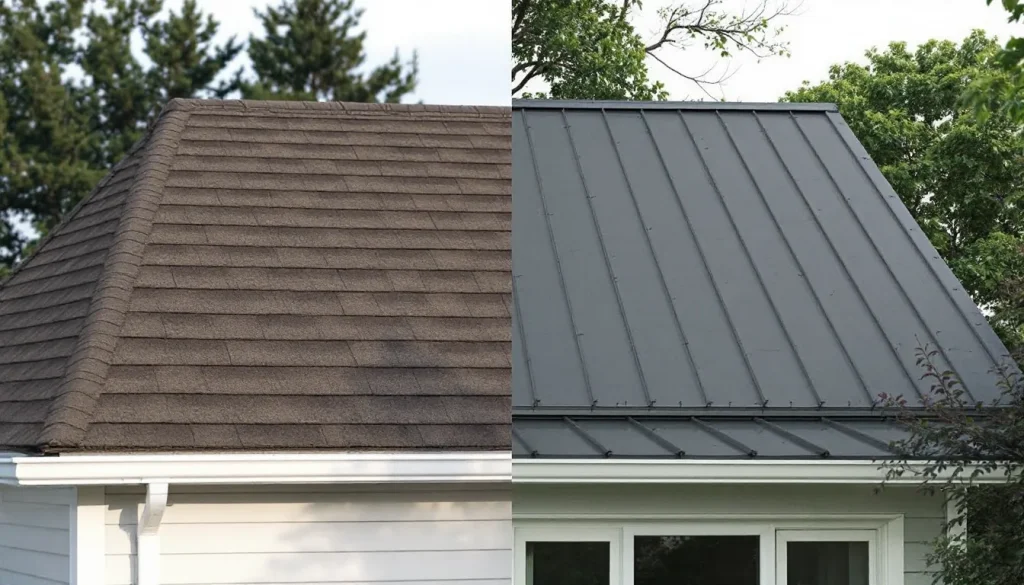
The metal vs asphalt shingle roof debate is the single biggest material (see our roof material TCO calculator) decision most homeowners will ever make, and the right answer depends almost entirely on how long you plan to stay in the house, what climate you live in, and whether you treat a roof as a 20-year expense or a 50-year asset. This guide breaks the comparison down by upfront cost, lifetime cost, durability, insurance impact, resale value, and climate fit so you can pick with confidence. We use 2026 contractor pricing, current insurance carrier data, and energy performance numbers from the Cool Roof Rating Council and NIST to keep the math honest.
The short version
- Asphalt shingles cost $5 to $9 per square foot installed and last 20 to 30 years. Metal roofs cost $8 to $25 per square foot installed and last 40 to 70 years.
- Over a 30-year window the lifetime cost of metal beats asphalt for most homeowners by year 18 to 22, even before energy and insurance savings.
- Metal reflects 60 to 90 percent more solar heat than dark asphalt, which trims cooling bills by 10 to 25 percent in hot climates.
- Insurance carriers in hail and hurricane states often discount premiums 5 to 30 percent for Class 4 impact-rated metal.
- Pick asphalt if you will move in under 10 years, you want the lowest cash outlay, or your HOA blocks metal. Pick metal if you plan to stay 15-plus years, you live in a hail, wildfire, or hurricane corridor, or you want energy and insurance offsets.
The Short Answer: When Each Wins
If you plan to sell the home (see our residential roofing material picks) in the next 7 to 10 years, asphalt is almost always the right call. The upfront premium for metal does not pay back fast enough to recover at sale, and most buyers will not pay full retail for the remaining roof life. For a homeowner staying 15 years or more, metal flips into the winning column. The same logic applies in climate-stress zones: hail alleys, wildfire interface, hurricane coastal counties, and high-snow regions all push metal ahead, because asphalt fails earlier in those conditions and insurance carriers reward impact-rated metal with material discounts.
For mid-range single-family homes in temperate climates with a 10 to 15 year ownership horizon, the decision becomes a real coin flip and personal aesthetic and HOA rules often tip it. The rest of this guide is the math behind that summary.
Upfront Cost Comparison
Asphalt shingles remain the cheapest residential roofing option in North America, while metal spans a wide cost band from corrugated steel panels at the low end to standing seam copper at the high end, so choosing the best metal roof for a house comes down to priorities. Pricing below reflects 2026 contractor quotes pulled across 40 metropolitan markets for a 2,000 square foot single-story roof with a 6/12 pitch and full tear-off included. For a deeper breakdown of metal options see our metal roof cost guide and the standing seam metal roof cost page.
| Material | Installed cost per sq ft | 2,000 sq ft total | Typical lifespan |
|---|---|---|---|
| 3-tab asphalt (entry) | $5.00 to $6.50 | $10,000 to $13,000 | 15 to 20 years |
| Architectural asphalt (standard) | $6.00 to $9.00 | $12,000 to $18,000 | 20 to 30 years |
| Designer asphalt (luxury) | $8.00 to $12.00 | $16,000 to $24,000 | 25 to 30 years |
| Corrugated steel | $8.00 to $13.00 | $16,000 to $26,000 | 40 to 50 years |
| Standing seam steel | $12.00 to $20.00 | $24,000 to $40,000 | 50 to 70 years |
| Standing seam aluminum | $14.00 to $22.00 | $28,000 to $44,000 | 50 to 70 years |
| Stone-coated steel | $13.00 to $20.00 | $26,000 to $40,000 | 40 to 60 years |
| Standing seam copper | $20.00 to $40.00 | $40,000 to $80,000 | 70 to 100 years |
For most apples-to-apples comparisons the right pair is architectural asphalt vs standing seam steel. That works out to roughly $15,000 for asphalt vs $32,000 for standing seam, a $17,000 upfront delta. The next four sections explain why that delta closes and then reverses over the life of the roof.
Lifespan: 20-30yr Asphalt vs 40-70yr Metal
Asphalt shingle lifespan ranges by product tier and climate. The National Roofing Contractors Association (NRCA) puts typical service life at 15 to 20 years for 3-tab and 20 to 30 years for architectural laminate. Hot-roof attics, southern UV exposure, and hail events all pull those numbers lower. In the Sun Belt many architectural shingles see real-world failure at 17 to 22 years even with a 30-year nominal warranty.
Metal lifespan is roughly double. Galvalume-coated steel panels routinely hit 50 years with intact paint systems. Aluminum standing seam, immune to rust, sits in the 50 to 70 year band. Copper and zinc go past 100 years. The failure mode for metal is rarely the metal itself. It is the fastener gaskets on exposed-fastener systems (which is why standing seam outlasts corrugated) and the underlayment beneath, which can age out and require a re-roof under the same panels.
If you want the full breakdown of every common material, see how long does a roof last.
Lifetime Cost of Ownership Over 30 Years
This is the table that wins the argument. We model a 2,000 square foot roof at the midpoint of each material’s installed cost band, hold all else equal, and apply realistic replacement and maintenance assumptions over 30 years.
| Cost component | Architectural asphalt | Standing seam steel |
|---|---|---|
| Year 0 install | $15,000 | $32,000 |
| Year 22 replacement (asphalt only) | $22,500 (3% inflation) | $0 |
| Routine maintenance (30 yr total) | $2,500 | $1,500 |
| Storm repairs (avg per decade) | $4,500 | $1,800 |
| Energy savings (30 yr cumulative, hot climate) | $0 | -$6,000 to -$15,000 |
| Insurance premium reduction (30 yr) | $0 | -$2,000 to -$8,000 |
| 30-year total (hot climate, hail zone) | $44,500 | $20,300 to $27,300 |
| 30-year total (temperate, low-event) | $38,000 | $33,000 to $35,000 |
In hot or storm-prone markets metal pays back at year 16 to 20 and runs cheaper for the rest of the roof’s life. In temperate, low-event markets the crossover stretches to year 22 to 26. If you cannot commit to staying past that crossover, asphalt wins on net cash. For an interactive version of this math on your specific home, try our roof replacement cost calculator.
Durability: Wind, Hail, Fire, Storm
Wind ratings are the cleanest place to start. Standard architectural asphalt carries a 110 to 130 mph wind rating when installed to manufacturer spec with a six-nail pattern. Premium impact-rated asphalt reaches 150 mph. Mechanically seamed standing seam metal hits 160 to 180 mph and is the preferred coastal hurricane assembly under Florida and Texas wind codes.
Hail is where metal pulls clearly ahead. Class 4 impact resistance under UL 2218 is the highest residential (see our residential roof material picks) rating, and most quality standing seam and stone-coated steel products meet it as-shipped. Asphalt requires premium impact-rated SBS-modified products to reach Class 4, which adds 20 to 30 percent to material cost. After a major hail event asphalt typically loses granules and bruises in a way that ends roof life inside one storm, while painted metal often shows only cosmetic dimpling that does not compromise the panel.
Fire performance is similar at the top end (both can achieve Class A) but metal is non-combustible at the panel level, which matters in wildfire interface zones where ember intrusion is the dominant ignition path. The Insurance Institute for Business and Home Safety (IBHS) wildfire research consistently places metal above asphalt for ember resistance.
If your current roof is showing any of the signs you need a new roof after a storm, the comparison shifts: insurance proceeds often cover an upgrade from asphalt to metal with only the depreciation gap as out-of-pocket.
Energy Efficiency
The Cool Roof Rating Council (CRRC) rates roof products on solar reflectance and thermal emittance. Dark asphalt sits at roughly 0.05 to 0.20 solar reflectance, meaning it absorbs 80 to 95 percent of incident solar energy. Cool-colored asphalt reaches 0.25 to 0.30. Metal varies by finish: unpainted Galvalume runs about 0.65, white painted metal reaches 0.70 to 0.85, and Energy Star qualified cool-pigment metal coatings hit 0.30 to 0.45 even in dark colors.
The downstream effect on cooling bills depends on attic ventilation, insulation, and climate, but NIST and Department of Energy field studies consistently show 10 to 25 percent cooling cost reduction with cool-roof metal vs dark asphalt in Climate Zones 1 to 3. In a Phoenix or Houston home with a $2,400 annual cooling bill, that is $240 to $600 per year, or $7,200 to $18,000 over a 30-year roof life.
| Roof finish | Solar reflectance | Thermal emittance | SRI (rough) |
|---|---|---|---|
| Black asphalt | 0.05 to 0.10 | 0.85 to 0.90 | 1 to 6 |
| Light gray asphalt | 0.20 to 0.25 | 0.85 to 0.90 | 22 to 28 |
| Cool-pigment asphalt (dark) | 0.25 to 0.30 | 0.85 to 0.90 | 28 to 34 |
| Unpainted Galvalume | 0.60 to 0.68 | 0.25 to 0.40 | 50 to 65 |
| Cool-pigment dark metal | 0.30 to 0.45 | 0.80 to 0.90 | 35 to 50 |
| White painted metal | 0.70 to 0.85 | 0.80 to 0.90 | 80 to 100 |
Warranty Comparison: Material and Workmanship
Warranty terms are the second-most-misunderstood part of a roof purchase after install quality. There are always two warranties on a roof: the material warranty from the manufacturer (asphalt or metal) and the workmanship warranty from the installer (see our metal roofing contractor finder). The two cover different failure modes and the right contract has both in writing.
| Warranty | Architectural asphalt (typical) | Standing seam metal (typical) |
|---|---|---|
| Material defect | 30 to 50 year prorated | 30 to 50 year non-prorated paint, lifetime panel |
| Algae and streaking | 10 to 25 year on premium | Not applicable |
| Wind | 110 to 150 mph on premium | 160 to 180 mph on mechanically seamed |
| Hail / impact | Class 4 on SBS-modified only | Class 4 standard on most steel and stone-coated |
| Workmanship (from contractor) | 5 to 25 year (GAF Golden Pledge top tier) | 10 to 40 year on standing seam specialists |
| Transferability | Once, often within 5 years of install | Often transferable for full term |
Asphalt warranty terms are nominal more often than they are functional. A “lifetime” architectural shingle warranty often prorates to 20 percent residual value by year 20 and excludes labor, disposal, and consequential damage. Metal warranties tend to be more honest because the panels actually last that long.
Aesthetic Considerations
Asphalt is the default look of suburban America, and that is a feature, not a bug. For traditional colonial, ranch, cape cod, and craftsman homes, an architectural shingle in a weathered-wood or charcoal tone simply looks correct. Designer asphalt now mimics slate, shake, and dimensional patterns convincingly enough that most ground-level observers cannot tell.
Metal pulls strongest aesthetically on three building types: modern and contemporary homes (standing seam in a charcoal or matte black), agricultural and barndominium styles (corrugated or ribbed steel), and historic or coastal homes (standing seam in heritage colors, or copper and zinc for premium projects). Stone-coated steel is the bridge product, looking near-identical to architectural shingles or shake from the street while delivering metal performance.
HOA approval is the practical constraint. Older suburban HOAs sometimes restrict metal explicitly. Read your covenants before shopping. Many HOAs that block panels will approve stone-coated steel because the visual signature matches asphalt.
Noise: The Metal Roof Myth
The single most persistent objection to metal is rain noise. The actual data does not support the fear. A properly installed standing seam roof over a sheathed deck with high-temp synthetic underlayment and attic insulation transmits the same interior sound level as architectural asphalt: roughly 50 dB during heavy rain, which is the threshold of light conversation.
The noise myth originated from agricultural and post-frame buildings where metal panels are screwed directly to open purlins with no decking, underlayment, or insulation between the panel and the interior. That assembly is loud. A residential install on a fully decked roof is not.
If you are unusually noise-sensitive, ask your contractor to install an additional sound-attenuating layer like a closed-cell foam underlayment. The marginal cost is $0.40 to $0.80 per square foot.
Resale Value Impact
Resale return follows ownership horizon. If you replace asphalt with asphalt right before listing, the National Association of Realtors Remodeling Impact Report shows roughly 60 to 70 percent cost recovery on a new asphalt roof at sale. A metal upgrade right before listing typically recovers 50 to 60 percent of the metal cost, because the buyer pool is smaller and most appraisers comp the home against asphalt-roof neighbors.
The picture flips for owners who installed metal 10-plus years before selling. A 12-year-old standing seam roof still has 35-plus years of life and is treated by buyers as a non-event on inspection, while a 12-year-old asphalt roof is two-thirds of the way through its life and typically becomes a negotiation point worth $5,000 to $10,000.
Insurance Premium Impact
This is the most underrated lever in the metal vs asphalt math. In hail-prone states (Texas, Oklahoma, Colorado, Kansas, Nebraska, Missouri) most major carriers offer 5 to 30 percent premium reductions for UL 2218 Class 4 impact-rated roofs. State Farm, Allstate, USAA, and Farmers all publish impact-rated discount schedules.
In hurricane-exposed Florida and the Gulf Coast, mitigation credits under the OIR Form 1802 wind mitigation inspection can stack a roof-cover credit, a roof-deck-attachment credit, and a secondary-water-resistance credit. A mechanically attached metal roof with sealed deck routinely cuts $800 to $2,500 off annual premiums on a $3,000 to $6,000 homeowner policy.
Ask your agent for the explicit discount schedule before you choose material. Get it in writing. Over a 30-year ownership horizon a $1,500 per year premium reduction is $45,000 of saved money, which by itself buys most of the metal upgrade.
Installation: Asphalt 2-4 days vs Metal 4-7 days
Asphalt is faster and the labor pool is much deeper, which keeps installed cost low. A standard 2,000 square foot single-story asphalt re-roof runs 2 to 4 days from tear-off to cleanup with a 5 to 7 person crew. The skill ceiling is lower and most regional contractors do this work daily.
Metal is slower and requires specialized crews. Standing seam panels are usually roll-formed on site to exact length, which adds a setup day. Installation runs 4 to 7 days for the same 2,000 square foot home, with smaller, more specialized crews. Flashings, valleys, and penetrations require sheet-metal craft and the labor rate is 30 to 60 percent higher than asphalt.
The labor delta is the largest single contributor to the metal cost premium. If you are quoted standing seam at the same per-square cost as architectural asphalt, you are almost certainly looking at exposed-fastener corrugated, not concealed-fastener standing seam.
DIY-ability and Repair Differences
Asphalt is the most DIY-friendly residential roof. A handy homeowner with basic tools and a weekend can replace a few blown shingles or seal a minor flashing leak. Full re-roofs are not realistic DIY projects on most homes due to disposal, safety, and warranty issues, but spot repair is genuinely accessible.
Metal repair is trade work. Replacing a single standing seam panel often requires unseaming adjacent panels and crimping new ones, which is a sheet-metal craft skill. The trade-off is that metal needs spot repair far less often. Most metal roofs go 30-plus years without any panel-level intervention; the most common service items are sealant refresh at penetrations every 10 to 15 years and gasket replacement on exposed-fastener systems every 15 to 20 years.
If you value the ability to fix small problems yourself, asphalt is the friendlier choice. If you would rather have a roof that needs almost no attention, metal wins.
Environmental Impact
The asphalt industry sends roughly 11 to 13 million tons of shingle waste to U.S. landfills annually per EPA estimates. Each asphalt re-roof generates about 4,000 to 6,000 pounds of waste on a typical home. Recycled-asphalt shingle (RAS) programs exist in some markets but most asphalt still lands in dumpsters.
Metal roofing is 25 to 95 percent recycled content at install depending on product, and 100 percent recyclable at end of life. A standing seam roof at the end of its 60-year service life sells for scrap that often covers tear-off costs. The lifecycle carbon footprint of metal is lower than asphalt by roughly 30 to 50 percent on a per-decade basis, primarily because asphalt requires petroleum feedstock and frequent replacement.
If green building certification (LEED, Living Building Challenge) is in scope, metal scores cleaner on Materials and Resources credits.
Which Climate Favors Which Material
Climate sorting is the single best predictor of the right choice. The table below summarizes the climate-by-material verdict our contractor network reports across 2024 to 2026 install data.
| Climate type | Asphalt fit | Metal fit | Winner |
|---|---|---|---|
| Hot, sunny (TX, AZ, NV, FL) | Poor (UV degradation accelerates) | Excellent (cool-roof reflects heat) | Metal |
| Hail alley (TX, OK, CO, KS, NE) | Poor (1 to 2 storm replacements per decade) | Excellent (Class 4 absorbs hail) | Metal |
| Hurricane coastal (FL, NC, SC, LA) | Fair (high-wind ratings exist) | Excellent (mechanically seamed standing seam) | Metal |
| Heavy snow (MN, ME, ND, mountain west) | Fair (ice dams a chronic issue) | Excellent (sheds snow) | Metal |
| Wildfire interface (CA, OR, ID, MT) | Fair (Class A possible but ember-vulnerable) | Excellent (non-combustible panel) | Metal |
| Mixed temperate (Mid-Atlantic, Midwest) | Excellent | Good but premium pricing | Toss-up |
| Cool marine (PNW, Northeast coast) | Good | Excellent (corrosion-resistant aluminum) | Metal or asphalt |
The Decision Framework: Match Material to Your Profile
Here is the decision tree we walk homeowners through.
Pick architectural asphalt if: you plan to move within 10 years; you need to keep the project under $20,000; your HOA blocks metal; you are in a temperate, low-event climate; you value DIY repair access; or your home style is traditional suburban and resale comps are all asphalt.
Pick standing seam metal if: you plan to stay 15-plus years; you live in any of the climate zones above where metal wins; you carry hail or hurricane wind premiums you want to cut; you want a roof that outlasts the next owner; or you value the lowest 30-year total cost of ownership.
Pick stone-coated steel if: you want metal performance but your HOA or aesthetic requires the look of shingle or shake. It is the highest-priced asphalt alternative but the lowest-priced metal alternative on a 30-year basis.
If you are still on the fence, run the math against your specific zip code and current insurance premium using our cost calculator and then talk to two contractors who install both materials, not just one. For the broader buying guide on roofing decisions see our /learn/ pillar and the how much does a new roof cost overview.
FAQs
Is metal roofing really worth twice the cost of asphalt?
For homeowners staying 15-plus years it usually is, once you factor lifespan, energy savings, and insurance discounts. For homeowners selling within 10 years it usually is not, because the upfront premium does not recover at sale. Run the 30-year math on your specific home before deciding.
Does a metal roof make a house hotter or cooler than asphalt?
Cooler in summer and roughly equivalent in winter. Cool-pigment and light-colored metal can reflect 60 to 85 percent of solar energy compared with 5 to 20 percent for dark asphalt, which cuts summer attic temperatures by 20 to 40 degrees Fahrenheit. The winter heat-loss difference is negligible when attic insulation meets code.
Will lightning hit a metal roof more often than asphalt?
No. The Metal Construction Association and National Lightning Safety Institute both confirm metal does not attract lightning. If lightning does strike, metal is the safer roof because it is non-combustible and disperses the charge over the surface rather than igniting.
Can I install metal over my existing asphalt shingles?
In many jurisdictions yes, and for some metal systems (notably standing seam over furring strips) it is the standard approach. It saves tear-off cost and avoids landfill. Confirm your local building code allows it and that your roof structure can carry the added dead load.
How long does a metal roof last vs a 30-year shingle?
A nominal 30-year asphalt shingle typically delivers 20 to 25 years of real service life in hot or storm-prone climates. A standing seam steel or aluminum roof typically delivers 50 to 70 years. Copper and zinc exceed 100 years. The difference is roughly 2 to 3x in service life.
Is hail damage worse on metal or asphalt?
Asphalt nearly always loses more. Hail bruises and granule loss on asphalt typically end the roof’s life in one storm. Painted metal usually shows only cosmetic dimpling that does not compromise weather-tightness, which is why insurance carriers offer Class 4 impact discounts on metal.
Does a metal roof void the warranty on solar panels?
The opposite is usually true. Standing seam metal is the preferred substrate for solar because S-5 and similar clamp mounts attach without roof penetrations. Many solar installers warranty their work longer on standing seam than on asphalt.
Can I get a metal roof installed in any color or style?
Almost. Modern metal roofing comes in 25 to 40 standard colors per major manufacturer (Sherwin-Williams Coil Coatings and PPG Duranar are the dominant paint systems), with custom colors available. Style options span standing seam, corrugated, ribbed, shake, shingle, tile, and slate profiles. Stone-coated steel matches most asphalt aesthetics.