
By The Roofing Brief Team | Last reviewed: November 2026
Modified bitumen roof maintenance means two inspections a year (spring and fall) plus one after any hail or high-wind event, drains kept clear so no water stands longer than 48 hours, and open laps, large blisters and loose flashing repaired before water reaches the insulation. If the roof carries a manufacturer guarantee, the paperwork matters as much as the roof: Johns Manville wants leak notice within 30 days of discovery and Polyglass within 10 days, and both void coverage for work done by an unapproved contractor.
Trapped moisture under a mod bit roof shows up on a thermal roof inspection, which is run after a sunny day and confirmed with cores.
Everything here is compiled from maker guarantee documents, IKO/CRCA repair recommendations, ARMA bulletins, NRCA definitions and NFPA fire codes. SBS versus APP basics are in our modified bitumen roofing guide.
Modified bitumen roof maintenance schedule
The Asphalt Roofing Manufacturers Association (ARMA) recommends inspection “at least twice a year, once in the fall before winter hits and again in the spring,” and Polyglass’s 20-year guarantee repeats that NRCA and ARMA recommend a visual inspection “at a minimum rate of two (2) times per year.”
| When | Task | Why on a mod bit roof | Source |
|---|---|---|---|
| Spring (March to May) | Full inspection walk; photo log; clear drains and scuppers | Freeze-thaw opens ridges, laps and flashing sealant over winter | JM Peak Advantage Guarantee, Maintenance Program |
| Fall (September to November) | Full inspection walk; remove leaves before winter | Summer UV ages surfacing and coatings | ARMA |
| Within days of hail, winds over 55 mph or a hurricane | Storm check of edges, flashings and the field | JM excludes damage from winds above 55 mph, so the event has to be documented separately | JM Peak Advantage Guarantee, Limitations and Exclusions |
| 48 hours after each heavy rain (first year especially) | Check for standing water | NRCA defines ponding as water remaining more than 48 hours after precipitation | NRCA glossary: ponding |
| Every rooftop service visit | Log who went up and why; check for dropped screws, oil and grease | Polyglass recommends a signed roof log for everyone who accesses the roof | Polyglass 20-year NDL sample warranty |
| Around year 5 (SBS) or at install (smooth APP) | Decide on a reflective or protective coating | A reflective coat within 5 years of install was reported to add up to 10 years of service life on SBS | Roofing Contractor, Feb 2005 |
Modified bitumen inspection checklist: what to look for
The IKO commercial manual, Part 16 reproduces the Canadian Roofing Contractors Association (CRCA) modified bitumen repair recommendations, pairing each condition with a remedial action. The table follows it and adds the maker warranty position.
| Condition | What it looks like | CRCA/IKO remedial action | Warranty note |
|---|---|---|---|
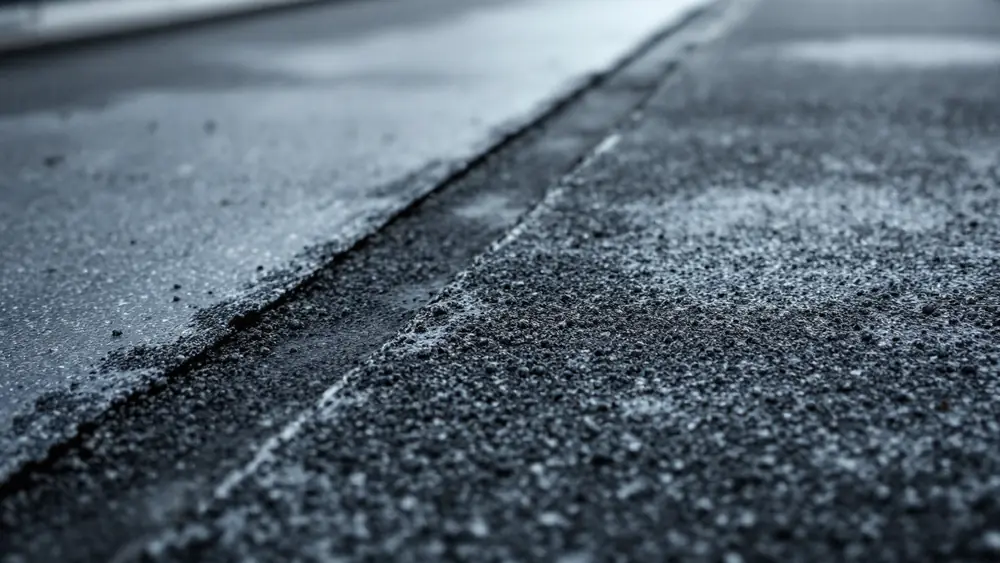
| Granule loss on the cap sheet | Black asphalt showing through the mineral surface, granules piled at drains and scuppers | Where surfacing has worn away, apply a roof coating and embed new surface material, or patch | Polyglass: granule loss “is typical, and not a manufacturing defect” and is not covered |
| Blisters | Soft, raised bubbles in the field or at laps | Monitor small blisters; repair large ones, and any that compromise seams or block drainage | JM excludes non-leaking blisters from coverage |
| Unbonded or open laps | A seam edge you can lift with a probe or fingernail | Cut away the unbonded edge, apply compatible coating and a new membrane layer, or heat-apply a patch | Repairs must use approved materials and contractors |
| Surface coating deterioration, alligatoring | Crazed, cracked or chalky coating on smooth APP or coated SBS | Recoat the membrane and reapply surfacing | JM: “any cracked, flaking, or blistered areas must be recoated” |
| Loose side or base flashing | Flashing pulling off parapets and curbs, open top edges | Cut away loose flashing; heat-apply or cold-adhere a patch | Damaged flashing must be repaired by an approved contractor (JM, Polyglass) |
| Pitch pockets | Sealant shrunk below the pan rim or cracked | Keep them filled and “crowned” with a flexible, non-slumping sealant | Polyglass treats all exposed mastics and sealants as owner maintenance items |
| Chemical or grease contamination | Soft, swollen or slumped bitumen near kitchen exhausts or HVAC units | Remove the affected membrane down to the substrate and replace | JM excludes exposure to oil, fertilizers or solvents |
Polyglass’s 2023 Kool Roof Solutions brochure lists Polyfresko granule loss of 0.09 g (APP) and 0.11 g (SBS) against an ASTM maximum of 2.0 g, so a new cap sheet sheds very little. Heavy loss on a young roof points to the causes CRCA names: water flow, foot traffic, ice action and forced air from ventilators.
How to walk a modified bitumen roof inspection, step by step
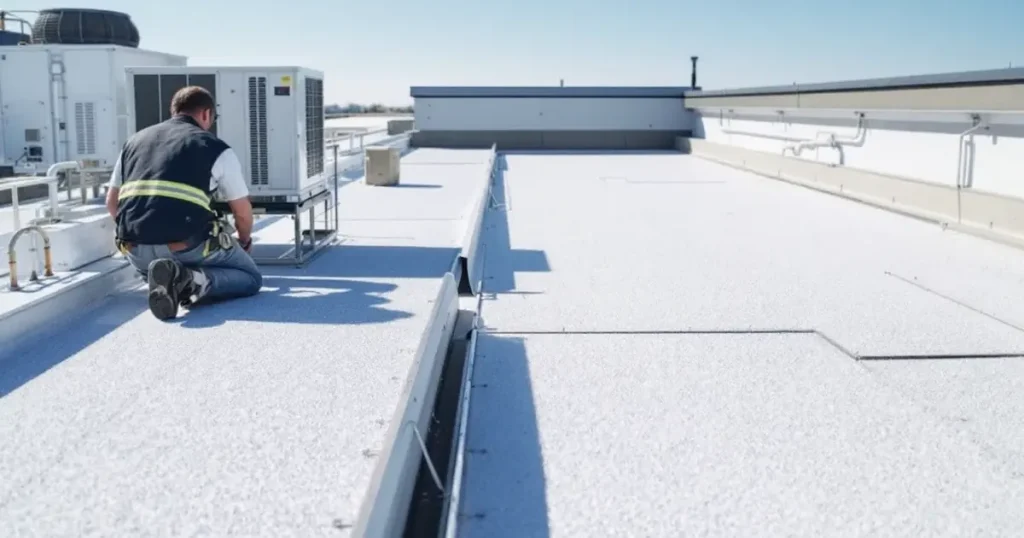
One person with a camera, a blunt probe and a notebook can do it. The Johns Manville Peak Advantage maintenance page calls low-slope roofs “easily examined” but warns that “care must be taken to prevent falling,” so stay back from unguarded edges and skylights.
- Start inside. Mark ceiling stains and deck rust on a sketch so you can find the matching roof area.
- Clear debris first. Leaves, branches and dirt come off before anything else; JM and Polyglass both list it as step one.
- Check every drain, scupper and gutter. Water should flow freely; Polyglass states “no standing water should remain on the roof surface within 48 hours after the last precipitation.”
- Walk the perimeter edge. JM notes wind damage “often occurs” at roof edges, and its guarantee excludes winds above 55 mph. Look for lifted edge metal, open cap sheet at the fascia and loose coping stones.
- Probe the laps. Run a blunt probe along side and end laps; any edge that lifts goes on the repair list.
- Inspect flashings and penetrations. Check base flashing at parapets, curbs and pipe boots, metal counterflashing for rust and loose fasteners, and pitch pockets for shrunken sealant, the items IKO Part 16 lists.
- Check rooftop equipment. Polyglass asks owners to look for leaking oil, loose parts and units that could shift in wind.
- Scan the field. Photograph blisters with a tape measure in frame so you can compare growth next season.
- Look at the walls above the roof. Both Johns Manville and Polyglass warn that damaged masonry, bad mortar joints and loose counterflashing “can appear to be a membrane leak.”
- File the report. Add dated photos to the roof file with the guarantee and invoices; send any leak notice within the maker’s deadline.
Ponding water, drains and housekeeping
Drainage is the cheapest part of modified bitumen roof maintenance and the one with the clearest rule. NRCA defines ponding as water “that remains more than 48 hours after precipitation under conditions conducive to drying,” and the 2024 IRC Section R905.11.1 requires that “modified bitumen roofing shall have a design slope of not less than one-fourth unit vertical in 12 units horizontal (2-percent slope) for drainage.” CRCA’s remedy for persistent ponding is a drain, sump, scupper, cricket or tapered insulation.
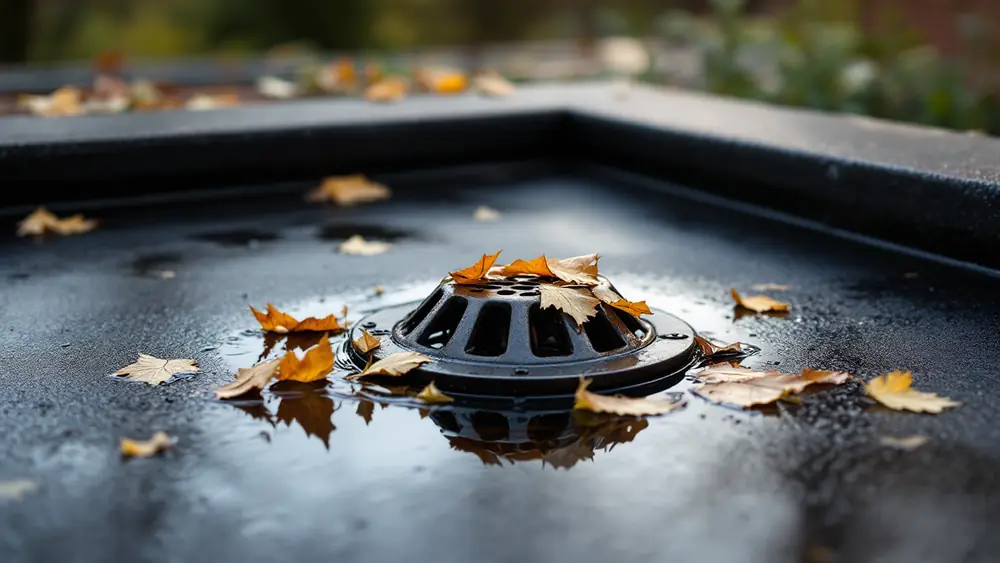
Weight is the reason to act on it. One inch of water weighs 5.2 lb per square foot (62.4 lb per cubic foot divided by 12), so a 10 ft by 10 ft pond 1 in deep holds about 520 lb in one low spot, and deflection under that load deepens the pond. Our guide to ponding water on a flat roof covers drain and taper fixes.
- Pipe condensate and equipment discharge into drains; ARMA lists equipment discharge onto the membrane as a cause of latent damage.
- Store nothing on the roof. Polyglass excludes damage from “traffic or storage of materials upon the roof.”
- Ask service techs to carry fasteners and panels off the roof; JM notes “dropped tools, heavy equipment, etc. can damage the membrane.”
Grease, oils and rooftop kitchens
Modified bitumen is asphalt, and asphalt dissolves in many of the substances that end up on commercial roofs. ARMA’s technical bulletin on contaminants (revised April 2024) says cooking oils and greases “may weaken and eventually break down the polymer-bitumen network,” and that solvents, acids and bases can cause “swelling, softening (reducing resistance to foot traffic), and slumping.”
ARMA’s fixes: grease traps or filters on exhaust fans, at least 1/4 in per foot of slope at the affected area, extra plies or a resistant coating where contamination is minor, and a report to the membrane maker. Heavy bird droppings can cause “mud cracking,” per the same bulletin.
What maker guarantees require you to do
Commercial modified bitumen guarantees are not maintenance contracts, and each one says so. JM’s Peak Advantage form states that “routine inspections and maintenance are the Building Owner’s sole responsibility,” and Polyglass’s 20-year NDL sample says failure to follow its owner maintenance guidelines “will void the warranty.” The table compares the clauses that most often decide a claim, compiled from the maker documents linked in each row.
| Maker and document | Inspection frequency | Leak notice deadline | Who may repair or alter | Other owner duties |
|---|---|---|---|---|
| Johns Manville Peak Advantage Guarantee (sample) | “At least semi-annually,” spring and fall, plus after severe weather | Immediately, and no later than 30 days after discovery; late notice is “a material ground for termination” | JM Approved Roofing Contractor only; no penetrations by service personnel | Keep a file of the guarantee, invoices and inspection logs; make JM-specified repairs promptly or lose coverage for that area |
| Polyglass 20-year NDL Roofing System Warranty (sample) | Two times per year minimum (citing NRCA and ARMA), spring and fall, plus after severe weather | Written notice by registered or certified mail within 10 days; other conditions in writing within 15 days | Polyglass Registered Contractor only; using anyone else ends coverage “without further notification” | Maintain all exposed mastics and sealants; keep a signed roof access log; non-warranty investigations billed at $75 per hour, 2-hour minimum |
| GAF Ruberoid/GAFGLAS Diamond Pledge NDL Guarantee (COMTS549) | “Regular inspections and maintenance” | Per the issued guarantee | Per the issued guarantee | “You must perform regular inspections and maintenance and keep records of this work” |
| Siplast Responsible Roof Maintenance | Owner recommendations published for SBS modified bitumen | Report performance claims immediately | Per the issued guarantee | Encompass program for scheduled inspection and maintenance |
Two clauses catch owners who did nothing wrong on the roof itself. JM excludes “changes, alterations, repairs” and new penetrations that are “not pre-approved in writing by JM,” which covers a new HVAC curb or a solar array. Polyglass makes a sale a deadline event too: transfer requires notice 30 days before the sale or up to 6 months after, plus a $500 fee.
Recoating a modified bitumen roof: when, with what, and with whose approval
Coating is maintenance on a smooth APP sheet and an option on a granule-surfaced SBS cap sheet. John D’Annunzio’s 2005 Roofing Contractor article advises a protective surface coating on APP at installation for UV protection, and cites studies finding that a reflective coating applied to SBS within 5 years of installation “can extend service life by up to 10 years.” JM’s maintenance program requires that “any cracked, flaking, or blistered areas must be recoated.”
| Coating system | Chemistry | Published rate or rule | Mod bit conditions | Source |
|---|---|---|---|---|
| Karnak 298 Alumin-R | SBS rubber-modified asphalt with aluminum pigment | 1.5 to 2 gal per 100 sq ft, one coat | Formulated for use over modified bitumen; Karnak’s silver system specifies 2 gal per 100 sq ft over smooth and granular mod bit | Karnak 298 product data |
| GacoFlex S2000 over asphalt (spec ASP-S2000-22-10) | White silicone, 96.5% solids by weight | GacoFlex A4271 BleedTrap base coat “as needed”; white only | “Non-white (i.e., colored) silicones are not approved for use on asphalt substrates”; nuclear or infrared scan and wet material removal first | Gaco ASP-S2000-22-10, rev. 05/2020 |
| Polyglass PolyBrite 70-QS | Acrylic | Per Polyglass data sheet | Marketed for BUR and polymer-modified membranes with smooth and mineral surfaces | Polyglass 2023 Kool Roof Solutions brochure |
In the GacoFlex S2000 spec, open seams and flashings are repaired first with “granule surfaced APP membrane that is torch-applied or heat fused, regardless of the existing asphalt membrane type.” Coating chemistry by membrane is in our flat roof reseal and recoat guide.
At Karnak’s 1.5 to 2 gal per 100 sq ft, a 1,000 sq ft roof takes 15 to 20 gal (3 to 4 five-gallon pails) and a 10,000 sq ft roof takes 150 to 200 gal. Get written approval from the guarantee holder before ordering: Polyglass voids coverage for alterations made without prior written approval, and JM excludes alterations it has not approved in writing.
Repair it yourself or call a contractor? Torch rules and decision table
Most owner-level maintenance stops at cleaning, logging and cold-applied sealant. Any work involving a torch falls under fire code: per Mark S. Graham’s July 2024 summary in Professional Roofing, NFPA 1 (2024) Section 16.4 lets the authority having jurisdiction require a permit for roof torching, and NFPA 241 (2022) Section 10.3.9 requires a fire watch “for at least two hours after torches are extinguished,” stricter than NFPA 1’s one-hour hot-work watch.
On a guaranteed roof the decision is mostly contractual. JM and the Polyglass 20-year NDL form both require their approved or registered contractor for repairs, so a homeowner patch on a commercial NDL roof can cost the coverage even if the patch holds. Our modified bitumen roof repair guide covers cold-applied patch methods and repair costs, and the torch-down roofing guide covers how torch-applied sheets go down.
| If you find | Then | Basis |
|---|---|---|
| Debris, leaves, clogged drain strainer | Clear it yourself; log the date and a photo | JM and Polyglass list it as an owner task |
| Small, firm blister away from laps and drains | Mark its size and recheck next season; do not cut it | CRCA/IKO: “smaller blisters are best left unattended” |
| Blister at a lap, growing season to season, or blocking drainage | Book a repair with the guarantee holder’s approved contractor | CRCA/IKO: repair blisters that compromise seams or impede drainage |
| Open lap or lifted flashing on a roof under guarantee | Notify the maker in writing within its deadline (10 days Polyglass, 30 days JM), then repair through its contractor | Maker guarantee claim terms |
| Water still standing 48 hours after rain | Clear the drain; if it persists, get a quote for a drain, cricket or tapered insulation | NRCA ponding definition; 2024 IRC R905.11.1 slope rule |
| Grease or oil softening the membrane near an exhaust fan | Fix or add a grease trap, report to the maker, replace the softened area | ARMA technical bulletin, April 2024 |
| Coating cracked or flaking over more than a few spots | Get maker approval, then recoat with an approved product | JM maintenance program; Polyglass alteration clause |
| Any repair that needs a torch | Licensed, insured roofer with a hot-work permit where required and a 2-hour fire watch | NFPA 241 (2022) 10.3.9; NFPA 1 (2024) 16.4 |
Modified bitumen roof maintenance cost per square foot
The most quoted maintenance figures are old: a 2012 Roofing Contractor guest column by Chris Zazo cites unnamed “industry studies” putting proactive maintenance at 14 cents per square foot per year, reactive maintenance at up to 25 cents, and roof life at 21 years proactive versus 13 years reactive. The same column says maintenance programs “typically cost about 1 to 3 percent per year of the estimated total replacement costs.” Treat both as rules of thumb rather than 2026 prices.
The Roofing Brief estimate below applies those ratios to the 2026 Roofing Cost Report baseline of $7 to $12 per square foot for commercial two-ply SBS, at the $9.50 midpoint.
| 10,000 sq ft roof, Roofing Brief estimate | Proactive program | Reactive repairs only |
|---|---|---|
| Maintenance per year (Zazo 2012 ratios) | 10,000 x $0.14 = $1,400 | 10,000 x $0.25 = $2,500 |
| Replacement cost at $9.50 per sq ft | $95,000 | $95,000 |
| Service life (Zazo 2012) | 21 years | 13 years |
| Replacement cost spread per year | $95,000 / 21 = $4,524 | $95,000 / 13 = $7,308 |
| Total annual cost of ownership | $5,924 | $9,808 |
| Cross-check: 1 to 3 percent of $70,000 to $120,000 replacement | $700 to $3,600 per year for a maintenance program | |
On a 1,000 sq ft rowhouse roof the 14 cent ratio gives about $140 a year. Small roofs are usually priced per visit, so ask for a flat fee covering drain clearing, a written photo report and pitch pocket sealant.
How long a maintained modified bitumen roof lasts
The site’s 2026 roofing material lifespan report puts modified bitumen at 15 to 25 years, and maintenance is what moves a roof toward the top of that range. The Zazo column’s 21-year versus 13-year gap is the largest effect any source attributes to upkeep, and Polyglass publishes NDL sample warranties at 12, 15 and 20 years, which signals the terms a maker will stand behind on a maintained roof.
Climate shortens the clock: Waypoint Inspection puts modified bitumen at 10 to 15 years in Florida. For other membranes, compare TPO roof maintenance and rubber (EPDM) roof maintenance; the full zone-by-zone walk for any membrane is in our commercial roof inspection checklist.
Frequently asked questions
What are three common problems you’ll find on modified bitumen roofs?
Open or unbonded laps, blisters and loose flashing at parapets and curbs are the three conditions the CRCA repair recommendations in IKO Part 16 spend the most space on. Granule loss on the cap sheet and ponding water are close behind. Polyglass treats normal granule loss as typical wear, not a defect, so it is a maintenance item rather than a warranty claim.
What is the average life expectancy of a modified bitumen roof?
About 15 to 25 years, per The Roofing Brief’s 2026 roofing material lifespan report. A 2012 Roofing Contractor column citing industry studies put proactively maintained roofs at 21 years against 13 years for roofs repaired only after leaks. Hot, high-UV climates sit at the low end; a Florida inspection firm cites 10 to 15 years there.
Can you walk on a modified bitumen roof?
Yes, for inspection and maintenance. A granule-surfaced cap sheet (GAF lists 0.160 in for Ruberoid EnergyCap Torch Granule FR) takes occasional foot traffic, but JM’s guarantee says to “avoid unnecessary roof top traffic,” and ARMA recommends walk pads on regular routes. Repeated traffic wears granules off the walking path, and solvents or grease can soften the bitumen and reduce its resistance to foot traffic, per ARMA.
Are modified bitumen roofs good?
For low-slope roofs with foot traffic and rooftop equipment, modified bitumen is a proven system: multi-ply SBS and APP assemblies carry maker NDL guarantees of 12 to 20 years from Polyglass and longer terms from other makers. Its weak points are UV aging of exposed asphalt and damage from grease and oils, which is why coating and housekeeping matter more than on single-ply membranes.