
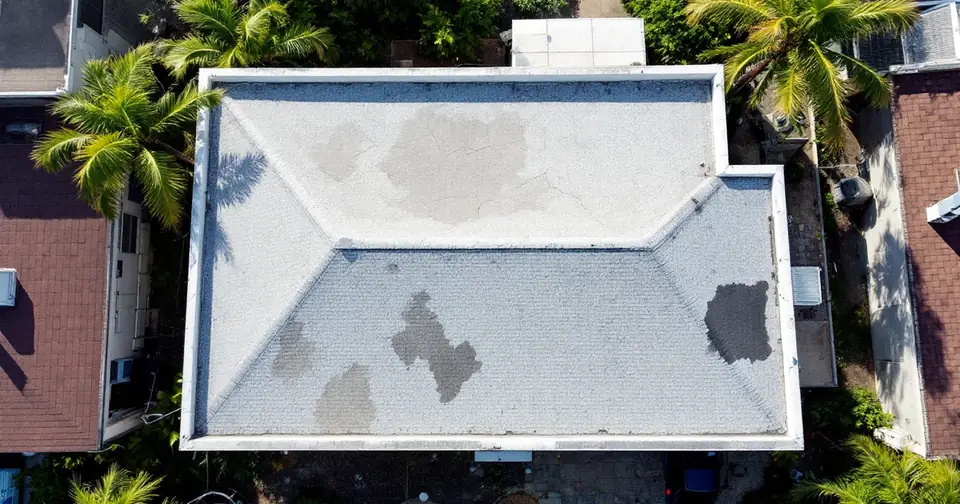
Concrete flat roof leak repair comes down to crack width and movement: a static crack from 0.002 in up to 1/8 in can be sealed by gravity-feeding a low-viscosity epoxy such as Sikadur-55 SLV, a crack that is moving or wider than 1/4 in needs a flexible polyurethane sealant or membrane, and a crack that is running water needs a polyurethane injection grout. A slab with many cracks, standing water or a worn coating needs a fleece-reinforced liquid membrane over the whole deck, laid to the 1/4 in per foot slope in IRC R905.15.1.
Concrete slab roofs are the subject here, poured or precast: flat garage and porch roofs, block (CMU) homes in Florida, Puerto Rico, Mexico and the Southwest, and roof decks over living space. A concrete tile roof is a different system of loose tiles over underlayment, priced and repaired differently, and our guide to concrete tile roof relay and replacement cost covers it. Flat roofs with an EPDM, TPO, PVC or modified bitumen membrane are covered in our flat roof leak repair guide by membrane type.
Concrete flat roof leak repair: key numbers at a glance
Seven figures decide most concrete roof repairs: the 0.004 in crack width ACI 224R treats as reasonable for water-retaining concrete, the 0.002 in to 1/8 in range a gravity-fed epoxy handles unaided (to 1/4 in with a sand fill), the 1/4 in per foot minimum slope for a liquid-applied roof, and the 28 days new concrete must cure before coating. Each figure is linked to its code, standard or data sheet.
| Figure | Value | Source |
|---|---|---|
| Reasonable crack width, water-retaining concrete | 0.004 in (0.10 mm); 0.016 in in dry air | ACI 224R-01 Table 4.1, reproduced in ASPIRE, Winter 2018 |
| Narrowest crack a gravity-fed epoxy seals | 0.002 in (2 mils) | Sikadur-55 SLV data sheet, Oct 2018 |
| Widest crack for Sikadur-55 SLV | Sand-fill over 1/8 in; do not inject over 1/4 in | Same data sheet |
| Minimum slope, liquid-applied roofing | 1/4 in per 12 in (2 percent) | 2021 IRC R905.15.1, reproduced in the Seattle Residential Code Ch. 9 |
| Minimum concrete age before coating | 28 days | Sikalastic-641 Lo-VOC data sheet, Feb 2026; Henry 887 data sheet |
| Maximum slab moisture before a membrane | 4 percent on a Sika-Tramex meter | Sikalastic-641 Lo-VOC data sheet |
| Installed cost, polyurethane or silicone roof coating | $1.50 to $4.00 (polyurethane), $1.50 to $4.50 (silicone) per sq ft | HomeGuide roof coating cost guide, 2026 edition |
Why concrete flat roofs leak, and where the water really gets in
Concrete roofs leak through cracks, cold joints, the slab-to-parapet corner, drains and penetrations, not through sound concrete. ACI 224R-01 treats 0.004 in as a reasonable crack width only for water-retaining structures, and it expects a portion of cracks to exceed the table values over time, so an uncoated roof slab with ordinary shrinkage cracks will usually pass water somewhere.
The drip inside is rarely below the entry point. InspectAPedia’s flat roof leak diagnosis article describes water creeping under poorly adhered coatings and following winding cracks, so the visible crack may not sit above the interior stain. Its worked example is a concrete roof in Mexico with under 1 in of fall per 12 in, draining to a single corner drain.
| Leak source | What you see on the roof | What you see inside | Reference |
|---|---|---|---|
| Shrinkage or thermal crack | Straight or mapped cracks, often near ponding | Stain along a line on the ceiling | ACI 224R-01 Table 4.1 widths |
| Cold joint between pours | Straight line, often parallel to a wall | Wet line where two pours met | Sikadur-55 SLV is for non-moving cracks only |
| Slab-to-parapet or wall joint | Hairline gap at the inside corner, cracked cant | Damp at the top of the wall, peeling paint | Treated as a moving joint, sealant class ASTM C920 Class 25 |
| Drain or scupper | Gap around the drain body, standing water near it | Leak near the drain pipe chase, worse in heavy rain | 2021 IRC R903.4 and R903.4.1 |
| Ponding over a low spot | Dirt ring, water still there 48 hours after rain | Slow seep that follows long storms | IRC positive drainage definition (48 hours) |
| Rebar corrosion and spalling | Rust stains, popped concrete over steel | Rust-colored stains, flakes falling from the ceiling | ASPIRE: epoxy injection may not suit cracks caused by corrosion |
A leak that only appears in heavy rain points to drains, scuppers and the parapet line before field cracks. Under 2021 IRC R903.4, a roof that does not drain over its edges needs a drain at each low point, and R903.4.1 adds an overflow drain with its inlet 2 in above the low point, or a scupper three times the size of the drain with an opening at least 4 in high. A roof built without that overflow fills above the drain flange in a cloudburst and pushes water into the parapet joint.
How to find the leak on a concrete flat roof
Find a concrete roof leak by mapping the stain inside, clearing the drains, measuring every crack with a crack-width card, reading the slab with a moisture meter, and hose testing one zone at a time from the lowest point uphill. Do it within 48 hours of rain, while the slab still holds water a meter can read.

- Map the stain. Measure from the stain to two walls inside, then transfer those distances to the roof with a tape, adding the parapet or wall thickness (often 8 in for a CMU block wall). Mark the spot and every crack uphill of it in chalk.
- Clear and check the drainage. Pull the dome strainer, clear the drain body and scuppers, and look for a gap between the drain flange and the concrete or coating. Note any water still standing 48 hours after rain, the line the IRC uses for positive drainage.
- Measure the cracks. Hold a crack-width comparator card on each crack and record the width. Under 0.004 in sits within the ACI 224R water-retaining guide; 0.002 in is the narrowest a gravity-fed epoxy reaches; anything over 1/8 in needs sand fill or a different method.
- Read the slab. Take moisture meter readings in a grid around the marked area against a dry reference spot. Sika sets 4 percent on a Sika-Tramex meter as the ceiling for its 641 membrane, so readings above that also tell you the slab must dry before coating.
- Hose test in zones. Wet one zone at a time with a garden hose, starting downhill of the stain, with a helper inside watching the ceiling. Keep the water on that zone until the helper sees a drip or you are satisfied it stays dry, and move uphill only after the lower zone stays dry, so you know which crack or joint carried the water.
- Do not flood the roof. ASTM D5957, the flood-test guide, is written for plaza and parking decks with a slope of 2 percent or less and says it is not intended for building roofing systems. Each inch of ponded water adds 5.2 lb per sq ft (62.4 lb per cu ft divided by 12), which a residential slab was not necessarily designed to carry.
Moisture meters and infrared cameras need recent water to work. InspectAPedia, which names Tramex meters, notes that if too much time has passed since the last rain there may be no moisture left to detect, so schedule the survey within 1 to 2 days of rain. Our guide to roof leak detection methods and what each misses covers the tools in more depth.
| Detection method | What it finds on concrete | Limit | Standard or source |
|---|---|---|---|
| Crack-width card | Width class of every visible crack | Says nothing about depth or movement | ACI 224R-01 Table 4.1 widths |
| Moisture meter | Wet areas under a coating or in the top of the slab | Misses old leaks once the slab dries | Sika 641 data sheet (4 percent ceiling) |
| Infrared thermography | Wet zones that hold heat after sunset | Needs a recent wetting and a clear evening | ASTM C1153 (insulated roofs) |
| Zoned hose test | The exact crack, joint or drain that leaks | Slow; needs a helper inside | Field practice; not a flood test |
| Electronic leak detection | Breaches in a membrane or coating over the slab | Needs an insulating membrane over a conductive deck; useless on bare concrete | ASTM D7877-25 |
| Flood test | Plaza deck waterproofing before the wearing surface goes on | Not for roofs; 4 in maximum head; 24 hours minimum | ASTM D5957 |
Crack width decides the concrete roof repair
Measure first, then choose: the right concrete roof repair for a crack depends on its width, whether it moves, and whether water is flowing through it today. The Sikadur-55 SLV, SikaFix HH+ and Sikaflex Self-Leveling data sheets each set their own limits, and this table lines them up so one crack gets one method.
| Crack condition | Repair method | Product example | Limit from the data sheet |
|---|---|---|---|
| Under 0.002 in, static, map cracking | Penetrating sealer or full membrane | Sikadur-55 SLV as surface sealer; Sikalastic-641 with Reemat | 150 to 175 sq ft per gal as a sealer (Sika) |
| 0.002 in to 1/8 in, static, dry or damp | Gravity-feed epoxy | Sikadur-55 SLV | Seals down to 0.002 in; not for moving cracks |
| 1/8 in to 1/4 in, static | Sand-fill, then gravity-feed epoxy | Oven-dried sand plus Sikadur-55 SLV | Sika: fill cracks over 1/8 in with oven-dried sand first |
| Over 1/4 in, or opens and closes with temperature | Rout and seal with polyurethane, then membrane | Sikaflex Self-Leveling Sealant | Plus or minus 25 percent movement, ASTM C920 Class 25; not for sloped surfaces |
| Water flowing through the crack now | Hydrophobic polyurethane injection | SikaFix HH+ | Expands up to 30 times; 200 to 2,500 psi; professional use only |
| Rust stains, spalls, sagging | Structural evaluation before any sealing | None until an engineer reviews it | ASPIRE: injection may not suit corrosion-driven cracks |
Epoxy or polyurethane injection: which one for a roof crack?
Epoxy bonds a dry or damp static crack back together; polyurethane stops running water and stays flexible. The ASPIRE article by Vector Construction notes that epoxy’s bond to concrete is stronger than concrete’s own tensile strength, so it can restore structural integrity in cracks 0.002 in or wider, but it is the wrong choice where the concrete will keep moving.
| Property | Epoxy (Sikadur-55 SLV) | Polyurethane grout (SikaFix HH+) |
|---|---|---|
| Main job | Seal and bond static cracks | Stop active water flow |
| Viscosity | About 105 cps | 700 cps uncured, at 74°F |
| Delivery on a roof slab | Poured and squeegeed so it ponds over the crack | 5/8 in holes drilled at 45 degrees to meet the crack, packers every 6 to 36 in |
| Movement after cure | Rigid; Sika says not for dynamic cracks | Flexible foam that displaces water |
| Temperature window | 40°F to 95°F ambient and substrate | 40°F to 90°F ambient |
| Time before traffic | 6 hours at 73°F | Gel time in minutes with SikaFix accelerator |
| Who should apply it | Sika: experienced professionals | Sika: professional use only |
For pressure injection of structural cracks, the ASPIRE article lists typical pressures of 50 to 100 psi, rising to 200 psi or more for very fine cracks, with injection always starting at the lowest port. Those pressures, the epoxy paste seal and the port spacing (at least the crack depth apart) are why injection is usually contractor work, while gravity feeding a horizontal roof crack is within reach of a careful owner.
Concrete flat roof repair products compared
Eight products cover nearly every concrete flat roof repair, from a $10 cartridge of polyurethane sealant to a 90 mil fleece-reinforced membrane. The specs below come from each maker’s current data sheet; prices are retail listings with the date checked, and they change, so treat them as a guide.
| Product | Type | Use on a concrete roof | Key spec | Rain or traffic time | Source |
|---|---|---|---|---|---|
| Sikadur-55 SLV | 2-part epoxy, 100 percent solids | Gravity-feed static cracks | ASTM C881 Types I and II; 20 min pot life | Traffic in 6 hours at 73°F | Sika data sheet, Oct 2018 |
| SikaFix HH+ | Hydrophobic polyurethane grout | Inject actively leaking cracks | Expands up to 30 times liquid volume | Gel in minutes with accelerator | Sika data sheet, May 2026 |
| Sikaflex Self-Leveling Sealant | 1-part polyurethane sealant | Rout-and-seal moving cracks and joints, flat areas only | Plus or minus 25 percent movement; ASTM C920 Class 25 | Cure varies with joint depth | Home Depot listing, $9.68 per 10.1 oz, Nov 2026 |
| SikaTop Seal 107 | Polymer-modified cementitious slurry | Balcony-type decks with static hairline cracks, under a wearing layer | 2 coats at 40 mils; about 25 percent flexibility | Protect from rain for 1 to 2 days | Sika data sheet, 2015 |
| Sikalastic-641 Lo-VOC with Reemat Premium | 1-part aliphatic polyurethane, fleece reinforced | Whole-roof membrane over concrete | 62 mils dry minimum (Sikalastic 10 build); SRI 108 white; ASTM C836; UL 790 Class A | Rain resistant in 1 hour | Sika data sheet, Feb 2026 |
| KEMPEROL 2K-PUR | 2-part polyurethane with 165 g/m2 fleece | Whole-roof or detail membrane | 90 mils (ASTM D5147); crack bridging at minus 15°F | Rainproof in 2 hours at 73°F | Kemper KEM-4-0202, Oct 2025 |
| KEMPEROL AC Speed FR | PMMA with 120 g/m2 fleece | Cold-weather or fast-turnaround details | 90 mils; applies down to 23°F | Rainproof in 35 minutes | Kemper KEM-4-0203, Oct 2025 |
| Henry 887 Tropi-Cool | 100 percent silicone coating | Whole-roof coat where water ponds | 1.5 gal per 100 sq ft; 22 mils dry minimum; lists concrete roofs | Rain-safe in 15 minutes | Henry data sheet, rev. 04/06/2017 |
The fleece is what separates a membrane from a paint-on coating. Kemper’s resin goes on about two thirds below a polyester fleece and one third above it, and the result is rated for crack bridging at minus 15°F. An unreinforced silicone coat at 22 mils dry does not carry that rating, which is why it should go over cracks that have already been sealed, not over open ones. Our Kemper System roofing review lists every KEMPEROL resin and warranty term.
Cementitious coatings have a narrow role on roofs. SikaTop Seal 107 is described by Sika as slightly flexible, about 25 percent in a modified ASTM D522 test, and recommended for static hairline cracks and balconies with light foot traffic. It is 18 perms and not a vapor barrier, so it suits a deck that has to breathe, but an exposed roof slab that moves with daily heat is better served by a reinforced polyurethane or PMMA membrane.
Step by step: sealing a static roof crack with gravity-fed epoxy
Gravity feeding is the one structural crack repair a careful owner can do on a horizontal slab, because the epoxy flows in under its own weight instead of under pump pressure. Every quantity and time below comes from the October 2018 Sikadur-55 SLV data sheet; Sika states the product is for experienced professionals, so read the full sheet first.
- Check the conditions. The slab must be at least 21 to 28 days old, and air and slab must sit between 40°F and 95°F. Do not use it on a crack that moves, on one wider than 1/4 in, or on one under hydrostatic pressure.
- Clean the crack. Wire-brush and vacuum a strip about 2 in wide along the crack, the surface prep the ASPIRE article describes. The surface should be dry for best results, though the epoxy tolerates damp.
- Fill wide cracks. Pour oven-dried sand into any crack wider than 1/8 in before the epoxy goes on.
- Mix. Combine 1 part Component B with 2 parts Component A by volume and mix for 3 minutes at 400 to 600 rpm with a paddle. You have about 20 minutes of pot life.
- Pond it over the crack. Pour the mix on the crack, spread it with a flat squeegee or broom, and let it pond so it soaks in; as a surface sealer, 1 gal covers 150 to 175 sq ft. Remove the excess with a roller so no visible film remains.
- Broadcast sand. After 20 to 30 minutes at 73°F, broadcast oven-dried 20/40 silica sand at 30 to 40 lb per 100 sq ft. The sand gives grip and a key for the coating that follows.
- Cure and coat. Allow at least 6 hours at 73°F before foot traffic, sweep off loose sand, then cover the repair with the roof membrane or coating, since Sika notes the epoxy may change color under UV.
Step by step: coating the whole concrete roof with a reinforced liquid membrane
When a roof has many cracks, a failed old coating or leaks you cannot pin down, the longer-lasting concrete roof leak repair is a fleece-reinforced liquid membrane over the entire slab. The steps below follow the February 2026 Sikalastic-641 Lo-VOC data sheet for its 10-year Reemat Premium build; Kemper and other systems follow the same order with their own rates.
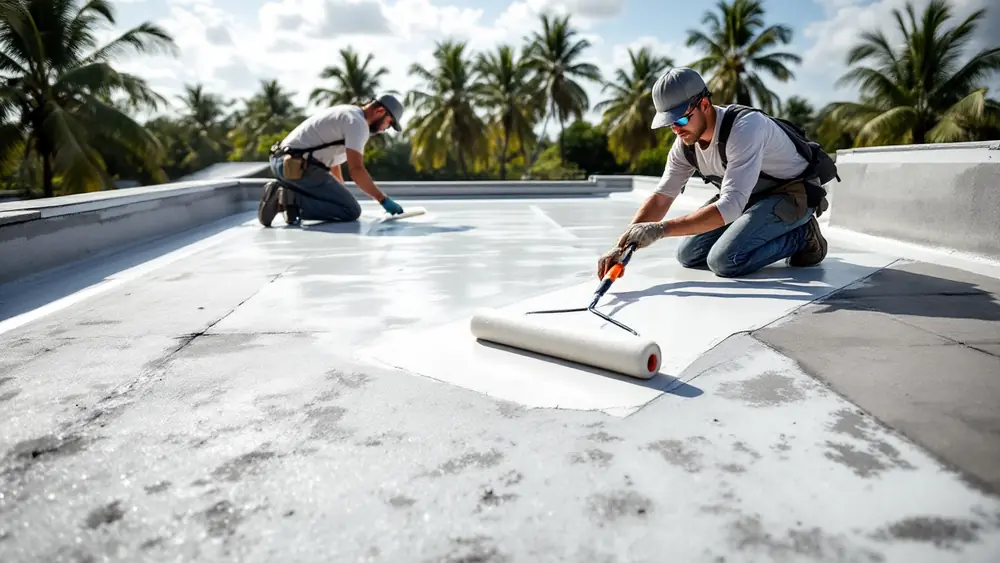
- Confirm the slab is ready. Concrete must be at least 28 days old and read 4 percent or less on a Sika-Tramex meter, with no rising moisture under a polyethylene sheet test (ASTM D4263).
- Prepare the surface. Remove loose coating, laitance and contaminants by grinding or shot blasting so the primer bonds to sound concrete.
- Repair first. Seal static cracks up to 1/4 in with epoxy and moving joints with an ASTM C920 Class 25 polyurethane sealant, and reset or replace loose drain bodies. The membrane bridges hairline cracks, not open joints.
- Prime. Apply the primer named in Sika’s substrate priming guide for concrete and let it cure.
- Base coat and fleece. Roll the base layer at 50 mils wet (32 sq ft per gal) and press Sika Reemat Premium into it while wet, lapping and working out wrinkles.
- Top coat. Apply the top layer at 20 mils wet (80 sq ft per gal). The finished build must reach 62 mils dry minimum.
- Respect the windows. At 70°F and 50 percent humidity the coat is rain resistant in 1 hour, touch dry in 4 hours and fully cured in 12 to 18 hours; minimum recoat time is 6 hours. After 7 days, the surface must be cleaned and reprimed before another coat.
Sika lists limits that matter on houses: Sikalastic-641 should not go over on-grade slabs, unvented metal pans, sandwich slabs with buried membranes or lightweight insulating concrete without a deck evaluation, and it is not for continuous immersion. A roof that holds water past 48 hours needs its drainage fixed as well.
Worked example: material for a 20 ft by 20 ft concrete garage roof
For a 400 sq ft slab, the Sikalastic-641 build needs about 17.5 gallons before waste, and a silicone recoat needs 6 gallons. The arithmetic uses each maker’s published coverage rate; real coverage drops on rough or porous concrete, so add 10 to 15 percent and confirm with the supplier.
| Line | Inputs | Result | Source of rate |
|---|---|---|---|
| Roof area | 20 ft x 20 ft | 400 sq ft | Roofing Brief arithmetic |
| Sikalastic-641 base coat | 400 / 32 sq ft per gal | 12.5 gal | Sika data sheet, Feb 2026 |
| Sikalastic-641 top coat | 400 / 80 sq ft per gal | 5.0 gal | Sika data sheet, Feb 2026 |
| Henry 887 silicone, one coat | 400 x 1.5 gal / 100 sq ft | 6.0 gal (one 4.75 gal pail plus two 0.90 gal cans) | Henry 887 data sheet |
| Henry 887 retail material | $369.00 + 2 x $129.00 | $627, about $1.57 per sq ft | Home Depot prices recorded Oct 19, 2026 in our Henry roof coating review |
| Crack sealant yield, 1/4 in x 1/4 in joint | 10.1 fl oz = 18.2 cu in; 18.2 / 0.0625 sq in | About 24 ft per cartridge | Roofing Brief arithmetic |
| Crack sealant yield, 1/2 in x 1/4 in joint | 18.2 / 0.125 sq in | About 12 ft per cartridge | Roofing Brief arithmetic |
| Weight of 1 in of ponded water | 62.4 lb per cu ft / 12 | 5.2 lb per sq ft, 2,080 lb over 400 sq ft | Roofing Brief arithmetic |
What concrete roof repair costs in 2026
A single crack sealed by a contractor often runs a few hundred dollars to about $1,500, and a whole-roof coating runs $1.50 to $4.50 per sq ft installed, according to the 2026 HomeGuide and Fixr guides below. Their crack figures are for foundation work, the closest published benchmark; roof access, parapets and the coating that must follow the repair can push a roof job higher.
| Repair | Typical price | What moves it | Source |
|---|---|---|---|
| Crack epoxy or polyurethane injection, per crack | $400 to $1,500 | Crack length, depth, number of passes | HomeGuide, 2026 (foundation cracks) |
| Crack sealing or epoxy injection, per job | $200 to $1,000 | Whether the crack is structural | Fixr, 2026 (foundation repair) |
| Acrylic or elastomeric coating, installed | $0.50 to $3.00 per sq ft | Number of coats; acrylic should not sit under ponding | HomeGuide roof coating guide |
| Polyurethane coating, installed | $1.50 to $4.00 per sq ft | Primer, fleece reinforcement, detailing | HomeGuide roof coating guide |
| Silicone coating, installed | $1.50 to $4.50 per sq ft | Mils applied, prep, ponding areas | HomeGuide roof coating guide |
| DIY silicone recoat, materials only | About $1.57 per sq ft | Pail size and retailer | Worked example above |
| Roofer labor | $26.65 per hour median | Region, union scale | BLS, May 2025 |
HomeGuide’s $0.50 to $4.50 per sq ft coating ranges cover all roof types, not concrete slabs specifically, so ask for a line-item bid that separates crack repair, surface prep, primer and membrane mils. For membrane roof repair pricing by patch type, see our flat roof repair cost guide.
Fixing ponding and slope on a flat concrete roof
Coatings seal a slab, but they do not move water off it. The 2021 IRC sets a 1/4 in per foot minimum slope for liquid-applied roofing in R905.15.1, and R908.1 exempts reroofing from that minimum only where the roof already has positive drainage, which the IRC defines as water clearing within 48 hours of rain.
Slope adds up quickly on a slab. At 1/4 in per foot, a roof that drains 20 ft to one edge needs 5 in of rise from the low edge to the high side, and one that drains 30 ft needs 7.5 in, which is more than most garage parapets can absorb. Our guide to ponding water on a flat roof compares the fixes and their costs.
| Ponding cause | Fix | Code or maker rule |
|---|---|---|
| Slab poured dead flat | Tapered insulation or tapered screed, then membrane | 2021 IRC R905.15.1: 1/4 in per 12 in |
| One low spot away from the drain | Add a drain or scupper at the low point | 2021 IRC R903.4: drains at each low point |
| Parapet traps water | Add overflow scupper 2 in above the low point, at least 4 in high | 2021 IRC R903.4.1 |
| Water lingers but clears within 48 hours | Ponding-tolerant coating (silicone or polyurethane) | Henry 887 and Sikalastic-641 data sheets list ponding resistance |
| Water stands for days | Regrade or drain first; do not rely on a coating | Sika: not for continuous immersion |
Tapered polyiso, usually made at 1/8 to 1/2 in of rise per foot, changes the assembly, since it needs a membrane over it, while a cementitious screed keeps the roof as bare concrete. Our tapered insulation guide gives slopes and costs, and our flat roof drain guide covers drain types and retrofit inserts.
Which concrete flat roof leak repair fits your roof?
Pick the repair from what the crack card, moisture meter and hose test showed: crack width in inches, slab moisture against the 4 percent ceiling, and hours of standing water against the 48-hour line. Where two rows apply, do the drainage fix first, then the crack repair, then the coating.
| If your roof has | Do this | Why |
|---|---|---|
| 1 or 2 static cracks under 1/8 in, rest of slab sound | Gravity-feed epoxy, then coat the repair | Sikadur-55 SLV seals to 0.002 in; UV can discolor it |
| A crack that leaks during every rain and is wet now | Polyurethane injection by a contractor | SikaFix HH+ displaces water; professional use only |
| Cracks that open in summer and close in winter, or over 1/4 in | Rout and seal with polyurethane, then membrane | Epoxy is rigid; Sikaflex SL handles plus or minus 25 percent movement |
| Map cracking over most of the slab | Fleece-reinforced liquid membrane | Fleece builds of 62 to 90 mils bridge many fine cracks at once |
| Old coating peeling, leaks you cannot locate | Strip, dry to 4 percent, prime, full membrane | Water under a loose coating travels to distant cracks |
| Water standing over 48 hours | Add drains, scuppers or slope before coating | IRC positive drainage definition and R905.15.1 |
| Rust stains, spalls or a sagging slab | Structural engineer before any waterproofing | Corroding rebar keeps cracking the slab |
| New slab under 28 days old | Wait, keep it covered | Sika and Henry both require 28 days of cure |
DIY or hire a pro for concrete roof repair
An owner can reasonably seal flat horizontal joints with a self-leveling polyurethane, and recoat a sound, drained slab with a retail silicone. Pressure injection, structural cracks and reinforced membranes are contractor work, and Sika labels both Sikadur-55 SLV and SikaFix HH+ for professional users.
When you hire, ask four things. Which crack-width threshold (for example 1/8 in or 1/4 in) sends a crack to epoxy, sealant or injection? What dry mils will the finished membrane measure, and will they show a wet-mil gauge reading? Will they take a moisture reading before priming? And, for a manufacturer warranty, are they an approved applicator, since Kemper’s warranted roofs are installed only by applicators it trains and approves? Answers with numbers in them are the ones to trust.
Frequently asked questions
What to do if your concrete roof is leaking?
Clear the drains and scuppers first, then mark the stain position on the roof and measure every nearby crack with a crack-width card. Seal static cracks up to 1/8 in with a gravity-fed epoxy such as Sikadur-55 SLV, use a polyurethane sealant on moving joints, and call a contractor for cracks that run water, which need polyurethane injection. Coat the whole slab if cracking is widespread.
My flat roof is leaking. How can I fix it?
First identify the roof surface. A bare or coated concrete slab is repaired by sealing cracks and adding a liquid membrane; an EPDM, TPO, PVC or modified bitumen roof is patched with that membrane’s own materials. On concrete, find the entry with a zoned hose test, fix drainage if water stands over 48 hours, seal the cracks, then coat the roof.
What to put on a flat roof to stop leaks?
On a concrete flat roof, a fleece-reinforced liquid membrane stops leaks most reliably: Sikalastic-641 with Reemat Premium builds at least 62 mils dry, and KEMPEROL 2K-PUR builds 90 mils. Where water ponds, a 100 percent silicone coat such as Henry 887 at 1.5 gallons per 100 sq ft (22 mils dry) tolerates standing water. Seal open cracks before any coating.
How can I seal leaks in my concrete roof?
Match the sealer to the crack. Static cracks from 0.002 in to 1/8 in take a gravity-fed epoxy; fill cracks over 1/8 in with oven-dried sand first. Moving cracks or joints take a polyurethane sealant rated ASTM C920 Class 25, such as Sikaflex Self-Leveling, which sold for $9.68 per 10.1 oz cartridge at Home Depot in November 2026. Cover repairs with a membrane.
Why does my concrete roof only leak in heavy rain?
Heavy-rain-only leaks usually come from drains, scuppers or the parapet joint rather than field cracks. When the drain cannot keep up, water rises above the drain flange and reaches joints that stay dry in light rain. The 2021 IRC R903.4.1 calls for an overflow drain 2 in above the low point, or a scupper at least 4 in high, where parapets can trap water.
Is there a permanent solution for concrete roof leakage?
No coating is permanent, but the longest-lasting fix combines three parts: slope or drains so water clears within 48 hours, cracks sealed by type, and a fleece-reinforced membrane of 62 to 90 mils over the whole slab. Kemper offers No Dollar Limit warranties of 10 to 20 years on approved jobs of at least 1,000 sq ft, which shows how makers rate that build.