
By The Roofing Brief Team. Last reviewed: November 2026.
Correction, November 14, 2026: an earlier version repeated the IBHS paper’s “108% difference” wording for granule loss of 7,687.2 mm2 versus 2,287.2 mm2; the correct comparison is about 236% more (3.4 times). It also described the test as one year of weathering with a single round of 400 and 600 ice spheres; the paper ran two rounds of 200 and 300 spheres, each followed by a year of weathering. The Gregory v. Safeco vote (4 to 3), the 365-day notice clause in that case and the Texas, Minnesota, Colorado and Florida deadlines were re-checked against the opinion and statute texts and stand. A second check the same day corrected further attributions and figures against their cited sources.
Old hail damage on a roof shows up as dull, weathered impact marks with no spatter marks around them, while hail from a recent storm leaves darker fractures with granules still pressed into the hit and clean spatter marks on oxidized metal and dirty surfaces. Spatter marks typically linger for about a year, per Haag Engineering principal Scott J. Morrison writing in Professional Roofing (May 2009), so their absence is the first clue that the hits are older than the last storm season. Our metro-level hail ranking maps ten years of NOAA hail reports to 350 US metros and ranks them by damaging-hail frequency per resident.
Dating matters because the age of the marks decides whether a claim is still possible. Florida bars a new property claim unless notice reaches the insurer within 1 year after the date of loss under Florida Statutes section 627.70132, and many homeowner policies elsewhere carry their own 1-year notice clause for wind and hail. For the general look of hail hits on each material, see what hail damage looks like on a roof; this page covers how old those hits are and what that means.
Key numbers at a glance
The 7 figures below, from Haag Engineering, Vertex, IBHS and two state statutes, decide whether a hail mark reads as old or new and whether old damage can still be claimed. Forensic timelines are field rules of thumb from engineering firms, not fixed laws of nature.
| Figure | Value | Source |
|---|---|---|
| How long hail spatter marks typically last | About 1 year | Morrison (Haag Engineering), Professional Roofing, May 2009 |
| Alternative spatter-mark estimate | About 1.5 to 2 years | Vertex, May 7, 2024 |
| Smallest hail that typically damages 3-tab / laminated shingles | 1.00 in / 1.25 in | Vertex, May 7, 2024 |
| NWS severe hail threshold | 1 in (25.4 mm) or larger | IBHS, Frontiers in Materials, Sept. 29, 2025 |
| Weathered shingles hit by small hail vs new shingles | About 10 times more susceptible to later severe hail | IBHS, same paper |
| Florida claim / supplemental claim notice limit | 1 year / 18 months after date of loss | Fla. Stat. 627.70132(2) |
| Minnesota standard-policy suit limit | 2 years after inception of the loss | Minn. Stat. 65A.01, subd. 3 |
How to tell old hail damage from new hail damage
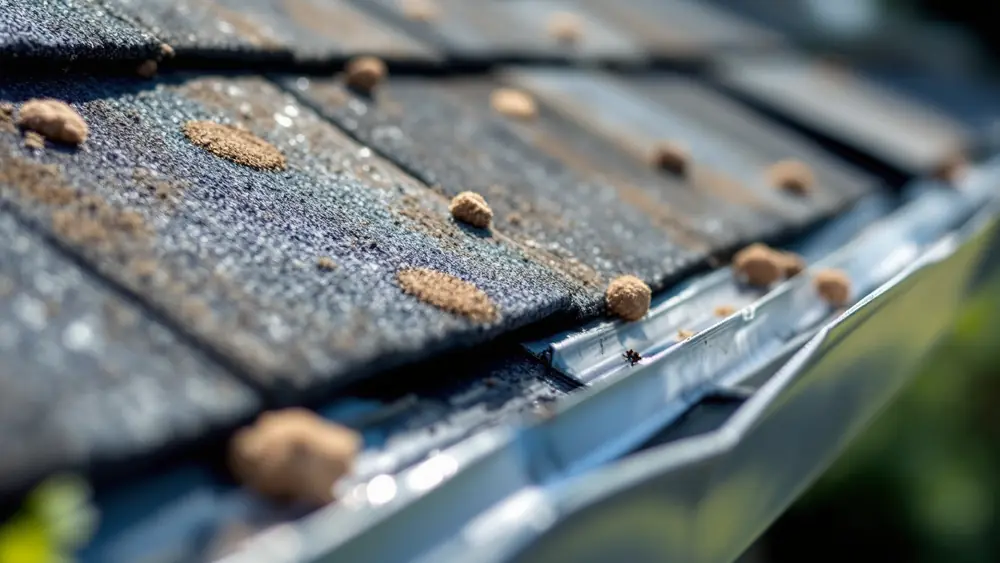
New hail damage looks clean and sharp: dark exposed asphalt with granules embedded in the impact, bright clean spatter marks, and freshly split wood with bright orange interiors. Old hail damage looks weathered: the exposed mat has dulled under UV, spatter marks have faded, wood splits have turned gray, and grime or growth has returned over the spot. Vertex (May 2024) states that “granules embedded in the asphalt shingle indicate that a significant amount of time has not yet passed.”
| Evidence | Recent hail (roughly this storm season) | Old hail (a year or more) | Source |
|---|---|---|---|
| Asphalt shingle impact | Granules still embedded in the asphalt at the hit; dark, sharp-edged exposure; soft when pressed if the mat is fractured | Exposed fibers and mat degraded by sunlight; edges worn; surface dull | Vertex, May 2024; Envista Forensics, Apr. 26, 2021 |
| Spatter marks on oxidized metal, painted wood, dirty or lichen-covered surfaces | Present, crisp, sized to the stones, on the storm-facing side | Faded or gone; Morrison puts the typical life at about 1 year, Vertex at 1.5 to 2 years | Morrison, 2009; Vertex, 2024; Envista, 2021 |
| Dents in gutters, vents, flashing, AC fins | Dents with spatter marks around them | Dents with no spatter; dents can be from any past storm | Morrison: “metals are permanent records of all the hailstorms the metals have endured” |
| Wood shakes, trim, fences | Split interior shows bright orange wood | Split interior weathered gray | Morrison, 2009 |
| Granules in gutters and at downspouts | Fresh piles after the storm date | No new piles; normal aging loss is uniform | Granule loss alone “is not considered functional damage” (Morrison) |
| Microbial growth over the hit | Hail strike removed growth, leaving a clean spot | Growth has returned over the spot | Envista: spatter marks are “temporary aesthetic conditions that will fade over time” |
Metal is the trap in this comparison. A dented gutter proves hail fell on the house at some point, but because metals keep every dent, a gutter full of round dings on a 20-year-old house can hold three or four storms’ worth of marks. Pair each dent field with spatter marks or a dated photo before using it to date a shingle hit.
How long do hail marks stay readable?
Hail evidence fades on different clocks: spatter marks within about 1 to 2 years, fresh-looking exposed asphalt within months of UV exposure, and metal dents never. The table orders the evidence from fastest to slowest to fade, so a homeowner can tell which clues still help when the suspect storm is 6, 18 or 36 months back.
| Evidence type | Readable as “recent” for about | Useful for dating a storm 2+ years back? | Basis |
|---|---|---|---|
| Granule dust and loose granules at the impact | Until the next few rains wash it away | No | Physical process; Vertex notes embedded granules mean little time has passed |
| Spatter marks | About 1 year (Haag) to 1.5 to 2 years (Vertex), climate dependent | Rarely | Morrison, 2009; Vertex, 2024 |
| Bright color inside wood splits | Until UV turns the split gray | Only to say “not recent” | Morrison, 2009 |
| Exposed asphalt and mat on shingles | Degrades faster once the mat sees sunlight | Only to say “not recent” | Vertex, 2024; IBHS, 2025 (granule loss exposes asphalt to UV, increasing brittleness) |
| Dents in soft metal | Permanent | Proves hail fell at some time, not when | Morrison, 2009 |
| Dated photos, inspection reports, NOAA storm records | Permanent | Yes, the strongest evidence | Verhulst, Bosley and Donaldson, ASCE Forensic Engineering 2022 |
How to date hail damage on your roof, step by step
Dating hail damage takes two lines of evidence that agree: physical marks on the house and a recorded storm at the address. The ASCE “Dating Hail” paper (2022) by Verhulst, Bosley and Donaldson frames it the same way: weather data shows reported hail dates and sizes near a site, but a site investigation is still needed. The sequence below works from the ground first and puts nobody on a steep roof.
- Pull the storm list for your address. Open the NCEI Storm Events Database, choose your state and county, set the date range back to the year you bought the house, and filter for Hail. Write down every date with reported stones of 1 inch or larger, the NWS severe threshold.
- Check recent dates on SPC. NCEI is updated about 75 to 90 days after a data month ends, so for the last 3 months use the Storm Prediction Center storm reports. SPC days run from 1200 UTC to 11:59 UTC the next morning, so an 8 p.m. CDT storm on May 3 (01:00 UTC May 4) still sits on the May 3 page.
- Walk the soft metals. Check gutter faces, downspout elbows, vent caps and the AC condenser fins on the side facing the storm direction in the report. Measure the largest dents with a tape: dents of 1 inch or more match NWS severe hail. Note dents with spatter marks separately from dents without them.
- Look for spatter on oxidized and dirty surfaces. Fences, painted trim, mailboxes and grimy vent tops show clean circles after recent hail. Crisp marks point to a storm within about 1 to 2 years; none means the last damaging hail was likely older, though Vertex says absence “does not altogether eliminate” an older event.
- Measure the marks. Hold a tape across 5 to 10 dents or spatter marks. Spatter diameter tracks stone size; if marks run 1.25 inches and larger, laminated shingles may be damaged, per the thresholds Vertex cites.
- Have the shingles read by someone with a written report. Ask for close-up photos of each hit with a scale, a note on whether granules sit in the impact, whether the mat is soft, and whether the edges are weathered. A paid inspection runs $100 to $400 on HomeGuide’s range, summarized in our roof inspection cost guide.
- Match the two lists. If fresh-looking hits line up with a storm inside your policy’s notice window, you have a datable claim. If only weathered hits remain and the last 1-inch storm is 2 or more years back, treat it as old damage.
Can insurance adjusters tell how old hail damage is?
Adjusters and the engineers carriers hire can often tell recent hail from old hail, because spatter marks, embedded granules and bright wood splits fade within roughly 1 to 2 years. They cannot pin an exact date from the roof alone, so they compare the marks with NOAA storm records and any hail history report. Envista Forensics (2021) warns that pre-existing damage “may be mistaken for being hail-related if not assessed by a trained eye.”
The practical consequence is the “pre-existing” or “wear and tear” note on an estimate. If the carrier’s inspector counts weathered hits with no spatter inside a 10 ft by 10 ft test square, the estimate may cover only the marks tied to the storm you reported. Ask in writing which hits were excluded as old, and on what evidence; disputes over that line are covered in our guide to appealing a denied roof claim.
| Storm record | What it shows | What it cannot prove | Source |
|---|---|---|---|
| SPC storm reports | Preliminary NWS local storm reports by day; hail and wind archive back to 1955 in SPC’s Severe Plot | That hail fell on your roof, not just nearby | SPC, “plotted and listed as is” |
| NCEI Storm Events Database | Official Storm Data entries by county and date, with reported hail size | Point reports, so gaps between reports are common | NCEI |
| Commercial hail history report | Radar-estimated hail size at an address on given dates | Ground truth; Envista says not to rely on “some sort of online weather report for the general vicinity” | Envista, 2021 |
| Your dated photos and inspection reports | Condition of the roof on a known date | Nothing on its own about cause | ASCE “Dating Hail,” 2022 |
Can you still claim old hail damage? Notice and suit deadlines
Old hail damage can be claimed only while the policy’s notice window and the state’s rules still allow it, and the clock runs from the date of loss, the day of the storm, not the day you noticed the marks. Florida sets 1 year by statute; most other states leave notice timing to the policy, which may say “prompt notice” or name a 1-year limit for wind and hail. Suit limits are a separate clock.
| State or form | Rule | What it means for old hail damage | Source |
|---|---|---|---|
| Florida | Claim or reopened claim barred unless notice within 1 year after date of loss; supplemental claim within 18 months | A hit from a storm 13 months ago is barred for a new claim in many cases | Fla. Stat. 627.70132(2) |
| Texas (TWIA coastal policies) | Claim must be filed by the first anniversary of the damage; the commissioner may extend by up to 180 days for good cause | Applies only to Texas Windstorm Insurance Association policies | Tex. Ins. Code 2210.573; 2210.205(b) |
| Texas (private policies) | A contract cannot limit the time to sue to under 2 years | Notice deadline still comes from your policy’s duties-after-loss clause | Tex. Civ. Prac. & Rem. Code 16.070(a) |
| Colorado | Homeowner may sue within the statute of limitations despite a shorter policy suit clause; policies issued or renewed from Jan. 1, 2014 cannot shorten it | Suit window is protected; notice clause is separate | C.R.S. 10-4-110.8(12) |
| Colorado (case law) | Notice-prejudice rule applies to first-party homeowners property policies; one policy in the case required wind or hail notice within 1 year | A late notice may not end the claim unless the insurer shows prejudice; the decision was 4 to 3 | Gregory v. Safeco, 2024 CO 13 |
| Minnesota | Immediate written notice; sworn statement within 60 days; suit within 2 years after inception of the loss | Old damage from a storm 3 years back is past the suit limit | Minn. Stat. 65A.01, subd. 3 |
| ISO HO 00 03 homeowners form | Duties after loss include “prompt notice”; the Suit Against Us condition commonly runs 2 years after the date of loss, often amended by state endorsements | Read your own form and state amendatory endorsement | ISO HO 00 03 conditions |
The claim steps after the date question is settled, including adjuster visits and supplements, are in our hail damage roof insurance claim guide.
Is a claim worth it on an older roof? The depreciation math
On a 20-year-old asphalt roof with an actual cash value (ACV) settlement, a hail claim may pay little or nothing after depreciation and the deductible. Using the 25-year straight-line schedule (4% per year) from our ACV vs RCV roof guide, a 20-year-old roof is 80% depreciated, so ACV is 20% of replacement cost before the deductible.
| Scenario (Roofing Brief estimate) | Arithmetic | Result |
|---|---|---|
| Replacement cost, 2,000 sq ft architectural asphalt | 2,000 x $5 to $8 per sq ft (our 2026 cost report baseline); midpoint $6.50 | $13,000 |
| Depreciation at 20 years, 4% per year | $13,000 x 80% | $10,400 |
| ACV before deductible | $13,000 minus $10,400 | $2,600 |
| ACV policy, $1,000 flat deductible | $2,600 minus $1,000 | $1,600 check |
| ACV policy, 1% wind/hail deductible on a $350,000 dwelling limit | $2,600 minus $3,500 | $0 |
| RCV policy, $1,000 deductible, repairs completed | $13,000 minus $1,000 (depreciation recovered after work is done) | $12,000 |
Read the loss-settlement wording and any roof payment schedule endorsement before filing. The Connecticut Insurance Department says insurers report to the LexisNexis C.L.U.E. database every claim they pay, open a file on, or formally deny, and the report holds 7 years of history with the date and type of loss, so a $0 claim on a 20-year-old roof can still appear when the house is sold. Our roof age and hail claim severity report shows why carriers price older roofs that way.
Bought a house with old hail damage? What the paperwork can show
Hail damage that happened before you closed is generally the prior owner’s loss, because the Policy Period condition in the ISO HO 00 03 homeowners form applies coverage only to loss that occurs during the policy period. A buyer’s leverage sits in the purchase: the seller’s disclosure, the seller’s claims history, and the inspection. Texas is a useful example of what a disclosure form does and does not ask.

| Document | What it can reveal about old hail damage | Who gets it | Source |
|---|---|---|---|
| Texas Seller’s Disclosure Notice (TREC OP-H, 09-01-2019) | Roof type and approximate age; whether the seller knows of roof defects; “Previous Structural or Roof Repair.” It asks about flood claims, not hail claims | Seller gives it to buyer | TREC OP-H |
| C.L.U.E. property claims report | 7 years of claims with date of loss, type of loss, amount paid and property address | Seller requests a free copy under the Fair Credit Reporting Act and shares it | Connecticut Insurance Department |
| Home inspection report | Roof condition notes and photos; Minnesota inspector Reuben Saltzman says he would not report minor marks a salesperson might flag, so ask for hail-specific notes | Buyer orders it, $200 to $500 for a full inspection (HomeGuide) | Structure Tech, Sept. 10, 2024 |
| Roof certification letter | An opinion that the roof should last 2 to 5 more years, after any repairs | Seller or buyer, $75 to $300 | Our roof certification guide |
| NCEI storm list since the seller bought | Every county hail report of 1 inch or more during the seller’s ownership | Anyone, free | NCEI Storm Events Database |
If the C.L.U.E. report shows a paid hail claim and the roof was never replaced, compare the amount paid by the insurer with a dated repair invoice. A paid claim with no repair can mean the old damage is still on the roof and a later adjuster may treat those hits as pre-existing.
Does old hail damage shorten a roof’s life?
Old hail damage shortens roof life when it fractured the mat or broke the seal, and it may not when the hit only removed granules. Morrison states granule loss “is not considered functional damage,” while the 2025 IBHS study found shingles exposed to two rounds of sub-severe hail (200 ice spheres at 1 inch and 300 at 0.7 inch per round, 1,000 in total), each followed by a year of natural weathering, were about 10 times more susceptible to later severe hail than new shingles.
The same IBHS paper measured average granule loss from 2-inch stones of 7,687.2 mm2 on the weathered group against 2,287.2 mm2 on the unweathered control, about 3.4 times as much, or 236% more granule loss (the control group lost about 70% less). The paper’s text describes the gap as a 108% difference, a figure that does not match its own numbers. For a homeowner, that means old small-hail marks are a reason to watch the roof more closely after the next storm, and the size thresholds in our hail size guide may run lower on a worn roof. Cosmetic-only marks on metal follow different rules, set out in our cosmetic damage exclusion guide.
What should you do about old hail damage? Decision table
The right move depends on three facts: how fresh the marks look, how long ago the last 1-inch storm hit the county, and how the policy settles roof losses. Match your situation to a row before calling a contractor or the carrier.
| If your situation is | Then do this | Why |
|---|---|---|
| Crisp spatter marks, granules in the hits, and an NCEI or SPC hail report of 1 inch or more within the last 12 months | Give notice now with that storm date as the date of loss | Inside a 1-year notice window in Florida and in most policies with that clause |
| Weathered hits, no spatter, last 1-inch storm 2 or more years ago | Treat it as old damage; pay for a written inspection and price repairs yourself | Minnesota’s 2-year suit limit and Florida’s 1-year notice limit have likely run |
| Colorado homeowner who missed a 1-year wind/hail notice clause | Ask a Colorado attorney or licensed public adjuster about Gregory v. Safeco before giving up | Notice-prejudice rule applies to homeowners property policies (2024 CO 13) |
| Roof 20 or more years old on an ACV policy | Get a replacement quote before filing a claim | Worked example above pays $0 to $1,600 depending on the deductible |
| Dented gutters and vents but shingles test firm with no fractures | Do not claim on dents alone | Metals record every storm; dents do not date the damage or prove shingle damage |
| Soft bruises with fractured mat on several slopes | Repair or replace even if the claim window has passed | Functional damage; localized repairs run $150 to $1,400 per our hail damage roof repair guide |
| Buying a house and the inspector notes old hail marks | Ask the seller for the C.L.U.E. report and repair invoices, then negotiate a credit | Loss before your policy period is generally not yours to claim |
Frequently asked questions
Can insurance adjusters tell how old hail damage is?
Often, within a range. Spatter marks last about 1 year per Haag Engineering’s Scott Morrison (1.5 to 2 years per Vertex), embedded granules mean little time has passed, and wood splits turn from bright orange to gray. Adjusters match those clues to NOAA storm records, but no roof inspection fixes an exact date without dated photos or a recorded storm.
How long can a roof last after hail damage?
No published standard sets a number of years. Granule loss alone is not functional damage per Haag Engineering, so a roof with only cosmetic marks may reach its normal life. A fractured mat lets sunlight and water work on the hit, and IBHS found weathered shingles hit by small hail were about 10 times more susceptible to the next severe storm.
Does hail damage ruin a roof?
Not always. Threshold data cited by Vertex puts the smallest damaging hail at about 1.00 inch for 3-tab shingles and 1.25 inches for laminated shingles. Below those sizes, hits are often cosmetic. Above them, fractured mats on several slopes can push an insurer toward a full slope or roof replacement rather than a repair.
What does a roof look like after hail damage?
Right after a storm, asphalt shingles show random dark hits with granules pressed into the asphalt, gutters and vents carry fresh dents with clean spatter marks, and granules pile at downspouts. After a year or more, the same hits look dull and weathered, spatter marks fade within about 1 to 2 years, and only metal dents stay as sharp as on day one.
Can I file a claim for hail damage from 2 years ago?
In Florida, a new claim is barred unless notice was given within 1 year after the date of loss (Fla. Stat. 627.70132). Elsewhere it depends on your policy’s notice clause and state law: Minnesota’s standard policy allows suit within 2 years, and Colorado’s 2024 Gregory v. Safeco decision generally requires insurers to show prejudice from late notice.
Is it worth claiming old hail damage on a 20-year-old roof?
On an ACV policy, often not. At 4% depreciation per year, a $13,000 roof is worth $2,600 at age 20, so a $1,000 deductible leaves $1,600 and a 1% deductible on a $350,000 home leaves $0. On an RCV policy the same roof could pay $12,000 once repairs are finished.
Does the seller have to disclose old hail damage?
Disclosure rules are state law. The Texas TREC OP-H form asks the roof’s type and approximate age, whether the seller knows of roof defects, and about previous roof repair, but its insurance claim question covers flood only. A C.L.U.E. report requested by the seller shows 7 years of claims with the date and type of each loss.