
By The Roofing Brief Team | Last reviewed: October 2026
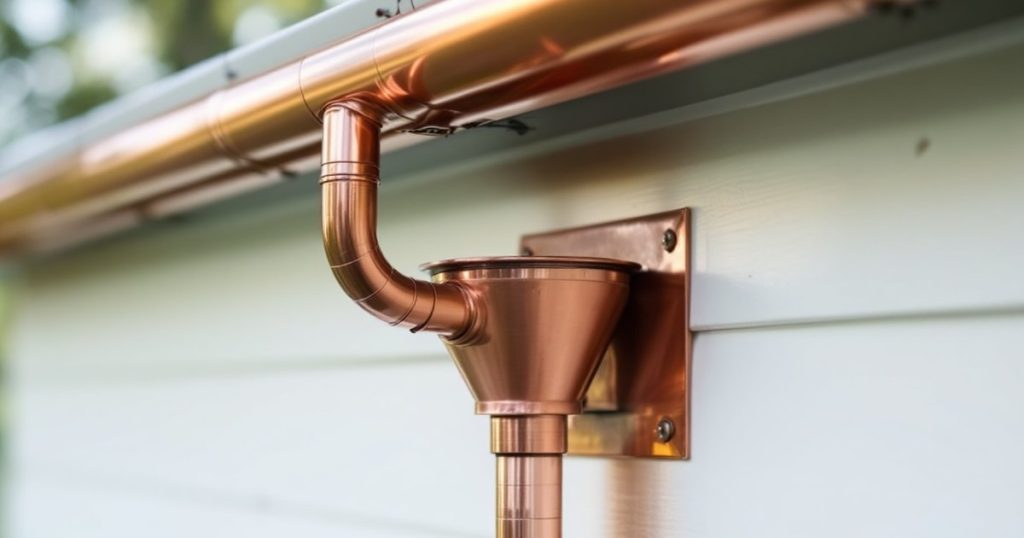
A conductor head, also called a leader head, is an open-top metal box mounted at the top of a downspout that catches water from a scupper or gutter and funnels it into the pipe. The National Roofing Contractors Association (NRCA) glossary defines it as “an enlargement or catch basin at the top of a downspout or leader to receive rainwater from a gutter or scupper.” Most are sheet metal (copper, aluminum, galvanized steel, Galvalume, or zinc), and at named U.S. retailers in October 2026 they list from about $80 for a plain aluminum box to more than $1,300 for an ornamental copper head.
Almost every page ranking for this term is a product listing. This guide pulls the sizing rules that the listings leave out from two published specifications, the Copper Development Association (CDA) Copper in Architecture Design Handbook and the federal Unified Facilities Guide Specification UFGS 07 60 00, and lines them up against what retailers actually sell and charge.
Key numbers at a glance
These are the figures that decide whether a conductor head works or overflows: how much wider it must be than the scupper feeding it, how deep its opening should be, the minimum metal weight, and what one costs. Each row names its source. Retail prices were checked on October 8, 2026 and can change, so treat them as a range rather than a quote.
| Figure | Value | Source |
|---|---|---|
| Head width vs. scupper width | At least 2 in. wider than the scupper | CDA Design Handbook, Detail 10.5C; UFGS 07 60 00, 3.1.21 |
| Depth of the top opening | Two-thirds of the conductor head width | UFGS 07 60 00, 3.1.21 |
| Rim height (head without overflow) | Set 1 in. below the scupper | CDA Design Handbook, Detail 10.5D |
| Minimum copper weight | 16 oz. per sq. ft. | CDA Design Handbook, 10.5C; UFGS 07 60 00, Table I |
| Minimum aluminum thickness | 0.032 in. | UFGS 07 60 00, Table I |
| Outlet tube length | Not less than 4 in. | UFGS 07 60 00, 2.2.18 |
| Retail price, one head | About $80 (plain aluminum) to $1,367 (ornamental copper) | GutterAll; K&M Sheet Metal; Gutter Supply listings, Oct. 2026 |
What is a conductor head?
A conductor head is the collection box between a roof outlet and a downspout. Water arrives from a through-wall scupper, a gutter outlet, or an upper downspout, drops into the open top of the box, and leaves through an outlet tube in the bottom that slips into the downspout. The box absorbs surges the pipe cannot take instantly, so water rises inside the head instead of spilling down the wall.
Wikipedia’s entry on leader heads notes that the open top keeps air entering the system, which helps water move faster through the downspout, and that some heads take more than one downspout or have several gutters converging on them. Englert, a gutter manufacturer, describes its aluminum leader head the same way: the wide opening helps water flow faster through downspouts in heavy rain.
Conductor head, leader head, scupper box: are they the same part?
Yes, in most U.S. usage these names describe the same part. Suppliers use conductor head, leader head, collector box, and collection box interchangeably; Gutter Supply’s category copy calls them “conductor heads, also known as leader heads or collector boxes,” and A.J.’s Gutters adds “scupper boxes.” Wikipedia notes the Australian term is rainhead, and British suppliers commonly say hopper head or rainwater head.
“Scupper box” causes the most confusion, because some contractors use it for the metal liner inside a scupper opening rather than the box on the wall outside. Our scupper drain guide explains that split, so ask which one a quote covers.
Why is it called a “conductor” or “leader” head?
The names come from plumbing terms for the pipe below it. The International Plumbing Code (IPC), as quoted in Connecticut Department of Consumer Protection code training, defines a conductor as “a pipe inside the building that conveys storm water from the roof to a storm or combined building drain” and a leader as “an exterior drainage pipe for conveying storm water from roof or gutter drains to an approved means of disposal.” The head sits on top of that pipe.
That is also the answer to the common question about a downspout versus a leader. On a house they usually mean the same exterior pipe; in code language, “leader” is the formal word for an exterior storm pipe, and “conductor” is the interior one.
When do you need a conductor head?
You need a conductor head when water arrives at a point faster or wider than a downspout can accept it directly: a scupper through a parapet, two or more gutters or downspouts meeting, an upper roof draining onto a lower one, or a facade where the head is an architectural feature. A plain gutter run with a standard drop outlet usually does not need one.
The CDA Design Handbook (Section 10.5) says scuppers can carry water into gutters or “directly into downspouts through conductor heads,” and that when neither a head nor a gutter is used, the scupper spout should extend past the building face so it does not wet the wall. It also says overflow scuppers do not require conductor heads and downspouts, because their job is to discharge visibly when the primary outlet clogs.
Which situation calls for which setup?
| Situation | Recommended setup | Why | Source |
|---|---|---|---|
| Primary scupper through a parapet, wall below | Conductor head plus downspout | Head catches the full scupper discharge and feeds the pipe | CDA 10.5C and 10.5D |
| Scupper with no head or gutter | Extended scupper spout | Spout must project past the wall face to avoid wetting it | CDA 10.5 |
| Overflow (secondary) scupper | Usually no head or downspout | Flows only when the primary scuppers clog | CDA 10.5E |
| Heavy snow, ice, or leaf debris | Conductor head with an overflow opening | Gives water a way out when the outlet tube freezes or clogs | CDA 10.5 |
| Two gutters or downspouts meeting | One head receiving both | Some heads are built to take more than one inflow | Wikipedia, Leader head |
| Historic or high-end facade | Decorative copper or zinc head | Heads have long carried ornamental detail | Wikipedia; CopperCraft catalog |
| Rainwater harvesting | Head with a leaf screen above the tank line | Directs water toward a cistern while screening debris | Wikipedia, Leader head |
For the scupper-versus-gutter decision on a flat roof itself, see scuppers vs. gutters on a flat roof. Overflow placement and sizing are covered in overflow scupper code requirements.
How to size a conductor head
Size a conductor head from the opening that feeds it and the downspout below it. Two published specifications agree on the core rule: the head should be at least 2 inches wider than the scupper (CDA Detail 10.5C; UFGS 07 60 00, 3.1.21). UFGS adds that the depth of the top opening should equal two-thirds of the head’s width, and the outlet must match the downspout size.
The Sheet Metal and Air Conditioning Contractors’ National Association (SMACNA) Architectural Sheet Metal Manual (7th edition, 2012) is the trade reference for gutter, scupper, and conductor head details, and UFGS 07 60 00 cites it as SMACNA 1793. Its detail pages are sold rather than published free, so the figures below come from the CDA and UFGS documents, which are public. Your project drawings or local code may set different values.
Conductor head sizing by scupper width
This worked table applies the two published rules to common scupper widths. The minimum head width adds 2 inches to the scupper width; the target opening depth is two-thirds of that head width. A larger head than the minimum is fine and gives more surge capacity.
| Scupper opening width | Minimum conductor head width | Target top-opening depth | Rule source |
|---|---|---|---|
| 4 in. | 6 in. | 4 in. | CDA 10.5C (width); UFGS 3.1.21 (depth) |
| 6 in. | 8 in. | About 5 1/3 in. | CDA 10.5C; UFGS 3.1.21 |
| 8 in. | 10 in. | About 6 2/3 in. | CDA 10.5C; UFGS 3.1.21 |
| 10 in. | 12 in. | 8 in. | CDA 10.5C; UFGS 3.1.21 |
| 12 in. | 14 in. | About 9 1/3 in. | CDA 10.5C; UFGS 3.1.21 |
Checked against stock parts, Gutter Supply lists its Standard Leader Head at 12 3/4 in. wide by 8 in. deep, a depth-to-width ratio of about 0.63, close to the UFGS two-thirds rule. Under the 2-inch rule, that head suits a scupper up to about 10 3/4 in. wide. Its Federal Conductor Head lists at 12 7/8 in. wide by 8 1/8 in. deep. For wider scuppers, look at larger commercial profiles or a shop-fabricated head sized to the opening.
Matching the outlet to the downspout
The outlet tube in the bottom of the head must fit the downspout below it, and the downspout must be sized for the roof area it drains. CDA Table 10.7A lists the cross-sectional area of standard downspouts, which is the number that sets how much water each size can carry. Heads are sold with outlets for specific downspout sizes, so pick the downspout first and the head second.
| Downspout | Cross-section area | Area relative to a 2 x 3 | Source |
|---|---|---|---|
| 2 x 3 in. plain rectangular | 6.00 sq. in. | 1.0x | CDA Table 10.7A |
| 3 in. plain round | 7.07 sq. in. | 1.2x | CDA Table 10.7A |
| 3 x 4 in. plain rectangular | 12.00 sq. in. | 2.0x | CDA Table 10.7A |
| 4 in. plain round | 12.57 sq. in. | 2.1x | CDA Table 10.7A |
| 5 in. plain round | 19.63 sq. in. | 3.3x | CDA Table 10.7A |
| 4 x 6 in. plain rectangular | 24.00 sq. in. | 4.0x | CDA Table 10.7A |
| 6 in. plain round | 28.27 sq. in. | 4.7x | CDA Table 10.7A |
Retail heads are built around these sizes. K&M lists its Standard head for 2 x 3, 3 x 4, or 4 x 5 downspouts and its Basic Small with 2 x 3 and 3 x 4 oval outlets; Gutter Supply offers 3 in. and 4 in. outlet options; Berger’s #14 conductor head comes with 3, 4, 5, and 6 in. oval outlets in 16 oz. copper or 26 ga. galvanized steel. In the CDA table, corrugated downspouts carry less area than plain ones of the same nominal size.
A 3 x 4 rectangular downspout carries twice the area of a 2 x 3 (12.00 vs. 6.00 sq. in.), so stepping up one size often does more for a head that keeps overflowing than a bigger box does. How many downspouts a roof needs and where they go is covered in our downspout placement and sizing guide, and the flat-roof version in flat roof downspout sizing. Leader size is ultimately set by the IPC sizing tables your jurisdiction adopts.
Conductor head materials compared
Choose a conductor head in the same metal as the downspout below it; UFGS 07 60 00 (2.2.18) calls for conductor heads and screens “in the same material as downspouts.” Matching metals avoids galvanic corrosion where they touch and keeps the finish consistent. Copper is the premium choice; aluminum and painted steel cover most residential and commercial work.
| Material | Weights or gauges offered | Typical use | Source |
|---|---|---|---|
| Copper | 16 oz. (CDA and UFGS minimum) and 20 oz. | Copper gutter systems, historic and high-end facades | CDA 10.5C; UFGS Table I; DMI; Metal Roofing Systems |
| Aluminum (painted or mill finish) | 0.027 in. (K&M), 0.032 in. (UFGS minimum), 0.040 and 0.050 in. | Residential aluminum gutters, color-matched trim | K&M spec sheet; UFGS Table I; DMI |
| Galvanized steel | 26 ga. (Berger), 24 ga. (K&M), 20 ga. HDG-90 (DMI) | Paint-grade and budget commercial work | Berger; K&M; DMI |
| Galvalume | 22 and 24 ga. | Commercial roofs with matching Galvalume trim | DMI; Metal Roofing Systems |
| Stainless steel | 0.015 in. (UFGS minimum) | Projects that specify stainless trim | UFGS Table I; K&M spec sheet (2B 304) |
| Zinc, lead-coated copper, Freedom Gray | Varies by supplier | Matching zinc or coated-copper roofs and gutters | K&M; CopperCraft; A.J.’s Gutters |
If you are pairing a head with a copper system, the hanger, fastener, and soldering rules in our copper gutters guide apply to the head as well. Metal Roofing Systems and DMI both offer painted heads in PVDF finishes (Kynar 500 and DynaClad), and DMI lists more than 32 colors for its Galvalume and aluminum heads.
Conductor head styles
Conductor head styles range from a plain tapered box to ornamental pieces, and the style changes price far more than it changes performance. Many styles are offered for round or rectangular downspouts (CopperCraft notes it depends on the model), and Gutter Supply, DMI, and Metal Roofing Systems all describe their heads as custom fabricated, so allow for lead time. Wikipedia notes heads come in square, round, hexagonal, and other shapes.
- Standard or basic box: a straight-sided, tapered box. K&M’s Basic Small and Standard and Gutter Supply’s Standard Leader Head are examples.
- Federal: a box with a curved (concave) bottom. K&M’s Residential head uses the Federal profile with a convex bottom instead.
- Commercial or industrial: simple profiles offered for larger downspouts. K&M says its Commercial head “allows for larger size downspout options”; Gutter Supply sells an Industrial Conductor Head.
- Corner: corner-mounted heads such as Gutter Supply’s Standard Corner Leader Head, listed at $490.91 in its copper category. Our rain chain without a gutter guide uses a corner leaderhead as the collection point.
- Decorative: ornamental heads such as Fleur-de-Lis, Medieval, Chancellor, and Wilshire at Gutter Supply. CopperCraft lists 23 styles with details such as rosettes, geometric patterns, and scrollwork.
- Overflow cut-out: any profile with a built-in overflow slot, an option Metal Roofing Systems lists for its custom heads and the CDA recommends where ice, snow, or debris are heavy.
How much does a conductor head cost?
A single conductor head costs about $80 to $310 at named retailers for aluminum, galvanized steel, Galvalume, or zinc, and about $210 to $1,370 for copper, based on listings checked October 8, 2026. Price tracks metal and ornament more than size: Gutter Supply’s Copper Federal Conductor Head lists at $209.76 while its ornate copper Medieval head lists at $1,366.75.
| Retailer and product | Material | Listed price | Notes |
|---|---|---|---|
| GutterAll Aluminum Gutter Leader Head, Collection Box (regular) | Aluminum, 25+ colors | $79.99 | Residential size |
| K&M Sheet Metal Basic Small Conductor Head | Copper, aluminum, steel, zinc | From $154.95 | Price varies by material; 2 x 3 and 3 x 4 outlets |
| K&M Sheet Metal Standard Conductor Head | Copper, aluminum, steel | From $169.95 | Fits 2 x 3, 3 x 4, or 4 x 5 downspouts |
| K&M Sheet Metal Commercial Conductor Head | Copper, Galvalume, aluminum, zinc, steel | From $184.95 | Built for larger downspouts |
| K&M Sheet Metal Residential Conductor Head | Copper, aluminum, steel | From $276.95 | Federal profile, convex bottom |
| Gutter Supply Federal Conductor Head | Painted aluminum | $173.13 | 12 7/8 in. wide; 3 or 4 in. outlet |
| Gutter Supply Standard Leader Head | Painted aluminum | $174.38 | 12 3/4 in. wide x 8 in. deep |
| Gutter Supply Standard Leader Head | Galvanized steel | $190.00 | Galvanized version of the same profile |
| Gutter Supply Preweathered Zinc Leader Head | Zinc | $307.02 | Pre-weathered finish |
| Gutter Supply Copper Standard Leader Head | 16 oz. copper | $219.51 | 3 or 4 in. outlet |
| Gutter Supply Medieval Conductor Head | Copper | $1,366.75 | Most expensive copper style listed |
These are part prices only, before shipping and installation. Labor depends on wall type, height, and whether a scupper must be cut or soldered, so get an itemized quote. Our scupper drain guide breaks out installed costs for a complete scupper, head, and downspout assembly.
How to install a conductor head
Installing a conductor head means locating it under the inflow, setting its rim at the right height, fastening it to the wall, joining the scupper or gutter to it, and seating the outlet tube in the downspout. The steps below follow CDA Details 10.5C and 10.5D and UFGS 07 60 00. Work at height and on parapets carries fall risk; many owners hire a roofer or sheet metal contractor for it.
- Confirm the inflow and the downspout size. Measure the scupper opening width (or the gutter outlet) and choose the downspout from the roof area it drains, then order a head with a matching outlet.
- Pick a head at least 2 inches wider than the scupper. Check that its top-opening depth is close to two-thirds of its width, per UFGS 07 60 00. Specify an overflow opening in heavy snow, ice, or leaf areas.
- Set the elevation. For a head without an overflow opening, the CDA says to set the rim 1 inch below the scupper, so a full head spills over its own rim instead of backing water up through the scupper.
- Fasten the head to the wall. On masonry, use masonry fasteners (CDA 10.5D; UFGS 3.1.21); A.J.’s Gutters describes mortar plugs on brick or stone and stainless steel screws on wood. At a gravel stop, the CDA shows the head attached to the wood nailer through the fascia.
- Join the scupper to the head. In copper work, the CDA details the scupper spout locked and soldered to the back edge of the head, with all joints between scupper, head, downspout, and fascia soldered. Follow the manufacturer’s joining method for aluminum or painted steel.
- Seat the outlet tube in the downspout. UFGS calls for an outlet tube at least 4 inches long. Strap the downspout to the wall with straps in the same metal.
- Fit the screen and water-test. UFGS says to fasten screens securely to heads. Run a hose into the scupper or gutter at full flow and watch for spill over the rim and leaks at the back seam.
Conductor head maintenance and common problems
Most conductor head failures are clogs at the outlet tube, where leaves and roof grit settle in the bottom of the box. A head that overflows in moderate rain usually has a blocked outlet or an undersized downspout, not a box that is too small. Clear the head when you clean gutters, and after storms that drop leaves or hail.
- Overflow at the rim: check the outlet tube and downspout for a clog first, then compare the downspout area against the roof area it serves.
- Water running down the wall behind the head: the scupper may be landing behind the back edge, or the back seam has opened. The 2-inch-wider rule exists so the head catches the full discharge width.
- Ice blocking the outlet: in freezing climates, a head with an overflow opening sends water clear of the wall instead of over the roof edge, which is why the CDA recommends that option.
- Corrosion where metals meet: a copper head on an aluminum or galvanized downspout puts dissimilar metals in contact. UFGS 07 60 00 avoids this by calling for heads in the same material as the downspouts.
Frequently asked questions
What is a conductor head?
A conductor head is an open-top box at the top of a downspout that catches water from a gutter or scupper and funnels it into the pipe. The NRCA glossary calls it “an enlargement or catch basin at the top of a downspout or leader.” It absorbs surges the downspout cannot take at once, lets air into the system, and is often a decorative feature on the facade.
What is a leader head in roofing?
A leader head is another name for a conductor head: the collection box at the top of a downspout that receives water from a scupper or gutter. “Leader” is the plumbing-code term for an exterior storm pipe, so a leader head is the head of that pipe. Suppliers including Gutter Supply and K&M Sheet Metal use leader head and conductor head interchangeably.
What is a gutter head?
“Gutter head” is an informal name for a conductor or leader head, the box that collects water from a gutter or scupper and feeds a downspout. Retailers more often list the part as a conductor head, leader head, collector box, or collection box, so search those terms when shopping. A single head can serve more than one gutter where runs meet.
What is another word for a leader head?
Common alternatives are conductor head, collector box, collection box, and scupper box in the U.S., rainhead in Australia, and hopper head or rainwater head in British usage. “Scupper box” can also mean the metal liner inside a scupper opening, so confirm which part a supplier or contractor means before ordering.
What’s the difference between a downspout and a leader?
On most homes there is no practical difference: both name the vertical pipe that carries roof water to the ground. In the International Plumbing Code, a leader is “an exterior drainage pipe for conveying storm water from roof or gutter drains to an approved means of disposal,” while a conductor is the equivalent pipe inside the building. A downspout is an exterior leader.
What is a leader on a roof?
A leader is the pipe that carries water down from a roof outlet, the same part most homeowners call a downspout. It connects to a gutter outlet directly or to a conductor head under a scupper. The International Plumbing Code uses “leader” for exterior storm pipes and sets leader sizes from roof area and local rainfall rate in its sizing tables.
What are the parts of a gutter called?
A gutter system includes the gutter trough, end caps, miters at corners, hangers or brackets, the drop outlet, the downspout (leader), elbows, and a splash block or extension at grade. Where a scupper or several gutters feed one pipe, a conductor head sits at the top of the downspout. Our gutter parts diagram labels each piece.
How much bigger than the scupper should a conductor head be?
At least 2 inches wider than the scupper opening, according to both the Copper Development Association Design Handbook (Detail 10.5C) and the federal UFGS 07 60 00 specification. UFGS also sets the depth of the top opening at two-thirds of the head’s width. For a 6-inch scupper, that means a head at least 8 inches wide with an opening about 5 1/3 inches deep.