
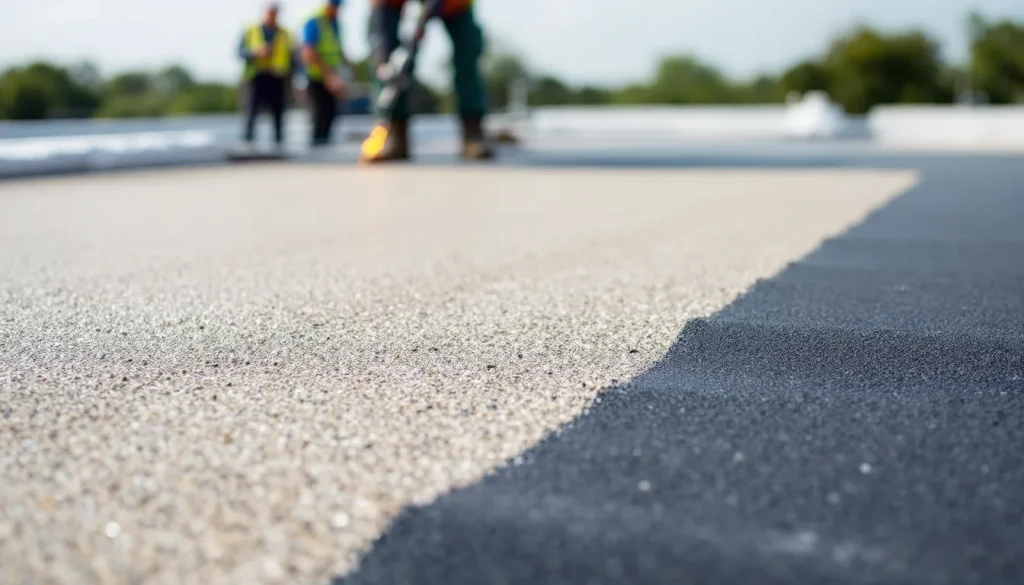
A modified bitumen roof is an asphalt-based membrane modified with SBS or APP polymers to add flexibility and durability. The 2026 installed cost ranges from $4 to $8 per square foot, lifespan averages 20 to 30 years, and it remains the go-to choice for low-slope commercial and residential applications where puncture resistance matters more than reflectivity. The category dominated commercial roofing from the 1980s through the early 2000s before TPO took the volume share, but it has held a steady commercial restoration and re-cover market on substrates where seam integrity is the priority. Here is how it compares to TPO, EPDM (see our EPDM rubber membrane pricing), and built-up systems, and when it remains the right choice.
The short version
- Modified bitumen is asphalt membrane modified with SBS (cold-flexible) or APP (heat-stable) polymers.
- Installed cost: $4 to $8 per square foot. Lifespan: 20 to 30 years typical.
- Installation methods: torch-down, cold-applied adhesive, hot-mopped asphalt, self-adhered peel-and-stick.
- Best use case: low-slope commercial and residential where puncture resistance, foot traffic tolerance, or seam reliability is the priority.
- ASTM D6162 (SBS) and ASTM D6222 (APP) are the master performance standards.
- Major manufacturers: Firestone, GAF, Johns Manville, Soprema, Polyglass, Carlisle.
The Short Answer: Modified Bitumen Use Cases Plus Cost
Modified bitumen (MB or mod-bit) is one of the most established low-slope roofing systems in the US commercial market and the dominant low-slope residential system before the TPO and EPDM eras took the volume share. The product is asphalt-based, modified with SBS (styrene-butadiene-styrene) rubber polymer or APP (atactic polypropylene) plastic polymer to deliver flexibility, UV resistance, and durability that pure asphalt cannot achieve.
The 2026 installed cost for a 2-ply modified bitumen system on a typical commercial roof runs $4 to $8 per square foot depending on installation method, manufacturer, and warranty. SBS modified bitumen with granular cap sheet on a 25,000 square foot commercial substrate typically costs $5.50 to $7.50 per square foot installed. The lifespan ranges from 20 years for entry-level single-ply MB to 30 years for premium 2-ply systems with proper maintenance.
The right use case for modified bitumen in 2026: low-slope commercial buildings where puncture resistance matters (HVAC equipment, foot traffic, debris exposure), residential low-slope additions, garage roofs, mobile home replacements, and any application where the lap seams in single-ply TPO or EPDM are a concern. The wrong use case: steep-slope residential where shingle is the standard, ultra-high-reflectance cool roof applications where white TPO or coating is preferred, and projects where weight is a structural concern.
What “Modified Bitumen” Actually Means
The “bitumen” in modified bitumen refers to asphalt, the same material in conventional built-up roofing and asphalt shingles. Pure asphalt becomes brittle at low temperatures and softens at high temperatures, limiting its useful temperature range. The “modified” prefix means the asphalt has been blended with a polymer modifier that broadens the useful temperature range and adds flexibility, elasticity, and durability.
The two main polymer modifiers are SBS (styrene-butadiene-styrene) and APP (atactic polypropylene). SBS is a rubber-like elastomer that delivers high cold-flexibility (the membrane stays flexible at -20 F), making SBS the preferred choice for cold climates. APP is a thermoplastic that softens at higher temperatures, making it the preferred choice for hot climates and for torch-down installation methods. Both modifiers add UV stability, tear resistance, and tensile strength compared to unmodified asphalt.
The membrane itself is multi-layer: a polyester or fiberglass reinforcement mat saturated with the modified bitumen compound, with a surface finish that varies by application (granular, smooth, foil, or sand). Total membrane thickness ranges from 60 to 180 mils (0.060 to 0.180 inches) depending on product.
SBS Modified Bitumen: The Flexible Cold-Climate Option
SBS modified bitumen dominates the US cold-climate commercial market. The styrene-butadiene-styrene rubber polymer delivers cold-flex performance below -20 F, making SBS the practical choice for any building north of the Mason-Dixon line. The membrane stays flexible through winter, resists thermal shock cracking, and withstands the building movement that destroys less-flexible membranes.
SBS membranes install via cold-applied adhesive, hot-mopped asphalt, or self-adhered (peel-and-stick) methods. Torch-down is technically possible but is more commonly used with APP. The cold-applied and self-adhered methods are growing market share because they eliminate open-flame torch risks and reduce installation labor.
Major SBS product lines include Firestone APP-Modified Bitumen SBS (note: branding can be confusing), GAF Ruberoid SBS, Johns Manville DynaLastic SBS, Soprema Sopralene SBS, Polyglass Polyflex SBS, and Carlisle Polar Cap SBS. The premium 2-ply SBS systems with granular cap sheet carry 25 to 30 year manufacturer warranties.
APP Modified Bitumen: The Heat-Stable Hot-Climate Option
APP modified bitumen is the dominant choice in hot climates (Florida, Texas, Gulf Coast, Southwest) where the higher heat stability matters more than cold flexibility. APP is a thermoplastic polymer that softens at the heat of a torch, making it the standard chemistry for torch-down installation. Once cured, APP membranes resist UV degradation and high-temperature deformation better than SBS in extreme heat.
APP membranes install primarily via torch-down (propane torch fusing the membrane to the substrate), though cold-applied adhesive and self-adhered APP products exist. The torch-down method is the fastest and most established installation, but it carries genuine fire risk that has driven insurance markets and some local codes to restrict it.
Major APP product lines include GAF Ruberoid APP, Johns Manville DynaWeld APP, Soprema Sopralast APP, Polyglass Polyflex APP, Carlisle CCW MiraDRI APP, and Firestone APP-Modified Bitumen. Like SBS, the premium 2-ply systems with granular cap sheet carry 25 to 30 year manufacturer warranties.
Cost: Materials Plus Labor by Installation Method
| Installation Method | Material Cost (per sq ft) | Labor Cost (per sq ft) | Total Installed |
|---|---|---|---|
| 2-ply hot-mopped (BUR-style) | $1.80 to $2.50 | $2.50 to $3.50 | $4.30 to $6.00 |
| 2-ply cold-applied adhesive | $2.20 to $3.00 | $2.20 to $3.20 | $4.40 to $6.20 |
| 2-ply torch-down (APP) | $1.80 to $2.50 | $2.50 to $3.80 | $4.30 to $6.30 |
| 2-ply self-adhered (peel-and-stick) | $2.50 to $3.50 | $2.00 to $3.00 | $4.50 to $6.50 |
| 3-ply premium system w/ insulation | $3.50 to $5.00 | $3.00 to $4.00 | $6.50 to $9.00 |
The installation method significantly affects total cost and project timeline. Torch-down is typically the fastest method (highest crew productivity) but carries the highest fire insurance load and is restricted by some local jurisdictions. Self-adhered is the safest method (no open flame, no hot kettle) but commands a material price premium. For complete cost analysis across roof systems see how much does a new roof cost.
Torch-Down Installation: The Classic Method
Torch-down is the original modified bitumen installation method and remains the most common installation for APP membranes in the southern US commercial market. A propane torch heats the underside of the membrane roll as it is unrolled across the substrate. The heated bitumen fuses to the substrate primer, creating a fully adhered, monolithic membrane.
Torch-down installation is fast (a 2-person crew can install 1,500 to 3,000 square feet per day on a typical commercial substrate) and produces high-quality watertight seams. The seam quality is the primary advantage of MB over single-ply systems: the heat-fused seams are mechanically integrated with the membrane sheets, eliminating the lap-failure modes that affect TPO and EPDM seams.
The disadvantage is fire risk. Open-flame work in the field has caused numerous building fires over the decades, leading some insurance carriers to refuse coverage for torch-down work and some jurisdictions (notably NYC, Chicago, San Francisco) to restrict it. The NRCA torch safety guidelines require: 1-hour fire watch after final torch use, fire extinguishers within reach at all times, hot work permits where required, and weekly safety training for torch-using crews.
Cold-Applied Adhesive Installation
Cold-applied adhesive installation eliminates the open flame by using either a single-component asphalt adhesive or a two-component urethane adhesive to bond the membrane to the substrate. The adhesive is rolled, sprayed, or brushed onto the substrate; the membrane is rolled out and pressed into the adhesive; the seams are similarly bonded with adhesive applied to the lap area.
Cold-applied installation is slower than torch-down (about 60 to 75 percent of torch-down crew productivity) but carries no fire risk, no insurance restrictions, and significantly lower hazard exposure for the crew. The adhesive systems are sensitive to substrate temperature (some have lower temperature limits around 40 F) and to humidity. Cured adhesive systems typically take 24 to 48 hours to reach full bond strength.
The major cold-applied adhesive product lines include GAF MB Cold Adhesive, Henry MB-15, and Firestone CSA-203. Cost premium over torch-down is typically 10 to 20 percent due to material cost and slightly slower installation. The fire risk reduction justifies the premium for many projects.
Self-Adhered (Peel-and-Stick) Installation
Self-adhered modified bitumen is the newest installation method and the fastest-growing category in 2026. The membrane has a peel-off release liner on the underside revealing a factory-applied adhesive. The installer pulls the liner and presses the membrane to the substrate.
The advantages: no flame (safest method), no adhesive mixing or application (faster than cold-applied), and excellent first-strike adhesion. The disadvantages: material cost premium of 20 to 30 percent over torch-down or hot-mopped methods, temperature sensitivity (most self-adhered products require 50 F minimum ambient and substrate temperature), and the requirement for thoroughly cleaned and primed substrate.
Major self-adhered product lines include GAF Liberty SBS Self-Adhered, Firestone APP-180 Self-Adhered, Henry Blueskin SA, Soprema Soprastick, and Carlisle CCW MiraDRI Self-Adhered. The self-adhered category is the dominant choice for re-cover applications over sound existing substrates where speed and safety matter more than cost.
Lifespan: 20 to 30 Years Typical
Modified bitumen lifespan varies by system specification, climate, and maintenance. Single-ply MB on residential or light commercial applications typically delivers 15 to 20 years. 2-ply MB on commercial applications delivers 20 to 30 years. Premium 2-ply or 3-ply systems with granular cap sheet and proper maintenance can reach 30 to 35 years.
The failure modes for MB at end of life: granule loss exposing the asphalt to UV (UV degrades the modifier polymer over 20+ years), seam failure (much rarer than in single-ply systems but possible at penetrations and laps), and membrane shrinkage at penetrations as the asphalt loses volatiles. None of these are typically catastrophic; MB tends to fail gradually with growing maintenance demand rather than sudden total failure.
The lifespan can be materially extended by topcoat application at year 15 to 20 (aluminum-pigmented asphalt emulsion, acrylic, or silicone elastomeric coating). See elastomeric roof coating for coating options. A properly applied silicone topcoat can extend MB lifespan by 10 to 15 years at significantly less cost than full replacement. For roof lifespan generally see how long does a roof last.
Modified Bitumen vs TPO
| Property | Modified Bitumen | TPO |
|---|---|---|
| Installed cost (per sq ft) | $4 to $8 | $5 to $9 |
| Lifespan | 20 to 30 years | 15 to 25 years |
| Seam strength | Excellent (heat-fused) | Good (hot-air welded, depends on weld quality) |
| Foot traffic tolerance | Excellent | Moderate |
| Puncture resistance | Excellent | Moderate |
| UV reflectance (white) | Lower (granular surface) | Higher (smooth white) |
| Cool roof rating | Available with aluminum surface | Standard 70 to 88 percent reflectance |
| Weight per sq ft | 1.2 to 1.8 lbs (2-ply) | 0.4 to 0.6 lbs |
The choice between MB and TPO depends on the priority. TPO wins on initial cost, reflectance, weight, and energy savings in hot climates. MB wins on seam reliability, puncture resistance, foot traffic, and overall durability. For commercial roofs with rooftop HVAC equipment, frequent maintenance access, or storm-driven debris exposure, MB is generally the more conservative choice. For pure energy savings and lowest install cost, TPO is generally the choice. See TPO vs EPDM roofing for the single-ply membrane analysis.
Modified Bitumen vs EPDM
| Property | Modified Bitumen | EPDM |
|---|---|---|
| Installed cost (per sq ft) | $4 to $8 | $4 to $7 |
| Lifespan | 20 to 30 years | 20 to 30 years |
| Seam method | Heat-fused or adhesive | Splice tape or adhesive |
| Cold weather flexibility (SBS MB) | Excellent | Excellent |
| UV resistance (black EPDM) | Better with cap sheet | Excellent |
| Puncture resistance | Excellent | Moderate to good |
| Color options | Granular cap (various) | Black or white |
| Hot climate UV (white surface) | Available with aluminum or coating | White EPDM available |
EPDM and MB compete in similar markets with similar pricing. EPDM is the lighter, faster-to-install option that has dominated the cold-climate single-ply market. MB has stronger puncture and seam performance but adds weight and cost. The choice often comes down to contractor preference and regional installation practice; in the Northeast and Midwest, EPDM dominates. In the South and West, MB and TPO compete.
Modified Bitumen vs Built-Up Roof (BUR)
Built-up roofing (BUR) is the ancestor of modified bitumen. A BUR system consists of alternating layers of asphalt-saturated felt and hot-mopped asphalt, typically 3 to 5 plies, surfaced with a flood coat of asphalt and an embedded layer of gravel. BUR was the dominant commercial low-slope roofing from the 1920s through the 1970s.
Modified bitumen is the post-1970s evolution of BUR. The modifier polymer (SBS or APP) replaces some of the asphalt’s brittleness with flexibility, and the multi-ply system is consolidated into a single membrane sheet that installs faster. A 2-ply MB system delivers performance equivalent to a 4-ply BUR system at lower cost, lower installation labor, and less weight.
| Property | Modified Bitumen | BUR (4-ply) |
|---|---|---|
| Installed cost (per sq ft) | $4 to $8 | $6 to $11 |
| Lifespan | 20 to 30 years | 20 to 30 years |
| Installation labor | Lower (2-ply vs 4-ply) | Higher (multi-ply) |
| Weight | 1.2 to 1.8 lbs / sq ft | 5 to 8 lbs / sq ft |
| Repair complexity | Lower | Higher |
| Cold weather installation | Cold-applied option | Hot-asphalt only |
BUR remains in use for specific high-end commercial and institutional applications where its established history is valued, but the market has largely transitioned to MB. New BUR installations are typically reserved for re-cover scenarios over existing BUR substrates or for institutional projects with multi-decade ownership horizons.
Granular Cap Sheet vs Smooth Cap Sheet
Modified bitumen cap sheets come in granular surfaced and smooth surfaced varieties. Granular cap sheet has mineral granules embedded in the top surface (similar to asphalt shingle granules) that provide UV protection, fire resistance, and walkability. Smooth cap sheet has a smooth surface that is intended for subsequent coating with reflective acrylic, aluminum, or silicone.
Granular cap sheet is the standard for direct-exposure applications. The granules absorb UV that would otherwise degrade the underlying asphalt and polymer. Granular colors are available in white, gray, tan, brown, and various manufacturer-specific tones. White granular cap sheet delivers initial solar reflectance of 25 to 35 percent (much lower than smooth white TPO but adequate for many applications).
Smooth cap sheet is the standard for coating-protected applications. The smooth surface accepts elastomeric coatings (acrylic, silicone, polyurethane) cleanly. A smooth MB substrate with a silicone topcoat delivers initial solar reflectance of 85 to 90 percent, equivalent to white TPO. This combination is increasingly popular as an alternative to single-ply installations.
Wind Uplift and Storm Performance
Modified bitumen performs well in storm wind events when properly installed and adhered. Wind uplift ratings for typical 2-ply MB systems span FM I-90 (90 PSF uplift) to FM I-180 (180 PSF uplift) depending on the specific assembly and the attachment method. UL 580 Class 90 ratings are standard for adhered MB systems.
In hurricane zones, MB on hurricane-rated substrates and attached per Miami-Dade NOA passes the wind uplift requirements for HVHZ work. The combination of fully adhered MB, code-compliant fasteners, and properly flashed perimeters and penetrations delivers a system rated for sustained 150 mph wind. For complete hurricane roof system analysis see hurricane proof roof.
Post-storm field assessments after Hurricane Ian (2022), Hurricane Idalia (2023), and Hurricane Helene (2024) showed properly installed MB commercial roofs performing comparably to TPO and EPDM in the same windfields. The MB advantage in storm performance shows in punctured-not-failed scenarios: MB roofs with debris impact damage typically remain watertight in the field while damaged TPO seams can open up.
Manufacturer Comparison: Firestone, GAF, Johns Manville, Soprema
| Manufacturer | Flagship MB Line | Warranty Range | Market Position |
|---|---|---|---|
| Firestone Building Products (Holcim) | APP and SBS Modified Bitumen | 10 to 30 years | Largest commercial MB share |
| GAF | Ruberoid SBS, Ruberoid APP, Liberty SA | 10 to 30 years | Strong commercial and residential |
| Johns Manville (Berkshire Hathaway) | DynaLastic, DynaWeld, DynaKap | 10 to 30 years | Strong institutional and government |
| Soprema | Sopralene, Sopralast, Sopra-Crown | 10 to 30 years | French parent, premium positioning |
| Polyglass (Mapei) | Polyflex, Elastoflex, Polystick | 10 to 25 years | Italian parent, growing US share |
| Carlisle SynTec | CCW MiraDRI, Polar Cap | 10 to 30 years | Commercial roof system leader |
| Tremco WTI (RPM) | Tremco MB, BURmastic | 10 to 20 years | Service-tied installations |
| Mule Hide (ABC Supply) | SBS, APP, self-adhered | 10 to 20 years | Contractor channel focus |
The major manufacturers all offer similar product specifications meeting ASTM D6162 (SBS) and ASTM D6222 (APP). Brand selection is typically driven by contractor relationships, regional distribution, and warranty terms rather than product chemistry. The warranty length and coverage are the most important differentiators for owners: full system warranties (membrane plus insulation plus fasteners) from a single manufacturer typically carry stronger field support than individually warranted components.
When to Choose Modified Bitumen
Modified bitumen is the right choice in specific scenarios. The clear-cut cases:
- Commercial low-slope roof with rooftop HVAC, frequent foot traffic, or maintenance access (puncture and traffic resistance)
- Re-cover over existing BUR or MB substrate (excellent compatibility)
- Building owner with multi-decade ownership horizon (lifecycle cost vs single-ply)
- Project where lap seam reliability is the priority over reflectance (cold climates, storm-driven debris zones)
- Residential low-slope additions or garage roofs where ease of installation is less critical
- Roof with structural movement (SBS flexibility tolerates movement better than rigid systems)
Modified bitumen is the wrong choice for: pure energy-driven cool roof applications (TPO or coatings beat MB on reflectance), steep-slope residential where shingle is the standard, projects where weight is a structural concern, and budget-constrained projects where single-ply TPO at lower install cost may be acceptable.
Frequently Asked Questions
How long does a modified bitumen roof last?
20 to 30 years for typical 2-ply systems on commercial applications. Single-ply MB on residential applications typically delivers 15 to 20 years. Premium systems with proper maintenance can reach 30 to 35 years.
What is the cost of a modified bitumen roof per square foot?
$4 to $8 per square foot installed in 2026. Hot-mopped and torch-down methods at the lower end; self-adhered and 3-ply premium systems at the upper end.
Is modified bitumen better than TPO?
Depends on priorities. MB wins on seam reliability, puncture resistance, and foot traffic tolerance. TPO wins on reflectance, weight, and initial install cost. For commercial roofs with rooftop equipment, MB. For pure energy savings, TPO. See TPO vs EPDM roofing.
What is the difference between SBS and APP modified bitumen?
SBS is rubber-modified for cold-flex performance (excellent in cold climates). APP is plastic-modified for heat stability (preferred in hot climates and for torch-down installation). SBS handles cold better; APP handles heat and torch-down better.
Can modified bitumen be installed in cold weather?
Yes for cold-applied adhesive and hot-mopped methods (substrate temperature must remain above the adhesive’s specified minimum, typically 40 F). Torch-down works in any temperature. Self-adhered methods require warmer substrate temperatures (typically 50 F minimum).
Does modified bitumen need a coating?
Not required for service life, but a topcoat applied at year 15 to 20 can extend lifespan by 10 to 15 years. Aluminum-pigmented asphalt emulsion is the traditional choice; silicone or acrylic elastomeric is increasingly common. See elastomeric roof coating.
Is torch-down installation safe?
Properly performed with safety protocols (1-hour fire watch, fire extinguishers, hot work permits), yes. But torch-down has caused building fires when corners are cut. Cold-applied and self-adhered methods eliminate the fire risk entirely.
Can I install modified bitumen over an existing roof?
Yes for re-cover applications where the existing substrate is sound. Self-adhered MB is particularly well-suited for re-cover over existing BUR or MB substrates. Most local codes allow up to 2 layers of roofing on a typical commercial structure before requiring tear-off.