
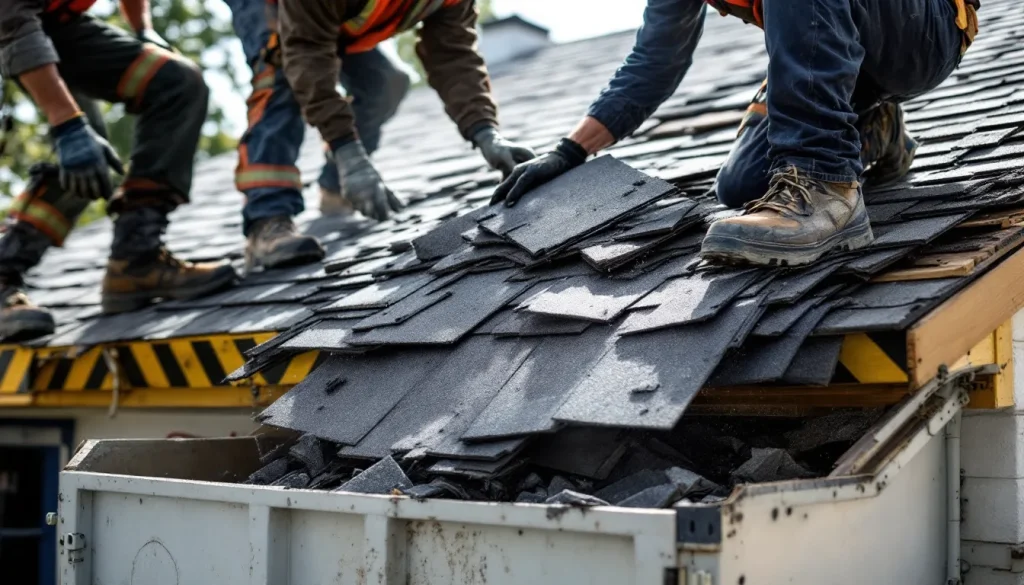
Tear off roof cost in 2026 averages $1 to $3 per square foot ($100 to $300 per 100 sq ft “square”) for asphalt shingles, making a typical 2,400 sq ft residential tear off $2,400 to $7,200 by itself before any new roofing material goes on. Two layer tear off (when an old reroof was installed over an existing roof) roughly doubles that to $5,000 to $14,000. Add $300 to $800 for the dumpster, $200 to $600 for the permit, and a likely $1,500 to $5,000 surprise for rotted roof decking discovered during the tear off, and the all in tear off portion of a full reroof is typically $4,500 to $20,000 of a project total before any new shingles or metal go on top. Here is the complete cost breakdown.
The short version
- Asphalt tear off runs $1 to $3 per square foot in 2026. Metal and tile tear off runs $2 to $5 per square foot due to weight and handling.
- Two layer tear off (overlay being removed) roughly doubles single layer cost because the labor is doubled and the dumpster is doubled.
- Dumpster fees run $300 to $800 for a typical residential tear off. Permits run $200 to $600 depending on jurisdiction.
- IRC R908 allows up to 2 layers of asphalt shingles, but many local codes prohibit overlay entirely. Overlay also voids most manufacturer warranties.
- Expect a 5 to 15 percent decking replacement surprise on most older roofs.
- Bundled with new roof, tear off is often priced as a line item but rarely discounted heavily versus standalone.
Short answer: tear off cost per square foot
Tear off (see our tear-off and reroof pricing) pricing in 2026 by material and layer count:
| Existing roof | Single layer per sq ft | Two layer per sq ft | 2,400 sq ft total (single) |
|---|---|---|---|
| 3 tab asphalt | $1.00 to $2.25 | $2.00 to $4.25 | $2,400 to $5,400 |
| Architectural asphalt | $1.25 to $2.75 | $2.50 to $5.25 | $3,000 to $6,600 |
| Wood shake / shingle | $1.75 to $3.50 | n/a | $4,200 to $8,400 |
| Standing seam metal | $2.00 to $4.50 | n/a | $4,800 to $10,800 |
| Corrugated metal | $1.75 to $3.75 | n/a | $4,200 to $9,000 |
| Concrete tile | $3.00 to $5.50 | n/a | $7,200 to $13,200 |
| Clay tile | $3.50 to $6.50 | n/a | $8,400 to $15,600 |
| Slate | $4.00 to $8.00 | n/a | $9,600 to $19,200 |
| Built up roof (BUR) | $2.50 to $5.00 | n/a | $6,000 to $12,000 |
| Single ply (TPO, EPDM) | $1.50 to $3.00 | n/a | $3,600 to $7,200 |
What tear off includes
A standard residential tear off line item includes removing the existing shingles, underlayment, drip edge, ridge cap, flashing, vents, pipe boots, and any other roof mounted accessories down to the bare deck. It includes removing nails and staples (or hammering them flush), cleaning up debris from the roof, ground, and gutters, and disposing of all material at a permitted landfill or recycling facility. It does not typically include replacing rotted decking (priced as a per square foot adder), removing or replacing skylights (priced separately), removing or replacing satellite dishes or solar panels (priced separately or excluded), or addressing structural framing issues.
What the contractor should disclose in the bid. The per square foot tear off price. The dumpster size and fee. The permit fee, if pulled by the contractor. The decking replacement adder per square foot (typically $5 to $12 per sq ft when discovered). The flashing replacement scope (full new flashing is standard on a quality reroof). Any handling fees for solar, antennas, or other mounted equipment. Without these line items, you are getting a lump sum that hides the surprise risk.
Dumpster fees: $300 to $800
A residential tear off requires a dumpster sized to the existing roof tonnage. Asphalt shingles weigh roughly 240 to 320 pounds per 100 sq ft (one “square”) for 3 tab, and 320 to 450 pounds per square for architectural. A 2,400 sq ft asphalt roof produces 6,000 to 11,000 pounds of debris, plus the underlayment and old flashings.
Typical dumpster sizing and cost. A 20 yard dumpster handles up to about 4,000 sq ft of single layer asphalt and runs $400 to $650. A 30 yard dumpster handles up to about 6,000 sq ft and runs $500 to $800. A 10 yard dumpster handles up to about 1,800 sq ft of small home or garage tear off and runs $300 to $500. Two layer tear offs push the next dumpster size up.
Some contractors absorb the dumpster into their per square foot price. Some line item it. Either way, confirm it is in the bid. A $400 surprise dumpster fee at the end of a project is a common dispute.
One layer vs two layer tear off
The single biggest variable in tear off cost is layer count. A single layer tear off is one strip of shingles down to deck. A two layer tear off (typical when a previous owner installed an overlay roof in 2010 over the original 1998 roof) is double the work, double the debris, and double the dumpster cost. Three layer tear offs exist on older homes and triple the cost.
How to tell layer count before tear off. Look at the rake (the gable end of the roof) where you can see the edge of the shingle stack. One thickness is single layer. Two visible courses is two layer. You can also lift the bottom edge of a shingle near the eave and look for a second shingle layer underneath. From the attic, count nails per rafter spacing. Single layer roofs have roughly 4 to 6 nails per rafter bay. Two layer roofs have 8 to 12.
Two layer tear off does not necessarily mean two times the price exactly. Most contractors charge a 1.6 to 2.0 multiplier on the per square foot tear off rate plus a larger dumpster. Total cost premium runs 70 to 110 percent over single layer.
Asphalt vs metal vs tile tear off
Material drives both the labor rate and the disposal cost. Asphalt is the cheapest to tear off because it tears apart easily, handles by the shovel full, and disposes at standard construction and demolition rates. Metal panel tear off requires careful unscrewing and panel handling (panels can slice hands and damage what they fall on), but recycles at scrap metal value, which sometimes offsets the disposal cost entirely. Tile tear off is expensive because tiles are heavy (concrete tile at 9 to 12 pounds each, clay at 8 to 11), they break easily and create hazardous dust, and they require larger dumpsters and more careful handling.
Slate is the most expensive tear off. Each slate is hand removed, the deck typically requires significant repair, and the slate itself either gets salvaged for resale (slow) or disposed at premium rates (fast and expensive). Budget $4 to $8 per square foot for slate tear off.
Built up roofs (BUR, the gravel and asphalt commercial flat roof) are messy and labor intensive. The gravel ballast comes off first, then layers of asphalt and felt. Disposal weight is high (40 to 60 pounds per sq ft). Cost runs $2.50 to $5.00 per sq ft.
When to tear off vs overlay
The IRC (R908.3) allows up to 2 layers of asphalt shingles. After 2, full tear off is required by code. However, many local jurisdictions prohibit overlay entirely, citing structural concerns and the difficulty of inspecting the underlying deck. Check with your local building department before pricing overlay as an option.
Code aside, overlay is usually a bad financial decision even when allowed. Three reasons. First, it covers up rotted decking and leaks that will continue to do damage out of sight. Second, it adds 350 to 450 pounds per square (3 to 4 pounds per sq ft) of dead load to the structure, which can stress older trusses. Third, most major shingle manufacturers (GAF, CertainTeed, Owens Corning, Atlas, Malarkey) void or limit warranty coverage on overlay installations. You save $2,400 to $7,200 on tear off but you may forfeit $10,000 to $20,000 in warranty value and you definitely shorten the new roof’s service life by 5 to 8 years.
The decision tree. Tear off if the existing roof has more than one layer, if there is any leak history, if the home is over 25 years old, if you cannot verify decking condition, or if you want full warranty coverage. Overlay only on a single layer existing roof with no leak history, on a home under 25 years old, with verified decking, and only if your code allows it.
Why some codes prohibit overlay
Local code prohibitions on overlay typically cite three concerns. First, structural load. An older home with 2×6 rafters at 24 inch spacing was designed for one layer of shingles plus dead load. A second or third layer can push the structure past its design limit, especially under snow load. Second, hidden damage. Overlay covers up rotted decking, damaged flashings, and active leaks. Code officials prefer that every reroof exposes the deck for inspection. See roof sheathing for the inspection scope.
Third, ventilation and ice dam concerns. Adding another layer of shingles changes the thermal profile of the roof, which can worsen ice damming in cold climates. IRC R905.1.2 requires that any reroof comply with the same ventilation and ice barrier requirements as a new roof, which is often easier to verify on a tear off than an overlay.
Cost by home size
| Roof area | Single layer asphalt | Two layer asphalt | Metal tear off | Tile tear off |
|---|---|---|---|---|
| 1,200 sq ft (small ranch) | $1,200 to $2,700 | $2,400 to $5,100 | $2,400 to $5,400 | $3,600 to $6,600 |
| 1,800 sq ft (typical) | $1,800 to $4,050 | $3,600 to $7,650 | $3,600 to $8,100 | $5,400 to $9,900 |
| 2,400 sq ft (typical) | $2,400 to $5,400 | $4,800 to $10,200 | $4,800 to $10,800 | $7,200 to $13,200 |
| 3,000 sq ft (large home) | $3,000 to $6,750 | $6,000 to $12,750 | $6,000 to $13,500 | $9,000 to $16,500 |
| 4,000 sq ft (large home or duplex) | $4,000 to $9,000 | $8,000 to $17,000 | $8,000 to $18,000 | $12,000 to $22,000 |
| 5,000 sq ft (estate) | $5,000 to $11,250 | $10,000 to $21,250 | $10,000 to $22,500 | $15,000 to $27,500 |
Roof area is not the same as home square footage. Roof area is larger because it covers overhangs and is measured along the slope. A 2,000 sq ft single story home with a 6/12 pitch and 2 foot overhangs has roughly 2,300 to 2,500 sq ft of roof area. A 2,000 sq ft two story home has roughly 1,200 to 1,400 sq ft of roof area. For a precise estimate, see roofing cost per square.
Decking discovery costs
The biggest variance in a tear off project is decking discovery. Roughly 60 to 80 percent of tear off projects discover some amount of rotted or damaged decking that needs replacement. The typical 5 to 15 percent decking surprise adds $1,500 to $5,000 to the total. Severe cases (heavy ice dam history, neglected leaks, structural sagging) can add $10,000 to $30,000.
How a reputable contractor handles this. Bid includes a stated decking replacement rate per square foot ($5 to $12 typical in 2026). Bid states an allowance amount (often “first 64 sq ft included,” with a per sq ft rate above that). Mid project, contractor photographs all damaged areas before replacement and produces a change order with quantities. You approve the change order in writing before the work proceeds.
Disreputable contractor signs. No decking allowance in the bid. No per square foot rate disclosed. Vague language about “addressing any rot found.” This setup gives the contractor unilateral pricing power once the roof is open. See rotted roof decking for the inspection and pricing detail, and how to choose a roofing contractor for the vetting checklist.
DIY tear off cost savings
DIY tear off is the largest single labor cost a homeowner can capture on a reroof project. A 2,400 sq ft single layer asphalt tear off costs $2,400 to $5,400 in contractor labor and dumpster. Doing it yourself, the costs are: dumpster $500 to $800, tear off shovels and roof magnets $80 to $200, tarps $40 to $80, dust masks and PPE $40 to $100, days off work or weekend time 16 to 32 hours for two people.
Net savings $1,500 to $3,500. Realistic risk profile. Falls (the leading cause of construction injury, see roof safety). Damage to landscaping, gutters, siding, and HVAC equipment below. Exposure of the home to rain if tear off takes longer than expected. Contractor may decline to install new shingles on a deck you tore off, citing liability concerns. Some manufacturers will not honor warranty on a DIY tear off followed by professional installation.
If you DIY, plan for 1 to 2 days of work for a 2,400 sq ft roof with 2 to 3 people, schedule a 48 hour weather window, and have tarp and underlayment ready to dry in the deck the same day you finish tear off. Do not start a tear off you cannot finish in one weather window.
Permit and disposal fees by region
| Region | Permit fee range | C&D tipping fee per ton | Typical 2,400 sq ft disposal cost |
|---|---|---|---|
| South (TX, AL, FL) | $150 to $400 | $40 to $75 | $160 to $400 |
| Midwest (OH, IL, MO) | $200 to $500 | $45 to $85 | $180 to $470 |
| Mountain West (CO, UT) | $250 to $600 | $50 to $90 | $200 to $500 |
| West Coast (CA, WA, OR) | $400 to $1,200 | $90 to $180 | $360 to $1,000 |
| Northeast (NY, MA, NJ) | $250 to $700 | $90 to $180 | $360 to $1,000 |
| Southeast (GA, NC, SC) | $175 to $450 | $45 to $80 | $180 to $440 |
Permit fees vary widely. The South and Texas typically run $150 to $400 for a residential reroof permit. The Midwest runs $200 to $500. The West Coast runs $400 to $1,200, with California highest. The Northeast runs $250 to $700. Some jurisdictions waive permits for like for like reroofs but most require them.
Disposal fees vary by tipping fee at the local landfill. Construction and demolition (C&D) tipping fees in 2026 range from $40 per ton in rural areas to $180 per ton in the dense Northeast and California. A 2,400 sq ft asphalt tear off produces 3 to 5.5 tons of debris, so disposal alone runs $120 to $1,000. The dumpster company usually bundles this into the rental fee, but some regions break it out.
Hidden costs that bid sheets often miss
Six cost categories that show up mid project on a high share of reroofs. First, plumbing vent boot replacement at $25 to $75 each, often 3 to 6 boots per home. Second, attic ventilation upgrades to meet current code, $300 to $1,500. Third, drip edge replacement, often required by code and not always included in lower bids, $200 to $700. Fourth, ice and water shield to current 24 inch from interior wall line standard in IRC R905.1.2, $400 to $1,200 added if not in base bid. Fifth, flashing replacement at chimneys, skylights, and wall to roof junctions, $300 to $2,500. Sixth, satellite or solar panel removal and reinstall, $200 to $2,000 depending on equipment. Get every one of these line items in writing before signing. The cheapest base bid often ends up the most expensive total project because of mid project surprise change orders. See how to choose a roofing contractor for the full vetting checklist.
Tear off plus new roof bundle pricing
Tear off is almost always bundled with the new roof install in a single contract. The combined cost runs $5.50 to $14 per square foot for asphalt and $10 to $25 per square foot for metal in 2026. The tear off portion alone is a smaller share of the bundled price than the standalone tear off rate, because the contractor has already mobilized for the project. Standalone tear offs are priced higher because the contractor has to mobilize just for the removal.
For full cost detail on the new roof side, see how much does a new roof cost and roofing cost per square. For the project timeline including tear off and install, see how long does roof replacement take.
Decision tree: tear off or overlay
| Condition | Recommended action |
|---|---|
| Existing roof has 2+ layers | Tear off, required by code |
| Existing roof has leak history | Tear off, inspect deck |
| Home over 25 years old | Tear off, deck likely needs work |
| Existing roof is wood shake, tile, metal, or slate | Tear off, overlay not possible |
| Local code prohibits overlay | Tear off, no choice |
| Insurance claim covering full reroof | Tear off, claim typically excludes overlay |
| Single layer asphalt, under 25 years, no leaks, code allows | Overlay legal but tear off still recommended |
FAQs
How much does tear off cost in 2026?
$1 to $3 per square foot for single layer asphalt. $2 to $5 per square foot for metal, tile, or two layer asphalt. A typical 2,400 sq ft single layer asphalt tear off runs $2,400 to $7,200.
Is overlay cheaper than tear off?
Yes by $2,400 to $7,200 typically, but overlay shortens new roof life by 5 to 8 years, voids most manufacturer warranties, hides decking damage, and is prohibited in many local codes.
Do I need a permit for tear off?
In almost every jurisdiction yes, even when bundled with new roof install. Permit fees run $150 to $1,200 depending on region and roof size.
Can I tear off my own roof?
Yes if you can safely access the roof, have 16 to 32 hours over a guaranteed weather window, and are prepared to handle the dumpster rental and disposal. Net savings $1,500 to $3,500 on a typical job. See roof safety first.
How much extra for decking replacement?
$5 to $12 per square foot of replaced decking. Most reroofs discover 5 to 15 percent of decking needs replacement, adding $1,500 to $5,000 to the project total.
Does insurance pay for tear off?
Yes when the reroof is a covered claim (hail, wind, fallen tree). The tear off cost is bundled into the total claim payout.
What size dumpster do I need for tear off?
20 yard for up to 4,000 sq ft single layer asphalt. 30 yard for up to 6,000 sq ft. 10 yard for small jobs under 1,800 sq ft. Two layer tear offs require the next size up.
Related reading: all roofing guides | how much does a new roof cost | roofing cost per square | how long does roof replacement take | rotted roof decking | roof sheathing | roof safety | how to choose a roofing contractor | signs you need a new roof | filing an insurance claim for roof damage