
By The Roofing Brief Team | Last reviewed: October 2026
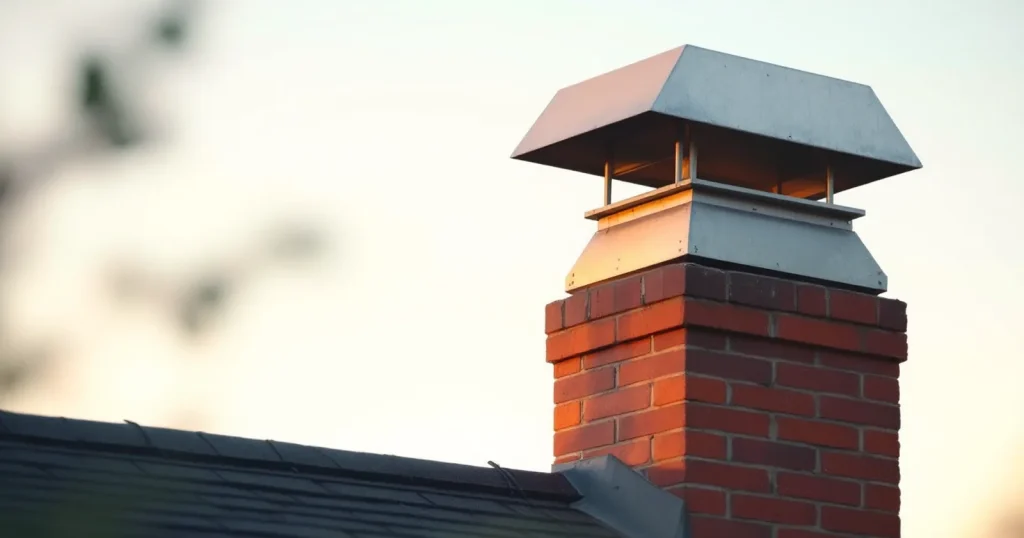
A chimney cap is the metal hood and mesh screen fixed over a flue to keep out rain, animals and sparks. Single-flue caps listed in October 2026 cost $84.99 in galvanized steel to $609.99 in copper, before labor.
Key takeaways
- The open area under a rain cap must be at least 4x the flue’s net area, so a 13 x 13 inch clay tile (127 sq in net) needs 508 sq in of opening (IRC R1003.9.3 and Table R1003.14(2), 2025 CRC text).
- A spark arrestor screen must stop a 1/2 inch sphere (IRC R1003.9.2); HY-C’s standard caps carry 3/4 inch mesh, with 5/8 inch sold “only when required by local codes” (HY-C Shelter page).
- HY-C bars its galvanized Shelter caps from oil or coal flues and from wood or pellets as primary heat; its Draft King stainless caps are rated for both (HY-C Draft King page).
- A bolt-on cap needs 3/4 inch of tile above the mortar; below that, HY-C calls for a leg kit, $44.99 at Rockford Chimney Supply in October 2026.
- HomeAdvisor’s June 20, 2026 guide puts an installed cap at $300 on average and $75 to $500 for most jobs, with labor about half (HomeAdvisor).
Chimney cap key numbers at a glance
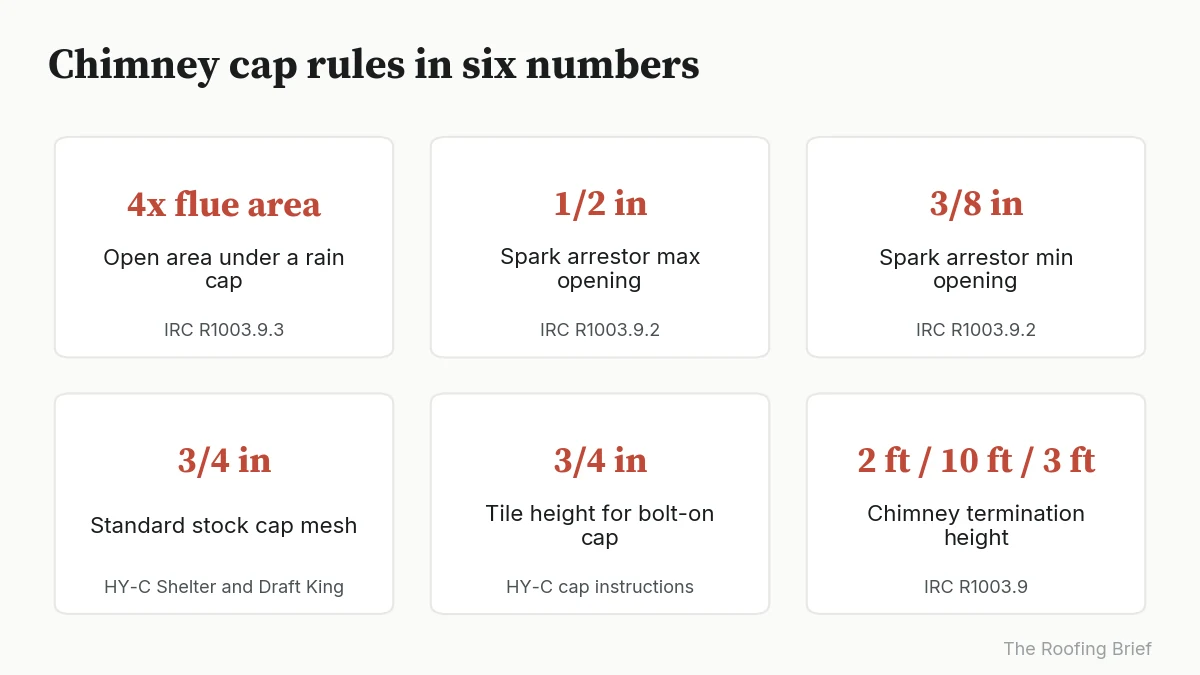
Seven figures decide whether a chimney cap fits, drafts and passes inspection: the 4x open-area rule, the 1/2 inch and 3/8 inch mesh limits, the screen metal equivalent, the 3/4 inch tile projection a bolt-on cap needs and the 2 ft, 10 ft, 3 ft termination rule. Each row cites the code section or maker document it comes from.
| Figure | Value | Source |
|---|---|---|
| Open area under a rain cap | At least 4x the net area of the flue outlet | IRC R1003.9.3 |
| Spark arrestor maximum opening | Must not pass a 1/2 in (12.7 mm) sphere | IRC R1003.9.2, item 3 |
| Spark arrestor minimum opening | Must pass a 3/8 in (9.5 mm) sphere | IRC R1003.9.2, item 3 |
| Spark arrestor screen metal | Equivalent to 19-gage galvanized or 24-gage stainless (California adds 12 gage wire) | IRC R1003.9.2, item 2 |
| Standard stock cap mesh | 3/4 in expanded, 18-gauge | HY-C Shelter and Draft King pages |
| Tile projection for a bolt-on cap | 3/4 in above the mortar, or use a leg kit | HY-C single flue cap instructions |
| Chimney termination height | 2 ft above anything within 10 ft, and 3 ft above the roof penetration | IRC R1003.9 |
What does a chimney cap do, and does code require one?
A chimney cap covers the flue opening with a lid and a screen. In code terms that hood is a “rain cap” under IRC R1003.9.3, while R1003.9.1 uses “chimney cap” for the sloped concrete, metal or stone top of the masonry. Base IRC text makes a screened spark arrestor optional; California’s 2025 code makes one mandatory on every solid-fuel chimney.
R1003.9.1 requires the masonry top to carry “a drip edge and a caulked bond break around any flue liners in accordance with ASTM C1283.” The trades call that slab the crown, covered in our sibling guide to the chimney crown.
| Code term | What the trade calls it | What the section requires | Section |
|---|---|---|---|
| Chimney cap | Crown | Concrete, metal or stone, sloped to shed water, drip edge, caulked bond break at the liners | IRC R1003.9.1 |
| Spark arrestor | Spark arrestor cap | Screen stops a 1/2 in sphere, passes a 3/8 in sphere, removable for cleaning | IRC R1003.9.2 |
| Rain cap | Chimney cap | Open area under the lid at least 4x the flue net area | IRC R1003.9.3 |
The model spark arrestor text starts “Where a spark arrestor is installed,” both in the 2021 IRC as adopted in New Jersey and in the Masonry Alliance for Codes and Standards’ 2009/2010 code change proposal that added the cap and rain cap sections. Outside amended jurisdictions, the screen is optional but regulated once fitted.
California removes the choice: 2025 California Residential Code R1003.9.2 requires “an approved spark arrester” on all chimneys attached to any solid-fuel appliance or fireplace. In wildfire zones, the 2025 California Wildland-Urban Interface Code Section 605 sets woven or welded 12 gage wire (0.1046 inch) with openings no larger than 1/2 inch for solid or liquid fuel. Ember resistance on the rest of the roof is covered in our guide to fire resistant roofing.
A cap does not count toward R1003.9’s height rule of 2 ft above any part of the building within 10 ft and 3 ft above the roof penetration. Chimneys wider than 30 inches parallel to the ridge also need a cricket under R1003.20, explained in our chimney cricket install guide.
Which type of chimney cap fits your chimney?
Four mounting styles cover most chimneys: an outside-mount bolt-on cap clamps to one clay flue tile with 4 corner screws; a slip-in or leg-kit cap pushes into a flush tile; a top-mount multi-flue cap screws to the crown over several flues; and a factory-built metal chimney takes only the cap its maker lists. The table names one current product for each.
| Type | How it attaches | Fits | Example product and spec | Source |
|---|---|---|---|---|
| Outside-mount bolt-on, single flue | Band around the tile, 4 slotted hex-head screws at the tile corners | One clay tile projecting 3/4 in or more | HY-C Shelter SC1313: fits 11.5 x 11.5 in to 13.5 x 13.5 in tile, 14-gauge galvanized base | Do it Best listing |
| Leg-kit or slip-in | Legs inserted no more than 1 in into the liner | Tile flush with, or under 3/4 in above, the crown | HY-C leg kit LK4-SS for the stainless Shelter cap | True Value SCSS1313 listing; HY-C instructions |
| Adjustable single flue | Adjustable brackets | Several tile sizes and round tile | Shelter adjustable: 8 x 8 in to 13 x 13 in square plus 8, 10 and 12 in round OD | Hemlock Hardware listing |
| Top-mount multi-flue | Hinged 1.5 in flange, silicone adhesive and 4 to 8 masonry screws into the crown | Two or more flues, or a crown you want covered | Rockford knock-down cap: 304 stainless, 3/4 in mesh, lid overhangs the screen 3 in | Rockford product page |
| Round clay tile or chimney pot cap | Clamps around a round tile or pot, or sits on a top plate | Round flue tile or clay pot | Rockford round clay tile cap, 304 stainless, from $148.99; pot rain caps from $309.99 stainless, $550.99 copper | Rockford single-flue caps catalog |
| Factory-built chimney cap | Pressed into the last pipe section, held by 4 screws | Listed metal chimney only | DuraVent DuraTech, listed to UL 103 HT (5 to 8 in) | DuraVent DuraTech install guide L923 |
A factory-built chimney is a listed system, so its cap is a listed part: DuraVent’s DuraTech guide, step 15, reads “Press chimney cap into the last section of pipe,” and warns that departing from the instructions can affect the UL listing. IRC R1005.2 adds that decorative shrouds may not sit on a factory-built chimney unless listed for that specific system. A framed box around a metal chimney takes a separate top, covered in our guide to the chimney chase cover.
How do you size a chimney cap to the flue?
Size a single-flue cap to the outside of the clay tile, not the brick. Measure both sides of the tile and pick the cap whose published fit range brackets them: HY-C’s 13 x 13 cap fits 11 1/2 x 11 1/2 to 13 1/2 x 13 1/2 inch tile. Then check screen height, because R1003.9.3 requires 4x the flue’s net area open under the lid.
Fit ranges overlap at the edges. The Rockford HY-C stainless listing gives 9 3/4 to 12 inch tile for the 11 x 11 cap and 11 1/2 to 13 1/2 inch tile for the 13 x 13, so a 12 inch tile fits both; buy the one whose band sits flat on all four faces. HY-C’s chimney cap guide says four sizes, 9 x 9, 9 x 13, 13 x 13 and 13 x 18 inches, fit “around 90% to 95% of the chimneys.”
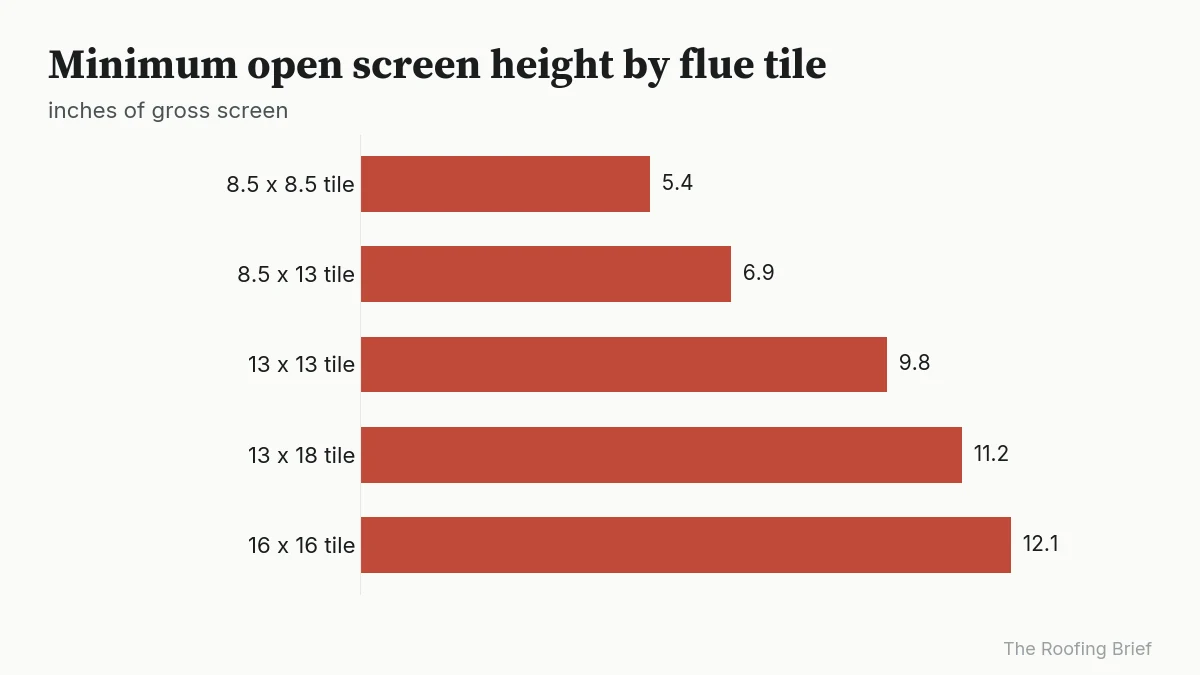
The open-area rule turns into a screen height. Net flue area comes from Table R1003.14(2); multiply by four for the required opening, then divide by the cap’s perimeter to get the minimum height of clear screen. Mesh strands block part of that opening, so treat the result as a floor and ask the seller for the cap’s screen height and net free area.
| Flue tile (outside, in) | Net flue area (sq in) | Required opening, 4x (sq in) | Cap size (in) | Cap perimeter (in) | Gross opening at 8 in screen (sq in) | Minimum screen height (in) |
|---|---|---|---|---|---|---|
| 8.5 x 8.5 | 49 | 196 | 9 x 9 | 36 | 288 | 5.4 |
| 8.5 x 13 | 76 | 304 | 9 x 13 | 44 | 352 | 6.9 |
| 13 x 13 | 127 | 508 | 13 x 13 | 52 | 416 | 9.8 |
| 13 x 18 | 173 | 692 | 13 x 18 | 62 | 496 | 11.2 |
| 16 x 16 | 181 | 724 | 15 x 15 | 60 | 480 | 12.1 |
Inputs: net areas from Table R1003.14(2); cap sizes from HY-C’s published fit ranges; the 8 inch screen is the height Olympia publishes for its HomeSaver Pro cap (Copperfield HomeSaver Pro listing). At 8 inches, the gross opening clears the 4x line on the two smaller tiles and falls short on the three larger ones, before any mesh is subtracted. The arithmetic is ours; the code does not publish screen heights.
Multi-flue caps are sized to the crown instead. Rockford asks for the exact length and width of the screen, adds at least 1/4 inch to both for an outside mount, and recommends a screen at least 6 inches taller than the tallest flue. Those caps are made to order in 1 to 2 weeks and cannot be returned, so measure twice.
What mesh size does a spark arrestor need?
A spark arrestor screen must block any sphere wider than 1/2 inch and pass any sphere narrower than 3/8 inch, in metal at least as heat and corrosion resistant as 19-gage galvanized or 24-gage stainless steel (IRC R1003.9.2). The screen or cap must also come off for flue cleaning. California’s WUI Code Section 605 sets 12 gage wire and the same 1/2 inch limit.
Both HY-C lines list 3/4 inch expanded mesh in 18-gauge metal as standard and 5/8 inch as the code option. A mesh designation names the expanded metal pattern, not a clear opening, so ask the seller whether the screen stops a 1/2 inch sphere, the test the code writes.
| Requirement | IRC R1003.9.2 | California WUI Code 605 | Typical stock cap (HY-C standard) |
|---|---|---|---|
| Largest opening | No 1/2 in sphere passes | Openings not over 1/2 in | 3/4 in expanded mesh |
| Screen metal | 19-ga galvanized or 24-ga stainless equivalent; CRC adds 12 gage wire | 12 gage wire (0.1046 in) | 18-gauge galvanized or stainless mesh |
| Open area | 4x flue net area | 4x chimney outlet net area | Not published on the pages we opened |
The 3/8 inch floor keeps the screen from choking the draft. HY-C’s installation sheet says to check the cover daily for frost or ice below freezing, because blocked venting “could be fatal,” a risk on gas furnace and water heater flues whose exhaust carries water vapor.
What do most chimney cap guides get wrong?
Three claims repeat across the top-ranking cap guides we read in October 2026: a fixed screen height rule, “spark arrestor” labels on 3/4 inch mesh, and lifespan figures quoted without a maker document. The primary sources give different answers, and on large flues the difference decides whether the cap meets R1003.9.3.
| What guides commonly say | What the primary source says | Source |
|---|---|---|
| The cap should stand 6 in (one guide) or 8 in (another) above the flue | No height rule; the open area must be 4x the flue net area, which is 9.8 in of gross screen on a 13 x 13 tile | IRC R1003.9.3; Table R1003.14(2) |
| Any mesh cap is a spark arrestor | Openings must stop a 1/2 in sphere; the standard HY-C mesh is 3/4 in | IRC R1003.9.2; HY-C pages |
| Galvanized is a cheaper version of the same cap | HY-C excludes its galvanized caps from oil, coal and primary wood or pellet heat | HY-C Shelter page |
| 5/8 in mesh is what California and Oregon require (HY-C guide) | California WUI Code 605 caps openings at 1/2 in; ask whether the clear opening stops a 1/2 in sphere | California WUI Code 605; IRC R1003.9.2 |
| Caps last 3 to 25 years (HomeAdvisor) or 50 years or more (HY-C guide) | HY-C warrants stainless for a limited lifetime and black powder coat for 7 years; Rockford’s listing states 7 years for the same stainless cap | HY-C Draft King page; Rockford listing |
Stainless, galvanized or copper: which metal suits which fuel?
Choose the metal by what burns below it. Galvanized steel suits an occasional wood fireplace and costs least; 304 stainless is the maker-approved choice for oil, coal and primary wood or pellet heat; copper costs about 3.8 times as much as stainless for a 13 x 13 cap at the same retailer in October 2026 ($609.99 vs $161.99).
| Metal | Example cap | Construction | Fuel limits | Warranty | Source |
|---|---|---|---|---|---|
| Galvanized steel, black powder coat | HY-C Shelter SC1313 | 24-ga hood, 18-ga 3/4 in mesh, 14-ga base | Not for oil or coal, or wood or pellets as primary heat | Not stated on the maker page | HY-C Shelter page; Do it Best |
| 304 stainless steel | HY-C Draft King single flue | 24-ga 304 hood, 18-ga 3/4 in mesh, 16-ga base | Rated for oil, coal, and wood or pellets as primary heat | Limited lifetime (HY-C); 7 years (Rockford listing) | HY-C Draft King page; Rockford listing |
| Copper | HY-C pre-assembled copper, 13 x 13 | 100% copper, 24-ga, 3/4 in screen | Not stated | HY-C lifetime (Rockford listing) | Rockford copper listing |
HY-C’s warranty covers the part only: claims are limited to the product’s replacement cost, excluding shipping and labor, and need the original invoice. The labor line repeats each time a cap fails, which is the case for $161.99 stainless over $84.99 galvanized on a chimney in regular use.
The case for copper at $609.99 is matching existing copper flashing or gutters; our copper roofing guide covers how the metal weathers.
How much does a chimney cap cost?
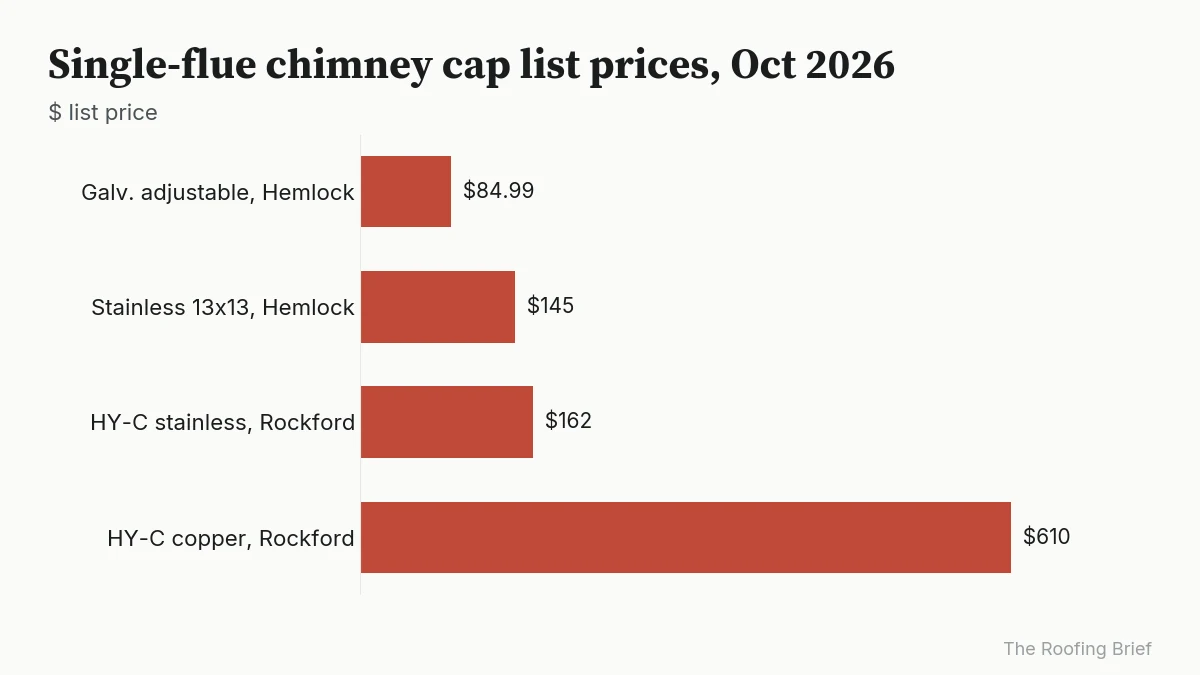
As of October 2026, a 13 x 13 inch single-flue cap lists at $84.99 (adjustable galvanized) to $609.99 (copper), and a stainless multi-flue cap runs $262.69 to $773.47 by size. HomeAdvisor’s June 2026 survey data puts a typical installed job at $75 to $500, averaging $300, with labor about half.
| Cap | Size or fit | Material | Price | Retailer, date seen |
|---|---|---|---|---|
| Shelter adjustable single flue (SKU 432377) | 8 x 8 to 13 x 13 in, 8 to 12 in round | Black galvanized steel | $84.99 | Hemlock Hardware, Oct 2026 |
| HomeSaver Pro single flue | 8 x 8 to 17 x 21 in range | Galvanized or stainless | $111.78 MSRP | Copperfield, Oct 2026 |
| Shelter stainless single flue (SKU 496901) | 13 x 13 in | 304 stainless | $144.99 | Hemlock Hardware, Oct 2026 |
| HY-C stainless single flue | 13 x 13 in | 304 stainless | $161.99 | Rockford Chimney Supply, Oct 2026 |
| HY-C pre-assembled copper | 13 x 13 in | Copper | $609.99 | Rockford Chimney Supply, Oct 2026 |
| Knock-down multi-flue cap | Made to order | 304 stainless | $262.69 to $773.47 | Rockford Chimney Supply, Oct 2026 |
| Bolt-on cap leg kit | Single flue | Galvanized | $44.99 | Rockford Chimney Supply, Oct 2026 |
Size moves the price more than shape: Rockford’s HY-C stainless cap runs $127.99 at 9 x 9 inches, $161.99 at 13 x 13 and $385.99 at 20 x 20 in October 2026, a threefold spread inside one product line.
| Cap size (all-in, installed) | HomeAdvisor range |
|---|---|
| 6 x 6 in | $50 to $250 |
| 8 x 10 in | $75 to $300 |
| 8 x 17 in | $100 to $400 |
| 13 x 13 in | $100 to $400 |
| 14 x 37 in | $200 to $450 |
| 17 x 29 in | $300 to $500 |
HomeAdvisor adds that two or more flues “could double the price” and puts custom caps at $200 to $1,000 installed. The worked example prices a common job from the dated listings, with labor at half of HomeAdvisor’s $300 average.
| Line | Amount | Basis |
|---|---|---|
| HY-C stainless cap, 13 x 13 in | $161.99 | Rockford listing, Oct 2026 |
| Leg kit (tile under 3/4 in above mortar) | $44.99 | Rockford listing, Oct 2026 |
| Labor | $150.00 | 50% of HomeAdvisor’s $300 national average |
| Total with leg kit | $356.98 | $161.99 + $44.99 + $150.00 |
| Total without leg kit | $311.99 | $161.99 + $150.00 |
Pairing the cap with the once-a-year NFPA 211 inspection avoids a second roof access. Our sibling guide to chimney inspection cost lists what that visit runs, and a damaged liner found at the same visit is priced in our chimney liner guide.
How do you install a chimney cap?
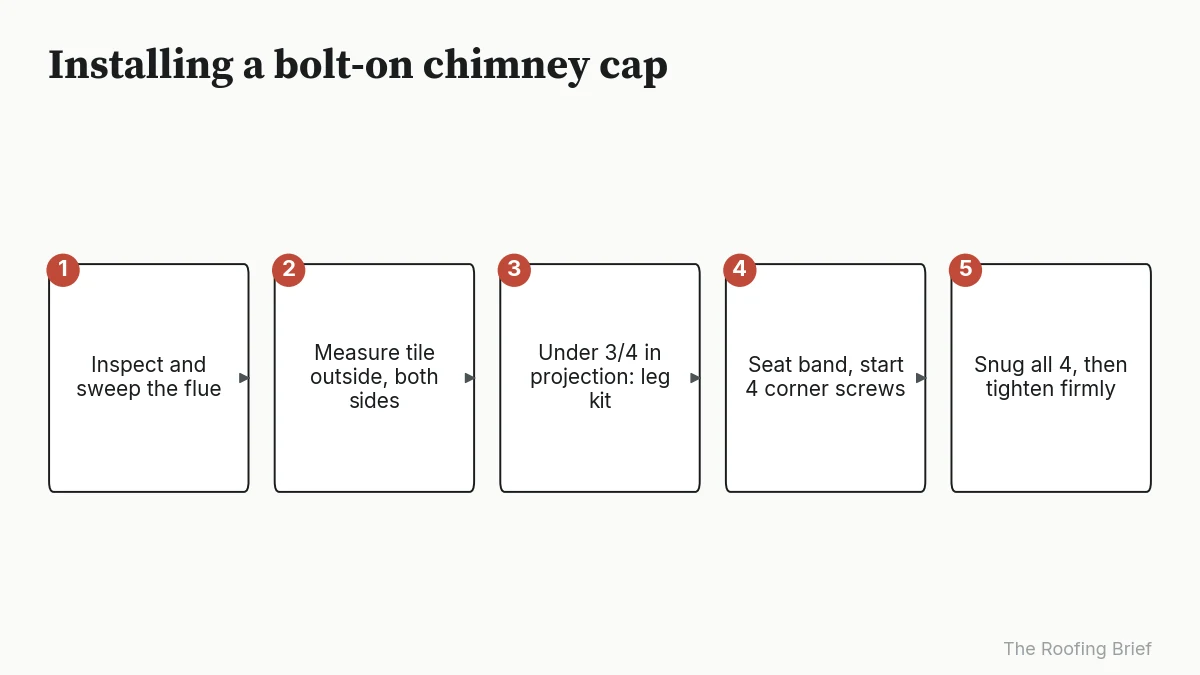
An outside-mount bolt-on cap goes on in five steps with a screwdriver: inspect the flue, measure the tile, check its projection, seat the cap and tighten four corner screws in two passes. HY-C’s instructions set the 3/4 inch projection threshold, and OSHA 1926.1053(b)(1) sets the ladder rule of 3 ft above the landing.
- Have the flue inspected and swept before capping. HY-C’s sheet says the chimney “should be inspected” for construction, size and obstructions first, and CSIA quotes NFPA 211 requiring inspection “at least once a year.” The U.S. Fire Administration gives the same yearly advice.
- Measure the outside of the flue tile on both sides and buy the cap whose fit range brackets both numbers (13 x 13 cap: 11 1/2 to 13 1/2 in tile).
- Measure how far the tile stands above the mortar. Under 3/4 in, fit the leg kit: insert two legs no more than 1 in into the liner and push the cap straight down.
- Seat the band on the tile and start one screw in the lower hole at each mitered corner, at the tile corners, which HY-C calls “the strongest part of the flue tile.”
- Snug all four screws to the tile, then tighten each one firmly.
The roof is the hazard, not the cap. OSHA’s construction ladder standard, 29 CFR 1926.1053, requires side rails 3 ft above the upper landing and a base set out about one quarter of the ladder’s working length.
Check for birds before you cap. Chimney swifts nest in open masonry flues and are protected by the Migratory Bird Treaty Act, which makes it unlawful to take “any migratory bird, any part, nest, or egg” (16 U.S.C. 703). Humane World for Animals advises removing nests after the birds leave in the fall and capping metal-lined chimneys, in which birds “can easily become trapped.”
A cap stops water at the flue opening only. If a ceiling stain persists, the crown (R1003.9.1) and the flashing are next: our guide to bad chimney flashing covers step and counter flashing, and who to call for a roof leak sorts mason work from roofer work.
Which chimney cap should you buy?
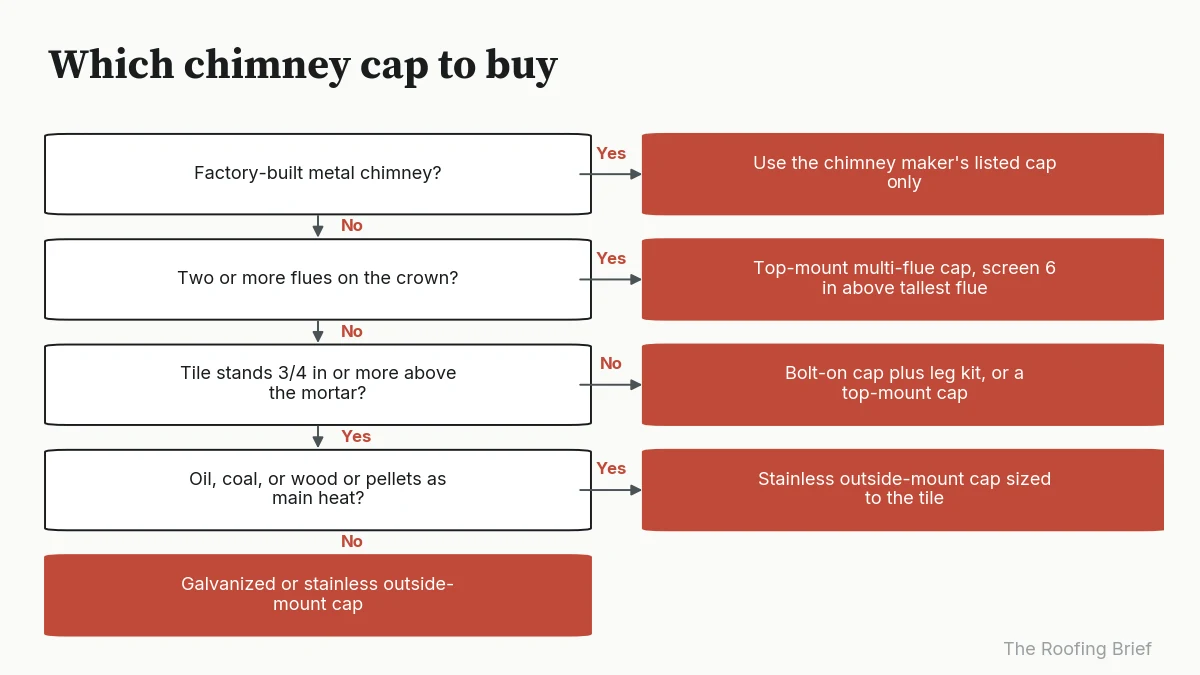
Start from the chimney type and fuel, then the flue count and tile height. A factory-built chimney takes its maker’s listed cap; oil, coal or primary wood heat needs stainless; two or more flues need a top-mount cap sized to the crown; and a flush tile needs a leg kit. In California, or near wildland, add a screen that stops a 1/2 inch sphere.
| If your situation is | Do this | Rule behind it |
|---|---|---|
| Factory-built metal chimney | Use the chimney maker’s listed cap only | DuraVent DuraTech guide L923, step 15; UL 103 listing |
| Oil or coal appliance, or wood or pellets as primary heat | Buy a stainless cap, not galvanized | HY-C Shelter and Draft King pages |
| Two or more flues, or a crown you want covered | Top-mount multi-flue cap, screen at least 6 in taller than the tallest flue | Rockford knock-down cap sizing note |
| Tile stands under 3/4 in above the mortar | Add a leg kit ($44.99) or use a top-mount cap | HY-C single flue cap instructions |
| Tile stands 3/4 in or more above the mortar | Outside-mount bolt-on cap sized to the tile | HY-C single flue cap instructions |
| Solid fuel in California, or a wildfire zone | Screen that stops a 1/2 in sphere; 12 gage wire under WUI 605 | CRC R1003.9.2; California WUI Code 605 |
| Flue tile 13 x 13 in or larger | Ask for screen height; 9.8 in or more of gross screen on a 13 x 13 | IRC R1003.9.3 arithmetic above |
| Swifts nesting in the flue | Wait until the birds leave in the fall, then cap | 16 U.S.C. 703; Humane World for Animals |
How we compiled this
We compiled this page in October 2026 from 25 documents: code text (the 2021 IRC as adopted in New Jersey, the 2025 California Residential and WUI codes, a 2009 code change proposal), HY-C and DuraVent maker documents including HY-C’s cap guide, dated listings from five retailers, the HomeAdvisor cost guide, and federal statute and OSHA text. We did not test or install any cap; the screen-height table is our arithmetic from the code’s net-area table.
Frequently asked questions
Is a chimney cap necessary?
Base IRC text does not require a mesh cap; it regulates one once installed, at 4x the flue’s net area open (R1003.9.3). California’s 2025 Residential Code R1003.9.2 does require an approved spark arrester on every chimney serving a solid-fuel appliance or fireplace. Without any cap, the open flue takes rain, leaves and animals straight down the liner.
Can I install a chimney cap myself?
Yes, if you can work safely on the roof. A bolt-on cap needs a screwdriver and four corner screws, plus a leg kit when the tile stands under 3/4 inch above the mortar (HY-C instructions). The ladder must extend 3 ft above the landing under OSHA 1926.1053. Have the flue inspected first, as HY-C instructs.
Do chimney caps keep rain out?
A cap keeps direct rain out of the flue opening, which is its main job. It does not stop water entering through a cracked crown, porous brick or failed flashing. Rockford’s multi-flue lid overhangs its screen by 3 inches on all sides; wind-driven rain can still reach a single-flue screen, so check flashing if leaks continue.
How long does a chimney cap last?
Makers publish warranties, not service lives. HY-C warrants its stainless caps for a limited lifetime and black powder coat for 7 years, covering the part only, not labor. HomeAdvisor’s June 2026 guide gives a 3 to 25 year life and a 5 to 10 year replacement interval. Galvanized caps exposed to oil or coal flue gas are excluded by HY-C.
Should an unused chimney be capped?
Yes, according to HY-C’s chimney cap guide, which calls a cap on an unused flue “a small $60 to $100 investment.” Humane World for Animals also advises capping metal-lined chimneys, where birds “can easily become trapped.” An open flue takes rain and debris straight down the liner whether or not the fireplace is used, and R1003.9.3 still applies to any rain cap fitted.
How tall should a chimney cap be?
The code sets open area, not height: under IRC R1003.9.3 the opening must be 4x the flue’s net area. For a 13 x 13 inch tile (127 sq in net) on a 13 x 13 cap, that is 9.8 inches of gross screen. For a 9 x 9 cap on an 8.5 inch tile, 5.4 inches is enough.
What is the difference between a chimney crown and a chimney cap?
The crown is the sloped concrete, metal or stone slab on top of the masonry; IRC R1003.9.1 calls it the chimney cap and requires a drip edge and a caulked bond break around the flue liners. The metal hood and mesh sold as a chimney cap is a rain cap under R1003.9.3 and sits on the flue tile.
Sources
- 2021 International Residential Code, Chapter 10, as adopted by the New Jersey UCC One- and Two-Family Dwelling Subcode (UpCodes), accessed Oct 2026
- 2025 California Residential Code, Section R1003 (IRC R1003.9 to R1003.20 and Table R1003.14(2)), accessed Oct 2026
- 2025 California Residential Code R1003.9: termination, caps and spark arrestors, accessed Oct 2026
- 2025 California Wildland-Urban Interface Code, Section 605 Spark Arrestors, accessed Oct 2026
- Masonry Alliance for Codes and Standards, code change proposal IBC 2113.9 / R1003.9 (2009), accessed Oct 2026
- HY-C Shelter Single Flue Galvanized Steel Chimney Caps, accessed Oct 2026
- HY-C, Everything You Need to Know about Chimney Caps (blog guide), accessed Oct 2026
- HY-C Draft King Single Flue Stainless Steel Chimney Caps, accessed Oct 2026
- HY-C single flue chimney cap installation instructions, accessed Oct 2026
- DuraVent DuraTech Install Guide L923, accessed Oct 2026
- True Value, Shelter SCSS1313 listing, accessed Oct 2026
- Do it Best, Shelter SC1313 listing, accessed Oct 2026
- Hemlock Hardware, Shelter 13 x 13 stainless cap listing, accessed Oct 2026
- Hemlock Hardware, Shelter adjustable galvanized cap listing, accessed Oct 2026
- Rockford Chimney Supply, HY-C stainless single flue cap, accessed Oct 2026
- Rockford Chimney Supply, HY-C pre-assembled copper cap, accessed Oct 2026
- Rockford Chimney Supply, stainless knock-down multi-flue cap, accessed Oct 2026
- Rockford Chimney Supply, single-flue chimney caps catalog (leg kit), accessed Oct 2026
- Copperfield, Olympia HomeSaver Pro single flue cap, accessed Oct 2026
- HomeAdvisor, chimney cap installation cost guide (updated Jun 20, 2026), accessed Oct 2026
- Chimney Safety Institute of America, homeowner resources (NFPA 211 annual inspection), accessed Oct 2026
- U.S. Fire Administration, heating fire safety, accessed Oct 2026
- 16 U.S.C. 703, Migratory Bird Treaty Act, accessed Oct 2026
- Humane World for Animals, what to do about chimney swifts, accessed Oct 2026
- OSHA 29 CFR 1926.1053, Ladders, accessed Oct 2026