

By The Roofing Brief Team | Last reviewed: October 2026
Attic fan installation: size the fan at 0.7 CFM per sq ft of attic, add 144 sq in of intake per 300 CFM, flash a roof unit 24 in below the ridge or bolt a gable unit behind a louver.
Key takeaways
- Air Vent’s September 2026 power vent sell sheet sizes a fan as attic square feet x 0.7, so a 1,500 sq ft attic needs at least 1,050 CFM (Air Vent AV-005).
- The same sheet sets intake at fan CFM divided by 300, times 144: a 1,050 CFM fan needs 504 sq in of net free intake area.
- GAF’s Master Flow roof-mount manual puts the top of the hood 24 in below the ridge, bans roofs flatter than 2:12 and asks for a 120 V grounded circuit with at least 14-gauge wire and 3 A of spare capacity (GAF V971381).
- In eight 1993 field tests, powered attic ventilators pulled an average of 231 CFM of conditioned air out of the house, and one water heater backdrafted (Tooley and Davis, ACEEE 1994).
- Our three worked jobs land between $171 and $916, using October 2026 fan prices and dated labor rates from cost guides.
Attic fan installation key numbers
These 8 figures govern most attic fan installation jobs, from the 0.7 sizing multiplier to the 24 in hood placement and the 14-gauge circuit. Each row comes from a maker manual, a field study or a dated cost guide, named in the Source column, so you can check the number at its origin.
| Figure | Value | Source |
|---|---|---|
| Minimum fan airflow | Attic sq ft x 0.7 = CFM | Air Vent AV-005 sell sheet, Sept 2026 |
| Intake needed | CFM / 300 x 144 = sq in of net free area | Air Vent AV-005 sell sheet, Sept 2026 |
| Roof-mount placement | Top of hood 24 in below the ridge line | GAF Master Flow V971381, 3/15 |
| Roof slope limit | Not on slopes under 2:12 | GAF Master Flow V971381, 3/15 |
| Circuit | 120 V, 60 Hz grounded, 14-gauge minimum, 3 A available | GAF Master Flow V971381, 3/15 |
| Thermostat | Adjustable 60 to 120°F, factory setting 105°F | GAF Master Flow V971381, 3/15 |
| House air pulled by a running fan | Average 231 CFM, range 104 to 646 CFM, 8 houses | Tooley and Davis, ACEEE 1994 |
| Typical installed price | $369 to $913, average $624 | Angi and HomeAdvisor data via Bob Vila, Dec 2023 |
Roof-mount or gable-mount: which attic fan installation fits your house?
Pick a gable-mount fan when the attic already has a gable louver, because it bolts to studs behind the opening and no roof deck gets cut. Pick a roof-mount fan on hip roofs or attics without gables: Air Vent’s 2026 sell sheet calls roof-mount power vents “ideal for hard-to-vent hip roof applications.” The roof-mount job adds a 15 or 17 in deck cut and shingle flashing.
The table compares the two mounts using the GAF Master Flow manuals for each style plus October 2026 prices at HVAC Quick, an online HVAC retailer. Installed ranges come from HomeGuide’s April 2024 cost survey, the most recent dated version we could open.
| Item | Roof-mount | Gable-mount | Source |
|---|---|---|---|
| Opening | 15 or 17 in circle cut through deck | Existing gable louver, no roof cut | GAF V971381 and V971382 |
| Placement | Hood top 24 in below ridge, centered between rafters | Fan 3 to 4 in behind the louver | GAF V971381 and V971382 |
| Framing | Fits 16 or 24 in on-center rafters | Brackets fit 16 in studs; two 2×4 supports 14 in apart for wider spacing | GAF V971381 and V971382 |
| Example model | Master Flow ERV5, 1,250 CFM | Master Flow EGV5, 1,450 CFM | HVAC Quick listing, Oct 2026 |
| Fan price | $149 (ERV5, mill) | From $106 (EGV5) | HVAC Quick listing, Oct 2026 |
| Installed range, electric | $200 to $1,200 | $200 to $1,000 | HomeGuide, Apr 2024 |
For louver net free area by size and when to block a gable, see our guide to roof gable vents.
What size attic fan do you need?
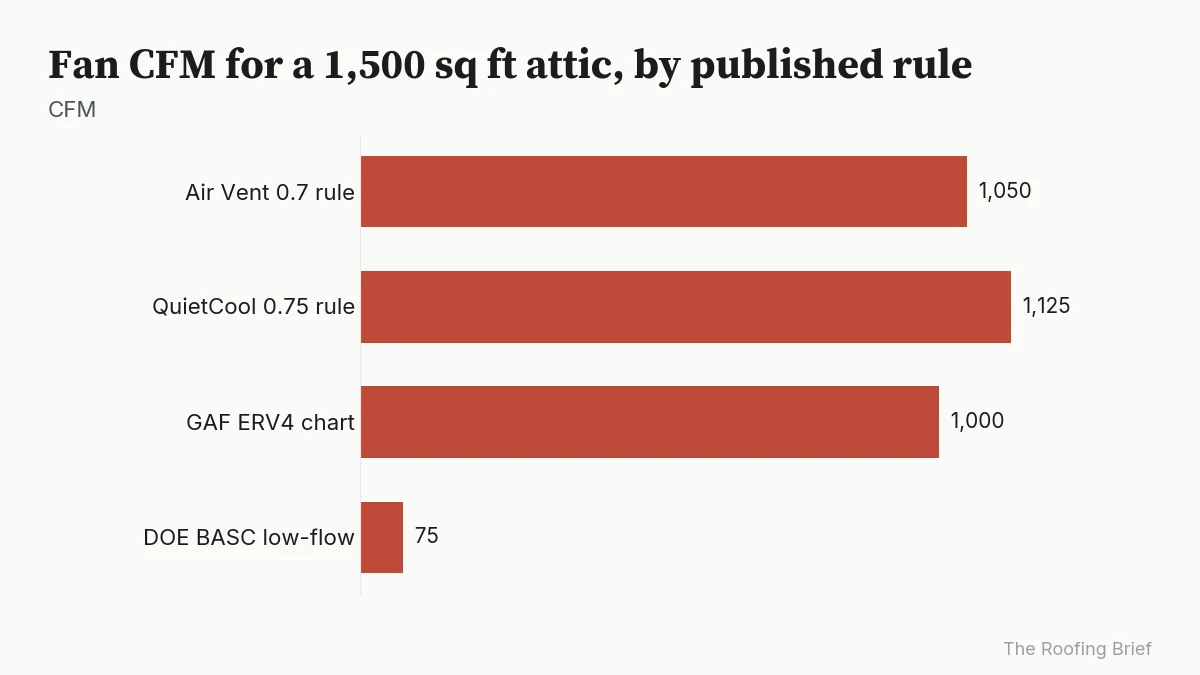
Most makers size an attic fan by multiplying attic floor area by a CFM factor between about 0.54 and 0.75, so a 1,500 sq ft attic lands near 1,000 to 1,125 CFM. Air Vent publishes 0.7, QuietCool rates coverage at 0.75, and GAF’s Master Flow charts work out to 0.54 to 0.63. The Department of Energy’s Building America guidance targets just 50 CFM per 1,000 sq ft.
That last figure is the correction the cost guides skip. The DOE Building America Solution Center advises a lower-CFM fan “to create less negative pressure” and cites 50 CFM per 1,000 sq ft as the rate shown to control vapor in attics. For a 1,500 sq ft attic that is 75 CFM, about one fourteenth of the Air Vent figure.
| Published rule | Multiplier | CFM for a 1,500 sq ft attic | Source |
|---|---|---|---|
| Air Vent 0.7 rule | 0.7 CFM per sq ft | 1,050 | Air Vent AV-005, Sept 2026 |
| QuietCool 0.75 rule | 0.75 CFM per sq ft | 1,125 | QuietCool AFG SMT PRO-3.0 sheet, Rev. 2/8/23 |
| GAF ERV4 chart | 1,000 CFM for up to 1,600 sq ft (0.625) | 1,000 | GAF RESMF334, Jan 2023 |
| DOE BASC low-flow | 50 CFM per 1,000 sq ft | 75 | Building America Solution Center |
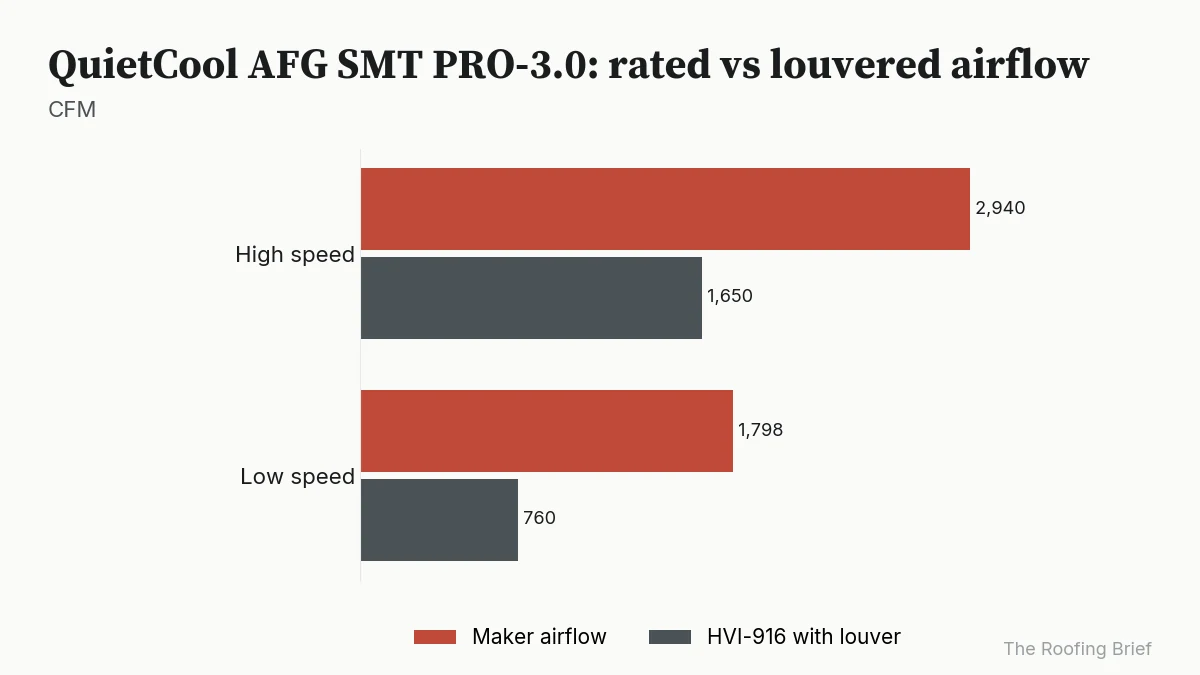
Rated airflow is measured in free air, and a louver cuts it. QuietCool’s own sheet for the AFG SMT PRO-3.0 gable fan lists 2,940 CFM on high, but 1,650 CFM under the HVI-916 test with a standard louver, a 44% drop (QuietCool spec sheet). Size a gable fan from the louvered number when a maker publishes one.
| QuietCool AFG SMT PRO-3.0 speed | Maker airflow (CFM) | HVI-916 with louver (CFM) | Power draw |
|---|---|---|---|
| High speed | 2,940 | 1,650 | 264 W, 2.4 A |
| Low speed | 1,798 | 760 | 191 W, 1.7 A |
The model table pulls CFM, rated attic area, intake and control from each maker’s 2023 to 2026 documents. Prices are the October 2026 listings we opened; we found no open retailer page pricing the Air Vent or QuietCool units.
| Model | Mount | CFM | Rated attic area | Intake required | Control | Warranty | Price, retailer, Oct 2026 |
|---|---|---|---|---|---|---|---|
| GAF Master Flow ERV5 | Roof | 1,250 | 2,200 sq ft | 600 sq in | Thermostat | 5 yr | $149, HVAC Quick |
| GAF Master Flow ERV6HT | Roof | 1,500 | 2,800 sq ft | 720 sq in | Thermostat and humidistat | 10 yr | From $186, HVAC Quick |
| GAF Master Flow EGV5 | Gable | 1,450 | 2,300 sq ft | Not on listing | Thermostat | Not on listing | From $106, HVAC Quick |
| GAF Master Flow EZCR1 | Roof, plug-in | 1,050 | 2,000 sq ft | Not on listing | Thermostat, power plug | Not on listing | $269, HVAC Quick |
| Air Vent PC12 | Roof | 1,170 | 1,650 sq ft | 562 sq in | Thermostat and humidistat | 10 yr limited | No listing found |
| Air Vent APGH | Gable | 1,620 | 2,300 sq ft | 778 sq in | Thermostat and humidistat | Limited lifetime | No listing found |
| Maxx Air 1000 Series | Roof | 1,080 | Not on listing | Not on listing | Thermostat | Not on listing | $139.99, Maxx Air store |
| QuietCool AFG SMT PRO-3.0 | Gable | 2,940 (1,650 louvered) | 3,750 sq ft | Not on sheet | Smart Control Hub, plug and play | 15 yr | No listing found |
Sources: GAF RESMF334 spec sheet (January 2023), the Air Vent 2026 Ventilation Catalog, the HVAC Quick listing and the Maxx Air store, October 2026.
How much intake does an attic fan need?
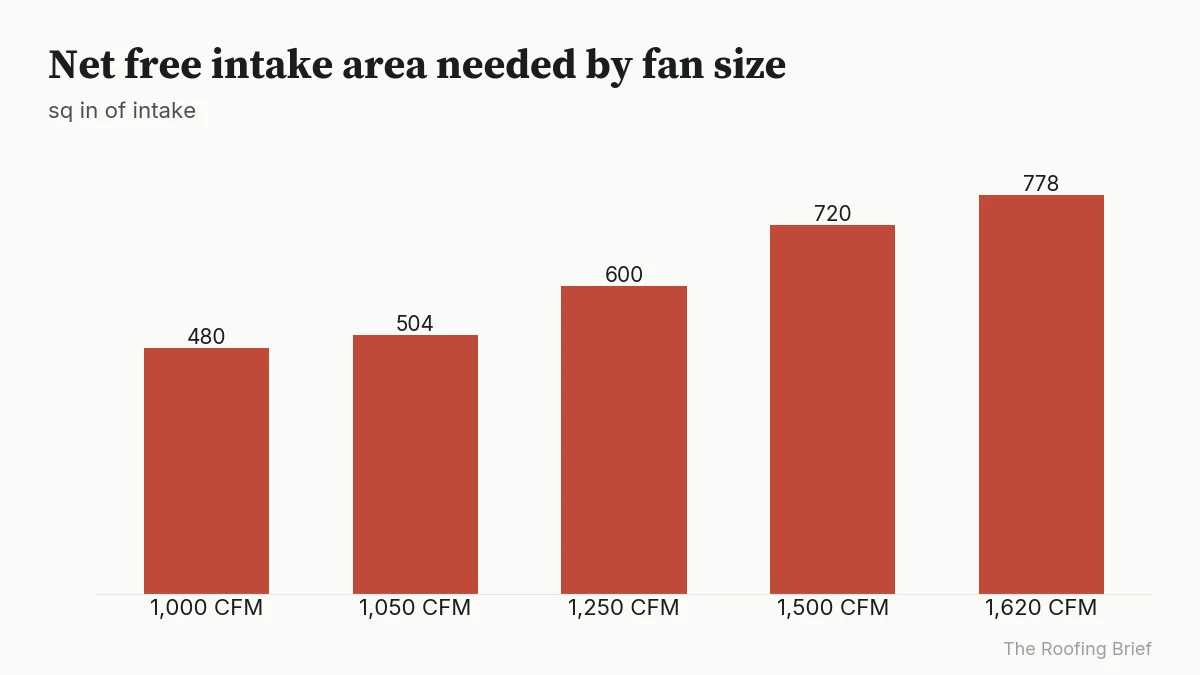
An attic fan needs 1 sq ft of net free intake area for every 300 CFM it moves, which is 144 sq in per 300 CFM. Air Vent states the formula on its 2026 sell sheet, and GAF’s Master Flow chart matches it exactly: 480 sq in for the 1,000 CFM ERV4, 600 for the ERV5 and 720 for the 1,500 CFM ERV6. Without that intake the fan pulls from the house.
Translate the requirement into hardware with the net free area printed on your intake vents. Air Vent’s SV201 continuous soffit vent is rated at 9 sq in per linear foot in its 2017 power vent brochure, so the last column shows the feet of that vent each fan size requires. Our net free area calculation guide covers other vent types.
| Fan CFM | Intake (sq ft) | Intake (sq in) | Feet of 9 sq in/ft soffit vent | Check against maker figure |
|---|---|---|---|---|
| 1,000 | 3.33 | 480 | 53.3 | GAF ERV4: 480 sq in |
| 1,050 | 3.5 | 504 | 56 | Air Vent example: 504 sq in |
| 1,250 | 4.17 | 600 | 66.7 | GAF ERV5: 600 sq in |
| 1,500 | 5 | 720 | 80 | GAF ERV6: 720 sq in |
| 1,620 | 5.4 | 778 | 86.4 | Air Vent APGH: 778 sq in |
GAF’s spec sheet adds the balance rule in plain terms: “In no case should the amount of exhaust ventilation at or near the ridge exceed the amount of intake ventilation at or near the soffit.” If soffits are blocked by insulation, fix that before buying a fan; our intake vs exhaust ratio guide shows why exhaust-heavy attics pull air from the wrong places.
How do you install a roof-mount attic fan and flash it?
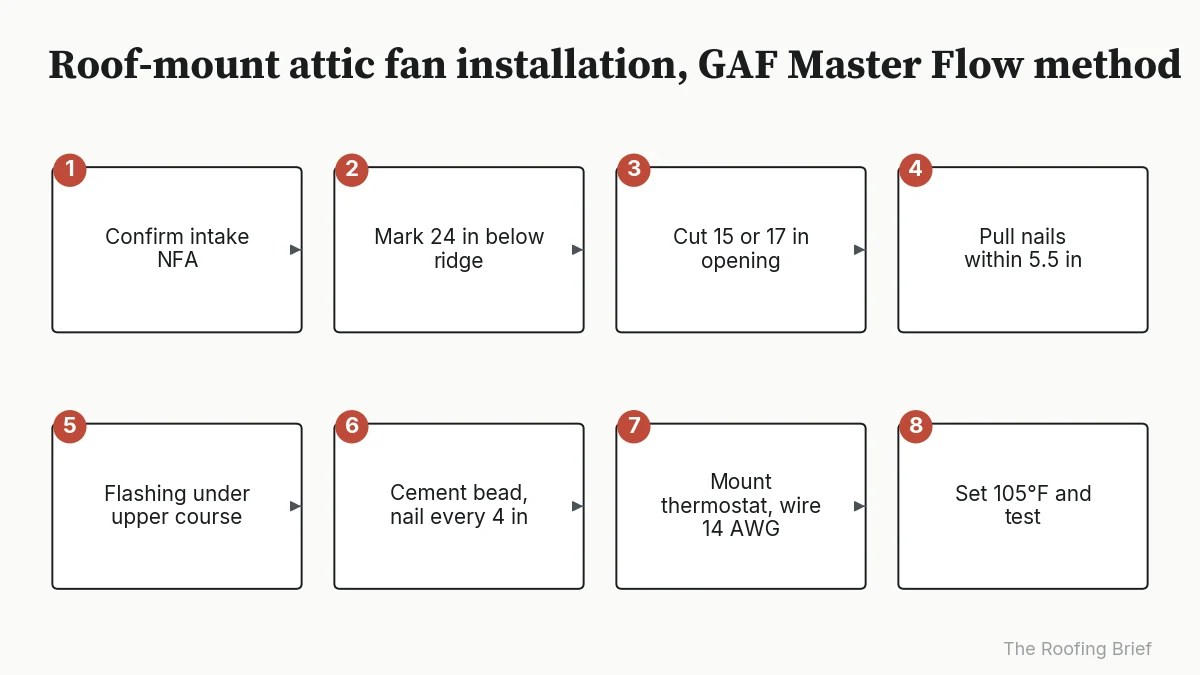
Install a roof-mount attic fan by marking a point centered between rafters with the hood top 24 in below the ridge, cutting the 15 or 17 in template circle, pulling nails within 5 1/2 in of the opening, then sliding the flashing under the upper shingles and nailing every 4 in. Those dimensions come from GAF’s Master Flow V971381 manual for the ERV4, ERV5 and ERV6.
- Confirm intake NFA. Match soffit net free area to the intake table; GAF warns low intake can cause premature motor failure.
- Mark 24 in below ridge. Transfer the hood position into the attic, centered between two rafters, and drill a 1/8 in locator hole.
- Cut 15 or 17 in opening. Trace the box template and cut with a saber or jig saw; the cutout shape differs for 16 and 24 in rafter spacing.
- Pull nails within 5.5 in. Remove every nail within 5 1/2 in of the sides and top of the opening, then dry-fit and trim shingles.
- Flashing under upper course. Slide the flashing under the upper shingles, arrow up, leaving its lower part on top of the shingles below.
- Cement bead, nail every 4 in. Bed the flashing in roofing cement or urethane sealant, then nail corners and every 4 in; excess cement can blister shingles.
- Mount thermostat, wire 14 AWG. Fix the thermostat box to a rafter, sensor uncovered, and run grounded 120 V Type NM cable through a 1/2 in clamp.
- Set 105°F and test. Set the factory 105°F, restore power, and lower the dial briefly to confirm the motor starts.
Broan’s 345SO instructions use a 16 1/2 in shingle circle, a 14 in deck hole and screws every 6 in, tell you not to seal the bottom edge of the base, and caution against bending asphalt shingles below 40°F. Plan tie-off for work near the ridge with our roof safety harness guide.
How do you install a gable-mount attic fan?
Install a gable-mount fan behind an existing louver: bolt four brackets to the fan shroud, place the fan 3 to 4 in from the louver, screw the brackets to 16 in on-center studs or to two 2×4 supports set 14 in apart, then wire the thermostat. GAF’s Master Flow V971382 manual for the PG2, PG3, EGV5 and EGV6 sets those numbers.
- Confirm soffit intake on the far side of the attic using the CFM / 300 x 144 rule.
- Use an existing gable louver or GAF’s SGM20 automatic gable louver, and seal any louver area the fan does not cover, as HomeGuide advises.
- Bolt the four brackets to the shroud with the 8 bolts and 8 Nylok nuts in the kit.
- Set the fan 3 to 4 in behind the louver and fasten the brackets flush to the studs, adding two 2×4 supports 14 in apart beyond 16 in spacing.
- Mount the thermostat on a nearby stud, wire it per the diagram, and set 105°F; each fan needs its own thermostat.
Air Vent’s SHT15W automatic gable shutter, listed at 1,620 CFM in its 2026 catalog, opens when the fan turns on, per its 2017 brochure. If the roof also has a ridge vent, check the decision table first.
How do you wire an attic fan, and do you need a permit?
Wire an electric attic fan to a grounded 120 V, 60 Hz circuit with at least 14-gauge copper and 3 A of spare capacity, never through an extension cord, and run a dedicated circuit if you cannot confirm that capacity. GAF’s Master Flow manuals require all wiring to meet the National Electrical Code and local codes, and permit rules for a new circuit are set by your city or county.
Current draw decides whether an existing lighting circuit can carry the fan. Air Vent’s website lists 2.2 A for its 1,500 CFM high-efficiency ECM roof fan, 2.8 A for its 1,170 CFM humidistat model and 3.6 A for its 1,500 CFM pre-wired models; QuietCool’s AFG SMT PRO-3.0 pulls 2.4 A on high. GAF’s 3 A spare-capacity rule is the test for an existing circuit.
- Use Type NM cable, a 1/2 in cable clamp connector and wire nuts, and give each fan its own thermostat (both GAF manuals).
- If a gas or oil furnace or other fuel appliance shares the attic space, GAF requires a switch or interlock that cuts the fan’s power so the furnace and fan cannot run together during heating.
- Plug-in units such as the Master Flow EZCR1 skip the hardwiring but still need an existing attic outlet.
Permit rules are local. Newport Beach, California, lists “Attic Exhaust” as its own residential mechanical permit and “Additional Circuits” as a separate electrical permit on its online permit list, so one fan job there can touch two permit types. Ask your building department whether the roof cut needs a building or mechanical permit and whether the circuit needs an electrical permit.
What thermostat and humidistat settings should you use?
Start an electric attic fan at the maker’s factory setting: 105°F on GAF Master Flow thermostats, which adjust from 60 to 120°F. Florida Solar Energy Center research describes typical units switching on at 105°F or more. For humidistats, Air Vent’s Solar Controller turns a fan on at 75% relative humidity and off at 65%, the only published humidistat set points we found in maker documents.
| Control | Setting | Source |
|---|---|---|
| GAF Master Flow thermostat | Range 60 to 120°F, factory and recommended 105°F | GAF V971381 and V971382 |
| Air Vent Solar Controller thermostat | On at 80°F, off at 77°F | Air Vent brochure AVI063, 2017 |
| Air Vent Solar Controller humidistat | On at 75% RH, off at 65% RH | Air Vent brochure AVI063, 2017 |
| Broan CWT45 cold cutoff (solar 345SO) | Motor off below 50°F, back on at 61°F | Broan 345SO instructions |
| QuietCool fire safety shut-off | 182°F | QuietCool AFG SMT PRO-3.0 sheet |
| Typical trigger in field research | 105°F or more | FSEC-CR-1496-05, 2005 |
A humidistat runs the fan in winter, when DOE’s Building America guidance warns a fan can pull warm, moist house air into the attic through ceiling gaps. If summer heat is the goal, BASC suggests summer-only operation, so switch the humidistat function off outside the cooling season.
How much does attic fan installation cost?
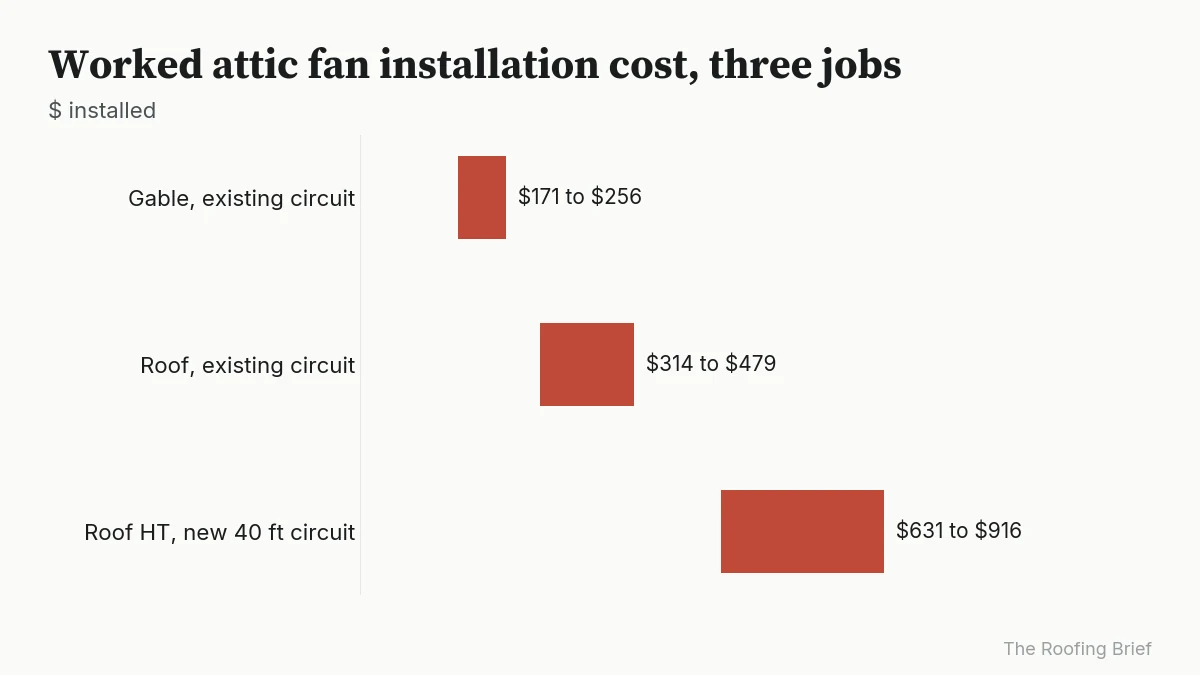
Attic fan installation typically runs $369 to $913 with a national average of $624, per Angi and HomeAdvisor data cited by Bob Vila in December 2023. Our three worked jobs, built from October 2026 fan prices and published labor rates, range from $171 for a gable fan on an existing circuit to $916 for a roof-mount humidistat model needing a new 40 ft circuit.
Labor inputs come from two dated cost guides: Bob Vila (December 2023) lists roofers at $45 to $75 per hour for about 2 hours and electricians at $50 to $100 per hour for about 1 hour, and HomeGuide (April 2024) lists new attic wiring at $7 to $10 per linear foot, roof sealant at $10 to $30 and supplies at $15 to $50. Permit fees are excluded because each jurisdiction sets its own.
| Line item | Gable, existing circuit | Roof, existing circuit | Roof HT, new 40 ft circuit |
|---|---|---|---|
| Fan (HVAC Quick, Oct 2026) | EGV5 $106 | ERV5 $149 | ERV6HT $186 |
| Roofer, 2 h at $45 to $75 | $0 | $90 to $150 | $90 to $150 |
| Electrician, 1 h at $50 to $100 | $50 to $100 | $50 to $100 | $50 to $100 |
| New circuit, 40 ft at $7 to $10 | $0 | $0 | $280 to $400 |
| Roof sealant | $0 | $10 to $30 | $10 to $30 |
| Supplies | $15 to $50 | $15 to $50 | $15 to $50 |
| Total | $171 to $256 | $314 to $479 | $631 to $916 |
Running cost adds up separately. FSEC’s 2005 literature review for Florida regulators says most electric attic ventilators draw 250 to 300 W, and Tooley and Davis estimate a typical run from 10 a.m. to 7 p.m., about 9 hours a day. At the July 2026 U.S. residential average of 18.31 cents per kWh from the EIA Electric Power Monthly, the arithmetic looks like this.
| Fan draw | Hours per day | kWh per 30-day month | Cost at 18.31 cents per kWh |
|---|---|---|---|
| 264 W (QuietCool AFG SMT PRO-3.0, high) | 9 | 71.3 | $13.05 |
| 300 W (top of FSEC range) | 9 | 81.0 | $14.83 |
The same FSEC-CR-1496-05 review says that draw, about 10% of peak air conditioner power, exceeds the roughly 6% cooling saving measured in earlier research. A solar fan removes the running cost; our solar attic fan comparison lists the models, panel sizes and prices.
When does an attic fan backfire?
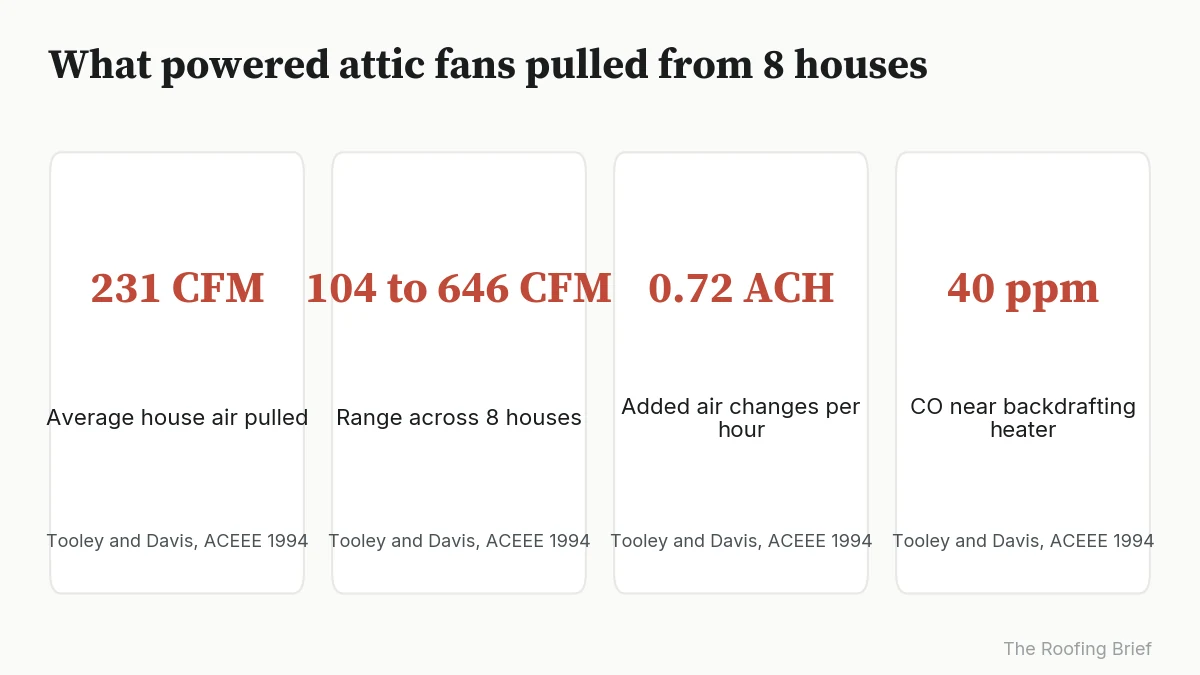
An attic fan backfires when it pulls more air than the soffits supply, because the shortfall comes from the house through ceiling gaps. In eight North Carolina houses tested in July to September 1993, running powered ventilators drew 104 to 646 CFM of conditioned air, averaging 231 CFM, and depressurized the houses by 0.5 to 2.5 pascals. One water heater stayed in complete backdraft.
| Measured result (8 houses, 1993) | Value |
|---|---|
| Average house air pulled | 231 CFM |
| Range across 8 houses | 104 to 646 CFM |
| Added air changes per hour | 0.72 ACH |
| CO near backdrafting heater | 40 ppm |
| CO in that heater’s flue at 5 minutes | 700 ppm |
| House pressure with fan running | -0.5 to -2.5 Pa |
Tooley and Davis put it in daily terms: 231 CFM x 60 minutes x 9 hours is 124,740 cubic feet of conditioned air sent to the attic each day. DOE’s Building America Solution Center adds radon pulled into basements, garage air pulled indoors, weaker bath fans and backdrafting of any appliance that is not sealed combustion.
BASC notes that ENERGY STAR does not recommend attic ventilation fans and that the Georgia State Energy Code does not allow them unless solar powered. Its mitigation list for anyone who installs one anyway:
- Air seal the ceiling first so the fan cannot pull from the living space; our attic air sealing guide lists the leak points.
- Provide ample intake, and pick a lower CFM or solar fan to create less negative pressure.
- Keep combustion equipment out of the attic and seal the house off from the garage and crawl space.
- Screen intake vents with metal mesh of 1/8 in or finer where wildfire embers are a risk.
Should you install an attic fan? Decision table
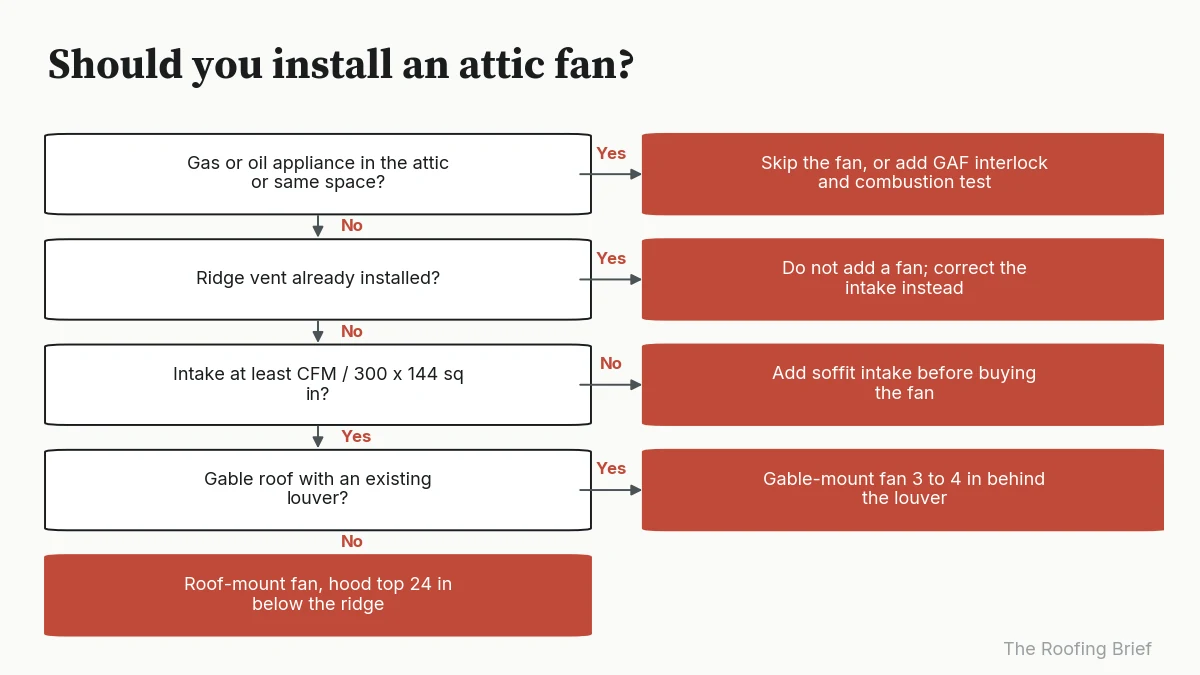
Install an attic fan only when four conditions hold: no fuel-burning appliance shares the attic, no ridge vent already serves it, intake meets the CFM / 300 x 144 rule, and the ceiling is air sealed. If any fails, fix that first or skip the fan. The table maps common situations to the action and names the maker rule or study behind each threshold.
| If your situation is | Do this | Basis |
|---|---|---|
| Gas or oil furnace or water heater in the same space | Skip the fan, or wire GAF’s required interlock and have a combustion safety test done | GAF V971381; Tooley and Davis 1994 |
| Ridge vent already installed | Do not add a fan; correct the intake instead | GAF RESMF334 balance rule |
| Intake below CFM / 300 x 144 sq in | Add soffit intake before buying the fan | Air Vent AV-005 |
| Ceiling not air sealed | Seal the attic floor first | DOE BASC |
| Gable roof with an existing louver | Gable-mount fan 3 to 4 in behind the louver | GAF V971382 |
| Hip roof, no gables, slope 2:12 or steeper | Roof-mount fan, hood top 24 in below the ridge | GAF V971381; Air Vent AV-005 |
| Slope under 2:12 | No Master Flow roof-mount; use a gable unit or a curb-mount design | GAF V971381 |
| No circuit within reach | Consider a solar unit or a plug-in model near an existing outlet | DOE BASC; HVAC Quick EZCR1 listing |
A powered fan is one of several exhaust options; our guide to ridge vents vs power attic fans compares them side by side, and the attic ventilation guide covers the 1/150 and 1/300 code ratios. A whole-house fan is a different device that cools the living space, not the attic.
How we compiled this
We compiled this from 16 primary documents opened in October 2026: GAF, Air Vent, QuietCool and Broan manuals and spec sheets, DOE Building America guidance, ACEEE and FSEC research, EIA prices, a city permit list and two retailer listings. Labor rates come from two dated cost guides. We did not install or test any fan.
Frequently asked questions
How much does it cost to have someone install an attic fan?
Most homeowners pay $369 to $913, with a national average of $624, per Angi and HomeAdvisor data cited by Bob Vila in December 2023. Our worked jobs at October 2026 fan prices run $171 to $256 for a gable fan on an existing circuit, $314 to $479 for a roof fan, and $631 to $916 when a new 40 ft circuit is needed.
Why don’t they put attic fans in houses anymore?
Building guidance turned against them. DOE’s Building America Solution Center recommends passive ventilation, notes that ENERGY STAR does not recommend attic fans, and says Georgia’s energy code bars them unless solar powered. In 1993 field tests, fans pulled an average of 231 CFM of conditioned air from eight houses, and GAF requires a furnace interlock when a fuel appliance shares the attic.
What size attic fan do I need for a 2000 square foot house?
Size by attic floor area, not living area. For a 2,000 sq ft attic, Air Vent’s 0.7 rule gives at least 1,400 CFM and 672 sq in of intake. GAF’s chart is looser, rating its 1,250 CFM Master Flow ERV5 for up to 2,200 sq ft, so check any fan you buy against the 0.7 figure.
Can I install an attic fan in an existing roof vent?
Often, yes. Broan’s 345SO instructions accept a shingle opening larger than 16 1/2 in if the roofing overlaps the ventilator by at least 2 in on every side, and a deck hole over 14 in if decking still supports the base. Patch a larger gap first, then cut to the new template.
How long does attic fan installation take?
Plan on a few hours for one fan. Bob Vila’s December 2023 cost guide puts a roofer at about 2 hours and an electrician at about 1 hour. A new circuit, an oversized old vent hole or several fans add time; a gable fan behind an existing louver needs no roof work.
Can I install an attic fan myself?
A handy owner can mount a gable fan, but GAF’s Master Flow manuals say wiring should be done by a qualified person under the National Electrical Code. A roof-mount job means cutting a 15 or 17 in deck hole near the ridge and flashing it, so plan fall restraint and check permits first.
Is an attic fan necessary with ridge vents?
No, and adding one usually hurts. GAF’s Master Flow spec sheet says ridge exhaust should never exceed soffit intake, and DOE’s Building America guidance warns that more exhaust area than intake area raises negative pressure in the attic. With a working ridge vent, spend the money on soffit intake and ceiling air sealing.
Do attic fans really work?
They cool the attic, but the house saves less than expected. FSEC’s 2005 review says a 250 to 300 W ventilator uses about 10% of peak air conditioner power, more than the roughly 6% cooling saving measured. DOE’s Building America guidance recommends passive ventilation over attic fans for most homes.
Sources
- GAF, Master Flow Power Attic Vent Roof Mount Installation Instructions V971381 (updated 3/15), accessed Oct 2026
- GAF, Master Flow Power Attic Vent Gable Mount Installation Instructions V971382 (updated 6/15), accessed Oct 2026
- GAF, Master Flow Power Attic Vent Roof Mount spec sheet RESMF334 (January 2023), accessed Oct 2026
- Air Vent, Power Vents Electric and Solar sell sheet AV-005 (September 2026), accessed Oct 2026
- Air Vent, 2026 Ventilation Catalog VC021726A, accessed Oct 2026
- Air Vent, Power Vents product page (motor amperage), accessed Oct 2026
- Air Vent, Power Vents brochure AVI063 (June 2017), accessed Oct 2026
- QuietCool, AFG SMT PRO-3.0 Specifications (Rev. 2/8/23), accessed Oct 2026
- Broan-NuTone, Models 345SOBK and 345SOWW Roof-Mount Solar Powered Attic Ventilator instructions, accessed Oct 2026
- U.S. DOE Building America Solution Center (PNNL), Attic Ventilation Fans, accessed Oct 2026
- Tooley, J.J. and Davis, B.E., Powered Attic Ventilators, ACEEE Summer Study 1994, accessed Oct 2026
- Parker, D.S., Literature Review of the Impact and Need for Attic Ventilation in Florida Homes, FSEC-CR-1496-05 (May 2005), accessed Oct 2026
- U.S. EIA, Electric Power Monthly Table 5.6.A, July 2026 data (released September 24, 2026), accessed Oct 2026
- City of Newport Beach, Citizen Access Self Service permit list, accessed Oct 2026
- HVAC Quick, attic fans listing (prices seen October 2026), accessed Oct 2026
- Maxx Air, roof mount power attic ventilators store page (prices seen October 2026), accessed Oct 2026
- HomeGuide, Attic Fan Installation Cost (April 19, 2024), cost aggregator, accessed Oct 2026
- Bob Vila, What You Need to Know About Attic Fan Installation Cost (updated December 19, 2023), cost aggregator, accessed Oct 2026