
By The Roofing Brief Team. Last reviewed: October 2026.
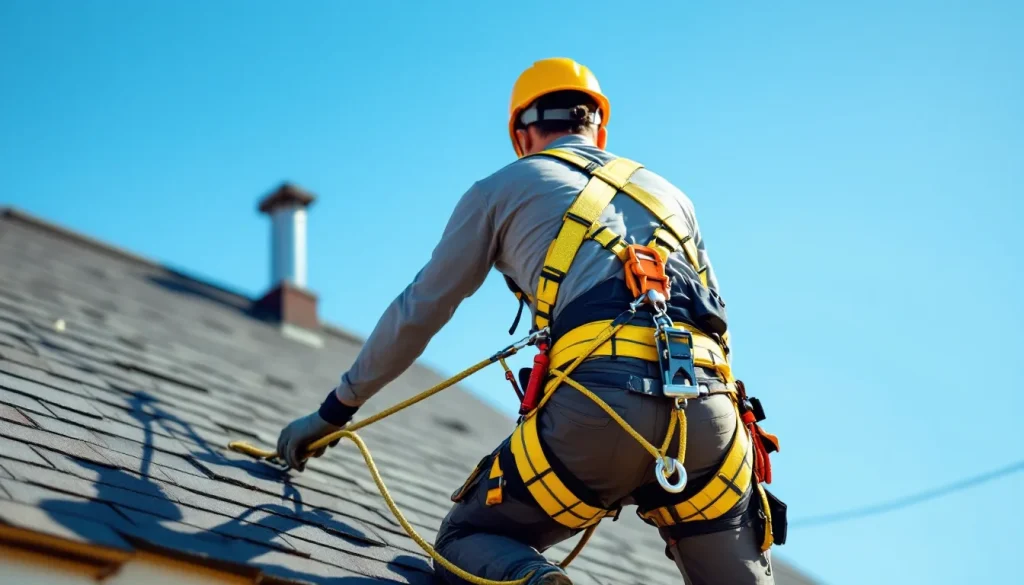
A roof safety harness anchor is the tie-off point your personal fall arrest system hangs from, and OSHA 29 CFR 1926.502(d)(15) requires it to support at least 5,000 lb per worker attached, or to be designed with a safety factor of at least two under a qualified person’s supervision. How to use a roof safety harness, in plain terms: put on a properly sized full-body harness with the D-ring in the center of your back near shoulder level, attach a shock-absorbing lanyard or self-retracting lifeline to that D-ring, connect the other end to a 5,000 lb anchor fastened through the sheathing into a rafter or truss, and set the line so a fall stops before you reach the eave or the ground. OSHA 1926.501(b)(13) requires fall protection at 6 feet or more on residential construction work. The harness alone does nothing; the full system of harness, connector, anchor and correct clearance is what stops the fall. Roofers recorded 104 fatal work injuries in 2024 and 113 in 2023, 95 of them falls, per the BLS Census of Fatal Occupational Injuries (see our roofing safety fatality report).
The short version
- OSHA 1926.501(b)(13) requires fall protection at 6 feet or more on residential construction work. State-plan states such as California (Cal/OSHA) enforce their own rules, which must be at least as effective as federal OSHA.
- A complete personal fall arrest system (PFAS) has three parts: full-body harness, connecting device (lanyard or self-retracting lifeline), and anchor rated to 5,000 lb.
- The D-ring goes in the center of your back near shoulder level, per OSHA 1926.502(d)(17). Front D-rings are for positioning only, not fall arrest.
- Total fall distance equals lanyard length plus deceleration distance plus harness stretch plus your height. On a 6 foot lanyard, plan for 18.5 feet of clearance.
- Temporary roof anchors fasten through the sheathing into a rafter or truss with the fasteners named on the anchor’s own label: the FallTech 7410, for example, ships with 16D nails and is rated 5,000 lb minimum static strength.
- The biggest weekend DIY mistake: anchoring to a ridge vent, a fascia, or a single nail. None of those are 5,000 lb anchors. Use a real roof anchor or stay off the roof.
Roof safety harness anchor: which anchor and tie-off to use
Match the anchor and connector to the roof and the clearance below it. Thresholds come from OSHA 29 CFR 1926.500 to 1926.502 and the makers’ own product pages.
| If | Use | Rule or threshold | Source |
|---|---|---|---|
| Roof slope is greater than 4:12 (a “steep roof”) and the edge is 6 ft or more above the ground | Guardrail with toeboards, safety net, or a personal fall arrest system (PFAS) | Slope over 4 in 12; 6 ft trigger | 1926.500(b), 1926.501(b)(11) |
| Roof slope is 4:12 or less (a “low-slope roof”) and you are doing roofing work | Guardrail, net, PFAS, or a warning line combined with one of those; a safety monitor alone only on roofs 50 ft wide or less | Slope 4 in 12 or less; 50 ft width | 1926.501(b)(10) |
| Residential job and guardrail, net and PFAS are all claimed infeasible | A written, site-specific fall protection plan | Employer must prove infeasibility or greater hazard | 1926.501(b)(13), 1926.502(k) |
| Reroof or repair on a wood deck, anchor removed after the job | Reusable wood roof anchor nailed into framing (FallTech 7410: 16D nails, up to 12/12 pitch) | 5,000 lb minimum static strength | FallTech 7410 page |
| Reusing an anchor on a second job | Same anchor, new fasteners | DEWALT DXFP842001 is “designed for multiple use with new fasteners” | DEWALT DXFP842001 page |
| New roof build, anchor left under the shingles | Single-use ridge anchor such as Guardian Ridge-It 00515 | Guardian states it is not reusable; butyl strip for long-term use | Guardian Ridge-It page |
| Less than about 18.5 ft of clear fall distance below the anchor | Self-retracting lifeline instead of a 6 ft shock lanyard | Worked clearance example in Step 4 | 1926.502(d)(16)(iii) |
| Two workers tied to one anchor | An anchorage rated for both | 5,000 lb per employee attached | 1926.502(d)(15) |
The short answer: what a safety harness system actually does
A safety harness system does not prevent falls. It arrests them after they start. Under OSHA 1926.502(d)(16), a compliant PFAS limits free fall to 6 feet, caps the arresting force on a harness wearer at 1,800 lb, and stops the worker within 3.5 feet of deceleration, without contact with any lower level. Then it holds the worker in suspension until rescue, which is why the rescue plan below is part of the system.
A complete personal fall arrest system (PFAS, the OSHA term) has three parts: the harness on your body, the connecting device (a lanyard or a self-retracting lifeline) running from your harness to the anchor, and the anchor itself. All three have to work. A perfect harness anchored to a fascia board fails on the first fall.
OSHA 1926.501: what the rule actually says
OSHA 29 CFR 1926.501 sets fall protection requirements for construction work. For residential construction, paragraph (b)(13) sets the trigger at 6 feet (1.8 m) or more above a lower level. At or above 6 feet, one of the following must be in place:
- Guardrail system on the working edge (with toeboards on a steep roof, per 1926.501(b)(11))
- Safety net system at or below the working level
- Personal fall arrest system (the harness method, the focus of this article)
- A written fall protection plan under 1926.502(k), only where the employer can show the three conventional systems are infeasible or create a greater hazard
The maximum federal OSHA penalty is $16,550 per serious violation and $165,514 per willful or repeated violation, per OSHA’s penalties page as checked in October 2026. State-plan programs such as Cal/OSHA (California), DOSH (Washington), Oregon OSHA and MIOSHA (Michigan) write their own construction safety orders, which must be at least as effective as the federal rule, so check the state text before relying on the federal 6 foot trigger. For a pre-climb check of the roof itself, use our 30-point inspection guide.
What changed in residential enforcement
OSHA’s 1999 interim residential guidance, STD 03-00-001 (successor to the 1995 STD 3.1 policy), allowed alternative methods such as slide guards and work practice plans instead of conventional fall protection on residential roofs. OSHA replaced it with directive STD 03-11-002, dated December 16, 2010 and effective June 16, 2011. Since then, residential roofing employers must meet 1926.501(b)(13): guardrail, net or PFAS, with a 1926.502(k) fall protection plan only where they can prove those are infeasible. Slide-guard-only advice still circulates online; it reflects the rescinded policy.
OSHA roof anchor and tie-off requirements
These are the federal numbers every roof tie-off has to meet, quoted from 29 CFR 1926.502(d). A system that misses any one of them is not a compliant PFAS.
| Requirement | Federal limit | Section | Source |
|---|---|---|---|
| Anchorage strength | 5,000 lb (22.2 kN) per employee attached, or designed with a safety factor of at least two under a qualified person | 1926.502(d)(15) | OSHA 1926.502 |
| Maximum arresting force, body harness | 1,800 lb (8 kN) | 1926.502(d)(16)(ii) | OSHA 1926.502 |
| Maximum free fall | 6 ft (1.8 m), with no contact with any lower level | 1926.502(d)(16)(iii) | OSHA 1926.502 |
| Maximum deceleration distance | 3.5 ft (1.07 m) | 1926.502(d)(16)(iv) | OSHA 1926.502 |
| Harness attachment point | Center of the wearer’s back near shoulder level, or above the head | 1926.502(d)(17) | OSHA 1926.502 |
| Rescue | Employer must provide for prompt rescue, or ensure workers can rescue themselves | 1926.502(d)(20) | OSHA 1926.502 |
| Fall protection trigger, residential | 6 ft or more above a lower level | 1926.501(b)(13) | OSHA 1926.501 |
The four components of a complete system
| Component | Function | OSHA spec | Typical brand examples |
|---|---|---|---|
| Full-body harness | Distributes arrest forces across the torso, holds you upright after fall | ANSI Z359.11, dorsal D-ring required for fall arrest | Werner H511202W (Home Depot, $49.98); Werner, Guardian Fall Protection, Malta Dynamics and Miller (Honeywell) all sell ANSI harnesses |
| Lanyard or self-retracting lifeline (SRL) | Connects harness to anchor, absorbs shock | Max arresting force 1,800 lb, max deceleration 3.5 ft (1926.502(d)(16)) | Werner 6 ft shock-absorbing lanyard (Home Depot, $44.98); Honeywell Miller TurboLite+ personal fall limiter ($144.00); FallTech 72706SB4 6 ft web SRL ($199.20) |
| Anchor point | The dead-stop point | 5,000 lb static load, or 2x max arrest force with engineered system | FallTech 7410 reusable ($46.00); Werner A210402W temporary ($22.98, Home Depot); DEWALT DXFP842001 reusable ($25.95, Home Depot); Guardian Ridge-It 00515 single-use |
| Rope grab (rope-line systems) | Lets you move along a vertical lifeline | ANSI Z359.15 | Included in roofer kits such as the Ironwear 2880 (harness, roof anchor, rope and rope grab, $104.94) |
Prices in this guide are retailer listings checked on Google Shopping on October 19, 2026. Bundled roofer kits ran from $114.98 (DEWALT Rooftop Safety Kit, Home Depot) and $145.00 (Guardian Complete Fall Protection Kit, Lowe’s) to $660.00 (3M DBI-SALA 2104169 Roofer’s Kit, Industrial Safety Products).
Step 1: select and fit the harness
Full-body harnesses come in three sizing tiers: standard, universal (one size with wide adjustment), and sized small or XL/XXL. Pick from the maker’s size chart, and check the capacity range on the label against your weight with tools: ANSI-rated fall protection is commonly labeled 130 to 310 lb, and FallTech labels its 7410 anchor 130 to 310 lb under ANSI and up to 425 lb under OSHA. An oversized harness lets the wearer slip or rotate during arrest.
Putting it on correctly
- Hold the harness by the dorsal D-ring (the metal ring on the back) and shake it out so the straps hang free.
- Put your arms through the shoulder straps as if putting on a vest.
- Pull the leg straps up between your legs and clip them at the hips. The leg strap buckles should be even on both sides.
- Connect the chest strap across the sternum. It should sit at mid-chest, not at the throat or below the ribs.
- Tighten all straps until you can fit two fingers (no more, no less) between strap and body.
- Confirm the D-ring sits centered between your shoulder blades, not riding up to the neck or down to the lumbar.
The D-ring position check
If you are wearing a PFAS correctly, the D-ring sits between your shoulder blades. OSHA 1926.502(d)(17) puts the harness attachment point “in the center of the wearer’s back near shoulder level, or above the wearer’s head.” Reach behind your back and feel for the dorsal D-ring. If it rides up to the neck, the shoulder straps are too long; if it sits at the lumbar, they are too short. Adjust before climbing.
Front D-rings are for positioning, not arrest
Many harnesses have a sternum or hip D-ring in front. These are for work positioning, rope access and ladder climbing systems, not for roof fall arrest. OSHA’s 1926.502(d)(17) attachment rule points to the back D-ring, and a fall caught on a hip ring pitches the worker sideways and loads the waist. Use the dorsal (back) D-ring for fall arrest, every time.
Step 2: pick a connecting device
The connecting device is the rope, webbing, or cable that runs from your harness D-ring to the anchor. Three options for residential roof work:
Shock-absorbing lanyard (6 foot, standard)
A 6-foot webbing lanyard with a built-in deceleration pack. The pack tears under load to absorb shock and keep arrest force within OSHA’s 1,800 lb limit. Cheapest option: the Werner 6 ft shock-absorbing lanyard listed at $44.98 at Home Depot and the FallTech A8259 at $79.99 at True Value in October 2026. Plan for about 18.5 feet of fall clearance below the anchor (Step 4).
Self-retracting lifeline (SRL)
An automatic-retracting cable or webbing line that pays out as you move and locks under sudden load. The arrest distance is printed on the unit’s label (ANSI Z359.14 Class A devices are built to arrest within 24 inches), so you can work closer to edges with less clearance. Listed prices for 6 ft web units in October 2026 ran $144.00 (Honeywell Miller TurboLite+) to $199.20 (FallTech 72706SB4). Best option for roof work where you need mobility.
Rope grab on a vertical lifeline
A vertical rope hangs from the anchor; a rope grab device on your harness slides up and down the rope and locks on sudden load. Lets you move up and down the slope without re-tying. Best for repeated trips up and down the same roof. Kits that bundle the rope grab, rope, harness and anchor were listed at $104.94 (Ironwear 2880) to $139.51 (Werner K111201) in October 2026.
Step 3: install the anchor
The anchor is the single most important component because it has to hold 5,000 lb per worker attached under 1926.502(d)(15). Roofers anchor to one of these:
Temporary roof anchor (screw-down)
A metal bracket with pre-drilled holes that gets nailed or screwed through the sheathing into a rafter or truss, using the fastener type and count printed on the anchor’s label, so the anchorage keeps its 5,000 lb rating under OSHA 1926.502(d)(15). The anchor stays in place until the job is done, then comes off and the holes are sealed.
| Anchor | Type | Published spec | Listed price (Oct 2026) | Source |
|---|---|---|---|---|
| FallTech 7410 Hinged Reusable Wood Roof Anchor | Reusable | 16D nails included; 5,000 lb min. static strength; flat to 12/12 pitch; OSHA 1926.502 and 1910.66 | $46.00 (Fall Protection Distributors) | FallTech |
| DEWALT DXFP842001 Reusable Rooftop Anchor | Reusable | Screws or nails depending on pitch; “designed for multiple use with new fasteners” | $25.95 (Home Depot) | DEWALT |
| Guardian Ridge-It 00515 | Single-use, left in place | Nails included; butyl strip against water intrusion; not reusable; OSHA 1910.140 and 1926.502 | $27.59 for the 00500 listing (Energy Safety Supply) | Guardian |
| Werner A210402W Temporary D-Ring Roof Anchor | Temporary | Fastener schedule on the product label | $22.98 (Home Depot) | Retailer listing |
Install over a rafter or truss, not between them, and drive every fastener the label calls for: FallTech’s 7410 uses 16D nails, and DEWALT tells users of its DXFP842001 to fit new fasteners on every reuse. After removal, seal the holes and replace any shingle the fasteners went through; a reused anchor on old nail holes no longer has a known 5,000 lb rating.
Permanent roof anchor
For homes where roof work happens regularly (chimney sweeps, solar maintenance, HVAC service), a permanent anchor screwed into a structural ridge beam and integrated under the ridge cap is the better answer. The Werner A230302W permanent roof anchor was listed at $19.97 at Home Depot in October 2026; installation into the ridge framing is extra. To price the roof work around it, use our roof cost estimator guide.
What does NOT count as an anchor
- A ridge vent (sheet metal, will tear)
- A fascia board (will pull out)
- A plumbing vent stack (will bend or break the seal)
- A truck on the ground (will move if hit hard enough)
- A second person holding a rope (will not stop a real fall)
- A single nail or screw (5,000 lb requirement applies to single-anchor systems)
The 5,000 lb figure in 1926.502(d)(15) is a fixed per-worker rule that needs no engineering. The only alternative is an anchorage designed, installed and used under the supervision of a qualified person as part of a complete PFAS with a safety factor of at least two. A vent, a fascia board or a single nail meets neither path.
Step 4: calculate fall clearance
OSHA 1926.502(d)(16)(iii) requires the system to be rigged so the worker cannot “contact any lower level.” Total fall distance is the number that checks this: a harness system can work perfectly and still fail if the ground is closer than the distance it needs to stop you.
The standard formula
Total fall distance = lanyard length + deceleration distance + harness stretch + worker height + safety factor
| Component | Typical value |
|---|---|
| Lanyard length | 6 feet (standard) |
| Deceleration distance | 3.5 feet (max under OSHA) |
| Harness stretch | 1 foot |
| Worker height (D-ring to feet) | 5 feet |
| Safety factor | 3 feet |
| Total clearance required | 18.5 feet below anchor |
Measure the drop from the anchor to the ground (or the next lower level) and compare it with the 18.5 feet in the table. If the anchor sits at least 18.5 feet above the lower level, a 6 ft lanyard works; if not, switch to an SRL. An anchor 6 feet up the slope from the eave almost never passes this check. If your anchor is too low on the slope, a 6 foot lanyard lets you fall past the eave before the arrest completes.
The SRL alternative
A self-retracting lifeline locks within inches of a sudden load, and Class A units under ANSI Z359.14 are built to arrest within 24 inches. Rerun the formula with the label’s arrest distance in place of the 6 ft lanyard plus 3.5 ft deceleration, and the required clearance drops by several feet. On single-story roofs where the anchor sits less than 18.5 feet above the ground, an SRL is usually the only fall arrest option that fits.
Step 5: working on the roof
Once the system is set up, the discipline is keeping slack out of the line and the anchor above you, so any free fall stays well under OSHA’s 6 foot limit. Grip still matters while you are tied off; on steel panels, see our guide to footwear for walking a metal roof.
The 100% tie-off rule
You are tied off the entire time you are on the roof. Detaching to move to a new anchor location leaves you with no protection at all. Use a two-leg (Y) lanyard and clip the second leg to the new anchor before unclipping the first, so one leg rated to the same 5,000 lb anchorage is always connected.
Stay below your anchor (the swing fall problem)
If you fall while positioned to the side of the anchor instead of directly below it, you swing on the lanyard like a pendulum. The swing can drive you into the eave, a wall, or the ground even though the lanyard arrested the vertical fall, and OSHA 1926.502(d)(16)(iii) bars contact with any lower level. Work as close to directly below the anchor as you can, follow the swing-fall limit in the connector’s manual, and add a second anchor rather than working far to one side.
Working at the eave
The eave is where the fall clearance math is tightest. Set the rope grab or lanyard length so you cannot reach the eave edge without deliberately moving the grab down, which turns the system into restraint for most of the job and keeps any free fall far below OSHA’s 6 ft limit.
Self-retracting lifeline (SRL) vs lanyard
| Factor | Shock lanyard | Self-retracting lifeline |
|---|---|---|
| Listed price, Oct 2026 | $44.98 (Werner, Home Depot) to $79.99 (FallTech A8259) | $144.00 (Miller TurboLite+) to $199.20 (FallTech 72706SB4) |
| Arrest distance | Up to 3.5 feet deceleration (OSHA max) | Per label; ANSI Z359.14 Class A: 24 inches max |
| Total clearance required | About 18.5 feet (Step 4 example) | Recalculate with the label arrest distance |
| Mobility | Fixed length (6 feet) | Pays out and retracts automatically |
| Best for | Single-spot work on tall structures | Active roof work, single-story, repeated moves |
| Maintenance | Inspect before each use | Inspect before each use, plus the periodic competent-person or factory service the maker’s manual sets |
For most residential roof work, SRLs win on safety because the shorter arrest distance gives more clearance margin and the auto-retract keeps slack out of the system. The price gap in October 2026 listings was about $100: $44.98 for a Werner shock lanyard versus $144.00 for a Miller TurboLite+.
Pre-use inspection checklist
Every piece of fall protection equipment gets inspected before every use. Tag and remove from service any item that fails inspection.
Harness
- No frayed webbing, cuts, burns, or chemical damage
- All stitching intact (red warning threads not exposed)
- D-ring not bent, cracked, or showing wear marks
- All buckles function smoothly and lock
- No corrosion on metal hardware
- Within the service life the maker states in the manual, and never used again after arresting a fall
Lanyard or SRL
- Snap hooks open and lock with positive engagement
- Shock absorber pack not deployed (no visible tear-out)
- Webbing or cable free of damage
- SRL retracts smoothly and locks on quick pull
- Service tag current
Anchor
- All lag bolts torqued to spec
- Bolts into solid wood (a rafter or truss, not just sheathing)
- No corrosion or cracking on the anchor plate
- Manufacturer label visible and legible
What kills weekend DIYers most often
1. No fall protection at all
The most common failure mode. Homeowner climbs the ladder, walks on the roof, slips. No harness, no anchor, nothing. Among paid roofers, the BLS Census of Fatal Occupational Injuries counted 95 fall deaths out of 113 roofer fatalities in 2023; homeowners working on their own houses are not in those counts at all.
2. Anchored to the wrong thing
Lanyard tied to a ridge vent, a vent stack, or a single nail. These are not 5,000 lb anchors. In a real fall, the anchor fails and the harness becomes useless.
3. Anchor too low on the slope
Worker installs the anchor 6 feet up from the eave because the ridge is too steep to climb to. On a fall, the worker reaches the ground before the lanyard arrests because the math doesn’t work. Anchor at the ridge or use an SRL.
4. Lanyard too long for available clearance
Single-story home, 6 foot lanyard, anchor at the ridge 12 feet up. The worker falls off the eave and hits the ground at full speed because the 18.5 foot clearance requirement isn’t met. SRL or shorter lanyard required.
5. Detaching to move
Worker reaches a spot where the lanyard won’t quite reach. Unhooks for “just a second” to move closer. Slips during the unhooked moment, when none of the 1926.502(d)(16) limits apply because nothing is connected. A Y-lanyard with two 6 ft legs or a second anchor fixes this.
6. Suspension trauma after a successful arrest
Worker falls, lanyard arrests the fall, worker hangs in the harness. Blood pools in the legs, and OSHA’s Safety and Health Information Bulletin SHIB 03-24-2004 cites research that suspension in a fall arrest device can result in unconsciousness, followed by death, in less than 30 minutes. Plan rescue before the fall, not after.
Suspension trauma and rescue planning
OSHA 1926.502(d)(20) requires employers to “provide for prompt rescue of employees in the event of a fall” or make sure workers can rescue themselves. SHIB 03-24-2004 adds that a worker who cannot be rescued promptly should “pump” the legs to limit venous pooling. For DIY homeowners and small crews, the practical options are:
- Suspension trauma straps. Foot loops attached to the harness that the worker deploys after a fall to stand in, the footholds SHIB 03-24-2004 recommends. Listed at $24.00 (Werner T320000) to $33.99 (Honeywell Miller) in October 2026. Should be on every harness used on residential roof work.
- Ground rescue plan. A second person on the ground with an extension ladder that reaches at least 3 feet above the eave (the OSHA 1926.1053(b)(1) setup rule), ready to climb to the suspended worker, take their weight and help them down.
- 911 call. Default backup, not a plan on its own: ask your local fire department whether it runs a rope rescue team and how long it takes to reach your address, and compare that with the under-30-minute window SHIB 03-24-2004 describes.
For employers, working a crew on a PFAS with no rescue provision breaks 1926.502(d)(20). OSHA does not cover homeowners working on their own houses, but the suspension timeline is the same, so a second person on the ground is the minimum reasonable practice for DIY work.
Cost of a complete homeowner kit
Listed prices below are from Google Shopping retailer listings checked on October 19, 2026. Prices move often, so treat them as a snapshot.
| Item | Spec | Example product and listed price | Source |
|---|---|---|---|
| Full-body harness | ANSI Z359.11, dorsal D-ring | Werner H511202W adjustable harness, $49.98 | Home Depot listing |
| 6-foot shock-absorbing lanyard | ANSI Z359.13 | Werner 6 ft shock-absorbing lanyard, $44.98 | Home Depot listing |
| Temporary roof anchor | 5,000 lb rated | Werner A210402W, $22.98; DEWALT DXFP842001, $25.95 | Home Depot listings |
| Fasteners | As named on the anchor label (16D nails on the FallTech 7410) | Often included with the anchor | Maker pages |
| Suspension trauma straps | Pair, harness-mounted | Werner T320000, $24.00 | ToolUp.com listing |
| Helmet (recommended) | ANSI Z89.1 Type I or II | Price varies by type | Not priced here |
| Bundled roofer kit | Harness, lifeline or lanyard, anchor | $114.98 (DEWALT) to $254.24 (Condor 53RG06) | Home Depot, Grainger listings |
Pre-packaged kits bundle the harness, connector and anchor: DEWALT Rooftop Safety Kit $114.98 (Home Depot), Werner K111201 $139.51, Guardian Complete Fall Protection Kit $145.00 (Lowe’s), FallTech 8595A $193.60. Add trauma straps and a helmet separately. See our broader roof safety guide for ladder safety and ground prep.
When to skip DIY entirely
Some roof work is not a reasonable DIY job regardless of harness use:
- Pitch above 8:12 without prior roofing experience. Steep roofs are physically different to work on. The harness saves your life when you slip; it doesn’t make the work easier.
- Three-story homes. Clearance math and anchor placement get harder, and an anchor low on the slope that cannot give 18.5 ft of clearance needs an SRL plus a second anchor to control swing.
- Wet, icy, or windy conditions. Postpone the work, regardless of harness setup.
- Solo work with no ground person. Even with a perfect system, rescue planning fails when there’s no one to call 911 and help.
- Active leak diagnosis where you don’t know what you’re looking for. Hire a roofer. See how to fix a roof leak.
Frequently asked questions
Do I really need a harness for a quick roof inspection?
If you are above 6 feet of fall distance (any single-story home and up), OSHA requires fall protection for occupational work. For homeowner non-occupational work, OSHA doesn’t apply, but the physics do. The fall doesn’t care whether you were getting paid. Bundled roofer kits were listed from $114.98 in October 2026 and live in the garage between uses.
What’s the difference between a harness and a body belt?
A body belt wraps around the waist only and is no longer OSHA-acceptable for fall arrest. Arrest forces concentrated at the waist can injure internal organs and the wearer often inverts after arrest. Full-body harnesses distribute force across the torso and keep you upright. Under OSHA 1926.502(d)(16)(i), a body belt system is limited to 900 lb of arresting force, half the 1,800 lb allowed with a harness, and body belts are now used only for positioning.
Where do I anchor on a roof with no ridge access?
Use a temporary roof anchor such as the FallTech 7410 or DEWALT DXFP842001, placed at the highest point you can reach safely and fastened through the sheathing into a rafter with the fasteners on its label. Check that the anchor still leaves about 18.5 feet of clearance for a 6 ft lanyard, or switch to an SRL. Seal the fastener holes after removal.
How long does a harness last?
Service life is whatever the maker states in the harness manual; some makers set a fixed number of years from manufacture and others retire a harness only on inspection. Sun exposure, chemical contact, and storage conditions shorten it. OSHA 1926.502(d)(21) requires inspection before every use, and (d)(19) pulls any component that took a fall load out of service until a competent person clears it. Tag out and replace any harness that has arrested a fall, shows webbing damage, or is past its service date.
Can I share my harness with my brother?
Sharing a harness is fine if it is refitted to each user before use and both users fall inside the capacity range on its label (ANSI-rated gear is commonly labeled 130 to 310 lb). Each user readjusts the leg, chest and shoulder straps until two fingers fit under each strap and the D-ring sits between the shoulder blades.
Where should the D-ring be if you are wearing a PFAS correctly?
Between your shoulder blades. OSHA 1926.502(d)(17) requires the body harness attachment point to be in the center of the wearer’s back near shoulder level, or above the wearer’s head. It does not belong across the chest or at the waist for fall arrest.
What are the OSHA roof anchor requirements?
Under OSHA 1926.502(d)(15), an anchorage for personal fall arrest must support at least 5,000 lb per employee attached, or be designed, installed and used under a qualified person’s supervision with a safety factor of at least two. It must also be independent of any anchorage used to support or suspend platforms.
How do you tie off on a roof?
Fasten a rated roof anchor into a rafter or truss near the ridge, put on a full-body harness with the back D-ring near shoulder level, and connect the D-ring to the anchor with a shock-absorbing lanyard, rope grab on a lifeline, or SRL. Check clearance (about 18.5 feet below the anchor for a 6 ft lanyard) and stay tied off 100% of the time with a two-leg lanyard when moving between anchors.
Bottom line
A safety harness without a proper anchor is theater. The system works when the harness fits correctly, the lanyard or SRL is rated and inspected, the anchor is engineered to 5,000 lb and installed into structural framing, and the fall clearance math works for the height of the anchor. All four conditions, every time you go on the roof.
For homeowners, the calculation is straightforward: bundled kits were listed from $114.98 in October 2026, and the clearance math takes one tape measure. Get the kit, learn the math, and remember that BLS counted 104 roofer deaths in 2024, most of them falls, among people who do this for a living. For the broader roof safety context including ladder use, ground prep, and personal protective equipment, see our roof safety guide.