
By The Roofing Brief Team | Last reviewed: October 2026
Soffit lighting is a set of fixtures recessed into or mounted under the roof overhang. Buy fixtures marked at least for damp locations, match them to the cavity depth, and space them about 1.2 times their height above grade.
Key takeaways
- A roofed open porch or overhang is a damp location under the NEC (NFPA 70) Article 100 definition, which OSHA restates in 29 CFR 1910.399; a fixture exposed to weather needs a wet listing.
- NEC 410.10(A) requires luminaires in wet or damp locations to be marked for that use, per the St. Paul 2023 NEC dwelling checklist.
- A 6 in. IC airtight can housing stands 7.5 in. tall (1000Bulbs listings, Oct 2026); a wafer light body is 1.1 to 1.2 in. tall, with a remote driver box that needs 3 in. of space.
- The Lithonia WF6 spec sheet lists a spacing-to-mounting-height ratio of 1.2, so a soffit 10 ft above grade takes fixtures at 12 ft centers.
- Installed recessed lights run $176 to $328 each (Fixr, updated Jan 31, 2025); a wet-listed 6 in. wafer fixture sold for $27.73 at 1000Bulbs in October 2026.
What types of soffit lighting fixtures are there?
Four fixture families cover nearly every soffit lighting job: recessed can housings with a trim, canless wafer downlights, low-voltage puck or pin lights, and permanent LED track lighting. They differ in the cavity depth they need, in voltage (120 V line voltage or 12 V to 36 V low voltage), and in how they mount to a thin vinyl or aluminum soffit panel.
| Fixture type | Named example | Key spec | Listing on the source page | Price seen | Source |
|---|---|---|---|---|---|
| Recessed can housing (needs a separate trim) | ELCO EL770ICDXA 6 in. new construction | 7.5 in. tall, IC rated, airtight | Wet location badge | $26.62 each | 1000Bulbs, Oct 2026 |
| Canless wafer downlight | Lithonia WF6 LED, 30K40K50K, 90 CRI | 1.1 in. tall, 14 W, 1,099 lm at 3000K, remote driver box needs 3 in. plenum | “Suitable for wet location, covered ceiling”; airtight to ASTM E283 | Not listed on sheet | Lithonia spec sheet, Rev. 03/23/23 |
| Canless wafer downlight | Juno WF6 SWW5 90CRI MW M6 | 1.2 in. tall, 13 W, 1,000 lm, 5 selectable CCTs | IC rated, wet location, 3-year warranty | $27.73 each | 1000Bulbs, Oct 2026 |
| Canless regressed downlight | Halo HLBC6, 6 in. | 16 W, 900 or 1,100 lm selectable, 90 CRI | Air-tite and wet location listed | Not listed | Cooper Lighting product page |
| Low-voltage puck or pin light | DEKOR LED Soffit Light | 12 VDC, housing 2 in. long by 1/2 in. wide | Not stated on the product page | $32.52 each | DEKOR, Oct 2026 |
| Permanent LED track lighting | Govee Permanent Outdoor Lights 2, H705E (100 ft) | 72 lights at 40 lm each, 72 W, about 417 mm between lights | String IP67, control box and adapter IP65 | $279.99 shown | Govee US store, Oct 2026 |
Can housings give the widest trim choice but need the deepest cavity. Wafer lights such as the Lithonia WF6 install from below through a hole no larger than 6-1/4 in., per the spec sheet, which suits a finished soffit. Puck lights run from a separate 12 V transformer, and the DEKOR soffit lighting collection lists every fixture at 12 VDC.
Every fixture in the table aims down at the walk and the base of the wall. For light that also washes up the siding, DEKOR sells a Recessed Up/Down LED light at $18.76, drilled with a 0.900 in. Forstner bit, and lists outdoor soffits, decks and railings as intended uses on its product page (October 2026).
Permanent track lighting is a different product: an aluminum channel with programmable LED points along the eave edge rather than in the soffit field. The Govee H705E page states the string cannot be cut and must plug into a covered, weatherproof Class A GFCI receptacle. Our guide to the four types of roof lights covers permanent roofline lighting as a category.
Do soffit lights need a wet or damp location rating?
Yes. Every soffit light needs at least a damp location marking, and a wet location marking where rain, spray or runoff can reach it. OSHA 29 CFR 1910.399, which restates the NEC Article 100 definitions, names “roofed open porches” and areas “under canopies” as damp, and “locations unprotected and exposed to weather” as wet. A wet-listed fixture may go in a damp spot; the reverse is not allowed.
| Location class | Code definition (abridged) | Typical soffit case | Marking required | Source |
|---|---|---|---|---|
| Dry | Not normally subject to dampness or wetness | Interior kitchen or hallway soffit | None beyond the listing | 29 CFR 1910.399 |
| Damp | Partially protected locations under canopies, marquees, roofed open porches | Boxed eave soffit or porch ceiling under a roof | “Suitable for Damp Locations” or “Suitable for Wet Locations” | 29 CFR 1910.399; NEC 410.10(A) |
| Wet | Locations unprotected and exposed to weather, or subject to saturation | Open pergola, carport edge, soffit within reach of wind-driven rain or a hose | “Suitable for Wet Locations” | 29 CFR 1910.399; NEC 410.10(A) |
Fixture makers test to UL 1598, the luminaire safety standard. A DMF Lighting technical bulletin (May 25, 2017) explains that UL 1598 has three wet location tests (rain, sprinkler and immersion), and that a recessed downlight used in ceilings protected from outside moisture takes the sprinkler test: 4 hours at 20 psi. That is why some sheets read “wet location, covered ceiling”, as the Lithonia WF6 sheet does: the listing assumes a roof above the fixture.
Ask your inspector one specific question before you buy: does the jurisdiction treat the eave soffit as damp or wet? The St. Paul checklist cites NEC 110.3 and 410.6, so the fixture must carry a mark from a Nationally Recognized Testing Laboratory (UL, ETL or CSA) and be installed per its listing instructions.
How deep does the soffit need to be, and does the fixture need an IC rating?
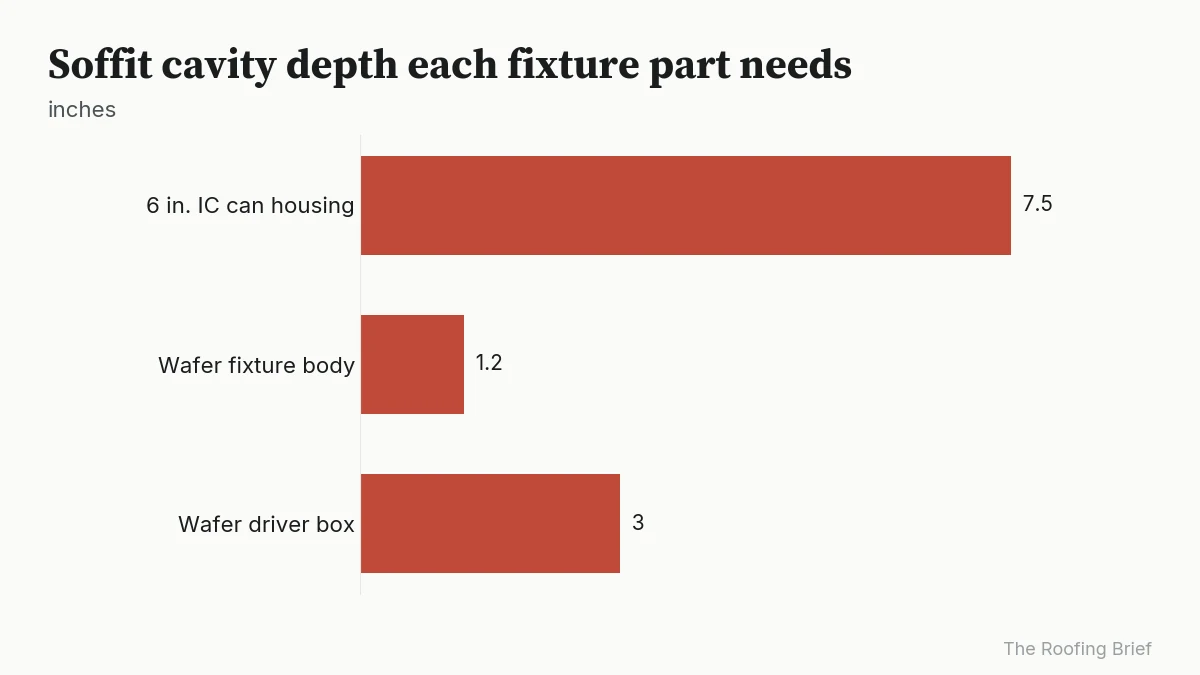
Measure the cavity first. A 6 in. new construction can housing needs about 7.5 in. of depth above the soffit panel, while a wafer light body needs 1.1 to 1.2 in. plus room nearby for a driver box that the Lithonia sheet sizes at 3 in. of plenum space. An IC rating matters only if insulation can touch the fixture, which happens where attic insulation runs out over the top plate.
| Component | Depth needed (in.) | Named product | Source |
|---|---|---|---|
| 6 in. IC can housing | 7.5 | ELCO EL770ICDXA; Nora NHIC-6LMRAT | 1000Bulbs listings, Oct 2026 |
| Wafer fixture body | 1.2 | Juno WF6 SWW5 90CRI | 1000Bulbs listing, Oct 2026 |
| Wafer remote driver box | 3 | Lithonia WF6 LED | Lithonia spec sheet, Rev. 03/23/23 |
The insulation rule is NEC 410.116(B), quoted from the 2023 NEC in EC&M’s April 2024 code quiz: thermal insulation may not sit above a recessed luminaire or within 3 in. of its enclosure, wiring compartment or LED driver unless the luminaire is identified as Type IC. The Lithonia WF6 sheet lists an “IC rated driver”, and the 1000Bulbs listing marks the Juno WF6 SWW5 as IC rated. A non-IC can in a soffit that holds blown insulation needs a 3 in. dam around it.
Airtight ratings are a separate question. The 2024 IRC energy chapter (N1102.5.4, shown on UpCodes for the Texas adoption) requires IC-rated fixtures with no more than 2.0 cfm leakage under ASTM E283 at 75 Pa only when they sit “in the building thermal envelope”. An eave soffit under a vented attic is normally outside that envelope, so airtight cans are optional there; a soffit over a heated porch room may be inside it.
How far apart should soffit lights be?
Space soffit lights at no more than 1.2 times their height above grade if you want even light on the ground, using the spacing-to-mounting-height ratio of 1.2 printed on every Lithonia WF6 photometric page. At a 10 ft soffit that is 12 ft centers. Several lighting retailers suggest 6 to 8 ft; that closer spacing is a look (bright scallops on the siding), not a coverage requirement.
The arithmetic below uses the WF6 30K40K50K test at 3000K: 1,099 delivered lumens, 14 W input and 396 candela straight down. Illuminance below a fixture equals candela divided by height squared. Midway between two fixtures, each beam arrives at about 31 degrees, where the sheet’s candela table interpolates to about 324 cd, and the two beams add.
| Soffit height above grade (ft) | Max spacing at S/MH 1.2 (ft) | Footcandles on grade below a fixture | Footcandles on grade midway between two | 50% beam circle on grade (ft) |
|---|---|---|---|---|
| 8 | 9.6 | 6.19 | 6.38 | 9.9 |
| 10 | 12 | 3.96 | 4.08 | 12.4 |
| 12 | 14.4 | 2.75 | 2.84 | 14.9 |
| 14 | 16.8 | 2.02 | 2.08 | 17.3 |
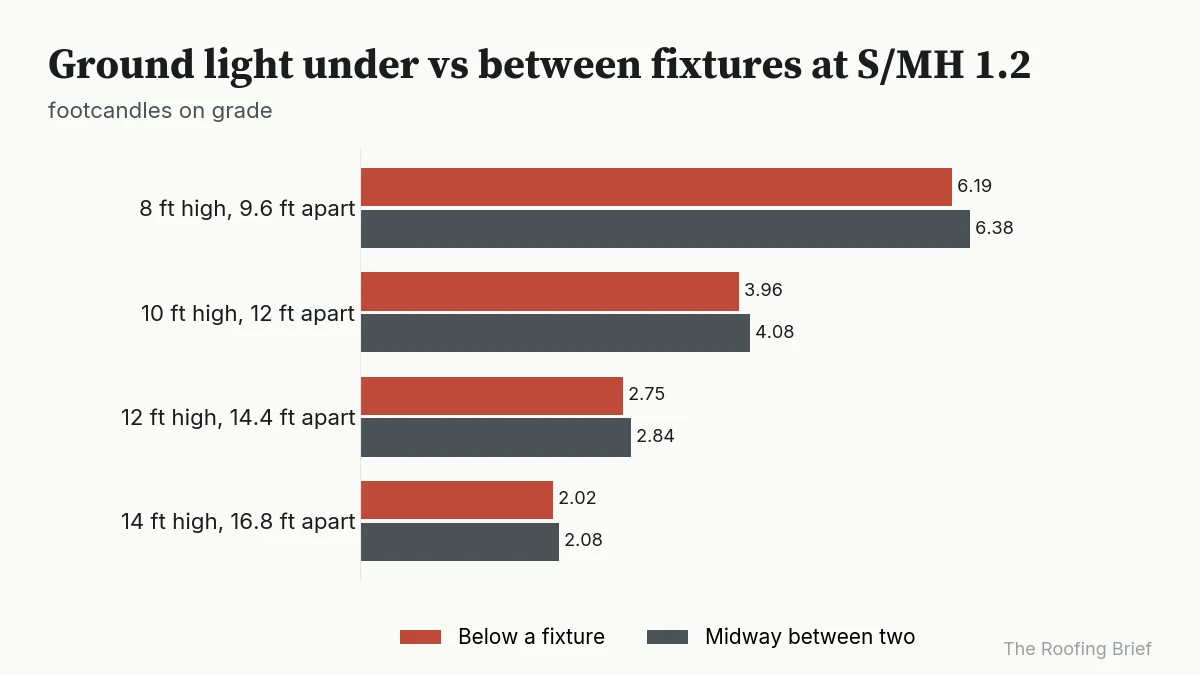
The midway reading is slightly higher than the reading under a fixture at every height, which is what a 1.2 ratio is designed to produce. The 50% beam column uses the sheet’s 63.5 degree beam angle: at 10 ft the 12.4 ft circles just overlap at 12 ft centers.
Worked example: a 48 ft front eave, soffit 10 ft above grade, WF6 fixtures at 3000K. Divide 48 ft by 12 ft for 4 fixtures, set the end fixtures 6 ft (half a space) from each corner, and the run delivers 4,396 lumens on 56 W.
| Input or result | 12 ft spacing (S/MH 1.2) | 6 ft spacing (retailer rule) | Source of the input |
|---|---|---|---|
| Fixtures on a 48 ft eave | 4 | 8 | Arithmetic: 48 ÷ spacing |
| Delivered lumens | 4,396 | 8,792 | Lithonia WF6 sheet: 1,099 lm each |
| Connected load | 56 W | 112 W | Lithonia WF6 sheet: 14 W each |
| Energy, dusk to dawn (12 h x 365) | 245.3 kWh/yr | 490.6 kWh/yr | Arithmetic |
| Energy cost at 18.31 cents/kWh | $44.91/yr | $89.82/yr | EIA, U.S. residential average, July 2026 |
| Energy cost on a 6 h timer | $22.46/yr | $44.91/yr | Arithmetic |
| Fixture cost at $27.73 each | $110.92 | $221.84 | 1000Bulbs, Juno WF6 SWW5, Oct 2026 |
The electricity price is the U.S. residential average of 18.31 cents per kWh for July 2026 in EIA Electric Power Monthly Table 5.6.A (released September 24, 2026). Halving the spacing doubles the fixture count, the lumens and the bill without making the ground meaningfully more even.
How do you wire soffit lights, and do you need a permit?
Line-voltage soffit lights are permanent 120 V wiring, so most jurisdictions want an electrical permit and a final inspection. Unincorporated Los Angeles County charges a $41.35 issuance fee plus $25.96 per new 15 or 20 A lighting circuit, which covers the fixtures on that circuit, under its electrical fee schedule effective July 1, 2026.
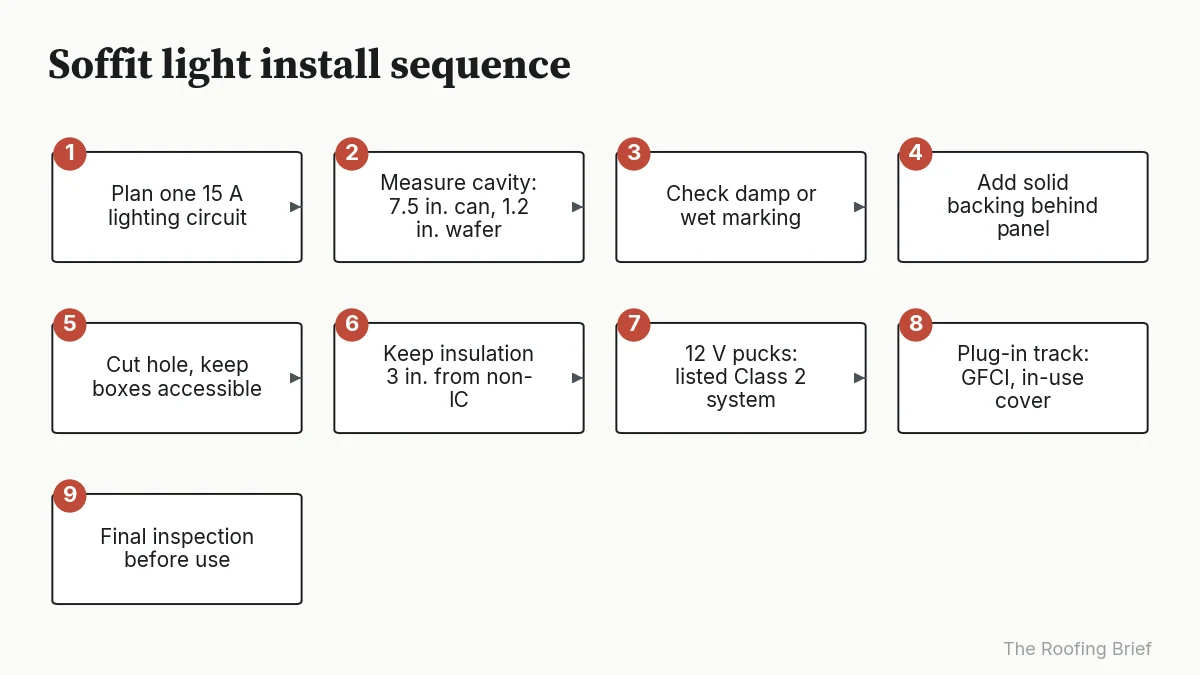
- Plan the circuit: a 4-fixture WF6 run draws 56 W, well inside one 15 A, 120 V lighting circuit. In LA County one new circuit plus issuance is $67.31 in fees.
- Measure the soffit cavity from the back of the panel to the lookouts: 7.5 in. for a 6 in. can housing, or 1.2 in. for a wafer body plus a 3 in. pocket for its driver box.
- Confirm the marking on the box: “Suitable for Damp Locations” at minimum under a roof, “Suitable for Wet Locations” where weather reaches it (NEC 410.10(A)).
- Add solid backing behind thin vinyl or aluminum soffit, because wafer spring clips need something to grip. The 2021 IRC R704.2.1 already requires vinyl soffit to be fastened at both ends, with nailing strips where a span exceeds 16 in.
- Cut the hole with the maker’s template: no larger than 6-1/4 in. for a WF6. Keep each junction or driver box reachable without removing building parts, per NEC 314.29.
- Keep insulation 3 in. from any non-IC fixture or driver (NEC 410.116(B)).
- For 12 V puck lights, use a listed low-voltage system with a listed Class 2 power source (NEC 411.4 on the St. Paul checklist).
- For plug-in permanent track lighting, use a GFCI-protected outdoor receptacle (NEC 210.8(A)) with an “extra duty” in-use cover in wet locations (NEC 406.9). NEC 400.8 bars using a cord in place of permanent wiring.
- Schedule the final inspection before you use the circuit. LA County sets an investigation fee for unpermitted work equal to the permit fee, not less than $504.47, or $252.23 for owner-builders on one and two family homes.
Can you put lights in a vented soffit?
Yes, if each fixture sits in a solid section and the intake area you remove is small. The 2021 IRC R806.2, shown on UpCodes for the Colorado adoption, requires net free vent area of 1/150 of the vented space, or 1/300 when 40 to 50 percent of it sits within 3 ft of the ridge. Soffit vents supply the low share, so every vented panel you replace with a solid backer subtracts intake.
For scale, take a 1,500 sq ft attic at the 1/300 ratio: 720 sq in. of net free area, of which 50 to 60 percent (360 to 432 sq in.) belongs low at the soffit. Variform’s full-vent T4 vinyl soffit provides 5.867 sq in. per sq ft, per its 2026 soffit brochure. A 16 in. by 16 in. solid backer at each of 4 fixtures removes about 41.7 sq in. (4 x 10.43), or roughly 12 percent of a 360 sq in. intake budget.
Two fixes keep the attic within R806.2: size backers no larger than the fixture needs, or swap a solid panel elsewhere on the same eave for a vented one. Our guide to net free area calculation shows the full arithmetic, and the soffit vents guide covers vent placement. Keep insulation baffles open above any new fixture, as our page on attic insulation baffles explains.
How much does soffit lighting cost?
As of October 2026, a wet-listed 6 in. wafer fixture costs $27.73 and a 6 in. IC can housing $26.62 at 1000Bulbs, before a trim. Installed, Fixr puts recessed lights at $176 to $328 each with electricians at $88 to $163 per hour (updated January 31, 2025). Permanent track lighting is priced by length: Trimlight quotes $18 to $35 per linear foot.
| Item | Low ($) | High ($) | Unit | Source and date |
|---|---|---|---|---|
| Wafer fixture only (Juno WF6 SWW5) | 27.73 | 27.73 | per fixture | 1000Bulbs, Oct 2026 |
| Can housing only (ELCO EL770ICDXA) | 26.62 | 26.62 | per housing, trim extra | 1000Bulbs, Oct 2026 |
| Installed recessed light | 176 | 328 | per light | Fixr, updated Jan 31, 2025 |
| Installed soffit light | 200 | 400 | per light | JellyFish Lighting blog, accessed Oct 2026 |
| Permanent LED track, installed | 18 | 35 | per linear foot | Trimlight pricing page, accessed Oct 2026 |
| Permanent LED kit, DIY (Govee H705E, 100 ft) | 279.99 | 279.99 | per kit as shown | Govee US store, Oct 2026 |
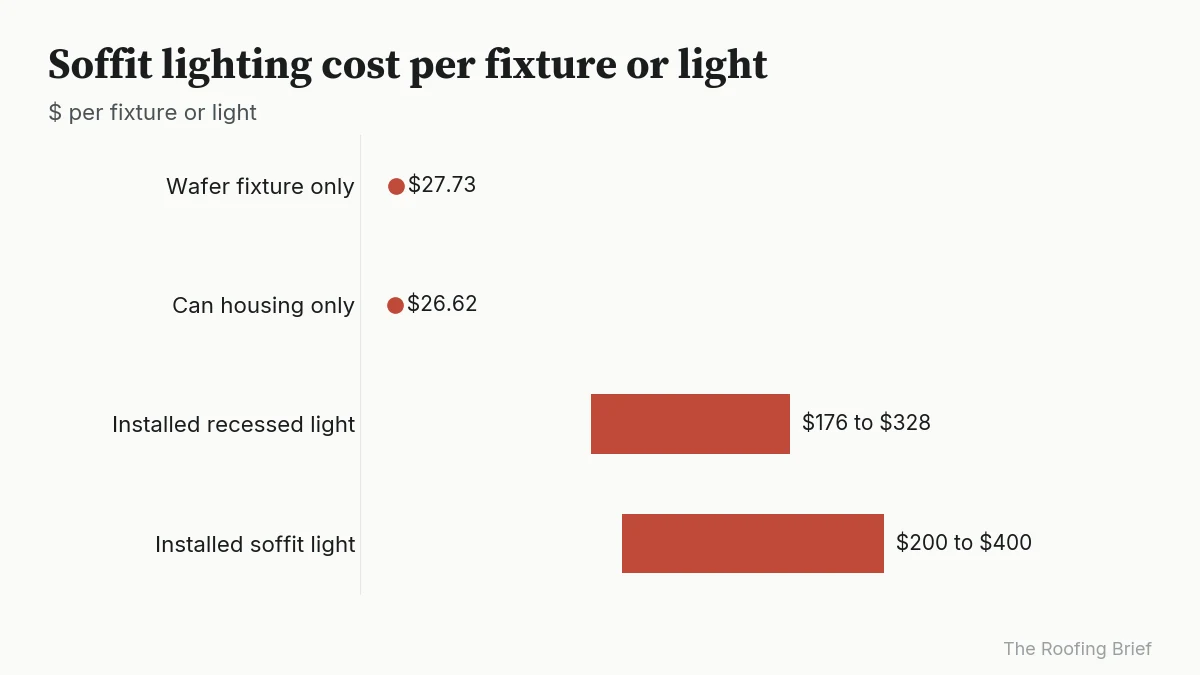
The JellyFish Lighting soffit lighting page gives $200 to $400 per light and ties the spread to fixture quality and installation difficulty. The Trimlight pricing page notes that the controller and installation “may or may not be rolled into” its per-foot price, so ask each bidder whether the quote includes the controller.
What moves an installed price the most is new wiring. For the 48 ft example, 4 fixtures at Fixr’s range come to $704 to $1,312 before permit fees, and the $67.31 LA County permit adds about 5 to 10 percent. The BLS median electrician wage was $30.38 per hour in May 2025, so Fixr’s billed range of $88 to $163 per hour is about 3 to 5 times the wage.
Which soffit lighting setup fits your house?
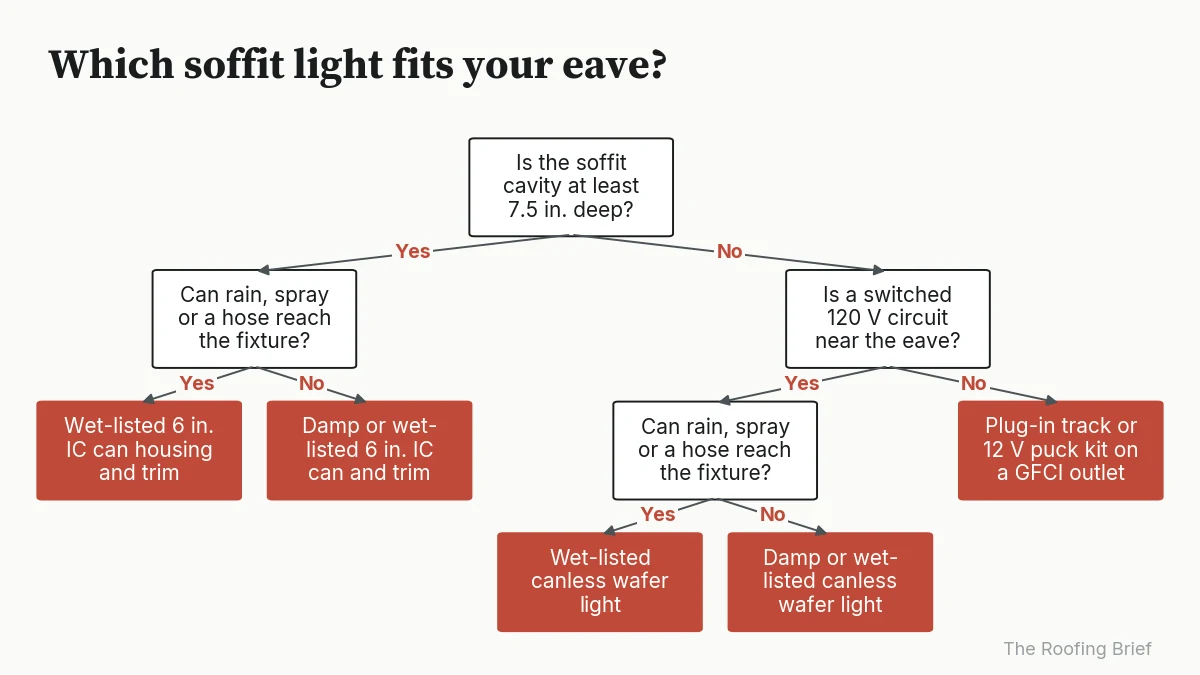
Pick by cavity depth first, exposure second and wiring access third. A soffit under 7.5 in. deep rules out a standard 6 in. can; an eave reached by wind-driven rain needs a wet listing; and an eave with no switched circuit nearby favors plug-in track lighting or a 12 V puck kit run from an existing GFCI outlet.
| If your situation is | Do this | Rule or source |
|---|---|---|
| Cavity under 7.5 in. deep | Use a canless wafer (1.1 to 1.2 in. body, 3 in. driver pocket) | 1000Bulbs listings; Lithonia sheet |
| Cavity 7.5 in. or deeper, new construction | A 6 in. IC can housing with a wet-listed trim works | 1000Bulbs listings |
| Soffit fully under a roof, no spray | Damp marking is the minimum; wet marking is also allowed | NEC 410.10(A); 29 CFR 1910.399 |
| Open eave edge, carport or hose reach | Wet marking only | NEC 410.10(A) |
| Insulation touches the fixture | Type IC fixture, or a 3 in. clearance | NEC 410.116(B) |
| Soffit 10 ft above grade | Space at 12 ft centers, ends 6 ft from corners | Lithonia S/MH 1.2 |
| Vented soffit | Backers no larger than the fixture; keep low intake at 50 to 60 percent of the R806.2 total | IRC R806.2 |
| No switched 120 V circuit near the eave | Plug-in track or a 12 V puck kit on a GFCI outlet | NEC 210.8(A); NEC 411.4 |
| Color-changing accent along the eave | Permanent track on a covered GFCI receptacle | Govee H705E warning; NEC 210.8(A) |
If the soffit itself is rotted or sagging, fix it before cutting holes; our guide to soffit repair covers repair vs replace, and our explainer on soffit panels compares the vinyl, aluminum and fiber cement panels you will be cutting into.
How we compiled this
We compiled this page from 22 documents opened in October 2026, listed under Sources and grouped below. We did not test or install any fixture. The spacing and footcandle figures are our arithmetic from the candela table Lithonia publishes for the WF6, and every price carries the retailer or vendor and the date we saw it.
- Maker documents: 1 Lithonia spec sheet with photometric tables, plus product pages from Cooper Lighting, DEKOR, Govee and Variform.
- Code and government text: OSHA 29 CFR 1910.399, the St. Paul 2023 NEC checklist, 3 UpCodes code pages, the LA County fee schedule, EIA Table 5.6.A and BLS pay data.
- Prices: 1000Bulbs listings, Govee, Trimlight, Fixr and JellyFish Lighting, each dated.
Frequently asked questions
Are soffit lights a good idea?
They suit eaves 8 to 14 ft above grade where you want even ground light from a hidden source. Four Lithonia WF6 wafers at 12 ft centers light a 48 ft eave with 4,396 lumens on 56 W, about $44.91 a year dusk to dawn at the July 2026 U.S. average of 18.31 cents per kWh (EIA). Fixr puts installed recessed lights at $176 to $328 each.
What are the best lights for under a soffit?
Choose by cavity depth and exposure rather than brand. A canless wafer such as the Juno WF6 (1.2 in. body, 1,000 lm, 13 W, IC rated, wet location) fits shallow boxed eaves, while a 6 in. IC can housing needs 7.5 in. of depth. Under a roof, a damp marking is the NEC 410.10(A) minimum; use a wet marking where rain reaches the fixture.
How do I add lights to my soffit?
Plan a 15 A, 120 V lighting circuit, measure the cavity, add solid backing behind vinyl or aluminum panels, and cut each hole to the maker’s template (6-1/4 in. maximum for a Lithonia WF6). Keep junction boxes accessible under NEC 314.29, keep insulation 3 in. from non-IC parts, and book the final inspection. One new circuit costs $67.31 in permit fees in unincorporated LA County.
What are some ideas for soffit lighting?
Three layouts cover most homes: recessed downlights spaced at 1.2 times the soffit height to wash the walk and siding, a permanent LED track such as the Govee H705E (72 lights at 40 lm each over 100 ft) for color effects, or 12 VDC puck lights for accents. DEKOR markets a Recessed Up/Down light at $18.76 that throws light both up the wall and down.
Do soffit lights need to be wet rated?
Not always. A soffit fully under a roof is a damp location under the NEC Article 100 definition, so a “Suitable for Damp Locations” marking meets NEC 410.10(A). Choose a wet marking where weather reaches the fixture, such as an open eave edge, a carport or hose range.
How far apart should soffit lights be?
For even light on the ground, space them at up to 1.2 times the soffit height above grade, the ratio on the Lithonia WF6 photometric pages. A 10 ft soffit takes 12 ft centers, with end fixtures 6 ft from each corner. Spacing of 6 to 8 ft doubles the fixture count.
Can you put recessed lights in a vented soffit?
Yes. Mount each fixture in a small solid backer and track the intake you remove. IRC R806.2 sets net free area at 1/150 of the attic, or 1/300 with high vents. Four 16 in. by 16 in. backers in Variform T4 full-vent soffit remove about 41.7 sq in.
Do I need a permit to install soffit lighting?
Usually yes for hardwired fixtures, because they add or extend a 120 V circuit. Unincorporated Los Angeles County charges $41.35 to issue the permit and $25.96 per new lighting circuit (July 1, 2026 schedule). Plug-in kits on an existing GFCI receptacle typically need none; ask your building department.
Sources
- Lithonia Lighting, WF4/WF6/WF8 LED Switchable White spec sheet, Rev. 03/23/23 (accessed Oct 2026)
- 1000Bulbs, Juno WF6 SWW5 90CRI MW M6 listing (LITH-0840) (accessed Oct 2026)
- 1000Bulbs, 6 in. IC airtight new construction housing listings (ELCO EL770ICDXA, Nora NHIC-6LMRAT) (accessed Oct 2026)
- Cooper Lighting Solutions, Halo HLBC slim regressed canless downlight product page (accessed Oct 2026)
- DEKOR Lighting, soffit lighting collection and LED Soffit Light product page (accessed Oct 2026)
- DEKOR Lighting, Recessed Up/Down LED Lights product page (accessed Oct 2026)
- Govee, Permanent Outdoor Lights 2 product page (accessed Oct 2026)
- OSHA, 29 CFR 1910.399 definitions (damp, dry and wet location) (accessed Oct 2026)
- City of St. Paul DSI, Residential Dwelling Checklist, 2023 NEC (revised 07/2023) (accessed Oct 2026)
- EC&M, Test Your Code IQ, April 2024 (2023 NEC 410.116(B)) (accessed Oct 2026)
- NFPA 70, National Electrical Code, code development page (accessed Oct 2026)
- DMF Lighting, Technical Bulletin: Wet Location Luminaires, May 25, 2017 (accessed Oct 2026)
- UpCodes, 2024 IRC N1102.5.4 recessed luminaire air leakage (Texas adoption) (accessed Oct 2026)
- UpCodes, 2021 IRC R704 soffits (Colorado DFPC adoption) (accessed Oct 2026)
- UpCodes, 2021 IRC R806.2 minimum vent area (Colorado DFPC adoption) (accessed Oct 2026)
- Variform, Soffit and Porch Ceiling Brochure, Rev B, 2026 (accessed Oct 2026)
- Los Angeles County Public Works, Electrical Code Fee Schedule, effective July 1, 2026 (accessed Oct 2026)
- U.S. EIA, Electric Power Monthly Table 5.6.A, released Sept 24, 2026 (accessed Oct 2026)
- U.S. BLS, Occupational Outlook Handbook: Electricians (May 2025 pay data) (accessed Oct 2026)
- Fixr, Recessed Lighting Installation Cost, updated Jan 31, 2025 (accessed Oct 2026)
- JellyFish Lighting, Soffit Lighting (accessed Oct 2026)
- Trimlight, Pricing (accessed Oct 2026)