

By The Roofing Brief Team | Last reviewed: October 2026
Roof rats (Rattus rattus) are slender climbing rats that enter attics from above through vents, tree limbs and gaps just over 1/2 inch (NebGuide G1530). Prune limbs 6 feet back, trap, then seal with metal.
Key takeaways
- A roof rat’s tail is longer than its head and body combined, and it weighs 5 to 10 ounces; a Norway rat weighs 7 to 18 ounces and its tail is shorter (UC IPM Pest Notes: Rats, Publication 74106, updated June 2025).
- Rats need a gap only slightly larger than 1/2 inch, can jump 48 inches horizontally and can climb the outside of pipes up to 3 inches in diameter (University of Nebraska NebGuide G1530, revised January 2009).
- UC IPM says to remove overhanging limbs within 6 feet of a roof and to cover rooftop plumbing vents over 2 inches in diameter with screens.
- Screens on attic vents must have openings between 1/16 and 1/4 inch under model code section R806.1, which is tighter than the 1/2-inch vent mesh some pest guides recommend.
- Consumer rodenticides must come as ready-to-use bait stations with block or paste bait; pellets and second-generation anticoagulants are not sold for consumer use (US EPA, Restrictions on Rodenticide Products).
- Clean droppings wet, never dry: air the space 30 minutes, soak with 1 part bleach to 9 parts water for 5 minutes, wipe and double-bag (CDC, How to Clean Up After Rodents, April 2024).
The table below collects the numbers that decide a roof rat job. Each row names the primary document it came from.
| Figure | Value | Source |
|---|---|---|
| Roof rat weight | 5 to 10 oz | UC IPM Pest Notes 74106 (2025) |
| Gap a rat can enter | Slightly more than 1/2 in | UNL NebGuide G1530 (2009) |
| Horizontal jump | 48 in | UNL NebGuide G1530 (2009) |
| Limb clearance from roof | 6 ft | UC IPM Pest Notes 74106 (2025) |
| Attic vent screen openings | 1/16 to 1/4 in | Model code R806.1 |
| Snap trap spacing | 10 to 20 ft apart | UC IPM Pest Notes 74106 (2025) |
| Bleach mix for droppings | 1 part bleach to 9 parts water, 5 minute soak | CDC (April 2024) |
What are roof rats, and how do you tell them from Norway rats?
Roof rats are Rattus rattus, also called black rats or ship rats, an introduced species now established in most coastal and southern US states and Hawaii, per University of Arizona Cooperative Extension publication AZ1775 (July 2018). The fastest field test is the tail: pulled toward the head, a roof rat’s tail reaches at least the snout, while a Norway rat’s reaches only mid-skull.
UC IPM adds an ear test: a roof rat’s ears reach the eyes when folded forward, and a Norway rat’s do not. Roof rats have a pointed muzzle and a gray to white belly; Norway rats have a blunt muzzle and are stockier. In Arizona, roof rats were first documented in Phoenix in 2001 and are now confirmed in Yuma and Tucson (AZ1775).
| Trait | Roof rat (Rattus rattus) | Norway rat (Rattus norvegicus) | Source |
|---|---|---|---|
| Head and body length | 7 to 8 in | 8 to 10 in | Univ. of Arizona AZ1775, Table 1 |
| Tail | Always longer than head and body | Shorter than head and body | AZ1775; UC IPM 74106 |
| Weight | 5 to 10 oz | 7 to 18 oz | UC IPM 74106 |
| Droppings length | 1/4 to 1/2 in (0.25 to 0.5 in), pointed, banana-shaped | 3/4 to 1 in (0.75 to 1 in), blunt ends | AZ1775, Table 1 |
| Droppings diameter | 3/16 in | 1/4 to 3/8 in | AZ1775, Table 1 |
| Ears | Large, almost hairless; reach the eyes when folded | Small, short hairs; do not reach the eyes | AZ1775; UC IPM 74106 |
| Snout | Narrow and pointed | Blunt and bulky | AZ1775 |
| Pairs of mammary glands | 5 | 6 | AZ1775, Table 1 |
| Typical nest | High: trees, attics, ivy, palm crowns | Low: burrows along foundations | UC IPM 74106; AZ1775 |
| Litters | 3 to 5 a year, up to 8 young each | 4 to 6 a year | UC IPM 74106 |
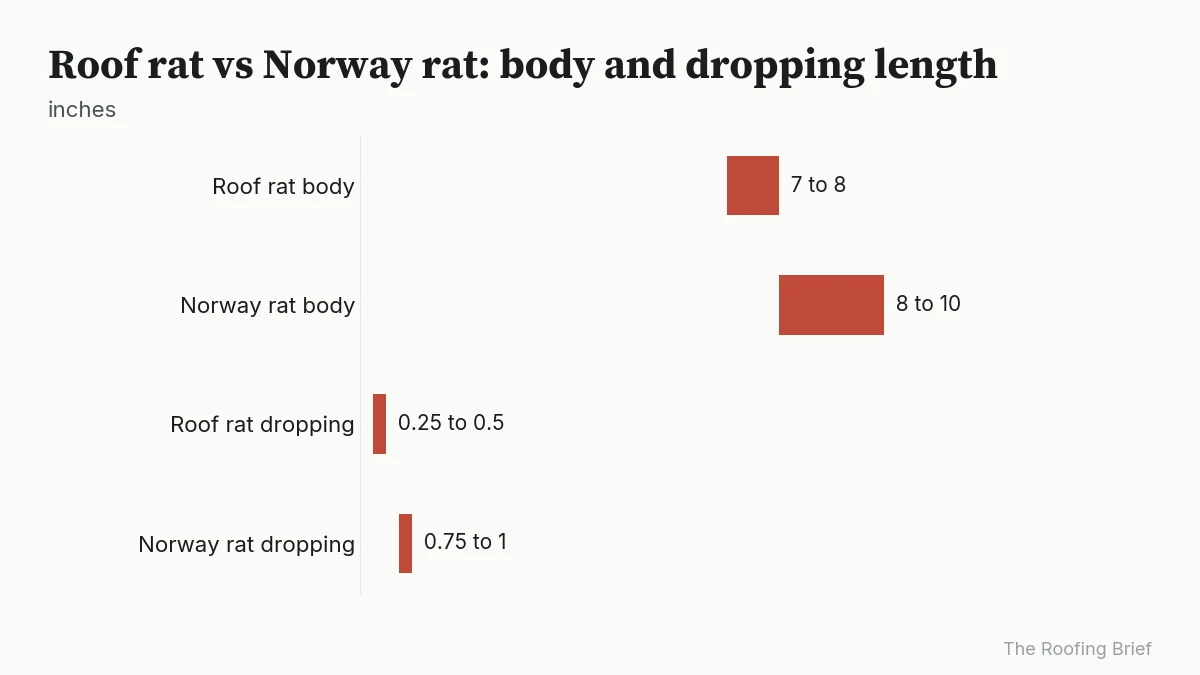
Published sizes differ by source, so measure against more than one. The Internet Center for Wildlife Damage Management roof rat chapter (Rex Marsh, UC Davis) gives a 6 to 8 inch body and a total length of about 16 inches, and the San Mateo County Mosquito and Vector Control District lists a 5 to 7 inch body with a 6 to 9 inch tail. All agree the tail outruns the body.
What are the signs of roof rats in an attic?
Noises in the attic at night are often the first sign, per University of Arizona publication AZ1775, followed by black, banana-shaped droppings 1/4 to 1/2 inch long. Look for greasy smudge marks high on rafters, beams and pipes rather than along the floor, and for rats running utility lines or fence tops at dusk, which UC IPM lists as a roof rat behavior.
Outdoors, hollowed-out citrus with the rind left hanging is a roof rat signature in Arizona, where the extension service reports activity peaks from November through May. AZ1775 also warns that droppings alone are not a reliable species test, so pair them with smudge height and the tail test before you buy traps sized for one species.
How do roof rats get into a roof and attic?
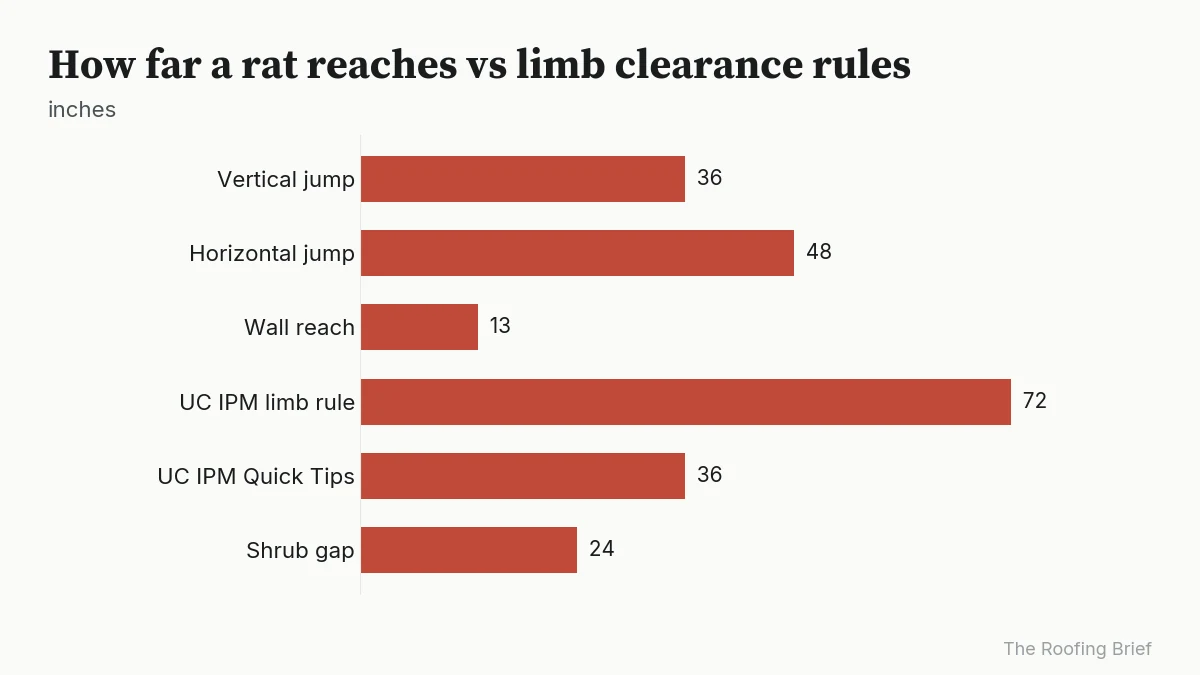
Roof rats reach a roof by climbing trees, vines, fences, downspouts and utility lines, then enter through vents, gaps at the eaves and soffits, open pipes and the roof-to-wall junction. Rats can jump 36 inches up and 48 inches across from a flat surface, climb the outside of pipes up to 3 inches in diameter and drop 50 feet without serious injury, per NebGuide G1530.
Those reach numbers explain the 6-foot limb rule. A branch 4 feet from the fascia is inside a rat’s 48-inch horizontal jump; at 6 feet it is outside it with 2 feet to spare. UC IPM’s Quick Tips box prints 3 feet while its management section says 6 feet; the 6-foot figure is the one that clears the jump distance.
| Ability or rule | Inches | Source |
|---|---|---|
| Rat vertical jump | 36 | UNL NebGuide G1530 |
| Rat horizontal jump | 48 | UNL NebGuide G1530 |
| Reach along a vertical wall | 13 | UNL NebGuide G1530 |
| Limb clearance, UC IPM management section | 72 (6 ft) | UC IPM 74106 |
| Limb clearance, UC IPM Quick Tips box | 36 (3 ft) | UC IPM 74106 |
| Shrub distance from buildings | 24 (2 ft) | UC IPM 74106 |
| Outside of vertical pipe a rat can climb | Up to 3 in diameter | UNL NebGuide G1530 |
| Inside of vertical pipe a rat can climb | 1 1/2 to 4 in diameter | UNL NebGuide G1530 |
The entry points below come from the CDC and UC IPM checklists, matched to the roof part they affect. The CDC seal-up page (April 2024) tells homeowners to check “in the roof among the rafters, gables, eaves, and soffits” and around attic vents.
| Roof entry point | What to look for | Fix | Source |
|---|---|---|---|
| Overhanging limbs | Branches within 6 ft of the roof | Prune back to 6 ft | UC IPM 74106 |
| Climbing vines | English or Algerian ivy, star jasmine, honeysuckle on walls or fences | Thin or remove | UC IPM 74106 |
| Overhead utility lines | Rats running wires at dusk | Call the utility or a pest professional; guards can fray insulation and short wires | UC IPM 74106; ICWDM |
| Gable, soffit and roof vents | Torn or missing internal screens | Rescreen with corrosion-resistant mesh, 1/4 in maximum opening | UC IPM 74106; R806.1 |
| Rooftop plumbing vents | Open pipes over 2 in diameter | Screen the top | UC IPM 74106 |
| Chimney | Open flue | Spark arrester | UC IPM 74106 |
| Eaves, rafters, soffits | Gaps, gnawed fascia joints, smudge marks | Sheet metal or hardware cloth | CDC seal-up page |
| Pipe and wire penetrations | Gaps around lines entering the attic or walls | Steel wool plus caulk for small holes; metal for large | CDC seal-up page; UC IPM 74106 |
Each vent style takes its screen differently, and our guide to roof vent types shows how ridge, box, turbine, soffit and gable vents are built. Gable openings get their own rules in our gable vent guide. For an open stack, UC IPM’s 2-inch threshold applies, and our plumbing vent repair guide covers the boot around it. A capped flue closes the last path, which is covered in our chimney cap guide.
What size gap can a roof rat fit through?
A rat needs a gap only slightly larger than 1/2 inch, and a mouse slightly more than 1/4 inch, per NebGuide G1530. UC IPM is stricter and says to seal every opening larger than 1/4 inch, because young rats squeeze through less and gnawing enlarges small holes. Seal to 1/4 inch and the same work stops mice, which the CDC says fit through a pencil-width hole.
Vents are where popular advice and the building code part ways. UC IPM recommends 1/2-inch mesh on vent grills, and NebGuide calls 1/2-inch screen a “reasonable compromise” for livestock-building airflow. Model code R806.1 requires that attic ventilation openings larger than 1/4 inch be covered with corrosion-resistant wire cloth, hardware cloth or similar material whose openings measure 1/16 inch minimum and 1/4 inch maximum (2025 California Residential Code R806.1 text; 2021 IRC R806.1).
| Claim | Opening (inches) | What the primary source says | Source |
|---|---|---|---|
| Rat entry gap | 1/2 in (0.5 in) | Rats need slightly more than a 1/2-inch gap | UNL NebGuide G1530 |
| Mouse entry gap | 1/4 in (0.25 in) | Mice fit through a hole the width of a pencil | CDC seal-up page |
| UC IPM sealing threshold | 1/4 in (0.25 in) | Seal cracks and openings larger than 1/4 inch | UC IPM 74106 |
| UC IPM vent grill mesh | 1/2 in (0.5 in) | 18-gauge expanded metal or 16-gauge wire cloth, 1/2-inch mesh | UC IPM 74106 |
| Code maximum, attic vent screen | 1/4 in (0.25 in) | Screen openings 1/4 inch maximum | R806.1 |
| Code minimum, attic vent screen | 1/16 in (0.0625 in) | Screen openings 1/16 inch minimum | R806.1 |
| Guide advice: “seal gaps larger than a quarter with silicone caulk” (PestWorld) | Not a measurement | Rats gnaw through plastic, foam, wood and caulk | PestWorld page vs UC IPM 74106 |

Which materials keep roof rats out?
Use metal for anything a rat can reach: galvanized hardware cloth of 19 gauge with 1/2 x 1/2 inch mesh excludes rats, and 24 gauge with 1/4 x 1/4 inch mesh excludes mice, per NebGuide G1530 Table I. Galvanized sheet metal should be 24 gauge or heavier. Steel wool or copper gauze is a temporary plug only, and UC IPM warns against lightweight chicken wire.
| Material | Minimum spec | Use on a roof | Source |
|---|---|---|---|
| Hardware cloth, rat exclusion | 19 gauge, 1/2 x 1/2 in mesh | Non-vent openings, eave gaps, crawl-through holes | UNL NebGuide G1530, Table I |
| Hardware cloth, mouse exclusion | 24 gauge, 1/4 x 1/4 in mesh | Attic vents (meets the R806.1 1/4 in cap) | UNL NebGuide G1530, Table I; R806.1 |
| Galvanized sheet metal | 24 gauge or heavier; perforated grills 14 gauge | Gnawed fascia joints, roof-wall gaps | UNL NebGuide G1530, Table I |
| Aluminum | 22 gauge frames and flashing; 18 gauge guards | Flashing patches, pipe guards | UNL NebGuide G1530, Table I |
| Vent grill cover | 18 gauge expanded metal or 16 gauge wire cloth, 1/2 in mesh | Foundation and crawl vents (check R806.1 before using on attic vents) | UC IPM 74106 |
| Steel wool or copper gauze | Packed tight, held with caulk or foam | Small holes, temporary | CDC seal-up page; UNL NebGuide G1530 |
| Chicken wire, caulk or foam alone | Not rodent-proof | Do not rely on them | UC IPM 74106 |
The 1/4-inch hardware cloth sold at retail is usually lighter wire than the rat spec. Hills Flat Lumber listed a 1/4 inch x 36 inch x 10 foot roll in 23 gauge and a 1/2 inch x 36 inch x 10 foot roll in 19 gauge, both at $29.99, in October 2026. The 23-gauge roll beats NebGuide’s 24-gauge mouse spec but is thinner than its 19-gauge rat spec, so check vent screens for chewing at every attic inspection.
Gnawed soffit panels and fascia joints are a carpentry repair before they are a screening job, and our soffit repair guide covers how to fix rot and holes in each material. NebGuide G1530 explains why metal edges work: rat incisors struggle on flat surfaces, round surfaces larger than 7/8 inch, and anything harder than iron.
How do you get rid of roof rats in the attic?
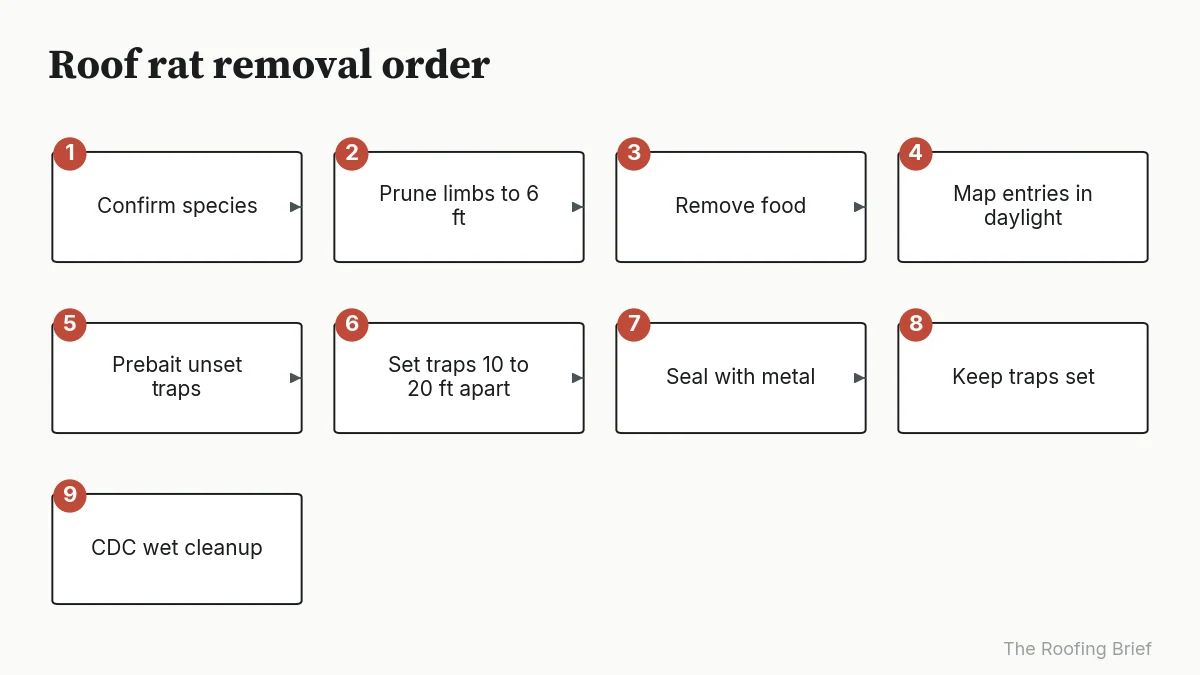
Cut off roof access, trap the rats already inside with snap traps set on beams and rafters, then seal every opening with metal and clean up wet. UC IPM calls snap traps the safest, most effective and most economical option, recommends 10 to 20 feet between traps, and says a heavily infested home may need a dozen or more. NebGuide G1530 warns against closing an opening before you know whether animals use it.
- Confirm the species. Match droppings (1/4 to 1/2 inch, pointed) and high smudge marks to the roof rat column in the identification table (AZ1775).
- Cut the highways. Prune limbs to 6 feet from the roof, thin ivy and jasmine, and keep shrubs 2 feet from walls (UC IPM 74106).
- Remove food. Pick up fallen fruit and nuts, store pet food in rodent-proof containers and feed pets only what they eat at one feeding (UC IPM 74106).
- Map entries in daylight. Walk the eaves, vents, plumbing stacks and roof-wall junctions from outside, then check the attic for daylight and smudge marks. Leave active holes open until trapping is under way (NebGuide G1530).
- Prebait. Place snap traps baited but unset with a pea-sized amount of nuts, dried fruit, bacon or dry pet food until rats take the bait several times (UC IPM 74106).
- Set and secure traps up high. Fasten traps to rafters, beams, ledges and pipes 10 to 20 feet apart. If bait vanishes from every trap, double the trap count (UC IPM 74106).
- Seal with metal. Close openings with 19-gauge 1/2-inch hardware cloth or 24-gauge sheet metal, and rescreen vents with mesh no larger than 1/4 inch (NebGuide G1530; R806.1).
- Keep monitoring. UC IPM says traps can be set and left indefinitely in attics where rats have been a problem.
- Clean up wet. Follow the CDC cleanup steps in the droppings section below.
Skip the shortcuts. UC IPM says rats get used to repeated sounds, which makes ultrasonic and high-frequency devices ineffective, and that no truly effective rat repellents are registered in California. The ICWDM roof rat control chapter says captured rats should be euthanized rather than relocated, and UC IPM does not recommend glue boards or live traps for nonprofessionals.
What rodenticide rules apply to homeowners?
Homeowners can buy only ready-to-use bait stations holding block or paste bait with bromethalin, chlorophacinone or diphacinone, according to the EPA’s rodenticide restrictions page. Pellets are no longer permitted in consumer products, and second-generation anticoagulants (brodifacoum, bromadiolone, difenacoum, difethialone) are registered only for professional and agricultural markets.
| Rule | Consumer products | Professional and agricultural products | Source |
|---|---|---|---|
| Form | Ready-to-use bait station with block or paste bait | Block, paste or pellet; not packaged with stations | EPA |
| Active ingredients | Bromethalin, chlorophacinone, diphacinone | Any registered, including brodifacoum, bromadiolone, difenacoum, difethialone | EPA |
| Refill bait in package | Up to 1 lb with a refillable station | Minimum 16 lb for second-generation; 4 lb for others | EPA |
| Where sold | Consumer stores | Not in drug, grocery, hardware or club stores | EPA |
| Where used | Indoors, or indoors and outdoors within 50 ft of buildings, per label | In or within 100 ft of buildings; tamper-resistant stations where children under 6, pets or wildlife can reach, and for all outdoor above-ground placements | EPA |
| California | Most first- and second-generation anticoagulants banned in most uses, including warfarin, diphacinone, chlorophacinone, brodifacoum, bromadiolone and difethialone | UC IPM 74106 | |
Anticoagulants typically kill between four days and two weeks after a rat starts feeding, per the EPA, so a poisoned rat in a closed attic can die where you cannot reach it. UC IPM warns that a poisoned rat can hold several lethal doses for a dog or cat that eats it. For an attic, a snap trap gives you a carcass you can find and double-bag.
Are roof rats harmful?
Yes: roof rats carry germs that cause illness, and University of Arizona publication AZ1775 lists murine typhus, leptospirosis, salmonellosis, rat-bite fever, lymphocytic choriomeningitis and plague. The CDC says leptospirosis spreads through the urine of infected animals including rats, and rat-bite fever through bites, scratches, saliva or pee. Gnawed wiring and gas lines add a fire risk, per UC IPM.
| Illness | How it reaches people | Time to symptoms | Source |
|---|---|---|---|
| Leptospirosis | Urine of infected animals, including rats; contaminated water or soil | 2 to 30 days | CDC, About Leptospirosis (Feb 2026) |
| Rat-bite fever | Scratches, bites, contact with saliva or pee | Usually 3 to 10 days, up to 21 | CDC, About Rat Bite Fever (July 2024) |
| Hantavirus pulmonary syndrome | Contact with rodent urine, droppings and saliva; deer mouse is the most common US carrier | Not stated on that page | CDC, About Hantavirus (May 2024) |
| Murine typhus, plague | Fleas such as the Oriental rat flea carried by roof rats | Not stated | Univ. of Arizona AZ1775 |
| Wiring and gas-line damage | Gnawing in attics and walls | Not applicable | UC IPM 74106; AZ1775 |
If a fever follows attic work, tell your doctor about the rodent exposure. The CDC’s hantavirus page (May 2024) names the deer mouse, not the roof rat, as the main US source of hantavirus pulmonary syndrome, but its cleanup guidance applies the same wet method to all rodent waste.
How do you clean up roof rat droppings safely?
Clean roof rat droppings wet, never by sweeping or vacuuming, which the CDC says can put virus-containing droplets into the air. Air the attic out for 30 minutes, wear rubber, latex or vinyl gloves, soak droppings and nests with a fresh mix of 1.5 cups of bleach per gallon of water for 5 minutes, then wipe and bag, per the CDC cleanup page (April 2024).
- Open doors and windows for 30 minutes before you start, and leave the area while it airs out.
- Put on rubber, latex or vinyl gloves. For heavy infestations, add disposable coveralls, rubber boots or shoe covers, goggles and a respirator with HEPA filtration.
- Mix 1 part bleach to 9 parts water (1.5 cups per gallon) fresh, or use a product labeled as a disinfectant.
- Spray droppings, urine and nests until very wet and let them soak 5 minutes, or as the label directs.
- Wipe up with paper towels and put them in a covered garbage can that is emptied regularly.
- Place dead rats, nests and used traps in a plastic bag, knot it, and seal it inside a second bag.
- Bag contaminated insulation and carry it outdoors, standing upwind as you handle it.
- Submerge reusable traps in disinfectant for 5 minutes.
When droppings cover most of the attic, the job usually becomes insulation removal. Our attic cleaning guide separates a basic clean-out from rodent decontamination, and our guide to getting rid of mice under attic insulation covers bagging and replacing insulation in sections, the same 1/4-inch rule applied to a smaller rodent.
What does roof rat damage cost to fix?
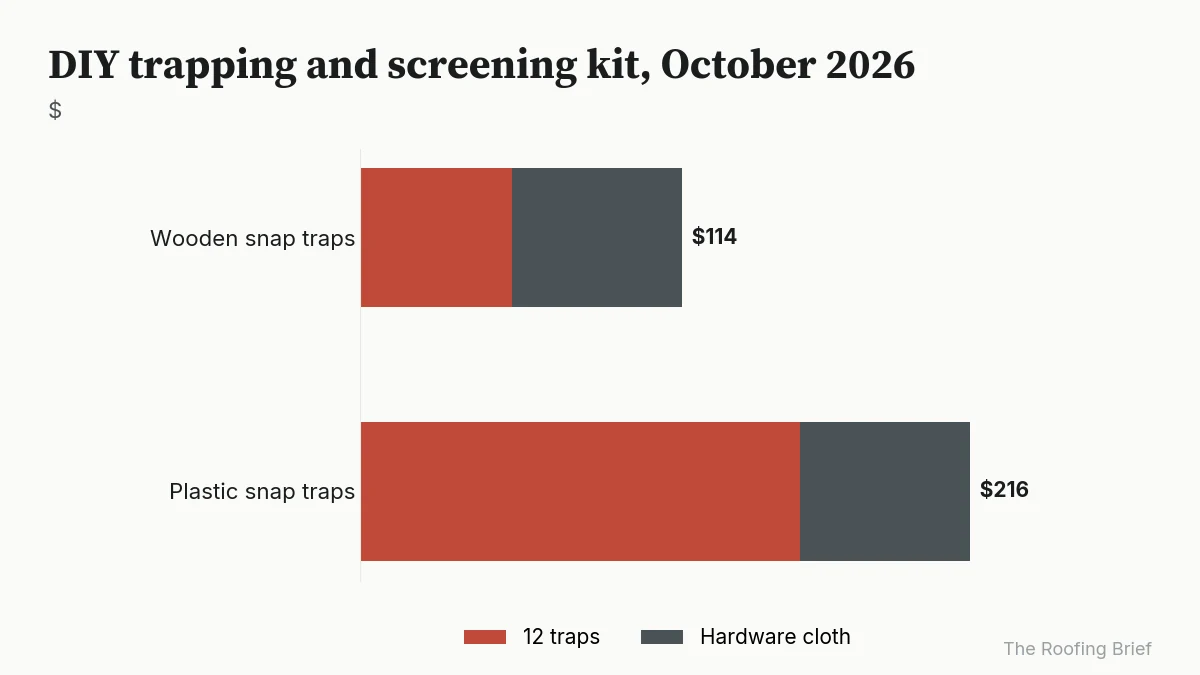
A do-it-yourself trapping and screening kit for one attic costs about $114 to $216 in materials at October 2026 listings, depending on trap type, before any repair to wiring, soffits or insulation. The low figure uses 12 wooden snap traps and two hardware cloth rolls from Hills Flat Lumber; the high figure swaps in plastic snap traps. Labor and insulation replacement are separate line items.
| Line | Quantity | Unit price | Line total | Basis |
|---|---|---|---|---|
| JT Eaton Bigfoot wooden rat trap, expanded trigger | 12 | $4.49 (regular) | $53.88 | Hills Flat Lumber listing, Oct 2026; 12 = UC IPM “a dozen or more” |
| Tomcat Secure-Kill plastic rat trap (alternative) | 12 | $12.99 | $155.88 | Hills Flat Lumber listing, Oct 2026 |
| Hardware cloth 1/4 in, 23 gauge, 36 in x 10 ft (vents) | 1 | $29.99 | $29.99 | Hills Flat Lumber listing, Oct 2026 |
| Hardware cloth 1/2 in, 19 gauge, 36 in x 10 ft (other openings) | 1 | $29.99 | $29.99 | Hills Flat Lumber listing, Oct 2026 |
| Hardware cloth subtotal | 2 rolls | $59.98 | Sum of the two rolls | |
| Kit total with wooden traps | $113.86 | $53.88 + $59.98 | ||
| Kit total with plastic traps | $215.86 | $155.88 + $59.98 |
Every figure above is Roofing Brief arithmetic from dated shelf prices at one California retailer, not a quote, and the two 30-square-foot rolls are sized for a handful of vents and eave gaps. Three things move a contractor’s bill far more than materials: how much insulation is soiled, whether soffit or fascia boards are gnawed, and whether wiring needs an electrician.
For those lines, use our insulation removal cost guide for per-square-foot rates and our soffit and fascia replacement cost guide for gnawed eaves. Ask each bidder to price exclusion, trapping visits, cleanup and insulation as four separate lines, and whether the cleanup crew follows the CDC wet method and HEPA respirator rule for heavy infestations.
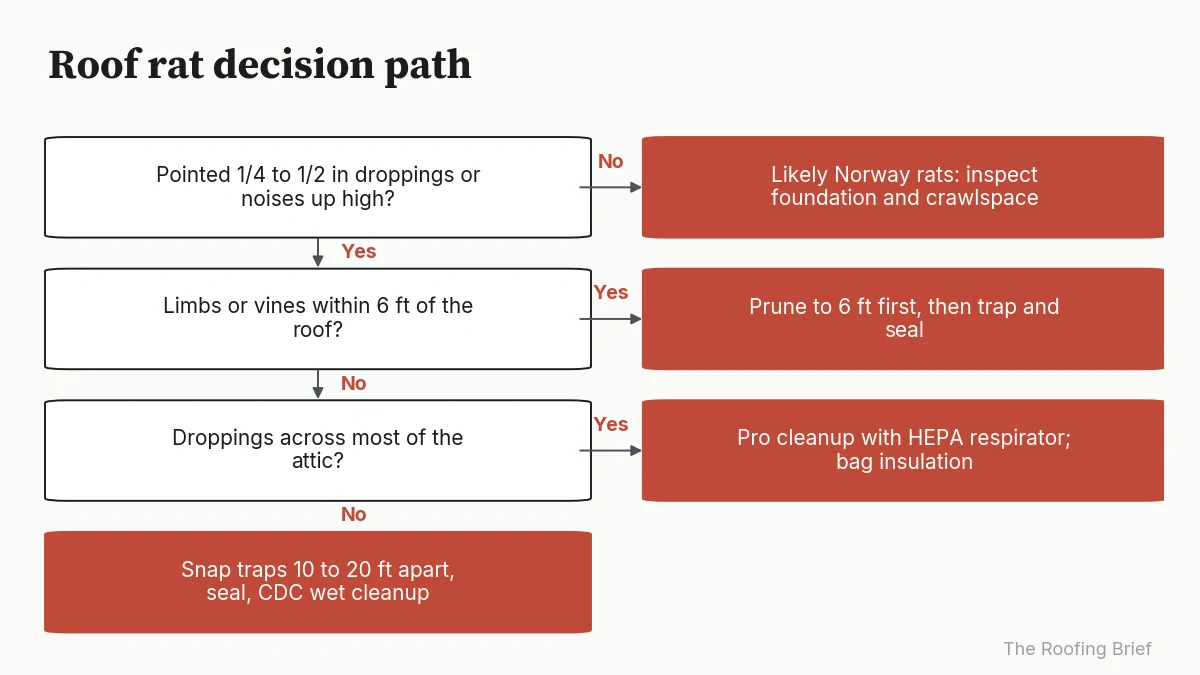
Roof rat decision table: what to do in your situation
Match your situation to a row before you buy anything. The thresholds come from UC IPM Pest Notes 74106, NebGuide G1530, the EPA consumer rodenticide rules and the CDC cleanup page, and each row names the action that source supports. Rows near the top decide whether you are dealing with roof rats at all.
| If your situation is | Do this | Source |
|---|---|---|
| Droppings 1/4 to 1/2 in and pointed, with noises or smudges up high | Treat as roof rats: trap on rafters and seal the roofline | AZ1775; UC IPM 74106 |
| Droppings 3/4 to 1 in with blunt ends, signs at ground level | Likely Norway rats: inspect foundation, crawlspace and burrows | AZ1775 |
| Limbs or vines within 6 ft of the roof | Prune to 6 ft first, then trap and seal | UC IPM 74106; NebGuide G1530 |
| Rats running overhead utility wires | Call the utility company or a pest professional | UC IPM 74106 |
| Vent screen openings larger than 1/4 in | Rescreen with corrosion-resistant mesh, 1/16 to 1/4 in | R806.1 |
| Children, pets or wildlife can reach bait | Use snap traps, or tamper-resistant stations only | EPA |
| You live in California | Do not use anticoagulant baits; trap instead | UC IPM 74106 |
| Droppings across most of the attic | Hire cleanup with coveralls and a HEPA respirator; bag insulation | CDC cleanup page |
| Droppings in one or two rafter bays | Snap traps 10 to 20 ft apart, seal, then CDC wet cleanup | UC IPM 74106; CDC |
Squirrels use many of the same roof gaps but follow wildlife laws on trapping and release, which our guide to squirrels in the attic covers state by state. Roof rats are unprotected and can be controlled at any time with registered methods used per the label, per the ICWDM roof rat chapter.
How we compiled this
We compiled this guide from 13 primary documents: University of California IPM, University of Arizona and University of Nebraska extension publications, the ICWDM roof rat chapters, five CDC pages, the EPA rodenticide restrictions page, the R806.1 code text and a county vector control district page, plus four dated Hills Flat Lumber listings, all accessed in October 2026. We did not test traps, inspect attics or survey contractors.
Frequently asked questions
What is the difference between a roof rat and a regular rat?
The “regular” rat most people mean is the Norway rat (Rattus norvegicus). Roof rats are smaller and sleeker, weigh 5 to 10 ounces against 7 to 18, carry tails longer than head and body, and have larger ears and pointed snouts, per UC IPM Pest Notes 74106. Their droppings run 1/4 to 1/2 inch and pointed, against 3/4 to 1 inch and blunt (AZ1775).
Where do roof rats live during the day?
Roof rats spend the day in nests in high, sheltered places: attics, soffits, overhead garage storage, vine-covered fences, woodpiles and dense trees, especially palm crowns with old fronds left on, per University of Arizona publication AZ1775. UC IPM adds wall voids, false ceilings and cabinets indoors. They begin roaming at twilight, which is when most people see them.
Is it possible to get rid of roof rats?
Yes, if trapping is paired with exclusion. NebGuide G1530 notes that research shows rodents reinvade through unsecured openings after control programs, and AZ1775 says roof rats breed year-round in warm areas with up to 5 litters a year. Trap with snap traps 10 to 20 feet apart, seal gaps over 1/4 inch with metal, and leave a few traps set in the attic (UC IPM).
What attracts roof rats to a house?
Food and cover up high attract roof rats. UC IPM lists fallen fruit and nuts, pet food left out, open compost and garbage, and climbing ivy, star jasmine and honeysuckle as conditions that invite them. University of Arizona publication AZ1775 adds citrus, palm fruit, birdseed and old palm fronds, and notes that roof rats in Arizona are most active from November through May.
Can roof rats chew through a roof?
Roof rats chew through many roofing and attic materials. NebGuide G1530 says rats and mice can gnaw aluminum sheeting, wood, rubber, vinyl, plastic and concrete block, and UC IPM adds foam and caulk. They struggle with flat surfaces and anything harder than iron, which is why NebGuide specifies 24-gauge or heavier galvanized sheet metal and 19-gauge hardware cloth for rat-proofing.
Do ultrasonic repellers work on roof rats?
No primary source supports them. UC IPM Pest Notes 74106 says rats quickly become accustomed to repeated sounds, which makes high-frequency and ultrasonic devices ineffective in homes and gardens. The ICWDM roof rat control chapter says ultrasonic devices have not been proven to provide rat control and that no chemical repellent is registered specifically for rats. Spend the money on snap traps and metal instead.
Should I relocate a roof rat caught in a live trap?
No. The ICWDM roof rat control chapter says captured rats should be euthanized rather than relocated because of disease risk, damage potential and harm to native wildlife. UC IPM does not recommend live traps or glue boards for nonprofessionals and calls snap traps the safest, most effective and most economical choice. The ICWDM lists roof rats as unprotected, so they can be controlled at any time.
Sources
- UC IPM, Pest Notes: Rats, UC ANR Publication 74106 (N.M. Quinn), updated June 2025, accessed Oct 2026
- University of Arizona Cooperative Extension, AZ1775: Roof Rats: Identification, Ecology, and Signs (Rivadeneira and Gouge), July 2018, accessed Oct 2026
- Internet Center for Wildlife Damage Management, Roof Rats (Rex E. Marsh, Prevention and Control of Wildlife Damage, 1994), accessed Oct 2026
- Internet Center for Wildlife Damage Management, Roof Rat Prevention and Control Methods, accessed Oct 2026
- University of Nebraska-Lincoln Extension, NebGuide G1530: Rodent-Proof Construction, Structural, revised January 2009, accessed Oct 2026
- CDC, How to Seal Up to Prevent Rodents, April 8, 2024, accessed Oct 2026
- CDC, How to Clean Up After Rodents, April 8, 2024, accessed Oct 2026
- CDC, About Leptospirosis, February 10, 2026, accessed Oct 2026
- CDC, About Rat Bite Fever, July 9, 2024, accessed Oct 2026
- CDC, About Hantavirus, May 13, 2024, accessed Oct 2026
- US EPA, Restrictions on Rodenticide Products, accessed Oct 2026
- International Code Council, 2021 International Residential Code, Section R806.1 Ventilation required (section wording checked against the 2025 California Residential Code reproduction below), accessed Oct 2026
- 2025 California Residential Code, Section R806.1 text, accessed Oct 2026
- San Mateo County Mosquito and Vector Control District, Roof Rat, accessed Oct 2026
- Hills Flat Lumber, 1/4 in x 36 in x 10 ft 23-gauge hardware cloth, $29.99, listing seen Oct 2026
- Hills Flat Lumber, Agway 1/2 in x 36 in x 10 ft 19-gauge hardware cloth, $29.99, listing seen Oct 2026
- Hills Flat Lumber, JT Eaton Bigfoot mechanical rat trap, $4.49 regular, listing seen Oct 2026
- Hills Flat Lumber, Tomcat Secure-Kill mechanical rat trap, $12.99, listing seen Oct 2026
- National Pest Management Association, PestWorld roof rat page (quoted for comparison only), accessed Oct 2026