
By The Roofing Brief Team | Last reviewed: November 2026
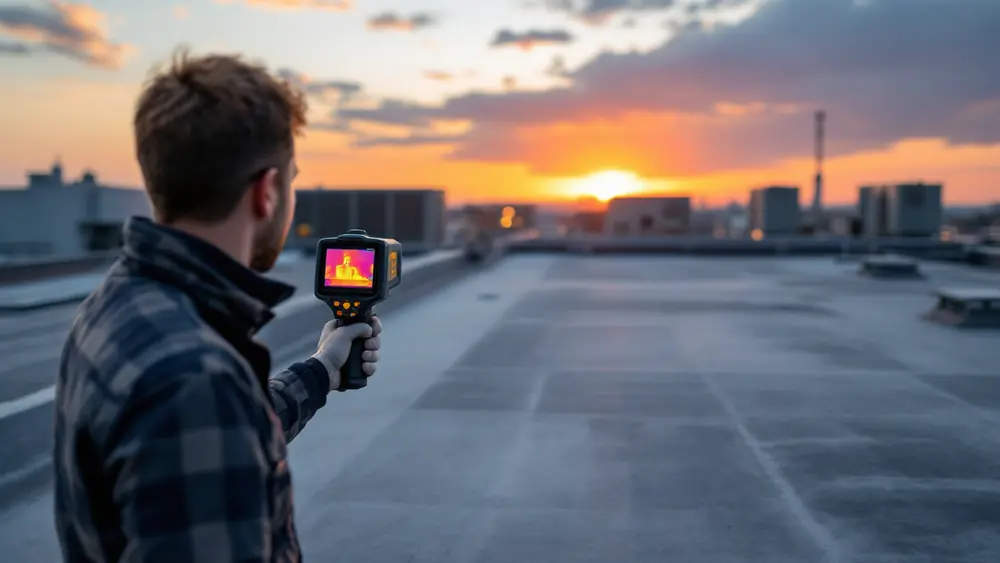
A thermal roof inspection (also sold as an infrared roof inspection) uses an infrared camera, usually after sunset following a sunny day, to map wet insulation under a low-slope roof membrane, because wet insulation releases the day’s stored heat more slowly than dry insulation and shows up warmer. It is governed by ASTM C1153-23, it works on flat roofs with insulation above the deck, it cannot read through asphalt shingles or metal panels from above, and every warm area it flags still has to be confirmed with a core cut.
On steep-slope homes, where infrared cannot read the roof from above, a camera pole for roof inspection gets close-up photos of the upper courses from the ground.
Thermographer Gregory R. Stockton of the Infrared Training Institute put infrared roof moisture surveys at 1 to 5 cents per square foot in 2013, while consumer cost guides list a residential infrared roof inspection at $400 to $600. Those figures, like every number on this page, come from the ASTM standards, code text and published thermographer papers linked where they appear, not from field surveys of our own.
How does a thermal roof inspection find water?
A thermal roof inspection finds water by its heat storage, not by “seeing” moisture. Water stores about 1 BTU per pound per °F (the definition of the BTU), more per pound than common roof insulation materials, so during a sunny day wet insulation soaks up more heat than dry insulation; after sunset the dry areas cool off quickly while the wet areas stay warm for hours, and the camera records that temperature pattern as a map of suspect wet zones.
Matt Dupuis, Ph.D., P.E., of SRI Consultants, wrote in NRCA’s Professional Roofing (October 2023) that infrared can locate moisture “within inches” but cannot say how much moisture is present. He also notes two blind spots: dirt or loose granules can create false warm patterns, and moisture deep in thick insulation can stay hidden when the upper layers are dry.
What ASTM C1153 covers, and what it does not
ASTM C1153-23, “Standard Practice for Location of Wet Insulation in Roofing Systems Using Infrared Imaging,” is the reference standard for roof thermography. Its scope is narrow: infrared imaging at night, on roofs whose insulation sits above the deck in contact with the waterproofing.
| C1153-23 clause | What it covers | What it means for the owner |
|---|---|---|
| 1.1 | Night infrared imaging of roofs with insulation above the deck, ground-based or aerial | A residential attic-insulated shingle roof is outside the standard |
| 1.2 | Equipment criteria: minimum resolvable temperature difference, spectral range, instantaneous field of view, field of view | Ask for the camera model and its rated sensitivity in the proposal |
| 1.3 | Meteorological conditions for the inspection | The report should state the weather the survey was run under |
| 1.4 | Effects of roof construction, materials and roof condition | Ballast, coatings and insulation type change what the scan can see |
| 1.5 | Operating procedures and operator qualifications | Ask who ran the camera and what certification that person holds |
| 1.6 | Verification of infrared data by invasive methods | Core cuts are part of the job, not an optional extra |
| 4.3 | Does not determine the cause of moisture or its point of entry | A thermal map shows where water sits, not where it got in |
Source: ASTM C1153-23 scope and significance statements, as published on the ASTM store page. The full meteorological limits are in the paid standard text, so ask the thermographer to cite which limits they apply.
Which roofs a thermal inspection can and cannot read
Infrared works best on low-slope roofs with absorbent insulation above the deck and a membrane that lets the stored heat show at the surface. In his June 2013 paper for the Infrared Training Institute, Stockton lists roof types that are difficult and roof types where a rooftop infrared survey is impossible, and that list is the fastest way to tell whether your roof is a candidate.
| Roof type | Infrared result from above | Better tool | Source |
|---|---|---|---|
| Built-up, modified bitumen or single-ply over absorbent board insulation | Good candidate | Infrared plus cores | ASTM C1153-23 scope 1.1 |
| Bright white membranes, or roofs over foil-faced insulation | Difficult | Nuclear survey or cores | Stockton, 2013 |
| Heavily ballasted roofs | Difficult; ballast must be dry | Nuclear survey | Stockton, 2013 |
| Lightweight concrete decks holding construction moisture | Difficult | Cores with gravimetric testing | Stockton, 2013 |
| Inverted (IRMA) roofs, insulation above the membrane | Impossible | Cores, or electronic leak detection before overburden goes on | Stockton, 2013 |
| Asphalt shingle roofs | Impossible except from underneath | Attic or interior thermal scan plus moisture meter | Stockton, 2013 |
| Metal roofs and highly reflective aluminum coatings | Impossible (metal readable only for rust or stains, or from underneath) | Interior scan, nuclear survey | Stockton, 2013 |
| New closed-cell foam or foam-glass insulation | Impossible | Cores | Stockton, 2013 |
For houses with asphalt shingles, which IRC R905.2.2 allows on slopes of 2:12 or steeper, the practical answer is that a thermal camera is used from the attic or from inside the rooms, where wet drywall or a wet roof deck shows a temperature difference, and a moisture meter confirms it. The roof-side search for the entry point is covered in our guide to roof leak detection methods and what each one misses.
Weather and timing for a valid infrared roof inspection
An infrared roof inspection needs a dry roof, a sunny day to load heat into the assembly, and a calm, mostly clear night for the dry areas to cool, with no rain in the prior 48 hours. Stockton’s crews required “a dry roof, low winds, no rain and few clouds on the night of the survey,” and any ballast or flood coat on the surface has to be dry as well.
The most specific published numbers come from Ronald D. Lucier, a FLIR Systems engineer, in a 2004 IIBEC paper on daytime roof surveys. He wrote that the ASTM C1153 parameters also apply in daytime and listed these conditions:
- No appreciable precipitation for the previous 48 hours.
- Wind less than 15 miles per hour.
- Air temperature above 50°F.
- Roof free of standing water.
- Direct sunshine on the roof during the day, or at least 18°F between the inside and outside of the roof when sun is limited.
Treat 15 mph as a ceiling, not a target: wind strips heat from the whole surface and flattens the pattern. If rain falls within 48 hours of the booked night, expect the survey to move.
Drone, aircraft or walk-on: choosing the thermal platform
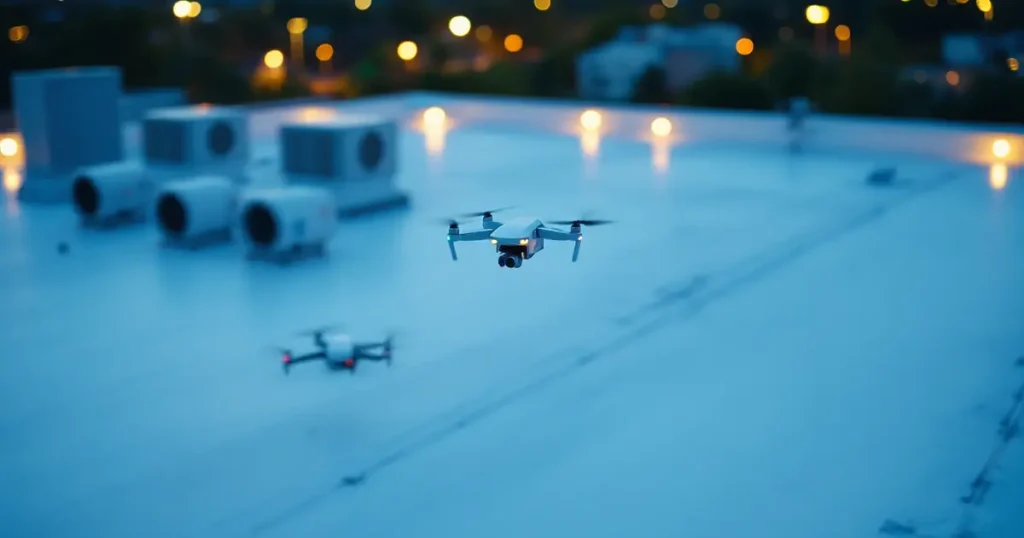
The same physics applies whether the camera is handheld on the roof, mounted on a drone or carried by a manned aircraft; what changes is coverage speed, image detail and whether the crew can mark wet areas and pull cores the same night. Stockton compared on-roof and aerial surveys in a Reliabilityweb article, and FAA Part 107 sets the limits for drones.
| Platform | Coverage | Strengths | Limits | Source |
|---|---|---|---|---|
| Walk-on handheld | About 200,000 sq ft in one night with a three-person crew (thermographer, helper, owner’s representative) | Can look under rooftop units, paint wet areas on the membrane and take cores on site | Needs a longer weather window; drawing dimensions less precise | Stockton, Reliabilityweb |
| Manned aircraft | A 200,000 sq ft roof imaged in under 10 minutes from at least 1,000 ft above ground | Near-vertical view avoids reflections; multiple roof levels and buildings in one flight | High fixed cost; cannot mark the roof | Stockton, Reliabilityweb |
| Drone (small UAS) | Limited to 400 ft above ground, or 400 ft above a structure within a 400 ft radius of it | Low mobilization cost; radiometric 640 x 512 sensors on current enterprise models | Night flights need anti-collision lighting visible for at least 3 statute miles and a pilot trained under the April 2021 rules | 14 CFR 107.51; 14 CFR 107.29 |
Image detail is the number most drone proposals leave out. The table below works it out for one common sensor, the thermal camera on the DJI Mavic 3 Thermal (Mavic 3T), which DJI lists at 640 x 512 pixels, a 61° diagonal field of view and a sensitivity (NETD) of 50 mK or better.
| Height above roof | Ground footprint per frame | Area per frame | Roof width per thermal pixel |
|---|---|---|---|
| 100 ft | 92 ft x 74 ft | About 6,770 sq ft | About 1.7 in |
| 200 ft | 184 ft x 147 ft | About 27,100 sq ft | About 3.5 in |
| 400 ft (Part 107 ceiling) | 368 ft x 294 ft | About 108,300 sq ft | About 6.9 in |
Roofing Brief arithmetic: diagonal footprint = 2 x height x tan(30.5°); divided by the 820-pixel sensor diagonal (the square root of 640² + 512²). A wet strip along a 4 in board joint spans about 2.3 thermal pixels at 100 ft but less than one pixel at 400 ft, so ask the pilot what height they will fly and why. For drone hardware, see our ranking of the best drones for roof inspection, and for visual drone work on houses, our drone roof inspection guide.
Thermal vs nuclear vs impedance vs electronic leak detection
Infrared (ASTM C1153) is one of four nondestructive roof moisture tools, and each has a standard and a roof type it fails on. Infrared and nuclear surveys map wet insulation, impedance scanners map moisture near the surface, and electronic leak detection finds the hole in the membrane rather than the wet area. Core cuts calibrate all of them.
| Method | Standard | What it finds | Where it fails | Source |
|---|---|---|---|---|
| Infrared thermography | ASTM C1153-23 | Wet insulation, located within inches | Shingles, metal, IRMA, closed-cell foam; deep moisture under dry layers | Dupuis, Professional Roofing, Oct 2023; Stockton, 2013 |
| Nuclear (neutron) gauge | ANSI/SPRI/RCI NT-1 | Hydrogen (water) at grid points, typically 10 ft x 10 ft | Slowest method: 15 seconds to 4 minutes per reading; lowest resolution between grid points | Dupuis, Professional Roofing, Oct 2023 |
| Electrical impedance scanner | ASTM D7954 | Relative moisture, pinpointed to fractions of an inch, no depth | EPDM, metal and aluminized coatings; wet surfaces; metal mesh, fasteners and conductive primers give false readings | Dupuis, Professional Roofing, Oct 2023 |
| Electronic leak detection | ASTM D7877 | The breach in the membrane | Needs an exposed membrane and a conductive path below it | ASTM D7877 title and scope |
| Core cut with gravimetric test | Oven-dry weight method | True moisture content at one spot | Destructive; only tells you about the sampled location | Dupuis, Professional Roofing, Oct 2023 |
Dupuis adds one warning in his October 2023 article that applies to every method: high-density polyisocyanurate cover boards can hide moisture from infrared, impedance and nuclear tools alike, so roofs with those boards need test cuts. Nuclear gauges, by contrast, read through EPDM, metal and conductive coatings that defeat impedance scanners.
How much does a thermal roof inspection cost?
A residential infrared roof inspection is listed at $400 to $600 by HomeGuide, and commercial infrared moisture surveys have been published at 1 to 5 cents per square foot by Stockton (2013) and 1 to 2 cents in his Reliabilityweb comparison, set mainly by report level, roof size and the number of problems found. Expect a minimum project fee on small roofs, and get a dated written quote because those figures are more than a decade old.
| Roof area | Infrared survey at 1 to 5 cents/sq ft | Visual commercial inspection at 5 to 10 cents/sq ft |
|---|---|---|
| 10,000 sq ft | $100 to $500, before any minimum fee | $500 to $1,000 |
| 50,000 sq ft | $500 to $2,500 | $2,500 to $5,000 |
| 200,000 sq ft | $2,000 to $10,000 | $10,000 to $20,000 |
Roofing Brief arithmetic from Stockton’s published survey rate (Infrared Training Institute, 2013) and HomeGuide’s $0.05 to $0.10 per sq ft commercial inspection range. Core cuts, patching and a CAD moisture drawing are often priced as extra line items. Wider inspection pricing is in our roof inspection cost guide.
When should you order a thermal roof inspection?
Order a thermal roof inspection before a recover decision, before buying a building with a low-slope roof, when a warranty claim needs evidence of wet area, and after a leak to size the damage. The recover case carries a code consequence: the reroofing section of the International Building Code bars a new roof over a wet one.
The recover limits sit in IBC Section 1511.3.1.1 (2015 and 2018 editions) and the matching International Existing Building Code section, reproduced in the ICC’s reroofing code-change document: “A roof recover shall not be permitted where any of the following conditions occur: 1. Where the existing roof or roof covering is water soaked or has deteriorated to the point that the existing roof or roof covering is not adequate as a base for additional roofing. 2. Where the existing roof covering is slate, clay, cement or asbestos-cement tile. 3. Where the existing roof has two or more applications of any type of roof covering.” Later editions keep the same three conditions in the reroofing section; check the section number and any amendments in your jurisdiction’s adopted edition.
Florida puts numbers on “water soaked.” The Palm Beach County Building Code Advisory Board’s March 15, 2017 technical advisory quotes the High Velocity Hurricane Zone rule: moisture “shall not exceed 5% by weight in the roofing membrane and 8% by weight in commercially manufactured rigid board insulation,” verified by a TAS 126 moisture survey. The board recommends that survey with recover permits for low-slope buildings other than single-family homes, and TAS 126 accepts infrared under ASTM C1153, nuclear under NT-1 and impedance under ASTM D7954. State-by-state partial reroof rules are in our 25% roofing rule guide.
| Worked example: 50,000 sq ft low-slope roof | Inputs | Result |
|---|---|---|
| Infrared survey | 50,000 x $0.01 to $0.05 | $500 to $2,500 |
| Wet area found (illustrative) | 8% of 50,000 sq ft | 4,000 sq ft to remove and replace |
| Tear-off avoided on dry area, if a recover is allowed | 46,000 sq ft x $1 to $2 tear-off | $46,000 to $92,000 |
| Survey cost as a share of tear-off avoided | $500 / $92,000 and $2,500 / $46,000 | About 0.5% to 5.4% |
Roofing Brief estimate. Tear-off at $1 to $2 per sq ft is the range in our flat roof estimate guide; the 8% wet share is an assumption for illustration only. Whether wet sections can be cut out and the rest recovered depends on the building official and the new roof maker’s warranty terms.
Which moisture survey to order: decision table
| If your roof or goal is | Then order | Why |
|---|---|---|
| Low-slope, absorbent board insulation, recover planned | ASTM C1153 infrared survey plus cores | Code bars recovering a water-soaked roof (IBC 1511.3.1.1) |
| Florida HVHZ recover permit | TAS 126 moisture survey with gravimetric cores | 5% membrane and 8% board insulation limits by weight |
| Heavy ballast, pavers or an inverted (IRMA) roof | Nuclear survey or cores, not rooftop infrared | Stockton lists IRMA as impossible and ballast as difficult |
| EPDM or aluminum-coated roof needing a quick check | Infrared or nuclear, not impedance | Impedance cannot read conductive membranes (Dupuis) |
| High-density polyiso cover board | Test cuts at planned points | Cover boards can hide moisture from all three survey tools |
| Need the exact hole in a new membrane | Electronic leak detection (ASTM D7877) | Infrared shows wet area, not the point of entry |
| Shingle or metal house roof with a ceiling stain | Interior or attic thermal scan plus moisture meter | Rooftop infrared cannot read these roofs from above |
| More than 200,000 sq ft, or several buildings | Aerial survey, then walk-on verification | Aircraft image 200,000 sq ft in under 10 minutes |
How to hire a thermographer: contract checklist
A thermal roof inspection proposal should name the standard, the weather limits, the person running the camera and the exact deliverable.
- Require the survey “in accordance with ASTM C1153-23” and ask the firm to state its wind, rain and sky limits in writing, at least as tight as Lucier’s 15 mph and 48-hour dry rules.
- Ask for the thermographer’s certification level (Level I, II or III), who issued it, and whether it follows an ASNT SNT-TC-1A written practice, which is an employer-run certification program, not a state license. Our certified roof inspector guide covers how to check roofing credentials.
- For drone work, ask for the pilot’s Part 107 Remote Pilot Certificate, confirmation of the post-April 2021 night training required by 14 CFR 107.29, and the planned flight height.
- Ask for the camera model and rated sensitivity, as C1153-23 clause 1.2 covers equipment criteria.
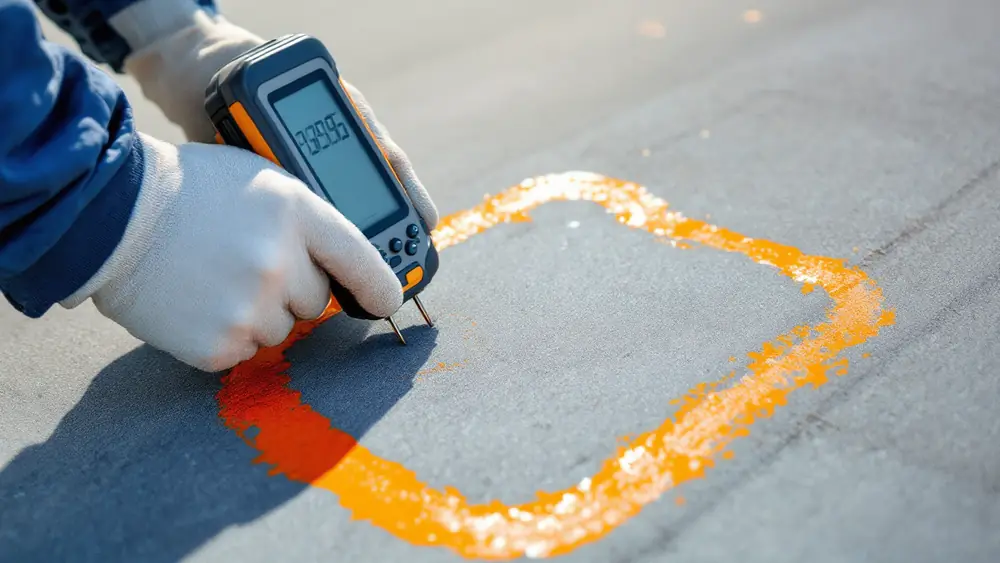
- Specify the deliverable: a scaled roof drawing (for example 1 in = 20 ft) with each wet area outlined and its square footage, paired thermal and visual images, and paint marks on the membrane for walk-on surveys.
- Fix the number and location of the verification cores ASTM C1153-23 clause 1.6 calls for, including at least one where the scan reads dry, who takes them, how moisture is measured (gravimetric oven-dry weight is the reference method) and who patches each cut, with the patch material named.
- Accept that the report will not name the leak source; C1153-23 section 4.3 says the practice does not determine the cause of moisture or its point of entry. Book electronic leak detection or a commercial roof inspector for that.
Because rain within 48 hours cancels a survey night, book it well ahead of a closing date or bid deadline. Typical durations by inspection type are in how long a roof inspection takes.
Frequently asked questions
Can thermal imaging detect roof leaks?
Thermal imaging detects the wet insulation a leak leaves behind, not the leak itself. Wet areas hold heat after sunset and show warmer on the camera, but ASTM C1153-23 section 4.3 states the practice does not find the cause of moisture or its point of entry. Electronic leak detection under ASTM D7877 or a water test locates the actual breach.
Does a thermal roof inspection work on a shingle roof?
Not from above. Thermographer Gregory Stockton lists asphalt shingle roofs as impossible to survey with rooftop infrared except from underneath, and metal roofs the same except for rust or stains. On a house, a thermal camera is used in the attic or on interior ceilings, and a moisture meter confirms any cool or warm spot.
What does thermal imaging do for a home inspection?
In a home inspection, a thermal camera maps temperature differences on ceilings and walls that can point to wet drywall, missing insulation or air leaks. It does not measure moisture, so a cold spot under a bathroom fan or a recessed light can look like water. Even ASTM C1153 requires invasive verification of infrared data, so inspectors confirm suspect areas with a moisture meter before reporting a leak.
How much does an infrared roof inspection cost?
HomeGuide lists a residential infrared roof inspection at $400 to $600. Commercial infrared moisture surveys have been published at 1 to 5 cents per square foot (Stockton, 2013), or $500 to $2,500 for a 50,000 sq ft roof, before minimum fees, core cuts and patching. Ask for a dated written quote with cores priced separately.