
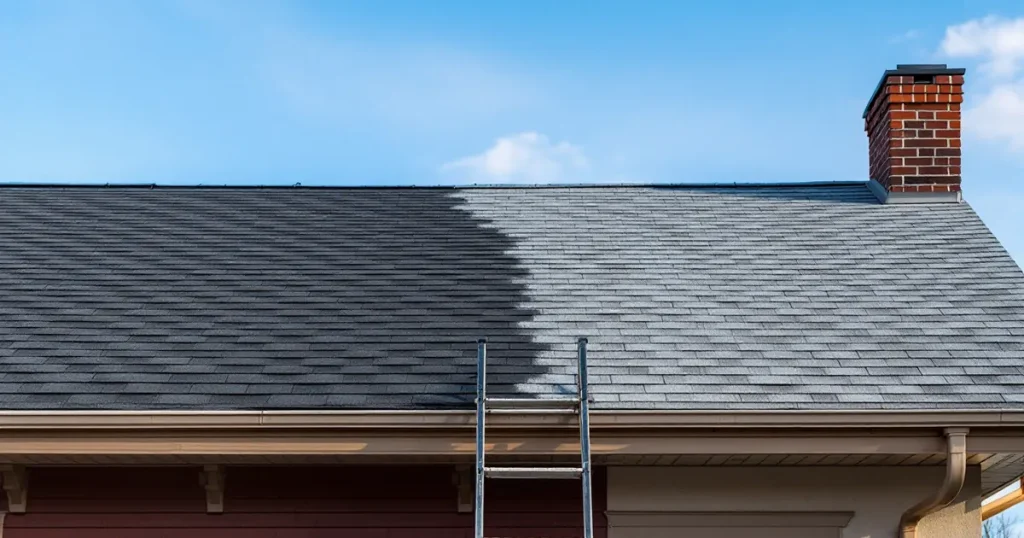
Short answer: The “25% rule” for roofing comes from the Florida Building Code: if more than 25 percent of a roof or roof section is repaired, replaced or recovered within 12 months, the whole roof covering must be brought up to the current code. We checked the building codes, statutes and insurance regulations of 49 states and the District of Columbia. Only Florida applies that whole-roof trigger statewide, and since 2022 it no longer applies to Florida roofs built to the 2007 code or later. Colorado has a 25 percent wildfire roof rule in mapped wildland-urban interface areas, Connecticut uses 25 percent as a permit exemption, and California has a related 50 percent fire-rating trigger. Everywhere else, no statewide 25 percent roof rule applies.
Homeowners meet the phrase on almost every local roofing search, often from a roofer or an insurance adjuster explaining why a repair has turned into a replacement. Because it is real law in one state and folklore in most others, the answer depends entirely on where the house is. This guide sets out what applies in each state, with the code or statute behind it, and separates the 25 percent rule from the insurance “matching” rules it is often confused with.
What the 25% rule actually says
Florida is the one state where the 25 percent rule is real statewide code. Section 706.1.1 of the Florida Building Code, Existing Building (8th Edition, 2023) says no more than 25 percent of a roof or roof section may be repaired, replaced or recovered in any 12-month period unless the roof covering on the entire roof or roof section is brought up to the current code. Since 2022, Fla. Stat. 553.844(5) carves out an exception: if the existing roof or roof section was built, repaired or replaced under the 2007 Florida Building Code or any later edition, only the portion being repaired, replaced or recovered must meet current code, however large it is. Local governments may not amend that exception by ordinance, so the full replacement trigger now matters mainly for roofs installed before the 2007 code applied.
The model codes most states adopt, the International Residential Code and International Existing Building Code, contain no 25 percent whole-roof trigger. What they do contain is the reroofing section: a roof replacement must strip the old covering down to the deck, and a new layer may not be laid over a roof that is water-soaked or deteriorated, over slate, clay, cement or asbestos-cement tile, or over two or more existing layers. In most states that, not a percentage, decides when a repair becomes a full tear-off.
For the full Florida picture, including the secondary water barrier rules, see our guide to Florida’s roofing code.
The states with a real 25 percent roof rule
Colorado
Colorado has no general statewide building code, but its state Wildfire Resiliency Code (8 CCR 1507-39, Colorado Wildfire Resiliency Code section 101.6) sets a true 25 percent roof rule for homes in mapped wildland urban interface areas: if 25 percent or more of the roof covering on an existing building is replaced, or work effectively replaces it, the entire roof covering must be replaced with a Class A rated roof meeting the new construction rules (sections 403.2 through 403.2.2), unless the roof already complies. Work affecting less than 25 percent of the roof covering is exempt, the code sets no 12 month look back period, and it does not apply where the state map shows no wildfire hazard or to a 35 acre parcel with a single home that does not abut a residential or commercial area. Local governments in the interface were required to adopt this code or a stricter one by April 1, 2026, and your city or county building department enforces it along with its own adopted residential code.
Connecticut
Connecticut has a statewide 25 percent roofing rule, but it is a permit exemption, not a requirement to replace the whole roof. The 2022 Connecticut State Building Code (based on the 2021 IRC, for permit applications filed on or after October 1, 2022) exempts from permits ‘repairs that are limited to 25 percent of roof covering and building siding within one calendar year’ on one and two family homes (amended IRC R105.2, item 11); work beyond that needs a building permit. Any reroof must still meet IRC R908: a replacement tears off down to the deck, and a recover is not allowed over a water soaked or deteriorated roof, over slate, clay, cement or asbestos cement tile, or over two or more existing layers.
Florida
Florida is the one state where the 25 percent rule is real statewide code. Section 706.1.1 of the Florida Building Code, Existing Building (8th Edition, 2023) says no more than 25 percent of a roof or roof section may be repaired, replaced or recovered in any 12-month period unless the roof covering on the entire roof or roof section is brought up to the current code. Since 2022, Fla. Stat. 553.844(5) carves out an exception: if the existing roof or roof section was built, repaired or replaced under the 2007 Florida Building Code or any later edition, only the portion being repaired, replaced or recovered must meet current code, however large it is. Local governments may not amend that exception by ordinance, so the full replacement trigger now matters mainly for roofs installed before the 2007 code applied.
California: a 50 percent rule instead
California has no 25 percent rule; its statewide trigger is 50 percent. Under the 2025 California Residential Code (Title 24, Part 2.5, in effect for permits applied for on or after January 1, 2026), if more than 50 percent of the total roof area is replaced within any one-year period outside fire hazard severity zones, the entire roof covering must be at least Class C fire rated, and inside Fire Hazard Severity Zones or Wildland-Urban Interface areas the 2025 California Wildland-Urban Interface Code (Part 7, Section 507.1) requires a roof with 50 percent or more replaced in a 12-month period to be redone to new-construction Class A standards. Any replacement roof must also be torn off to the deck (CRC R908.3), and many cities adopt stricter local amendments (for example requiring Class A or Class B citywide), so check with your city or county building department.
Insurance matching rules are not a 25 percent rule
Much of the confusion comes from insurance. Some states require an insurer, when a damaged section cannot be matched, to replace enough of the undamaged roof to give a reasonably uniform appearance. That is a claims rule about what the policy pays for, not a building code trigger, and it carries no percentage. We found a matching statute, regulation or regulator directive in 12 of the 50 jurisdictions checked:
- Alaska: Yes: 3 AAC 26.090(l)(2) requires that on a replacement cost claim, if replacement property does not match in quality, color or size, the insurer replace the property in the area to provide a reasonably uniform appearance, for interior and exterior losses, with the claimant paying only the deductible.
- California: Yes: Cal. Code Regs. tit. 10, section 2695.9(a)(2) requires that when replaced items do not match in quality, color or size, the insurer replace all items in the damaged area to a reasonably uniform appearance (replacement cost policies).
- Connecticut: Conn. Gen. Stat. 38a-316e requires that when a covered loss requires replacing items that do not match adjacent items in quality, color or size, the insurer must replace all such items with like kind and quality material so as to conform to a reasonably uniform appearance (interior and exterior losses).
- Florida: Fla. Stat. 626.9744(2): unless the policy provides otherwise, when replaced items do not match in quality, color or size, the insurer must make reasonable repairs or replacement of items in adjoining areas, and may weigh the cost, the uniformity achievable, the remaining life of the undamaged portion and other relevant factors.
- Iowa: Yes: Iowa Administrative Code 191-15.44(1)(b) requires that, under replacement cost policies, when replaced items do not match in quality, color or size, the insurer must replace as much of the item as necessary for a reasonably uniform appearance within the same line of sight, for interior and exterior losses, with exceptions case by case and no cost to the insured beyond the deductible.
- Kentucky: 806 KAR 12:095 Section 9(1)(b): if replaced items do not reasonably match in quality, color and size, the insurer must replace all items in the area so as to conform to a reasonably uniform appearance, at no cost beyond the deductible; the Department of Insurance’s Advisory Opinion 2023-08 reads ‘area’ as the entire roof and rejects a line of sight limit, though the opinion itself is not legally binding.
- Nebraska: Yes: Nebraska regulation 210 NAC 60, section 010.01(B), says that under replacement cost policies, when replacement items do not reasonably match in quality, color or size, the insurer must replace all items in the area to a reasonably uniform appearance, for interior and exterior losses, with the insured paying nothing beyond the deductible.
- Ohio: Yes: Ohio Adm. Code 3901-1-54(I)(1)(b) says that when a replacement item does not match the quality, color or size of the damaged item on a replacement cost policy, the insurer shall replace as much of the item as needed for a reasonably comparable appearance (rule effective 2/14/2022).
- Rhode Island: 230-RICR-20-40-2.9(A)(1)(b) requires that on replacement cost policies, when replaced items do not match in quality, color or size, the insurer must replace all such items so as to conform to a reasonably uniform appearance, for interior and exterior losses, with the claimant paying no more than the deductible.
- Tennessee: Tenn. Comp. R. & Regs. 0780-01-05-.10(1)(b) (effective October 9, 2017): under replacement cost policies, when replaced items do not match in quality, color or size, the insurer must replace items so as to conform to a reasonably uniform appearance according to the applicable policy provisions, for interior and exterior losses, with the insured paying nothing beyond the deductible.
- Utah: Yes: Utah Admin. Code R590-190-13(1)(a)(ii) requires that if repaired or replaced items do not match in color, texture or size, the insurer repair or replace items to a reasonably uniform appearance for interior and exterior losses (replacement cost policies), with the insured responsible only for the deductible.
- Vermont: Vermont Regulation I-79-2 (Fair Claims Practices, revised), Section 8, requires that when replacement items do not match adjacent items in quality, color or size, the insurer must replace them with like kind and quality material to conform to a reasonably uniform appearance within the same line of sight, taking natural breaks into account, with the insured paying no more than the deductible.
The 25% rule in every state
Each row states what applies to a partial roof repair or replacement on a house, from the primary sources listed at the end. Confidence reflects whether we could read the governing text directly.
| State | Statewide 25% rule? | What applies | Insurance matching rule | Confidence |
|---|---|---|---|---|
| Alabama | No | Alabama has no statewide 25 percent roof rule. Right now there is no single statewide residential code for existing homes: reroofing follows whatever code your city or county has adopted, the edition varies by jurisdiction, and some rural areas do no residential permitting at all. Under Act 2024-443, starting January 1, 2027 builders and roofers must work to the Alabama Residential Building Code adopted by the Home Builders Licensure Board (or the local code where one exists), enforced only where local inspection programs exist. Anyone doing residential roofing work costing more than $2,500 must hold a roofing license from the Home Builders Licensure Board. | None found: Alabama’s property and casualty claims standards rule (Ala. Admin. Code ch. 482-1-125) contains no matching requirement. | medium |
| Alaska | No | Alaska has no 25 percent roof rule and no statewide residential building code for houses of one to three units: state fire and life safety standards cover buildings with four or more dwelling units (AS 18.70.080), and the State Fire Marshal exempts residential housing that is a three-plex or smaller from plan review. Reroofing rules for a house therefore come only from local codes in cities and boroughs that adopt them, such as Anchorage, Fairbanks and Juneau. Outside those jurisdictions no state reroof code requirement was found. | Yes: 3 AAC 26.090(l)(2) requires that on a replacement cost claim, if replacement property does not match in quality, color or size, the insurer replace the property in the area to provide a reasonably uniform appearance, for interior and exterior losses, with the claimant paying only the deductible. | high |
| Arizona | No | Arizona has no 25 percent roof rule and no statewide residential building code; counties (A.R.S. 11-861) and cities adopt their own codes. Phoenix, for example, adopted the 2024 International Residential Code effective August 1, 2025, and its local amendments do not change the reroofing section, so a replacement roof must be torn off to the deck (R908.3) and a recover is not allowed over a water-soaked or deteriorated roof, slate or tile, or two existing layers (R908.4). Ask your city or county building department which edition applies to your address. | none found (Ariz. Admin. Code R20-6-801, the unfair claims settlement rule, contains no matching requirement). | high |
| Arkansas | No | Arkansas has no statewide 25 percent roof rule. The state residential code is the Arkansas Fire Prevention Code, Volume III, which is the 2021 International Residential Code as amended by the State Fire Marshal and effective January 1, 2023, and the state amendments do not change the reroofing section. Under 2021 IRC R908.3 a roof replacement means tear-off to the deck, and R908.3.1.1 does not allow a recover over a water-soaked or deteriorated roof, over slate, clay, cement or asbestos-cement tile, or over two or more layers; there is no percentage trigger for partial repairs. Permits and inspections are handled by local building officials, so requirements vary by city and county. | None found: Arkansas Insurance Department Rule 43 (Unfair Claims Settlement Practices, 054.00.15 Ark. Code R. 005) contains no matching requirement. | medium |
| California | No (50% fire-rating rule) | California has no 25 percent rule; its statewide trigger is 50 percent. Under the 2025 California Residential Code (Title 24, Part 2.5, in effect for permits applied for on or after January 1, 2026), if more than 50 percent of the total roof area is replaced within any one-year period outside fire hazard severity zones, the entire roof covering must be at least Class C fire rated, and inside Fire Hazard Severity Zones or Wildland-Urban Interface areas the 2025 California Wildland-Urban Interface Code (Part 7, Section 507.1) requires a roof with 50 percent or more replaced in a 12-month period to be redone to new-construction Class A standards. Any replacement roof must also be torn off to the deck (CRC R908.3), and many cities adopt stricter local amendments (for example requiring Class A or Class B citywide), so check with your city or county building department. | Yes: Cal. Code Regs. tit. 10, section 2695.9(a)(2) requires that when replaced items do not match in quality, color or size, the insurer replace all items in the damaged area to a reasonably uniform appearance (replacement cost policies). | high |
| Colorado | Yes (wildfire areas) | Colorado has no general statewide building code, but its state Wildfire Resiliency Code (8 CCR 1507-39, Colorado Wildfire Resiliency Code section 101.6) sets a true 25 percent roof rule for homes in mapped wildland urban interface areas: if 25 percent or more of the roof covering on an existing building is replaced, or work effectively replaces it, the entire roof covering must be replaced with a Class A rated roof meeting the new construction rules (sections 403.2 through 403.2.2), unless the roof already complies. Work affecting less than 25 percent of the roof covering is exempt, the code sets no 12 month look back period, and it does not apply where the state map shows no wildfire hazard or to a 35 acre parcel with a single home that does not abut a residential or commercial area. Local governments in the interface were required to adopt this code or a stricter one by April 1, 2026, and your city or county building department enforces it along with its own adopted residential code. | None found: Colorado has no matching statute or Division of Insurance regulation requiring replacement of undamaged roofing for a uniform appearance; matching depends on policy wording and case law. | medium |
| Connecticut | Yes (permit exemption) | Connecticut has a statewide 25 percent roofing rule, but it is a permit exemption, not a requirement to replace the whole roof. The 2022 Connecticut State Building Code (based on the 2021 IRC, for permit applications filed on or after October 1, 2022) exempts from permits ‘repairs that are limited to 25 percent of roof covering and building siding within one calendar year’ on one and two family homes (amended IRC R105.2, item 11); work beyond that needs a building permit. Any reroof must still meet IRC R908: a replacement tears off down to the deck, and a recover is not allowed over a water soaked or deteriorated roof, over slate, clay, cement or asbestos cement tile, or over two or more existing layers. | Conn. Gen. Stat. 38a-316e requires that when a covered loss requires replacing items that do not match adjacent items in quality, color or size, the insurer must replace all such items with like kind and quality material so as to conform to a reasonably uniform appearance (interior and exterior losses). | high |
| Delaware | No | Delaware has no statewide 25 percent roof rule and no statewide residential building code; counties and towns adopt their own. Sussex County and towns that follow it, such as Bridgeville, use the 2021 IRC, while New Castle and Kent Counties and their towns set their own editions. Where the 2021 IRC applies, a replacement means tear off to the deck (R908.3), and a recover is barred over a water soaked or deteriorated roof, over slate, clay, cement or asbestos-cement tile, or where two or more layers already exist (R908.3.1.1). Check your county or town building office for its edition and reroof permit rules. | none found; 18 Del. Admin. Code 902 (prompt investigation and payment of claims) has no matching requirement. | medium |
| District of Columbia | No | Washington, DC has no 25 percent roofing rule. The 2017 DC Construction Codes, effective May 29, 2020 and still the codes listed by the Department of Buildings, use the 2015 IRC amended by 12-B DCMR, and the only DC change to the roofing chapter is a cool roof requirement for roofs with slopes of 2 in 12 or less (R905.1.3). Under 2015 IRC R908.3 a replacement tears off down to the deck, and under R908.3.1.1 a recover is not allowed over a water soaked or deteriorated roof, over slate, clay, cement or asbestos cement tile, or over two or more existing layers. DOB announced in June 2026 that it is updating all construction codes to newer ICC editions, so check the current code before a project. | None found: no DC statute or regulation requiring insurers to match undamaged roofing was identified. | medium |
| Florida | Yes | Florida is the one state where the 25 percent rule is real statewide code. Section 706.1.1 of the Florida Building Code, Existing Building (8th Edition, 2023) says no more than 25 percent of a roof or roof section may be repaired, replaced or recovered in any 12-month period unless the roof covering on the entire roof or roof section is brought up to the current code. Since 2022, Fla. Stat. 553.844(5) carves out an exception: if the existing roof or roof section was built, repaired or replaced under the 2007 Florida Building Code or any later edition, only the portion being repaired, replaced or recovered must meet current code, however large it is. Local governments may not amend that exception by ordinance, so the full replacement trigger now matters mainly for roofs installed before the 2007 code applied. | Fla. Stat. 626.9744(2): unless the policy provides otherwise, when replaced items do not match in quality, color or size, the insurer must make reasonable repairs or replacement of items in adjoining areas, and may weigh the cost, the uniformity achievable, the remaining life of the undamaged portion and other relevant factors. | high |
| Georgia | No | Georgia has no statewide 25 percent roof rule. Since January 1, 2026 the state minimum code for one and two family homes is the 2024 International Residential Code with Georgia amendments, and those amendments do not change the reroofing section. Under 2024 IRC R908.3 a roof replacement means removing all existing layers down to the deck (with narrow exceptions for an adhered ice barrier or self-adhered underlayment), and R908.4 does not allow a recover over a water-soaked or deteriorated roof, over slate, clay, cement or asbestos-cement tile, or where two or more layers already exist; nothing ties a repair to a percentage of the roof. Your city or county building department issues reroof permits and may have local rules. | None found: Georgia’s first-party property claim standards (Ga. Comp. R. & Regs. 120-2-52) contain no matching requirement, and a 2024 matching bill (HB 1310) was introduced but I found no record that it was enacted. | high |
| Hawaii | No | Hawaii has no 25 percent roofing rule. The State Residential Code adopted by the State Building Code Council is the 2018 IRC with Hawaii amendments, and those amendments do not change the roofing chapter, so IRC R908 applies: a replacement tears off down to the deck, and a recover is not allowed over a water soaked or deteriorated roof, over slate, clay, cement or asbestos cement tile, or over two or more existing layers. Each county adopts and enforces its own version of the code and decides by ordinance which work needs a permit, so check with your county building department. | None found: no Hawaii statute or regulation requiring insurers to match undamaged roofing was identified. | medium |
| Idaho | No | Idaho has no 25 percent roof rule. The Idaho Residential Code is the 2018 International Residential Code (Parts I, II, III and IX) with Idaho amendments adopted in IDAPA 24.39.30.600, and those amendments do not change the reroofing section. Under 2018 IRC R908.3 a roof replacement must be removed down to the deck, and R908.3.1.1 bars a recover over a water-soaked or deteriorated roof, slate or tile, or two existing layers. Local building departments enforce the code and should be asked about permits. | none found (no Idaho statute or rule located; not confirmed against Idaho Department of Insurance rules). | medium |
| Illinois | No | Illinois has no statewide 25 percent roof rule and no single statewide residential code that sets reroofing rules. Under 20 ILCS 3105/10.18, as amended by Public Act 103-0510, local building codes since January 1, 2025 must regulate residential structural design at least as stringently as the IRC; the Capital Development Board points to the current or prior IRC edition where a town has no code. That means reroofing rules, including any tear-off and layer limits, come from your city or county code, and Chicago runs its own code, so check with the local building department. | none found; the Illinois claims practice rule (50 Ill. Adm. Code 919.80) has no matching requirement. | medium |
| Indiana | No | Indiana has no 25 percent roof rule. The 2020 Indiana Residential Code (675 IAC 14-4.4) is the 2018 IRC with state amendments, has been in effect statewide since December 26, 2019, and is still listed as current by the Fire Prevention and Building Safety Commission. Indiana’s amendments do not change the reroofing section R908, so a roof replacement must tear off to the deck (R908.3). A recover is not allowed over a water soaked or deteriorated roof, over slate, clay, cement or asbestos-cement tile, or where two or more layers already exist (R908.3.1.1). | none found | high |
| Iowa | No | Iowa has no 25 percent roofing rule. The Iowa state building code (481 IAC chapter 301) adopts the 2024 International Residential Code and the 2024 International Existing Building Code with no roof percentage trigger, but it only applies to state buildings, to local governments that adopt it, and to cities over 15,000 people without their own nationally recognized code (Iowa Code 103A.10); most larger cities enforce their own adopted codes. Under the IRC, a reroof must be torn off to the deck if the existing roof is water soaked or deteriorated, is slate or tile, or already has two or more layers. Check your city or county building department for its adopted edition. | Yes: Iowa Administrative Code 191-15.44(1)(b) requires that, under replacement cost policies, when replaced items do not match in quality, color or size, the insurer must replace as much of the item as necessary for a reasonably uniform appearance within the same line of sight, for interior and exterior losses, with exceptions case by case and no cost to the insured beyond the deductible. | high |
| Kansas | No | Kansas has no statewide 25 percent roofing rule because Kansas does not enforce a statewide residential building code; cities and counties adopt their own codes, usually an edition of the International Residential Code. Whatever reroofing limits apply, such as tear off rules or layer limits, come from your city or county’s adopted code, and some rural areas have no building code at all. Ask your local building department which edition it enforces and whether it has added any reroof rules. | None found: Kansas adopts the NAIC Unfair Claims Settlement Practices Model Regulation (K.A.R. 40-1-34), which bars lowball cash settlements below repair cost but contains no matching requirement. | medium |
| Kentucky | No | Kentucky has no statewide 25 percent roof rule. The mandatory statewide residential code is the 2015 International Residential Code as amended by the 2018 Kentucky Residential Code (815 KAR 7:125); its R908.3 requires tear-off to the deck for a roof replacement and R908.3.1.1 does not allow a recover over a water-soaked or deteriorated roof, over slate, clay, cement or asbestos-cement tile, or over two or more layers, with no percentage trigger for partial repairs. Permits and inspections for a single family home are required only where a local ordinance requires them. In Kentucky, a full roof after partial storm damage usually comes from the insurance matching regulation below, not a building code percentage. | 806 KAR 12:095 Section 9(1)(b): if replaced items do not reasonably match in quality, color and size, the insurer must replace all items in the area so as to conform to a reasonably uniform appearance, at no cost beyond the deductible; the Department of Insurance’s Advisory Opinion 2023-08 reads ‘area’ as the entire roof and rejects a line of sight limit, though the opinion itself is not legally binding. | high |
| Louisiana | No | Louisiana has no statewide 25 percent roof rule. The Louisiana State Uniform Construction Code adopts the 2021 International Residential Code for homes (La. Admin. Code tit. 17, I-107), but makes its enforcement mandatory only for new construction, reconstruction, additions and extensive alterations, so a routine reroof falls under your parish or city permit rules. Where the 2021 IRC is applied, R908.3 requires removing existing layers down to the deck for a roof replacement, and R908.3.1.1 does not allow a recover over a water-soaked or deteriorated roof, over slate, clay, cement or asbestos-cement tile, or over two or more existing layers; there is no percentage trigger. | None in force: a matching provision (proposed La. R.S. 22:1895.1) was in the original 2022 HB 539 but was stripped before the bill became Act 734 of 2022, so Louisiana has no matching statute. | medium |
| Maine | No | Maine has no 25 percent roofing rule. The Maine Uniform Building and Energy Code adopts the 2021 IRC for one and two family homes (16-642 CMR Chapter 5, amended March 4, 2025) and adopts Chapter 9, Roof Assemblies, without changes, so IRC R908 applies: a replacement tears off down to the deck, and a recover is not allowed over a water soaked or deteriorated roof, over slate, clay, cement or asbestos cement tile, or over two or more existing layers. The code applies statewide, but municipalities of 4,000 or more residents must enforce it while smaller towns may choose to, and permits are required only where a municipal ordinance requires them. | None found: no Maine statute or regulation requiring insurers to match undamaged roofing was identified. | medium |
| Maryland | No | Maryland has no statewide 25 percent roof rule. The Maryland Building Performance Standards adopt the 2021 IRC for houses (COMAR 09.12.51.04), and repairs and alterations to existing homes go under the Maryland Building Rehabilitation Code, which is the 2021 IEBC (COMAR 09.12.58.03). Counties and cities enforce these codes and may amend them (COMAR 09.12.51.05), so the local building department sets reroof permit requirements. Under the 2021 IRC a replacement means tear off to the deck (R908.3), and a recover is barred over a water soaked or deteriorated roof, over slate, clay, cement or asbestos-cement tile, or where two or more layers already exist (R908.3.1.1). | none found; the unfair claim settlement rules (COMAR 31.15.07) have no matching requirement. | medium |
| Massachusetts | No | Massachusetts has no 25 percent roofing rule. The 10th Edition State Building Code (780 CMR 51.00, the 2021 IRC with Massachusetts amendments) has been the only code in effect since June 30, 2025, and its roofing amendments do not change the IRC reroofing section R908, so a replacement tears off down to the deck and a recover is not allowed over a water soaked or deteriorated roof, over slate, clay, cement or asbestos cement tile, or over two or more existing layers. Massachusetts adds that roofing and reroofing must also meet the energy conservation requirements of Chapter 11 (R901.1), and reroofing is not on the permit exempt list (R105.2), though ordinary repairs need no permit (R105.2.2). | None found: no Massachusetts statute or regulation requiring insurers to match undamaged roofing was identified. | high |
| Michigan | No | Michigan has no 25 percent roof rule. The Michigan Residential Code in force is the 2015 IRC with state amendments (R 408.30500), and Michigan does not amend the IRC reroofing section R908. LARA says that while a July 7, 2025 Court of Claims stipulated order stays in place, the 2015 IRC remains in effect, and the 2021 based code filed for August 29, 2025 is on hold. Under R908.3 a roof replacement means tear off to the deck, and R908.3.1.1 bars a recover over a water soaked or deteriorated roof, over slate, clay, cement or asbestos-cement tile, or where two or more layers already exist. | none found | medium |
| Minnesota | No | Minnesota has no 25 percent roofing rule. The Minnesota Residential Code (Minnesota Rules chapter 1309, based on the 2018 International Residential Code) applies statewide and supersedes city building codes under Minn. Stat. 326B.121, and it contains no percentage trigger for upgrading the whole roof. Under it, a reroof must be torn off to the deck if the existing roof is water soaked or deteriorated, is slate or tile, or already has two or more layers (IRC R908.3 and R908.3.1.1); Minnesota’s amendments delete the IRC drip edge requirement and say kick out flashing is not required when you only reroof. The state is in rulemaking to move to the 2024 IRC, so confirm the current edition with your local building official. | None found: Minnesota has no matching statute or regulation; the Minnesota Supreme Court in Cedar Bluff Townhome Condominium Ass’n v. American Family (2014) held that replacement material must reasonably match, which is case law, not a statute. | high |
| Mississippi | No | Mississippi has no statewide 25 percent roof rule. Under Miss. Code Ann. 17-2-4, every county and city that did not opt out within 120 days after August 1, 2014 must adopt one of the last three editions of the International Residential Code adopted by the Mississippi Building Codes Council, so the reroofing rules depend on your local code, and places that opted out may have no residential code. None of those IRC editions has a percentage trigger for roof repairs; they require tear-off when a recover is not allowed, such as over a water-soaked or deteriorated roof, over tile or slate, or where two or more layers already exist. Check with your city or county building department. | None found: I located no Mississippi statute or Insurance Department regulation requiring matching. | medium |
| Missouri | No | Missouri has no statewide 25 percent roofing rule because it has no statewide residential building code; the state adopts codes only for state owned buildings, and cities and counties adopt their own codes, usually an edition of the International Residential Code. Reroofing limits such as tear off and layer rules therefore come from your local adopted code, and some rural areas have no building code. Ask your city or county building department which edition it enforces and whether it has added any reroof rules. | None found: Missouri has no matching statute or regulation; courts enforce matching only where the policy can reasonably be read to require it (Alessi v. Mid-Century Ins. Co., 2015). | medium |
| Montana | No | Montana has no 25 percent roof rule. The state adopted the 2024 International Residential Code effective September 26, 2026 (ARM 24.301.154), with no Montana changes to the reroofing section, but by statute the state code does not apply to homes with fewer than five units unless the local city, county or town has made it applicable (MCA 50-60-102). Where the IRC applies, a roof replacement must be torn off to the deck (R908.3) and a recover is not allowed over a water-soaked or deteriorated roof, slate or tile, or two existing layers (R908.4). Check with your local building department, since many rural areas have no residential code enforcement. | No statute or rule, but Commissioner advisory memoranda (August 20, 2003 on roofing and July 6, 2009 on all building materials) state the agency position that damaged materials must be replaced with similar quality, kind, texture and color so there is a reasonable match, and if that is unavailable the existing materials must be replaced to achieve a match. | high |
| Nebraska | No | Nebraska has no 25 percent roofing rule. The state building code (Neb. Rev. Stat. 71-6403) adopts the 2018 International Residential Code and the 2018 International Existing Building Code without any roof percentage trigger, and it applies to state buildings, to cities and counties that adopt it, and by default to local governments that fail to adopt a code within two years of a state update. Under the 2018 IRC, a reroof must be torn off to the deck if the existing roof is water soaked or deteriorated, is slate or tile, or already has two or more layers (R908.3 and R908.3.1.1). Cities such as Omaha and Lincoln adopt their own codes that must conform generally to the state code, so check locally. | Yes: Nebraska regulation 210 NAC 60, section 010.01(B), says that under replacement cost policies, when replacement items do not reasonably match in quality, color or size, the insurer must replace all items in the area to a reasonably uniform appearance, for interior and exterior losses, with the insured paying nothing beyond the deductible. | medium |
| Nevada | No | Nevada has no 25 percent roof rule and no statewide residential building code; cities and counties adopt their own building codes under NRS 278.580. Clark County (the Las Vegas area) enforces the 2024 International Residential Code with Southern Nevada amendments effective January 11, 2026, and those amendments do not change the reroofing section, so a replacement roof must be torn off to the deck (R908.3) and a recover is not allowed over a water-soaked or deteriorated roof, slate or tile, or two existing layers (R908.4). Elsewhere, ask your city or county building department which edition and amendments apply. | none found (NAC 686A.660 to 686A.680 claim standards contain no matching requirement). | medium |
| New Hampshire | No | New Hampshire has no 25 percent roofing rule. The State Building Code (RSA 155-A) moved to the 2024 IRC and 2024 IEBC with New Hampshire amendments on July 1, 2026, with either the 2021 or 2024 codes allowed for permit requests through December 31, 2026, and the New Hampshire amendments do not change the IRC reroofing section. Under 2024 IRC R908.3 a replacement tears off down to the deck, and under R908.4 a recover is not allowed over a water soaked or deteriorated roof, over slate, clay, cement or asbestos cement tile, or over two or more existing layers. The state code applies everywhere, but permits and inspections depend on whether your municipality has adopted an enforcement ordinance. | None found: no New Hampshire statute or regulation requiring insurers to match undamaged roofing was identified. | medium |
| New Jersey | No | New Jersey has no 25 percent roofing rule. Under the Uniform Construction Code, the repair or replacement of existing roof covering on a detached one or two family home is classed as ordinary maintenance, so no permit, inspection or notice to the construction office is required (N.J.A.C. 5:23-2.7(c)1.x). Roof work on existing buildings follows the Rehabilitation Subcode, which requires the old roofing to be torn off before new roofing goes on when the existing roof is water soaked or deteriorated, is wood shake, slate, clay, cement or asbestos cement tile, or already has two or more layers (N.J.A.C. 5:23-6.4(e)7). The state’s one and two family dwelling subcode is the 2024 IRC as amended in N.J.A.C. 5:23-3.21. | None found: no New Jersey statute or regulation requiring insurers to match undamaged roofing was identified. | high |
| New Mexico | No | New Mexico has no 25 percent roof rule. The statewide 2021 New Mexico Residential Building Code (14.7.3 NMAC, adopting the 2021 IRC, mandatory since December 14, 2023) rewrites IRC R908.3 so that a new roof may go over the old one unless the existing roof is water-soaked or deteriorated, is wood shake, slate, clay, cement or asbestos-cement tile, already has two or more layers, or has pumice or other granular fill, in which case the old roofing must be removed. No percentage of roof area triggers a full replacement. Some municipalities run their own permit programs, so check with the local building department or the Construction Industries Division. | none found (no New Mexico matching statute or rule located). | high |
| New York | No | New York has no 25 percent roofing rule. Outside New York City, roofs are governed by the 2025 Uniform Code, which took effect December 31, 2025 and includes the 2025 Residential Code of New York State and the 2025 Existing Building Code of New York State; neither sets a 25 percent repair threshold that forces the whole roof up to code. Under Residential Code Section R908.3, a roof replacement means tearing off existing layers down to the deck, and under R908.4 a new layer may go over the old one only if the existing roof is not water soaked or deteriorated, is not slate, clay, cement or asbestos cement tile, and does not already have two or more layers. New York City enforces its own Construction Codes, and local building departments set their own permit practices. | None found: no New York statute or regulation requiring insurers to match undamaged roofing was identified (the text of 11 NYCRR Part 216, Regulation 64, could not be retrieved to confirm). | high |
| North Carolina | No | North Carolina has no statewide 25 percent roof rule. The 2018 North Carolina Residential Code (based on the 2015 IRC) is still in effect statewide, because S.L. 2025-2 delayed the 2024 code until 12 months after the State Fire Marshal certifies that it is published and the Residential Code Council is fully constituted; as of June 2026 the earliest possible date was May 1, 2027. Its reroofing section follows the IRC approach: a roof replacement means tear-off to the deck, and a recover is not allowed over a water-soaked or deteriorated roof, over slate, clay, cement or asbestos-cement tile, or over two or more existing layers, with no percentage trigger for partial repairs. Your county or city inspections department handles reroof permits. | None found: no matching requirement appears in North Carolina’s insurance rules (11 NCAC chapters 4, 10 and 19). | medium |
| North Dakota | No | North Dakota has no 25 percent roofing rule. The North Dakota State Building Code, effective January 1, 2026, is the 2024 International Residential Code and 2024 International Existing Building Code with state amendments, none of which add a roof percentage trigger, and any city, township or county that enforces a building code must adopt this state code but may amend it for local needs (NDCC 54-21.3-03). Under the IRC, a reroof must be torn off to the deck if the existing roof is water soaked or deteriorated, is slate or tile, or already has two or more layers. Ask your local building department about permits and any local amendments. | None found: North Dakota has no matching statute or insurance regulation. | high |
| Ohio | No | Ohio has no 25 percent roof rule. Houses fall under the Residential Code of Ohio, which is based on the 2018 IRC and took effect July 1, 2019 (OAC 4101:8-1-01 and 4101:8-9-01). Its Section 908 requires a roof replacement to remove existing layers down to the deck, and allows a recover over the old roof only if the old roof is not water soaked or deteriorated, is not slate, clay, cement or asbestos-cement tile, and does not already have two or more layers. Ohio does have an insurance matching rule, described below, that people often confuse with a 25 percent rule; local building departments handle permits and inspections. | Yes: Ohio Adm. Code 3901-1-54(I)(1)(b) says that when a replacement item does not match the quality, color or size of the damaged item on a replacement cost policy, the insurer shall replace as much of the item as needed for a reasonably comparable appearance (rule effective 2/14/2022). | high |
| Oklahoma | No | Oklahoma has no 25 percent roofing rule. The statewide minimum residential code is the 2024 International Residential Code as amended by the Oklahoma Uniform Building Code Commission (OAC 748:20, Subchapter 6), effective September 14, 2026, and it contains no percentage trigger for upgrading a whole roof. For reroofing, the IRC requires a tear off to the deck when the existing roof is water soaked or deteriorated, is slate or tile, or already has two or more layers, and Oklahoma’s amendment to section R908.4 adds that new asphalt shingles may not be laid over existing asphalt shingles. Cities may amend the state code under Oklahoma law, so check with your local building department. | None found: Oklahoma has no matching statute or insurance regulation; matching disputes turn on policy language. | high |
| Oregon | No | Oregon has no 25 percent roof rule. Homes are governed by the Oregon Residential Specialty Code: the 2023 ORSC (based on the 2021 IRC) and the new 2026 ORSC (based on the 2024 IRC), which took effect October 1, 2026 and becomes mandatory April 1, 2027. Oregon does not amend the IRC tear-off rules, so a roof replacement must be removed to the deck and a recover is not allowed over a water-soaked or deteriorated roof, slate or tile, or two existing layers; the 2023 ORSC also exempts most reroofing from a building permit when the added roofing and sheathing weight stays within 30 percent of the roof’s design live load, except in local wildfire hazard zones, on townhouses, and for solar roof products. Where a city or county has adopted the R327 wildfire standards, replacing a roof in its entirety must meet those standards (at least Class B equivalent, no wood shakes). | none found (OAR 836-080-0205 to 0250 claim settlement standards contain no matching requirement). | high |
| Pennsylvania | No | Pennsylvania has no 25 percent roof rule. The Uniform Construction Code adopted the 2021 IRC and 2021 IEBC for houses effective January 1, 2026 (34 Pa. Code 403.21 and 403.27), but the UCC does not apply to repairs to residential buildings, or to alterations with no structural or egress changes, unless a local ordinance requires it (403.1(b)(8) and (9)). Where the 2021 IRC applies, a replacement means tear off to the deck (R908.3), and a recover is barred over a water soaked or deteriorated roof, over slate, clay, cement or asbestos-cement tile, or where two or more layers already exist (R908.3.1.1). Your municipality decides whether a reroof needs a permit. | none found; 31 Pa. Code Chapter 146 (unfair claims settlement practices) has no matching requirement. | medium |
| Rhode Island | No | Rhode Island has no 25 percent roofing rule in its building code. The Rhode Island One and Two Family Dwelling Code (510-RICR-00-00-2, effective December 1, 2025) adopts the 2021 IRC and adopts Chapter 9, Roof Assemblies, with no changes, so IRC R908 applies: a roof replacement tears off down to the deck, and a recover is not allowed over a water soaked or deteriorated roof, over slate, clay, cement or asbestos cement tile, or over two or more existing layers. Roofing is not on Rhode Island’s list of work exempt from permits. What Rhode Island does have is an insurance matching regulation, which is often confused with a 25 percent rule. | 230-RICR-20-40-2.9(A)(1)(b) requires that on replacement cost policies, when replaced items do not match in quality, color or size, the insurer must replace all such items so as to conform to a reasonably uniform appearance, for interior and exterior losses, with the claimant paying no more than the deductible. | medium |
| South Carolina | No | South Carolina has no statewide 25 percent roof rule. Every county and city must enforce the state adopted codes (S.C. Code 6-9-10), and the current residential code is the 2021 International Residential Code with South Carolina modifications (S.C. Code Regs. 8-1200 et seq.), which do not change the reroofing section. Under 2021 IRC R908.3 a roof replacement means tear-off to the deck, and R908.3.1.1 does not allow a recover over a water-soaked or deteriorated roof, over slate, clay, cement or asbestos-cement tile, or over two or more layers; nothing ties a repair to a percentage of the roof. The 2024 IRC with South Carolina modifications (Regulation Document 5417, also no reroofing change) is slated for local implementation on January 1, 2027. | None found: no matching requirement appears in South Carolina’s insurance regulations (S.C. Code Regs. ch. 69) or in the claims and property insurance chapters of Title 38. | high |
| South Dakota | No | South Dakota has no 25 percent roofing rule and no mandatory statewide residential code. Under SDCL 11-10-12, a city may adopt the 2024 International Residential Code for one and two family homes and townhouses, but it may not impose requirements more stringent than the 2024 IRC, which itself has no percentage trigger for upgrading the whole roof. Where the IRC is adopted, a reroof must be torn off to the deck if the existing roof is water soaked or deteriorated, is slate or tile, or already has two or more layers, and your city’s building department can confirm what it enforces. | None found: South Dakota has no matching statute or insurance rule; courts apply general policy interpretation rules. | high |
| Tennessee | No | Tennessee has no statewide 25 percent roof rule. The State Fire Marshal’s minimum code for one and two family homes is the 2018 International Residential Code with Tennessee amendments (Tenn. Comp. R. & Regs. 0780-02-23-.02), none of which touch roofing, but the statewide standards do not apply to renovations of existing one and two family homes, and cities that enforce their own codes or have voted to exempt homes set their own rules. Where a local government applies the 2018 IRC, R908.3 requires tear-off to the deck for a roof replacement and R908.3.1.1 does not allow a recover over a water-soaked or deteriorated roof, over slate or tile, or over two or more layers; there is no percentage trigger. | Tenn. Comp. R. & Regs. 0780-01-05-.10(1)(b) (effective October 9, 2017): under replacement cost policies, when replaced items do not match in quality, color or size, the insurer must replace items so as to conform to a reasonably uniform appearance according to the applicable policy provisions, for interior and exterior losses, with the insured paying nothing beyond the deductible. | high |
| Texas | No | Texas has no statewide 25 percent roofing rule. State law (Texas Local Government Code 214.212) makes the International Residential Code as it existed on May 1, 2012 the minimum residential code inside city limits, and each city may adopt a newer edition and its own amendments by ordinance, so the reroofing rules (tear off to the deck when the old roof is water soaked or deteriorated, or already has two layers) come from your city’s adopted code. On the Gulf Coast, TDI windstorm rules let roof covering repairs under 100 square feet (one square) that do not involve decking skip the windstorm inspection needed for Texas Windstorm Insurance Association coverage; larger repairs and replacements need it. Check your city’s building department for any local reroof rules. | None found: Texas has no matching statute or Department of Insurance regulation requiring insurers to replace undamaged roofing for a uniform appearance, so matching depends on your policy wording. | high |
| Utah | No | Utah has no 25 percent roof rule. The State Construction Code adopts the 2021 International Residential Code statewide (Utah Code 15A-2-103, still the 2021 edition in the version effective January 1, 2027), and Utah’s statewide IRC amendments in Title 15A, Chapter 3, Part 2 do not change the reroofing section. Under 2021 IRC R908.3 a roof replacement must be torn off to the deck, and R908.3.1.1 bars a recover over a water-soaked or deteriorated roof, slate or tile, or two existing layers. Some local amendments exist in Title 15A, Chapter 4, so check with your city or county. | Yes: Utah Admin. Code R590-190-13(1)(a)(ii) requires that if repaired or replaced items do not match in color, texture or size, the insurer repair or replace items to a reasonably uniform appearance for interior and exterior losses (replacement cost policies), with the insured responsible only for the deductible. | high |
| Vermont | No | Vermont has no 25 percent roofing rule and no statewide building code for owner occupied single family homes. The state Fire and Building Safety Code covers ‘public buildings’, and 20 V.S.A. 2730 excludes an owner occupied single family residence from that definition, while rentals, condominiums and buildings where people work are covered. Some towns enforce their own building codes, so check with your municipality before reroofing. Vermont does have an insurance matching rule that is limited to the same line of sight. | Vermont Regulation I-79-2 (Fair Claims Practices, revised), Section 8, requires that when replacement items do not match adjacent items in quality, color or size, the insurer must replace them with like kind and quality material to conform to a reasonably uniform appearance within the same line of sight, taking natural breaks into account, with the insured paying no more than the deductible. | medium |
| Virginia | No | Virginia has no 25 percent roof rule. The 2021 Uniform Statewide Building Code (13VAC5-63, effective January 18, 2024) uses the 2021 IRC for new homes, and its Part II, the Virginia Existing Building Code, governs reroofing (VEBC 602.3.2.1): no recover over a water soaked or deteriorated roof, over slate, clay, cement or asbestos-cement tile, or where two or more layers already exist. USBC 108.2 item 14.5 treats replacing any amount of roof covering on a one or two family home as an ordinary repair that needs no permit, unless the nominal design wind speed exceeds 100 mph. Localities may still require permits in historic districts and flood hazard areas. | none found; 14VAC5-400-90 (property claims) only requires a reasonable repair estimate and has no matching requirement. | high |
| Washington | No | Washington has no 25 percent roof rule. The statewide code for houses is the 2021 International Residential Code with Washington amendments (chapter 51-51 WAC), effective March 15, 2024; the 2024 codes are scheduled to take effect May 3, 2027. Washington does not amend the IRC reroofing section, so a roof replacement must be torn off to the deck (R908.3) and a recover is not allowed over a water-soaked or deteriorated roof, slate or tile, or two existing layers (R908.3.1.1); the state’s wildland-urban interface code amendments are still reserved pending statewide mapping. Cities and counties issue the permits and may add local requirements. | none found (chapter 284-30 WAC unfair claims settlement rules, including versions effective October 18, 2026, contain no matching requirement). | high |
| West Virginia | No | West Virginia has no 25 percent roof rule. The State Building Code (87 CSR 4, effective August 1, 2022) adopts the 2018 IRC and 2018 IEBC, but it is enforced only in counties and municipalities that adopt it (87 CSR 4, Section 7). Where it applies, a replacement means tear off to the deck (IRC R908.3), and a recover is barred over a water soaked or deteriorated roof, over slate, clay, cement or asbestos-cement tile, or where two or more layers already exist (R908.3.1.1). | none found; the unfair trade practices rule 114 CSR 14 (effective 4/24/2006) has no matching requirement. | high |
| Wisconsin | No | Wisconsin has no 25 percent roof rule. The Uniform Dwelling Code sets reroofing limits in SPS 321.28(6): a new roof covering may not go over an existing one that is water soaked or deteriorated, that is wood shake, slate, clay, cement or asbestos-cement tile, or that already has two or more layers. A note to that section says it applies to alterations of dwellings the code covers, which are one and two family homes begun on or after June 1, 1980. The UDC does not apply to older homes, or to repairs and maintenance (SPS 320.05), unless your municipality adopts it for that work. | none found; Wis. Admin. Code Ins 6.11 (claim settlement practices) has no matching requirement. | high |
Verified roofers by state
Whatever your state requires, the person who decides how much of the roof comes off is the contractor. The Roofing Brief ranks manufacturer-certified roofers in each metro below and checks the leaders against licence and BBB records; every page sets out that state’s 25 percent answer alongside the local permit and licensing rules.
Alabama: Birmingham, Huntsville, Mobile, Montgomery, Tuscaloosa, Daphne, Auburn, Decatur, Florence, Dothan, Anniston.
Alaska: Anchorage.
Arizona: Phoenix, Tucson, Prescott Valley, Lake Havasu City, Yuma, Flagstaff, Sierra Vista.
Arkansas: Little Rock, Fayetteville, Fort Smith, Jonesboro.
California: Los Angeles, Riverside, San Francisco, San Diego, Sacramento, San Jose, Fresno, Bakersfield, Oxnard, Stockton, Modesto, Santa Rosa, Visalia, Vallejo, Santa Maria, Salinas, Merced, San Luis Obispo, Santa Cruz, Chico, Yuba City, El Centro, Redding, Hanford, Napa.
Colorado: Denver, Colorado Springs, Fort Collins, Greeley, Boulder, Pueblo, Grand Junction.
Connecticut: Hartford, Bridgeport, New Haven, Waterbury, Norwich.
Delaware: Dover.
District of Columbia: Washington.
Florida: Miami, Tampa, Orlando, Jacksonville, North Port, Cape Coral, Lakeland, Deltona, Palm Bay, Port St. Lucie, Pensacola, Ocala, Naples, Tallahassee, Gainesville, Crestview, Panama City, Punta Gorda, Sebastian, Homosassa Springs, Wildwood, Sebring.
Georgia: Atlanta, Augusta, Savannah, Columbus, Macon, Athens, Gainesville, Warner Robins, Valdosta, Dalton, Albany, Brunswick.
Idaho: Boise, Coeur d’Alene, Idaho Falls, Twin Falls.
Illinois: Chicago, Peoria, Rockford, Champaign, Springfield, Bloomington.
Indiana: Indianapolis, Fort Wayne, South Bend, Evansville, Lafayette, Elkhart, Terre Haute, Bloomington, Muncie, Michigan City.
Iowa: Des Moines, Davenport, Cedar Rapids, Iowa City, Waterloo, Sioux City, Ames.
Kansas: Wichita, Topeka, Manhattan, Lawrence.
Kentucky: Louisville, Lexington, Bowling Green, Elizabethtown, Owensboro.
Louisiana: New Orleans, Baton Rouge, Lafayette, Shreveport, Slidell, Lake Charles, Monroe, Houma, Alexandria, Hammond.
Maine: Portland, Bangor, Lewiston.
Maryland: Baltimore, Hagerstown, Lexington Park, Salisbury.
Massachusetts: Boston, Worcester, Springfield, Barnstable Town, Amherst, Pittsfield.
Michigan: Detroit, Grand Rapids, Lansing, Flint, Ann Arbor, Kalamazoo, Saginaw, Muskegon, Jackson, Traverse City, Monroe, Niles, Battle Creek.
Minnesota: Minneapolis, Duluth, Rochester, St. Cloud.
Mississippi: Jackson, Gulfport, Hattiesburg.
Missouri: St. Louis, Kansas City, Springfield, Columbia, Joplin, Jefferson City, St. Joseph.
Montana: Billings, Missoula, Bozeman.
New Hampshire: Manchester.
New Jersey: Trenton, Atlantic City, Vineland.
New Mexico: Albuquerque, Las Cruces, Santa Fe, Farmington.
New York: New York, Buffalo, Rochester, Albany, Poughkeepsie, Syracuse, Utica, Binghamton, Kingston, Glens Falls, Watertown.
North Carolina: Charlotte, Raleigh, Greensboro, Winston-Salem, Durham, Wilmington, Asheville, Fayetteville, Hickory, Jacksonville, Burlington, Greenville, Rocky Mount, Goldsboro, Pinehurst.
North Dakota: Fargo, Bismarck.
Ohio: Cincinnati, Columbus, Cleveland, Dayton, Akron, Toledo, Youngstown, Canton, Springfield, Mansfield, Sandusky.
Oklahoma: Oklahoma City, Tulsa, Lawton.
Oregon: Portland, Salem, Eugene, Bend, Medford, Albany.
Pennsylvania: Philadelphia, Pittsburgh, Allentown, Harrisburg, Scranton, Lancaster, York, Reading, Erie, State College, Chambersburg, Lebanon, Johnstown, Altoona, Williamsport, Gettysburg.
Rhode Island: Providence.
South Carolina: Greenville, Columbia, Charleston, Myrtle Beach, Spartanburg, Hilton Head Island, Florence.
South Dakota: Sioux Falls, Rapid City.
Tennessee: Nashville, Memphis, Knoxville, Chattanooga, Clarksville, Kingsport, Johnson City, Jackson, Cleveland, Morristown.
Texas: Dallas, Houston, San Antonio, Austin, McAllen, El Paso, Killeen, Corpus Christi, Brownsville, Beaumont, Lubbock, Waco, Longview, College Station, Amarillo, Laredo, Tyler, Midland, Abilene, Odessa, Sherman, Wichita Falls, Texarkana, San Angelo.
Utah: Salt Lake City, Provo, Ogden, St. George, Logan.
Vermont: Burlington.
Virginia: Virginia Beach, Richmond, Roanoke, Lynchburg, Charlottesville, Blacksburg, Winchester, Harrisonburg, Staunton.
Washington: Seattle, Spokane, Kennewick, Olympia, Bremerton, Yakima, Bellingham, Mount Vernon, Wenatchee, Longview.
West Virginia: Huntington, Charleston, Morgantown, Wheeling, Weirton, Beckley.
Wisconsin: Milwaukee, Madison, Green Bay, Appleton, Racine, Eau Claire, Oshkosh, La Crosse, Kenosha, Janesville, Wausau, Sheboygan.
Frequently asked questions
What is the 25% rule for roofing?
It is a Florida Building Code rule: if more than 25 percent of a roof or roof section is repaired, replaced or recovered in a 12-month period, the entire roof covering must be brought up to the current code. Since 2022 Florida exempts roofs built to the 2007 code or later, which need only the repaired part to meet current code.
Does the 25% rule apply in my state?
Only Florida applies it statewide as a whole-roof trigger. Colorado has a 25 percent wildfire roof rule in mapped wildland-urban interface areas, Connecticut exempts repairs of up to 25 percent of the roof covering a year from permits, and California has a 50 percent fire-rating trigger. In the other states we checked, no statewide 25 percent roof rule applies, though a city or county can adopt its own.
Is the 25% rule an insurance rule?
No. It is a building code rule. Insurance matching laws, found in some states, are separate: they can require an insurer to pay for more of the roof so it matches, but they set no percentage.
What decides whether my roof must be fully replaced if there is no 25% rule?
The reroofing section of the residential code your state adopts: a replacement must go back to the deck, and you cannot lay a new layer over a soaked or deteriorated roof, over slate or tile, or over two existing layers. Local permit rules and your insurance policy decide the rest.
Methodology and sources
Between 18 and 19 October 2026 The Roofing Brief read the building codes, state amendments, statutes and insurance regulations of 49 states and the District of Columbia, every jurisdiction where we rank roofers. Where an official site blocked automated access we read the text from a published copy and lowered the confidence rating. We did not survey individual city and county codes, which can add their own rules. Sources by state:
- Alabama: hblb.alabama.gov; admincode.legislature.state.al.us; admincode.legislature.state.al.us; admincode.legislature.state.al.us
- Alaska: www.akleg.gov; dps.alaska.gov; www.akleg.gov
- Arizona: www.azleg.gov; web-prod.phoenix.gov; up.codes; www.law.cornell.edu
- Arkansas: www.law.cornell.edu; up.codes; www.law.cornell.edu; www.law.cornell.edu
- California: up.codes; up.codes; up.codes; www.dgs.ca.gov
- Colorado: tlcco.specialdistrict.org; publicsafety.colorado.gov; leg.colorado.gov; www.garfieldcountyco.gov
- Connecticut: portal.ct.gov; portal.ct.gov; www.cga.ct.gov; codes.iccsafe.org
- Delaware: regulations.delaware.gov; bridgeville.delaware.gov; codes.iccsafe.org
- District of Columbia: dob.dc.gov; dob.dc.gov; dob.dc.gov; www.dcregs.dc.gov
- Florida: www.leg.state.fl.us; www.leg.state.fl.us; www.leg.state.fl.us; up.codes
- Georgia: dca.georgia.gov; www.lithoniacity.gov; up.codes; www.law.cornell.edu
- Hawaii: ags.hawaii.gov; ags.hawaii.gov
- Idaho: www.law.cornell.edu; up.codes; www.mwl-law.com
- Illinois: cdb.illinois.gov; www.law.cornell.edu
- Indiana: www.in.gov; secure.iot.in.gov; www.law.cornell.edu; www.law.cornell.edu
- Iowa: www.legis.iowa.gov; www.legis.iowa.gov; www.legis.iowa.gov; www.legis.iowa.gov
- Kansas: www.law.cornell.edu; www.iccsafe.org
- Kentucky: apps.legislature.ky.gov; up.codes; apps.legislature.ky.gov; insurance.ky.gov
- Louisiana: www.law.cornell.edu; up.codes; www.legis.la.gov; www.legis.la.gov
- Maine: www.maine.gov; www.maine.gov; codes.iccsafe.org
- Maryland: dsd.maryland.gov; dsd.maryland.gov; dsd.maryland.gov; dsd.maryland.gov
- Massachusetts: www.mass.gov; www.mass.gov; www.mass.gov; codes.iccsafe.org
- Michigan: www.michigan.gov; www.law.cornell.edu; www.law.cornell.edu; www.law.cornell.edu
- Minnesota: www.revisor.mn.gov; www.revisor.mn.gov; www.revisor.mn.gov; www.revisor.mn.gov
- Mississippi: attorneygenerallynnfitch.com; www.mid.ms.gov
- Missouri: www.iccsafe.org
- Montana: bsd.dli.mt.gov; bsd.dli.mt.gov; mca.legmt.gov; up.codes
- Nebraska: doi.nebraska.gov; us.vlex.com; update.legislature.ne.gov; update.legislature.ne.gov
- Nevada: www.clarkcountynv.gov; up.codes; www.law.cornell.edu; www.law.cornell.edu
- New Hampshire: firemarshal.dos.nh.gov; mm.nh.gov; codes.iccsafe.org
- New Jersey: www.nj.gov; www.nj.gov
- New Mexico: srca.nm.gov; www.rld.nm.gov; www.mwl-law.com
- New York: dos.ny.gov; codes.iccsafe.org; codes.iccsafe.org; codes.iccsafe.org
- North Carolina: www.ncosfm.gov; nclicensing.org; up.codes; reports.oah.state.nc.us
- North Dakota: ndlegis.gov; www.medialibrary.nd.gov
- Ohio: www.law.cornell.edu; www.law.cornell.edu; www.law.cornell.edu
- Oklahoma: oklahoma.gov
- Oregon: www.oregon.gov; www.oregon.gov; www.oregon.gov; www.oregon.gov
- Pennsylvania: www.pacodeandbulletin.gov; www.pacodeandbulletin.gov; www.pacodeandbulletin.gov; codes.iccsafe.org
- Rhode Island: rules.sos.ri.gov; rules.sos.ri.gov; codes.iccsafe.org
- South Carolina: www.scstatehouse.gov; www.scstatehouse.gov; www.scstatehouse.gov; www.scstatehouse.gov
- South Dakota: sdlegislature.gov; sdlegislature.gov; sdlegislature.gov
- Tennessee: www.tn.gov; www.law.cornell.edu; www.mtas.tennessee.edu; publications.tnsosfiles.com
- Texas: tcss.legis.texas.gov; www.law.cornell.edu
- Utah: le.utah.gov; le.utah.gov; le.utah.gov; le.utah.gov
- Vermont: legislature.vermont.gov; dfr.vermont.gov
- Virginia: law.lis.virginia.gov; law.lis.virginia.gov; law.lis.virginia.gov; law.lis.virginia.gov
- Washington: sbcc.wa.gov; app.leg.wa.gov; app.leg.wa.gov; app.leg.wa.gov
- West Virginia: apps.sos.wv.gov; apps.sos.wv.gov; apps.sos.wv.gov; apps.sos.wv.gov
- Wisconsin: www.law.cornell.edu; www.law.cornell.edu; www.law.cornell.edu; www.law.cornell.edu