
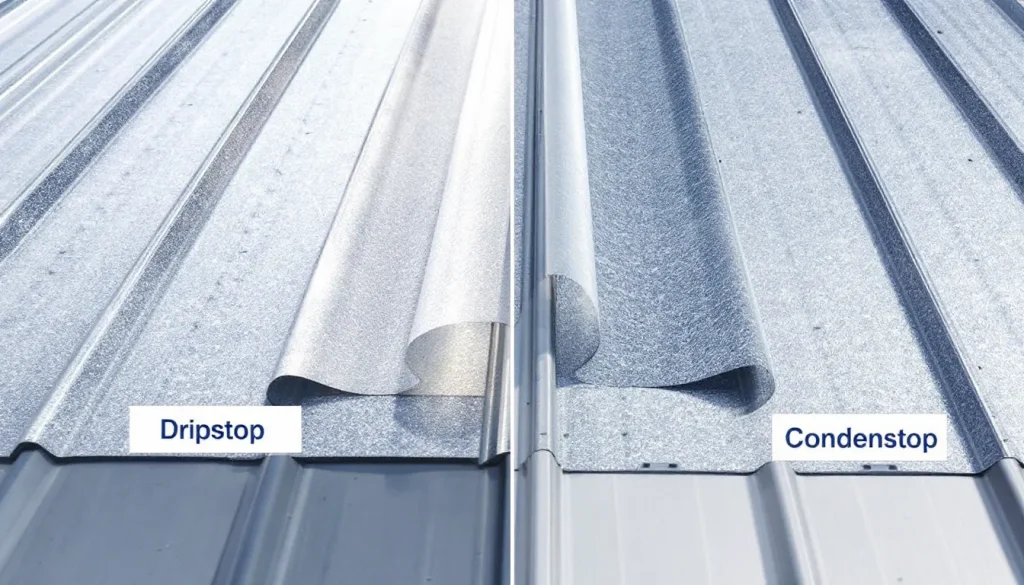
Dripstop vs Condenstop is a comparison of two factory-applied anti-condensation (see our heat cable for roofs guide) membranes glued to the underside of metal roof panels. Both solve the same problem (condensation forming on the cold underside of a metal panel in unconditioned spaces) and both use the same basic mechanism (a felt-like fabric that absorbs morning dew and releases it back to the air by evaporation later). The differences are real but small: Dripstop (manufactured by Filc in Slovenia) holds about 90 grams of water per square meter and dominates the U.S. market through partnerships with McElroy Metal, Mueller, Central States, and dozens of regional rollformers. Condenstop holds about 100 to 120 g/m2 depending on grade, ships from European manufacturers, and is harder to source in the U.S. but offers higher absorption per square meter. For most U.S. agricultural and pole-barn buyers in 2026, Dripstop is the de facto choice because it’s what the panel supplier already stocks.
The short version
- Both Dripstop and Condenstop are factory-bonded anti-condensation membranes for metal roof panels. Both solve the same problem the same way.
- Dripstop (Filc): 90 g/m2 absorption, Class A fire rating, dominant U.S. supply (McElroy Metal, Mueller, Central States, many others).
- Condenstop: 100 to 120 g/m2 absorption depending on grade, less U.S. distribution but increasingly available through metal building suppliers.
- Felt-backed alternatives (McElroy Metal Vapor-Shield, Tectum acoustic) trade higher absorption for thicker profile and higher cost.
- Cost premium runs $0.15 to $0.45 per square foot installed on top of the bare panel. Cheaper than spray foam insulation by 4x to 8x.
- Neither product replaces proper ventilation. Both work alongside it. In a sealed unventilated metal building, both saturate within hours and stop working.
The short answer: why condensation is the problem
Metal roof panels cool faster than the air below them on clear nights. The panel underside hits dew point before the air does, and water vapor in the building condenses onto the bare metal as droplets. In a pole barn, machine shed, garage, or any unconditioned metal building, the result is a recurring “rain from the ceiling” that wets equipment, rusts machinery, and rots wood framing. The condensation itself is not unusual physics. What’s new is that homeowners are increasingly metal-roofing their backyard sheds and detached garages, and condensation problems that used to be a commercial agricultural issue are now a residential one. Anti-condensation membranes solve the problem without spray foam, batts, or a sealed thermal envelope.
How the membranes work
Both Dripstop and Condenstop work by storing dew temporarily and releasing it back to the air later in the day. The mechanism has three phases:
- Absorption. Overnight, the metal panel cools and condensation forms. The felt-like membrane bonded to the panel underside soaks up the droplets through capillary action before they can drop.
- Storage. The membrane holds the water in its fiber matrix without releasing it. Capacity is the key spec: 90 g/m2 for Dripstop, 100 to 120 g/m2 for Condenstop grades.
- Release. As the air in the building warms and dries out during the day, the membrane releases the stored water back to the air as vapor. The cycle resets and the membrane is ready for the next night.
The system requires daytime air movement and lower daytime humidity to dry out the membrane (see our synthetic underlayment brands guide). Without that cycle, the membrane saturates after a few nights and starts dripping just like a bare panel. This is why neither product replaces ventilation; they buffer the condensation, but the ventilation completes the cycle.
Side-by-side spec comparison
| Spec | Dripstop | Condenstop (standard) | Condenstop (premium) |
|---|---|---|---|
| Manufacturer | Filc (Slovenia) | European manufacturers | European manufacturers |
| Absorption capacity | 90 g/m2 | 100 g/m2 | 120 g/m2 |
| Thickness | ~0.7 mm | ~0.9 mm | ~1.2 mm |
| Fire rating | Class A (ASTM E108) | Class A | Class A |
| Color | White or gray | White or gray | White, gray, black |
| Bond method | Factory-glued during panel rollform | Factory-glued during panel rollform | Factory-glued during panel rollform |
| Warranty | 30 years against delamination | 15 to 25 years depending on supplier | 25 to 30 years |
| U.S. distribution | McElroy Metal, Mueller, Central States, ABC, Metal Sales, dozens of regional rollformers | Limited, growing through metal building distributors | Limited |
| Typical cost premium | $0.15 to $0.35 per sq ft over bare panel | $0.20 to $0.40 | $0.30 to $0.45 |
Absorption is reported as grams of water per square meter of membrane. A 1,000 square foot metal roof has roughly 93 square meters of membrane. At Dripstop’s 90 g/m2 capacity, that’s 8.4 liters (about 2.2 gallons) of total dew storage before saturation. At Condenstop premium’s 120 g/m2 capacity, it’s 11.2 liters (about 3 gallons).
Where Dripstop wins
U.S. supply chain
Dripstop has been the U.S. market leader since the early 2010s. McElroy Metal, Mueller, Central States, ABC, Metal Sales, and dozens of regional metal rollformers stock Dripstop-bonded panels as a standard add-on option. Lead times match the bare panel. For most U.S. buyers, ordering a panel with Dripstop adds zero delay because the rollformer already runs the membrane through the line.
Cost
The cost premium for Dripstop over a bare metal panel typically runs $0.15 to $0.35 per square foot (see our metal roof cost per square foot guide) installed. On a 1,500 square foot pole barn, that’s $225 to $525 added to the panel price. The same panel with spray foam insulation underneath would cost an additional $1,500 to $3,500.
Warranty and track record
Filc has a 30-year warranty against delamination, with documented field installations going back 20+ years in Europe. Real-world failures (membrane peeling away from the panel, mildew, dripping) are rare when the install is done correctly and the building is ventilated.
Brand consistency
Buying Dripstop from McElroy gets you the same product spec as buying Dripstop from Mueller or any other partner. The factory-bonded process is identical and the warranty terms are consistent across U.S. distributors.
Where Condenstop wins
Absorption capacity
Condenstop’s standard 100 g/m2 and premium 120 g/m2 both beat Dripstop’s 90 g/m2. In high-humidity climates or buildings with high indoor moisture loads (livestock barns, indoor pools, grow operations), the extra capacity matters. Saturation happens slower and the daily release cycle has more headroom.
Color options
Condenstop is available in black (which hides dust and stains in agricultural settings) in addition (see our metal lean-to roof) to the standard white and gray. Dripstop is white or gray only.
Thickness for acoustic dampening
The premium Condenstop grade at 1.2 mm thickness offers measurable acoustic dampening on rain noise (4 to 8 dB reduction). Standard Dripstop at 0.7 mm has minimal acoustic effect. For garages, workshops, and any application where rain noise matters, the thicker grade earns its premium.
Premium agricultural and industrial markets
European farm and industrial builders specify Condenstop more often than Dripstop because the absorption headroom matters for high-moisture livestock and agricultural processing. U.S. agricultural rollformers are starting to offer Condenstop as a premium option alongside Dripstop.
The felt-backed alternative
A third option exists: panels with a thick felt backing bonded to the underside. McElroy Metal “Vapor-Shield” is the best-known U.S. example. Felt-backed panels behave like Dripstop and Condenstop but use a thicker, less specialized fabric.
What you get
- Higher absorption capacity (typically 150 to 250 g/m2)
- Better acoustic dampening (5 to 10 dB on rain noise)
- Slight thermal benefit (R-0.5 to R-1, marginal)
- Higher cost (typically $0.40 to $0.80 per square foot premium)
- Thicker profile (1.5 to 3 mm) that may require panel clip and fastener adjustments
Felt-backed panels are the right call for grow operations, indoor pools, food processing facilities, and any building where moisture load is high enough to saturate a thinner membrane. For typical pole barns, garages, and machine sheds, the cost premium isn’t justified.
Tectum acoustic panels (a different solution entirely)
Tectum is an acoustic ceiling panel made of compressed wood fiber and Portland cement. It’s sometimes confused with anti-condensation membranes but solves a different problem (sound absorption in commercial spaces). Tectum can incidentally reduce some condensation issues by adding thermal mass and absorbing some moisture, but it’s not designed as an anti-condensation product. Use Dripstop, Condenstop, or felt-backed for condensation. Use Tectum for acoustic control in commercial buildings.
What both products cannot do
They are not insulation
Anti-condensation membranes have minimal R-value (R-0.1 to R-0.5). They will not reduce heat loss or gain through the panel meaningfully. For thermal performance, you still need batts, blow-in, spray foam, or rigid foam under the panel.
They cannot handle a sealed unventilated building
If the building has no soffit-to-ridge ventilation, the membrane saturates within 2 to 5 nights of heavy condensation and stops absorbing. The dripping resumes. Ventilation is what dries the membrane between cycles. For ventilation context on metal roofs, see our metal roof condensation guide.
They cannot replace a vapor barrier in a heated/conditioned space
If the building is going to be insulated and conditioned, a proper vapor barrier on the warm side of the insulation is the correct solution. Anti-condensation membranes are for unconditioned spaces. Using them in a finished, heated metal building creates a condensation plane between the membrane and the panel that the membrane cannot dry out.
They cannot fix a leak
If water is appearing on the underside of the panel from leaks at fasteners, ridge, or eaves rather than from condensation, the membrane will mask the symptom until it saturates, then dump it all at once. Diagnose the source before assuming condensation. See metal roof condensation for the diagnostic flowchart.
Install considerations
Factory-bonded only
Both Dripstop and Condenstop are bonded to panels during the rollforming process. There is no aftermarket spray-on or peel-and-stick version that approaches the same performance. If you want anti-condensation on a panel you already own, the only retrofit option is a separate batt or rigid insulation under the panel. The membrane has to be specified at panel order time.
Panel sealing remains the same
Membrane-backed panels install with the same screws, gaskets, and ridge details as bare panels. The membrane does not affect fastener placement, lap sealing, or trim details. The screw goes through the membrane along with the panel.
Eave drip path
At the eave, the membrane terminates just before the panel edge. Any condensation that runs along the membrane drips at the eave. In open-eave installs (no soffit), this is invisible. In closed-eave installs, the soffit needs to be vented to catch and exhaust the moisture rather than trap it.
Ventilation specification
Per most manufacturer install guides, anti-condensation membrane panels still require minimum 1:300 net free vent area in the building (the same ratio as IRC for attics). Soffit-to-ridge balanced ventilation is the standard configuration. See our attic ventilation guide for the calculation method.
Climate considerations
Both membranes work in any climate, but the failure modes differ.
| Climate | Primary risk | Recommended grade |
|---|---|---|
| Hot/humid (FL, LA, TX coast) | High humidity prevents daytime drying | Condenstop premium or felt-backed |
| Cold/dry (MT, ND, WY) | Long overnight condensation hours | Dripstop or Condenstop standard |
| Marine (WA, OR coast) | Persistent dew, slow drying | Condenstop premium |
| Continental (OH, MI, IL) | Seasonal extremes, freeze-thaw at panel surface | Dripstop standard adequate |
| Desert (AZ, NV, NM) | Rapid daytime drying favors low-grade product | Dripstop, low cost premium worth it |
Pricing comparison: 30×40 pole barn
For a 1,200 square foot pole barn with metal roofing:
| Option | Add to bare panel cost | Total for roof |
|---|---|---|
| Bare metal panel (baseline) | $0 | $3,000 to $4,200 |
| Dripstop-bonded panel | $0.20/sf premium | $3,240 to $4,440 |
| Condenstop standard panel | $0.30/sf premium | $3,360 to $4,560 |
| Condenstop premium panel | $0.40/sf premium | $3,480 to $4,680 |
| Felt-backed panel | $0.60/sf premium | $3,720 to $4,920 |
| Bare panel + closed-cell spray foam (1.5 inch) | $2.50/sf installed | $6,000 to $7,200 |
| Bare panel + R-19 batt insulation | $1.20/sf installed | $4,440 to $5,640 |
For unconditioned buildings, the Dripstop or Condenstop options are the dominant cost-effective answer. For conditioned buildings, the spray foam path is more expensive but handles thermal performance and condensation in one assembly. The right answer depends on whether you want the building heated or cooled. See our corrugated metal roofing guide for panel selection.
Common questions buyers ask their rollformer
“Can you ship Dripstop on a 36-foot panel?”
Yes. Both Dripstop and Condenstop are bonded inline during rollforming and don’t constrain panel length. Most rollformers ship Dripstop-bonded panels up to 50 feet without modification.
“Is the warranty separate from the panel warranty?”
Usually combined. The rollformer’s warranty typically covers both the panel finish (paint, corrosion) and the bonded membrane. Filc separately backs the Dripstop with a 30-year delamination warranty that runs through the rollformer.
“Can I order Condenstop instead of Dripstop from McElroy?”
Not currently. McElroy is exclusively a Dripstop partner. Condenstop in the U.S. ships through a smaller subset of rollformers (primarily independents in the Midwest and Southeast). Most major U.S. rollformers offer Dripstop or felt-backed (Vapor-Shield) but not Condenstop.
“Does it matter for residential applications?”
For a detached garage, machine shed, or pole barn, no. Dripstop is more than adequate. For a finished residential metal roof with conditioned space below, neither product is appropriate; you want batt or spray foam insulation with a proper vapor barrier instead.
FAQ
Is Dripstop better than Condenstop?
For most U.S. buyers, Dripstop wins on availability and price. Condenstop wins on absolute absorption capacity (100 to 120 g/m2 vs 90 g/m2) and color options. For typical pole barns and detached garages, the difference is academic; both work. For high-moisture-load buildings (livestock, indoor pools, grow operations), Condenstop premium or felt-backed Vapor-Shield is the better spec.
Does Dripstop or Condenstop replace insulation?
No. Neither product has meaningful R-value (R-0.1 to R-0.5). They prevent condensation in unconditioned buildings but do not reduce heat transfer. If the building is heated or cooled, batts, blow-in, spray foam, or rigid foam are still required for thermal performance.
Can I apply Dripstop to an existing metal roof?
No. Both Dripstop and Condenstop are factory-bonded to the panel underside during rollforming. There is no field-applied retrofit version. For existing panels with condensation problems, options are spray foam underneath the panel, batt insulation in the rafters, or a sealed-cavity assembly. See our metal roof condensation guide for retrofit options.
Will Dripstop work in a sealed metal building with no ventilation?
No. Both products require ventilation to dry out between condensation cycles. In a sealed building, the membrane saturates within a few nights and dripping resumes. Minimum 1:300 net free vent area, balanced soffit-to-ridge, is the standard requirement.
What’s the lifespan of Dripstop or Condenstop?
Both have warranties of 25 to 30 years against delamination. Field reports from European installations going back 20+ years show the membranes remain functional with no visible degradation when the building is properly ventilated. Saturation cycles do not appear to degrade the membrane over time.
Bottom line
For 90% of U.S. buyers planning a pole barn, machine shed, or detached garage with metal roofing, Dripstop is the right answer. It’s what your rollformer already stocks, it adds $200 to $500 to a typical building, and it solves the condensation problem when the building is reasonably ventilated. Condenstop has higher absorption and is worth the upgrade in high-humidity climates or high-moisture-load buildings, but supply is more limited in the U.S.
Skip both if the building is going to be conditioned (heated or cooled). For conditioned metal buildings, batt or spray foam insulation with a proper vapor barrier on the warm side handles condensation along with thermal performance. Neither anti-condensation membrane is a substitute for insulation, and using them in a sealed conditioned cavity creates a worse problem than it solves. For the broader diagnostic and retrofit context, see our metal roof condensation guide.