
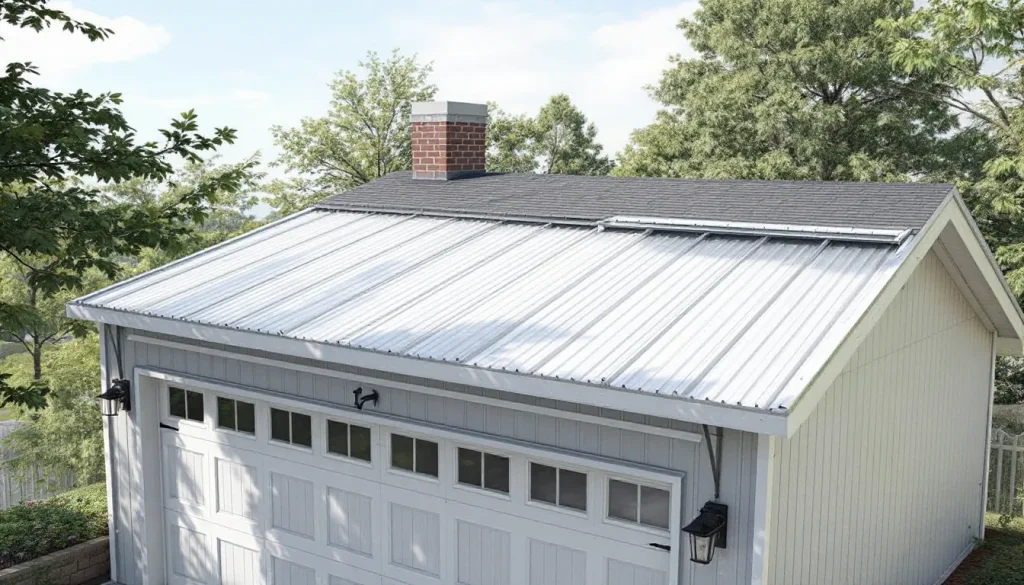
Putting a metal roof on lean to (see our shed roof material options) structures is the right call about 90% of the time, because lean-tos almost always have a shallow slope (1:12 to 4:12) where shingles can’t drain reliably, and because the metal-into-siding flashing detail is easier to weatherproof than a shingle equivalent. The four decisions that matter: panel type (standing-seam for any slope under 3:12, corrugated for 3:12 and steeper), how the high side attaches to the existing wall (ledger board into rim joist, flashing tape under the WRB, kick-out at the corner), the pitch math (do not go below the panel manufacturer’s minimum), and the four mistakes that cause leaks in year one (wrong flashing order, missing closure strips, over-tightened screws, no kick-out flashing). A typical 8 by 12 lean-to off a residential garage runs $400 to $1,100 DIY in materials and $1,500 to $3,500 turnkey from a contractor. Below is the full sequence.
The short version
- Lean-to slopes are usually too shallow for shingles. Metal is the practical choice from 1:12 up.
- Standing-seam panels go down to 1:12. Corrugated and R-panel need 2:12 minimum, 3:12 recommended.
- The wall connection is the failure point. Step flashing or counter-flashing into the existing siding plus a kick-out at the eave is mandatory.
- Attach the metal panels to roof framing or proper purlins, not directly to OSB without screws hitting structure.
- Closure strips at eave and ridge are non-negotiable. Open corrugations let pests, wind, and snow under the panels.
- DIY material cost for an 8×12 lean-to: $400 to $1,100. Contractor turnkey: $1,500 to $3,500.
- Year-one leaks almost always trace to one of: wrong flashing layering, missing closure strips, crushed screw gaskets, or no kick-out flashing.
The short answer: why metal beats shingles on a lean-to
A lean-to is a single-slope addition that attaches to an existing wall at the high side and runs out over posts or open framing at the low side. Common uses: firewood storage off a garage, equipment shelter, carport extension, animal shelter on a barn. On the lightest-duty covers where you want daylight through the roof, some builders reach for translucent plastic roofing sheets instead of metal. The single-slope geometry forces a critical constraint: the pitch is whatever the available headroom allows, and that’s usually shallow.
Shingles need a 4:12 minimum to drain reliably. 2:12 to 4:12 is allowed with double underlayment but is a known leak risk in real conditions (driving rain, snow accumulation, ice). Below 2:12, shingles are not an option at all.
Standing-seam metal panels are designed for low-slope applications down to 1:12. Corrugated and R-panel metal handle 2:12 and up with proper closure strips and underlayment. The flashing into existing walls is also easier with metal because the panel profile creates a defined termination point for counter-flashing.
Add the lifespan math (30 to 50 years on metal vs 15 to 25 on shingles) and the wind performance (metal panels survive 110+ mph if fastened correctly), and metal becomes the obvious choice for a lean-to.
Pitch math and panel selection
The first decision is panel type, which is constrained by your available pitch.
| Available pitch | Best panel type | Example products | Installed cost per sf |
|---|---|---|---|
| 1:12 to 2:12 | Standing-seam | Englert S-2000, MBCI Lokseam, Drexel 1-Inch Snap-Lock | $5.50 to $8.50 |
| 2:12 to 3:12 | Standing-seam or R-panel | MBCI BattenLok, ABC R-Panel | $4.00 to $7.00 |
| 3:12 to 4:12 | R-panel or corrugated | ABC R-Panel, McElroy R-Panel, generic corrugated | $3.50 to $6.00 |
| 4:12+ | Any metal profile | Corrugated, R-panel, or standing seam | $3.50 to $8.50 |
For a typical 8 ft deep lean-to off a single-story house, you have roughly 2 to 3 ft of vertical drop available from the soffit to the top of the support posts. That puts you at 3:12 to 4:12, which works for any metal panel type. For a deeper lean-to (12 to 16 ft) off the same house, you may be forced into 1:12 or 2:12, which requires standing seam.
Calculate your available pitch before you buy panels. Measure from where the ledger will sit on the existing wall down to the top of the post or beam, and divide that vertical drop by the horizontal run.
Step 1: The ledger board into the existing wall
The high side of the lean-to attaches to the existing wall via a ledger board, just like a porch roof. The mechanical attachment must reach structural framing inside the wall, not stop at the siding. Lag bolts (1/2 inch diameter, minimum 5 inch embedment into the wall’s rim joist or stud) or through-bolts with washers are the correct fasteners.
Locating wall framing
If the lean-to attaches at the second-floor rim joist of a two-story house, you have continuous structural lumber to bolt into. Drill exploratory holes from inside the house to confirm.
If the lean-to attaches at a one-story wall (mid-wall, not at the rim joist), you must hit studs, typically every 16 inches on center. Use a stud finder and confirm with a 1/16-inch test drill.
If the attachment is to brick veneer or stucco-over-frame, the structural member is the framing behind the veneer. Lag bolts must pass through the veneer and into framing. For brick veneer, this requires a 5/8-inch through-bolt with washer plates on both sides for proper distribution. Many jurisdictions require engineer review for ledger attachment to brick veneer.
Waterproofing the ledger
This is the second failure point that turns into a wall-rot problem in year three.
- Strip siding back at least 12 inches above the planned ledger location.
- Apply self-adhering flashing tape (3M All Weather, Grace Vycor, ZIP Flashing) over the existing weather-resistive barrier (WRB) or housewrap where the ledger will sit.
- Install the ledger with structural standoff washers (DeckLogic, MTI, or similar) to leave a 1/4 inch drainage gap between the ledger and the wall.
- Apply Z-flashing or counter-flashing over the top of the ledger so water sheds out away from the wall.
- Reinstall siding lapped over the top edge of the flashing.
For broader flashing detail context, see our roof flashing guide.
Step 2: Posts, beam, and rafters
The low side of the lean-to sits on a beam carried by posts on footings. Footings below frost depth, posts plumb, beam sized for the post-to-post span (a doubled 2×10 or 4×10 typically handles 10 to 12 ft between posts on a residential lean-to).
Rafters span from the ledger to the beam. Size them per IRC R802.5.1 for the actual rafter span and snow load (see our snow guards for metal roofs guide). A typical 10 ft rafter span at 30 psf snow load uses 2×8 rafters at 16-inch on-center.
The rafter top end is plumb-cut to sit flush against the ledger. The rafter bottom end is birdsmouth-notched to sit on the beam. Hurricane ties (Simpson H2.5A or equivalent) attach rafters to both the ledger and the beam for uplift resistance.
Step 3: Sheathing decision (sheathing vs purlins)
Metal panels can be installed two ways: over plywood/OSB sheathing with underlayment, or directly onto purlins (horizontal 2×4 strips screwed across the rafters at the panel’s specified spacing).
Sheathing approach
- 1/2-inch CDX plywood or 7/16 OSB over the rafters
- Synthetic underlayment over the sheathing
- Metal panels screwed through to rafters
Pros: solid feel, no daylight visible through panels, easier to switch to shingles later if you change your mind. Cons: about $1.00 per square foot (see our cost per square foot guide) more in materials.
Purlin approach
- 2×4 purlins screwed to rafter tops at the panel’s specified spacing (typically 24-inch on-center for corrugated, varies for standing seam)
- Metal panels screwed directly to purlins
- No sheathing, no underlayment in many installations
Pros: cheaper, faster install. Cons: condensation drips inside the lean-to (every cool night, especially if the lean-to encloses warm air), and the daylight visible between panels can be unsightly.
For lean-tos used as enclosed storage or anywhere with humidity, sheathing plus underlayment is the better call. For open-side carports or pole barns, purlins are fine. Add an anti-condensation membrane (such as Dripstop) to the panel if condensation is a known concern.
For more on metal roof condensation, see our metal roof condensation guide.
Step 4: Panel install (corrugated or R-panel)
For most DIY lean-tos at 3:12 to 4:12 pitch, R-panel or corrugated is the practical choice. Sequence:
- Install drip edge or eave trim at the low side. Most metal systems use a specific eave trim that matches the panel profile.
- Run synthetic underlayment from eave to wall, lapping each course by 4 inches.
- Install closure strips at the eave (these foam profile strips match the panel corrugations and prevent water, pest, and snow entry).
- Position the first panel at one rake edge with a 1.5 to 2 inch overhang past the eave drip. Square it to the eave, not to the wall.
- Drive metal roofing screws with EPDM washers at every other corrugation low point (for corrugated) or at every minor rib (for R-panel), into rafters or purlins beneath. Drive until the gasket compresses about 1/16 inch (visible squish), then stop. Over-tightening causes leaks.
- Install adjacent panels with a 1-corrugation overlap. Fasten through both panels at the overlap.
- At the wall, install closure strips at the high end, then sidewall flashing that tucks under the siding (counter-flashing) and over the panels.
- Use a metal-roof pipe boot (Dektite or Oatey Master Flash) for any roof penetrations.
Step 5: The wall flashing detail (where 80% of leaks start)
The metal panel terminates at the existing wall. The flashing detail at that termination is the most critical waterproofing in the entire build.
Two-piece counter-flashing method
This is the right way to do it. Two pieces:
- Lower piece (apron flashing or transition flashing): sits on top of the panels, has an upturned leg that runs up the wall 4 to 6 inches under the WRB. Screw-fasten to the panel ribs only.
- Upper piece (counter-flashing or Z-flashing): tucks under the WRB and lapped siding, runs down over the top of the lower piece. Not fastened to the lower piece; gravity holds it tight.
The two-piece detail lets the existing siding shed water onto the upper flashing, which drains onto the lower flashing, which drains onto the panels. No water ever touches the wall framing.
The kick-out flashing
At the corner where the lean-to roof eave meets the existing wall, water shedding off the eave can hit the wall and run down behind the siding. A small triangular flashing piece (the kick-out) diverts this water out into the gutter or away from the wall.
Pre-formed kick-outs are made by DryFlekt, Quickflash, and most metal coil suppliers. Field-cut kick-outs work too. The cost (for the full data set, see our the full 2026 Roofing Cost Report) is $15 to $40. The consequences of skipping it are wall rot, mold, and a $3,000 to $8,000 siding-and-sheathing repair in year three.
The four mistakes that cause year-one leaks
1. Wrong flashing layering at the wall
If the WRB or siding overlaps the top of the metal flashing (rather than the flashing tucking under the WRB), water runs from the wall down behind the metal and into the lean-to. The layering rule: every piece up the wall must lap over the piece below, all the way to the existing siding. WRB always over flashing, never under.
2. Missing closure strips at eave or ridge
The corrugations or ribs in metal panels leave gaps at the eave and ridge. Closure strips (foam profiles that match the corrugation pattern) fill those gaps. Without them, wind drives rain up under the panels, snow blows in, and birds/squirrels nest in the corrugations.
3. Over-tightened screws with crushed gaskets
Metal roofing screws have an EPDM gasket under the head. Driving the screw until the gasket squashes flat ruins it. The gasket has to compress just enough to seal but stay slightly domed. Visually, the gasket should bulge outward by about 1/16 inch around the screw head. Use an impact driver with a clutch or pay attention to feel. The good news: bad gaskets are easy to fix later (back out the screw, replace, re-drive).
4. No kick-out flashing at the eave-to-wall corner
Skip it and the wall behind the siding rots within 3 to 5 years. The $25 part prevents a $5,000 problem.
DIY budget for an 8 by 12 lean-to
| Line item | DIY cost |
|---|---|
| 4 concrete pier footings | $80 to $160 |
| 2 to 4 PT 6×6 posts (8 to 10 ft) | $120 to $260 |
| Doubled 2×10 PT beam | $110 to $160 |
| Ledger board (PT 2×10) + flashing tape | $80 to $130 |
| Rafters (8 to 10 of 2×6 or 2×8) | $160 to $280 |
| Sheathing (4 sheets 1/2 CDX) | $140 to $200 |
| Synthetic underlayment | $50 to $80 |
| R-panel or corrugated metal (~100 sf) | $120 to $260 |
| Closure strips, eave trim, rake trim | $80 to $130 |
| Sidewall flashing (counter + apron) | $60 to $110 |
| Kick-out flashing | $20 to $40 |
| Screws, hurricane ties, fasteners | $80 to $130 |
| Total DIY | $1,100 to $1,940 |
Contractor turnkey for the same 8 by 12 lean-to typically runs $2,500 to $4,500 including permits and engineering if required. Standing-seam upgrade adds about 30% to material cost.
Permits and code
Most jurisdictions require a permit for any new roof structure attached to an existing house, regardless of size. The exception is some agricultural districts that exempt small ag structures. Verify with your local building department before starting.
Engineer review is typically required when the ledger attaches to a shearwall (most exterior walls), when snow load is over 50 psf, when design wind speed is over 140 mph, or when the structure exceeds prescriptive IRC tables. Stamped drawings run $300 to $900.
FAQ
What’s the minimum slope for a metal roof on a lean-to?
1:12 with standing-seam panels (Englert S-2000, MBCI Lokseam, Drexel Snap-Lock). 2:12 with R-panel or corrugated. Going below the manufacturer’s minimum voids warranty and almost guarantees leaks at side laps and panel ends.
Can I put a metal roof over my existing shingled lean-to?
Yes, with hat-channel furring strips installed over the existing shingles. This is a common 2026 retrofit. Total install cost runs $4 to $7 per square foot. You skip tear-off but pay for the furring strips and longer screws.
Do I need underlayment under metal panels on a lean-to?
If you’re sheathing the roof, yes (synthetic underlayment). If you’re using purlins with no sheathing, technically no but you’ll get condensation drips inside on cool nights. Underlayment plus anti-condensation membrane (Dripstop or similar) is the durable answer.
How do I flash the metal roof into the existing siding?
Two-piece flashing: an apron piece that sits on top of the panels and runs up the wall under the WRB, and a counter-flashing piece that tucks under the WRB and laps over the apron. The siding then laps over the counter-flashing. Add a kick-out at the eave-to-wall corner to divert eave water out.
What gauge metal should I use for a lean-to?
29-gauge painted Galvalume is the budget option ($1.20 to $1.80 per sf). 26-gauge is the durable option ($1.60 to $2.40 per sf) and is what most pros use. 24-gauge is overkill for most lean-tos but worth it in high-hail regions or for commercial use.
Bottom line
A metal roof on a lean-to is the right choice almost every time, because lean-to geometry forces a shallow slope that shingles can’t drain. Use standing-seam from 1:12 up, corrugated or R-panel from 2:12 to 3:12 up. The wall connection (ledger to rim joist or studs, flashing tape under the WRB, two-piece counter-flashing into existing siding, kick-out at the eave-to-wall corner) is where 80% of leaks originate. Sheath the roof rather than purlin-only if the lean-to encloses humidity or condensation matters. DIY material cost is $1,100 to $1,900 for an 8 by 12. Contractor turnkey is $2,500 to $4,500. Pull a permit, get engineer review if your jurisdiction requires it, and don’t skip the kick-out flashing.