
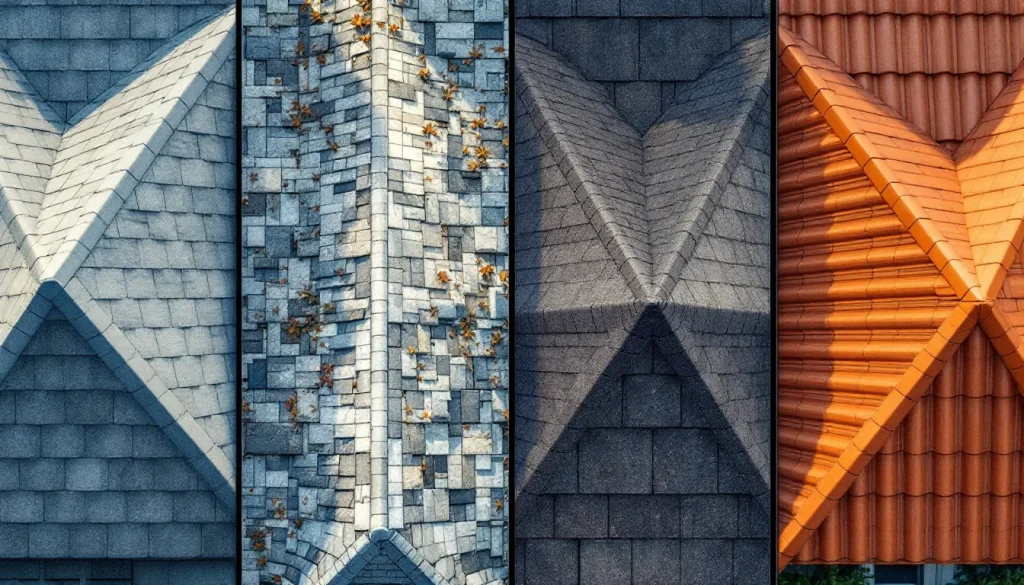
The roof cost (for the full data set, see our the full 2026 Roofing Cost Report) per square foot in 2026 ranges from about $4 to $30 installed depending on material: asphalt shingles run $4 to $7 per square foot installed, standing seam metal $9 to $16, clay or concrete tile $10 to $18, and natural slate $15 to $30. Labor accounts for 40% to 60% of the total in most markets, which is why the same shingle in Phoenix can cost $4.50 per square foot while the same shingle in Boston costs $6.80. Tear-off, decking replacement, flashing, and permit fees are billed separately on most contracts, and they can add another $1.50 to $4 per square foot on top of the material-and-labor base. The pricing tables below break it all out by material, by region, and by what the contractor actually has to do on your roof.
The short version
- Asphalt shingles: $4 to $7 per square foot installed. Architectural mid-tier is the volume seller.
- Standing seam metal: $9 to $16 per square foot. Exposed-fastener metal panel is cheaper at $5 to $9.
- Clay or concrete tile: $10 to $18 per square foot. Concrete is the lower half of that range.
- Natural slate: $15 to $30 per square foot. Synthetic slate runs $10 to $16.
- Tear-off adds $1 to $2 per square foot. Decking replacement adds $50 to $100 per 4×8 sheet installed.
- Labor is 40% to 60% of total in most markets. Regional swings move per-square-foot pricing by 30% to 40%. See our roof replacement cost per square guide for the contractor pricing unit.
The short answer: cost per square foot by material in 2026
Per-square-foot pricing is the consumer shorthand. Contractors actually price per roofing square (100 square feet), which we cover in detail in our roof replacement cost per square guide. Both numbers point to the same job, just at different scales. The table below is the installed all-in cost for the material plus standard labor, before tear-off and decking allowances.
| Material | Cost per sq ft installed | Cost per square (100 sq ft) | Typical lifespan |
|---|---|---|---|
| 3-tab asphalt shingles | $3.50 to $5.50 | $350 to $550 | 15 to 20 years |
| Architectural asphalt shingles | $5.00 to $8.00 | $500 to $800 | 25 to 30 years |
| Premium dimensional shingles | $6.50 to $10.50 | $650 to $1,050 | 30 to 40 years |
| Designer shingles (slate-look) | $8.50 to $14.00 | $850 to $1,400 | 35 to 50 years |
| Exposed-fastener metal panel | $5.00 to $9.00 | $500 to $900 | 30 to 45 years |
| Standing seam metal | $9.00 to $16.00 | $900 to $1,600 | 40 to 70 years |
| Stone-coated steel | $10.00 to $15.00 | $1,000 to $1,500 | 40 to 60 years |
| Concrete tile | $10.00 to $14.00 | $1,000 to $1,400 | 50 years |
| Clay tile | $12.00 to $18.00 | $1,200 to $1,800 | 75 to 100 years |
| Natural slate | $15.00 to $30.00 | $1,500 to $3,000 | 75 to 150 years |
| Synthetic slate (Brava, DaVinci) | $10.00 to $16.00 | $1,000 to $1,600 | 50 years |
| Cedar shake | $8.00 to $14.00 | $800 to $1,400 | 25 to 40 years |
These ranges assume a single-story home (see our cost to roof a house by size) with moderate pitch (4:12 to 8:12), one or two roof penetrations (chimney, plumbing stack), and standard suburban access. Steep roofs, complex valleys, and second-story-only access push every line item up 15% to 40%.
Asphalt shingles: $4 to $7 per square foot installed
Asphalt (for the full data set, see our the 2026 Shingle Brand Comparison Report) is the dominant residential material in 2026, accounting for over 70% of new installs. Within asphalt there are four tiers, and the per-square-foot spread inside the category is wider than most homeowners realize: a 3-tab on a tract home can come in at $3.50 per square foot, while a designer shake-look shingle from the same contractor on the same house can hit $14.
The volume product is architectural mid-tier: GAF Timberline HDZ, Owens Corning Duration, CertainTeed Landmark, IKO Cambridge, Atlas Pinnacle Pristine, Tamko Heritage, Malarkey Legacy. All of these install for $5 to $8 per square foot in most U.S. markets, with the lower end in Texas and the Southeast and the upper end in the Northeast, Pacific Northwest, and California. For a deeper walk-through of the asphalt category, see our asphalt shingle roof lifespan guide.
What you pay for inside asphalt
- 3-tab basic: single layer, 60 mph wind rating, 190 to 240 lb per square. Cheapest cycle cost but shortest life.
- Architectural mid: laminated dual layer, 110 to 130 mph with 6-nail pattern, 240 to 350 lb per square. The volume product.
- Premium dimensional: thicker laminate, 130 to 150 mph wind, 350 to 480 lb per square. Class 4 impact options at the top.
- Designer luxury: multi-piece slate or shake mimicry, lifetime warranties, designer aesthetics.
Metal roofing: $5 to $16 per square foot installed
Metal splits into two product categories that get conflated in homeowner research. Exposed-fastener metal panel (R-panel, PBR, 5V-crimp) is the cheaper option, installing for $5 to $9 per square foot. Standing seam, where the seams are mechanically locked and there are no exposed fasteners, runs $9 to $16. Stone-coated steel (Decra, Boral, Westile) sits in the upper standing-seam range at $10 to $15. Cost (see our roof material calculator (TCO method)) differences come from sheet thickness (24 vs 26 gauge), coating type (Galvalume vs Galvanized, Kynar 500 vs SMP paint), and seam-locking labor.
Top manufacturers in 2026 include McElroy Metal, MBCI, ATAS, Englert, Drexel Metals, Fabral, and Petersen (PAC-CLAD). Color choice is wider than asphalt and Kynar 500 coatings hold color for 25+ years without fading. For the full asphalt vs metal price-and-lifespan comparison, see our metal vs asphalt shingle roof guide and metal roof cost deep dive.
Tile and slate: $10 to $30 per square foot installed
Tile and slate are the long-cycle materials. Both are heavy (900 to 1,200 lb per square for tile, 700 to 1,000 lb for slate), expensive to install, and require structural framing that may not exist on a typical asphalt (see our asphalt shingle roof cost installed)-framed roof. Replacing asphalt with tile or slate frequently requires a structural engineering review and may need rafter or truss reinforcement, adding $3,000 to $8,000 to the project.
Within tile, concrete is cheaper ($10 to $14 per square foot installed (see our roof shingles cost installed)) and visually similar to clay but heavier. Clay tile ($12 to $18) is the traditional Mediterranean look common in California, Arizona, and Florida. Natural slate ($15 to $30) is North-Eastern and historic-district territory. Synthetic slate from Brava, DaVinci, EcoStar, and CertainTeed Symphony installs for $10 to $16 per square foot and weighs roughly the same as architectural asphalt, eliminating the structural-upgrade requirement.
What the per-square-foot number actually includes
This is where homeowner research gets confusing. “Roof cost per square foot” in a contractor quote usually means material plus standard labor for the installation only. It typically does not include tear-off, decking replacement, ventilation upgrades, permits, dumpsters, or flashing replacement. Each of those is a separate line item, and on a real quote they add up fast.
| Line item | Cost per sq ft of roof | Cost on a 25-square (2,500 sq ft) roof |
|---|---|---|
| Tear-off (single layer) | $1.00 to $2.00 | $2,500 to $5,000 |
| Tear-off (two layers) | $1.50 to $3.00 | $3,750 to $7,500 |
| Decking replacement (per 4×8 sheet, 10% allowance typical) | $0.30 to $0.60 | $750 to $1,500 |
| Synthetic underlayment upgrade | $0.15 to $0.30 | $375 to $750 |
| Ice and water shield (eaves and valleys) | $0.20 to $0.50 | $500 to $1,250 |
| Drip edge (full perimeter) | $0.10 to $0.20 | $250 to $500 |
| Step flashing replacement | $0.10 to $0.25 | $250 to $625 |
| Ridge vent + soffit upgrade | $0.20 to $0.60 | $500 to $1,500 |
| Pipe boots and roof vents | $0.04 to $0.12 | $100 to $300 |
| Permit + inspection | varies | $150 to $500 |
| Dumpster + disposal | varies | $300 to $600 |
On a real architectural shingle reroof, the line items above typically add $2 to $4 per square foot on top of the base $5 to $8 material-and-labor figure. That’s why the all-in cost number you should plan around is $7 to $12 per square foot for architectural shingles in most U.S. markets. See our tear-off roof cost guide for the demolition line in detail, and our roof deck repair cost guide for what decking replacement actually costs.
Regional pricing: the 40% swing nobody warns you about
The same architectural shingle install costs different amounts in different markets, primarily because of labor rates, permit fees, and material logistics. The price swing between the cheapest and most expensive U.S. metro for an identical job typically runs 35% to 45%.
| Region | Architectural shingle ($/sq ft installed) | Standing seam metal ($/sq ft) |
|---|---|---|
| Texas, Oklahoma, Tennessee | $4.50 to $6.50 | $8.50 to $13 |
| Florida, Georgia, Carolinas | $5.00 to $7.00 | $9.00 to $14 |
| Midwest (OH, IN, IL, MO) | $5.00 to $7.50 | $9.50 to $14 |
| Mountain West (CO, UT, AZ) | $5.50 to $7.50 | $10 to $15 |
| Pacific Northwest (WA, OR) | $6.00 to $8.50 | $11 to $16 |
| California | $6.50 to $9.50 | $12 to $17 |
| Northeast (NY, NJ, MA, CT) | $6.50 to $9.00 | $12 to $17 |
| Hawaii, Alaska | $8.00 to $12.00 | $14 to $22 |
Three drivers explain the spread. First, labor cost: a Texas roofing crew runs $35 to $55 per hour fully loaded; a New York crew runs $65 to $95. Second, permit and inspection cost: Florida and California permit fees are 3x to 5x Texas equivalents. Third, material logistics: Hawaii and Alaska pay sea-freight premiums on every bundle.
How pitch and complexity move the price
Roof pitch (steepness) and complexity (valleys, dormers, hips, multiple planes) both add labor hours. The per-square-foot number a contractor quotes on a simple gable roof at 5:12 pitch is the floor of the range. For steep or complex roofs, expect multipliers.
Pitch multipliers
- 3:12 to 6:12 (low to moderate): baseline pricing. Standard scaffolding, walkable.
- 6:12 to 8:12 (moderate steep): 10% to 15% labor premium. Rope and harness required.
- 8:12 to 12:12 (steep): 20% to 35% labor premium. Roof jacks and toe boards required.
- 12:12 and steeper (very steep): 40% to 60% labor premium. Full fall-protection harnessing on every worker.
For how to calculate your roof’s pitch from inside the attic, see our how to calculate roof pitch guide and the roof pitch chart.
Complexity multipliers
- Simple gable (2 planes): baseline. Standard waste factor 7% to 10%.
- Hip roof (4 planes): 10% to 15% material premium for hip-cap shingles, 5% to 10% labor.
- Cross-gable with valleys (4 to 6 planes): 15% to 25% labor premium, higher waste factor (12% to 15%).
- Multi-plane with dormers: 25% to 40% labor premium, 15% to 18% waste factor.
- Mansard or gambrel: 30% to 50% labor premium, specialty flashing required.
The math: showing the all-in number on a real house
Theoretical pricing is useful but the all-in number on a real house is what homeowners actually pay. Here’s a worked example for a 2,400 square foot footprint single-story home with a 6:12 pitch, simple gable roof, and architectural shingle reroof.
Footprint x pitch multiplier = roof area. At 6:12 the multiplier is 1.118, so 2,400 x 1.118 = 2,683 square feet of roof, or 26.83 squares. Round up to 27 squares for ordering. For the calculation methodology, see our how to calculate roof square footage guide.
- Architectural shingles at $6.00 per square foot installed: 2,683 x $6.00 = $16,098
- Tear-off single layer at $1.50 per square foot: 2,683 x $1.50 = $4,024
- Decking allowance (10% of roof, 4×8 sheets): 8 sheets at $90 installed = $720
- Synthetic underlayment upgrade: $0.20 per sq ft = $537
- Ice and water shield (eaves + 2 valleys): $700
- Drip edge full perimeter: $400
- Step flashing + pipe boots + ridge vent: $1,200
- Permit + dumpster: $600
- Subtotal: $24,279
- Waste factor + overhead + profit (already in line items): no adjustment needed
All-in for a real 2,400 sq ft home: $24,000 to $26,000 for architectural shingles in a mid-cost region. That’s $8.95 to $9.70 per square foot of roof, or about $10 per square foot of home footprint. The “cost per square foot of roof” reported number ends up well above the $6 base because of all the line items. For the full builder pricing method, see our roofing cost calculator method guide.
What most homeowners get wrong about per-square-foot pricing
Three mistakes show up in almost every shopping conversation. First, conflating per-square-foot of home (footprint) with per-square-foot of roof. The roof is always larger than the footprint because of pitch, and the difference is 12% on a low-slope roof and 40% on a steep roof. Second, comparing material-only per-square-foot prices between contractors when one quote includes tear-off and the other doesn’t. Third, treating the cheapest per-square-foot quote as the best deal when the line items hidden behind the headline number tell a very different story.
The fix is to ask for an itemized estimate with all line items spelled out. Our new roof estimate breakdown guide walks through the 12 line items every quote should have. If a contractor refuses to itemize, that’s a red flag covered in our red flags roofing contractor guide.
Lower the per-square-foot cost without buying junk
Three legitimate ways exist to bring per-square-foot pricing down without sacrificing quality. First, schedule outside peak season. Late fall and winter installs in mild climates run 10% to 20% cheaper because crews need work. Second, use the contractor’s preferred manufacturer (see our the big three brands compared guide). GAF Master Elite, Owens Corning Platinum, and CertainTeed SELECT ShingleMaster contractors get volume pricing on their certified brand that’s 8% to 15% cheaper than competing brands they’d have to special-order. Third, batch with neighbors. Two or three houses on the same street installed in the same week saves the contractor mobilization cost, and that savings often gets passed through.
What doesn’t work: assuming the lowest bid means equal quality. The roofing-scam playbook in our roofing scams guide explains the pattern of low bids that turn into change-order avalanches once the tear-off starts.
Cost per square foot vs cost per square: which one to use
Contractors price in roofing squares (100 square feet) because that’s how shingle bundles, underlayment rolls, and labor crews are organized. A bundle of architectural shingles covers about 33 square feet, so three bundles per square. A 4×8 sheet of decking covers 32 square feet. Labor crews quote “$X per square” to install. When you see a quote in roofing-square units, divide by 100 to get the per-square-foot number. When you see a homeowner-facing number per square foot, multiply by 100 for the contractor unit. The two are the same number at different scales. See our roof replacement cost per square guide for the contractor-unit deep dive.
Cost per square foot vs cost per home footprint
Real estate listings, news articles, and homeowner conversations frequently use “cost per square foot” in reference to the home footprint, not the roof. The two numbers differ by the pitch multiplier, which adds 12% to 40% to roof area depending on slope. To convert: home footprint x pitch multiplier = roof area. A 2,400 sq ft (see our roof size calculator method) footprint home at 6:12 pitch has 2,683 sq ft of roof. At 10:12 pitch, the same home has 3,121 sq ft of roof, 16% more. When comparing per-square-foot quotes between contractors, confirm which “square foot” base they’re using. Most pros quote per-square-foot of roof; some homeowner-facing calculators quote per-square-foot of home.
Cost per square foot by roof age and condition
An aging roof costs more per square foot to replace than a young one, even with identical materials, because the contractor finds more decking damage, more flashing corrosion, and more soft-spot remediation under the old shingles. Roofs over 20 years old typically have 10% to 25% decking replacement needed (vs the 5% to 10% allowance on younger roofs). Old flashing almost always needs full replacement (vs partial). Soffit and fascia damage runs $400 to $1,500 on older homes. Plan for $1 to $3 per square foot above the base reroof cost on any roof over 20 years old.
2026 cost trends: what’s changed since 2023
Asphalt shingle material costs have ticked up 8% to 14% since early 2024 due to crude oil-linked bitumen pricing. Standing seam metal is up 6% to 11% on steel coil pricing. Tile and slate have been stable. Labor is the bigger story: roofing crew wages are up 18% to 25% since 2023 in most major metros, driven by skilled-trade shortages. The net effect is that 2026 per-square-foot pricing is roughly 12% to 18% higher than 2023 across the board. Going forward, expect continued labor inflation and material pricing tied to steel and crude oil markets.
Frequently asked questions
What is the average roof cost per square foot in 2026?
For an architectural shingle reroof on a typical 2,400 sq ft home, the all-in cost runs $8 to $11 per square foot of roof, or about $20,000 to $28,000 on the full project. Metal roofing all-in runs $11 to $18 per square foot. Tile and slate run $12 to $35 per square foot all-in.
Why does my contractor quote per square instead of per square foot?
Roofers price in roofing squares (100 square feet) because that’s how shingle bundles, underlayment, and labor crews are organized. A roofing square is the contractor unit; per square foot is the consumer unit. Multiply per square foot by 100 to convert, or divide per square by 100 the other way.
Does the per-square-foot price include tear-off?
Usually no. Most contractor quotes break tear-off out as a separate line item at $1 to $2 per square foot for single-layer tear-off, $1.50 to $3 for double-layer. Always confirm which line items are in the headline per-square-foot number before comparing quotes.
How much does labor cost per square foot of roof?
Labor runs 40% to 60% of total in most markets. For architectural shingles at $6 per square foot total, labor is $2.40 to $3.60. For standing seam metal at $12 per square foot total, labor is $5 to $7. Regional labor cost differences are the biggest single driver of the per-square-foot spread.
Is metal roofing really 2x to 3x the per-square-foot cost of asphalt?
For standing seam, yes: $9 to $16 per square foot vs $5 to $8 for architectural asphalt. Exposed-fastener metal panel is much closer to asphalt at $5 to $9. Metal lifespan is also 2x to 3x asphalt, so the cycle cost is comparable, but the upfront cost gap is real. See our metal vs asphalt shingle roof guide for the full lifecycle math.
Can I get a per-square-foot price over the phone?
Most contractors will quote a ballpark per-square-foot range over the phone but won’t commit to a firm number without a site visit. The site visit is needed to assess pitch, complexity, decking condition, and access. A contractor who quotes a firm price without seeing the roof is a red flag; see red flags roofing contractor.
What’s the cheapest roofing material per square foot?
3-tab asphalt shingles at $3.50 to $5.50 per square foot installed. They have the shortest lifespan (15 to 20 years), so the cost-per-year-of-life is higher than architectural shingles in most cases. See our cheapest roofing material guide for the full cost-per-year analysis.
How do I estimate my own roof cost per square foot before I get quotes?
Use this method: measure your home footprint, multiply by the pitch multiplier from our roof pitch chart, then multiply by $8 to $11 for architectural asphalt, $11 to $18 for metal, or $13 to $25 for tile and slate. Add 10% for waste, 10% for decking replacement allowance, and a $500 permit allowance. That gets you within 15% of the final all-in quote.
Bottom line
Roof cost per square foot in 2026 ranges from $4 for basic asphalt to $30 for premium slate, but the headline number is only part of the story. Tear-off, decking, flashing, permits, and regional labor swings move the final all-in cost by $3 to $5 per square foot above the material-and-labor base. For a 2,400 sq ft home, plan on $20,000 to $28,000 for architectural shingles, $26,000 to $42,000 for standing seam metal, and $30,000 to $70,000 for clay tile or slate. Get itemized quotes from three contractors, verify their workmanship coverage, and confirm exactly what’s in the per-square-foot number before signing.