
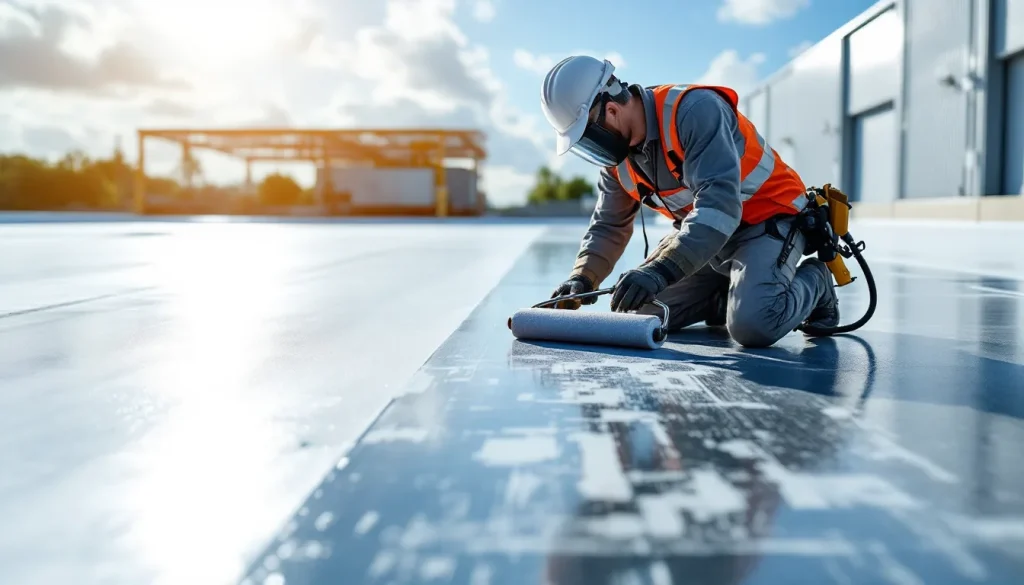
The specialist tier of commercial flat roofing contractors in 2026 is small. Most commercial roofers will tell you they do “everything,” meaning they install asphalt shingles on small commercial buildings, TPO on warehouses, and metal on retail strip centers as the work comes. The contractors who actually specialize, who install nothing but single-ply and modified bitumen on low-slope commercial roofs week in and week out, are a different category. They run heat-welder calibration logs, they have crews who only know TPO/EPDM/PVC, and they hold authorized applicator status with one or two manufacturers at the top tier instead of dabbling across all of them. This guide explains how to identify the genuine flat-roof specialists, what certifications matter, and the crew-day economics that separate serious bidders from generalists.
What makes a flat-roof contractor a specialist
Three things separate flat-roof specialists from generalists:
First, crew specialization. A specialist crew runs TPO, EPDM, PVC, or mod-bit projects 90%+ of their billable hours. A generalist crew is on shingles Monday, metal Tuesday, TPO Wednesday. The specialist crew’s seam welds are tighter because their hot-air welder is calibrated weekly and operated by the same hands. Their detail flashings are cleaner because they have detailed 500 parapet caps this year alone, not 20.
Second, equipment. A specialist owns dedicated single-ply equipment: Leister Varimat hot-air welders (or Sievert, or Forsthoff), seam probes, pressure-tested vacuum chambers for QC, and dedicated insulation cutting tools. Generalists rent welders for the week and return them. The calibration history on a rented welder is unknown.
Third, manufacturer credentials. Specialists hold authorized applicator status at the highest tier (Carlisle Centurion, GAF Master Select, Versico VersiTrac, Holcim Elevate Red Shield Master, Sika RSB), not at the entry-level “approved” tier. The difference is meaningful: top-tier status activates the 30-year NDL warranty. Entry-level status caps at material-only coverage with shorter terms.
The big five manufacturer cert programs
If you are hiring a commercial flat roofing contractor, the first question is which manufacturer system they are installing and what tier they hold in that manufacturer’s program. The big five:
Carlisle Authorized Applicator and Centurion Award. Carlisle SynTec is the largest single-ply manufacturer in North America, with roughly 35% market share across TPO, PVC, and EPDM combined. The Authorized Applicator program requires installer training on Sure-Weld TPO, Sure-Flex PVC, and Sure-Seal EPDM systems, plus an annual installation audit. Centurion Award goes to applicators who maintain top-tier performance metrics for multiple consecutive years (typically 3+). A Carlisle Authorized Applicator with Centurion status is the highest tier you will find on a Carlisle bid. Carlisle’s “Total Roofing System” warranty extends up to 30 years NDL with this credential.
GAF Master Select Roofer. GAF dominates residential but runs a serious commercial program. Master Select is the top of three tiers (after Master and Certified). Master Select activates the GAF Wellington 30-year NDL warranty on commercial TPO, EPDM, and modified bitumen systems. Roughly 2-3% of GAF commercial installers nationwide are at Master Select. The qualification requires 5+ years of clean installation history, manufacturer audits, and ongoing training.
Versico VersiTrac. Versico is a Carlisle subsidiary that runs a parallel commercial brand, distributed through different distributors. VersiTrac certified installers carry comparable training rigor to Carlisle Authorized Applicators and qualify for the Versico Total System warranty up to 30 years.
Firestone Red Shield (now Holcim Elevate). Firestone Building Products was acquired by Holcim and rebranded Elevate in 2022, but the Red Shield contractor program continues. Red Shield Master Contractors qualify for the Platinum 30-year NDL warranty, which is the longest commercial single-ply warranty in the market on EPDM specifically. Master Contractors must complete annual training and pass installation audits.
Sika Sarnafil Roofing Standards Bureau (RSB). Sika is the gold standard for PVC in North America and a leading brand for buildings with chemical, grease, or oil exposure (restaurants, hospitals, schools, lab buildings, food processing). The Roofing Standards Bureau is Sika’s quality assurance arm that audits every Sika Sarnafil installation. RSB-certified contractors qualify for the Sika Sarnafil 30-year Roof Guarantee.
A bidder who holds master-tier status with at least one of these five is a genuine specialist. A bidder who holds entry-level status with three of them is a generalist using the breadth of certifications as a marketing claim. The depth in one program is more meaningful than breadth across many.
The national flat-roof specialists
Tecta America. The largest pure-play commercial roofer in the United States, around $1.5B in annual revenue across 80+ operating locations. Majority-owned by Altas Partners and Leonard Green & Partners. Tecta operates as a roll-up: each location was a regional flat-roof specialist (often family-owned) acquired and integrated under the Tecta brand. Tecta carries authorized applicator status with Carlisle, Versico, GAF, Sika, and Holcim Elevate across most regions.
Centimark. Pittsburgh-based, around 90 service centers across the U.S. and Canada. Centimark is privately held by the Edwards family and runs a large dedicated maintenance arm (CentiMark Service Network) that handles preventive maintenance and 24/7 emergency response on top of new installation. Strong in industrial, distribution warehouses, and big-box retail.
Nations Roof. Joliet, Illinois headquartered, around 25 regional offices. Nations Roof is a strong bidder on industrial and distribution warehouse projects across the Midwest and Mid-Atlantic.
KPost Company. Dallas-based, expanding across the Sunbelt. KPost is dominant on stadium, airport, and high-profile commercial projects in the South.
Regional flat-roof specialists worth knowing
Baker Roofing. Charlotte, NC, founded 1915, 100% employee-owned ESOP, around 1,500 employees. Baker is the Carolinas benchmark with offices across the Southeast.
Latite Roofing. Pompano Beach, FL, founded 1947. Latite is the South Florida flat-roof specialist with deep HVHZ (high-velocity hurricane zone) experience and Miami-Dade NOA approval system fluency.
A.W. Farrell & Son. Buffalo, NY, founded 1937. Farrell handles cold-climate flat-roof work across upstate New York, northern Pennsylvania, and into Ohio.
Maxwell Roofing & Sheet Metal. Nashville, TN, founded 1897, family-owned. Maxwell is one of the oldest continuously-operating commercial roofers in the country.
MR Roof. Indianapolis, IN. Family-owned with a strong commercial book across the Midwest.
Every major metro has 3-5 flat-roof specialists at this caliber. The right way to source them is through the manufacturer authorized contractor directories (Carlisle, Versico, GAF Commercial, Holcim Elevate, Sika) filtered by zip code, plus peer building owner referrals. For more on sourcing, see our local commercial roofer finder and commercial roofers near you guides.
Crew-day economics: how flat-roof bids actually work
A commercial flat roof bid is built on crew-day costs. A typical TPO install crew is 4-6 roofers plus a foreman, with a daily burdened cost of $3,500-5,500 (depending on region, wage rates, and benefits). A crew can install roughly 50-80 squares (5,000-8,000 sq ft) of mechanically attached single-ply per day in good conditions. Fully adhered systems install slower: 30-50 squares per day.
This means a 200-square (20,000 sq ft) TPO replacement is a 3-5 day install for a competent crew. The labor portion of the bid is approximately 3-5 days x $4,500/day = $13,500-22,500. Add material (membrane, insulation, fasteners, cover board, flashing accessories) at $4-7 per sq ft = $80,000-140,000. Add tear-off, dumpster, mobilization, overhead, profit, and warranty registration, and you arrive at $7-12 per sq ft installed for TPO in 2026.
The ranges by membrane system for installed cost in 2026:
- TPO mechanically attached: $7-12/sq ft
- TPO fully adhered: $9-14/sq ft
- EPDM mechanically attached: $5-9/sq ft
- EPDM fully adhered: $7-11/sq ft
- PVC: $9-15/sq ft (higher material cost, similar labor to TPO)
- Modified bitumen: $7-12/sq ft (torch, hot-asphalt, or self-adhered)
- BUR (built-up): $5-10/sq ft for re-cover, more for full tear-off and replace
Wide ranges reflect insulation thickness (R-25 vs R-30 vs R-35), cover board type, attachment method, parapet count, drain count, penetration count, and tear-off scope. A bid 30% below the next-lowest with no obvious system difference is either underbidding or cutting fastener density and insulation thickness. For more detail, see our TPO roof installation cost and commercial roof replacement cost breakdowns.
TPO vs. EPDM vs. PVC: matching system to building
The right flat-roof system for a building depends on the building’s climate, exposure, and use. Quick decision framework:
TPO is right for: most warehouses, distribution, light manufacturing, big-box retail, and office buildings without chemical exposure. White reflective surface (energy code credit). Heat-welded seams. Excellent UV resistance. Most cost-effective per-warranty-year. Recent improvements in TPO formulation have addressed earlier failure modes.
EPDM is right for: Northern climate buildings where flexibility at cold temperatures matters. Long established (40+ year track record). Adhered installs perform exceptionally well over insulation. Lower cost than TPO in some regions. Black surface is a thermal disadvantage in summer, a thermal advantage in winter (debatable depending on R-value of insulation below).
PVC is right for: Restaurants (kitchen grease exposure), hospitals (cleaning chemicals on the roof), schools (cafeteria exhaust), pharmaceutical, food processing, anywhere with chemical exposure that would shorten TPO or EPDM service life. Higher cost justified by chemical resistance and 30-year warranty options.
For the head-to-head, see our TPO vs EPDM and TPO vs PVC membrane comparisons. For the broader low-slope category, see low-slope roof systems overview.
Mod-bit and BUR specialists: a smaller pool
Modified bitumen and built-up roof specialists are a shrinking pool. Most new commercial work is single-ply, and the contractors who still field mod-bit and BUR crews are often the older established firms (Baker, A.W. Farrell, Maxwell) plus specialty divisions inside the nationals (Tecta, Centimark). If your existing roof is mod-bit or BUR and you want to re-cover with the same system rather than convert to single-ply, the contractor pool is smaller and you should source through manufacturer directories (Soprema, Polyglass, IKO, Johns Manville).
EMR, insurance, bonding: same gates as general commercial
Flat-roof specialists face the same pre-qualification gates as any commercial roofer. EMR below 1.0 (ideally below 0.85). General liability $2M per occurrence and $5M aggregate minimum, often higher for larger projects. Workers compensation compliant in every state where the contractor has crews. Bonding capacity 2-5x largest project size. All standard. See our commercial roofing contractor guide for the full vetting checklist.
The crew you actually want on the roof
The single most predictive question for flat-roof quality is who is actually doing the welding. Ask the bidder: will the welder operator be a W-2 employee of your company or a subcontracted crew? How long has the operator been welding TPO/PVC? What welder model? When was it last calibrated? A specialist contractor answers these instantly. A generalist contractor mumbles about “our team” without naming the operator.
On install day, walk the roof (see our emergency commercial roofing response). Look for clean seam welds (consistent bead, no scorch marks), proper detail flashing at penetrations (rounded corners, oversized cover patches), uniform fastener pattern, and proper cover board joints. The seam probe test (a thin metal probe run along every seam to detect cold welds) should be performed by the foreman before the crew leaves the area, not after the project is complete.
Workmanship warranty: the contractor’s own paper
The manufacturer NDL warranty covers material and (at master-tier) labor for full membrane replacement. The contractor workmanship warranty is a separate document covering install defects for a shorter term, typically 2-5 years. A specialist contractor stands behind 2 years minimum, often 5. A generalist often offers 1 year or none at all. Get the workmanship warranty in writing as part of the contract. For the broader warranty hierarchy, see commercial roof warranty guide.
Pre-installation moisture survey and condition assessment
Before any major flat-roof install or overlay, a moisture survey is standard practice. The survey uses infrared thermography (best at dawn or dusk when the temperature differential between wet and dry insulation peaks), nuclear moisture meters, or capacitance meters to map wet areas of the existing roof. Wet insulation must be cut out and replaced before the new system goes over the top, or the new membrane will fail prematurely as trapped moisture migrates and condenses.
A specialist contractor either performs the moisture survey in-house or coordinates with an independent roof consultant. The survey report becomes part of the bid documentation: the contractor’s price assumes a defined quantity of wet insulation replacement, and any additional wet area discovered during tear-off becomes a change order. A generalist contractor often skips the moisture survey entirely, which is how a $200,000 TPO overlay becomes a $260,000 project six weeks into install when wet decking surprises everyone.
The moisture survey also documents the pre-install condition for warranty and litigation purposes. If the membrane fails years later and a dispute arises, the moisture survey establishes what was in place at install. For the broader pre-install due diligence flow, see commercial roof inspection schedule.
The bottom line
Commercial flat roofing contractors who specialize are a small group, identifiable by manufacturer master-tier certifications, dedicated single-ply equipment, and crew specialization in TPO, EPDM, PVC, or mod-bit at 90%+ of billable hours. The nationals (Tecta, Centimark, Nations Roof, KPost) and the regional specialists (Baker, Latite, A.W. Farrell, Maxwell, MR Roof) make up the bulk of the genuine specialist tier in 2026. The right contractor for a flat-roof project holds top-tier certification with the manufacturer of the system being installed, runs EMR below 1.0, carries adequate insurance and bonding, and answers detailed questions about welder calibration and crew tenure without flinching. Vet on the credentials, drive to two finished projects, and read the bid against the manufacturer specification. The right contractor reveals themselves.