
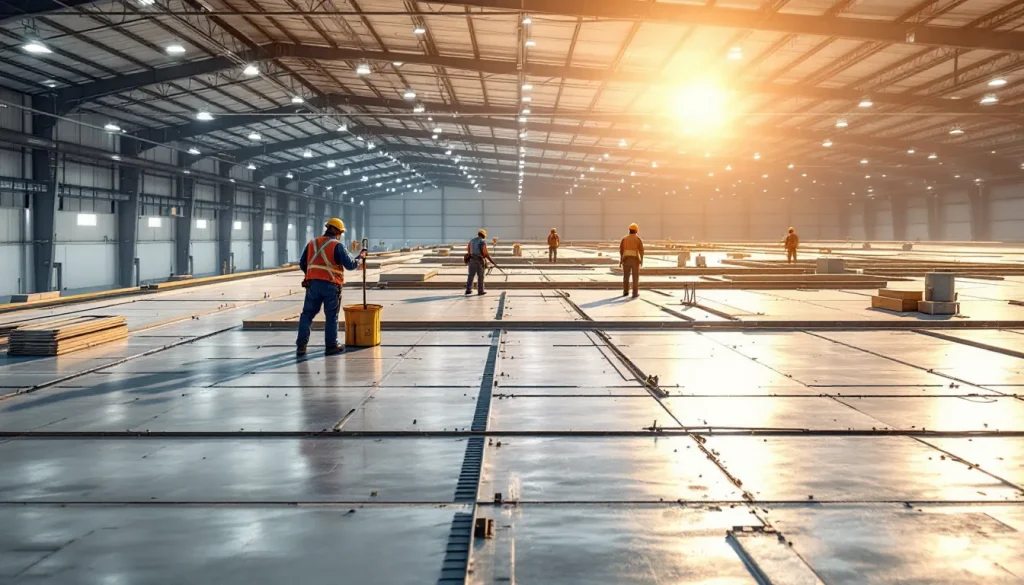
Hiring industrial roofing contractors in 2026 is not the same exercise as hiring a commercial roofer. The buildings are larger (100,000+ sq ft is normal, 500,000+ sq ft is not unusual), the rooftop conditions are nastier (chemical exhaust, food-processing grease, cold-storage condensation, manufacturing heat plumes), the tenant operations cannot stop (you cannot shut down an automotive assembly plant for a roof tear-off), and the failure consequences are an order of magnitude worse (a leaking pharmaceutical clean room, a wet-deck in a $50M finished goods warehouse, a frozen cold-storage cooler with $2M of inventory). The contractors who handle industrial roof projects well are a smaller subset of the commercial pool. This guide explains how to identify genuine industrial specialists, what additional credentials and capabilities matter, and the tenant-continuity planning that no residential or small-commercial roofer has ever practiced.
What makes a contractor “industrial”
The line between commercial and industrial is not size alone. A 100,000 sq ft office building is commercial. A 100,000 sq ft food-processing plant with chemical wash-down stations on the roof is industrial. The differentiators:
Scale of crew mobilization. An industrial project may need 15-25 roofers on-site for 6-10 weeks, organized into multiple crews working different sections in parallel. The contractor needs the staffing depth to mobilize that headcount without pulling crews off other projects, and the supervisory layers (project superintendent, multiple foremen, safety officer, QC inspector) to coordinate.
Chemical and exposure expertise. Industrial roofs are not clean. Pharmaceutical and food-processing buildings have caustic wash-down water on the roof. Chemical plants have process exhaust depositing residue on the membrane. Cold-storage facilities have constant condensation in the deck cavity. The membrane selection (PVC dominates for chemical exposure, hybrid systems for cold storage), the insulation system (closed-cell vs. open-cell, vapor retarder placement), and the detail flashing all change for industrial conditions.
Tenant continuity planning. An industrial tenant typically cannot vacate during the roof replacement. The contractor must phase the work so that production continues underneath. This requires interior protection (catch systems, temporary ceilings, dust barriers), scheduled work windows that align with shift changes or planned shutdowns, and 24-hour weather contingency planning. A residential roofer has never planned around a 24/7 manufacturing schedule. An industrial roofer plans around it every week.
Bond capacity. Industrial roof projects routinely run $1M-10M. Bonding capacity needs to cover the project value plus headroom for concurrent work. A contractor with $5M aggregate bond capacity cannot serve a $4M industrial project plus their existing book.
The nationals who do industrial well
Most industrial work is bid by the national commercial roofers, who have the scale and pre-qualification infrastructure to clear the institutional procurement gates.
Tecta America. The largest pure-play commercial roofer in the U.S., around $1.5B in annual revenue across 80+ operating locations. Majority-owned by Altas Partners and Leonard Green & Partners. Tecta has dedicated industrial divisions in several regions that focus on warehouse, manufacturing, and food-processing facilities. Their portfolio includes major distribution centers, automotive plants, and pharmaceutical buildings across the U.S.
Centimark. Pittsburgh-based, around 90 service centers across North America, privately held by the Edwards family. Centimark is particularly strong in industrial because they built much of their book around manufacturer warranty installs for big-box retail and distribution warehouses through the 1990s-2010s. Their preventive maintenance arm (CentiMark Service Network) is well-positioned for industrial recurring work.
Nations Roof. Joliet, IL headquartered, around 25 regional offices, particularly strong on industrial, manufacturing, and distribution warehouse work across the Midwest and Mid-Atlantic.
KPost Company. Dallas-based, with a strong industrial book in Texas and the Sunbelt covering automotive, aerospace, and oil/gas downstream facilities.
Baker Roofing. Charlotte, NC, founded 1915, 100% employee-owned ESOP, around 1,500 employees. Baker has dedicated industrial divisions across the Southeast covering pharmaceutical, food processing, and manufacturing.
Industrial work also gets bid by regional specialists (see our vetted regional roofers) in markets where the industrial concentration justifies it: A.W. Farrell in upstate NY/PA for industrial manufacturing, Maxwell Roofing & Sheet Metal in Tennessee for automotive supplier facilities, MR Roof in Indiana for distribution and manufacturing.
Cold-storage facilities: a separate specialty
Cold-storage roofs are a sub-specialty within industrial. The buildings (refrigerated distribution centers, food-processing freezers, pharmaceutical cold storage) maintain interior temperatures from +35F (refrigerated) down to -10F or colder (deep freeze). The constant temperature differential between exterior and interior creates condensation problems in the deck cavity that destroy ordinary insulation systems within 5-10 years.
The right roof system for cold storage is typically an insulated metal panel (IMP) system or a high-density polyiso system with carefully placed vapor retarder. The contractor needs to understand:
- Vapor retarder placement (warm side, sealed, continuous)
- Insulation R-value sized to climate plus interior temperature
- Penetration detail (every roof penetration is a condensation pathway)
- Thermal bridging at structural connections
- IMP system options including Kingspan, Metl-Span (Cornerstone Building Brands), and ATAS
IMP installed cost in 2026 runs $16-26 per sq ft, considerably higher than single-ply over polyiso, but the system is engineered for cold-storage conditions.
Cold-storage contractor selection narrows further. Tecta has cold-storage divisions in several regions. Some regional specialists (e.g., Roofing Solutions Group in the Midwest, Imperial Roofing in California) carry IMP installer credentials with Kingspan and Metl-Span. Ask any bidder for their cold-storage portfolio specifically. If they cannot list completed cold-storage projects with operator references, they are not the right bidder for cold storage.
Manufacturing facilities: chemical exposure realities
Manufacturing facility roofs see exposures that ordinary commercial buildings do not: kitchen exhaust grease (food processing), process exhaust acids (chemical plants), wash-down detergents (pharmaceutical), oil and grease (automotive, machine shops), and high heat plumes from manufacturing processes. These exposures shorten TPO and EPDM service life. The system choice is typically:
PVC for chemical exposure. Sika Sarnafil, Carlisle Sure-Flex, and other PVC systems resist chemical exposure that destroys TPO and EPDM. PVC is the right answer for food processing, pharmaceutical, and chemical plant rooftops. Installed cost $9-15 per sq ft, with 30-year NDL warranty available through Sika RSB-certified contractors.
Mod-bit for puncture resistance. Manufacturing facilities with heavy rooftop traffic (constant HVAC service, equipment changes, mechanical access) benefit from mod-bit’s puncture resistance. Multi-ply construction handles foot traffic that punctures single-ply membranes. Installed cost $7-12 per sq ft.
SPF (spray polyurethane foam) for irregular conditions. SPF is sprayed onto the existing roof surface and forms a continuous, monolithic membrane with no field seams. SPF works on irregular shapes (mansards, curves, complex penetration patterns) where single-ply is awkward. Specialty contractors (Honeywell, BASF, ICP, Lapolla certified) install SPF with warranty coverage to 20 years.
Manufacturer certifications: industrial-specific tiers
Industrial bids should specify manufacturer certifications at top tier. The standard list applies:
Carlisle Authorized Applicator with Centurion Award status. GAF Master Select Roofer (for commercial systems). Versico VersiTrac. Holcim Elevate Red Shield Master (formerly Firestone Red Shield). Sika Sarnafil RSB-certified. Additional industrial-specific credentials: Kingspan IMP installer, Metl-Span IMP installer, Soprema modified bitumen authorized installer (for SBS systems), Polyglass authorized contractor.
For the broader cert program walkthrough, see our commercial flat roofing contractors and commercial roofing contractor guide.
EMR and safety: tighter gates for industrial
EMR thresholds are tighter on industrial work. Many institutional and Fortune 500 procurement systems disqualify any contractor with EMR above 0.90 from industrial bid lists. Best-in-class industrial contractors run EMR between 0.60 and 0.80. The fall-protection regime on industrial roofs (often 20-50 ft tall, multiple roof levels, edge-of-roof penetrations) is more rigorous than commercial work. Industrial contractors should have:
- Documented fall arrest equipment inspection logs
- Dedicated safety officer on every project over $500K
- Daily toolbox talks recorded with crew sign-in
- Hot work permits and fire watch protocols (for torch-applied or hot-asphalt work)
- Lockout/tagout coordination with the facility safety team
Industrial facility owners typically require contractors to attend a facility-specific safety orientation before any crew enters the building. The contractor should have completed orientations at multiple comparable facilities and be able to reference them.
Insurance and bonding limits for industrial
Industrial roof projects need higher insurance limits than commercial. Standard requirements:
- General liability: $5M per occurrence, $10M aggregate
- Excess/umbrella liability: $5-25M depending on project value and facility risk
- Workers compensation: statutory in every state where the contractor has crews
- Pollution liability: $1-5M for projects with chemical exposure or hot work
- Builders risk: typically carried by owner but verify in contract
- Performance and payment bonds: 100% of contract value standard, increased on public projects
Bond capacity needs to cover the project plus existing committed work. A contractor with $10M aggregate bond capacity cannot serve a $4M industrial project on top of $8M of in-progress work without surety distress. Ask for the bond capacity letter and the in-progress backlog.
Tenant continuity: the planning that residential roofers do not understand
An industrial tenant rarely vacates for a roof project. Production continues underneath. The contractor must plan around it. Key elements:
Phased work plan. The roof is divided into work zones, each of which is torn off, dried in, and made weather-tight within a 24-48 hour window. The crew never opens more roof than can be closed before nightfall or the next weather event.
Interior protection. Below the work zone, the contractor installs catch systems (tarps, plastic sheeting, plywood platforms) to protect production equipment, finished goods, and inventory. In food-processing facilities, additional protection is required to maintain FDA sanitary conditions.
Work hour coordination. Production-critical zones may require night-shift work, weekend work, or coordination with planned shutdowns. The contractor needs to staff multiple shifts and the project schedule needs to flex around production windows.
Communication protocol. A designated owner representative, a designated contractor superintendent, and a designated facility safety contact meet daily. Issues get raised same-day, not next-week.
For the broader industrial systems overview, see our industrial roofing systems guide. For full replacement cost ranges, see industrial roof replacement.
Repair contractors and maintenance programs
Beyond new installation, industrial facilities need maintenance contractors. The right industrial maintenance program is a multi-year contract covering twice-yearly inspections, quarterly drain clearing, repair allowance (typically $1,500-5,000 included per quarter), and 24/7 emergency response. Pricing runs $0.10-0.25 per sq ft per year. For more detail, see our commercial roof maintenance program guide. For repair-specific cost ranges, see industrial roof repair cost and warehouse roof repair methods.
The 14 questions to ask any industrial bidder
- How many industrial projects of comparable scope (square footage, occupancy type, tenant continuity requirements) have you completed in the last 24 months?
- Provide three industrial owner references with phone numbers I can call this week.
- What manufacturer certifications do you hold at master tier, and for which membrane systems?
- What is your EMR for the most recent policy year, and may I see the EMR letter?
- What are your general liability, excess liability, and pollution liability limits?
- What is your current bonding capacity and your in-progress backlog?
- Who is your dedicated safety officer, and how many years of industrial roofing safety experience do they have?
- What is your tenant continuity plan for this project, including phased work zones, interior protection, and work hour coordination?
- Will the install crew be your direct employees? How many years of tenure does the foreman have with your company?
- Walk me through your hot work permit and fire watch protocol, if applicable.
- What is the manufacturer warranty (term, NDL vs material-only, exclusions)?
- What is your workmanship warranty?
- What is the payment schedule? Reasonable industrial terms: 5-10% deposit, progress payments tied to milestones with retention.
- How do you handle change orders mid-project? Provide a sample change order form.
Crane access, lifts, and rooftop logistics
Industrial roofs introduce logistical realities that residential and small-commercial contractors do not face. On a 200,000+ sq ft roof, material movement is a project in itself. Bulk insulation, membrane rolls, and fasteners are typically craned to the roof in staged loads, requiring a mobile crane (often 50-ton or larger) with operator certification and ground-level lay-down area. Some facilities require night-shift crane work to avoid daytime traffic conflicts.
Personnel access on tall industrial buildings (40-80+ ft) requires either interior stair access (coordinated with facility security and shift schedules) or exterior aerial lift access. The contractor’s lift fleet (scissor lifts, boom lifts) and operator certifications become part of the bid evaluation.
Material delivery scheduling matters. A 200,000 sq ft TPO project consumes roughly 200 rolls of membrane plus 1,200 boards of polyiso insulation plus pallets of fasteners and accessories. Storage on the roof must be planned so that the membrane and insulation are not damaged by weather during the install period. A specialist industrial contractor walks through this logistics plan as part of pre-construction. A bidder who has not thought it through is a bidder who will discover the problem mid-project.
The bottom line
Industrial roofing contractors in 2026 are a smaller, more rigorously vetted subset of the commercial pool. The nationals (Tecta, Centimark, Nations Roof, KPost) and regional specialists (Baker, Latite, A.W. Farrell, Maxwell) make up the bulk of genuine industrial bidders. The credentials that matter beyond standard commercial are: cold-storage system experience (for refrigerated facilities), chemical exposure expertise (PVC for food/pharma/chemical), tighter EMR thresholds (often <0.90), higher insurance limits ($5M/$10M minimum), pollution liability coverage, bond capacity to absorb $1M-10M projects, and tenant continuity planning that keeps production running underneath. The right contractor for an industrial roof can walk through their phased work plan, interior protection scheme, and shift coordination protocol without needing to call the office for answers. Source through manufacturer authorized contractor directories at master tier, verify the credentials, and drive to two completed industrial projects of comparable scope.