
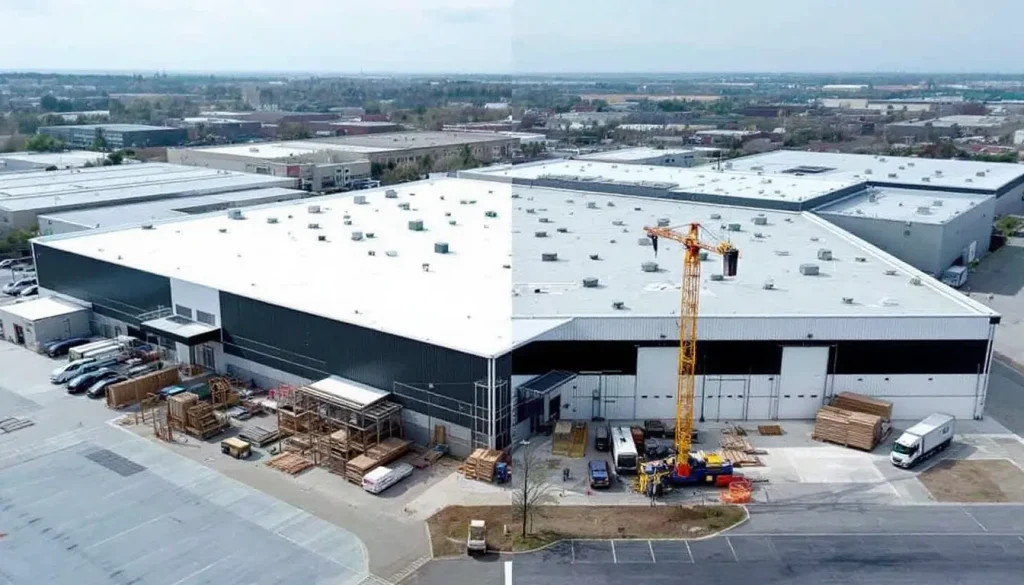
Industrial (see our industrial roof replacement cost guide) roof replacement on a 50,000 to 200,000 square foot warehouse is a logistics problem as much as a roofing problem. The membrane decision is the easy part. The hard parts are keeping the tenant operating, staging crane access without blocking the loading docks, sequencing the work around shipping schedules, and finishing before the next thunderstorm because there’s no rain cover over a million dollars of inventory. This guide is about how an industrial reroof actually gets built in 2026, who the players are, what it costs, and the mistakes that turn a 4-week project into an 8-week dispute.
Industrial roofs are not just bigger versions of commercial roofs. The scale changes the entire approach: phasing, equipment, crew (see our national and regional commercial roofers guide) structure, daily production targets, and tenant communication all look different at 100,000 square feet than at 20,000. The economics also change. The per-square-foot installed cost is lower on industrial work because the perimeter detail percentage is lower, but the absolute project value (often $700,000 to $4 million) means the owner-side diligence is much heavier.
Project Scope: What’s Actually Being Replaced
A complete industrial reroof includes the membrane, the insulation, sometimes the cover board, the perimeter edge metal, the parapet flashings, and the rooftop penetrations (HVAC curbs, exhaust fans, skylights, vent stacks). On a 100,000 square foot building, that’s 100,000 square feet of new membrane, 200,000 square feet of new insulation (often two layers of 2-inch polyiso), 1,200 linear feet of new edge metal, and 40 to 80 rooftop curbs and penetrations to be re-flashed.
The structural deck almost always stays. Pre-engineered metal building (PEB) bar joists with metal deck on top, common on 1980s and 1990s industrial construction, have a service life of 50 to 80 years and rarely need replacement at the time of a reroof. Concrete decks on tilt-up construction (mostly West Coast) and on heavy industrial buildings also stay. The exception: wood-decked industrial buildings (rare, mostly older construction) where rot from prior leaks sometimes requires partial deck replacement.
Skylights are the wild card. Most industrial buildings have hundreds of fiberglass-reinforced plastic (FRP) skylights at 4×8 feet or similar. The FRP yellows and embrittles over 15 to 20 years. A reroof is the right time to replace them with current-generation polycarbonate skylights with curb-mounted upstand bases. Add $400 to $800 per skylight to the project budget (for the full data set, see our the full 2026 Roofing Cost Report).
Tear-Off vs. Recover: The Foundational Decision
The first scope decision on an industrial reroof is whether to tear off the existing system or install a new membrane over it.
Tear-off removes the existing membrane and insulation, exposes the structural deck, and installs a complete new system. Advantages: known substrate condition, opportunity to upgrade insulation R-value to current code, ability to address any structural deck issues. Disadvantages: 30 to 50 percent more landfill weight, higher labor cost, exposure of the building interior to weather during phased work.
Recover leaves the existing membrane and (often) insulation in place and installs new insulation and membrane on top. The existing roof becomes a vapor barrier. Advantages: faster install, lower labor cost, no landfill cost on the existing material, less weather exposure during the work. Disadvantages: added dead load (typically 1.5 to 3 psf), the existing membrane’s hidden defects (wet insulation, etc.) become permanent inclusions in the new assembly, and code in most jurisdictions only allows one recover before tear-off is required.
The right answer depends on the existing roof’s condition and the local code. Industrial buildings get recovered all the time on first reroof (year 20 to 25 from original construction) when the existing system is dry and the structural deck is sound. They almost always get torn off on second reroof (year 45 to 50) because two recovers stacked is too much dead load and the original roof has become an unknown.
An infrared moisture survey is the standard pre-bid diligence for the recover decision. The survey identifies wet insulation areas under the existing membrane; if more than 15 to 20 percent of the roof shows wet insulation, the recover doesn’t pencil and tear-off is the right call. Surveys cost $0.04 to $0.08 per square foot ($4,000 to $8,000 on a 100,000 sq ft building).
Phased Zone Replacement and Tenant Continuity
An industrial reroof is almost never a single-zone job. The owner can’t shut down 100,000 square feet of warehouse operations for 4 weeks while the roof is open. The work gets phased into zones, with each zone being weathered-in before the next zone opens.
Typical phasing on a 100,000 square foot warehouse: divide into 5 to 8 zones of roughly 12,000 to 20,000 square feet each. Each zone is torn off in the morning, has new insulation and base flashings installed by midday, and gets a temporary or permanent membrane down by end of shift. Crews chase rain forecasts: if rain is forecast within 6 hours, the zone gets a temporary tarp instead of permanent membrane and the work resumes the next dry day.
The tenant operations underneath have to know the daily plan. Specific bays get loading-dock closures or material relocation. HVAC equipment over an open zone gets shut down so it doesn’t draw moist outside air into the building. Fire sprinkler systems below the open zone are checked daily because debris can interfere with sprinkler heads.
The construction management interface with the tenant is the single biggest source of friction on industrial reroofs. A daily 7 a.m. coordination meeting between the GC superintendent, the roofing foreman, the tenant’s facility manager, and the tenant’s operations manager is standard practice. The meeting reviews the day’s work zone, identifies any tenant operations that need to relocate, confirms HVAC and sprinkler status, and identifies any access issues for forklifts and trucks.
Night Work and Weekend Work
For tenants whose operations can’t tolerate any daytime disruption (24/7 fulfillment centers, food production with rolling shifts, refrigerated storage), the reroof gets done at night or on weekends.
Night work has trade-offs: cooler temperatures help with TPO seam welding (which doesn’t work well above 95 F roof temp), but lighting setup costs $4,000 to $8,000 per night for tower lights and generators, and night-shift labor commands a 25 to 40 percent premium. Net cost premium for night work versus day work: 20 to 35 percent on labor, with material cost unchanged.
Weekend work is the middle ground. Most industrial tenants do reduced operations on Saturdays and Sundays, allowing crew access to the full roof without operational interference. Saturday work commands a 15 to 25 percent labor premium; Sunday work commands 25 to 40 percent. Weekend work also tends to be more weather-dependent because Monday morning has to be operational, regardless of whether the weekend’s planned zones got finished.
The right answer for most projects: day-shift work during the week with Saturday catch-up days budgeted in case of weather delays. Pure night work is reserved for tenants who genuinely can’t accept any daytime presence on the roof.
Crane Access and Material Staging
Material gets to the roof one of two ways: crane lift from a staging area on the ground, or by elevator-mounted material hoist for buildings tall enough to justify it. On industrial single-story buildings, it’s always the crane.
A 100-ton hydraulic truck crane is the standard rig for industrial reroof material handling. The crane lifts insulation, membrane rolls, fasteners, plates, and waste containers between the ground and the roof. Crane positioning has to balance reach (the boom has to access all areas of the roof in zones) with traffic flow (the crane can’t block loading docks, employee parking, or fire lanes).
Daily crane rate in 2026: $2,800 to $4,500 for a 100-ton crane plus operator, with 8-hour minimums. For a 4-week project on a 100,000 square foot building, the crane budget runs $60,000 to $90,000. On larger jobs, the crane is dedicated to the project and the cost is folded into the unit price.
Staging area on the ground requires 4,000 to 8,000 square feet of secure space for material delivery, palletized insulation storage, equipment laydown, and waste containers. Tenant cooperation on staging space is usually necessary and is one of the first items in the pre-job kickoff meeting.
The Right Membrane for Industrial
The membrane decision for industrial buildings in 2026 has narrowed considerably. The volume leaders are TPO and modified bitumen, with EPDM and PVC playing specialty roles.
TPO (thermoplastic polyolefin) wins on cooling cost. A white TPO roof reflects 75 to 85 percent of incoming solar radiation versus 5 to 15 percent for a black EPDM or aged mod-bit. On a 100,000 square foot warehouse in a hot climate, that’s $0.15 to $0.30 per square foot per year in HVAC savings, or $15,000 to $30,000 annually. TPO dominates industrial new construction and reroofs in the Sun Belt for this reason.
Modified bitumen (mod-bit) wins on puncture resistance. Industrial roofs see a lot of foot traffic from mechanical service contractors, antenna installers, and tenant maintenance. Mod-bit’s multi-ply asphalt construction tolerates dropped tools, abrasion, and HVAC condensate exposure better than single-ply membranes. Mod-bit dominates industrial reroofs where the building has heavy rooftop equipment and active service traffic.
EPDM (ethylene propylene diene monomer) wins in cold climates. The membrane’s freeze-thaw performance and 25 to 35-year service life make it the right call on northern industrial buildings where the cool-roof benefit doesn’t matter. EPDM also performs well under ballasted assemblies on older industrial buildings.
PVC (polyvinyl chloride) wins on chemical exposure. Food processing, chemical manufacturing, and any industrial facility with rooftop discharge of grease, solvents, or animal fats specifies PVC. The chemistry resists degradation that destroys TPO or EPDM. PVC is also the right call on cold storage with refrigerant line penetrations.
For the detailed chemistry comparison, our TPO vs. EPDM piece breaks down the seam welding and adhesion differences.
Insulation Upgrade: Code, R-Value, and the Tax Math
Most industrial roofs being replaced in 2026 were built in the 1980s or 1990s with R-15 to R-22 insulation. Current IECC code requires R-30 to R-40 depending on climate zone. A reroof triggers compliance with the current code on the replaced assembly.
Adding R-15 to R-25 of additional insulation on a 100,000 square foot warehouse during a reroof costs $0.80 to $1.50 per square foot, or $80,000 to $150,000. The HVAC savings on a heated and cooled warehouse run $0.10 to $0.20 per square foot per year, or $10,000 to $20,000 annually. Payback period: 7 to 12 years before tax incentives.
With Section 179D (the energy-efficient commercial building deduction), the payback gets dramatically better. A building that achieves the 25 percent envelope improvement threshold gets a $2.50 per square foot immediate tax deduction. On 100,000 square feet, that’s a $250,000 deduction, or roughly $90,000 in actual tax savings at a 37 percent marginal rate. Net cost of the insulation upgrade after 179D: $0 to $60,000. Payback inside year one.
For the financing structures that pair with these tax benefits, our commercial roof financing piece covers C-PACE, ESCO contracts, and the bank loan math.
Timing: When to Reroof and When Not To
Industrial reroofs are weather-dependent in ways residential and small-commercial work isn’t. The project takes 2 to 6 weeks, the roof is partially open through that whole period, and any major rain event during the project can damage tenant inventory.
The right weather windows:
Spring (April-June) in northern climates. Above-freezing temperatures for TPO seam welding, low humidity, manageable rain risk. The downside: spring is also tornado season in much of the Midwest and South.
Fall (September-October) anywhere. Best window in most markets. Past the summer heat that breaks adhesives on adhered systems, before winter weather. Industrial reroof contractors book up 6 to 12 months ahead for fall slots.
The wrong weather windows:
July-August in the Sun Belt. TPO seam welding doesn’t work well above 95 F roof temperature. Adhered systems’ solvent-based adhesives flash off too fast in extreme heat. Crew productivity drops 30 to 40 percent in 100 F heat.
December-February in the North. Adhered systems require above-freezing temperatures for proper bond. Mechanically fastened TPO can install at lower temperatures, but seam welding still requires careful temperature management. Snow loads on partially completed zones create scheduling chaos.
Hurricane season in coastal markets. June through November in the Gulf and Atlantic coasts. The hurricane window doesn’t preclude reroofing, but it does require contingency tarping plans and accelerated phasing to limit the open-roof window during any given day.
Contractor Selection for Industrial Work
Industrial reroof contractors are a different category than residential or small-commercial roofers. The qualified bidders for a 100,000 square foot industrial reroof in any major market are typically 5 to 12 firms, all of whom employ project superintendents, certified safety officers, and have the capital and crew capacity to mobilize a 6 to 12-person crew for the duration.
The credentials to verify: NRCA (National Roofing Contractors Association) membership, manufacturer certification for the specific membrane being installed (Carlisle, GAF, Sika, etc. all have certified-contractor (see our industrial roofing contractors) programs), OSHA 30 training for the project superintendent, written safety program, EMR (experience modification rate) below 1.0 on workers comp, and general liability and umbrella coverage at minimum $5 million combined.
Three competitive bids is standard practice. The bids should be analyzed not just on total price but on unit pricing for the major line items (membrane, insulation, edge metal, flashings), the bid’s contingency allowance for change orders, and the proposed phasing plan. A contractor who can’t explain the phasing plan in the bid interview is a contractor who’ll phase by improvisation during construction.
Our contractor selection guide covers the broader diligence pattern that applies here at scale.
Change Orders: The Industrial Project’s Friction Point
Change orders happen on every industrial reroof because the existing roof’s hidden conditions only get revealed during tear-off. Wet insulation that the infrared survey missed, rusted bar joists that need treatment, rotted nailers at the parapet, electrical conduits that weren’t on the drawings: all of these surface during construction and drive change orders.
The right contract structure includes a contingency allowance (typically 5 to 10 percent of the base contract value) for known-unknown change orders, with unit pricing pre-negotiated for the most likely items. Wet insulation removal at $X per square foot. Deck repair at $Y per square foot. Nailer replacement at $Z per linear foot.
Pre-negotiated unit pricing eliminates the change-order negotiation during construction and removes the contractor’s incentive to inflate change order prices when discoveries happen mid-project. The owner pays the unit price for the actual quantity discovered, and the project moves forward without delay.
What This Costs in 2026
Installed cost for an industrial reroof in 2026, including tear-off, new insulation to current code, new membrane, edge metal, and flashings:
50,000 sq ft warehouse, TPO 60-mil adhered, single-zone phasing: $400,000 to $600,000 ($8 to $12/sq ft). Project duration: 2 to 3 weeks.
100,000 sq ft warehouse, TPO 60-mil mechanically fastened, 5-zone phasing: $650,000 to $950,000 ($6.50 to $9.50/sq ft). Project duration: 3 to 4 weeks.
200,000 sq ft distribution center, TPO 60-mil mechanically fastened, 8-zone phasing: $1.1 million to $1.8 million ($5.50 to $9/sq ft). Project duration: 5 to 7 weeks.
Modified bitumen on the same square footage runs roughly 10 to 20 percent more on installed cost but offers longer service life and better puncture resistance for buildings with heavy rooftop traffic. Our modified bitumen roof guide covers the SBS vs. APP chemistry that drives that puncture performance.
Recover (vs. tear-off) saves $1.50 to $3 per square foot when the existing system qualifies and code permits.
Insulation upgrade to current code adds $0.80 to $1.50 per square foot beyond like-for-like replacement, but with Section 179D the upgrade pays back inside year one.
The math on industrial reroofing is favorable enough that deferral is almost always the wrong call. A failing roof on a 100,000 square foot warehouse leaks $50,000 to $200,000 worth of tenant inventory per major event. Even one significant water event during a deferred year erases the carrying cost of doing the reroof properly. The right answer is to plan the project 12 to 18 months out, lock in a fall or spring weather window, do the financing diligence, run a clean bid process, and execute with disciplined phasing. The industrial reroof market in 2026 has enough qualified contractors to do this work well, and enough financing structures to fund it efficiently. The bottleneck is almost always the owner’s internal approval process, not the construction itself.