
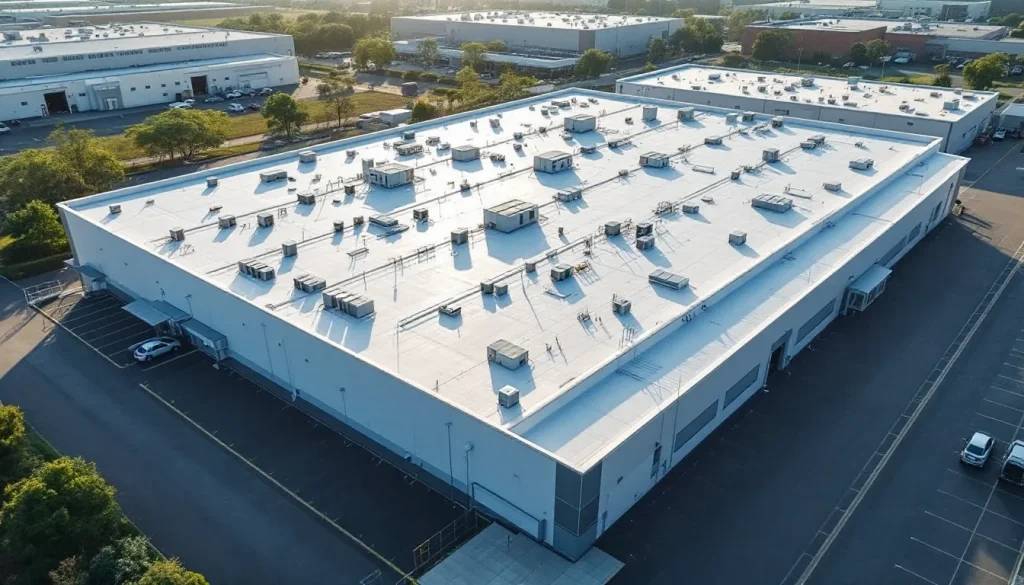
Industrial (see our warehouse roof repair methods) roofing is its own discipline. The buildings are larger, the rooftop traffic is heavier, the chemical and thermal loads are unique, and the consequences of a wrong-system specification can run into seven figures of lost product and downtime. In 2026, the industrial roofing market is split across three broad use cases: distribution and warehousing (TPO and EPDM territory), manufacturing with chemical or thermal exposure (PVC and modified bitumen territory), and cold storage (insulated metal panel territory). This guide walks through what gets specified where, and why.
Warehouses and distribution centers
The typical big-box warehouse (see our industrial roof replacement cost) in 2026 is 200,000 to 1.2 million square feet of flat or low-slope roofing over a tilt-up concrete or steel-frame building. Roof loads are modest (HVAC packages, exhaust fans, occasional skylights), foot traffic is light, and the operational requirement is straightforward: keep water out and keep cooling costs down.
The default specification is white TPO (thermoplastic polyolefin), 60 or 80 mil thick, mechanically attached. White TPO reflects roughly 80% of incident solar radiation, which on a 500,000 square foot roof translates to meaningful cooling load reduction during summer months. The Cool Roof Rating Council assigns Solar Reflectance Index (SRI) values, and white TPO routinely lands SRI 95+. That qualifies for LEED credits and Title 24 California energy code compliance, and Dallas, Phoenix, and Atlanta logistics operators pay real attention to the reduction in HVAC energy use.
Mechanically attached TPO is the right answer for warehouses because it is fast to install (see our commercial roof installation guide) (a competent crew can install 10,000+ square feet per day), the fasteners and plates are spaced predictably (12-24 per board depending on wind zone), and the seams are heat-welded for a watertight bond that does not rely on adhesive cure. The trade-off is wind uplift performance. Mechanically attached systems require careful fastener pattern calculation per ASCE 7 and FM Global wind ratings, especially for buildings in hurricane zones or high-wind areas. In 2026, FM 1-90 (90 psf uplift) is the standard for inland warehouses, FM 1-120 for hurricane-exposed buildings. Carlisle Sure-Weld and Versico VersiWeld dominate the TPO market by volume, with GAF EverGuard and Johns Manville JM TPO also widely specified.
EPDM (ethylene propylene diene monomer) remains specified for warehouses in regions with severe hail or where the building owner prefers a 60-year service track record over the 25-year TPO record. EPDM is a synthetic rubber, black or white, available in 45, 60, 75, and 90 mil thicknesses. It can be installed mechanically attached, fully adhered, or ballasted with river rock or pavers. EPDM costs less per square foot than TPO and is more puncture-resistant, but it does not reflect heat the way white TPO does (unless specified in white EPDM, which is uncommon). EPDM seams are taped or glued rather than heat-welded, which is faster to install but historically a weaker failure point. Modern EPDM seams using factory-applied seam tape have closed most of that gap. Carlisle Sure-Seal and Firestone (now Elevate) RubberGard are the dominant EPDM systems.
Manufacturing with chemical or thermal exposure
Where the warehouse roof problem is wind uplift and reflectivity, the manufacturing roof problem is what the roof has to survive every day. Chemical plants vent acids, alkalis, and hydrocarbons. Food processing facilities vent grease and fats. Auto manufacturing exhausts solvents. Pharma cleanrooms vent through HEPA stacks that can dump particulate onto downwind roof areas. TPO and EPDM are not the right specification for these conditions because the membranes break down faster under chemical assault.
The answer is PVC (polyvinyl chloride). PVC is the chemically resistant single-ply membrane, and the major brands in industrial PVC are Sika Sarnafil, Carlisle Sure-Flex, IB Roof Systems (now part of MULE-HIDE), and Duro-Last. Sika Sarnafil holds the largest specification share in industrial chemical and food processing because the Sika Sarnafil Roofing Standards Bureau (RSB) audits installations and the resulting Roof Guarantee has a 50+ year service track record. The membrane is typically 60, 72, or 80 mil thick, heat-welded at seams, and available in colors and reflective finishes. White smooth-surface PVC is the standard for food processing because the surface resists biological growth and is easy to clean.
PVC also handles roof traffic better than TPO under most conditions. Manufacturing roofs see weekly to daily traffic for HVAC maintenance (see our industrial roof repair cost guide), exhaust fan service, refrigeration system service, and process equipment maintenance. PVC membranes are more puncture-resistant than 60 mil TPO and far more resistant to point-loading damage from dropped tools or equipment. The cost premium is real (PVC typically runs $9-15 per square foot installed compared to $7-12 for TPO), and for facilities where chemical and traffic exposure is high, it is the only honest answer.
Modified bitumen (mod-bit) is the legacy alternative for manufacturing roofs, particularly facilities with hot processes or rooftop equipment that generates extreme thermal cycling. Mod-bit is a multi-layer system: a base sheet, an interply sheet, and an asphalt-impregnated SBS or APP cap sheet, torched or cold-applied. Mod-bit handles thermal cycling extremely well, has high puncture resistance, and can be installed in cold weather when single-ply systems cannot. The downside is install labor intensity, the open-flame torch hazard, and the limited reflectivity unless a granulated white cap sheet is specified. Mod-bit costs $7-12 per square foot installed and remains specified for steel mills, paper mills, and other heavy-thermal manufacturing. SBS (styrene-butadiene-styrene) modifications are more flexible and forgiving; APP (atactic polypropylene) modifications are more heat-resistant. Both are sold under GAF Ruberoid, Siplast Paradiene, Soprema Elastophene, and Tremco PowerPly. Our overview of modified bitumen roof covers the install variants in detail.
Cold storage and food processing freezers
Cold storage facilities (refrigerated warehouses, blast freezers, controlled atmosphere produce storage, pharma cold chain) operate at internal temperatures from 40 F down to -20 F and below. The roof has to do two jobs that conflict with each other in standard single-ply specification: maintain a continuous vapor barrier (so moisture from outside air does not condense inside the insulation) and provide R-32 to R-48 of continuous thermal insulation (so the refrigeration plant is not chasing 80 F summer heat through the roof deck).
The dominant 2026 specification for new cold storage is insulated metal panels (IMP). IMP systems are factory-laminated panels with steel skins on both sides and a polyurethane (PUR) or polyisocyanurate (PIR) foam core. PIR is the higher-performance core in 2026 because it offers better fire resistance under ASTM E108 and FM 4471 testing. Panel thicknesses are 4 inches (R-32), 5 inches (R-40), and 6 inches (R-48). Spans are typically 5 feet of structural support spacing, panel widths are 30-42 inches, lengths to 50+ feet for a single panel run.
The three dominant IMP manufacturers in North America in 2026 are Metl-Span (Cornerstone Building Brands), Kingspan, and Centria. Each produces panels with PIR cores, factory-applied finish coatings (typically Kynar 500 PVDF for 30+ year fade resistance), and tongue-and-groove or shiplap edge profiles for weather-tight assembly. The installed cost runs $16-26 per square foot, which is significantly more than membrane systems. The cooling load savings make the math work over a 20-30 year operating period.
IMP requires precise structural design. Each panel sits on a purlin or sub-girt system that has to support the panel load, accommodate thermal movement, and detail correctly at parapets, eaves, ridges, and penetrations. The flashings between panels and rooftop equipment (refrigeration condensers, exhaust stacks) are the critical detail. Sub-spec flashings let warm humid air infiltrate, condense inside the panel cavity, and ice up. The result is panel deflection, eventual delamination, and a refrigeration cost spike that often runs 30-50% over baseline before anyone diagnoses the source.
For cold storage retrofits where IMP is not feasible (existing steel deck and cannot reframe), the alternative is a hybrid system: a vapor barrier directly on the deck, 6-8 inches of polyisocyanurate insulation in two staggered layers, a cover board, and a 60-80 mil white TPO or PVC membrane fully adhered. The vapor barrier is the make-or-break detail, and it must be continuous and sealed at every penetration. A 1/16 inch gap in the vapor barrier is enough to let interior moisture migrate into the insulation, where it condenses, freezes, and destroys the R-value within two years.
R-value, code minimums, and the math on insulation
Code minimums for industrial roofing insulation in 2026 are set by ASHRAE 90.1 and IECC, both of which were updated in 2024. For commercial roofs over conditioned space in climate zone 4 (most of the central US), the minimum is R-30 continuous insulation above the deck. For climate zone 5 and colder, R-35 continuous. For cold storage operating below 35 F internal, R-32 to R-48 is the practical specification regardless of code minimum, because the refrigeration cost savings on each marginal unit of R-value are significant.
Polyisocyanurate (polyiso) is the dominant insulation board in 2026 for industrial roofing. Polyiso provides R-5.7 to R-6.0 per inch at 75 F, derating to about R-5.0 per inch at design conditions. Two layers of 2.6 inch polyiso staggered gives R-25 to R-26 continuous, which is the standard warehouse spec. Cold storage stacks polyiso higher, often 4 to 6 inches in two or three staggered layers. Always staggered. Single-layer thick polyiso has board joints that align top (see our best commercial roofing companies guide) to bottom, which become thermal bridges and water infiltration paths.
Cover boards go on top of the polyiso before the membrane. Securock (USG), DensDeck (Georgia-Pacific), and Hydrostop are the common gypsum-based cover boards. 1/4 or 1/2 inch cover board distributes point loads from rooftop traffic, protects the polyiso from puncture, and provides a substrate the membrane can bond to. Skip the cover board, and the first time a maintenance tech drops a wrench, you get a soft spot in the insulation that telegraphs into membrane damage within months.
Rooftop equipment loading and structural review
The roof structure has to support the system. That sounds obvious, and yet it is the single most common engineering oversight on industrial retrofits. A 1960s steel deck designed for a 4-ply built-up roof at 8 psf may not support a 2026 IMP system at 12 psf without supplemental framing. A roof originally designed for 6 rooftop HVAC units may not handle the 14 units that have accumulated over 30 years of expansions. Adding insulation thickness adds dead load. Adding solar PV adds dead load and wind load. Replacing a membrane system with a heavier system requires structural review.
The structural engineer review is non-negotiable on any industrial replacement (see our industrial roof replacement project guide), and it should happen before the contractor bids the work. Some manufacturers require structural review as a warranty condition. Skipping it is how owners discover, partway through tear-off, that the deck is corroded or the trusses are over-stressed.
Fire ratings and code compliance
Industrial roofs must meet UL 790 (external fire exposure) and ASTM E108 (fire exposure from below) ratings. Class A is the highest rating and is mandatory in many jurisdictions for buildings over 5,000 square feet. FM Global also rates assemblies for fire resistance (FM 4471 and FM 4470). Sprinklered industrial buildings often qualify for relaxed roof fire ratings, but the manufacturer system warranty still requires the listed assembly. Substituting components voids both the warranty and potentially the code compliance.
For manufacturing with combustible processes (paint booths, solvent storage, paper handling), additional roof fire-rating requirements apply under NFPA and OSHA standards. Modified bitumen with mineral cap sheet typically achieves Class A by default. Single-ply membranes typically require a gypsum cover board to achieve Class A on combustible decks (wood, plywood). Always confirm the listing for the specific assembly being installed, not just the membrane.
Drainage and ponding
Industrial roofs ponding water for 48+ hours after rain are violating most manufacturer warranties. Ponding accelerates membrane degradation, freezes and expands at seams in winter, and adds dead load (1 inch of standing water is 5.2 psf). Proper drainage requires 1/4 inch per foot positive slope to drains, scuppers, or gutters. New construction designs slope into the deck or into tapered insulation. Retrofit projects either use tapered insulation (expensive, but standard) or add drains and crickets to direct flow. Tapered polyiso adds 2-4 dollars per square foot to the project cost, which most owners discover late in the bidding process.
Drain quantity is sized per the International Plumbing Code at one primary drain per 10,000 square feet of roof, plus overflow drains or scuppers as secondary protection. Older industrial buildings often have undersized drains, and a replacement project is the right moment to add drains. Skipping it because “they have always been adequate” is how a building owner finds out about the drainage shortfall during the first 50-year storm event.
Cost ranges in 2026
Installed cost ranges per square foot for industrial roofing systems in 2026:
- TPO mechanically attached, 60 mil, R-25 polyiso: $7-9
- TPO fully adhered, 60 mil, R-25 polyiso: $8-12
- EPDM mechanically attached, 60 mil, R-25 polyiso: $6-8
- EPDM fully adhered, 60 mil, R-25 polyiso: $7-10
- PVC fully adhered, 60 mil, R-25 polyiso: $9-15
- Modified bitumen, 2-ply SBS, R-25 polyiso: $7-12
- Standing seam metal, 24 gauge Galvalume, R-30 polyiso: $14-22
- Insulated metal panels, 5 inch PIR, integrated: $16-26
These ranges include tear-off, vapor barrier where applicable, insulation, cover board, membrane or panel system, fasteners, flashings, and drain modifications. Crane fees, parapet caps, expansion joints, and complex penetration details typically add 10-15%. Deeper cost detail is in commercial roof replacement cost, with system-specific breakdowns in TPO roof installation cost and our overview of flat roof materials compared.
Warranty terms that matter on industrial
Industrial roof warranties run 20, 25, or 30 years on single-ply systems and 30 years on IMP. The two categories that matter are NDL (no dollar limit) and material-only. NDL warranties cover labor and material for full replacement if the manufacturer system fails. Material-only warranties cover only the membrane cost, leaving the building owner on the hook for tear-off and re-installation labor. Material-only is not insurance, and it is rarely worth paying a premium for. NDL is the spec to chase, and it requires manufacturer-certified installers, periodic inspections, and proper drainage to keep valid. Full breakdown of warranty language is in commercial roof warranty guide.
Inspection schedules
Industrial roofs need professional inspections twice annually, once in spring after winter freeze-thaw cycles, once in fall before winter sets in. Drains, scuppers, and gutters should be checked monthly during leaf season. Penetration sealants and flashings should be re-caulked every 5-7 years on schedule, not after they fail. Annual cost of professional inspections runs $0.05 to $0.15 per square foot, which is trivial compared to the cost of unmanaged failure. Our detailed cadence is in commercial roof inspection schedule.
The bottom line
Industrial roofing in 2026 is system selection plus disciplined installation (see our industrial roofing contractors) plus ongoing maintenance. Warehouses get TPO or EPDM. Manufacturing with chemical exposure gets PVC. Heavy thermal cycling gets modified bitumen. Cold storage gets IMP. The pricing reflects the material and labor (for the full data set, see our the 2026 Roofing Contractor Industry Report) differences, the warranties reflect the manufacturer confidence in the system, and the failures all share a common root cause: cutting corners on insulation thickness, fastener pattern, drainage, or maintenance. Specify the right system for the operation, hire a certified installer, schedule the inspections, and the roof will outlast the equipment under it.