
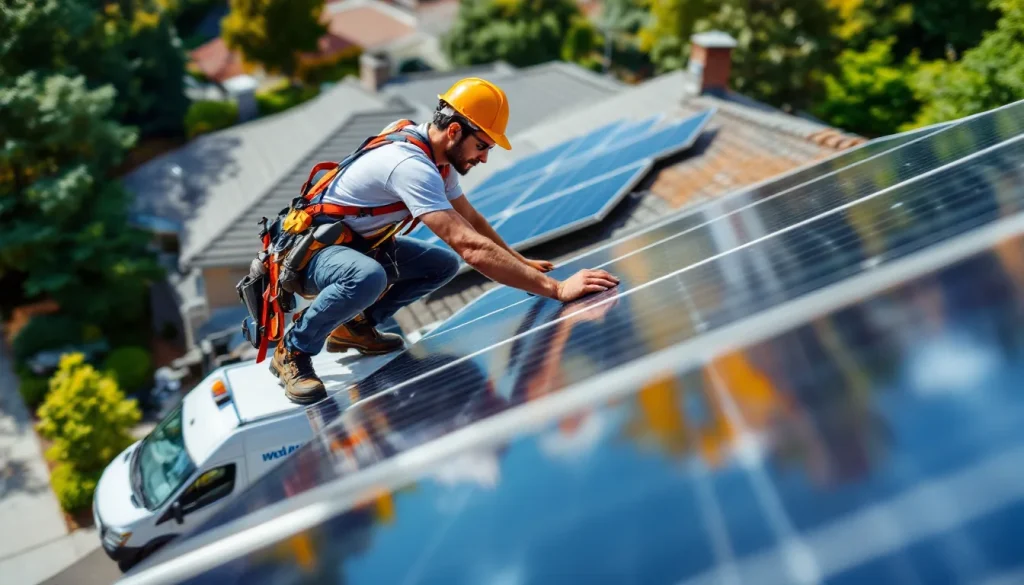
Finding the right solar system installer in 2026 means understanding that the residential solar market is divided into three distinct business models, and the company that knocks on your door, the company that quotes the system, and the company that actually puts panels on your roof may all be different entities. The national dealer-installers like Sunrun, Sunnova, and Trinity Solar use armies of 1099 sales reps to source customers and then route the actual install to subcontracted EPC (engineering, procurement, construction) crews. Regional installers like Freedom Forever, GreenHome Systems, and Ion Solar handle sales and install in-house within a defined geography. Local EPC-only specialists never knock on a door but show up at the end of a referral chain to install whatever the dealer sold. Each model has a different cost structure, a different warranty path, and a different probability that someone will answer the phone when a panel fails in year 11. This is the landscape.
The three business models
The national dealer-installer model is what most homeowners encounter first. Sunrun is the largest by installed base, with approximately 1 million customers under contract as of mid-2026 and a national footprint covering 22 states plus DC. Sunnova reorganized under Chapter 11 in 2025 and emerged with a leaner cost structure, refocused on solar-plus-storage in markets with high time-of-use rate spreads. Palmetto operates as a software-and-marketplace model that connects homeowners with vetted installers, taking a referral spread. Trinity Solar runs an integrated sales-and-install model in the Northeast corridor. Momentum Solar covers California, Texas, Florida, and the Northeast. ADT Solar (formerly Sunpro) was wound down by ADT in 2024, and the customer base was sold off to other installers in 2025.
Regional installers are the middle tier. Freedom Forever operates as a hybrid dealer and installer across roughly 25 states. GreenHome Systems works in the Southwest and Mountain West. Ion Solar runs in Utah, Idaho, Arizona, Nevada, and a handful of additional states. Suntuity covers the Mid-Atlantic and Florida. These companies typically have a defined service area where they handle the full sales-design-install cycle in-house, which means the install quality is correlated with the company brand rather than dispersed across subcontractors.
EPC-only specialists are the third model. These are the crews that show up to install when a dealer has sold the job. Most do not market directly to homeowners and instead operate as B2B installation partners for the dealer networks. A homeowner working with an EPC-only specialist usually arrives by referral from a roofer, an electrician, or a local energy advisor. The cost advantage of going direct to an EPC can be significant because the dealer markup and sales commission are stripped out. The downside is that the homeowner is responsible for the financing, the equipment selection, and the permit coordination that a dealer would normally handle.
What the EPC model actually means
EPC stands for engineering, procurement, construction. An EPC installer does the engineering on your specific roof (panel layout, structural review, electrical design), procures the equipment from distributors, and performs the construction. An EPC-only operator does not sell financing, does not run lead generation, and does not market directly to homeowners. They install for dealers, for residential energy companies, and for direct-to-consumer customers who have done their own homework.
The benefit of working with an EPC directly: you can usually shave 10 to 25 percent off the dealer price, because the dealer’s overhead (sales rep commission, marketing spend, financing markup) is stripped out. The cost: you handle the equipment decisions, the financing arrangement (cash, HELOC, solar loan from a credit union), the utility interconnection paperwork, and the federal tax credit filing. If you are comfortable with the homework, the EPC route saves real money. If you want a single point of contact for sales-to-service, the integrated regional installer is the better fit.
NABCEP and what certifications actually mean
The North American Board of Certified Energy Practitioners (NABCEP) is the residential solar industry’s primary certification body. The PV Installation Professional (PVIP) certification requires documented field experience plus an exam. The PV Installer Specialist is the lower-tier credential. The PV Design Specialist covers the design side rather than the install side. The PV Commissioning and Maintenance Specialist covers ongoing service.
When you ask whether an installer is NABCEP-certified, the right follow-up question is whether the lead installer on your specific project will be NABCEP-certified, not just whether the company has any certified employees on payroll. National dealers often advertise NABCEP certification on their corporate website while the actual installer crew may not include a NABCEP-certified lead. Insist on naming the lead installer in writing and verifying their certification through the NABCEP public database. Our detailed framework for vetting solar installers is in how to choose solar installer.
State licensing: the other gating credential
Every state with meaningful solar volume requires either a specific solar contractor license or a general electrical contractor license with solar endorsement. California requires a C-46 Solar Contractor license or a C-10 Electrical license (the C-10 covers systems below specific thresholds). Florida requires an Electrical Contractor (EC) or Electrical Class C (ECC) license, with a Solar Contractor license required for some installations. Arizona requires a CR-11 Solar/Wind license. Texas requires a licensed Master Electrician sign-off on the electrical work but does not have a separate solar license. New York requires an electrical contractor license issued at the municipality level (NYC is different from Buffalo is different from Albany).
Verify the license number on the state contractor license board database before signing anything. The license should be in the company name, not in an individual employee’s name. Look for active status, no suspensions, and no recent disciplinary actions. A 2-minute search on the state board website filters out a meaningful share of problem operators.
The financing structure trap
Most national dealer-installers in 2026 push three financing options: a cash purchase, a solar loan, or a Power Purchase Agreement (PPA) or lease. The cash purchase is the simplest. You pay the system cost up front, you own the system, you claim the 30 percent federal Investment Tax Credit on your tax return, and you receive all the production from the system. The math is straightforward and the ownership question is settled.
The solar loan is the next step. A 20-year solar loan at 6 to 9 percent typically structures around the assumption that the homeowner uses the 30 percent federal Investment Tax Credit (currently $5,000 to $9,000 on a typical residential system) as a year-one principal paydown. If the homeowner has insufficient federal tax liability to capture the full credit, the loan payment structure does not work as designed. Verify your federal tax liability and confirm with a tax professional before signing a solar loan structured around the ITC.
The PPA or lease is where the dealer-installer model makes most of its margin. The homeowner pays nothing up front and instead pays a monthly fee for the electricity the system produces, with annual escalators of 1.99 to 2.99 percent baked into the contract. Over 25 years, the escalators compound, and the dealer captures the federal tax credit, the SREC value, and any state-level incentives. The PPA can still make sense for homeowners with no federal tax liability or no cash to deploy, but the long-run economics favor the dealer. Our breakdown of the contract structure is in solar installation companies vetting.
What 2026 per-watt pricing actually looks like
Residential solar in 2026 ranges from $2.50 to $3.50 per watt installed before the federal Investment Tax Credit. A 7 kilowatt system (about 17 to 18 panels at 410W each) lands at $17,500 to $24,500 before incentives. After the 30 percent federal ITC, the same system runs $12,250 to $17,150. State incentives, utility rebates, and the SREC market in your state can drop the effective cost further. The detailed cost model is in solar installation cost 2026.
Pricing below $2.50 per watt usually means cut corners somewhere. The racking may be a discount steel system instead of name-brand IronRidge or Unirac. The inverter may be a string inverter with no panel-level monitoring instead of Enphase microinverters or SolarEdge optimizers. The workmanship warranty may be 1 year instead of 10 or 25. Pricing above $3.50 per watt usually means commission stacking. The dealer markup, the sales rep commission, and the financing finance charge are layered onto a base install cost that the EPC crew is delivering for $1.80 to $2.20 per watt.
Equipment selection: panels, inverters, and racking
The panel decision is covered in our piece on best solar panel brands. The short version: Q CELLS Q.PEAK DUO BLK is the volume default for good reason. REC Alpha Pure-R and SunPower Maxeon 6 are the premium options. Silfab Prime is the domestic-content option for the 10 percent ITC adder. Avoid Tier-2 cells from manufacturers with no US service presence.
The inverter decision is between microinverters and string inverters. Enphase IQ8 microinverters install one per panel and convert DC to AC at the panel. SolarEdge HD-Wave uses a centralized string inverter with per-panel DC optimizers. Both deliver panel-level monitoring. Microinverters handle shading and panel-level failure more gracefully. String inverters are slightly cheaper. Our detailed comparison is in microinverter vs string inverter.
Racking is the third equipment leg and the one most homeowners ignore. IronRidge, Unirac, and S-5! (for metal roofs) are the industry standards. The racking attaches the array to the roof and is the structural connection that has to last as long as the panels. Cheap racking that flexes in wind loads or corrodes in coastal salt air becomes a 10-year repair. For installations on metal roofs, the racking choice is different than asphalt and the breakdown is in solar panels on metal roof.
The 30 percent federal ITC math
The federal Investment Tax Credit for residential solar is set at 30 percent through 2032, stepping down to 26 percent in 2033, 22 percent in 2034, and then expiring for residential systems unless Congress renews it. The 30 percent credit applies to the system cost including panels, inverter, racking, labor, permitting, and sales tax. Battery storage paired with the solar system also qualifies for the 30 percent ITC if the battery is charged from the solar system rather than the grid.
The 10 percent domestic content adder brings the effective ITC to 40 percent on installations using qualifying US-made equipment. Silfab Prime panels, Crown Battery storage, and several US-assembled racking systems qualify. The detailed mechanics are in solar roof tax credit 2026. The credit is non-refundable, which means the homeowner needs enough federal tax liability to absorb it. Excess credit carries forward to subsequent tax years.
Warranty structure: panel, inverter, workmanship
A residential solar system in 2026 carries three warranty layers. The panel warranty from the manufacturer runs 25 years on product, with a separate 25-to-40-year performance warranty guaranteeing minimum production output (typically 86 to 92 percent at year 25). The inverter warranty runs 10 to 25 years depending on manufacturer (Enphase IQ8 is 25 years standard, SolarEdge is 12 years standard with 25-year extension available). The workmanship warranty from the installer covers labor on warranty repairs and ranges from 1 year (the dealer minimum) to 25 years (the integrated regional installer best practice).
The workmanship warranty is the warranty that matters most over time. Panel failures are rare and the manufacturer handles the panel cost. The labor to remove the failed panel, identify the replacement, and reinstall is the real cost, and that is what the workmanship warranty covers. A 1-year workmanship warranty leaves the homeowner with the labor bill for the next 24 years. A 25-year workmanship warranty matches the panel warranty term. Insist on the longer term and verify the installer has the company longevity to honor it.
Monitoring and post-installation support
Every solar system in 2026 should include panel-level monitoring through the Enphase Enlighten platform or the SolarEdge mySolarEdge platform. The homeowner sees production data per panel, alerts on panel-level failures, and historical performance trends. Most dealer-installers provide monitoring for the first year and then expect the homeowner to manage their own monitoring after that. The integrated regional installers typically include ongoing monitoring as part of a 10-or-25-year service contract.
The diagnostic question for any installer: who watches the production data after year one, and what is the protocol for alerting the homeowner when a panel underperforms. The right answer is that the installer’s service team monitors the system and contacts the homeowner when a panel-level alert fires. The wrong answer is that monitoring is the homeowner’s responsibility and the installer responds to service tickets when the homeowner submits one.
The 2026 net metering landscape
Net metering is the utility-side policy that determines how the homeowner is credited for excess solar production exported to the grid. California’s NEM 3.0 (now fully phased in for new installations as of 2024) reduced export rates significantly and pushed the economics toward solar-plus-storage rather than solar-only. Massachusetts, New York, New Jersey, and several other states maintain full retail net metering for now, but the policy direction across the country is toward reduced export credit and increased time-of-use rate structures. Our detailed coverage is in net metering explained 2026.
The right installer for your market knows the local utility’s net metering policy in detail and designs the system size to optimize against it. A system sized for full retail net metering may be over-built for a market with NEM 3.0 export rates. A system sized too small for a market with full retail net metering leaves money on the table. Local market knowledge separates a good installer from a national dealer pushing a one-size-fits-all package.
Solar plus storage: when batteries make sense
Adding battery storage to a solar system runs $10,000 to $20,000 installed for a Tesla Powerwall 3, Enphase IQ Battery 5P, or Franklin aPower 2. The battery makes economic sense in markets with NEM 3.0 export rates that disincentivize grid export, in markets with high time-of-use rate spreads where the homeowner can charge the battery on cheap off-peak power and discharge during peak hours, or for homeowners with backup power requirements where grid outages are routine.
The dealer-installer push toward solar-plus-storage in 2026 is partly economic (battery margin is higher than panel margin) and partly policy-driven (NEM 3.0 changed the math in California). If your installer is pushing storage in a market with full retail net metering and infrequent outages, the economics may not pencil. Run the math before signing.
Comparing companies on the same job
The right way to compare solar installers is to get three written quotes on the same system size, the same panel and inverter brand, the same warranty terms, and the same financing structure. Most homeowners get three quotes that differ on all four dimensions and then try to compare. The dealer who quoted a PPA with Q CELLS panels is not comparable to the EPC who quoted cash purchase with REC Alpha. Force the apples-to-apples by asking each installer to quote the same equipment and financing terms. Our deep dive on comparing the top installers is in solar install companies comparison and the quote-request framework is in solar system quotes.
Watching for the door-knocker scam
If a solar sales rep showed up at your door this month, you are talking to a 1099 dealer rep, not an installer. The door-knocker is incentivized to close the contract and move on. The follow-up work (design, permitting, install, service) lands on someone else. The dealer-installer model is not inherently fraudulent, but the high-pressure same-day-close sales tactics are correlated with PPA contracts that lock the homeowner into 20-25 year escalators. Take the meeting if you want, but do not sign on the first visit. Get two additional quotes before committing. Our piece on roofing scams covers the broader pattern of high-pressure sales tactics, and many of the same patterns apply to solar.
The installer-and-roof question
Your solar system installs on your roof, and the roof has to outlast the system or you are paying to detach and reset the array when the roof fails. If your roof is more than 10 years into its service life, replace it before going solar. Our broader coverage on roof-and-solar interaction is in our piece on the broader solar service category at solar panel installation services, and the types of solar systems available is covered in types of solar energy. Roof warranty implications of solar installation are addressed in solar roof warranty 2026.
The bottom line
The right solar system installer in 2026 is the company that designs for your specific roof and your specific utility’s net metering policy, holds state contractor licensing and NABCEP certification on the actual lead installer for your project, provides panel-level monitoring as a multi-year service rather than a year-one add-on, delivers a 10-to-25-year workmanship warranty matching the panel and inverter warranties, and prices the system between $2.50 and $3.50 per watt installed. Get three written quotes on matching specs. Verify the licensing and certifications. Read the financing contract before signing. Match the installer to your situation, whether that is a national dealer, a regional integrated installer, or a direct EPC engagement. The system is on your roof for 25 years. The installer relationship should be designed to last at least as long.