
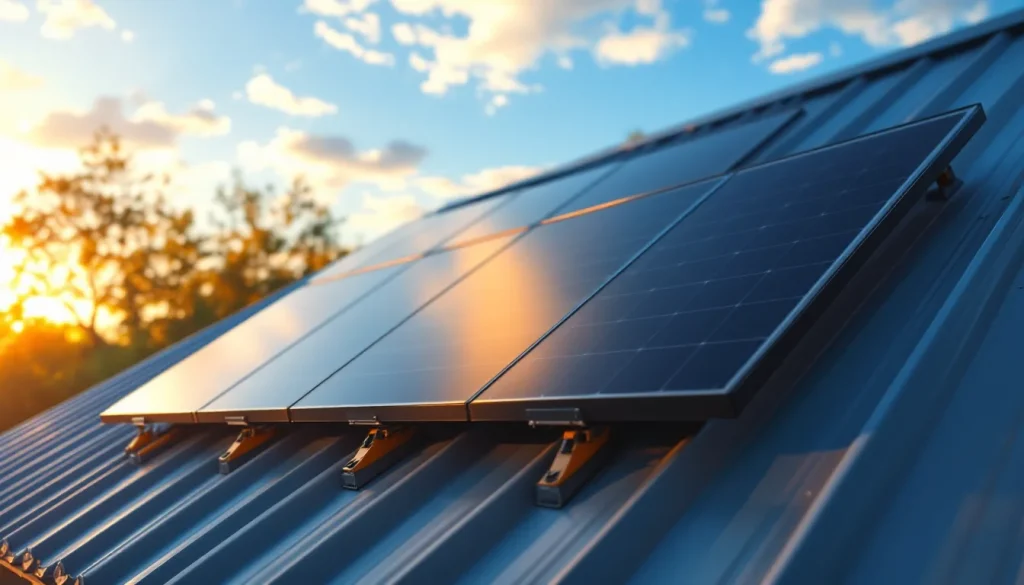
Installing solar panels on metal roof systems in 2026 costs $2.80 to $3.50 per watt installed (versus $2.50 to $3.20 for asphalt roofs), the 10 to 20 percent premium coming from S-5 clamp mounting hardware that attaches to standing seam ribs without any roof penetration. The mounting approach delivers two big advantages: no leak risk and the full 40 to 70 year metal roof lifespan stays intact. For a typical 8 kW residential system, that translates to $22,400 to $28,000 before the 30 percent federal Section 25D Investment Tax Credit, which drops the net cost to roughly $15,680 to $19,600. The metal roof itself outlives the panels by 20 to 40 years, meaning you will never have to remove and reinstall the array for a reroof, a hidden cost that quietly adds $3,000 to $7,000 to asphalt-roof solar over the system’s lifetime.
The short version
- Solar panels on a metal roof cost $2.80 to $3.50 per watt installed in 2026, a 10 to 20 percent premium over asphalt.
- S-5 clamps grip the standing seam ribs without penetrating the roof, so warranty and waterproofing stay intact.
- A typical 8 kW system runs $22,400 to $28,000 gross, $15,680 to $19,600 after the 30 percent federal tax credit.
- Metal roofs last 40 to 70 years versus 20 to 30 for panels, so you avoid the $3,000 to $7,000 panel-removal cost at reroof time.
- Standing seam is the gold standard for clamp mounting; corrugated and exposed-fastener panels require different brackets.
- Payback period is 9 to 14 years in most US markets, slightly faster than asphalt because of zero reroof-removal cost.
The short answer and the cost premium explained
The premium for solar on metal versus asphalt is not labor (it is actually faster to install on standing seam) but the mounting hardware itself. S-5 brand clamps run $18 to $32 each at distributor pricing, and a 20-panel array needs roughly 60 to 80 clamps depending on rail length. That hardware alone adds $1,200 to $2,500 to the project. The rest of the premium comes from slightly higher engineering fees (PE stamps need to confirm clamp spacing matches your specific seam profile) and the labor of bonding the racking to ground per NEC 690.43.
Asphalt installs use lag bolts driven through the deck into rafters, with flashing kits sold by IronRidge, Quick Mount PV, and Unirac at $8 to $14 per attachment point. The mounting itself is cheaper, but every penetration is a 25-year leak risk and a void point on most asphalt shingle warranties. On metal, you trade hardware cost for warranty certainty.
Why metal is the ideal solar substrate
Three things make metal the best solar host material. First, lifespan: standing seam systems carry 40 to 50 year paint warranties (Kynar 500 PVDF finishes) and 70+ year service lives. Crystalline silicon panels are warrantied to retain 80 to 85 percent of nameplate output at year 25, with most installers projecting 30 to 35 years of useful generation. The roof outlives the panels by a full generation, so you never face the reroof-with-panels-installed problem.
Second, fire rating: NRCA and most state codes recognize Class A fire ratings for steel and aluminum metal roofs, which simplifies permits in WUI (wildland-urban interface) zones in California, Oregon, Colorado, and Arizona. Third, thermal performance: a cool-pigment metal roof reflects 25 to 70 percent of solar radiation depending on color, which keeps the panels themselves cooler. Crystalline silicon loses roughly 0.3 to 0.5 percent of output per degree C above 25C, so a cooler mounting surface translates to 2 to 5 percent more annual generation in hot climates.
For the cost difference between roofing types, see our metal vs asphalt shingle roof comparison.
S-5 clamp mounting: no penetration, no leak risk
S-5 Metal Roof Innovations (based in Colorado Springs) makes the dominant clamp system used for solar on standing seam in North America. The clamps grip the vertical seam between two metal panels using set screws that bite into the seam material. Because the seam is folded metal (not a sealed joint), the clamp creates a mechanical bond with structural strength of 1,200 to 2,500 pounds per clamp depending on seam profile.
Critically, the clamp never touches the flat field of the panel. No screw, no sealant, no flashing. The waterproof envelope of the roof stays untouched. This matters for two reasons: the metal roof manufacturer’s leak warranty (typically 30 to 50 years) stays in force, and you avoid the slow drip failures that asphalt-mounted arrays develop at year 10 to 15 when neoprene flashing washers age out.
The major S-5 clamp models are the S-5-N (for nail-strip seams), the S-5-V (for vertical seams), the S-5-T (for trapezoidal seams), and the S-5-U (universal). Spacing is typically every 24 to 48 inches along the seam, and the engineering stamp confirms wind uplift compliance with ASCE 7-22.
Standing seam vs corrugated mounting approaches
Standing seam roofs are the gold standard for solar because the raised seams give clamps something to grip. Corrugated metal (also called R-panel or exposed-fastener metal) is a different animal. Corrugated panels have no raised seam, so you cannot use S-5 clamps. Instead, installers use specialty brackets like the S-5-PVKIT-2.0 attached at the panel’s high rib, or worse, lag bolts driven through the rib into purlins.
The lag-bolt-on-corrugated approach reintroduces the asphalt problem: you have created 60 to 80 sealed penetrations, each of which is a future leak. Butyl tape and EPDM washers buy 15 to 25 years of waterproofing, but they will eventually fail. If your roof is corrugated, the honest answer is that solar adds 8 to 12 percent on top of the standing seam premium because of the bracket selection and the increased engineering scrutiny.
For more on corrugated specifically, see our corrugated metal roofing guide. For standing seam pricing context, see standing seam metal roof cost.
Panel layout and orientation
Most residential metal roofs are pitched 4:12 to 9:12, which lands close to the optimal solar tilt for latitudes 30 to 45 (the bulk of the US population). Azimuth (the compass direction the panels face) matters more than tilt within reasonable ranges. Due south at 180 degrees is ideal in the Northern Hemisphere; 90 to 270 (east to west) is workable; anything north-facing should not be panelized.
Layout tools like Aurora Solar and HelioScope model shading from chimneys, vent stacks, and adjacent trees. On metal roofs, the seam spacing (typically 12, 16, or 18 inches on center) constrains panel positioning. Most 60-cell and 66-cell residential panels are 39 to 41 inches wide, which means they span 2 or 3 seams. The installer adjusts the rail layout to land clamps at integer seam multiples.
Roof age and warranty considerations
The cardinal rule: never install solar on a roof with less than 15 years of life remaining. Removing and reinstalling an 8 kW array runs $3,000 to $7,000 in 2026, and a reroof during the solar warranty window also voids most production guarantees from the installer.
For metal roofs, this almost never bites because lifespans are so long. A 10-year-old standing seam roof has 30 to 60 years remaining, which comfortably exceeds the 30-year panel projection. For older corrugated agricultural-style metal (which sometimes has 25 to 40 year lifespans), check the screw heads first: if the EPDM washers have crumbled and the screws have rust streaks, you need to reroof or rescrew the entire surface before paneling it.
For lifespan benchmarks across roofing types, see how long does a roof last.
Electrical run and inverter placement
The DC-to-AC conversion happens at either a string inverter (one big box on the side of the house) or microinverters (one small unit per panel, mounted under each panel). Microinverters from Enphase add $0.20 to $0.35 per watt to the system cost but improve performance under partial shading and simplify panel-level monitoring.
For metal roofs, the DC homerun from the array enters the attic via a flashed conduit penetration. Most installers cut a 1.5 to 2 inch hole at a roof valley or eave (low visibility), install an Oatey or QuickFlash all-flash boot, and route 10 AWG PV wire through the attic to the inverter. This is the only penetration in the entire install: one hole, one boot, sealed once.
Cost breakdown: solar on metal vs asphalt
| Line item | Asphalt roof (8 kW) | Metal roof (8 kW) | Difference |
|---|---|---|---|
| Panels (20 x 400W) | $5,600 | $5,600 | $0 |
| Microinverters (20 units) | $3,200 | $3,200 | $0 |
| Racking (IronRidge / S-5) | $1,400 | $2,800 | +$1,400 |
| Flashing / attachments | $640 | $0 | -$640 |
| Wire, conduit, BOS | $900 | $900 | $0 |
| Labor (3 days vs 2.5 days) | $3,600 | $3,200 | -$400 |
| Permit + engineering | $1,200 | $1,400 | +$200 |
| Interconnect + inspections | $800 | $800 | $0 |
| Installer margin (18%) | $3,840 | $4,275 | +$435 |
| Gross total | $21,180 | $22,175 | +$995 |
| Federal 30% Section 25D ITC | -$6,354 | -$6,653 | -$299 |
| Net cost | $14,826 | $15,523 | +$697 |
The headline-level $0.30 to $0.50 per watt premium narrows to under $1,000 on an 8 kW system once you account for the labor savings on metal (no shingle removal at each attachment point). On a 25-year horizon, the metal install wins by $2,000 to $6,000 because you skip the panel-removal-and-reinstall cost at the asphalt reroof event.
The federal Section 25D 30 percent solar tax credit
The Inflation Reduction Act of 2022 set the federal residential solar tax credit at 30 percent of total installed cost, locked in through 2032 (then stepping down to 26 percent in 2033 and 22 percent in 2034). The credit covers panels, inverters, racking, labor, permits, and any battery storage of 3 kWh or larger. There is no cap on the credit and no income phase-out.
The credit is non-refundable but carries forward indefinitely. If your federal tax liability in the install year is $4,000 and your credit is $6,653, you take $4,000 against this year’s taxes and carry $2,653 forward to next year. For most homeowners, a 6 to 8 kW system credit clears in 1 to 3 tax years. The credit is claimed on IRS Form 5695, line 6a (solar electric property).
Important: the credit is calculated on total project cost including the roof if (and only if) the roof and solar are functionally one system. Solar shingles qualify the whole roof for the credit. Conventional panels on a metal roof generally do not qualify the roof itself, only the solar equipment.
Payback period math by region
| Region | Net cost (8 kW) | Annual generation | Avg utility rate | Annual savings | Payback years |
|---|---|---|---|---|---|
| Phoenix, AZ | $15,523 | 14,200 kWh | $0.143/kWh | $2,031 | 7.6 yrs |
| San Diego, CA | $15,523 | 13,100 kWh | $0.382/kWh | $5,004 | 3.1 yrs |
| Austin, TX | $15,523 | 12,800 kWh | $0.146/kWh | $1,869 | 8.3 yrs |
| Denver, CO | $15,523 | 12,400 kWh | $0.142/kWh | $1,761 | 8.8 yrs |
| Boston, MA | $15,523 | 10,600 kWh | $0.298/kWh | $3,159 | 4.9 yrs |
| Atlanta, GA | $15,523 | 11,800 kWh | $0.139/kWh | $1,640 | 9.5 yrs |
| Seattle, WA | $15,523 | 8,900 kWh | $0.116/kWh | $1,032 | 15.0 yrs |
| Newark, NJ | $15,523 | 10,800 kWh | $0.187/kWh | $2,020 | 7.7 yrs |
Annual generation pulls from NREL’s PVWatts calculator (default loss factor 14 percent, tilt matching latitude). Utility rates are 2026 EIA residential averages. The fastest payback markets are high-rate California and Northeast states; the slowest are low-rate states with moderate sun (Washington, Oregon coast). Anywhere outside Seattle and Portland, a metal-mounted 8 kW array pays back within 10 years.
Choosing a solar installer: NABCEP and metal-specific experience
The North American Board of Certified Energy Practitioners (NABCEP) is the gold-standard credentialing body for residential solar. Look for a NABCEP PV Installation Professional (PVIP) certificate holder on the install crew, not just in the office. NABCEP certification requires 58 hours of advanced training, two years of field experience, and passing a rigorous exam.
Beyond NABCEP, ask three metal-specific questions before signing a contract. First, how many metal-roof installs has the company completed in the past 24 months (you want at least 15). Second, which S-5 clamp model they will use and why (the answer should reference your specific seam profile, not a generic SKU). Third, who stamps the engineering plans (you want a licensed PE in your state who has signed off on the S-5 spacing chart).
SEIA (Solar Energy Industries Association) maintains a member directory at seia.org that filters by state, system size, and certifications. For broader contractor vetting, see how to choose a roofing contractor, and for metal roof installation context, metal roof installation.
Annual generation by panel orientation on a metal roof
| Roof orientation | Tilt angle | Phoenix AZ (kWh/yr per 8 kW) | Chicago IL (kWh/yr per 8 kW) | Charlotte NC (kWh/yr per 8 kW) |
|---|---|---|---|---|
| Due south (180 deg) | 4:12 (18 deg) | 14,200 | 10,700 | 12,300 |
| Due south (180 deg) | 8:12 (33 deg) | 14,650 | 11,150 | 12,650 |
| Southwest (225 deg) | 6:12 (26 deg) | 13,750 | 10,400 | 11,900 |
| Southeast (135 deg) | 6:12 (26 deg) | 13,650 | 10,300 | 11,800 |
| Due west (270 deg) | 6:12 (26 deg) | 12,650 | 9,400 | 10,950 |
| Due east (90 deg) | 6:12 (26 deg) | 12,500 | 9,250 | 10,800 |
| Due north (0 deg) | 6:12 (26 deg) | 9,200 | 6,700 | 8,100 |
Numbers are NREL PVWatts modeled output for 8 kW DC arrays with a 14 percent loss factor. Most homes with a southerly main roof plane can achieve 95+ percent of optimum output simply by panelizing that plane. East-west bifacial layouts (panels on both east and west slopes) are common in California and generate near-south totals across the combined planes while spreading production across the morning and afternoon peak demand windows.
Hybrid: solar plus battery on metal roofs
| System config | Gross cost | Federal 30% credit | Net cost | Payback at $0.18/kWh |
|---|---|---|---|---|
| 8 kW solar only | $22,175 | -$6,653 | $15,523 | 7.2 yrs |
| 8 kW solar + Powerwall 3 (13.5 kWh) | $32,825 | -$9,848 | $22,977 | 9.8 yrs (incl outage value) |
| 10 kW solar + 2x Powerwall 3 (27 kWh) | $45,400 | -$13,620 | $31,780 | 11.5 yrs (incl outage value) |
| 12 kW solar + Tesla Powerwall 3 + EV charger | $38,900 | -$11,670 | $27,230 | 10.3 yrs (incl EV fuel offset) |
Battery additions of 3 kWh or larger qualify for the full 30 percent Section 25D credit, which materially closes the cost gap. In utility territories with time-of-use rates (most of California, parts of New York, much of Arizona), battery arbitrage from cheap overnight charging or peak solar storage to evening peak discharge adds $400 to $1,200 per year of incremental savings.
What to do if your roof has fewer than 15 years left
If your metal roof was installed before 2000 and shows seam corrosion, fastener back-out, or coating chalking, reroof first. A reroof with solar pre-design is cheaper than a reroof-then-solar sequence because you can specify seam profile, clamp spacing, and conduit penetrations during the metal install. Reroofing on standing seam runs $14 to $25 per square foot installed in 2026, with the upper end on Kynar-painted aluminum or zinc systems.
For an asphalt-to-metal conversion before solar, calculate the 30-year lifecycle cost including one reroof event for asphalt (year 22 to 25) versus zero for metal. The metal path is usually cheaper on lifecycle once solar is in the picture.
The asphalt-to-metal reroof premium is real (a 2,500 sq ft standing seam install runs $35,000 to $55,000 versus $12,000 to $18,000 for architectural asphalt) but the lifecycle math changes when you factor in zero panel-removal cost at year 25, longer paint warranties, and the cool-roof energy savings of 8 to 15 percent on summer cooling bills. NREL’s lifecycle modeling for metal-plus-solar shows positive net present value over asphalt-plus-solar at 22 to 28 years for most US climates.
NEC bonding and grounding on metal roofs
Solar on metal raises a wiring code question that does not exist on asphalt: how to bond the racking system to ground per NEC 690.43 and 690.45. The metal roof itself is conductive, and the panel frames and racking become an extension of the building’s electrical bonding system. Most installers use S-5 brand bonding washers or weeb (washer electrical equipment bond) lugs at every clamp to establish electrical continuity from the panel frames through the racking to the system ground.
The 2026 NEC update tightened requirements for equipotential bonding in PV systems and AHJ (authority having jurisdiction) inspectors increasingly want to see a single-line diagram showing every bond point. Pre-emptive labeling at the inverter and combiner box smooths the inspection. NABCEP-certified installers are trained on this; less experienced electricians sometimes fail the first inspection over bonding labeling gaps.
Snow load and panel mounting in cold climates
Metal roofs in heavy-snow regions (Vermont, New York, Michigan, Minnesota, Colorado high country) shed snow far better than asphalt, which is good for solar generation but creates a hazard: snow released from a high-clamp section can crash through a porch roof or onto a parked car below. Solar arrays interrupt that shedding pattern, so installers in snow country often spec snow guards (S-5 SnoFox or similar pad-style guards) above the array, below the array, or both.
Snow guards add $4 to $9 per linear foot of guarded eave. For an array sized to a 30-foot section of eave, that is $120 to $270 of incremental cost, plus engineering time to size guard spacing per load. The pad guards distribute snow release pressure across the roof rather than dumping it in one cascade.
Conduit run paths on metal roofs
The single conduit penetration from the array to the inverter is the only point where the metal roof’s weatherproof envelope gets breached. Best practice: locate the penetration at a low-visibility spot (north or back-side eave), drill through the deck between standing seams (never through a seam), install a Quick Flash or Oatey all-flash boot rated for the roof’s pitch, and seal with the manufacturer’s specified sealant.
The conduit runs through the attic to the inverter. EMT (electrical metallic tubing) is standard; flexible MC cable is acceptable in some jurisdictions but EMT is preferred because of the wire fill capacity and the cleaner cable management. The DC homerun typically carries 10 AWG PV wire for residential strings up to 8 kW; larger systems use 8 AWG.
For inverter placement, exterior wall mounting is most common because it simplifies the conduit run and keeps inverter heat outside the conditioned space. Garage interior mounting is acceptable in non-coastal climates where the inverter’s IP65 rating is sufficient. The disconnect switch between inverter and utility service panel is required by NEC and AHJ-inspected.
Frequently asked questions
Do solar panels void a metal roof warranty?
No, if installed with S-5 clamps or equivalent non-penetrating hardware. Every major metal roof manufacturer (McElroy Metal, Petersen Aluminum, ATAS, Englert, Drexel) has issued letters confirming that S-5 clamp installation does not void their material or paint warranties. Get the letter in writing from your specific manufacturer before signing the solar contract.
Can solar panels be installed on any metal roof, or only standing seam?
Standing seam is the easiest and cheapest. Corrugated (R-panel, AG panel) is possible but requires either specialty brackets or through-rib lag bolts, which adds 8 to 12 percent cost and reintroduces leak risk. Stone-coated steel and metal shingles are the hardest because they have no continuous seam to clamp.
How much does an 8 kW system cost on a metal roof in 2026?
$22,400 to $28,000 gross before incentives, or $15,680 to $19,600 net after the 30 percent federal Section 25D tax credit. State and utility incentives can drop the net 5 to 25 percent further depending on jurisdiction.
Will solar panels make a metal roof leak?
With S-5 clamps, no, because there are no roof penetrations. The only penetration is the conduit run from the array to the attic, which uses a single flashed boot. Asphalt installs have 60 to 100 penetrations and are statistically more likely to develop slow leaks at year 12 to 18.
Are solar panels heavier than the metal roof can support?
A 400W panel weighs 45 to 55 pounds. A 20-panel array adds 2 to 3 pounds per square foot of mounted area. Standing seam metal roofs are designed for 30 to 50 psf live loads. Solar adds well under 10 percent of design load. The PE engineering stamp confirms this for your specific structure.
Does the federal tax credit cover a new metal roof if I install solar?
Generally no for conventional rack-mounted panels. The Section 25D credit applies to the solar equipment and its installation, not the roof itself. The exception is integrated solar shingle systems where the roof and solar are functionally one product (Tesla Solar Roof, GAF Timberline Solar, CertainTeed Apollo II), which can qualify the integrated roof portion for the credit.
How long does the install take on a metal roof?
2 to 3 days for an 8 kW system, slightly faster than asphalt because clamps install faster than lag-and-flash. Day 1 is racking layout and clamp placement, day 2 is panel mounting and microinverter wiring, day 3 is conduit run, inverter hookup, and inspection prep.
Can I DIY solar on my metal roof?
Technically yes for the racking and panel install, but you will likely lose the 30 percent tax credit on labor and you cannot self-permit the electrical interconnect in most jurisdictions. DIY also voids most panel warranties (Enphase, REC, Q Cells require licensed installer registration). Net of lost credit and warranty risk, DIY rarely saves money.