
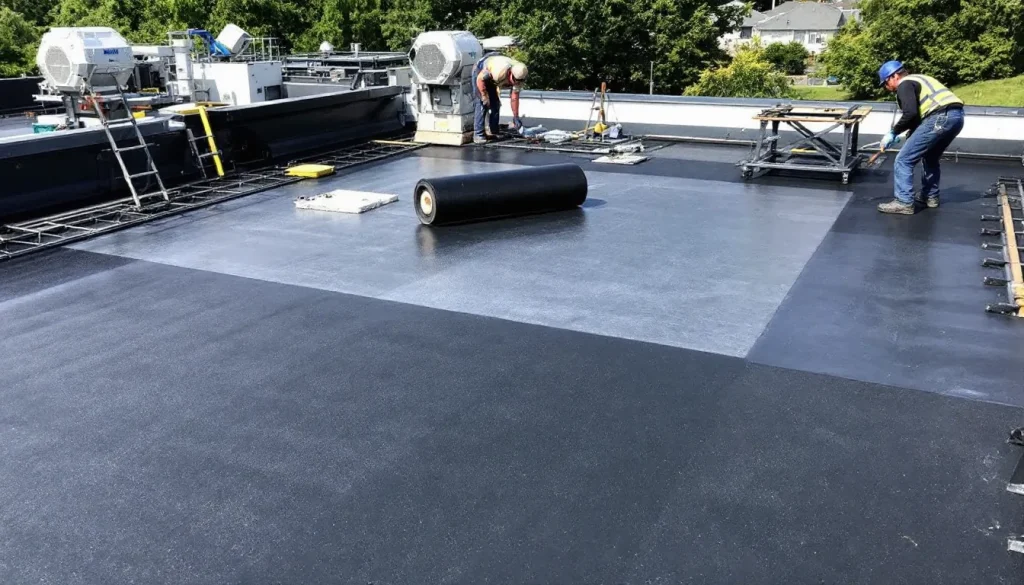
EPDM rubber membrane pricing in 2026 runs $5 to $10 per square foot installed for the vast majority of U.S. commercial flat roof projects, with the spread driven by mil thickness (45-mil, 60-mil, or 90-mil), attachment method (mechanically attached, fully adhered, or ballasted), insulation R-value, and the brand and warranty tier specified. A 20,000 sq ft warehouse with 45-mil mechanically attached EPDM over R-25 ISO and a basic 10 year material warranty might land at $5.50 per square foot. The same building with 90-mil fully adhered EPDM over R-30 ISO and a 30 year No Dollar Limit warranty might land at $11.50. Both are real bids from real authorized installers.
Last reviewed: August 2026.
EPDM (ethylene propylene diene monomer) is the oldest of the modern single-ply commercial membranes, with installs going back to the early 1970s. It is still the volume leader in some U.S. regions, especially the Northeast and Midwest, where the cold-weather performance and the long real-world track record matter more than the white-membrane reflectivity that drives TPO and PVC spec decisions in the Sun Belt. This guide breaks the 2026 cost by component so you can read an EPDM (see our TPO vs EPDM roofing comparison) bid and know exactly what the line items mean.
Mil thickness: the first lever on EPDM cost
EPDM membrane is sold in 45-mil, 60-mil, and 90-mil thicknesses, with 60-mil dominating new commercial work in 2026. The mil number is the membrane thickness in thousandths of an inch. Thicker rubber resists puncture, holds seam tape and adhesive better under thermal cycling, and qualifies for longer manufacturer warranty terms.
45-mil mechanically attached: $5 to $7 per square foot installed. The cost-floor spec for warehouse, light manufacturing, and budget-driven reroofs. The membrane is rolled out, fasteners and stress plates secure it through the cover board into the deck, and seams are joined with EPDM seam tape and primer. Warranty terms typically top out at 10 to 15 years material-only at this thickness. Not specified for high-wind zones or roofs with heavy foot traffic.
60-mil mechanically attached: $6 to $8 per square foot installed. The 2026 commercial standard for most warehouse, big-box, and light industrial work. The extra 15 mils of membrane buys meaningful puncture resistance, better seam performance, and a 20 year material warranty from most major brands. This is the spec you should expect to see on roughly 60% of mechanically attached EPDM bids in 2026.
90-mil mechanically attached: $7 to $10 per square foot installed. The puncture-resistance upgrade for roofs with heavy rooftop equipment service, frequent foot traffic, or hail exposure. The extra cost over 60-mil is modest, and the warranty term typically jumps from 20 years to 25 or 30 years from Carlisle, Holcim/Firestone, and Johns Manville on certified installs.
Fully adhered upgrade: add $1 to $2 per square foot regardless of mil thickness. The membrane is bonded to the cover board with bonding adhesive, eliminating the mechanical fastener pattern and substantially improving wind uplift performance (rated for 120+ mph). Slower install, more material cost, and longer warranty terms available. This is the spec for coastal Florida, the Gulf Coast, and any project where wind uplift is the governing design load.
Ballasted EPDM: $4 to $6 per square foot installed. The membrane is loose-laid over the cover board and held down by river rock or concrete pavers at roughly 10 to 15 lbs per square foot. Cheap, fast, but heavy. The building’s structural design has to support the ballast load, which is why ballasted is now almost exclusively a retrofit spec on older buildings designed for it. New commercial construction in 2026 rarely specifies ballasted because of the inspection difficulty and the cost of moving rock for any repair.
| EPDM system | Installed cost per sq ft | Typical warranty term |
|---|---|---|
| 45-mil mechanically attached | $5 to $7 | 10 to 15 years, material-only |
| 60-mil mechanically attached | $6 to $8 | 20 years |
| 90-mil mechanically attached | $7 to $10 | 25 to 30 years |
| Fully adhered upgrade | add $1 to $2 | Longer terms available |
| Ballasted EPDM | $4 to $6 | Varies by spec |
The choice between mechanically attached, fully adhered, and ballasted is not just a wind calculation. It is a leak-diagnosis question (each system leaks differently), a warranty question (NDL terms differ by attachment), and a recoverability question (overlay and recover work later in the building’s life is easier on fully adhered systems). See our flat roof materials comparison for how EPDM sits against TPO, PVC, and modified bitumen on each of these axes.
The major EPDM brands in 2026
EPDM is a consolidated market with five manufacturers dominating the U.S. spec sheets. The technical performance differences between them are small. The warranty terms, authorized installer networks, and pricing are where the real spec decisions get made.
Carlisle SynTec Sure-Seal: the volume leader in U.S. commercial EPDM and the most commonly specified brand in 2026. Sure-Seal is the 60-mil and 90-mil EPDM line, with FleeceBACK as the fleece-backed adhered variant. Carlisle’s authorized installer network is the largest in the industry, and the 30 year Golden Seal NDL warranty is the gold-standard spec on premium commercial work.
Holcim Elevate (formerly Firestone Building Products) RubberGard: the historic Firestone EPDM line, rebranded after the Firestone Building Products sale to Holcim closed in April 2022. The membrane and warranty structure are unchanged. RubberGard Platinum is the premium 90-mil tier with the 30 year Red Shield NDL warranty.
Versico VersiGard: wholly-owned subsidiary of Carlisle that operates as a separate brand with its own authorized installer network. VersiGard EPDM is the same membrane chemistry as Sure-Seal at the manufacturing level but priced slightly below in many markets. Useful when an authorized Versico installer is available and the Carlisle authorized installer pool is thin in the region.
Mule-Hide Products: distributed through ABC Supply and historically the EPDM brand of choice for smaller commercial and residential flat roof work. Strong distributor network through ABC means availability in tertiary markets where the larger brands have thin distribution. Warranty terms run shorter on the standard tiers but the value proposition holds up on smaller projects.
Johns Manville: the most technically conservative of the five, with a strong commercial spec presence and a deep history in the Northeast and Midwest. JM EPDM warranty terms are competitive with Carlisle and Holcim on the premium tiers, and the JM Peak Advantage system is the premium 90-mil NDL spec.
The pricing spread between brands on identical specs is typically $0.30 to $0.60 per square foot. The bigger driver of bid variation is the installer’s authorization status and the certification level. An installer who is a Carlisle Centurion or a Holcim Elevate Master Contractor will charge more than a non-certified installer but qualifies the project for the longer NDL warranty terms.
Insulation: R-value drives 15% to 25% of EPDM total cost
Polyisocyanurate (ISO) insulation sits between the deck and the cover board on virtually every modern EPDM install. The R-value spec determines both energy performance and cost, and ASHRAE 90.1 commercial energy code drives the spec floor.
R-25 ISO (about 4 inches): roughly $1.50 per square foot installed. The cost-floor spec, increasingly out of code in most U.S. climate zones for new construction but still common on reroofs in code-grandfathered jurisdictions.
R-30 ISO (about 5 inches): roughly $1.80 per square foot installed. The 2026 new-construction baseline in most of the country.
R-38 ISO (about 6.5 inches): roughly $2.30 per square foot installed. The spec for LEED-certified projects and northern climate zones (6, 7, 8) where the energy code minimums are higher.
Tapered ISO system: add 10% to 25% to insulation cost depending on slope complexity. Tapered insulation establishes positive drainage on otherwise flat decks and is required by code in many jurisdictions for new low-slope work. The complexity of crickets and saddles around drains drives the upper end of the cost band.
Cover board, fasteners, and accessories
Cover board sits between the ISO and the EPDM membrane and provides hail-impact resistance, foot-traffic protection, and a stable substrate for membrane adhesion. Gypsum cover board (Securock from USG, DensDeck from Georgia-Pacific) adds $0.50 to $0.80 per square foot and is the market-standard spec on commercial EPDM in 2026. High-density ISO cover board runs $0.40 to $0.65, and perlite board (older spec, increasingly rare) runs $0.30 to $0.50.
Mechanical attachment hardware (steel fasteners and stress plates) for mechanically attached EPDM runs $0.40 to $0.70 per square foot. Bonding adhesives for fully adhered systems add $0.70 to $1.20 per square foot. Seam tape, primer, and lap sealant typically add $0.20 to $0.40. Accessory components (walk pads, pipe boots, T-joint covers, edge metal, drain flashings) typically add $0.30 to $0.70.
The omission of cover board to cut bid cost is a common move that pays back badly. A bid that comes in $0.50 to $0.80 per square foot cheaper than the others should be checked for cover board omission. The savings on the bid will be paid back as hail damage repairs and reduced warranty in year 6 or 7.
Total cost breakdown: a typical 2026 EPDM install
Here is how a 2026 bid for a 30,000 sq ft warehouse reroof with 60-mil mechanically attached Carlisle Sure-Seal EPDM, R-30 ISO, Securock cover board, and a 20 year NDL warranty looks on the unit-price side:
Tear-off of existing roof: $1.20 per sq ft (gravel BUR tear-off runs higher at $2.00+; single-ply tear-off can be $0.80).
R-30 ISO insulation: $1.80 per sq ft.
Securock cover board: $0.65 per sq ft.
60-mil EPDM membrane: $1.20 per sq ft (material).
Fasteners, plates, seam tape, primer, lap sealant: $0.75 per sq ft.
Labor for membrane install: $1.90 per sq ft.
Accessory components (drains, flashings, edge metal, walk pads): $0.50 per sq ft.
Mobilization, dumpster, crane, overhead, profit: $0.70 per sq ft.
Total: about $8.70 per sq ft.
The same building with 90-mil fully adhered Sure-Seal and a 30 year Golden Seal NDL warranty might add $0.60 per square foot for the thicker membrane, $0.90 per square foot for adhesive plus additional labor, and roughly $0.25 per square foot for the longer warranty premium and additional manufacturer pre-install inspection requirements, putting total at about $10.45 per square foot. Compare that math to the cost calculus we work through in our 2026 commercial roof restoration cost guide, which covers the alternative path of restoring an aging EPDM roof with a silicone or acrylic coating instead of replacing it.
EPDM vs the alternatives: when each one wins
EPDM dominates in the Northeast and Midwest because of cold-weather performance and the long real-world track record on buildings now in year 30+ of service. The black membrane absorbs solar heat, which is a code-compliance issue in some Sun Belt cool-roof jurisdictions but a real benefit in cold-climate snow-shed performance.
TPO is the volume leader nationally in 2026 because the white membrane meets cool-roof code requirements in most Sun Belt jurisdictions and because the heat-welded seams are easier to QC than EPDM’s taped seams. PVC is the chemical-resistance spec for restaurants, labs, and food processing, where rooftop grease and chemistry would degrade EPDM and TPO. See our PVC roof cost installed guide for the PVC pricing breakdown and our TPO membrane pricing by mil guide for the TPO equivalent of this document.
The decision between EPDM, TPO, and PVC for a specific building is a function of climate zone, code requirements, rooftop chemistry exposure, owner hold-period, and the available pool of authorized installers in the market. The cost-floor on each membrane is similar enough that the spec decision should be driven by long-term performance, not by the bid difference. Our 2026 flat roof types overview walks through the decision framework.
What an EPDM contractor selection costs (or saves)
EPDM is a manufacturer-warranted system, and the NDL warranty only issues when the install is done by a contractor on the manufacturer’s authorized installer list. The certification process requires the contractor’s crew to complete manufacturer training, the project to be inspected by a manufacturer technical rep before, during, and after install, and the contractor to maintain authorized status through documented continuing education and clean project history.
Bids from non-authorized contractors can be $0.40 to $1.20 per square foot cheaper than authorized installer bids. They get there by skipping the manufacturer’s spec details that the authorization process verifies, often by using non-spec seam tape, omitting primer on dirty seam areas, or installing on cold-weather days when the adhesive cure window is compromised. The result is a roof that looks like an EPDM roof but has a contractor warranty rather than a manufacturer warranty. When the contractor is out of business in year 5 (and the failure rate on small commercial roofers is high enough to make this a real planning assumption), the building owner has no warranty recourse.
The questions to ask are the same as for any commercial roofing spec. Ask for the manufacturer authorization number and call the manufacturer to verify it is current. Ask for two recent NDL warranty projects with the manufacturer’s pre-install inspection report attached. Ask which seam tape system the contractor uses (Carlisle FAST, Holcim QuickSeam, or competitive equivalent) and whether they primer every seam. The contractors who pass these checks are the ones whose installs are still serving the building in year 25 and 30. The contractors who do not pass are the ones whose roofs become the next reroof bid in year 8.
Where EPDM pricing is headed in 2026 and 2027
EPDM raw material costs (ethylene propylene diene monomer) tracked broader petrochemical pricing in 2024 and 2025 and stabilized in early 2026 after a multi-year run of input cost inflation. Most manufacturers held 2026 list prices flat or with single-digit increases over 2025, which is the first year of relative price stability since the post-COVID supply shock.
The longer-term trend that matters more for total installed cost is labor. The roofing labor pool in most U.S. metros is tight in 2026, and authorized installer crews are charging premium labor rates because the manufacturer training and certification creates a meaningful skill barrier. Expect installed costs to drift up 3% to 5% annually for the next several years on labor alone, regardless of what raw material pricing does.
For a building owner planning a reroof in the next 12 to 24 months, the EPDM cost picture is stable enough to budget against today’s numbers. For a building owner trying to defer a reroof decision past 2027, the deferred capex math is going to look worse by then because of the labor inflation, not because of the membrane material cost. The full long-term cost framework is in our 2026 Roofing Cost Report, which models reroof economics across all the major commercial membrane systems and includes the deferred-replacement penalty calculation. Pair that with our commercial roof replacement cost overview for the broader replacement framework that applies regardless of membrane type.
EPDM roofing cost: frequently asked questions
How much does EPDM roofing cost per square foot in 2026?
EPDM runs $5 to $10 per square foot installed for most U.S. commercial flat roof projects in 2026. The spread is driven by mil thickness, attachment method, insulation R-value, and warranty tier. A 45-mil mechanically attached job over R-25 ISO can land near $5.50, while 90-mil fully adhered over R-30 with a 30 year No Dollar Limit warranty can reach $11.50.
What is the difference between mechanically attached, fully adhered, and ballasted EPDM?
Mechanically attached EPDM is fastened through the cover board into the deck and is the 2026 commercial standard. Fully adhered bonds the membrane with adhesive, adding $1 to $2 per square foot and improving wind uplift to 120+ mph. Ballasted EPDM is loose-laid under river rock or pavers at $4 to $6 per square foot but needs a structure designed for the added weight.
Which EPDM mil thickness should I choose?
60-mil dominates new commercial work in 2026 at $6 to $8 per square foot and carries a 20 year material warranty. 45-mil at $5 to $7 is the budget floor with 10 to 15 year terms. 90-mil at $7 to $10 adds puncture resistance for heavy foot traffic or hail exposure and can qualify for 25 to 30 year warranty terms.
Why does an authorized installer cost more?
The manufacturer NDL warranty only issues when a contractor on the authorized installer list does the work, with a manufacturer rep inspecting before, during, and after install. Non-authorized bids can be $0.40 to $1.20 per square foot cheaper but carry only a contractor warranty, which disappears if that contractor goes out of business in year 5.
Which EPDM brand is most commonly specified?
Carlisle SynTec Sure-Seal is the volume leader in U.S. commercial EPDM in 2026, with the largest authorized installer network and the 30 year Golden Seal NDL warranty. Holcim Elevate RubberGard, Versico VersiGard, Mule-Hide, and Johns Manville round out the five major brands, with pricing on identical specs varying about $0.30 to $0.60 per square foot.