
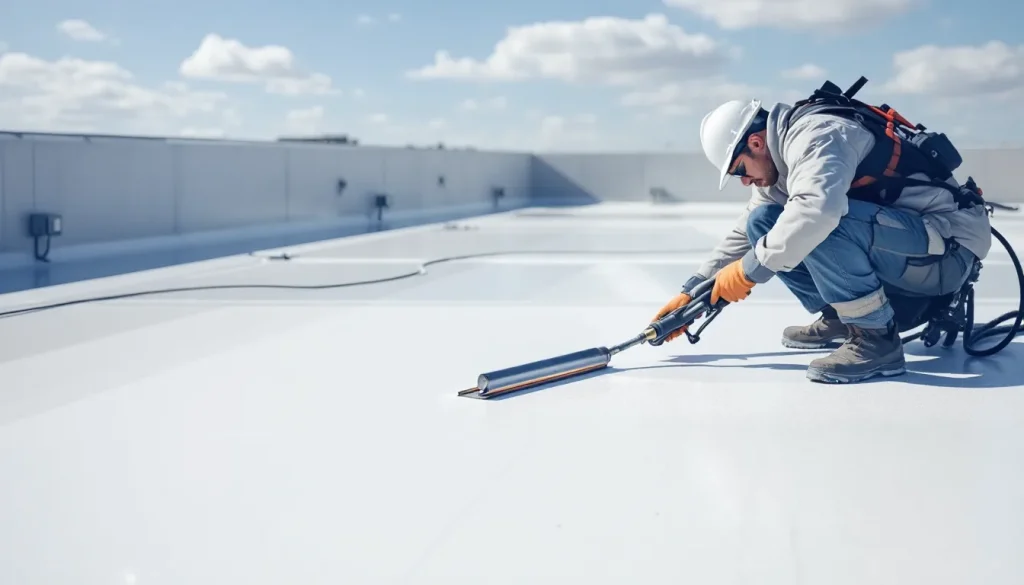
The five common flat roof materials in 2026 are TPO ($7 to $12 per square foot installed, 20 to 30 year life), EPDM ($5 to $9, 25 to 30 year life), PVC (see our TPO vs. PVC head-to-head guide) ($9 to $15, 25 to 30 year life), modified bitumen ($6 to $11, 15 to 25 year life), and built up roofing or BUR ($5 to $10, 20 to 30 year life). The lifespan numbers are not marketing claims, they come from NRCA field studies and manufacturer warranty data. Real world failures concentrate in three areas across all five materials: ponding water (the single largest cause of premature failure), seam degradation (welds on TPO and PVC, tape on EPDM), and detail flashing failures at penetrations and walls. This guide is the by the numbers comparison: cost, lifespan, install method, warranty traps, repair difficulty, and where each material wins or loses in the field.
The short version
- TPO and PVC use heat welded seams that outlast the field membrane when welded right and fail fast when welded wrong. Probe every seam.
- EPDM uses cured tape seams that need clean dry primed surface and proper roller pressure. The 1990s era taped EPDM roofs are why people remember EPDM as a leaker. Modern tape is dramatically better.
- Modified bitumen and BUR are asphalt systems with redundant ply construction. A single ply puncture does not leak immediately, which is why these systems persist in heavy traffic applications.
- Ponding water is excluded on essentially every major manufacturer warranty. GAF, Carlisle, Firestone, Sika, Versico, Johns Manville, Mule Hide all carve it out.
- Membrane thickness matters more than brand. 80 mil TPO from any major maker outperforms 45 mil TPO from any maker by 5 to 10 years.
- Real warranty value lives in the exclusions, not the headline term. A 30 year warranty with ponding exclusion on a ponding roof is functionally a 0 year warranty.
Short answer: cost, lifespan, and real failure data
The cost ranges quoted above are 2026 installed cost per square foot including tear off of existing roofing, new insulation to current code minimum (typically R 25 to R 30 polyiso), membrane (see our low-slope roof systems overview), fasteners or adhesive, perimeter and penetration flashing, and disposal. They assume a typical 10,000 to 50,000 square foot commercial roof in a standard labor market. Smaller jobs run higher per square foot. Coastal high wind specs and complex roofs with many penetrations run higher. Simple square roofs over wood deck on residential additions run lower.
The lifespan (for the full data set, see our the 2026 Roofing Material Lifespan Report) numbers are the published service life ranges from NRCA member surveys combined with major manufacturer warranty data. The bottom of each range is the warranty term most often offered as a baseline. The top of each range is what the membrane delivers in benign conditions with maintenance. The fail point for each material is what we cover in detail below.
Cost per square foot, side by side
| Material | Membrane only | Installed (tear off + insulation + membrane) | 20 yr cost per sq ft per year |
|---|---|---|---|
| TPO 60 mil | $0.70 to $1.40 | $7 to $12 | $0.35 to $0.60 |
| EPDM 60 mil | $0.60 to $1.20 | $5 to $9 | $0.25 to $0.45 |
| PVC 60 mil | $1.30 to $2.50 | $9 to $15 | $0.45 to $0.75 |
| Modified bitumen 2 ply | $0.80 to $1.60 | $6 to $11 | $0.40 to $0.73 |
| Built up roofing 4 ply with gravel | $1.00 to $2.20 | $5 to $10 | $0.25 to $0.50 |
The 20 year normalized cost is the better comparison because it accounts for lifespan. A roof that costs more upfront but lasts longer can have a lower annual cost. EPDM and BUR tie for lowest normalized cost. PVC is most expensive even on a normalized basis but earns it in the conditions where chemical resistance matters. For a deeper teardown of replacement pricing, see flat roof replacement cost.
Real world failure data by material
NRCA tracks membrane (see our PVC roof cost installed) failure modes through member contractor reports and manufacturer claim data. The patterns are consistent across the 2016 to 2025 reporting period. Failures concentrate in predictable spots.
| Material | Most common failure | Second most common | Avg years to first claim |
|---|---|---|---|
| TPO 45 mil | Seam separation at welds | Surface cracking from UV after 12 to 15 years | 8 to 12 years |
| TPO 60 mil | Seam separation at welds | Penetration flashing failure | 12 to 18 years |
| EPDM | Seam tape separation at field laps | Shrinkage tearing at wall flashing | 15 to 22 years |
| PVC | Plasticizer migration on older formulations (pre 2010) | Seam shrinkage at terminations | 18 to 25 years |
| Modified bitumen | Cap sheet UV degradation and granule loss | Lap seam failure | 12 to 18 years |
| BUR 4 ply | Gravel displacement and surface erosion | Flashing failure at penetrations | 15 to 25 years |
The pattern across all materials is that detail flashing fails before field membrane. This is true for every roof, every material (see our EPDM rubber membrane pricing), every climate. The reason is that field membrane gets the design attention and warranty coverage. Detail flashing gets whoever the contractor sent to wrap the curb. Train the crew on flashing or you will pay for it at year 10.
TPO field performance and brand differences
TPO is the volume leader and the brand competition is the most active. Carlisle SynTec Sure Weld is the long time market leader by share. GAF EverGuard TPO has grown share through aggressive distribution. Versico VersiWeld (the Carlisle owned alternative brand) is the cost competitive Carlisle product. Firestone UltraPly TPO (now under Holcim) has strong industrial distribution. Johns Manville TPO and Mule Hide TPO round out the major players.
The brand differences matter less than the thickness and warranty term you specify. A 60 mil Carlisle Sure Weld, a 60 mil GAF EverGuard, a 60 mil Versico VersiWeld, and a 60 mil Johns Manville all perform within a year or two of each other in field conditions. What separates them is warranty coverage, contractor network, and parts availability for accessory items.
Where TPO fails in the field. Seam separation is the dominant mode. Welds run cold (under 1,000 degrees Fahrenheit at the seam interface) and the seam never fully fuses. Two to five years later the seam pulls apart. The fix is to probe every seam at install with a screwdriver or seam probe. A properly welded seam will not separate under blade pressure. A cold weld will pop open.
Surface cracking after 12 to 15 years is the second failure mode, especially on 45 mil TPO in southern climates. UV exposure plus thermal cycling eventually breaks down the polymer surface. The fix is to spec 60 mil minimum and consider 80 mil in extreme sun zones. The 80 mil sheet costs 25 to 35 percent more but delivers 5 to 10 years more service life. For the TPO vs EPDM comparison, see TPO vs EPDM roofing.
EPDM field performance and the tape seam evolution
EPDM is the oldest single ply system in continuous use, dating to 1960s installations that are still on roofs today. Field data on long term EPDM performance is excellent. The challenge with EPDM has always been seams.
Pre 1995 EPDM used uncured butyl tape and field applied seam adhesives. These seams failed within 8 to 15 years on most installations. The legacy of those failures is why some property managers still associate EPDM with leaks. From 1995 to 2005 the industry transitioned to factory cured seam tape with higher peel strength. From 2005 forward the tape technology is dramatically better, and properly installed 2026 EPDM seams routinely outlast the field membrane.
The major EPDM brands are Carlisle SynTec Sure Seal, Firestone (Holcim) RubberGard, Versico VersiGard, Johns Manville EPDM, and Mule Hide EPDM. All use similar cured EDPM polymer and similar factory cured tape technology. Brand differences are smaller than on TPO.
Where EPDM fails. Seam tape separation at field laps is the dominant mode, almost always tied to install sloppiness rather than tape failure. The tape requires clean dry surface, proper primer activation, and roller pressure across the full seam. Skip any of those steps and the seam will fail at year 10 to 15. The fix is contractor selection and seam inspection at install.
Shrinkage tearing at wall flashing is the second failure mode. EPDM is a thermoset rubber that shrinks slightly over decades. On a wall flashing that was installed tight to the parapet, that shrinkage can pull the flashing away from the wall over 15 to 25 years. The fix is proper flashing detail with slack in the membrane at the wall transition, which the manufacturer details show. See parapet wall roofing detail.
PVC field performance and chemical resistance
PVC has the strongest chemical resistance of any single ply membrane. Grease, animal fats, plant oils, and many industrial chemicals slide off PVC without degrading it. This is why every restaurant, hospital cafeteria, food processing plant, and chemical plant in 2026 specifies PVC over kitchen exhaust hoods and chemical exhaust stacks.
Sika Sarnafil has been the global PVC leader for decades and has the longest field track record. Carlisle Sure Flex is the Carlisle PVC offering. IB Roof Systems is the regional player with strong west coast presence. Duro Last is unique because it prefabricates the membrane to roof dimensions in the factory, with 80 percent of seams welded in controlled conditions before shipment.
Where PVC fails. Older PVC (pre 2010) used plasticizers that migrated out of the polymer over decades, leaving membranes brittle and prone to surface cracking. Modern PVC formulations have largely solved this, but you may see it on older roofs. Seam shrinkage at terminations is the second mode, similar to EPDM. The fix on both fronts is modern PVC product and proper detailing.
Where PVC wins. Long term chemical resistance is unmatched. A PVC roof over a busy commercial kitchen will deliver 25 plus years where TPO or EPDM would fail in 5 to 10 years. The cost premium ($9 to $15 per square foot versus $7 to $12 for TPO) pays back through deferred replacement.
Modified bitumen field performance
Modified bitumen is asphalt with SBS or APP polymer modifiers added for flexibility and temperature performance. Two ply application (base sheet plus mineral surface cap sheet) is standard. Three ply systems exist for higher warranty coverage. The system has redundant construction by design, meaning a single ply puncture does not leak immediately.
The major brands are Soprema (the global leader with Sopralast and Sopralene brands), IKO (Cambridge and Modified Bitumen Membrane), CertainTeed Flintastic, Henry HE925 series, Polyglass Polyflex, GAF Liberty (the self adhered residential favorite), and Johns Manville Dynaweld. Soprema and Henry compete for the high end commercial spec. GAF Liberty dominates the small residential flat roof category.
Install methods include torch down (open flame heating the back of the roll), cold adhered (asphalt adhesive), self adhered (factory applied PSA), and hot mopped (over hot asphalt). Self adhered is the safest for occupied buildings or wood decks. Torch down delivers the strongest bond but carries real fire risk. NRCA reports an average of one major torch fire incident per 2,000 commercial mod bit installs.
Where modified bitumen fails. Cap sheet UV degradation and granule loss after 12 to 18 years is the dominant mode. The granules protect the asphalt underneath from UV. When granules wash off (storms, foot traffic, weathering), the asphalt UV degrades rapidly. The fix is recovery with a new cap sheet or coating with elastomeric or silicone. See flat roof coating restoration for the coating path. For the broader system, see modified bitumen roof.
BUR field performance and why it persists
Built up roofing predates every other system on this list. The first commercial BUR installations date to the 1860s. Modern BUR is multi ply asphalt saturated felts mopped together with hot asphalt or coal tar pitch, surfaced with gravel for UV protection. Three to five ply construction is standard.
Why BUR persists in 2026. Three reasons. First, the gravel surface tolerates foot traffic and rooftop equipment service better than any single ply. Second, the redundant ply construction means a single ply puncture does not immediately leak, which is valuable on heavy traffic roofs. Third, government specs and historic building requirements often dictate BUR specifically.
The remaining BUR producers in 2026 are GAF, Johns Manville, Soprema, and IKO. All offer code compliant felt and asphalt systems. Most BUR replacement work today goes to modified bitumen rather than another BUR, but new BUR install volume persists in cold storage, refrigerated facilities, and historic preservation.
Where BUR fails. Gravel displacement and surface erosion expose the asphalt underneath to UV. After 15 to 25 years the surface plies degrade and need replacement. The fix is gravel replacement and coating, or full recover with modified bitumen, or tear off and new system. Heavy install weight (4 to 5 pounds per square foot) is the other limitation, especially on older buildings with marginal structural capacity.
Repair difficulty: who can fix it when it leaks
| Material | Repair difficulty | Who can repair | Typical small leak repair cost |
|---|---|---|---|
| TPO | Moderate, needs hot air welder | Trained commercial roofers | $300 to $1,200 |
| EPDM | Easy, peel and stick or seam tape patches | Most commercial roofers, some residential | $250 to $900 |
| PVC | Moderate, needs hot air welder, matching membrane increasingly hard to source | Sika or PVC certified roofers | $400 to $1,500 |
| Modified bitumen | Easy, torch or cold adhered patch | Almost any roofer | $300 to $1,100 |
| BUR | Moderate, needs hot asphalt or modified bitumen patch | Specialty commercial roofers | $400 to $1,400 |
EPDM and modified bitumen are the easiest materials to repair, which matters on roofs where leaks need quick attention from whoever you can get on a truck. TPO and PVC require welding equipment, which limits the contractor pool. PVC repairs are increasingly hard because matching membrane color and formulation gets harder on older roofs as manufacturers update product lines. For broader repair pricing, see flat roof repair cost and roof leak repair.
Warranty: the headline number vs the exclusions
Flat roof warranties run 10 to 30 years depending on material, thickness, and whether the warranty covers materials only or full system (materials, labor, and accessories). The headline number is what shows up in marketing. The exclusions are where the real value lives or dies.
| Common warranty term | What it usually covers | What is usually excluded |
|---|---|---|
| 10 year material only | Membrane sheet manufacturing defects | Ponding, traffic damage, labor, accessories, wind above 55 mph |
| 15 year full system | Materials, labor, accessories, normal weathering | Ponding, owner damage, wind above 75 mph, modifications |
| 20 year NDL (no dollar limit) | Full system to the warranty terms | Ponding, neglect, owner damage, wind above 90 mph |
| 30 year premium | Full system, often with wind coverage upgrade | Ponding, neglect, owner damage |
Ponding water is the single most important exclusion because it shows up on almost every commercial flat roof and is the most common reason for warranty claim denial. GAF, Carlisle SynTec, Firestone (Holcim), Sika Sarnafil, Versico, Johns Manville, and Mule Hide all exclude ponding. Some carriers offer a ponding water waiver upgrade for $0.04 to $0.08 per square foot added to the system cost. If your roof has any history of ponding, this waiver is almost always worth buying. See ponding water flat roof for the full ponding treatment.
Cool roof and energy performance
Cool roof credentials matter for commercial flat roofs in cooling dominant climates and for any project chasing LEED, Title 24 (California), or ENERGY STAR certification. The metric is solar reflectance index (SRI) under ASTM E1980.
| Material and color | SRI (initial) | SRI (3 year aged) | Cool roof qualified |
|---|---|---|---|
| White TPO | 78 to 86 | 64 to 72 | Yes |
| White PVC | 80 to 88 | 68 to 76 | Yes |
| Tan or gray TPO | 50 to 65 | 40 to 55 | Marginal |
| Black EPDM | 10 to 18 | 8 to 15 | No |
| Mineral surfaced modified bitumen | 20 to 35 | 15 to 28 | Most no, some white granule yes |
| Gravel surfaced BUR | 15 to 25 | 12 to 22 | No |
White TPO and white PVC are the only flat roof materials that consistently qualify as cool roofs. Reflective coatings can convert any flat roof to cool roof performance, but only the membrane manufacturers can pre certify the SRI rating. For a roof in Phoenix, Houston, or Miami, this matters for cooling cost (15 to 25 percent HVAC savings versus black EPDM) and for code compliance under local cool roof ordinances.
Climate matchup matrix
| Climate | Best material | Why |
|---|---|---|
| Hot dry (Phoenix, Tucson, Las Vegas) | White TPO 80 mil or white PVC | Cool roof savings, UV resistance, thermal cycling |
| Hot humid (Houston, New Orleans, Miami) | White TPO 60 mil or white PVC | Cool roof savings, chemical resistance for industrial |
| Cold (Chicago, Minneapolis, Denver) | EPDM 60 mil or 90 mil | Cold flexibility to -40F, heating dominant climate |
| Mixed (Atlanta, Memphis, St Louis) | TPO 60 mil or EPDM 60 mil | Either works, choose by primary energy load |
| Coastal hurricane (Florida, Texas Gulf) | TPO 80 mil mechanically attached, FM 4470 spec | Wind uplift to Class 150 or 180 |
| Restaurant or food service anywhere | PVC | Grease and animal fat resistance, mandatory near exhaust |
| Historic preservation | BUR or modified bitumen | Matches existing assembly, code grandfathered |
Total cost of ownership over 30 years
The headline cost per square foot tells you the install bill. The total cost of ownership tells you what the roof actually costs over its life. A 50,000 square foot commercial roof modeled over 30 years.
| Material | Install cost | Replace at year | 30 year total (install + maintenance + replace) |
|---|---|---|---|
| TPO 60 mil | $350,000 to $600,000 | 22 to 25 | $520,000 to $920,000 |
| TPO 80 mil | $450,000 to $750,000 | 27 to 30 | $480,000 to $780,000 |
| EPDM 60 mil | $250,000 to $450,000 | 25 to 30 | $280,000 to $500,000 |
| PVC 60 mil | $450,000 to $750,000 | 25 to 30 | $510,000 to $830,000 |
| Modified bitumen | $300,000 to $550,000 | 18 to 22 | $510,000 to $900,000 |
| BUR with gravel | $250,000 to $500,000 | 25 to 30 | $320,000 to $600,000 |
EPDM 60 mil is the lowest total cost over 30 years. TPO 80 mil pulls close on heat reflective savings. PVC costs the most but earns it in chemical resistance applications. Modified bitumen looks competitive on install but the shorter lifespan pushes total cost up. BUR delivers strong value if you can tolerate the heavy weight and the slow install schedule.
What the roofers actually install in 2026
The market share split among NRCA reporting contractors for 2024 to 2026 new commercial flat roof installs: TPO 58 percent, EPDM 18 percent, modified bitumen 10 percent, PVC 9 percent, BUR 3 percent, all others (liquid applied, single ply blends) 2 percent. The TPO dominance is real and growing. The PVC share is concentrated in food service and chemical applications. BUR is fading except in cold storage and historic preservation.
For residential flat roof work, the mix flips. EPDM and modified bitumen dominate residential because they install with hand tools rather than welders. TPO residential share is growing but is still under 15 percent of residential flat work. PVC residential is rare. For the residential angle, see residential flat roof guide.
FAQ
FAQs
Which flat roof material is most reliable?
EPDM has the longest field track record (60 plus years) and the most consistent service life when properly installed. TPO and PVC both deliver similar lifespans but with shorter real world history. Modified bitumen and BUR are reliable when installed by competent crews but more variable in field performance.
How do I compare warranties between manufacturers?
Read the actual warranty document, not the marketing brochure. Compare four things: term length, coverage type (material only vs full system), wind speed cap, and ponding language. A 30 year material only warranty with ponding exclusion is functionally weaker than a 20 year full system warranty with ponding waiver.
Is membrane thickness more important than brand?
Yes. Going from 45 mil to 60 mil on any major brand delivers more service life improvement than switching brands at the same thickness. The 80 mil step is even more impactful in extreme climates and high traffic applications.
Can I install a flat roof over my existing flat roof?
IBC allows recover up to two total layers. If you already have an original roof plus one recover, your next replacement must be full tear off. Always run a moisture survey before recover to verify the existing insulation is dry. Wet insulation under a recover destroys both layers.
What is the cheapest reliable flat roof material?
EPDM 60 mil at $5 to $9 per square foot installed delivers the lowest cost per year of service life. BUR 4 ply can match it but install labor availability is shrinking. Modified bitumen self adhered is the residential value pick.
Does a flat roof leak more than a sloped roof?
A properly installed flat roof with proper drainage does not leak more than a sloped roof. The leaks happen when slope is inadequate (under 1/4 inch per foot), when drains are clogged or undersized, or when flashing details at penetrations and walls are poorly executed. Material choice matters less than detail execution and drainage design. See flat roof drainage design.
Bottom line
Compare flat roof materials on cost per square foot, service life, install method, warranty exclusions, and climate fit. EPDM 60 mil is the value leader. TPO 60 mil or 80 mil is the volume choice for new commercial. PVC is mandatory for restaurants and food service. Modified bitumen and BUR are legacy systems that still make sense in specific applications. The membrane is only half the equation. Insulation thickness, slope adequacy, drain count, and flashing detail execution determine whether your chosen material delivers its rated service life or fails at year 10. For replacement pricing in detail, see flat roof replacement cost. For the system you build it on, see flat roof drainage design. For the residential variant, see residential flat roof guide.
Related reading: all roofing guides | flat roof types 2026 | TPO vs EPDM roofing | modified bitumen roof | ponding water flat roof | commercial flat roof overview | TPO roof installation cost | elastomeric roof coating