
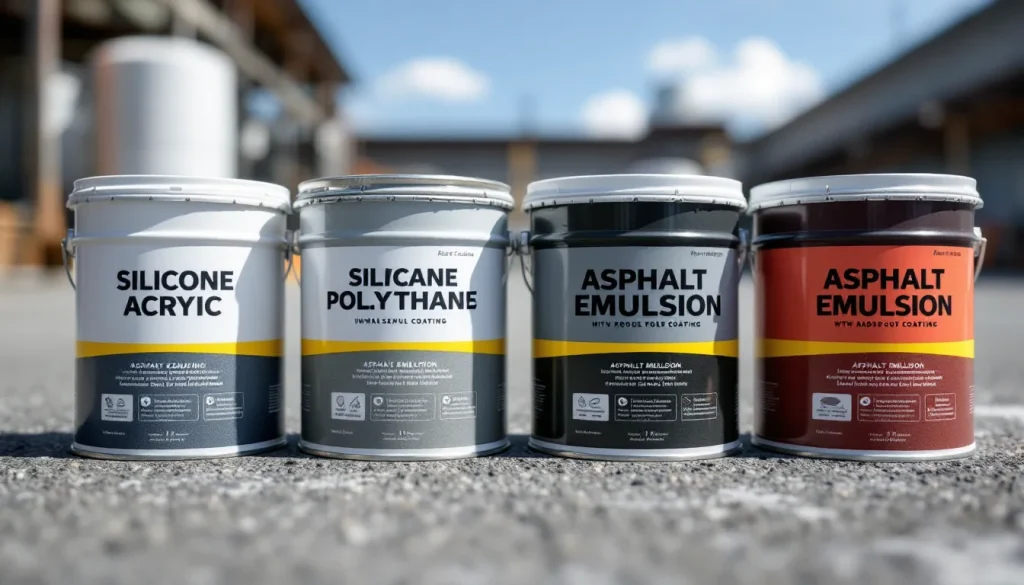
Roof coating types in 2026 break down into four major chemistries that dominate the U.S. commercial and residential restoration market: silicone at $2.50 to $5 per square foot installed, acrylic at $1.50 to $3, polyurethane at $3 to $6, and asphalt emulsion at $1 to $2.50. Each chemistry has a specific use case driven by climate, ponding water tolerance, UV exposure, foot traffic, and the substrate being coated. Picking the wrong coating chemistry for the application is the most common reason a $2 per square foot restoration job becomes a $10 per square foot reroof three years later, so the spec decision matters more than the price comparison.
Last reviewed: August 2026.
This guide walks through each chemistry by formulation, application method, lifespan, and cost, then works through the decision framework for matching a coating to a roof. If you are restoring an aging single-ply or modified bitumen flat roof, our flat roof coating restoration guide covers the broader restoration question. If you are deciding between coating restoration and full replacement, our 2026 commercial roof restoration cost guide works through the cost vs hold-period math.
Silicone roof coatings: $2.50 to $5 per square foot installed
Silicone is the premium roof coating chemistry in 2026 and the spec of choice for flat roofs with ponding water issues, which is most of the U.S. low-slope commercial inventory after the original tapered insulation has settled and drainage paths have shifted. Silicone holds up under continuous water exposure better than any other coating chemistry, including the high-end polyurethanes. The molecular backbone (silicon-oxygen, not carbon) does not hydrolyze or break down in standing water the way acrylic and asphalt-based coatings do.
Our silicone roof coating guide goes deeper on the chemistry, but the short version is that the silicon-oxygen backbone resists standing water indefinitely, which is why silicone owns the ponding-water spec across the commercial market.
The major silicone brands in 2026:
GACO GacoFlex S2000: the reference-grade silicone in the U.S. commercial coating market. GacoFlex S2000 is a single-coat high-solids silicone that goes on at 2 to 3 gallons per 100 square feet for a single-coat restoration system. The 50 year limited warranty on properly applied GacoFlex S2000 systems is the industry’s longest, and the field track record on commercial flat roofs going back to the 1990s supports the warranty claim. Pricing on a GacoFlex S2000 system runs $3 to $5 per square foot installed depending on prep, mil thickness, and reinforcement.
Henry 887 Tropi-Cool: the volume-leader silicone in the U.S. coating market, distributed through every major roofing supply channel. Henry 887 is a high-solids silicone that competes directly with GacoFlex S2000 on most spec criteria. Pricing runs $2.50 to $4.50 per square foot installed.
Silicone application requires the substrate to be clean and dry. The coating cures by absorbing atmospheric moisture, which is the chemistry that makes it work over standing water but also the chemistry that requires careful application timing in high-humidity or rain-prone weather windows. The cured silicone surface is slippery when wet, which is the standard knock on silicone for roofs with frequent foot traffic. Most manufacturers offer a granulated topcoat option that addresses the slip issue at a small cost premium.
The 2026 silicone spec is the right choice for: flat roofs with ponding water that does not drain within 48 hours, single-ply membranes (TPO, EPDM, PVC) in year 12 to 18 that are still serviceable but need life extension, and metal roofs with rust progression that has not yet penetrated the panel. See our elastomeric roof coating guide for the broader elastomeric coating framework that includes silicone alongside acrylic and polyurethane.
Acrylic roof coatings: $1.50 to $3 per square foot installed
Acrylic is the volume-leader roof coating chemistry in the U.S. by gallons sold in 2026, and the spec of choice for budget-driven restoration work on roofs that drain well, see moderate UV exposure, and do not have continuous water exposure. Acrylic is water-based, which makes application clean and low-VOC, but the chemistry breaks down under continuous water exposure faster than silicone or polyurethane.
The major acrylic brands in 2026:
Karnak Spray-Lon: the high-solids acrylic that competes on the premium end of the acrylic market. Spray-Lon goes on at 1.5 to 2 gallons per 100 square feet and cures to a flexible, UV-stable surface that holds up well on roofs that drain properly. Pricing runs $2 to $3 per square foot installed.
Conklin Rapid Roof III: the network-marketed acrylic that has been on commercial flat roofs since the early 1980s. Rapid Roof III is a high-build acrylic that includes the polymer-bound granulated filler that builds mil thickness faster than thinner acrylics. Pricing through the Conklin distributor network runs $2 to $3.50 per square foot installed. The Conklin warranty structure is competitive with most acrylic systems and the distributor network is strong in the Midwest and central states.
Acrylic application is the most forgiving of the four major coating chemistries. The water-based formulation cleans up with water, sprays easily through standard airless equipment, and has a workable application window even in moderately humid weather. The downside is the limited tolerance for ponding water (acrylic on roofs with standing water will fail in year 4 to 6 instead of year 12+) and the relatively short lifespan compared to silicone and polyurethane on harder applications. For a side-by-side on the two most common chemistries, see our silicone vs acrylic roof coating comparison.
The 2026 acrylic spec is the right choice for: flat roofs with positive drainage, sloped metal roofs with rust that needs UV protection, RV and camper roofs that need resealing, modified bitumen roofs that need reflective topcoat for cool-roof code compliance, and budget restorations on buildings with a short remaining hold-period.
Polyurethane roof coatings: $3 to $6 per square foot installed
Polyurethane is the most durable of the four major roof coating chemistries on hard-wear applications. The cured polyurethane surface resists foot traffic, abrasion, and chemical exposure better than silicone or acrylic, which is why polyurethane is the spec on roofs with frequent rooftop equipment service, deck-style amenity roofs, and any application where the coating will see mechanical wear.
Polyurethane comes in two formulations: aliphatic (UV-stable, used as the topcoat) and aromatic (faster-curing, used as the basecoat). Most polyurethane systems are two-coat installations with an aromatic basecoat for adhesion and waterproofing followed by an aliphatic topcoat for UV stability. The two-coat application is what drives the cost premium over single-coat silicone and acrylic systems.
The major polyurethane brand in 2026:
APOC Tropi-Cool 247: the high-build polyurethane that dominates the U.S. polyurethane coating market. APOC 247 is a two-coat system with aromatic basecoat and aliphatic topcoat that builds to 30 to 40 mils dry film thickness over two passes. Pricing runs $3.50 to $5.50 per square foot installed.
Polyurethane application is the most technique-sensitive of the four chemistries. The coating has a narrow application temperature window, requires careful substrate preparation (often including a primer coat on porous substrates), and produces a strong solvent odor during application that requires building occupants to vacate the building’s airspace below the roof. The cured coating is excellent but the application logistics are harder than silicone or acrylic.
The 2026 polyurethane spec is the right choice for: amenity decks and high-traffic rooftops, parking deck waterproofing, single-ply membranes that need life extension under heavy mechanical wear, and any application where the coating’s mechanical durability is the spec driver. Our polyurethane roof coating guide breaks down the aliphatic and aromatic formulations in more detail.
Asphalt emulsion roof coatings: $1 to $2.50 per square foot installed
Asphalt emulsion is the oldest of the major roof coating chemistries and still the most cost-effective for specific applications. Asphalt emulsion is water-based asphalt (asphalt particles dispersed in water with emulsifiers) that cures by water evaporation to a black, flexible, fully waterproof film. It is the spec on built-up roofing (BUR) restoration, modified bitumen seal coats, and budget restoration of any asphalt-based roof substrate.
The major asphalt emulsion brand in 2026:
Henry 107 Asphalt Emulsion: the reference-grade asphalt emulsion in the U.S. coating market. Henry 107 goes on at 3 to 4 gallons per 100 square feet for a single-coat restoration system on BUR or modified bitumen. Pricing runs $1.20 to $2.20 per square foot installed.
Asphalt emulsion application is straightforward. The coating sprays or rolls easily, cleans up with water, and has a workable application window in most weather conditions. The cured film is black, which means it absorbs solar heat and increases rooftop temperature, the opposite of the cool-roof effect that silicone and white acrylic coatings provide. For roofs in cold climates this is a benefit (the absorbed solar heat helps shed snow), but for roofs in Sun Belt jurisdictions with cool-roof code requirements, asphalt emulsion is typically combined with a reflective acrylic topcoat or replaced entirely by a white-pigmented silicone or acrylic system.
The 2026 asphalt emulsion spec is the right choice for: BUR restoration where the existing membrane is still serviceable, modified bitumen seal coats where the cap sheet granules have weathered, budget restoration of any asphalt-substrate roof, and cold-climate roofs where solar heat absorption is a benefit.
The four major roof coating chemistries at a glance, with installed cost ranges and best-fit applications drawn from the sections above:
| Coating type | Best use | Typical installed cost per square foot |
|---|---|---|
| Silicone | Flat roofs with ponding water, single-ply and metal roof life extension | $2.50 to $5 |
| Acrylic | Well-drained roofs, reflective cool-roof topcoats, budget restorations | $1.50 to $3 |
| Polyurethane | High-traffic and mechanical-wear roofs, amenity decks, parking decks | $3 to $6 |
| Asphalt emulsion | Built-up roofing and modified bitumen restoration, cold-climate roofs | $1 to $2.50 |
Climate fit: matching coating chemistry to climate zone
Matching roof coating chemistry to climate zone drives long-term performance. Sun Belt and high-UV regions favor silicone and white-pigmented acrylic, coastal and high-humidity areas favor silicone for its ponding-water tolerance, and high-altitude zones push toward silicone or polyurethane because UV intensity climbs with elevation. Cold-climate Northeast and Midwest roofs stay flexible, with the spec driven by application rather than climate. Each chemistry has a sweet spot and a hard exclusion zone.
Sun Belt and high-UV climates (Florida, Texas, Arizona, Southern California, Nevada): silicone and white-pigmented acrylic dominate the spec. The UV exposure breaks down asphalt emulsion within a few years if applied without reflective topcoat, and the temperature cycling stress on the membrane substrate is severe enough that the coating chemistry matters for substrate longevity, not just coating longevity.
Cold-climate Northeast and Midwest: the coating decision is more flexible. Silicone, polyurethane, acrylic, and asphalt emulsion all see service. The dominant spec is application-driven (ponding water drives silicone, foot traffic drives polyurethane, budget drives acrylic or asphalt emulsion) rather than climate-driven.
Coastal and high-humidity climates (Gulf Coast, Pacific Northwest, Southeast): silicone is the dominant spec because of the ponding water tolerance and the moisture-cure chemistry that handles high-humidity application windows better than other chemistries. Acrylic comes in second on properly drained roofs. For flat commercial roofs specifically, our best roof coating for a flat roof guide narrows the choice.
High-altitude and mountain climates (Colorado, Utah, Wyoming, Montana): the UV exposure is severe (UV intensity at altitude is roughly 10% higher per 1,000 feet of elevation gain), which drives silicone or polyurethane spec on most commercial work. Acrylic and asphalt emulsion lifespans at altitude run 30% to 40% shorter than at sea level.
Application method: spray, roll, or brush
The application method is largely a function of roof geometry and crew preference, not coating chemistry. All four major chemistries can be sprayed through airless equipment, rolled with paint rollers on long extension poles, or brushed in detail areas around penetrations and seams.
Airless spray application: the fastest method, used on roofs over about 5,000 square feet. The coating sprays through a heated airless rig at 2,500 to 3,500 psi through a tip sized for the coating viscosity. A two-person crew can apply a single-coat coating to a 10,000 square foot roof in a day with airless spray equipment.
Roller application: the slower method, used on roofs under 5,000 square feet and on detail work around penetrations. The roller application allows tighter control over the film thickness in detail areas where spray would overshoot.
Brush application: reserved for detail work around penetrations, seams, drains, and edges where the bigger application equipment cannot reach with the required precision. Brush application is also the standard for the first detail coat over polyester reinforcing fabric in seams and penetrations.
Reinforcement: where polyester fabric goes in
Most coating systems include polyester reinforcing fabric in seams, penetrations, and high-stress detail areas. The polyester fabric is embedded in the first coat of coating, smoothed out to eliminate bubbles, and then over-coated with the subsequent coats. The reinforcement adds tensile strength to the coating film at the most failure-prone areas (where two membrane sheets meet, where a pipe boot transitions to the membrane, where the membrane terminates at an edge metal).
Polyester reinforcement adds about $0.30 to $0.60 per square foot to the coating system cost, depending on the linear footage of seam and penetration detail. The reinforcement is what separates a coating that lasts 20 years from a coating that lasts 8 years on the same roof. Skipping the reinforcement in detail areas to save cost is the most common reason a coating job fails in year 4 to 6 at the seams while the field of the roof still looks fine. Which coating bonds to which substrate is a separate spec question, covered in our roof coating materials guide.
Lifespan and warranty by chemistry
Roof coating lifespan tracks chemistry closely. Silicone lasts 15 to 25 years with warranty terms reaching 50 years, polyurethane lasts 12 to 20 years, acrylic lasts 8 to 15 years on well-drained roofs, and asphalt emulsion lasts 5 to 10 years. The warranty terms reflect these real chemistry differences, and the field track record on commercial buildings supports them. The per-chemistry breakdown below covers the numbers in detail.
Silicone: 15 to 25 year lifespan, 10 to 50 year warranty terms depending on mil thickness and certified install. GacoFlex S2000 carries the longest warranty in the industry on properly applied systems.
Polyurethane: 12 to 20 year lifespan, 10 to 20 year warranty terms.
Acrylic: 8 to 15 year lifespan on properly drained roofs, shorter on roofs with ponding water. 5 to 15 year warranty terms.
Asphalt emulsion: 5 to 10 year lifespan, 3 to 7 year warranty terms.
The warranty terms reflect the real chemistry differences, not just the manufacturer marketing. A 25 year silicone warranty is meaningful because the chemistry supports it; a 10 year acrylic warranty is meaningful for the same reason. The lifespan numbers from the broader market data are in our 2026 Roofing Material Lifespan Report, which models lifespan by material type and climate zone across the U.S. commercial inventory.
When coating restoration beats reroof: the cost math
A coating restoration at $2 to $5 per square foot can extend a roof’s serviceable life by 10 to 20 years. A full reroof at $9 to $14 per square foot resets the building’s roof life clock at 20 to 30 years. The decision between the two paths comes down to substrate condition and owner hold-period.
If the existing membrane is still watertight, the deck is dry, the insulation is intact, and the building owner intends to hold for less than 25 years, coating restoration is almost always the better economic decision. If the membrane has active leaks, the deck has moisture intrusion, the insulation is compromised, or the owner intends to hold for 25+ years, full reroof is the better path. The intermediate cases are where most of the actual spec decisions get made, and the right answer typically requires a moisture survey (infrared, capacitance, or core sample) to confirm the substrate condition before the coating decision is final.
Our commercial roof restoration overview walks through the full restoration vs replacement decision tree, and the broader cost framework is in our 2026 Roofing Cost Report. For owners weighing restoration against the alternatives on a specific commercial building, pair this guide with our industrial roof repairs cost piece for context on the repair vs restore vs replace decision on industrial flat roofs.
Roof coatings: frequently asked questions
Which roof coating lasts the longest?
Silicone lasts the longest of the four major chemistries, with a 15 to 25 year real-world lifespan and warranty terms that reach 50 years on certified GacoFlex S2000 installs. Polyurethane follows at 12 to 20 years, acrylic at 8 to 15 years on well-drained roofs, and asphalt emulsion at 5 to 10 years. Reinforcement at seams and penetrations is what lets a coating reach its full rated lifespan.
How much does roof coating cost per square foot?
Installed roof coating cost runs $1 to $6 per square foot depending on chemistry. Asphalt emulsion is cheapest at $1 to $2.50, acrylic runs $1.50 to $3, silicone runs $2.50 to $5, and polyurethane is the priciest at $3 to $6 because it is a two-coat system. Polyester reinforcement in detail areas adds about $0.30 to $0.60 per square foot.
What is the best roof coating for ponding water?
Silicone is the best roof coating for ponding water. Its silicon-oxygen backbone does not hydrolyze or break down under continuous water exposure the way acrylic and asphalt-based coatings do, and it cures by absorbing atmospheric moisture. For flat roofs where water does not drain within 48 hours, silicone is the standard spec across most of the U.S. low-slope commercial inventory.
Is roof coating cheaper than a full reroof?
Yes. A coating restoration at $2 to $5 per square foot extends serviceable roof life by 10 to 20 years, while a full reroof at $9 to $14 per square foot resets the clock at 20 to 30 years. Coating wins when the membrane is still watertight, the deck is dry, and the owner holds for under 25 years. A moisture survey confirms the substrate before the decision is final.
Do roof coatings need reinforcement fabric?
Most coating systems need polyester reinforcing fabric in seams, penetrations, and high-stress detail areas. The fabric is embedded in the first coat and over-coated with later coats, adding tensile strength where two membrane sheets meet or a pipe boot transitions to the membrane. Skipping reinforcement is the most common reason a coating fails at the seams in year 4 to 6 while the field still looks fine.
Which roof coating is best for hot, sunny climates?
Silicone and white-pigmented acrylic dominate the spec in Sun Belt and high-UV climates such as Florida, Texas, Arizona, and Nevada. Both reflect solar heat for a cool-roof effect. Asphalt emulsion breaks down within a few years under high UV unless topped with a reflective acrylic coat, so it is rarely specified on its own in these regions.